
Description

Print Length
84

Language
English

Publisher
Portland Area Bible Students
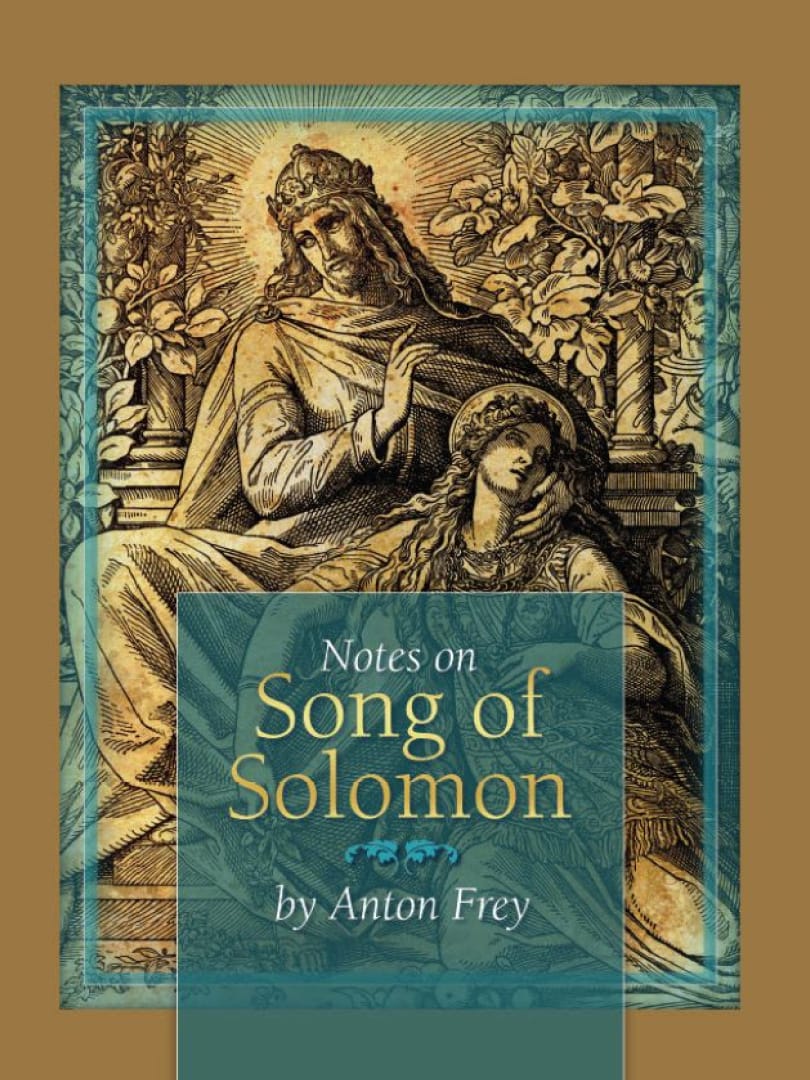
Anton Frey’s Notes on Song of Solomon presents a devotional, allegorical interpretation of the biblical Song of Solomon, viewing it not primarily as a literal love poem between Solomon and a Shulammite woman, but as a symbolic portrayal of the love relationship between Christ (the heavenly Bridegroom) and the Church (His espoused virgin, the Bride-to-be).
Frey’s approach draws heavily from the “Harvest Message” as taught by Charles Taze Russell and emphasizes spiritual readiness, consecration, and separation from the world in preparation for the final union with Christ. The commentary weaves together scripture references, typology, symbolic language, and practical application for believers.
The book proceeds verse-by-verse through the Song of Solomon, explaining each line in light of Christ’s relationship to the Church. It combines:
Symbol Interpretation (e.g., myrrh = consecration, lilies = purity of heart, fig tree = Israel, foxes = small spiritual hindrances)
Historical Context (oriental imagery, ancient wedding customs, temple/tent symbolism)
Spiritual Application (guidance for the believer’s life of faith)
The Bridegroom is Christ, who admires and calls His Bride.
The Bride is the faithful Church, wholly devoted to Him.
Their dialogue symbolizes the deepening fellowship, mutual admiration, and longing for final union.
Earthly romance is only a faint picture of the pure, spiritual love between Christ and the Church.
Frey assigns spiritual meanings to almost every object in the Song:
| Symbol | Spiritual Meaning |
|---|---|
| Kisses of His mouth | Assurances of Christ’s personal love through His promises. |
| Ointment | Christ’s anointing with the Holy Spirit, fragrant with consecration, faithfulness, kindness, and self-denial. |
| Black but comely | Outward lowliness yet inward spiritual beauty valued by Christ. |
| Lilies | Purity of heart; believers separated unto God. |
| Apple tree | Christ as the unique source of spiritual fruit and shade. |
| Banqueting house | Fellowship in God’s Word and love. |
| Little foxes | Small sins, habits, or distractions that spoil spiritual fruit. |
| Green pastures | Rest and nourishment under Christ’s care. |
| Cedar and fir beams | Eternal stability and incorruptibility of the heavenly home. |
| Palanquin (chariot) | The “new and living way” by which the Bride is brought to Christ. |
| Crown from His mother | Reward of glory, honor, immortality through the Sarah covenant. |
The commentary sees a spiritual growth pattern in the dialogue:
Initial Attraction & Commitment – The Bride longs for intimacy with Christ, drawn by the “fragrance” of His character.
Mutual Admiration – Christ praises her faith, purity, and devotion; she responds with adoration of His virtues.
Separation from the World – She faces misunderstanding and opposition from “the daughters of Jerusalem” (nominal Christians) and “mother’s children” (fellow believers with worldly priorities).
Growth in Maturity – The Bride learns not only to claim Christ as “mine” but also to yield herself fully as “I am my Beloved’s.”
Readiness for Union – The Bride is called to rise and “come away,” making her calling and election sure before the day of final union.
Throughout, Frey emphasizes:
Spiritual Vigilance – Avoid being distracted by “the flocks of His companions” (good works or ministries that are near, but not the same as Christ Himself).
Inner Separation – True consecration begins in the heart, not merely in outward form.
Sensitivity to the Spirit – Maintain unbroken fellowship, avoiding actions that disturb spiritual communion.
Rooting Out Hindrances – “Catch the little foxes” before they destroy the vine.
Rest in Christ’s Love – Even when misunderstood or tried, find strength in His embrace.
Frey occasionally interprets parts of the Song as symbolic of specific periods in Christian history:
The delay after 1914–15 – He suggests the Song reflects the unexpected extension of time before the glorification of the Church, a period for refining and completing the Bride.
Fig tree budding – Seen as a sign of Israel’s restoration and the nearness of Christ’s reign.
Latter rains – Associated with the outpouring of truth during the ministry of the Laodicean Messenger (C.T. Russell).
Love is central – The book reinforces that love for Christ must be supreme, surpassing even doctrinal knowledge or service.
Transformation through fellowship – By beholding Christ’s beauty, the Bride becomes like Him.
Readiness for the Bridegroom – The believer must live in constant readiness, sensitive to His voice and call.
Frey’s commentary is:
Deeply devotional and affectionate toward Christ.
Rich in cross-references to both Old and New Testament.
Layered with symbolic interpretations rather than literal-historical readings.
Encouraging toward believers undergoing trials, viewing them as opportunities for deeper union with Christ.