

Today’s society is filled with many fears. New fears such as global warming, microplastics, and AI compete alongside long-established fears like war, societal instability, financial insecurity, sickness, and perhaps the oldest fear of all, death. For many, faith is the remedy for fear. Christians are taught to have faith in God, as well as in His Son, Jesus, and look to them for salvation. However, for some, the very system of beliefs meant to guide their lives becomes another source of fear and dread. This fear can even spill over into non-Christian people who come to know some portion of certain teachings, often adding to the fears and doubts that may already be in their minds.
Faith is intended by God to be a source of hope, joy; a revitalizing source of energy that drives one’s heart and mind toward a greater appreciation for its Creator, a love for all of one’s fellow human beings, and a certainty that the future will be wonderful for all. Faith, based on a true appreciation for God, makes every fiber of one’s being resonate and sing with the desire to glorify Him in every word, action and thought because of His abiding goodness and mercy (1 John 1:5). Over time, though, different interpretations of the Bible, mixed with an interspersing of non-biblical philosophies, have in some cases muddled mankind’s understand of its Creator’s nature and His plan for them. An inaccurate understanding of the Bible can lead to an incorrect appreciation of God’s true character and plan. In these cases, the very faith intended to inspire hope for the future and love for the Creator and His creation, mankind, can become a source of dread for the future. In cases where faith inspires fear instead of hope, it may be beneficial to re-examine the teachings that lead to that fear.
In this new series of articles, some of the more prevalent fear-inducing teachings that have permeated different segments of Christianity will be examined, compared against scriptural evidence, and evaluated as to their harmony with the Bible’s testimony about God’s character and His plan for mankind. The first part of this series focuses on the teaching of the Rapture.
What Is the Rapture?
Some branches of Christianity teach that at a certain point in time, the earth’s population will face a sudden judgement. This time is generally associated with Jesus’ return, or “second coming”. Those who are judged worthy will immediately be transformed from their physical bodies to a spiritual form, which will rise up into the air to meet Jesus and the others of mankind who are judged worthy. Those not judged worthy will be forced to remain on the earth and deal with the chaos resulting from such a significant portion of the world’s population instantaneously disappearing. This teaching is often referred to as “the Rapture.” To a substantial degree, the teaching is based on interpretations of 1 Corinthians 15:51-52 and 1 Thessalonians 4:16-17.
Setting the Stage
Before examining these two sets of scriptures, it is necessary to consider their greater context in God’s plan for mankind, as revealed in the Bible. A full examination of God’s plan is not practical in a single study such as this one; however, the meaning of 1 Corinthians 15:51-52 and 1 Thessalonians 4:16-17 is inextricably tied to the greater testimony of His plan. For the purposes of establishing a foundation for the remainder of this study as well as context for these two sets of scripture, the following summarized list of events in God’s plan is provided. Each of the events in this list could be a study, even a series of studies, on their own. Because many of these events may differ from the teachings and interpretations of some branches of Christianity, a list of further resources has been provided at the end of this article, each of which provide a more in-depth study and justification for the interpretations put forth.
- Much of Christianity, including some non-Christians, wait in anticipation for Jesus’ return. The return is expected by some to be an outwardly dramatic spectacle, fully visible to all mankind. However, the scriptures compare Jesus’ return to being “like a thief in the night,” perceived by those with “an eye of faith” as opposed to physical eyes.
- Jesus’ invisible return has already taken place, specifically in 1874. Since then, Jesus has been invisibly and powerfully present, laying the foundation for the world’s transition to God’s kingdom.
- Jesus’ sacrifice provides two paths to salvation for mankind. The first path is a “narrow way,” recognized by only a relatively small percentage of people since the time of Jesus’ sacrifice. This group is invited to respond to God’s “high calling” and consecrate their lives to Him. If judged worthy of their consecration vows, this group will receive the reward of a heavenly existence alongside the glorified Jesus. There is only a select number of people that God is looking for to fill this group, sometimes referred to as Christ’s church. Once this full number has been gathered, God’s kingdom on earth will begin in earnest.
- Shortly after Jesus’ return, those members of the Church who “had fallen asleep in death” were judged and resurrected to their higher, heavenly reward and are now working alongside the glorified Jesus. However, the Church has not yet reached its full number. Thus, prospective members of the Church who remain “faithful unto death” since that time will receive their heavenly reward at the end of their present lives without the need to “sleep in death” until Jesus’ return.
- The second path to salvation applies to all those throughout mankind’s long history who did not or could not respond to God’s high calling to Christ’s church. After their future resurrection to a new human life, these members of mankind will be brought back into harmony with God. Once this process of harmonization is complete, each individual will then be judged according to their obedience to God. Those who choose obedience will gain an everlasting perfect physical life in continued perfect harmony with their loving Creator.
An Examination of 1 Corinthians 15:51-52

1 Corinthians 15:51-52 and 1 Thessalonians 4:16-17 are often tied together. Both sets of scriptures, written by the Apostle Paul, describe different aspects of the uniting of the returned, glorified Jesus with the faithful resurrected members of his Church. Although from his perspective this was a future event, Paul knew, through divine inspiration, that God’s high calling to the Church would continue for some time, until the full number of members was found and proven faithful. Paul also understood that the call to the Church would not be recognized by the majority of mankind and that even for those who recognized Jesus, many of the details surrounding the Church would be cloudy and misunderstood. In fact, even though it had been a relatively short time since Jesus’ death, Paul was already seeing misunderstandings and misinterpretations creeping into the early Christian churches, including the church at Corinth. Some members of the church had begun to teach that there was no resurrection, leading Paul to explain, in the first part of 1 Corinthians 15, the fundamental fact that if there was no resurrection, then Jesus was not resurrected, and the basis of all Christian faith was false.
Later in chapter 15, Paul switches his focus to the future resurrection of the Church. He describes their resurrection as a being to a spiritual existence, different than the physical resurrection that would be granted to the majority of mankind (1 Corinthians 15:22-23). Perhaps because he knew he was reinforcing the concept of the resurrection to people who were starting to believe there was no resurrection at all, Paul begins to give some details related to the time frame of the resurrection. The church’s resurrection would be, from their perspective, a future event that would accompany Jesus’ return. This was an important point, because just as some members of the church were being taught that there was no resurrection (1 Corinthians 15:12), some were also being taught that the resurrection had already happened and was over (2 Timothy 2:16-18). Paul evidently felt it was necessary for the church members to have a proper appreciation for the time frame of the resurrection as a foundation for their faith.
Beginning in 1 Corinthians 15:51-52, Paul begins to speak about “a mystery;” so named because he knew that much of what he said would not be understood by the majority of mankind. When used in the New Testament, the word “mystery” often has some relationship to Christ’s church. In these verses, Paul explains one of these mysteries, teaching that the completion of the Church would be a more gradual process than was perhaps expected.
Breaking down Paul’s words in 1 Corinthians 15:51-52:
- “I shew you a mystery” – The “mystery” Paul refers to is that Jesus’ return, unrecognized at first by the majority of the world, would shortly be followed by the resurrection of the members of his Church who had “fallen asleep” in death in the years since his own resurrection. However, the Church wouldn’t be complete yet, so others, also called by God to the Church, would need to still prove their faithfulness unto death. The “mystery” here is one of timing. These last members of the Church will instantly be given their heavenly reward after their deaths. They don’t need to “sleep” in the state of death, waiting for Jesus’ return like the Church members who died earlier, because Jesus has returned.
- “We shall not all sleep” – “Sleep” here refers to the condition of death. The members of the Church who died before Jesus’ return “slept” in death until called forth after Jesus’ return.
- “but we shall all be changed” – “Changed” here refers to the Church members’ receiving their reward of their divine bodies – “changed” from the physical bodies they had prior to their resurrection.
- “in a moment, in the twinkling of an eye” – The Church members resurrected after Jesus’ return will not need to sleep in death as their fellow Church members did. They will still need to prove their faithfulness until their deaths, but will immediately receive their reward afterwards – “in the twinkling of an eye.”
- “at the last trump the trumpet shall sound” – Paul is referring to the symbolic trumpet that accompanies Jesus’ return, tying the events described in these verses to the end of the current age of God’s plan and the dawning of the next. It also connects these scriptures, time-wise, to the events described in 1 Thessalonians 4:16-17.
- “the dead shall be raised incorruptible” – Paul doesn’t refer to all mankind here. These verses are limited to the resurrected Church members, who will receive an incorruptible existence on the divine plane with their glorified Head, Jesus.
- “we shall be changed” – Regardless of when they proved their faithfulness to God, all members of Christ’s church will receive the same reward of a divine existence alongside the Church’s glorified Head, Jesus.
An Examination of 1 Thessalonians 4:16-17
Taken literally, 1 Thessalonians 4:16-17 conveys a dramatic picture of Jesus descending out of the sky. Verse 17 states the those who are alive at the time will be “caught up together with them in the clouds, to meet the Lord in the air.” When combined with 1 Corinthians 15:51-52, these verses are sometimes interpreted to mean that at some point, probably in the near future, Jesus will visibly appear to mankind, cast judgement, and some of the population will begin to literally rise up in the air to meet him. Those who are not judged worthy will be left in their physical states on the earth.
Symbolic language can be difficult to identify in the Bible. One indicator that a passage may be symbolic is that a literal interpretation may be so fantastic that it seems out of harmony with the way that God’s plan has unfolded over the centuries. The Bible teaches that each member of the Church is required to prove their faithfulness to God until their deaths (Revelation 2:10). Further, the call to the Church has been going on since Jesus’ death and resurrection, not just at the end of age when Jesus returns. The idea that one day, a swath of mankind will be instantly judged and taken up into the clouds to be with Jesus seems out of harmony with these two fundamental facts. However, when interpreted as a symbolic teaching about the church’s completion, Paul’s meaning becomes clearer.
The concept of being “caught up” is an example of symbolic language. Throughout the scriptures, there is a hierarchy to God’s creations, and with that hierarchy comes the thought of an implied direction. This direction isn’t literal, like right or left, but intended to convey a degree of glory. God’s spirit creations, such as angels, are often referred to as being “above” mankind, the pinnacle of God’s physical creation (Psalm 8:4-5). Hebrews 2:7, referring to Jesus in his human body, states that he was made “a little lower than the angels.” God is repeatedly referred to as “the Most High” (Genesis 14:29, Psalm 83:18, Isaiah 14:14, Hebrews 1:3, as examples). Interpreted from this perspective, 1 Thessalonians 4:17 is a description of this same concept; that those in Christ’s church class will be granted a higher, heavenly existence than the physical lives in which they proved their obedience, as the reward for their lifetimes of faith and consecration.
Verse 17 also describes this class as meeting Jesus in the air and being caught up together in the clouds. When analyzing symbolic language, it can sometimes be helpful to look for other places in the Bible that use similar symbols but are, perhaps, more solidly understood. 1 Thessalonians 4:16-17 refer to events happening with Jesus’ return (“the Lord himself shall descend with a shout” – verse 16). Daniel 12:1 also refers to Jesus’ return. Prophetically referring to Jesus as “Michael,” this verse describes “a time of trouble” that will follow Jesus’ return. During his second presence, one of Jesus’ objectives is the establishment of God’s Kingdom. With any great construction project, it is often necessary to first demolish any previously existing structure. To establish his perfect rule, Jesus needs to demolish mankind’s old, imperfect order. This will, of necessity, cause difficult times for those living through this transitional period; hence the term “time of trouble” and why it’s associated with Jesus’ return.
Zephaniah 1:14-15 also prophesizes this same “time of trouble” alongside “a day of clouds”. When taken in the context of the rest of the verse, it is likely that this does not refer to a literal day when there will be nothing but clouds in the literal sky, but the time of symbolic darkness and trouble also referred to in Daniel 12:1. Just as literal clouds obscure the natural light of the sun, symbolic clouds may be seen as symbols of trouble or distress, obscuring the reassuring light of peace and harmony and truth. 1 Thessalonians 4:17 prophesizes the same “time of trouble” and “great distress” that accompanies Jesus’ second presence and the completion of his Church.
According to Strong’s concordance, the word “clouds” is used eight times in the New Testament. Each of these instances is in harmony with the thought that clouds often used as a symbol of trouble:
- Matthew 24:29-31 Matthew 24:30 is the first verse in the New Testament to use the word “clouds”. Here, Jesus refers to the same ending of the current age referred to in Daniel and Zephaniah. His words, highly symbolic, reflect the same tone and many of the same words and descriptive phrases as those of Zephaniah. Considering this is a description of the same “time of trouble”, it is reasonable to interpret these verses as Jesus telling his followers to expect his return during this same time, and that the “clouds in heaven” are the same clouds of the “time of trouble” referred to in Zephaniah. Note that verse 31 refers to Jesus “gathering his elect from the four winds.” This is reminiscent of the prophecy in Revelation 7:1-3, which prophesize a prevention of the full “time of trouble” as “holding back the four winds” until the Church class is complete, strengthening the thought that the clouds refer to the symbolic darkness of this “time of trouble.”
- Matthew 26:62-64 Here again, Jesus is referred to as “coming in the clouds of heaven,” aligning this with the thought that Jesus’ second presence will coincide with the “time of trouble.”
- And 4: The next two occurrences of the word “clouds” in the New Testament are both from the book of Mark; Mark 13:23 and Mark 14:62. These are Mark’s accounts of Jesus’s same words found in Matthew 24:30 and 26:64.
- 1 Thessalonians 4:17 The verse under examination. It reflects the same relationship between Jesus’ second presence and the “time of trouble,” represented by clouds
- 2 Peter 2:17 In this chapter, Peter is discussing false prophets, comparing them to “wells without water” and “clouds that are carried with a tempest”. As such, there is no relationship here with clouds to the clouds of the “time of trouble” in Zephaniah 1. However, clouds continue here to be a symbol of negativity and trouble.
- Jude 1:12 Similar to 2 Peter 2:17, this verse stresses the need to resist negative influences like those that had begun to creep into the early church. The verse uses the phrase “clouds without water” again to represent these troublesome influences. Like before, there is no direct relationship to the clouds of Zephaniah 1 and the “time of trouble,” but clouds continue to be a symbol of trouble.
- Revelation 1:7 Like the previously examined verses of Matthew and Mark, Revelation 1:7 describes the time of Jesus’s second coming and presence. His presence is accompanied by the “clouds” of the “time of trouble,” as mankind’s systems are dismantled to be replaced with Jesus’ perfect rule. The trouble “such as never was nor will be again” will be intense, but as it progresses, mankind will become aware of Jesus’ hand in the process. “Every eye shall see him” is symbolic reference to this realization – Jesus will not be physically seen by mankind, but mankind will grow to realize Jesus’ invisible reign.
In summary, 1 Thessalonians 4:15-17 describes the ending of the current age in God’s plan. Jesus has invisibly, yet powerfully returned, and has begun the process of setting up his Father’s kingdom on earth. As prophesized in the scriptures, those who, over the past several hundred years since the time of his death and resurrection, have been judged worthy to be members of his Church class have been resurrected to assist with this important task. They have already been granted the promised reward of a divine existence with their glorified Head. However, the age has not fully ended, and the Church class is not yet complete. The last few members are still alive, and must be given their opportunity to “be faithful unto death.” Once they have finished the course that God has set for them to prove their faithfulness, they will not “sleep” in death as their fellow Church-class brethren have. Their resurrection to their new, divine existence will be granted immediately after their deaths, invisible to human eyes as all spiritual matters, but nevertheless instantaneous – “in the twinkling of an eye.” As the clouds of the “time of trouble” gather to facilitate the needed changes for the Kingdom’s establishment, these last few members of the Church will be “be caught up” to join the rest of the glorified Church, and the next phase of God’s marvelous plan to bless all the families of the earth will begin to unfold in full force.
What about everyone else?
1 Corinthians 15:51-52 and 1 Thessalonians 4:15-17 portray the faithful of Christ’s church receiving the wonderful reward of a divine existence alongside the Church’s head, Jesus. However, the call to Christ’s church was only given to a relatively small number of mankind throughout the centuries (Matthew 7:14). Even more, God’s standard for this exceptional reward is high, and many who are called will not achieve the reward (Matthew 22:14). The examination of these two sets of scriptures specifically discusses Christ’s church, not the remainder of mankind who are not called or chosen. What about all the people who are not called to Christ’s church? Thankfully, God’s plan for the rest of mankind, once understood, is not a source of fear, but one of joy and hope for the future.
God created the first man and woman, Adam and Eve, with the intention that they would live an everlasting perfect life on the beautiful earth He created for them (Genesis 2:15-17). As a result of disobedience to God’s command, Adam and Eve became subject to the penalty of death (Genesis 3:19). This curse had a much wider reach than just Adam and Eve. It was also applied to the earth itself (Genesis 3:17) and further applied to Adam and Eve’s descendants who form the sum total of mankind. The death penalty brought about by their disobedience is the reason why people have died throughout the centuries of mankind, and is the reason people continue to die today.
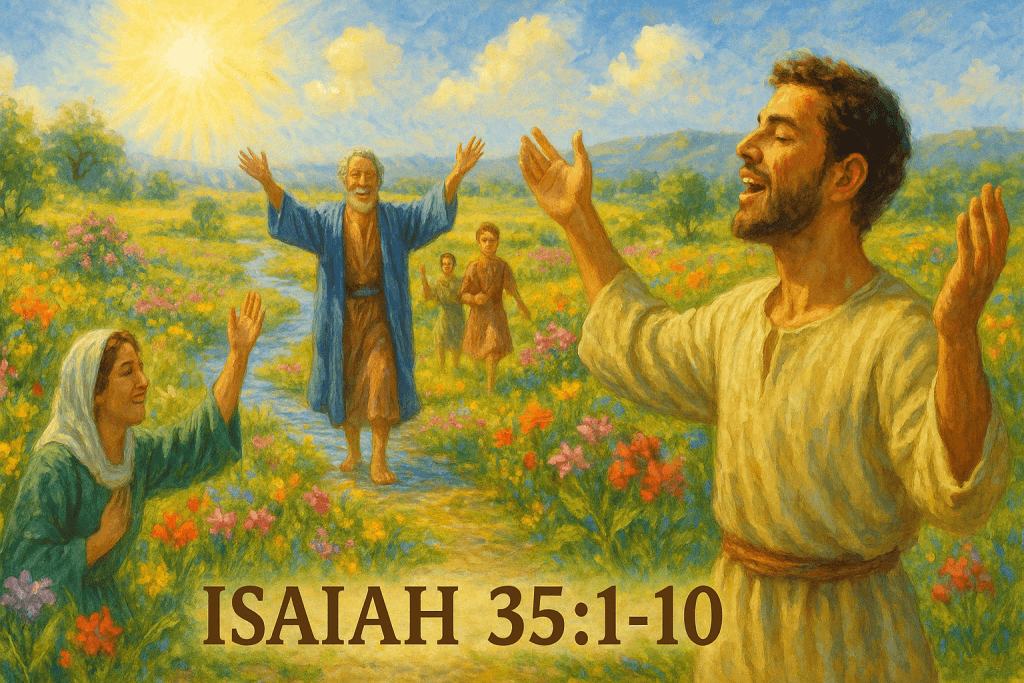
Acts 3:21 refers to “the times of restitution.” Restitution refers to restoring something to a previous, usually superior state. In this case, restitution refers to the restoration of mankind to its perfect human state originally intended for Adam, Eve and their descendants. The “times of restitution” encompasses the future time when every man, woman and child who ever lived will be resurrected from the dead (John 5:28-29, I Corinthians 15:42-49). Following their resurrection, over a gradual period of time, they will be restored to the harmonious relationship with God originally enjoyed by Adam. Among other chapters in the Bible, this wonderful time is pictured in Isaiah 35. Verse 8 refers to a “way of holiness,” which refers to the process, or “path” that people will follow to grow back into harmony with God. Verse 9 refers to the “ransomed” walking there, referring to the resurrected masses of mankind, ransomed by Jesus’ sacrifice. Satan and all evil influences will be bound and unable to deceive people during this time (“no lion shall be there, nor shall any ravenous beast go up thereon”; also see Revelation 20:1-3 for another picture of Satan being bound during this time) so that nothing will interfere with mankind’s re-education process.
Eventually, the period of re-education will end, and each person will be tested as to their commitment to God. During this time, Satan will be loosed again (Revelation 20:7) and will look for those who want to go back to the old ways of sin (Revelation 20:8). Those who choose sin over the new harmony with God will again experience the penalty for sin – death; except this time, with every individual clearly making their own choice after having been fully educated about God and the penalty for sin, there will be no salvation for those who choose sin. The penalty doesn’t change; it will be the same as it always has been – death, not eternal punishment and torture. This individual testing is pictured in Revelation 20:12. It is also referred to in Jeremiah 31:29-30, which prophesizes this future time when each individual will be tested and tried according to their own obedience. Having at last proven their obedience to God, mankind will finally go forward to its glorious future, forevermore at peace with their loving Creator (Revelation 21:3-4).
Conclusion: The Rapture – Faith or Fear?
I Corinthians 15:51-52 and 1 Thessalonians 4:15-17 are about the gradual rewarding of Christ’s church as they finish their physical lifetimes and are rewarded with a higher, divine existence with their glorified Head, Jesus. For those of mankind not chosen to be part of Christ’s church, the potential for an everlasting and joyful perfect human existence will be open once the Church is complete. When viewed from this perspective, much of the fear and dread regarding the teaching of the Rapture is defused. God does, and always will, expect obedience. Those who answer His call now have the opportunity for a heavenly reward. However, His plan includes a future period of gradual re-education and restitution for mankind, led by Christ and his Church. God is the perfect embodiment of power, justice and wisdom, but also, equally, love. Misunderstandings or misinterpretations of the Bible have been at the heart of many misunderstandings about God throughout history. Teachings that seem out of line with His character are often brought to clearer vision when examined in the context of the greater biblical teachings about God’s plan. A literal interpretation of symbolic passages may also lead to a more fantastic expectation of the unfolding of future events than is in harmony with God’s workings. Any teaching presented by mankind regarding God should harmonize completely with the greater testimony of His plan revealed in the Bible. Studying the Bible as a whole helps us to understand God’s plan, and through that, His character. As we begin to see His true overwhelming love, our faith in Him begins to fill our hearts and minds more and more, crowding out all fears, because we know He can be trusted with having all things well in hand.
The next article in this series will examine the teaching of hell. For generations, this teaching has inspired fear and dread in the hearts of many faithful and unfaithful ones alike. The teaching of hell has become so ingrained in society that even non-Christians are familiar with the concept, and many assume that all Christians believe in its teaching. But is the teaching of hell as a place of torment actually supported in the Bible? What does the Bible actually teach about mankind’s judgement? Is there an explanation for how a God of love could condemn so many of His creation to a hopeless eternity of torment? Does the Bible express a message that inspires faith, or fear? When examined through the lens of scriptural truth, many of the misapprehensions about God’s plan, and in turn, His character are stripped away, leaving the glorious truth of His love for His creation shining through the clouds of centuries of error-fueled fear.
Further Readings
This article presented interpretations of biblical teachings that could not be fully presented due to space and time limitations. Each conclusion is fully provable by the greater testimony of the Bible. As a starting point for those who may with to review studies which examine these concepts in greater detail, the following list is provided:
- The study “Our Lord’s Return” offers a detailed examination of the purpose behind Jesus’ return.
- The study “The Manner of Our Lord’s Return and Appearing” offers an examination of how mankind should expect Jesus’ return to appear and how to recognize the impacts of his return.
- The study “Bible Chronology” offers an in-depth background examination of the Bible’s testimony regarding time. This study is helpful for understanding the conclusion that Jesus returned in 1874.
- The beginning of the times of restitution which accompanies Jesus’ return is also biblically taught by Israel’s jubilee cycles. The study “Earth’s Great Jubilee” covers the jubilee cycles, and uses chronology to further establish the date of Jesus’ invisible return as 1874.
- The 2003 November/December issue of The Herald magazine offers a series of articles each covering a different aspect of Jesus’ return. The article titled 1874 particularly examines the basis for considering 1874 as the year of Jesus’ return.
- The study “Spiritual and Human Natures Separate and Distinct” offers an examination of the different planes of existence and what mankind’s relationship is with each.
- The study “The Three Ways – The Broad Way, The Narrow Way, The Highway” offers an examination of the two distinct paths to salvation offered to mankind – the “narrow way” as the present path to a heavenly reward, recognized and undertaken by relatively few, and the “highway” as the future path to a physical reward on a perfect, restored earth, to be recognized and undertaken by the majority of mankind.
Image Credits
- Featured image: Jesus descending during the Rapture. Image generated by ChatGPT (OpenAI), 2025, based on a description provided by the author.
- Painting of Apostle Paul: Jan Lievens: Apostle Paul, 1627, Nationalmueseum (Photo: Erik Cornelius), public domain
- Mankind will rejoice as God’s kingdom fills the earth, as described in Isaiah 35. Image generated by ChatGPT (OpenAI), 2025, based on a description provided by the author.


