

If you ask a random person, “What do Christians believe happens to you after you die?”, a likely answer would be “Christians think that ‘good’ people go to heaven and ‘bad’ people go to hell.” Hell is widely taught to be place of separation from God; a place of punishment and often one of conscious torment, anguish and torture. Books, movies, stories and other media throughout the centuries have added to the dreadfulness of hell, defining it as an actual place in which Satan and his fallen minions rule over those consigned there; the place from which all evil power and influence originate.
The fear of hell is very real to a large number of people today, even as it has been for many hundreds of years. Hell, as a place of torment, has kept people away from God, because, they reason, how is a God that can condemn so many of His creation to eternal and hopeless punishment worthy of worship? Different branches of Christianity have compounded the fear of hell by defining specific acts one can commit and be condemned to hell. For example, some teach that those who die by suicide are “condemned to hell.” This causes fear and anguish on behalf of grieving loved ones, and can draw them away from God, because, they reason, what kind of God would so severely punish a person not for evil, but for being lost or anguished or mentally unwell?
Before accepting any teaching that seems so out of harmony with the character of God, who “so loved the world that He gave His only begotten son” (John 3:16), each thinking Christian has the responsibility to ask one simple question – does the Bible actually teach that hell is a place of conscious torture where those who fail to meet God’s standards are consigned for all eternity?
Fully covering the concept of hell, its origins, and how the teaching crept into Christianity, is beyond the scope of this article. Instead, we’ll focus on an overview of Biblical teachings to serve as a foundation, and use it to demonstrate that God’s plan, as taught by the Bible, does not include the concept of eternal conscious anguish for any of mankind, but instead declares the hope of everlasting salvation and joy for all.
- We’ll start by examining what the Bible teaches about what death actually is, and why people die.
- We’ll then examine the Bible’s teachings on salvation from death, which is provided by Jesus.
- We’ll discuss the two different paths of salvation provided by Jesus’ sacrifice, and look into whether hell is a part of either path.
- We’ll consider the parable of the rich man and Lazarus, which has been used to support the idea of hell as a place of torment, and offer an alternate interpretation of it that is in harmony with the lesson Jesus was teaching at the time.
- As we begin to conclude, we’ll have one last discussion on God’s character as proclaimed by the Bible, and ask whether the concept of hell is in harmony with it.
- Lastly, we’ll end the article with a series of resources for those who wish to further investigate the truth about hell.
What does the Bible teach about death and why people die?
Hell and heaven are taught by many branches of Christianity as places people go after they die. However, the Bible teaches a different, perhaps surprisingly clear definition of what death is, and what happens to those who die. Simply put, death is the cessation of life. It’s not a continuation; it’s not a transitional experience of one state to another. It’s a definitive ending.
We are used to thinking that everything that lives eventually dies. Plants, animals, people – all living things progress through a life cycle that ultimately ends in death. Every generation of mankind has seen and experienced this fundamental lesson. Because of this, we may draw the conclusion that this was always the plan of God, who created all things, including people. However, nothing in the Bible teaches that God created the first man and woman, Adam and Eve, with the intention that they would live for some amount of time then die. In fact, the Bible supports the opposite conclusion.
Genesis 2:7 teaches that God created Adam, the first man, “from the dust of the earth” and gave him dominion over the earth (Genesis 1:26). In Genesis 2:15-17, God tells Adam that he is free to eat from any tree in the Garden of Eden except one specific tree. If Adam eats from this tree, he will die. There is at least an implication in God’s direction that as long as Adam is obedient, and doesn’t eat from this certain tree, he will continue to live. God’s words don’t put any limitation on this statement. This same requirement, and thus implication, was passed to Eve as well, as evidenced when she repeats it to the serpent (Genesis 3:2-3).
Genesis 3:6 records Adam and Eve’s disobedience to God’s commands. As a result, they become subject to death (Genesis 3:17-19). God Himself describes what death means when He tells them “thou [shall] return unto the ground; for out of it wast thou taken: for dust thou art, and unto dust shalt thou return.” In God’s own words, death is a return to the state of non-existence prior to life. This definition is emphasized in Ecclesiastes 9:10, which teaches that there is “no work, nor device, nor knowledge, nor wisdom, in the grave.” There is no mention, or even implication, of any type of continued consciousness after death.
The right to continued life for Adam and Eve was lost as a result of disobedience. Disobedience to God is also known as sin. The fall into sin was carried forward from Adam and Eve into their children, and further into each subsequent generation since then. This act of disobedience is the reason Adam and Eve died, and is the reason why death has been the inevitable experience of every person since then, including people today. Scriptures such as Ezekiel 18:20 and Romans 6:23 clearly teach the relationship between sin and death.
What does the Bible teach about salvation from death?
A major theme of the Bible is the need for each person to be saved from both the inevitability of death and from the condition of death. Although the definition of what death is has not changed since God’s original judgement on Adam and Eve’s disobedience, Jesus provides the only means for salvation from death, as taught, for example, in Acts 4:10-12.
- How did Jesus provide this salvation?
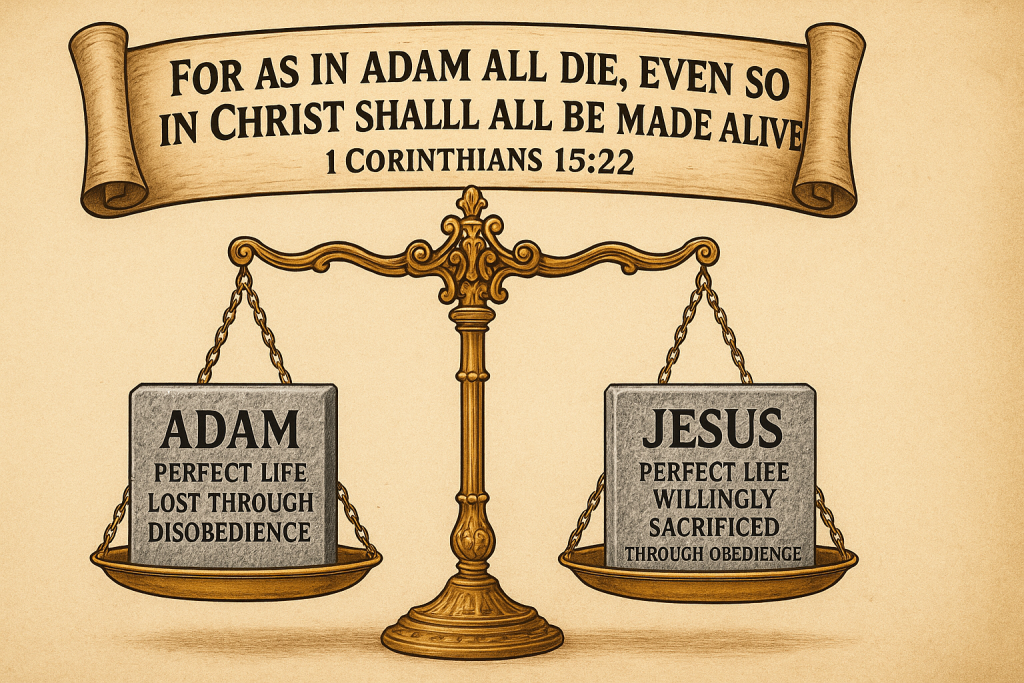
According to the Law God gave to the ancient Israelites, any Israelite who perfectly kept all of God’s laws earned a right to life (Leviticus 18:4-5, reinforced later in Ezekiel 18:19). Jesus was “obedient unto death” (Philippians 2:8). According to God’s justice, Jesus therefore had a right to his continued perfect human life. He willingly allowed himself to be put to death, thereby providing an equal, corresponding life, sometimes called “a ransom price,” for the perfect human life Adam lost through disobedience. 1 Corinthians 15:22 lays out this simple balancing of God’s justice between Adam and Jesus. On the one hand, Adam’s disobedience caused mankind to fall into sin and death. On the other hand, Jesus provides the means for mankind to be resurrected from death. Other scriptures, such as Romans 5:12, 5:19 and 6:23 also emphasize this point.
Through God’s grace, the salvation provided by Jesus’ sacrifice takes two distinct forms, each with its own separate timetable and path. One path is available now, for a limited time. The second, more expansive path to salvation will be open broadly to all mankind – every single man, woman and child who ever lived or ever will live.
- What is the salvation from death for those who follow Jesus’ example now? (Path #1 to salvation – the present)
During his ministry, Jesus searched for people who, like him, were willing to dedicate their full minds and hearts to God. He knew that this way of life was at odds with the prevailing priorities of society, such as the gathering of wealth, professional success and attaining status and fame. Whether then or now, even if people understand these standards, they are too high for many to accept. Jesus understood this, leading him to refer this path as “a narrow way” that few would find (Matthew 7:14).
Before the salvation of the entirety of mankind begins in the future, God is seeking a smaller group of people whose hearts are in harmony with Him now, in their present lives. This group is given many titles in the Bible, such as “the little flock,” “the bride class,” “Christ’s church,” and simply “the church.”
The Apostle Paul speaks of this class as “pressing toward the prize of the high calling” (Philippians 3:14), because just as the standards for this type of life are higher, the reward God will grant for being faithful to Him until death is likewise higher (Revelation 2:10). In Romans 8:16-17, he speaks of those who have answered the high calling as being “children of God” and refers to their “glorification” (Romans 8:16-17). 1 John 3:2 teaches that those who prove themselves worthy of becoming “sons of God” will be granted a spiritual existence alongside the glorified Jesus.
These teachings may seem very similar to the teaching that “good people go to heaven after they die.” However, many overlook the high requirements for those who choose this path. It’s not about one simple act of baptism. It’s not about following the belief structure of a specific system over others. It’s about committing one’s life to God now; about giving up the pursuits of the world to focus one’s life on God, as Jesus did. It requires the consecrated devotion that Paul exhibited when he declared that his life was about doing only one thing (Philippians 3:13-14) and that he counted all the pleasures of the world he left behind as dross (Philippians 3:7-8).
Most people don’t perceive the calling to this kind of life, and even for those who know something about God and Jesus, fewer still respond to this high calling and remain faithful to it. What about all of the people, who for whatever reason, don’t (or didn’t) accept Jesus as their salvation before death? Are they going to be lost to the tortures of hell for all eternity?
- What about everyone else? (Path #2 to salvation – the future)
In His grace, mercy and love, God’s plan offers a clear path to salvation for all people, separate and distinct from the present narrow path of salvation, open only to those few who recognize it and whole-heartedly embrace it. This wonderful truth of God’s plan is sometimes confusing, because although Jesus’ sacrifice enabled this path to salvation, it will be open and available to all in the future.
Romans 8:21-23 teach that after the full number of people God desires for the Church have proven their faithfulness and have been granted their higher, spiritual reward, a different salvation will begin to flow out for the remainder of God’s creation (mankind). This simple set of scriptures demonstrates that those who do not accept Jesus as their salvation now, in their present lives, will not be considered lost, whether in death or in eternal punishment. Their salvation is simply delayed until the future time when Christ’s church is complete.
In symbolic language, Revelation 20 provides a picture of how certain key aspects of this future time will unfold. As the great resurrection of mankind from death, enabled by Jesus’ sacrifice, begins to happen, Satan, the original source of temptation and spirit of disobedience (Genesis 3:4) will be bound for a thousand-year period (Revelation 20:2). During this time, all people, resurrected and restored to perfect human bodies such as were lost by Adam and Eve, will be taught the truth about God and the role of Jesus’ sacrifice in their salvation. Isaiah 35 offers a beautiful description of this future time, in which this process of restoration is described as a “highway” called “the way of holiness” (Isaiah 35:8). Isaiah 35:9 explains that “no lion… or ravenous beast” will be allowed on this path; a thought that is in harmony with Revelation 20:2. Isaiah 35:9 also explains that the “redeemed [all mankind, redeemed in the eyes of God’s justice by Jesus’ sacrifice] shall walk there [will be shown how to progress down this path of reharmonization with God]”. Isaiah 35:10 further emphasizes the thought that the blessings of this wonderful time will apply to all mankind by explaining that the “ransomed of the Lord [all people, granted salvation from death by the ransom price paid by Jesus] shall return.”
Neither of these two paths to salvation include a condemnation of any person to an eternity of torture in hell after death.
- What about those who don’t follow either path, present or future? Will they be committed to hell and punished eternally?
Although the opportunity for salvation will be opened to all, that opportunity will not last forever. Revelation 20:7 explains that after the thousand years of reeducation ends, Satan will be released again for a short period. Each person, now fully educated regarding God, the glorious blessings of living in harmony with Him, and the penalty for disobedience, will need to decide for themselves whether to remain obedient to God or to allow themselves to be drawn back into sin and disobedience. Revelation 20:9 describes the fate of those who still willfully disobey against God. Fire is a symbol of destruction in the Bible, and this verse indicates that “fire” will “devour,” or destroy, the disobedient. Destruction does not equate to eternal torture.
Once each person proves or disproves their obedience to God, Satan will be destroyed (Revelation 20:10). Although it seems as if Revelation 20:10 seems to teach the concept of eternal torment in fire and brimstone, a common teaching about what hell looks like, this verse does not describe individual people being tormented in eternal anguish. The symbolic picture describes how Satan (and although beyond the scope of this study, the beast and the false prophet, who are not people, but symbolically represent corrupt systems) will be tormented by his failure until destroyed forever. Fire here again is used a symbol of destruction, and brimstone, which increases the intensity of fire, describes the utter completeness of that destruction.
As emphasized by Revelation 20:13, every person will be judged according to their own personal obedience during this time of testing. God’s law doesn’t change. As God Himself told Adam in the Garden of Eden (Genesis 2:15-17), as it was explained in Ecclesiastes 9:10, and as the Apostle Paul taught in Romans 6:23, the penalty for sin will still be death. As it has been since Adam and Eve first “returned to the dust from which they came,” (Genesis 3:17-19), death will still be the complete absence of life. It will still mean non-existence and oblivion. This consistent message has not and will not change to allow for the possibility of “people being condemned to torment for eternity.” As taught by the scriptures (Acts 4:10-12), only Jesus provides salvation from death, the state of non-existence, and having given his life once, there will be no salvation from this state a second time.
Revelation 20:15, the final verse of the chapter, symbolically describes those who are “not found written in the book of life” will be “cast into the lake of fire.” Here, the “lake of fire” symbolically describes the state of complete destruction – death – that will be sentenced upon the willfully disobedient.
Does the parable of the rich man and Lazarus teach that hell is a place of torment?
Beginning in Luke 14, Jesus heals a man, and in so doing draws a crowd from a wide variety of the population, including his disciples, Pharisees, publicans, and those described as “sinners” (Luke 15:1). Over the course of the next several chapters, Jesus delivers several messages, some of which were in parables, which are simple stories Jesus used as pictures to convey greater lessons. One of those parables was the parable of the rich man and Lazarus, recorded in Luke 16:19-31. Even though parables were not meant to be taken literally, this parable has nonetheless been used to support the thought of hell as a place of eternal conscious torture.
In this parable, Jesus chose to use the picture of a beggar named Lazarus dying and being “carried by angels into Abraham’s bosom” (verse 22). He also used a picture of a rich man dying and after death, being in torment. The rich man is aware of both Abraham and Lazarus, and begs that Lazarus be sent with some water, because the flames he was experiencing tormented him (verses 23-24). Taken literally, these verses certainly seem to paint a picture of hell as a place of conscious torment after death. But what was Jesus’ actual intended message with this parable?
- What did the rich man do to be condemned to eternal torment? What did Lazarus do to be rewarded with being carried to heaven?
Jesus doesn’t describe the rich man as having committed any sins, certainly none that would be worthy of an eternity of torment in hell. Equally, he doesn’t describe any good behavior done by Lazarus that make him worthy of an eternity of good things in heaven. Being rich is often a matter of comparison. Even today, the average or even less fortunate citizen in one country might be considered “rich” by those of another country where standards of living are more difficult. It’s illogical to think that Jesus was condemning all but the most unfortunate as being worthy of eternal torture, which strengthens the thought that Jesus didn’t intend for the elements in his parable to be taken literally, but instead had another meaning.
The parable also describes Lazarus being carried by angels into Abraham’s bosom. This is often equated with Lazarus being taken to heaven. However, Jesus very plainly taught that “no man hath ascended up to heaven” (John 3:13). He taught that “no man hath seen God at any time” and that he, God’s only begotten Son, was “in the bosom of the Father” (John 1:18). In contrast, in his parable, Lazarus is being described as taken to “Abraham’s bosom.” The contrast in phrases also indicates that Jesus was conveying a different meaning regarding Lazarus being carried into “Abraham’s bosom” other than a heavenly reward after his death.
- Why did Jesus tell the parable of the rich man and Lazarus?
Jesus had been preaching for some time before the Pharisees, who had been listening, began to deride him (Luke 16:14). Jesus responds to them, telling them that although they had been given God’s law and that although they understood its words, their proud and haughty hearts were not pleasing to God (Luke 16:15-18). As descendants of Israel (who in turn was descended from Abraham), the Pharisees were among God’s chosen people. Yet, in their pride, they did not recognize the Messiah they had long waited for (Luke 3:15). Jesus’ words, especially in verse 16, were meant as a warning that Israel’s time of special favor was ending due to their disobedience and pride, at least for a time, and that the Gentiles (all other people who were not descended from Israel) would soon be given the opportunity to have a relationship with God.
- Who, or what do the rich man and Lazarus represent? Does understanding that help explain why Jesus chose the words he did?
Lazarus and the rich man were not meant to represent actual individual people, but groups. The rich man, who was clothed in fine closes and ate sumptuously each day, represented the Jewish nation. Lazarus, a beggar in poor health, represented the rest of mankind – the publicans, sinners and Gentile people.
Notice the wording in verse 21, which describes Lazarus as desiring to be fed with the crumbs from the rich man’s table. Compare this against Jesus’ encounter with the Samaritan woman who begged Jesus to heal her daughter (Matthew 15:21-28). In verse 26, Jesus tells the woman that it’s not appropriate to allow the blessing intended for Israel (at that time) flow down to the rest of the world (the Gentile people). He uses a picture of it not being appropriate to take “the children’s bread” and “casting it down to the dogs” (verse 26). The Samaritan woman, desperate for her daughter to be healed, answers Jesus that although his words are true “the dogs each the crumbs which fall from the master’s table). The similarities in this exchange are strikingly similar to Luke 16:21.
Being “taken into Abraham’s bosom” in Luke 16:22 wasn’t a reference of being taken into heaven. Instead, it was a reference to the covenant that God made with Abraham, and later repeated to his son Isaac, and his grandson Jacob (who later was renamed Israel by God). For centuries, God’s covenant with Israel made them the sole people with whom God had a relationship. However, as foreshadowed in Jesus words earlier in Luke 16:16, a new covenant was then dawning, and it would be open to all mankind who recognized it and answered it. Primarily, this answering would be done by the Gentile people. Being taken to “Abraham’s bosom” meant that the Gentile people would now be able to share in God’s promises. This is the same lesson that, years later, the Apostle Paul taught in Galatians 3:29, where he taught that those who are Christ’s are “Abraham’s seed and heirs according to the promise.”
In keeping with this understanding, “being carried by the angels” is symbolic language describing how the Gentile people would be brought to their relationship with God by the teachings of the messengers of the Gospel, such as the apostles and the other members of the early Christian churches.
- What about the rich man being tormented by flames after dying?
Just as Jesus didn’t mean that Lazarus would be taken to heaven after death, the rich man suffering in flames was also symbolic language. The rich man represented the Jewish nation, who had, for generations, been the only people capable of having a relationship with God (Amos 3:2). By describing the rich man as dying, Jesus symbolically foreshadowed the impending destruction of the nation of Israel. This prophecy was fulfilled in AD 70, which marked the beginning of God’s punishment of the nation for their disobedience to Him.
Even though the Jewish nation was destroyed, the people weren’t. They were scattered across the other nations of the world. Luke 16:24 describes the anguish of the Jewish people after realizing they had lost their privilege of being the sole people allowed to have a relationship with God. Fire is often a symbol of destruction. Over the generations, the Jewish people were tormented by the destruction of their nation (the “fires” of torment). They suffered much persecution, and longed for the time when their nation was in full bloom, blessed by God.
- Summarize the meaning of the parable of the rich man and Lazarus.
In summary, the parable of the rich man and Lazarus isn’t a picture about people going to heaven or hell. It’s is a parable that Jesus told to describe the changes of relationships that would soon come between God, the Jewish nation of Israel, and the Gentile people.
- Israel (symbolically, the rich man) would be soon committed to “hell” – a state of destruction – for their disobedience to God.
- The Gentile people (symbolically, Lazarus) would soon have the opportunity to have a covenant relationship with God, previously only available to the people of Israel.
Is punishing people for all eternity in hell in harmony with the Bible’s teachings of God’s character?
Even a brief examination of the scriptures reveals overwhelming evidence that God highly values all of His human creation. God is also perfect and good, beyond even what our imperfect minds can imagine. The thought of Him condemning so many of the creation He claims to live is not only illogical, but insulting to the essence of God’s character. In the fulness of time, all mankind will grow to understand God and have the opportunity to understand Him. The Bible is the mechanism by which God reveals His character to mankind. Consider just a few descriptions of that character and the thought of attributing God with the willingness to condemn even one person to everlasting torture becomes unthinkable.
- 1 John 1:5 provides the very straightforward teaching that God’s character is one of absolute light, and that there is no darkness in Him at all. How can a character which has no darkness whatsoever condemn so many to an unimaginable eternal existence of torture?
- Psalm 145 is a testimony to God’s character, and Psalm 145:9 specially describes God as being “good to all” and that “His tender mercies over [are] over all.” The concept of a condemnation of even one person to an eternity in hell is the complete opposite God’s tender mercies extending over all.
- James 1:17 teaches that “every good gift and every good gift is from above, and cometh down from the Father of lights. The scripture also teaches that there is no variableness in God, which is a blessed assurance that God will not change His mind about the value of His human creation.
- 1 Timothy 2:3-4 describes God as the savior of all men. God loves His human creation so much that He provided His most beloved, only begotten Son to provide their salvation (John 3:16). As examined earlier in this article, God’s plan will ensure that all people will be given an accurate understanding of Him, of Jesus and his role in salvation, and of the penalty for disobedience (all will “come unto the knowledge of the truth” in 1 Timothy 2:4. This is God’s will, and God Himself affirms that His word will not return to Him without having accomplished that which He desires (Isaiah 55:11).
- Psalm 100:5 begins with the simple statement that God is good. The verse continues with the declaration that His mercy (translated lovingkindness in some translations) is everlasting, and ends with the assurance that His faithfulness (as rendered in some translations of the Bible) applies to all generations of mankind. The thought of a faithful, loving, kind, and merciful God that also condemns so many to eternal torture is illogical.
- Lastly, the person who knew God firsthand, His only begotten son Jesus, offered a profound thought regarding God’s character, recorded in Matthew 7:11. Human parents, being of the fallen imperfect human race, still know how to give their beloved children good gifts. He points out that God, who is in heaven, knows even more how to give His children (mankind) “good things.” This scripture gives a little bit of insight into the love God has for mankind. No one would accuse a parent of being capable of condemning one of their beloved children to an eternity of anguish and torture. Yet the teaching of hell accuses our perfect and loving God of precisely this unthinkable act.
In Summary
In this article, we have sought to lay out a case that the teaching of hell as a place of eternal, conscious torment is not in harmony with the Bible’s teachings of death, salvation or the character of God. We started by demonstrating that death, as taught by the Bible, is a state of unconscious oblivion, a return to the dust from which God formed us, brought about by Adam and Eve’s disobedience to God’s commandment in the Garden of Eden. We reflected on mankind’s need for salvation from this condition, and how Jesus sacrificed his own perfect human life to provide a balancing price, or ransom, for the perfect human life lost by Adam. We discussed the two paths of salvation that were opened by Jesus’ sacrifice; a present path to salvation open to those who consecrate their lives to God now, and a future path to salvation that will be open to all mankind. None of these considerations offer any support for the concept of eternal, conscious torment after death.
We then examined the parable of the rich man and Lazarus, which is often used as evidence that hell, as a place of torment, is taught in the Bible. We reasoned that, being a parable, Jesus’ language was highly symbolic, used to convey concepts about the relationship between God, Israel and the Gentile people, not to teach that people would be forever tortured in fire after death.
Lastly, we reviewed a set of scriptures that testify to the complete goodness of God’s character, and teach that His love and mercy extend to all mankind. God provided mankind’s salvation at great personal expense – the sacrifice of His most beloved Son. It is impossible to reconcile the teaching of such a loving God with one who would condemn so many to eternal torture.
The threat of hell has been a source of fear for many generations of mankind. When harmonized with an understanding of God’s character, the Bible provides an antidote for that fear by highlighting the true depths of God’s love and mercy for His human creation. God is a God of life and love, completely trustworthy and faithful, and fully, unreservedly worthy of our full faith and worship.
In our next installment of the “Faith or Fear” series, we’ll cover the topic of Armageddon. As world events seem to unfold more rapidly than ever before, many people in the world feel as though we’re somehow living in some sort of “end times,” and that events are reaching a crucial tipping point. We’ll discuss what the Bible teaches about “Armageddon” and how it fits into the world’s future. Although many in the world fear what the future has in store, the Bible offers true comfort and reason for faith in our loving God, who has all things well in hand.
I still have questions about hell that haven’t been fully answered. Where can I go next?
- “The Truth About Hell” offers a concise yet comprehensive review of every occurrence of the term “hell” in both the Old and New Testaments of the Bible. (This booklet may be read/downloaded for free on our website. Physical copies may be purchased from our bookstore.
- In the audio sermon, “The Power of Hell,” the concept of hell is examined by a speaker who was raised with its teaching. The sermon covers the scriptural teachings and logical reasonings that led him to reconsider the concept.
- The video sermon “The Gates of Hell” offers another look at the teaching of hell, focusing on the disharmony between the true loving character of God and the teaching of that same God condemning so many to eternal torment.
- The book “Keynotes of Faith” offers a chapter on “The Truth About Hell” (This book can be read/downloaded for free on our website. Physical copies may be purchased from our bookstore.
- In the larger collection of studies The Atonement Between God and Man, study 12 offers an in-depth examination of man, the soul, death and salvation. Sub-studies within the larger studies examine references to the Hebrew word sheol in the Old Testament and the Greek word hades in the New Testament, both of which are sometimes translated as “hell.”
- Would you prefer to ask us a question directly? Please visit our contact page where we offer form to submit your question directly to us.


