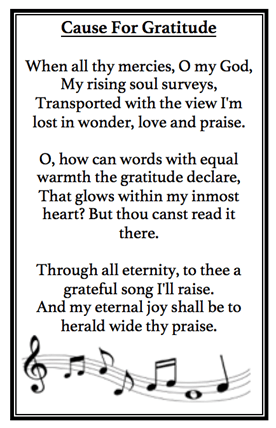
 We have so much to be thankful for. And yet, sometimes we don’t always have a thankful heart. This can be because we forget that we’re dealing with the Creator of the universe and that He has promised divine supervision of our lives.
We forget His covenants with us, His absolute purity of purpose and His love for us. We forget that He has showered us with blessings, and the amazing promises He has made to us. We forget these things and live in the moment, which is so short sighted.
The answer is simple… don’t forget! We need to find a way to keep these things in the forefront of our minds and use our memory of what we know about God as a counter-measure to despair, discouragement and a lack of gratitude.
Gratitude is a discipline that we can learn to apply under any circumstance of life. Gratitude can be cultivated in our hearts. It’s not just a byproduct of things going well for us, or of our circumstances being positive.
In Colossians 2:6 &7 the Apostle Paul said, “Therefore as you have received Christ Jesus the Lord, so walk in Him, having been firmly rooted and now being built up in Him and established in your faith, just as you were instructed, and overflowing with gratitude.”
Notice that the Apostle Paul didn’t say “let your gratitude overflow only when things are going well, when you’re young, strong and prosperous.” He said, let your life overflow with gratitude… no conditions… no special circumstances when we can forget to give thanks to God.
But how do we begin to put gratitude in its proper place in our lives?
A Christian writer once said, “The thing that awakens the deepest well of gratitude in a human being is that God has forgiven sin.”
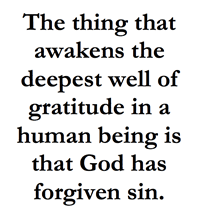 Gratitude begins when we see our need for forgiveness. And if we really believe that, and the need is important enough to us, we will make the effort to be more grateful to God.
In the busyness of life we can sometimes forget our need for forgiveness. That is, until we do or say something that comes from our sinful nature. Then we remember why the sacrifice of Christ is so important. Not only does it provide the promise of eternal life to come, it also allows us to be free from the guilt of sin today.
 An understanding of Jesus’ ransom sacrifice allows us to see ourselves in a different light, in the light of what God is doing in us, and what we will become if we continue to grow in Christ. It allows us to run to Jesus when we sin and to know that we are forgiven. It allows us to see our brethren in gleaming white robes of righteousness, rather than in the rags of sin. It allows us to see God, not as a judgmental being ready to pounce on our every mistake, but as a loving Father who wants to bless us and has provided everything necessary for our salvation and elevation to a higher level of understanding and to a higher level of life.
Knowing how God has provided for our escape from sin and death is the foundation of gratitude. And it is important to remember that generous provision often and to say, “Thank you Father. Thank you for your goodness, for your generosity, for being the perfect Father. And thank you Lord Jesus for being willing to suffer so much, to put up with the evil that was done to you so that you could save us from sin and death.”
Sometimes we just need a pep talk that reminds us of these things. Other times we need to see how others do it, how other Christians discipline their minds to be grateful for every experience of life.

The following stories relate the experiences of real life individuals who found a way to have thankful hearts, in spite of great adversities.
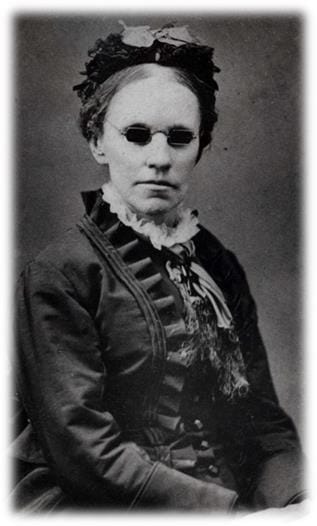 Fanny Crosby was a writer of more than 8,000 Christian hymns. When she was only six weeks of age she developed an infection in both eyes. The doctor who treated her recommended that hot mustard plasters be placed over her eyes as treatment. That unfortunate procedure blinded Fanny for the rest of her life.
When she was only one year old her father died, so her mother and grandmother raised her. These women grounded Fanny in Christian principles, helping her to memorize long passages from the Bible.
At age 15, she enrolled in the New York Institute for the Blind where she learned to play the piano, the guitar and the harp. Later she joined the faculty at that school, teaching English and history. In 1858 she married Alexander Van Alstyne, a blind musician and fellow teacher. They had one daughter, Francis, who died while a baby. The death of her daughter, of course, was very difficult for Fanny and as a result she became depressed and stopped writing for a time. She finally came out of her depression and wrote “Safe in the Arms of Jesus” as a commemoration to her daughter. Fanny Crosby wrote the words to such favorite hymns as “All the Way My Savior Leads Me,” “Blessed Assurance,” “Close to Thee,” “Jesus Is Tenderly Calling You Home,” “Near the Cross,” “Pass Me Not, O Gentle Savior,” “To God Be the Glory” and many, many others.

 Imagine being able to say, as Fanny Crosby did, “I might not have sung hymns to the praise of God if I had been distracted by the beautiful and interesting things about me…” It seemed intended by the blessed providence of God that I should be blind all my life, and “I thank Him for the dispensation.”
How could she thank him for her condition unless she disciplined herself to see the good in a life of blindness. There is some profound wisdom here. Wisdom that is able to see beyond the immediate handicap and understand the spiritual benefits she was receiving. Part of the wisdom was to be grateful for the experience. That’s hard… but that’s how God would have us see our trials.
Fanny Crosby chose to grow through them. She chose to be thankful and see the good in her experiences. Rather than harboring bitterness for the doctor who blinded her or dwelling on her handicap and feeling sorry for herself, she was determined that her story was not going to be about her blindness.

 That was her message when she penned the words to “Blessed Assurance,” where she said, “This is my story, this is my song, praising my Savior all the day long.”
The next time you have a trial think of Fannie Crosby and try to do what she did. Try to see the good in the experience, because the scriptures guarantee that something good can come out of every trial.
The value of the relationship that we can have with God could never be measured. Think about the benefits of having God in your life.
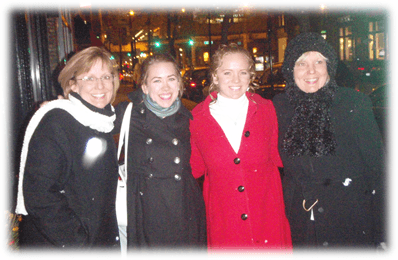 As impossible as it might seem to know a Creator who is so far above us, He is inviting us to do just that, to become intimately acquainted with Him. To begin that process He gives us family and friends to learn from. And when that family is united and loves one another, there is no greater bond that people can have.
When we think of our fellow Christians, we see that a spiritual family can often become an even greater blessing than a natural family.
God will always do His part when we need Him. Our part is to have the determination to get up when we fall and continue the race. Rev. 2:10 tells us to “Be thou faithful even unto death.”
When we come to understand the heart of our Heavenly Father, gratitude for Him becomes a core principle, both intellectually and emotionally. If we can achieve that constant disposition of gratitude then everything in life will fall into its proper place.

An Amazing Story
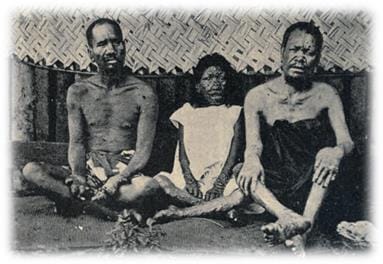 A church group from New Bern, North Carolina, traveled to the Caribbean on a missionary trip. The conditions at the posh, luxury resorts were a far cry from the impoverished way of life endured by many others on these tropical islands.
During this trip, their host took the group to visit a leper colony on the island of Tobago. And while there, they held a worship service in the campus chapel. As you can imagine, the sight of emaciated lepers filing into their seats on the bare pews bore deeply into the minds and memories of each visitor to this unaccustomed scene.
When the pastor announced, “We have time for one more hymn. Does anyone have a favorite?” he noticed a lone patient seated awkwardly on the back row, facing away from the front. At this final call for hymn requests, with great effort, the woman slowly turned her body in the pastor’s direction.
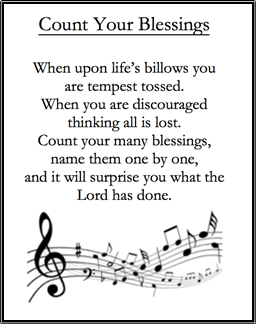 “Body” would perhaps be a generous description of what remained of hers. No nose. No lips. Just bare teeth, askew within a chalky skull. She raised her boney nub of an arm to see if she might be called on to appeal for her favorite song to be sung. Her teeth moved to the croaking rhythm of her voice as she said, “Could we sing ‘Count Your Many Blessings’?”
The pastor stumbled out of the pulpit, out the door, and into the adjoining yard, tears raining down his face. One of the traveling party rushed to fill his place, beginning to sing the familiar song in this unfamiliar place, arguably the most “unblessed” of any spot in the universe.
A friend hustled outside, put his arm around the sobbing pastor, and consolingly said, “I’ll bet you’ll never be able to sing that song again, will you?”
 “Yeah, I’ll sing it,” the pastor answered, “but never the same way, ever again.”
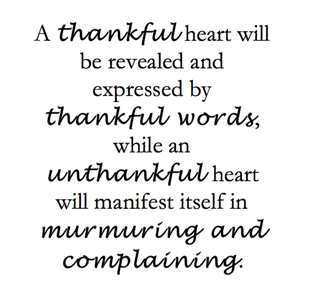
Leave it to the grotesquely deformed leper to remind us that grateful people are characterized by grateful words, while ungrateful people are given to griping, complaining, murmuring and whining.
Some grumble at why God put thorns on roses, while others wisely notice – with awe and gratitude – that God has put roses among thorns. Hear what people are saying when they talk about the everyday events of their lives, and you will see in an instant the difference between gratitude and ingratitude.

People with grateful hearts find things to be grateful for. And they’re not foolish dreams or wishful thinking. They are real and tangible, but it may take mental discipline to bring them out and make them a reality. This poor leper woman found room in her heart for thanksgiving to God.
Through the darkness of a debilitating disease she found a way to count her blessings.
 Psalm 69:30 says, “I will praise God with a song, and will magnify him with thanksgiving.” The antidote for negativity and murmuring is the magnifying glass of thanksgiving!
The word “magnify” used here actually means to make large. Gratitude makes God larger and more real to our thinking than the problem or obstacle we face!
The question is what are we magnifying? We can magnify our problems and the result will be that the enemy appears like a giant and we will appear as grasshoppers. We can make a mountain out of a molehill simply by our perception of a challenge.
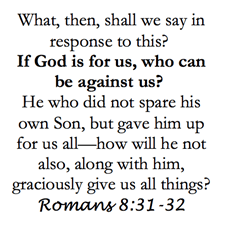 When we use the magnifying glass of gratitude it helps us see the magnitude of God’s ability, and we will see that if God is for us, no one can be against us.
What a wonderful way to understand gratitude, that it is a magnifying glass of God’s goodness and promises. May we use it often to see God for who He is; that He is bigger and more powerful than any enemy or obstacle that we will ever face. We truly have cause for gratitude because of who we are dealing with and the inherent goodness that He brings into our lives.
One of the things we learn in our Christian lives is that
trusting God through trials and painful experiences is essential to our very survival.

A Story of Faith
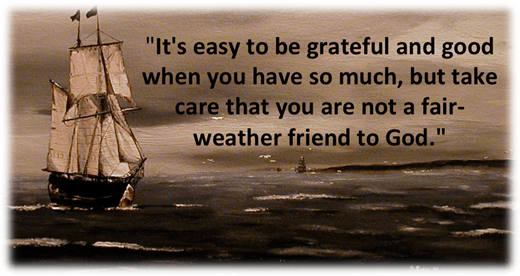
On November 2, 1873, a ship named the ‘Ville de Havre’ collided with ‘The Lochearn’, an English vessel. It sank in only 12 minutes, claiming the lives of 226 people. A woman named Anna Spafford had stood bravely on the deck, with her daughters Annie, Maggie, Bessie and Tanetta clinging desperately to her. They were eleven, nine, five and two years old. Her last memory had been of her baby being torn violently from her arms by the force of the waters. Anna was only saved from the same fate of all her daughters by a plank, which floated beneath her unconscious body and propped her up. When the survivors of the wreck had been rescued, Mrs. Spafford’s first reaction was one of complete despair. Then she heard a voice speak to her, “You were spared for a purpose.” And she immediately recalled the words of a friend, “It’s easy to be grateful and good when you have so much, but take care that you are not a fair-weather friend to God.”
Upon hearing the terrible news, her husband Horatio boarded the next ship out of New York to join his bereaved wife. Bertha Spafford (the fifth daughter of Horatio and Anna born later) explained that during her father’s voyage, the captain of the ship had called him to the bridge. “A careful reckoning has been made,” he said, “and I believe we are now passing the place where the de Havre was wrecked. The water is three miles deep.” Horatio then returned to his cabin and penned the lyrics of his great hymn, “It is Well With My Soul.”
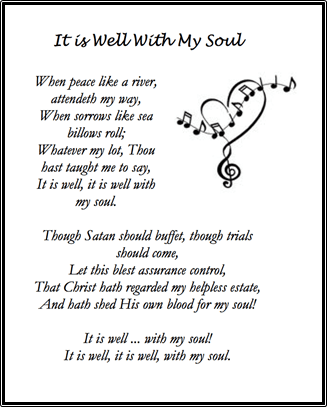
How could he not be overwhelmed with grief and haunted by what his children must have experienced? It must have been mental discipline to force himself to remember the goodness of God and trust in His grace and mercy in spite of the immediate circumstances.
The words which Spafford wrote that day come from 2 Kings 4:26. They echo the response of the Shunammite woman to the sudden death of her only child. Though we are told “her soul is vexed within her,” she still maintains that ‘It is well.” And Spafford’s song reveals a man whose trust in the Lord is as unwavering as hers was.
 It would be very difficult for any of us to predict how we would react under circumstances similar to those experienced by the Spaffords. But we do know that the God who sustained them would also be with us.
No matter what circumstances overtake us may we be able to say with Horatio Spafford, “it is well with my soul.”
It would be so much easier to believe in God and things associated with Him if we could see things with our eyes, if we could be transported to heaven and see things for ourselves. If we could see His angels, talk to them and understand everything that God has them doing it would be so much easier to believe. But that’s not how God chose to do it. He chose to allow us to have difficult experiences and asks us to develop faith in spite of them. He allows trials and even asks us to be grateful for them.
His approach is much more difficult. But, in the long run it’s the best way, because faith developed in adversity becomes deeper and more ingrained in us than in any other way.
Gratitude developed through mental discipline becomes part of our free will. And when developed under those circumstances it becomes a permanent part of who we are.