

The word “Noel” is one we hear often at Christmas time. Webster’s dictionary says, “English speakers borrowed the word noel from French. It can be traced further back to the Latin word natalis, which can mean ‘birthday’ as a noun or ‘of or relating to birth’ as an adjective.”
Noel
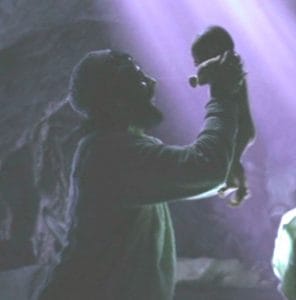 As used today, “Noel” refers to the most unusual and special birth this world has ever seen. The simple word “birth” is now connected to our Lord. So when we hear the word Noel, can think of “The birth.”
Considering the Lord’s birth and those precious moments in Bethlehem, finds us contemplating some amazing things. Looking at the image of Joseph holding up that small child, so dependent and weak, we think of our Heavenly Father who could take the essence of His son, who had been a spirit being with great knowledge, ability and a mature personality, and somehow put that information into this baby whose human brain was still developing. Yet someday, that child would have all the memories of his past life with his Father and of his heavenly home come back to him, and see his previous personality and memories blend with the new experiences he would have as a man.
We stand in awe as we try to comprehend the ability of God and the lengths He is willing to go to accomplish good for His creation.
In that child we see the confidence of God in knowing that by sending His son to earth to be tempted and tried and pushed to the physical breaking point, He would not lose that son. But in the end the son would be wiser and stronger and more compassionate. Someone may suggest that God was taking a big risk. There was the potential that Jesus would fail and if he did, he would be lost forever. But, God’s confidence is apparent—confidence in His own ability to carry out His plan, and confidence in the faithfulness of His son. These are astonishing things as we contemplate that helpless child. God was not afraid of losing His only begotten son.

Lowly Bethlehem
The location chosen for the birth of Jesus has, in itself, a deep spiritual message. This lowly place reflected the humble character of the our Lord in his pre-human form., a trait that was deeply ingrained in him.
Speaking of Jesus the Apostle Paul wrote,
By becoming a bondsman, or a servant to mankind, it seems strangely appropriate he should be born in a stable, a place where even a servant would probably not have been born. This conveys the hidden message God wants us to see: Humility is of paramount importance to God. So important was this message that it was to be demonstrated through His own son. 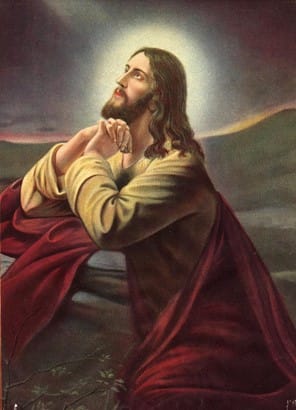 People were to see it in his ministry, in the things he said and the lifestyle he lived. To come from such an exalted position in heaven and then become a servant to mankind was a tremendous demonstration of humility.
To give himself up to the cruel hands of his enemies, knowing there was a higher purpose behind his suffering, showed us that his own human reputation was of little concern to him. His one goal was to do the will of his Father, and such an emptying of self absolutely required a humble heart.
 Simple People
God chose simple people to accomplish extraordinary things. Here was a poor carpenter and a young girl, neither of whom were from well-to-do or famous families. How difficult it would have been for them to endure the whispers and reputation that Mary’s son did not belong to Joseph. To faithful Jews under the law moral purity was essential.
This reputation followed Jesus all his life. In John 8:41 the Pharisees said to him, “We be not born of fornication; we have one Father, even God.” What an awful thing to say, even if it was true, but of course, it was not. This child was not born of fornication but was more the son of God than the Pharisees ever were.
From Mary and Joseph, we learn that when the Lord calls people to serve Him, He will not spare them from the cost of discipleship. In that statement there is another wonderful lesson. When we suffer for righteousness, or when we sacrifice for the Lord or the brethren, those things come to mean more to us than if there was no cost associated with them.
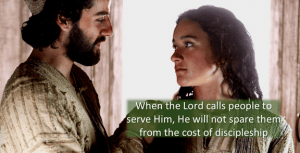
When it hurts to serve, or to struggle against a character fault, one might ask, “Why am I doing this? This is so difficult.” But a proper reflection says, it is simply the right thing to do. The Lord has earned our devotion. He deserves our faith. He has demonstrated His commitment to us and we can offer no less than our full devotion. The marvelous thing about serving God is that what He asks of us will always bless us in the end. Sometimes we just have to get passed the initial struggle of thinking a sacrifice may not be worth the effort.
Joseph and Mary paid a high price for being the parents of Jesus. But every time the adultery issue came up they undoubtedly thought of the privilege they were given to raise the son of God. Was there any price too high for that honor? They likely never questioned it.
Mary received strength from God. But Joseph was also a source of strength for her. The Lord often answers prayer and gives His people strength through someone close, a husband or wife or a fellow Christian. Such a course strengthens the bond between those involved and it thrills the Lord when He sees it.
There is little information about the character of Joseph, except by implication. The fact that he was chosen to help raise Jesus implies strength of character. Obeying the Lord and taking Mary as his wife, in spite of what it would mean to his own reputation, speaks volumes of his purity of heart and devotion to God. He was a simple man who worked hard and took his responsibilities seriously as he endeavored to live a righteous life under the Law.
When God looks for people to fill a special role in the Divine Plan, He generally invites simple people, but ones who are willing to adapt to what He wants of them.
Joseph and Mary will be remembered for their wise choice of accepting a difficult and challenging task with humility and grace. They chose to serve and trust the Lord for strength and guidance. That is the legacy they left and why God invited them to Bethlehem and to raise Jesus.

By Invitation Only
The invitation to come to Bethlehem was very restricted.. As unlikely as it may have appeared at the time, the privilege of going to Bethlehem was by invitation only. Joseph was required to go because of the decree by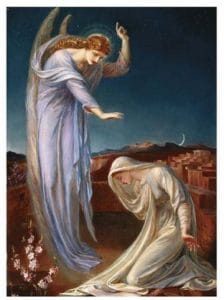 Caesar Augustus. But in reality, the Lord used that as a way of saying that He did not forget His promise to David. This provides another subtle lesson in the Noel story:
The Lord is a maker of many promises and not one of them will ever fail. We simply have to wait for the time God determines best according to His plan.
When the angel first appeared to Mary to tell her that she would have a son, this is one of the things he said:
“He shall be great, and shall be called the Son of the Highest: and the Lord God shall give unto him the throne of his father David: And he shall reign over the house of Jacob forever; and of his kingdom there shall be no end.” Luke 1:32, 33
That message was repeated to the shepherds when the angel said, “For unto you is born this day in the city of David a Savior, which is Christ the Lord.” Luke 2:11
By connecting the Savior to a forgotten little town God was reminding us of His promise to David. Bethlehem was now to be the birthplace of the great King of Kings and would never be forgotten again.
Isaiah prophesied, saying, 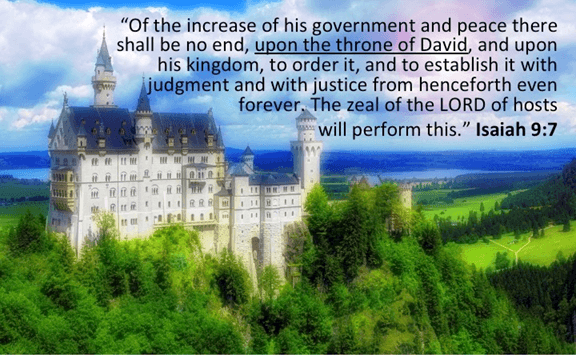
Not only did the Lord make this wonderful promise, but when the appointed time arrived, the prophet tells us the Lord of Hosts did it with zeal. God has a vast army of angels to carry out His will. So by connecting the birth of Jesus with the promise to David and with Bethlehem God proclaimed that He keeps His promises.
God’s Promises
The prospect of God’s kingdom in heaven and on earth can seem almost too good to be true. But the reality is that when God makes a promise we can be confident it will be inherently good.
After Joseph and Mary came to Bethlehem, the shepherds were invited next. Their lives were profoundly changed that night in the fields outside Bethlehem as the darkness was dispelled by the angelic light.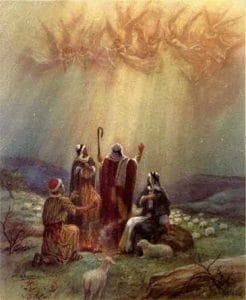
“… An angel of the Lord suddenly stood before them, and the glory of the Lord shone around them; and they were terribly frightened. But the angel said to them, ‘Do not be afraid; for behold, I bring you good news of great joy which will be for all the people; for today in the city of David there has been born for you a Savior, who is Christ the Lord. This will be a sign for you: you will find a baby wrapped in cloths and lying in a manger.’ And suddenly there appeared with the angel a multitude of the heavenly host praising God and saying, ‘Glory to God in the highest, And on earth peace, good will toward men.'” Luke 2:9-14
Why did these shepherds receive this extraordinary invitation to the Bethlehem stable? They certainly must have been noble and righteous men. However, it was not merely their noble characters that generated an invitation. It was their unique occupation that called for a special role in the nativity story.
Tower of the Flock
In the book, The Life and Times of Jesus the Messiah (page 186-187), Alfred Edersheim writes:
 “Jewish tradition may here prove illustrative and helpful. That the Messiah was to be born in Bethlehem was a settled conviction. Equally so was the belief that he was to be revealed from Migdal Eder, the ‘tower of the flock.’ This Migdal Eder was not the watchtower of the ordinary flocks which pastured on the barren sheep ground beyond Bethlehem, but lay close to the town, on the road to Jerusalem.
A passage in the Mishnah leads to the conclusion that the flocks, which pastured there, were destined for Temple sacrifices, and accordingly, that the shepherds, who watched over them, were not ordinary shepherds. These were under the ban of the Rabbis, on account of their necessary isolation from religious ordinances, and their manner of life, which rendered strict legal observance unlikely, if not absolutely impossible… Of the deep symbolic significance of such a coincidence it is needless to speak.”
Biblical commentator, Dr. Juergen Buehler adds the following:
 “There was a place just outside of Bethlehem city, but still within the region commonly known as Bethlehem, where Passover lambs were kept by specially trained shepherds. The lambs were born in this ‘tower of the flock’ known as Migdal Eder under the watchful eye of the shepherds who would then inspect and either certify them for use as sacrifices in the temple or designate them to be released for common use. The new lambs would, according to some sources, even be wrapped in special swaddling clothes once certified.”
(From International Christian Embassy Jerusalem)
So, apparently, these were not ordinary shepherds. The flocks they watched were to be part of the temple sacrifices. Now, with this majestic visit from the angels these men were to apply their training and inspect another newborn lamb. They came to certify that he could one day be offered in sacrifice and his blood be the cause of deliverance. This child was to eventually be the Passover lamb.
Edersheim said it was because of their occupation the shepherds were banned by the rabbis. Yet, in spite of this, they were still able to provide acceptable lambs for sacrifice. That fact provides yet another subtle message. By being the first to hear the glorious birth announcement of our Savior, God was saying, they were not unclean, as the Rabbis had pronounced. And so, God invites ones who, by worldly standards, may seem like the most unlikely choices.
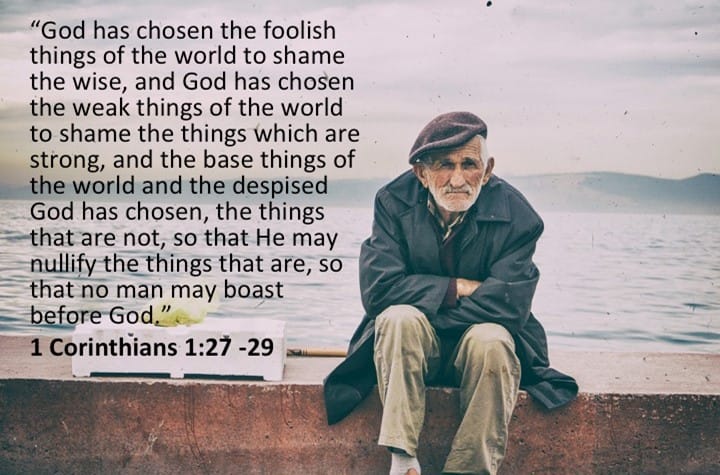
God is not a respecter of persons, but chooses as He sees fit.
“And it came to pass, as the angels were gone away from them into heaven, the shepherds said one to another, Let us now go even unto Bethlehem, and see this thing which is come to pass, which the Lord hath made known unto us. And they came with haste, and found Mary, and Joseph, and the babe lying in a manger. And when they had seen it, they made known abroad the saying which was told them concerning this child. And all they that heard it wondered at those things which were told them by the shepherds. And the shepherds returned, glorifying and praising God for all the things that they had heard and seen, as it was told unto them.” Luke 2:15-18, 20
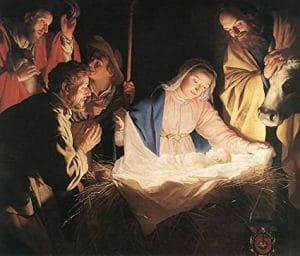
In these verses we see the certification given by the shepherds that this was an unblemished lamb, fit for sacrifice, the true lamb of God.
In connection with these shepherds, there is a wonderful prophecy in Micah the 4th chapter that mentions the shepherd’s watchtower. The opening verses of chapter 4 describe God’s earthly kingdom.

Verse 2 says that the nations will come to the mountain of the Lord. That He will teach them of His ways and they will walk in His paths.

Verse 3 says He will judge among the nations and they will beat their swords into plowshares and nation would not lift up sword against nation or learn war anymore.

Verse 4 tells us that every man will sit under his own vine and fig tree and there will be no more fear.

And then verse 8 says, “Thou, therefore O Migdal-eder, mound of the daughter of Zion, so shall arrive a chief dominion, the kingdom of the daughter of Jerusalem.” (Rotherham translation)
In the King James version the phrase “Migdal-eder is translated “tower of the flock.”
This lovely passage about the earthly Kingdom says the shepherd’s tower, where temple lambs were born, will someday see the antitypical lamb of God receive the chief dominion of earth and bring to fruition all the kingdom promises listed in the opening verses.
So these were not insignificant shepherds. They received confirmation that one day the child would bring good tidings of great joy to all people of the world in his kingdom.
Imagine how thrilled they were to realize they were chosen to hear the announcement of the Savior’s birth and to tell others Messiah had come. What a blessed privilege was theirs!
The Wise Men
The wise men from the east were the last group to receive an invitation to Bethlehem. Vine’s dictionary states that the phrase “wise men” comes from the Greek word “magoi,” denoting “one of the sacred caste, originally Median, who apparently conformed to the Persian religion while retaining their old beliefs.”
Even the Gentile world was in expectation of a Messiah. Virgil, an ancient Roman poet before Christ, predicted that “a child from heaven would be looked for who would bring in the Golden Age and take away sin.”
In discussing Gentile expectations, Biblical commentator Charles Russell writes, “…The clearest of all these (Gentile) prophecies was one by Zoroaster. The Nestorians say that Zoroaster was a disciple of Jeremiah, from whom he learned about the Messiah and talked concerning him to his disciples… In this connection we should remember that Daniel, Shadrach, Meshach and Abednego were at this time princes of Persia and intimate with the wise men of that country, which was at that time the principal nation of the world.
It is easy to see how traditions would be handed down through that channel, and especially may we suppose that Daniel’s prophecy respecting the time of Messiah’s birth would be well known to the disciples of Zoroaster, Persia’s wise men. Furthermore, there were Jews scattered abroad throughout that country who still more or less kept alive the thoughts of Israel’s hope for the great Messiah so long promised of God…”
The possibility that these Magi were likely connected to Daniel is thrilling. Daniel was never shy about his faith in God and was willing to die for his beliefs. King Nebuchadnezzar eventually realized there was something very special about Daniel and his three Hebrew friends. Daniel 1:20 says, “they were in all matters of wisdom and understanding ten times better than all the magicians and astrologers of Babylon.”
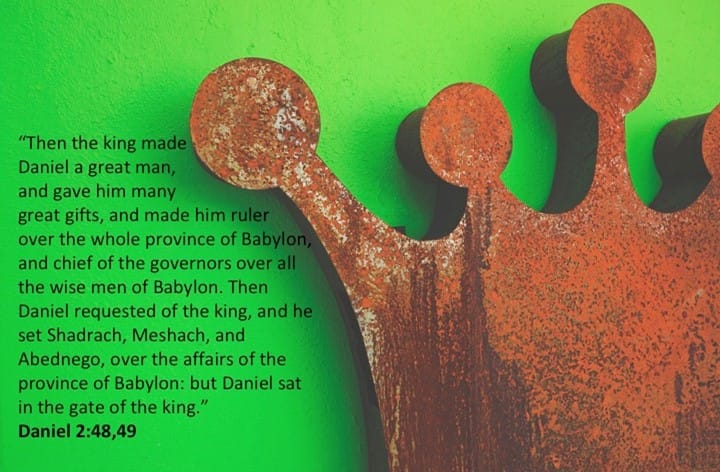
Being in such an elevated position, their passion for God and for the prophecies of deliverance would have spread throughout Babylon. So, 500 years later, as the wise men from the east came to Israel to worship the newborn king, they carried with them the implanted faith of Jeremiah, Daniel and his 3 friends, as well as all others who believed and promoted these beliefs. They were an extraordinary example!
Someday, looking back on this bit of history, they will rejoice that their faith became such a witness in a Gentile land and that it was passed down through the corridors of time.
Simeon’s Prophecy
Another hint of how the new born king would bring good tidings to the Gentiles is provided in a wonderful scene described in Luke the 1st chapter. As Joseph and Mary brought Jesus to the temple to be circumcised, they met a man named Simeon:
“And, behold, there was a man in Jerusalem, whose name was Simeon; and the same man was just and devout, waiting for the consolation of Israel: and the Holy Spirit was upon him. And it was revealed unto him by the Holy Spirit, that he should not see death, before he had seen the Lord’s Christ. And he came by the Spirit into the 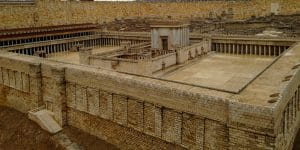 temple: and when the parents brought in the child Jesus, to do for him after the custom of the law.
Then took he him up in his arms, and blessed God, and said, Lord, now lettest thou thy servant depart in peace, according to thy word: For mine eyes have seen thy salvation, Which thou hast prepared before the face of all people; A light to lighten the Gentiles, and the glory of thy people Israel. And Joseph and his mother marveled at those things which were spoke of him.”
Luke 2:25-33
The words of Simeon provide another reason the Magi may have invited to Bethlehem. As Simeon declared this baby was to bless both Jews and Gentiles. He would be a light to the Gentiles, portrayed in the wise men, and the glory of Israel, as represented in the noble Jewish shepherds.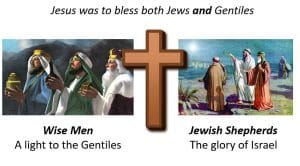
The men from the east brought rare and special gifts to honor the new king. They brought myrrh, gold and frankincense. But why these particular gifts? Various explanations have been offered. One likely explanation looks to Israel’s ancient Tabernacle as each of these gifts were prominently used in the service there and later in the temple.
 Myrrh
Myrrh
 Myrrh
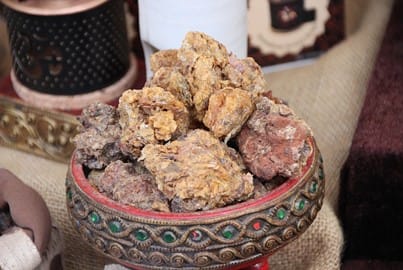
MyrrhMyrrh is an aromatic gum. It was mixed with other spices and olive oil to make up the holy anointing oil. It was used to anoint Israel’s High Priest as well as the kings. Its purpose was to convey divine approval of that which was anointed. As part of the anointing oil, the scriptures qualify it as, “Pure Myrrh.”
Barnes Commentary says:
“The word here rendered pure, is literally, “freely flowing,” a description which is explained by the fact that the best myrrh is said to exude spontaneously from the bark, while that of inferior quality oozes out in greater quantity from incisions made in the bark.
(Barnes on Exodus 30:23)
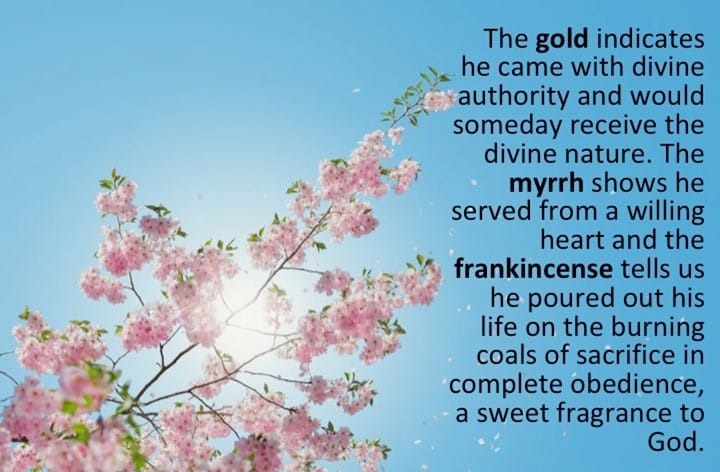
The description of spontaneous, free-flowing myrrh, provides the symbolic meaning of why it was added to the anointing oil. It represents “a willing heart.” Olive oil is a picture of the Holy Spirit. The Holy Spirit works best in conjunction with a willing heart. Though sweet smelling, myrrh is bitter to the taste. These two qualities may be the reason myrrh was offered as a gift to the baby, Jesus. It said he would demonstrate a willingness to serve, even to the extent of bitter suffering.
Olive oil alone was burned in the candlestick, within the Holy of the Tabernacle. It pictures how the Holy Spirit brings enlightenment. This reveals that knowledge is important. Without knowledge we cannot know what God wants of us. But knowledge by itself is useless unless it produces change or action, or some positive response. And so the oil burned in the lamp was simply olive oil, while the anointing oil was more complex and affects personal change in those under its anointing.
A contemporary lesson then describes how willingness to sacrifice creates a condition that allows the Holy Spirit to do its work in us. That is a lovely lesson and we see how an ancient structure like the Tabernacle can bring such practical lessons for us today.

It is unlikely the Magi understood the lesson of myrrh, that it indicated this baby would someday bring a willing sacrifice; a sacrifice that would be a sweet fragrance to God, but would be a bitter experience to his flesh.
However, now that we know what myrrh represents we can read passages in the Song of Solomon and see how they fitly describe our Lord and his church. In an early passage the bride describes her bridegroom, saying, “A bundle of myrrh is my well-beloved unto me…” Song of Solomon 1:13. The life of our Lord radiates a sweet fragrance that we can love and appreciate because he was so willing to suffer for our sakes.
Then in chapter 3, the Lord speaks of his bride; “Who is this that cometh out of the wilderness like pillars of smoke, perfumed with myrrh and frankincense.” Song of Solomon 3:6. There is the description of the bride as she comes up out of the wilderness condition of the Dark Ages. Jesus sees her perfumed with myrrh after the bitter experiences of persecution, which she so willingly endured.

As Christians then we should value the lesson of myrrh and be willing to serve. Our service is a sweet fragrance to God. We should not overestimate the cost of serving, but be willing to be stretched, understanding the rewards which come to a willing heart.
“Behold, how good and how pleasant it is for brethren to dwell together in unity! It is like the precious ointment upon the head, that ran down upon the beard, even Aaron’s beard: that went down to the skirts of his garments; As the dew of Hermon, and as the dew that descended upon the mountains of Zion: for there the LORD commanded the blessing, even life for evermore.” Psalm 133:1-3
In addition to understanding how the Holy Spirit works best with a willing heart, the Psalmist uses the anointing of the High Priest to describe the importance of unity. He describes how the Holy Spirit flowing from the head to the body and down to the hem of the garment. This lovely illustration describes how the Lord’s Spirit is often conveyed through brethren in Christ. We learn from each other and as we work together there is a bond that grows and helps us realize we are on the same team, pulling together for a common cause. Unity is a characteristic of those who are part of the anointing. Let every Christian do their part in building this unity that comes from the Holy Spirit.
Gold
 The Magi also brought gold and frankincense. Gold in the Tabernacle is a picture of things divine. The tabernacle structure was built with acacia wood covered with gold. Everything in the Holy and Most Holy were either solid gold or covered in gold, while those in the court were copper, showing the distinction between the human (copper) and the divine (gold).
Again, it is not clear if the wise men understood any of this symbology. Messages from God are often not understood by those first conveying them. But these three gifts were likely prophetic statements about this child, and what his life would be like. Gold indicates that his mission was divinely approved and some day he would possess the divine nature.
Frankincense
 Concerning frankincense Charles Russell wrote: “As High Priest, Jesus slew the bullock; at baptism he offered the sacrifice of his humanity. The typical priest took his two hands full of incense and crumbled it in the fire of the incense altar – that represented the three and one-half years of our Lord’s ministry. This picture of the incense falling upon the fire represented the glorious qualities of Jesus as he came in contact with the trials of life. In every case his faithfulness yielded a sweet perfume… His death upon the cross was the last crumb of incense falling into the fire.”
In the frankincense then we see a picture of faithfulness and obedience. The perfect obedience of Jesus resulted in perfect praise to the One he was obeying.
As these Gentiles from the east came, their gifts foreshadowed the elements that would make our Lord’s mission successful.
There are other ways to interpret the meaning of these gifts. But if God’s hand was involved in the choice, the Tabernacle connection seems reasonable.
Summary
The list of those invited to Bethlehem was short, but each invitee conveyed a meaningful lesson. And now, because we understand the work this newborn baby was to accomplish, we too can come in praise and adoration. Many of us come as Gentiles who love the prophecies and the hope they create in our hearts. And like the men who brought gifts, we too can bring our gifts to him as we endeavor to follow the principles he laid down for us.


