“Watchman, What of the Night? The Morning Cometh.” Exhaustive research and examination of prophetic and historic testimony relating to the divine times and seasons.
“Ye, brethren, are not in darkness, that that day should overtake you as a thief. Therefore let us not sleep, as do others: but let us watch and be sober” (1 Thessalonians 5:5,6).
No question can be of more absorbing and thrilling interest to the child of God than that of the time of the complete and permanent overthrow of the empire of evil on earth and the full and lasting establishment of the kingdom of righteousness, justice, and peace. Having been clearly informed in the holy Scriptures that the establishment of that great empire of justice and truth will mean a thorough vindication of the character of God and of all those who throughout the ages have stood in defense of His holy name, and that it will signify additionally the crushing of evil, and the removal of sorrow, suffering, and death from the earth, what child of faith would not realize every fibre of his soul stirred within him on being brought face to face with the facts and evidences showing that the “time is at hand” for the “night of weeping” to pass, and the “morning of joy” to dawn.
Such has been the happy experience of the watching and waiting people of God in these last times as they have continued to pray, “Thy kingdom come, Thy will be done.” It has been the joyful privilege of these to realize the fulfilment of the message of St. Paul: “But of the times and the seasons, brethren, ye have no need that I write unto you. But ye, brethren, are not in darkness, that that day should overtake you as a thief. Ye are all the children of light, and the children of the day: we are not of the night, nor of darkness. Therefore let us not sleep, as do others; but let us watch and be sober” (1 Thessalonians 5:1,4-6).
Again the thrill and rapture of joy experienced by this class was well described by the Prophet Daniel: “Oh, the blessedness of him that waiteth earnestly, and cometh,” etc. (Daniel 12:12). The heavens, as it were, have been opened unto them, and like the Seer of Patmos, it is as if they were transported to a great and high mountain from where they have been privileged to behold the wealth of the New Jerusalem and the glory of the world to come.
Ye Brethren Are Not in Darkness
But this cup of blessedness, like that of which the faithful of the past have supped, has not been without its mixture of myrrh and wormwood; for in addition to the suffering incidental to the fulfilment of their consecration, and in addition to the perils and fiery trials of these days, the Lord’s people have been permitted to feel keenly the bitterness of disappointment with regard to some of their cherished hopes and expectations and a wise Providence has seen fit to allow those circumstances to obtain that tend to disturb and perplex and that give rise to doubts and fears, making it necessary for those who would hold fast to their faith and hope to earnestly seek the light of the Lord’s countenance, the reflection of His Word and Spirit. Such in the past as have humbly and with their whole heart sought Him have not been turned away empty, nor been left in hopeless solitude, but have been made to drink abundantly of the springs of His truth and grace by which they have been enabled to press on with refreshment and renewed vigor to the end of their journey.
Amongst the illustrious examples of the Bible is that of the Prophet Daniel, who, out of intense anxiety for the deliverance of God’s people, sought the face of the Lord with his whole heart: “In those days I Daniel was mourning three full weeks. I ate no pleasant bread, neither came flesh nor wine in my mouth, neither did I anoint myself at all, till three whole weeks were fulfilled.” In response a special messenger was sent from the Lord to enlighten and comfort him: “And he said unto me, O Daniel, a man greatly beloved, understand the words that I speak unto thee, and stand upright: for unto thee am I now sent. And when he had spoken this word unto me, I stood trembling. Then said he unto me, Fear not, Daniel for from the first day that thou didst set thine heart to under- stand, and to chasten thyself before thy God, thy words were heard, and I am come for thy words” (Daniel 10:2,3,11,12). And Daniel was made to understand concerning the matter that lay near to his heart, and he was given the honor of recording one of the most significant prophecies of the Bible.
Nor will those who now, out of humility and full consecration, seek the face of the Lord and guidance by His Spirit be left comfortless with regard to the important matters that lie near to their hearts, and with regard to the great issues in which the spiritual interests of all the Lord’s people are wrapped up. Thus it is our firm conviction, based upon the sure promises of the Divine Word, that the Lord will grant unto His people such vision and such comprehension of the wisdom from above that they need not remain in doubt and perplexity with regard to the things in which they have been hoping and trusting.
Vital Questions of the Hour
Ever since this association of Bible students, known as the “Pastoral Bible Institute,” was called into existence, over seven years ago, the brethren to whom the interests of this ministry have been committed have been appealed to by other brethren from nearly all parts of the earth who have experienced deep perplexity as to many of the existing conditions, and as to the seeming failure of much that was hoped for and expected would be realized by the Lord’s people by this time. During these days of waiting many of the brethren have very properly been making inquiry into the causes of the seeming delay of the fulfilment of our hopes. Some have asked, Why has not the Church realized her final deliverance and reward by this time? Considering the views we have entertained for a number of years on the subject of chronology, as to where we are on the stream of time, and as to the end of the “six thousand year period” and the “times of the Gentiles,” etc., why is not the time of trouble over with by now — why has not the old order of things passed away, and why has not the Kingdom been established in power before this? Is it not possible that there may be an error in the chronology? None can dispute that these are questions entirely proper for consideration, and on which we may reasonably seek assistance from the Word of the Lord. And yet, considering the responsibility of touching things that involve so much, and remembering the divinely solemn instruction, “Be not rash with thy mouth, and let not thine heart be hasty to utter any thing before God,” it has been with much hesitation that decision is reached to speak with regard to these matters; but surely it is proper for us to speak where the Word of the Lord speaks, and likewise, we trust to remain silent where that Word is silent. The earnest inquiries and heartfelt appeals from the brethren during these days have caused much earnest and prayerful thought and seeking the Lord and His Word for the wisdom from above. We have humbly acknowledged to Him our utter incompetence to know or to accomplish anything of ourselves, and that our every confidence is in Him; that we are sure that, as in the past, He is still able to use very weak vessels in His service to honor His name. We have therefore asked that if it were His good pleasure, we might be blessed with such understanding of His Word and will as would enable us to counsel others wisely and in a manner that would honor His name and cause. And it is concerning some of these vitally and deeply important things that have perplexed the brethren, that we have undertaken to submit the general examination that follows in this issue.
“We Have not Followed Cunningly Devised Fables”
All the readers of this journal well know that we have not used these columns to promulgate any vain imaginations or fanciful theories of our own. All can surely attest that the most conservative policy has been adhered to and rigidly followed out, to the extent of apparently being an annoyance to some. It has not seemed to us to be the Lord’s will, nor have we had any desire, to place before the brethren something new or our own manufacture with which to fascinate and startle others or to satisfy idle curiosity. Nor do we now have any intention of departing from the policy and custom practiced from the beginning of this movement. We will not launch out into the field of wild speculation and idle guessing; but while endeavoring always to exercise that sobriety and conservatism becoming to all ambassadors of Christ, we purpose to maintain that alertness and watchfulness as to the signs of the times and the fulfilment of the “more sure word of prophecy” that we may discern the will of our God and thus be enabled to stand and to assist others to maintain faith, fortitude, and courage in this very trying time.
We submit what is given herein only after the most careful and prayerful search of the Scriptures, and only after reaching the conclusion that it is well sustained by the infallible Word of the Lord. As our own hearts and heads have been greatly refreshed and blessed in the examination of these matters and in the conclusions reached, we believe that a responsibility rests with us to make known these things to others. We urge nothing upon any. We would say nothing to coerce any to see the situation as we do. We merely say to all that these things look most reasonable and Scriptural to us and we are convinced that they are true. We only ask that careful and earnest attention be given to the matters that we here review, believing that a rich blessing will be realized therefrom, as we ourselves have experienced.
The Failure of Our Former Expectations
All who are acquainted with the writings of Brother Russell are well aware of the fact that it was his conviction up to within a short time before October, 1914, based upon his study of the chronology of the seven times (2520 years) of the Gentiles, that that date would witness the complete overthrow of the Gentile nations — indeed, the utter collapse of the present order of things, civil, ecclesiastical and social, and the full establishment of God’s Kingdom, which last event of course would necessitate the change of all the Kingdom class to the glory and honor of the Divine nature. We cite a few of the many statements of this character:
“In view of this strong Bible evidence concerning the times of the Gentiles, we consider it an established truth that the final end of the kingdoms of this world, and the full establishment of the Kingdom of God, will be accomplished by the end of AD 1914. Then the prayer of the Church, ever since her Lord took His departure — ‘Thy Kingdom come’ — will be answered; and under that wise and just administration, the whole earth will be filled with the glory of the Lord.”
“The ‘Gentile times’ prove that the present governments must all be over- turned before the close of AD 1914; and the Parallelism above shows that this period corresponds exactly with the year AD 70, which witnessed the completion of the downfall of the Jewish polity.”
Referring to the sixth vial-plague, which Brother Russell believed had been in process of fulfilment for some years past, he said:
“ ‘The battle of the great day of God Almighty’ (Revelation 16:14), which will end in AD 1914 with the complete overthrow of earth’s present rulership, is [was at the time he wrote] already commenced.”
Three of the most stupendous events of Scripture prophecy were thus expected by us to occur in October, 1914. First, the utter collapse of what is generally termed Christendom, which comprehends both the nominal Christian system or temple, and the so-called Christian civilization, as also the other Gentile powers. The event in Jewish history which corresponded or parallele this great catastrophe was that of the overthrow of Jerusalem and the destruction of its temple in Zedekiah’s day, and the same event in 70 AD. The parallel event did not eventuate in October, 1914, nor has it yet, as all are now aware. The second event that was to occur was the end of the battle of the great day of God Almighty. Neither did this take place. The third event is that of the “full” establishment of the Kingdom of God, which, as is also plainly apparent, has not yet occurred.
Prove All Things Hold Fast That Which Is Good
In view of the utter failure to date of the three propositions above mentioned, as well as others, what would seem to be the proper course dictated by the spirit of a sound mind? One method would be to blindly close our eyes to the facts and say that somehow we must have been right in our former convictions regarding events, times, and seasons, anyway, and then enter into a scheme of theorizing and twisting the Scriptures to force them to fit our former calculations. Another method would be to say that since so many of us for so long a time held the convictions that we did, it would not be wise policy for us to now question anything or make any investigation, but to just remain silent and quiet on the subject. Neither of the above methods appeals to us as representing the part of wisdom or the spirit of the Lord. Rather we are deeply impressed by the attitude taken and the course adopted by Brother Russell during his last hours. And what were his latest utterances in regard to these matters? How did he account for the manifest failure of our expectations? We reply: In 1916, he said along this line:
“Some of us were quite strongly convinced that the Harvest would be ended by now, but our expectations must not be allowed to weigh anything as against the facts. The fact is that the Harvest work is going grandly on. At first we were inclined to surmise that the Harvest proper had closed in October, 1914, and that the work since going on was a gleaning work; but the facts seem not to bear this out.”
In other words, since the facts are that some things we expected have not been realized, we must not insist that our expectations were right anyway, but should accept the facts and recognize the failure up to date of our expectations.
Again, about two months before his death Brother Russell expressed his convictions; and concerning Gentile times he frankly admitted mistaken calculations, and stated that instead of expecting the complete collapse of Gentile kingdoms, etc., in 1914 we should have expected a simple running out of the lease of power to the Gentile nations; in other words, that the Divine decree, giving the dominion of the world to Babylon and the empires succeeding Babylon, which was for a period of “seven times” (2520 years), ran out then, October, 1914, and that the complete collapse would be due to occur in a few years from the time he wrote, in 1916. He, however, fixed no date. His words to this effect are:
“The Gentile nations were guaranteed a certain amount of possession and control for a certain period of time. That time having expired, dispossession proceedings are now in process. We see no reason for doubting, therefore, that the times of the Gentiles [i.e., their lease of power] ended in October, 1914; and that a few more years will witness their utter collapse and the full establishment of God’s Kingdom in the hands of Messiah.”
Evident Error in Former Reckoning
The statement here cannot possibly be misunderstood, and is briefly this: that the date 1914 ended the 2520 years of lease of power to the Gentiles. This would of course make this lease of power to begin 606 BC. Again, with regard to the parallels and the Harvest, he said:
“We imagined that the Harvest work of gathering the Church would be accomplished before the end of the Gentile times; but nothing in the Bible so said. Our thought was purely an inference, and now we see that it was an unjustified one.”
It is evident from the statements made by Brother Russell in September, 1916, that he looked forward to 1918 as possibly marking the utter collapse and end of the present order. But now we are moving rapidly away from and beyond that date with the Gentiles still in power and the present order of things intact. What would now appear to be our course of wisdom? Again we ask the reader to weigh and ponder carefully our Brother’s advice published in 1914, for we consider it most significant and the very essence of wisdom.
“If October, 1915, should pass, and we should find ourselves still here and matters going on very much as they are at present, and the world apparently making progress in the way of settling disputes, and there were no time of trouble in sight, and the nominal Church were not yet federated, etc., we would say that evidently we have been out somewhere in our reckoning. In that event we would look over the prophecies further, to see if we could find an error. And then we would think, have we been expecting the wrong thing at the right time? The Lord’s will might permit this.”
Surely what Brother Russell said he would do in the event that matters were going on much the same several years beyond 1915, cannot be unreasonable or improper for us to do now, that we “find ourselves still here, and matters going much the same,” namely to go back over the prophecies “to see if we have been looking for the wrong thing at the right time.”
How frequently has it been the case with the Lord’s people in their investigation to discover the time for important events in connection with the unfolding of the Lord’s great plans and purposes, that they have made the mistake of looking for the wrong thing at the right time. In connection with the most important event of human history — the First Advent of the Redeemer — the nation of Israel, who had been so long looking for their Messiah, and who were accustomed to having the Scriptures relating to that event read publicly in their hearing every Sabbath day, made the most serious mistake in expecting that their Messiah at his First Advent was coming to reign, instead of to suffer and die; overlooking or failing to give heed to the fact that those predictions taught that He must first suffer before He would enter into His glory. This was true not only of the nation as a whole, but even many of the disciples made the same mistake. In their cases, however, because of their being true disciples, their disappointment was overruled for their eternal good; and not only so, but the Savior revealed to them later the Divine Plan more fully.
Miscalculations of the Past in Expecting “Wrong Thing at Right Time”
Not understanding the nature of our Lord, the manner of his Second Advent, nor the object to be accomplished by the Advent, and because of a too hasty conclusion concerning the nature of the events that were to mark the end of certain prophetic periods, Mr. Miller, in 1844, a most godly disciple of Christ, and his associates, made the same mistake, and looked for the Lord to come in a body of flesh, to literally burn the world and purify it by the fires thereof to become the eternal home of all the saved.
Would it not be possible for the Lord’s people who have gained a very much clearer and more consistent and Scriptural knowledge of the manner and object of the Second Advent to make a similar mistake in their fixing time for events to take place when certain prophetic periods seem to have run their course? May not this be true concerning the prophetic period of the “seven times” of the Gentiles? We have found that one of the wise servants of God, one much used of the Lord, acknowledged just before he finished his course in death, certain mistaken calculations with relation to the forty-year Harvest parallels. Would it not be best, in view of this, for the Lord’s people to give heed to his words uttered in 1914 concerning what he would do if he found himself living beyond 1915 and certain things did not eventuate? And now that eleven years have passed since these words were uttered, and nearly ten since his death, would it not be the much wiser course for us to pursue to receive his words of advice, instead of trying to reconcile what he acknowledged himself were mere inferences and have been proved such. Would it not be much wiser to follow his suggestion and look very closely to those Scriptures that mark the beginning of Gentile times, particularly that feature of the same which we and he failed to see until after 1915 and 1918 passed meant the cessation of a lease of power instead of an overthrow and destruction of the Gentile nations and apostate Christi- anity? Would it not be more consistent and a better exhibition of the spirit of a sound mind, more pleasing to our Divine Lord, to examine and discover where the mistake is, than to do as many have been doing, building up theories based upon that which he himself acknowledged was wrong, only to be disappointed again later? We certainly believe it would be prudent to proceed to investigate as he said he would do.
Be our sentiments what they may, we are now confronted with certain facts which outweigh all past considerations, and as students of the sure Word, we want our feet on as firm foundation as possible. Though all the expectations relative to the year 1914 did not mature, the Lord was very gracious in permitting just sufficient events of a certain character to transpire to sustain the faith and hopes of His dear children, who have been “kept by the power of God through faith unto salvation ready to be revealed in the last time.” And His goodness will continue even now in affording a further view into His chronological arrangements, revealing that everything is occurring exactly on time as He had intended, and showing approximately at least the location of some future events of great importance in the outworking of His Plan.
The Lease of Power to the Gentiles
In the course of this investigation there has been located, we believe, the point of difficulty or discrepancy in what we have considered our great chain of chronology. It is found to be in connection with the commencement of the “times of the Gentiles”; that designation, as we have seen, having reference to the sole or world dominion given to the Gentiles at the conclusion of Israel’s kingdom, which dominion continues to control the nations of the earth. Concerning the fact that this lease of power began 606 BC, there is scarcely a dissenting voice amongst Bible expositors who have given the matter attention; furthermore, it is agreed that this lease of power began 70 years before 536 BC. Concerning these two items both historical and chronological writers are in perfect agree- ment. One of these writers has expressed the very general thought concerning the significance of this date 606 BC, and its great importance as a chronological date: “It has been justly termed the point of contact between sacred and profane history; and its importance in the sacred chronology is immense on account of its being the [beginning] epoch of the [70 years] servitude of Judah to Babylon.” This latter period mentioned, the 70 years of Judah’s servitude to the kingdom of Babylon, enters into the point of difficulty in a very important sense.
Table of Chronology as Heretofore Understood
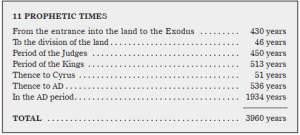
In the development of this investigation it will be well to have before us briefly the table of chronology as we have heretofore understood it. (See box at top of next page.)
These time periods are elaborated in The Time is at Hand, pages 43 to 51. So far as we are able to know, all the conclusions are correct with the exception of one point, which constitutes the crux of our presentation, and which we feel is the solution of our difficulties. The question at issue is concerning the beginning of the 70 years called “the period of desolation.” This period of 70 years, ending at 536 BC, will be seen to be more properly called the “70 years of servitude.” Heretofore we have begun this period with the destruction of Jerusalem at the end of Zedekiah’s reign thus forcing 70 years from Zedekiah’s overthrow to 536 BC; whereas careful investigation now reveals that this era of 70 years really began 18-19 years earlier — about the third year of the reign of Jehoiakim, with the first year of the reign of Nebuchadnezzar, king of Babylon.
And this conclusion compels a discrepancy or difference of 19 years in the ultimate outcome of the chronology, though it will be seen, we believe, to sustain an arrangement in the whole system of prophetic time measurements that is harmonious.
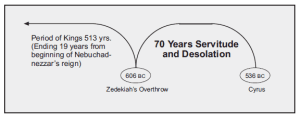
It has surely occurred to all students of chronology that we are absolutely dependent upon secular history for our chronological measurements from the year 536 BC onward; that Bible chronology stops with the 70-year period ending at the beginning of the reign of King Cyrus, the Persian, and that the inspired Word has brought us forward only so far as necessary, from which point we will be able to search out the truth from such sources as are at hand, and which are considered to be quite reliable. Now, what are the facts at hand concerning secular testimony covering the period in question? We find a very general agreement that the reign of King Cyrus began in the year 536 BC, and as this is the date we have already settled upon, no discussion is necessary, believing that it should stand. If the 70 years ended in 536, then they began in 606. There is no occasion for changing that date either. The following diagram will serve to illustrate how we have reckoned the 70-year period heretofore, but which we believe was erroneous:
Now here comes the test. If the seventy years began with the close of the reign of Zedekiah, then Zedekiah’s reign ended in the year 606, and this is what we have believed, but there is not a secular authority of any reliability which places the close of Zedekiah’s reign so far back. The only authority (if such it may be called) we have ever heard of which so presents the matter is Josephus, but it is generally known that he is inconsistent with himself and unreliable. All the great authorities found in our libraries, without exception place the date of Zedekiah’s overthrow from 589 to 586. We believe the correct date is 588 BC, as that is the one which sustains harmony in all the time prophecies and is the date given by the following authorities:
The American Encyclopedia (under “Babylonian Exile”); Appleton’s New Practical Encyclopedia (Page 409, under “Jews”); Chamber’s Encyclopedia (Page 393 under “Jews”); Usher; Hawes; Blair.
What Say the Scriptures
The question before us is, What Bible statement is there to show that Zedekiah was overthrown and Jerusalem destroyed in 606 BC? None whatever nor is there even an inference to that effect. Why then have we in the past believed that these events took place in 606 BC? Answer: Because we read various state- ments about a period of 70 years in that connection — of how the Jews were to serve the king of Babylon 70 years, etc. These years we saw ended 536 BC, when Cyrus issued a proclamation of freedom. All was right thus far, but we too hastily concluded that those 70 years started with Zedekiah’s overthrow, which of course would put that event at 606 BC. We overlooked a number of facts, both Scriptural and historical, which it is our purpose to present at this time. These facts clearly show that those 70 years of servitude had been running for about 19 years when Zedekiah as a vassal king was removed and the temple destroyed; and that consequently it was 588 BC when those events took place, and but 51 years remained from that point to 536 BC instead of 70 years.
First of all we would call forth the testimony that it was approximately 606 BC that the Divine decree giving the lease of power to the Gentiles was issued to Nebuchadnezzar and had its beginning. This lease of power signified the “times of the Gentiles” or universal rule of Gentile dominion over all nations, and thus commenced the prophetic “seven times” of 2520 years.
The important question before us then is, What events in connection with Gentile and Jewish history mark the date of the Divine decree and the commencement of the rule over the Jews and all nations? We read:
“In the second year of the reign of Nebuchadnezzar [king of Babylon], Nebuchadnezzar dreamed dreams.” The particular dream referred to is that of the great metallic image (Daniel 2:1,31-35). This great image is universally believed by Bible students to be descriptive of the outline of Gentile dominion as represented in the four great empires of Babylon, Medo-Persia, Greece, and Rome and division of the last. The young Prophet Daniel, who had been a captive in Babylon for about three years, was called upon to interpret this dream, and in his interpretation, which was divinely given him, he states that the beginning of Gentile dominion or lease of power had at this time, the second year of Nebuchadnezzar, already begun. We quote: “Thou, O king, art a king of kings: for the God of heaven hath given thee a kingdom, power, and strength and glory. And wheresoever the children of men dwell, the beasts of the field and the fowls of heaven hath He given into thine hand, and hath made thee ruler over them all. Thou [thy kingdom] art this head of gold” (Daniel 2:37,38). The question then is answered — the event in Gentile history that marked the beginning of the Divine lease of power was at that time a matter of history, and was that of the accession of Nebuchadnezzar to the throne of Babylon.
Date of Beginning of Times of the Gentiles
Let the reader remember in this connection that it was in the nineteenth year of Nebuchadnezzar and in the eleventh year of Zedekiah that the destruction of Jerusalem and its temple occurred (Jeremiah 52:1-12); therefore, about nineteen years after the Divine lease of power was given; and during all those years the Jewish nation and its kings, Jehoiakim, Jehoiachin, and Zedekiah, were subject to the king of Babylon by Divine decree. They were merely vassal kings, and made themselves liable to Divine penalty if disobedient (see Jeremiah 27:11-13).
We next inquire, What event of Jewish history marked the beginning of Israel’s servitude and the beginning of Gentile dominion or Gentile lease of power? We turn to the Scriptures for an answer and read:
“In the beginning of the reign of Jehoiakim king of Judah, came this word unto Jeremiah from the Lord, saying, Thus saith the Lord [hath the Lord said — margin] to me: Make thee bonds and yokes, and put them upon thy neck, and send them to the king of Edom. I have made the earth, the man, and the beast that are upon the ground. And now I have given all these lands into the hand of Nebuchadnezzar, the king of Babylon, my servant And all nations shall serve him, and his son, and his son’s son, until the very time of his land come: and then many nations and great kings shall serve themselves of him. And it shall come to pass, that the nation and kingdom which will not serve the same Nebuchadnezzar, the king of Babylon, and that will not put their neck under the yoke of the king of Babylon, that nation will I punish, saith the Lord, with the sword, and with the famine, and with the pestilence, until I have consumed them by his hand” (Jeremiah 27:1-8).
Let the reader note that this Divine decree constituting a lease of power to the Gentiles was made in the beginning of the reign of Jehoiakim, king of Judah. Jehoiakim reigned about eleven years; Jehoiachin, three months; and Zedekiah, about eleven years.
The next inquiry is, When did this decree begin to be enforced on the Jewish nation? Again, we let the Scriptures answer: “In the third year of the reign of Jehoiakim, king of Judah, came Nebuchadnezzar, king of Babylon, unto Jerusalem, and besieged it. And the Lord gave Jehoiakim, king of Judah, into his hand” (Daniel 1:1,2, see also 2 Kings 24:1, 2 Chronicles 36:6). It was at this same time, the third year of Jehoiakim, that certain of the children of Israel, and of the king’s seed, and of the princes, amongst whom was Daniel and his companions, were carried captives to Babylon (Daniel 1:3-6). It was therefore at this time that the servitude of Judah to Babylon began; some serving in Babylon, others in their own land; the whole nation, however, serving the king of the kingdom of Babylon, and their kings were Nebuchadnezzar’s vassals. This servitude lasted throughout the whole length of the Babylonian Empire, and ended with the decree of Cyrus 536 BC, about two years after Babylon’s fall.
Proceeding with the investigation we discover that the reign of Babylon over all nations, including the Jewish, therefore, lasted 70 years — certainly no longer, which is a very important matter to keep in mind when calculating the length of Gentile times. What say the Scriptures?
Kingdom of Babylon Reigns 70 Years Covers Period of Judah’s Servitude
We begin with Jeremiah 25:11, which reads as follows: “And this whole land shall be a desolation, and an astonishment; and these nations shall serve the king of Babylon seventy years.”
Here is the initial declaration of Jeremiah concerning a certain period of seventy years, another reference to the same period immediately following in the next verse. Considering verse 11 with its context, we note, first of all, that the statement is made that “this whole land shall be a desolation and an astonishment,” which statement refers to the land of Israel, but the same was to be true also of the “nations round about,” as we read in verse 9, and also in the further statement of verse 11, that “these nations [the nations round about Israel] shall serve the king of Babylon seventy years.” Notice that the direct statement is that those nations (which would also include Israel) should serve the king of Babylon seventy years. Verse one of the chapter reveals that these words were spoken in the fourth year of Jehoiakim.
Certain portions of the 27th, 28th, and 29th chapters of Jeremiah favor the thought that these seventy years were in effect several years before the over- throw of Zedekiah and the complete desolation of Jerusalem. As a matter of fact, both Bible and profane history show that the nations mentioned came under the yoke of Nebuchadnezzar from the very beginning of his reign, though at no time were all the people completely subjugated. Not until the Fifth Universal Empire of earth shall become established will every knee bow for the first time. Nevertheless, the subjugating process commenced when Nebuchadnezzar began his invasion during the third year of Jehoiakim (Daniel 1:1). Then it was that the nations began to serve the king of Babylon, though of course not willingly.
All Nations Serve King of Babylon
It is evident that the announcement of Jeremiah concerning the ascendancy of Babylon was first proclaimed about the very time when King Nebuchadnezzar was carrying out his memorable campaign, and then his message was repeated during the first years in particular of the reign of Zedekiah. Let us note Jeremiah 27:4-17, which seems to have been first proclaimed in the reign of Jehoiakim and then again in the fourth year of Zedekiah.
“Thus saith the Lord of hosts, the God of Israel I have made the earth, the man, and the beast that are upon the ground, by My great power and by My outstretched arm, and have given it unto whom it seemed meet unto Me. And now have I given all these lands unto the hand of Nebuchadnezzar the king of Babylon, My servant; and the beasts of the field have I given him also to serve him. And all nations shall serve him, and his son [Evil Merodach], and his son’s son [Nabonadius — Belshazzar], until the very time of his land come; and then many nations and great kings shall serve themselves of him [appropriate his kingdom unto themselves]. And it shall come to pass, that the nation and kingdom which will not serve [but start a rebellion] the same Nebuchadnezzar, the king of Babylon, and that will not put their neck under the yoke of the king of Babylon [will not submit to the universal empire], that nation will I punish, saith the Lord, with the sword, and with the famine, and with the pestilence, until I have consumed them by his hand. Therefore hearken not ye to your prophets, nor to your diviners saying, Ye shall not serve the king of Babylon [the first fourteen verses of Chapter 28 give an example of these false prophets, and show that the nations had already come under the yoke; that the thought, therefore, is that of continuing to serve the king of Babylon — not a matter of beginning to serve at some future date] for they prophesy a lie unto you, to remove you far from your land and that I should drive you out, and ye should perish. But the nations that bring their neck under the yoke of the king of Babylon [submit and do not rebel], and serve him, those will I let remain still in their own land, saith the Lord; and they shall till it, and dwell therein [showing that those nations might remain in their own lands, and thus serve Nebuchadnezzar seventy years, but rebellion would cause them to be removed; and Jehovah foreknew and foretold that they would rebel].
“I spake also to Zedekiah king of Judah according to all these words, saying, Bring your necks under the yoke of the king of Babylon [submit to him], and serve him and his people, and live [in your own land during the seventy years of servitude]. Why will ye die, thou and thy people, by the sword, by the famine, and by the pestilence, as the Lord hath spoken against the nation that will not serve the king of Babylon? Therefore hearken not unto the words of the prophets that speak unto you, saying, ye shall not serve the king of Babylon; for they prophesy a lie unto you.”
The incident of Hananiah, the false prophet, is set forth in the first fourteen verses of Chapter 28. We quote verses 10-14, which show unmistakably that the nations had already come under the yoke of Nebuchadnezzar several years in advance of Zedekiah’s overthrow; hence that the seventy years began to run before that event.
“Then Hananiah the prophet took the yoke from off the Prophet Jeremiah’s neck, and brake it. And Hananiah spake in the presence of all the people, saying, thus saith the Lord, even so will I break the yoke of Nebuchadnezzar king of Babylon from the neck of all nations within the space of two full years [showing very plainly that the yoke had already been placed upon them] … thus saith the Lord of hosts, the God of Israel [through Jeremiah this time], I have put a yoke of iron upon the neck of all these nations, that they may serve Nebuchadnezzar king of Babylon; and they shall serve him [continue under the yoke]; and I have given him the beasts of the field also.”
Still More Evidence From Jeremiah
Thus the evidence seems clear and strong that so far as Jehovah God was concerned, He had placed a yoke upon all of those nations, even that of Nebuchadnezzar, His servant, and that the seventy years of service had commenced. But there is still further evidence. Let us note carefully the testimony of Chapter 29. Verse 10 reads as follows:
“For thus saith the Lord, that after seventy years be accomplished at Babylon I will visit you, and perform My good word toward you, in causing you to return to this place.”
Verse one of the chapter shows that this message was sent to “the residue of the elders which were carried away captives, and to the priests, and to the prophets, and to all the people whom Nebuchadnezzar had carried away captive from Jerusalem” and the next verse clearly shows which of the captives are meant, or which particular captivity it is in connection with: “After that Jeconiah the king, and the queen, and the eunuchs, the princes of Judah and Jerusalem, and the carpenters and the smiths, were departed from Jerusalem.” Then by reference to 2 Kings 24:8-16 we see that this occurred in the eighth year of the reign of Nebuchadnezzar, which was eleven years in advance of the destruction of Jerusalem at the close of Zedekiah’s reign. The promise to these captives was that after seventy years be accomplished at Babylon the Lord would visit them and cause them to return to the land of Palestine. But are we to understand that they were to wait eleven years before this promise concerning the seventy years would be effective; that, as a matter of fact, they would be at Babylon eighty-one years before the Lord would remember them? Is it not more reasonable to understand that the seventy years had already begun to run, even eight years before they (these particular captives) had been taken to Babylon? Surely from God’s standpoint those seventy years must have begun at the time the beloved Daniel and others (including princes or elders) were taken captives to Babylon in the third year of Jehoiakim (Daniel 1:1-3) when he was made a vassal king and came under the yoke of the king of Babylon, which was Nebuchadnezzar’s first year — the time when he was told that all nations were put under him.
At this point we remind the reader that the period of the servitude of Judah must not be confounded with the captivities and the period of desolation, as it generally is. The captivity and desolation that came later is a separate matter and has nothing whatever to do with the original decree that Israel and all nations should be brought into bondage to the king of Babylon in Nebuchadnezzar’s first year. Nor would bondage or slavery to the kingdom of Babylon necessarily signify that the Jews or any other nation would need to be carried away captive and their lands be left desolate. Let this point be clearly seen, therefore, that it was rebellion against the Divine decree (which decree made the kings and people of Judah and their land subject to Babylon) that brought upon the Jews and their king Jeconiah (Jehoiachin) the further judgment of a national deportation to Babylon in the eighth year of Nebuchadnezzar; and the still more terrible punishment of the “desolations,” and captivity of Zedekiah and the nation in the nineteenth year of Nebuchadnezzar. It is unquestionable that it was in connection with this latter invasion of the land in Zedekiah’s time that the desolations occurred, and the land began to enjoy her sabbaths to fulfil 70 years. However, this seventy-year sabbath-keeping and desolation, and its ending, etc., we will discuss fully later on.
After 70 Years Accomplished at Babylon
Our present object is to establish when the lease of power to the Gentiles began. The Scriptures that we have already considered thus far make this event to synchronize with the first year of Nebuchadnezzar, which was the third year of Jehoiakim, king of Judah, and both these events synchronize with the beginning of the 70 years of servitude, which end with the first year of Cyrus, 536 BC. Seventy years prior to 536 brings us to 606 BC, thus making the point where sacred chronology unites with profane chronology, the first year of Nebuchadnezzar instead of the nineteenth, as we previously supposed, and with the third year of Jehoiakim instead of the eleventh of Zedekiah, as we also supposed, which was about nineteen years later. If we allow that there was a period of 70 years beginning with Zedekiah’s overthrow in Nebuchadnezzar’s nineteenth year to 536 BC, would it not make the era of servitude 89 years instead of 70, as the Scriptures make it? Still further, if we reckon the 70 years of servitude as beginning in Nebuchadnezzar’s nineteenth year would it not make the reign of the empire of Babylon 89 years instead of 70, as the Bible plainly declares it to be, and incidentally secular history also states it to be? For Jehovah had declared through the Prophet Jeremiah that after the 70 years elapsed (not after 89 years had elapsed) His people in Babylon would call upon Him to fulfil His promise and restore them to their land and then He would hear and answer them. We read Jehovah’s words to this effect:
“That after seventy years¹ be accomplished at Babylon I will visit you, and perform My good word toward you, in causing you to return to this place. For I know the thoughts that I think toward you, saith the Lord, thoughts of peace, and not of evil, to give you an expected end. Then shall ye call upon Me, and ye shall go and pray unto Me, and I will hearken unto you. And ye shall seek Me, and find Me, when ye shall search for Me with all your heart” (Jeremiah 29:10- 13).
Do we have in Scripture recorded that any of His people did call upon Him after the 70 years of servitude ended, and that He responded to their call?
“In the first year of Darius, the son of Ahasuerus, of the seed of the Medes, which was made king over the realm of the Chaldeans [Babylonians]; in the first year of his reign I Daniel understood by books the number of the years, whereof the word of the Lord came to Jeremiah the Prophet, that He would accomplish seventy years in the desolations of Jerusalem … And I prayed unto the Lord my God … O Lord according to all Thy righteousness, I beseech thee, let Thine anger and Thy fury be turned away from Thy city Jerusalem, Thy holy mountain” (Daniel 9:1-27).
The Prophecy Fulfilled
The fall of Babylon as we have seen had been predicted by Jeremiah to occur after its 70 years of rule over all nations had ended, which 70 years began with Nebuchadnezzar’s first year. Both secular history and the Bible record that the combined armies of Darius, the Mede, and Cyrus, the Persian king, were God’s instruments in its overthrow, thus preparing the way for the release of His captive people and the commencement of the ending of the “desolation” period during which the land was to enjoy sabbath-keeping. However, the end of this desolation or sabbath period was not reached until about seventeen years after the decree of Cyrus, 536 BC, which would be about 519 BC. Concerning this we have most clear and definite statements of Scripture as we shall show later. Daniel was an old man at the time he offered up this prayer. If he was 18, or as some think, 21 years of age when he had finished his three-years’ schooling at Babylon, when he interpreted the king’s dream, he would be at the time he offered up this prayer either 88 or 91 years of age. At the fall of Babylon we read that at first Darius the Mede took the kingdom (Daniel 5:31). In the year 536 BC, about two years after this, Cyrus began ruling. And in Cyrus’ first year, he issued the decree releasing the captive people, as we read:
“Now in the first year of Cyrus, king of Persia, that the word of the Lord by the mouth of Jeremiah might be fulfilled, the Lord stirred up the spirit of Cyrus, king of Persia, that he made a proclamation throughout all his kingdom, and put it also in writing, saying, Thus saith Cyrus, king of Persia, the Lord God of heaven hath given me all the kingdoms of the earth [as He did to Nebuchadnezzar 70 years before; thus continuing the times of the Gentiles]; and He hath charged me to build Him an house at Jerusalem [as Nebuchadnezzar was to destroy the house] which is in Judah. Who is there among you of all His people? His God be with him, and let him go up to Jerusalem, and build the house of the Lord God of Israel (He is the God), which is in Jerusalem,” etc. (Ezra 1:1-4).
Did a Considerable Number of Jews Live Over 100 Years
We have cited direct Scripture texts containing mention of the seventy years and find that none of them thus far is really antagonistic to the thought that those years began in the third year of Jehoiakim. We now offer some further texts by way of corroboration of this thought, which have an indirect bearing and add strong testimony by way of inference. Shortly after the return of the Jews to their land there were many of the people still living who had seen the temple of the Lord in its former glory (Ezra 3:12,13), and even as late as the second year of Darius Hystaspes (Ezra 4:24, Haggai 1:1, 2:1,3), which was the year BC 520, there were those living who remembered the former temple. Now here is an important proposition: if it was at least seventy years from the destruction of the temple to the event recorded in Ezra 3:12,13, there were a great many people living who were then at least ninety years of age, for they must have been about or nearly twenty years of age at the time of their removal to Babylon in order to appreciate the matter as recorded, and those living fifteen years later would be over a hundred years of age. Or, considering that they were as young as ten years of age when deported, those people would have been at least eighty years of age in 536 BC, and ninety-six years of age in 520 BC. Not many people go beyond the allotted threescore years and ten, as we all know, and as is attested by history. From Luke 2:36,37, we see that eighty-four years was considered by the Jews as “a great age, indicating that very few ever reached that mark. But if the period from Zedekiah to Cyrus was fifty-one years, as we are suggesting, then this great number of people would have been around seventy years of age (or sixty, if they had been nine years old upon the removal) at the time of the return, and those still remaining some sixteen years later would have been around seventy-six or eighty-six, which seems much more reasonable.
We would not forget the case of Daniel, who was a young man at the time of his deportation, in the third year of Jehoiakim. Assuming that he was twenty years of age at that time, he would have been one hundred and nine years old according to the chronology as applying the seventy years from Zedekiah, or ninety years of age according to our suggestion, which is in harmony with historical chronology, at the beginning of the reign of Cyrus, and it is noted that he was still living at a later date in the reign of Cyrus (Daniel 6:28, 10:1). Thus these reason- able considerations seem to favor the thought that the seventy years began in the third year of Jehoiakim and not in the eleventh year of Zedekiah.
Isaiah’s Testimony
“And it shall come to pass in that day, that Tyre shall be forgotten seventy years, according to the days of one king” (Isaiah 23:15).
The word “king” here, as in some other instances, stands for a “kingdom,” and it is believed that the kingdom referred to is Babylon. While Nabopolassar tore Babylonia away from the old Assyrian Empire, his son Nebuchadnezzar by the victory of Carchemish established the first universal empire, from which time we reckon the beginning of the kingdom (Daniel 2:37,38). And approximately seventy years from that event Babylon fell. It seems that language could hardly be any stronger than the foregoing words of Isaiah in showing that the kingdom of Babylon would endure just seventy years. But if the seventy years of Jeremiah began with the end of the reign of Zedekiah, then the kingdom of Babylon endured (or its days were) eighty-nine years. Yet here is a statement that Tyre would be “forgotten” seventy years, according to the days of one king, or kingdom. (Note the use of the word “king” throughout the eleventh chapter of Daniel.) Nebuchadnezzar’s army came against Tyre in the third year of Jehoiakim’s reign, and for a long time the city was besieged ere it was finally taken, thus being forgotten seventy years, the seventy years of Tyre synchronizing with Israel’s seventy years. (Compare Jeremiah 25:11,22 and 27:3,6 with Isaiah 23:15.)
Three Campaigns Against Jerusalem
From a careful examination of all the Scriptures bearing on the subject, it appears that Nebuchadnezzar conducted three campaigns against Jerusalem, in addition to sending bands, “the families of the north,” against it during the latter days of the reign of Jehoiakim.
(1) In the third year of Jehoiakim, as shown by Daniel 1:1, 2 Kings 24:1, 2 Chronicles 36:6, and Jeremiah 35:11.
(2) In the days of Jehoiachin, as shown by 2 Kings 24:10-12 and 2 Chronicles 36:10.
(3) At the close of Zedekiah’s reign.
No doubt King Nebuchadnezzar would have preferred to leave the Jews in their own land if he could be guaranteed their loyalty to him. This seems to have been the course he at first pursued, though waveringly (2 Chronicles 36:6), taking some of the chief of the people (princes, elders, etc.), including some of the king’s family, to Babylon (in the third year of Jehoiakim), with the thought, no doubt, that the king whom he had left in the land would be loyal on their behalf. The captives were accorded generous treatment (Daniel 1:1-7). Notwith- standing the rebellion of Jehoiakim, King Nebuchadnezzar must have decided to try the same scheme with Jehoiachin, but becoming suspicious he finally took Jehoiachin captive to Babylon, with a large number of the people, leaving only the worst of the people (2 Kings 24:14), whom he thought, because of ignorance, etc., would be more likely to submit to him under the new king, Zedekiah. Thus, there appears ample Scriptural support for laying emphasis upon the expedition of Nebuchadnezzar mentioned in Daniel 1:1,1 and other Scriptures, as being a proper place from which to reckon the seventy years of Jeremiah as starting. It was in the following year, the fourth year, of Jehoiakim, that Jeremiah first made the announcement concerning the seventy years.
(1) This prophecy of Jeremiah, uttered long before Zedekiah’s overthrow, was in the nature of a letter sent to those who had been taken captive when Jehoiachin was taken, in Nebuchadnezzar’s eighth year, as well as to those taken captive originally, in Jehoiakim’s third year and Nebuchadnezzar’s first year. This message was designed to comfort them, assuring them that the entire era of servitude already begun, would not last longer than 70 years.
(1) Some have experienced difficulty in harmonizing Daniel 1:1,5,6,18, with Daniel 2:1,16, the seeming discrepancy appearing to be in the statements that Daniel was taken captive in the third year of Jehoiakim’s reign, which was the first year of Nebuchadnezzar’s reign, and that he was in training three years, and then in the second year of Nebuchadnezzar’s reign was admitted into his presence. In fact this seeming inconsistency has been triumphantly appealed to by skeptics in depreciation of the book of Daniel, for it is urged that if the King of Babylon kept Daniel three years in training before allowing him to come into his presence, how could the Prophet have interpreted the dream in his (Nebuchadnezzar’s) second year?
Those who hold to the old line of chronology attempt to harmonize the statements by saying that Daniel 1:1 must be in error, a wrong translation, that the words, “third year of the reign of Jehoiakim,” must mean the third year of the vassalage or servitude of Jehoiakim, which would place the matter three years later. To us this explanation is not satisfactory, for there is no reason whatever for construing the word reign to mean vassalage. The two words are entirely different. A harmonious understanding is found in the explanation that Daniel was writing from the standpoint of the records in Babylon. He would therefore accept the Babylonian records bearing upon the reign of Nebuchadnezzar, according to which he began to reign at the death of his father, but in reality he had reigned previously — while his father was still alive. History clearly states that it was about two years before his father died that Nebuchadnezzar led the siege against Jerusalem in Jehoiakim’s third year, when Daniel was taken captive. This would place the second year of the reign of Nebuchadnezzar from the Babylonian standpoint about three or four years after the third year of Jehoiakim; and thus Nebuchadnezzar’s reign being recorded as beginning at his father’s death, would be two years after Daniel and companions were taken captive, and the second year of Nebuchadnezzar’s reign would synchronize with Daniel’s fourth year in Babylon, after the three years schooling had expired, when he was called into the king’s presence to interpret the dream. It is suggested in this connection that a careful comparison be made of the following Scriptures: 2 Kings 23:36, 24:8,12. These Scriptures clearly state that Jehoiakim reigned 11 years, and that the end of the eleventh marked Nebuchadnezzar’s eighth year. (Jehoiachin reigning only three months.) Eight years reckoned backward would make Nebuchadnezzar’s first year to synchronize with Jehoiakim’s third year, as Daniel states.
As for the seeming discrepancy between Daniel 1:1, the third year of the reign of Jehoiakim, and Jeremiah 25:1, where it is stated that Jehoiakim’s fourth year was (Footnote continued from previous page) — Nebuchadnezzar’s first year, the explana- tion is that Jeremiah is recording the matter from the Jewish standpoint, which would count Nebuchadnezzar’s reign as commencing two years earlier than the Babylonian records — at the time he led the siege against Jerusalem. It would be the fourth year according to the Jewish method of reckoning, counting the year from Nisan to Nisan. Whatever portion of the year had expired before Nisan would be counted as a year, and there the second year would commence. Two years from that time the fourth year would be counted, whereas, actually less than three years had expired. Thus Daniel calls it the third year of Jehoiakim, while Jeremiah calls it the fourth; but the matter seems to be entirely harmonious from the above explanation.
(1) The Jewish year commencing about April, the fourth and fifth months would be approximately July and August.
Further Evidences in Confirmation
Before concluding this particular section of our investigation, attention is called to another line of testimony, which clearly indicates that there were but 70 years between the first year of Nebuchadnezzar’s reign and the first year of Cyrus, 536 BC, instead of 89 years, according to former calculations:
Let us consider a few candid facts. In 2 Kings 25:27 (or Jeremiah 52:31) we read:
“And it came to pass in the seven and thirtieth year of the captivity of Jehoiachin king of Judah, in the twelfth month in the seven and twentieth day of the month, that Evil-Merodach king of Babylon, in the year that he began to reign did lift up the head of Jehoiachin king of Judah out of prison.”
Hence Jehoiachin had been in captivity thirty-seven full years when this event took place. Zedekiah succeeded Jehoiachin with a reign of eleven years (2 Chronicles 36:11). Therefore a period of twenty-six years elapsed from the close of Zedekiah’s reign until Jehoiachin was lifted up out of prison (37 minus 11 equals 26). Secular authority agrees with these Bible statements. But now: If the seventy years began with the close of Zedekiah’s reign, then a period of forty-four years ensued from the time Jehoiachin was lifted up out of prison until the first year of the reign of King Cyrus (70 minus 26 equals 44). But what does secular authority say about this period? It claims a period of only 25 years, or a difference of 19 years. History has given an apparently accurate and complete account of this period, as follows:
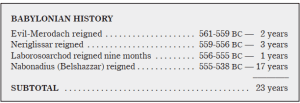
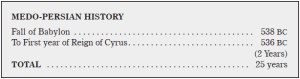
It does not appear that any “chronological irregularities” of more than three years exist for this period among secular authorities.
Let us note the situation from the standpoint of reason, aside from the Scriptures; but we will show the Scriptural corroboration of the reasonable conclusions also. We find the Scriptures and secular authority agreeing with reference to the twenty-six year period from the overthrow of Zedekiah until the beginning of the reign of Evil-Merodach; then for the following link in the chain of chronology reaching to the beginning of the reign of Cyrus we find secular authority claiming this a period of 25 years, and then we reach the point on the stream of time where we are absolutely dependent upon history. Here we are confronted with the element of reason: Is it reasonable to say that such great discrepancy as 19 years for so brief a period exists between the sacred and secular chronology? that secular chronology is in error to such large extent? that in a period of 44 years a hiatus of 19 years occurs in history, of which men have absolutely no record, although they have apparently accounted for the period the same as for those preceding and succeeding? Considering the tendency of profane history to lengthen rather than to abridge ancient time periods, and the fact that we are so dependent upon the same at this juncture, is it reasonable, we inquire, to totally reject the testimony of men without endeavoring to make some explanation why such discrepancy exists, or without attempting to harmonize the Scripture chronology herewith? Is it consistent, in view of our dependence? Is there a hopeless conflict between the sacred and profane? We believe not.
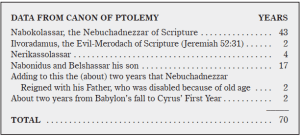
Let us face the proposition from another angle: The Canon of Ptolemy, which established the first year of the reign of Cyrus as BC 536, has also established various dates back to Nebuchadnezzar as follows
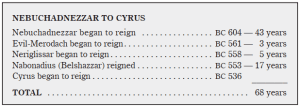
Now, if Jeremiah’s seventy years began with the overthrow of Zedekiah, the date of the beginning of Nebuchadnezzar’s reign would be BC 625, a difference of 21 years from the above. A difference of only two or three years for such a period might be allowable from the standpoint of reason; but in view of our acceptance of and dependence upon the Canon with reference to the BC 536 date, is it reasonable or consistent to reject its authority as to the BC 604 date, to the extent of 21 years, when a period of only 70 years is involved? Would not such situation suggest the need of making a very thorough and honest examination of all Scripture texts bearing thereupon with the hope of finding some reasonable and satisfactory solution?
Important Eras Thus Marked
It has been deemed important to go exhaustively into the subject as has been done foregoing that all the facts and evidences might be seen showing that but 70 years passed between the time when Nebuchadnezzar was given his universal rule in the first year of his reign and 536 BC; for this point stands most closely related to the great question of the beginning and ending of the times of the Gentiles. We believe the conclusion is well established thus far that the lease of power to the Gentiles began in Nebuchadnezzar’s first year instead of his nine-teenth; that the 70 years of Judah’s servitude began at the same time; that the Bible makes the 70 years of servitude to Babylon to be the length of time that the Babylonian kingdom, according to Divine decree, was given dominion.
If, as we believe the evidence herein given proves, there was but 70 years from the time Nebuchadnezzar ascended the throne of Babylon to 536 BC, then 606 BC marks the beginning of Nebuchadnezzar’s reign, and 19 years later, or 588 BC, Zedekiah was overthrown, because we read:
“Zedekiah reigned eleven years in Jerusalem and it came to pass in the ninth year of his reign, in the tenth month, in the tenth day of the month, that Nebuchadnezzar, king of Babylon, came, he and all his army, against Jerusalem, and pitched against it, and built forts against it round about. So the city was besieged unto the eleventh year of king Zedekiah. And in the fourth month … the city was broken up. Then he [the king of Babylon] put out the eyes of Zedekiah; and the king of Babylon bound him in chains Now in the fifth month, in the tenth day of the month, which was the nineteenth year of Nebuchadnezzar, king of Babylon, came Nebuzaradan captain of the guard … and burned the house of the Lord, and the king’s house; and all the houses of Jerusalem, and all the houses of the great men, burned he with fire” (Jeremiah 52:1,4,5,6,11,12,13).
Is it not manifest from the sacred record that the fourth and fifth months of Nebuchadnezzar’s nineteenth year, when Zedekiah was overthrown and the city destroyed, would be approximately the summertime of the year 588 BC?¹ The tenth month of the ninth year of Zedekiah’s reign (verse 4) would be approximately a year and six months prior thereto, or January, 589 BC, when Nebuchadnezzar made his final great assault upon Palestine and Jerusalem, causing general cessation of agricultural pursuits, thus marking the beginning of the 70 years of desolation and sabbath-keeping, as we shall see more clearly further on in this discussion.
Now with regard to the prophetic “seven times,” if they are to be understood to represent 2520 years (and we believe they are), and if these years represent the length of the Divine decree giving a lease of power to the Gentiles (this we also think is true) — then sure enough the 2520 years ran out in 1914 AD, and that year marked the end of the lease of power, but not necessarily the full end of the exercise of power, nor the complete fall of the Gentile governments, even as the kingdom of Israel did not fall and was not overthrown in the final and absolute sense until Zedekiah, a vassal king under Nebuchadnezzar, was taken captive nineteen years after the period of servitude began.
Logical Deductions
Stating our conclusions up to this point in another way, the sum of the matter is as follows:
Whereas we have heretofore understood that Zedekiah’s overthrow took place in 606 BC, we now find that to be erroneous, for it was but 606 BC, nineteen years prior to his overthrow, when Nebuchadnezzar in the first year of his reign began the exercise of his world dominion and commenced the period of the servitude of the Jews. Accordingly it was 588 BC when Zedekiah was taken captive, and not 606 BC, and hence while the 2520 years’ lease of Gentile power, starting in Nebuchadnezzar’s first year, 606 BC, would run out in 1914, yet the full end of the Gentile times and the complete fall of Gentile governments is not indicated as taking place till nineteen years later, or about 1933-1934. For if the downfall and destruction of Jerusalem and its temple in Zedekiah’s eleventh year (which was nineteen years later than the Divine decree of the lease of power) be regarded as marking the full establishment of the Gentile dominion, which is a logical deduction, then the parallel event, the downfall of Christendom, could not occur until nineteen years later than 1914, which would be about 1934. In other words, the seven times or 2520 years counting from Zedekiah’s fall and the fall of Jerusalem would end approximately in 1934: 587 BC + 1933 AD = 2520.
Let none misunderstand us; we are not prophesying — we are predicting nothing. We are calling attention to the facts as to the two points of time that stand out in much prominence in the starting and full establishment of Gentile times or Gentile dominion, namely, 606 BC, when the lease of power was given to Nebuchadnezzar, and 588 BC which marked the complete removal of the Jewish kingdom. The reasonable deduction is that the great changes and events which we have heretofore expected to take place in 1914 would, in view of the foregoing, be logically expected to be in evidence somewhere around 1934.
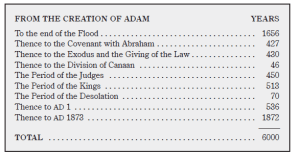
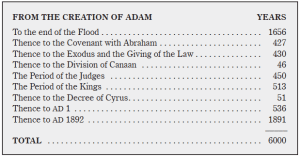
Another item that becomes evident is this: In fixing the 606 BC date in Nebuchadnezzar’s first year and King Jehoiakim’s third year, instead of at Zedekiah’s overthrow, nineteen years later, we are compelled to subtract 19 years from the period of the kings in computing the 6,000 years from Adam. In other words, we have in the past been saying that the period of the kings was 513 years and then we added 70 years of servitude on to that, which we said extended to 536 BC. This we believe is incorrect, for we must go back into the period of the kings nineteen years to begin the 70 years of servitude; thus there is a lapping over of 19 years, which leaves but 51 years between the end of the period of the kings and 536 BC, instead of 70. Note the accompanying diagram.
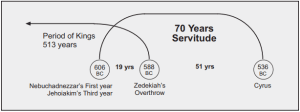
Thus it is seen that in computing the various periods of the past to make up 6000 years of human history we are short 19 years of the results we have here- tofore regarded as correct; that instead of 1872 marking the end of 6000 years of the world’s history, we must look at least 19 years beyond 1872 to locate the end of 6000 years, provided all the other periods of the chronology are correct. The chronological table therefore stands as follows.
Testimony of Secular History
Though we are not relying upon secular history in establishing the various points of this investigation, it is most interesting to observe that secular authorities have fully accounted for the time from Nebuchadnezzar to Cyrus, giving the names and lengths of reigns of the intermediate rulers, even accounting for one of them by number of months; yea, and have given all the principal events of those reigns with their respective dates, and are practically unanimous in their testimony as to its length — all in general accord with what we are presenting from the Scriptures. Note the following table from the Canon of Ptolemy:
Nor is it fair or reasonable to attempt to discredit and sweep away all the testimony of secular history by saying that these dates furnished us of the reign of the kings of Babylon prior to 536 BC have come from Pagans and therefore is “Pagan” history and utterly worthless. Let such remember that if there is no reliance to be put in so-called Pagan history, then the date 536 BC, accepted by all students, is of no value, for we get it from the Pagans — not from Jews or Chris- tians. Then between 36 BC and 1 AD there are several other important dates accepted by all scholars that we get from “Pagan” history. With the end of the first century AD all sacred history ends, and for the following eighteen centuries to the present time we depend largely upon “Pagan” history for our information.
Gibbon, one of the greatest historians, who wrote The Decline and Fall of the Roman Empire, must be classed amongst Pagans, for he was neither a Jew nor a Christian believer; but no one for a moment would think of questioning the reliability and truthfulness of this historian. It does not require a divinely inspired writer to write history, but merely a measure of intellect and integrity. Therefore, those who would refuse to accept the records of secular history, should produce the proof and evidence that it is not valid or authentic. We are interested in this connection in noting what Brother Russell said on the subject of “Pagan” chronology:
“The period from the time of the restoration of the Jews from Babylon, at the close of the 70 years desolation of their land, in the first year of Cyrus, down to the date known as AD 1, is not covered by Bible history. But, as before stated, it is well established by secular history as a period of 536 years. Ptolemy, a learned Greek-Egyptian, a geometer and astronomer, has well established these figures. They are generally accepted by scholars, and known as Ptolemy’s Canon.”
Again in setting forth the point where he regarded secular or so-called Pagan history as being reliable, he said:
“As with history, so with dates: the world has, aside from the Bible, no means of tracing its chronology farther back than BC 776. On this subject we quote Prof. Fisher, of Yale College. He says: ‘An exact method of establishing dates was slowly reached. The invention of eras was indispensable to this end. The earliest definite time for the dating of events was established in Babylon — the era of Nabonassar, 747 BC. The Greeks (from about 300 BC) dated events from the first recorded victory at the Olympic games, 776 BC. These games occurred every fourth year. Each Olympiad was thus a period of four years. The Romans, although not for some centuries after the founding of Rome, dated from that event, i.e., from 753 BC.’ ”
The Seventy Years Desolation and Sabbath-Keeping a Different Word
“To fulfil the word of the Lord by the month of Jeremiah, until the land had enjoyed her sabbaths: for as long as she lay desolate she kept sabbath, to fulfil threescore and ten years” (2 Chronicles 36:21).
The purpose of this phase in our investigation is to set forth the Scripture testimony showing that the 70 years of desolation and sabbath-keeping was an entirely separate era from that of the 70 years of servitude that has been described foregoing though according to former reckoning they were regarded as one and the same period. Because the same prophecies in Jeremiah speak of a period of desolation of the land and also bondage and servitude to the kingdom of Babylon, they were understood to refer to one and the same time; whereas, the evidence before us now is that there were two 70-year periods, having separate beginnings and endings.
Thus some who reckon the period of servitude to the kingdom of Babylon and the period of desolation and sabbath-keeping as being all the same period, logically raise the objection to commencing this 70 years in Nebuchadnezzar’s first year; for it is urged that we would be including in that period the 19 years before Zedekiah’s overthrow and Jerusalem’s destruction during which the land was not desolate and was still filled with inhabitants, whereas Jeremiah’s prophecy had said that the land should be desolate without an inhabitant (Jeremiah 26:9). Is not this a vital and most serious objection? We reply that we think this objection is entirely eliminated when we consider all the facts. The sum of the matter is Jeremiah’s prophecy does not state that the land will remain desolate without an inhabitant 70 years. Even if we calculate that the seventy-year period began at Zedekiah’s overthrow and extended to 536 BC, it is impossible to find 70 years of desolation of the land without an inhabitant from that point forward. For the desolation of the land, without an inhabitant, did not occur at the destruction of Jerusalem and the Jewish temple in Zedekiah’s eleventh year, which was Nebuchadnezzar’s nineteenth. In proof of this we refer to the Scriptures, and read:
“Now in the fifth month, in the tenth day of the month, which was the nineteenth year of Nebuchadnezzar … came Nebuzaradan and burned the house of the Lord, and the king’s house; and all the houses of Jerusalem, and all the houses of the great men, burned he with fire But Nebuzaradan left certain of the poor of the land for vinedressers, and for husbandmen” (Jeremiah 52:12,16).
As showing that about four years after this event there were still numbers of people in the land, we quote another statement of Scripture:
“In the three and twentieth year of Nebuchadnezzar, Nebuzaradan, the captain of the guard, carried away captive of the Jews seven hundred forty and five persons” (Jeremiah 52:30).
Desolate “Without an Inhabitant”
It does not appear that any statement occurs in the Scriptures to the effect that the land would be desolate, “without an inhabitant” (Jeremiah 9:11) for seventy years. We know that there were people in the land five years after the destruction of Jerusalem, and that there were people in the land for a while prior to the return of the Jews in the days of Cyrus (Ezra 3:3, 4:4); so that, although there was doubtless a period in which the land was “without an inhabitant,” that period cannot be shown to be seventy years. In this connection attention is invited to Ezekiel 29:10-13:
“I will make the land of Egypt utterly waste and desolate, from the tower of Syene even unto the border of Ethiopia. No foot of man shall pass through it, nor foot of beast shall pass through it, neither shall it be inhabited forty years. And I will make the land of Egypt desolate in the midst of the countries that are desolate, and her cities among the cities that are laid waste shall be desolate forty years; and I will scatter the Egyptians among the nations, and will disperse them through the countries. Yet thus saith the Lord God; at the end of forty years will I gather the Egyptians from the people whither they were scattered.”
These words uttered by the Prophet Ezekiel about the close of Zedekiah’s reign furnish a most positive and direct statement that the land of Egypt would be desolated without an inhabitant forty years. No such positive, direct statement is made concerning the land of Israel in connection with the seventy years, and yet the Lord could have stated it just as positively if it was to be so. It seems probable that it was about five years after the dethronement of Zedekiah that this forty years of the desolation of Egypt began to run. Counting the period from Zedekiah’s overthrow until Cyrus as fifty-one years, this would indicate that people began to settle in the desolated countries, including the land of Palestine, about six years before the decree of Cyrus (see Ezra 4:4 and 9:1, noting that in the latter text the Egyptians are mentioned), and that the time during which the land of Canaan was “desolate without an inhabitant” was likewise a period of forty years, though no doubt the Jews were entirely removed from the land for about forty-six years. Otherwise, if the land of promise was “desolate without an inhabitant” for seventy years, it was given thirty years more of such desolation than the land of Egypt, whereas it appears that it was Jehovah’s intention to give “all these nations” about the same kind of treatment by the hand of Nebuchadnezzar, His servant, as indicated by Ezekiel 29:12.
Now, if the 70 years of desolations do not have reference to the land being all that time without an inhabitant, the inquiry is proper and to the point, What does it refer to? A careful scrutiny of the Scriptures that have special reference to the “desolations” will discover that it has especially to do with the cessation of sowing and reaping; in other words, the cessation of agricultural pursuits until the divinely appointed time for the land to enjoy her Sabbaths had ended. One of the several ordinances enjoined upon the Jewish people was that every seventh year, as well as every fiftieth year, the land was to lie fallow, and it was in relation to this neglect to observe this ordinance that the era of desolations was decreed (Leviticus 25). In proof of the fact that this is what is meant we quote a passage in 2 Chronicles, which passage is preceded by a description in general of Nebuchadnezzar’s invasion of the land in his seventeenth year, which culminated in the siege of the city of Jerusalem, which siege lasted until his nineteenth year, when the city and temple were captured and destroyed. The Scripture referred to reads:
“And them that had escaped from the sword carried he away to Babylon; where they were servants to him [Nebuchadnezzar] and his sons until the reign of the kingdom of Persia; to fulfil the word of the Lord by the mouth of Jeremiah, until the land had enjoyed her sabbaths; for as long as she lay desolate she kept sabbath, to fulfil threescore and ten years” (2 Chronicles 36:20,21).
Desolation of the Land and Captivities Additional Punishment to that of Servitude
Let it be kept in mind that these words do not describe the beginning of the 70 years of servitude or vassalage, because this era began seventeen years before, in 606, and ended with Cyrus in 536 BC, as we have shown. This Scripture, it is very apparent, describes or refers to the 70 years of sabbath-keeping of the land; and it is most reasonable to think that this could not begin until the whole land was desolated, by the invasion of an army. That this judgment-desolation began to count with Nebuchadnezzar’s laying siege to Jerusalem in Zedekiah’s ninth year several Scripture statements very plainly declare, each statement giving the year, month, and day that it occurred. As we quote these Scriptures let the reader keep in mind when examining them that this desolation of the land was a Divine judgment which came upon the people of the land because of a failure to obey the Divine decree made seventeen years before. In proof of this we refer to Jeremiah’s prophecy found in the 27th chapter. The Prophet is rehearsing the Divine decree given to him in the beginning of Jehoiakim’s reign, seventeen years before Nebuchadnezzar laid siege to Jerusalem, 589 BC, which decree Jehoiakim had disobeyed and as a result incurred the judgment threatened, meeting finally a disgraceful death and burial (Jeremiah 22:18,19). In the Scripture we now quote, Jeremiah is calling Zedekiah’s attention to this Divine decree, for he was disobeying it at the time. We read his words:
“The nations that bring their neck under the yoke of the king of Babylon, and serve him, those will I let remain still in their own land, saith the Lord; and they shall till it, and dwell therein. I spake also to Zedekiah, king of Judah, according to all these words, saying, Bring your necks under the yoke of the king of Babylon, and serve him and his people, and live. Why will ye die, thou and thy people, by the sword, by the famine, and by the pestilence, as the Lord hath spoken against the nation that will not serve the king of Babylon? There- fore hearken not unto the words of the [false] prophets that speak unto you, saying, Ye shall not serve the king of Babylon; for they prophesy a lie unto you. For I have not sent them, saith the Lord, yet they prophesy a lie in My name; that I might drive you out, and that ye might perish, ye, and the prophets that prophesy unto you” (Jeremiah 27:11-15).
Beginning and Ending of Seventy-Year Sabbaths
From the foregoing Scripture it will be seen that that which was involved in the judgment-desolaion was not so much that of a ruined city and temple, but rather a land laid desolate by the terrible scourge of an invading army, the effects of which would be followed by famine and pestilence, the continuing evidences of the Lord’s displeasure. It is quite plain, therefore, that the true beginning of this desolating judgment is not the capture of Jerusalem in Zedekiah’s eleventh year, and Nebuchadnezzar’s nineteenth year, but rather the invasion of Judea just previous to his investiture or siege of the city. It will be apparent that from the time Nebuchadnezzar’s armies entered the land, all agricultural pursuits ceased, were suspended, and therefore the desolation may be reckoned from the day the capital city, Jerusalem, was invested, namely the tenth day of the tenth month (Tebeth) in the ninth year of Zedekiah, 589 BC. In proof that this was the time, we quote:
“And it came to pass in the ninth year of his reign [that is, Zedekiah’s, see 2 Kings 24:20], in the tenth month, in the tenth day of the month, that Nebuchadnezzar, king of Babylon, came, he, and all his host, against Jerusalem, and pitched against it and they built forts against it round about. And the city was besieged unto the eleventh year of King Zedekiah.”
The Jewish year commencing in the spring about April, the tenth month would correspond to our January. This would mean that it was early in the year, about January 589 BC, that the siege against Jerusalem was started. A very significant thing as establishing this date as the proper time for beginning the judgment-desolation is the fact that the Prophet Ezekiel, who was in exile, a captive in Babylon at the time this siege of Jerusalem began, was informed by the Lord concerning the solemn importance that this day would have after in Jewish history. Note his words:
“Again in the ninth year [of Zedekiah], in the tenth month, in the tenth day of the month, the word of the Lord came unto me, saying, Son of man, write thee the name of the day, even of this same day: the king of Babylon set himself against Jerusalem this same day” (Ezekiel 24:1,2).
The further significance of this day as showing its sad importance on the Jewish mind is seen in the fact that for over 2500 years since, it has been observed as a fast day, as will be seen by consulting a Jewish Almanac of Feasts and Fasts (see “New York World Almanac”).
And now before citing those Scriptures that plainly declare when this desolation in which the land enjoyed her sabbaths to fulfil 70 years ended, we call attention to the fact that the seventy-year desolations and sabbath keeping did not cease in the first year of Cyrus in 536 BC, because only about 52-53 years had elapsed since 589 BC, when the era of seventy-year sabbath- keeping began.
The decree of Cyrus was the Divine fulfilment of the promise made to those of the captivity recorded in Jeremiah 29th chapter, and, as will be noted by the decree itself, granted all the captives in Babylon the fullest possible liberty to return to the land of Palestine. However, not until the seventy-year era of the desolations had run its full course, was there any success achieved in building the temple. The returned captives commenced to build (Ezra 3:10), but the work was immediately stopped by the adversaries of Judah, as we read:
“Now when the adversaries of Judah and Benjamin heard that the children of the captivity builded [started to lay the foundation] the temple unto the Lord God of Israel then they came to Zerubbabel, and the chief of the fathers, and said unto them, Let us build with you: … but Zerubbabel, and Jeshua, and the rest of the chief of the fathers of Israel said unto them, Ye have nothing to do with us to build an house unto our God but we ourselves together will build unto the Lord God of Israel, as king Cyrus the king of Persia hath commanded us. Then the people of the land weakened the hands of the people of Judah, and troubled them in building, and hired counselors against them, to frustrate their purpose, all the days of Cyrus king of Persia, even until the reign of Darius king of Persia” (Ezra 4:1-5).
In the verses following in this same chapter we read that these same adversaries succeeded in getting a decree from Artaxerxes, one of Cyrus’ successors, against the work of building the temple (see Ezra 4:7-24), and this continued to hold back the building until Zerubbabel succeeded in securing another decree from Darius, Artaxerxes’ successor, and the work was resumed again under the encouraging exhortations of the Prophets Haggai and Zechariah, divinely called for this service. One writer has thus commented on this cessation of the work in Cyrus’ day:
“Till the era of ‘desolations’ had run their course not one stone was to be set upon another on Mount Moriah. And this explains the seemingly inexplicable fact that the firman [decree] to build the temple, granted to eager agents by Cyrus in the zenith of his power, remained in abeyance till his death: for a few refractory Samaritans were allowed to thwart the execution of this, the most solemn edict in respect of which a Divine sanction seemed to confirm the unalterable will of a Medo-Persian king” (The Coming Prince).
Evidence Marking End of the 70 Sabbaths
As showing that the desolations had continued and the Lord’s blessing was withheld up to that time (519 BC), and the work of laying the foundation of the temple was then resumed by the Lord’s command, we quote from Haggai the Prophet:
“In the second year of Darius the king, in the sixth month, in the first day of the month, came the word of the Lord by Haggai the Prophet unto Zerubbabel, the son of Shealtiel, governor of Judah, and to Joshua, the son of Josedech, the high priest, saying,
“Thus speaketh the Lord of hosts, saying, This people say, The time is not come, the time that the Lord’s house should be built. Then came the word of the Lord by Haggai the Prophet, saying, Is it time for you, O ye, to dwell in your cieled houses, and this house lie waste? Now therefore thus saith the Lord of hosts; Consider your ways [set your heart on your ways — marginal reading]. Ye have sown much, and bring in little; ye eat, but ye have not enough; ye drink, but ye are not filled with drink; ye clothe you, but there is none warm; and he that earneth wages earneth wages to put into a bag with holes.
“Thus saith the Lord of hosts; Consider your ways. Go up to the mountain, and bring wood, and build the house; and I will take pleasure in it, and I will be glorified, saith the Lord. Ye looked for much, and, lo, it came to little; and when ye brought it home, I did blow upon it. Why? saith the Lord of hosts. Because of Mine house that is waste, and ye run every man unto his own house. Therefore the heaven over you is stayed from dew, and the earth is stayed from her fruit. And I called for a drought upon the land, and upon the mountains, and upon the corn, and upon the new wine, and upon the oil, and upon that which the ground bringeth forth, and upon men, and upon cattle, and upon all the labor of the hands” (Haggai 1:1-11).
This shows that from the days of Cyrus, sixteen years before, the Lord had withheld His blessing; and does it not also plainly show that it was because of the wrong condition of heart on the part of the people that the Lord withheld His blessing as He said He would do in the beginning of their history, as we read:
“Thou shalt carry much seed out into the field, and shalt gather but little in for the locust shall consume it. Thou shalt plant vineyards, and dress them, but shalt neither drink of the wine, nor gather the grapes for the worms shall eat them. Thou shalt have olive trees throughout all thy coasts, but thou shalt not anoint thyself with the oil; for thine olive shalt cast his fruit” (Deuteronomy 28:38,39).
We now quote the words of the Prophet which plainly show that the special indignation of the Lord, which started with the desolation of the land in Nebuchadnezzar’s seventeenth year when he laid siege to Jerusalem, and which was to continue full seventy years, did not cease until early in the year 519 BC. The words were uttered in connection with a vision given to Zechariah in the second year of Darius, in the four and twentieth day of the eleventh month, the month Sebat; a vision in which the Lord declared the seventy years of indignation had then and only then ceased.
“Then the angel of the Lord answered and said, O Lord of hosts, how long wilt Thou not have mercy on Jerusalem and on the cities of Judah, against which Thou hast had indignation these threescore and ten years? And the Lord answered the angel that talked with me with good words … Therefore thus saith the Lord; I am returned to Jerusalem with mercies; My house shall be built in it” (Zechariah 1:7,12,16).
It being a well established fact that Darius’ second year was 520 BC, his first year would be 521 BC, commencing about April (the first month, Nisan). The eleventh month (Sebat), of his second year would therefore be February, 519 BC, when this statement was uttered, the 70 years desolation or sabbath-keeping having ended less than two months previous, in the ninth month, Chisleu, or December 520 BC.
“From This Day Forward”
What further proof do we need that the seventy years of desolating indignation did not cease until the close of 520 BC, seventeen years after the 70 years of servitude had ceased? We now give the word of the Lord in which the exact month and day of the month is given, when the desolation did cease and the land began to receive the Lord’s blessing by beginning to be fruitful. The words are from the Prophet Haggai:
“And now, I pray you, consider from this day and upward [onward], from before a stone was laid upon a stone in the temple of the Lord … I smote you with blasting and with mildew and with hail in all the labors of your hands yet ye turned not to Me, saith the Lord.
“Consider now from this day and upward [onward], from the four and twentieth day of the ninth month [Chisleu], even from the day that the foundation of the Lord’s temple was laid, consider it. Is the seed yet in the barn? yea, as yet the vine, and the fig tree, and the pomegranate, and the olive tree, hath not brought forth; from this day will I bless you” (Haggai 2:15-19).
This Scripture states that the Lord promises His people through Haggai that from the day that they gave heed to the Prophet’s words, and commenced in earnest the work of restoring the temple, which had been over fourteen years hindered (which was doubtless of the Lord, because of their wrong heart condition) by “the adversaries of Judah” (Ezra 4), God’s blessing would come upon them, the defective harvests would cease, and the year of drought and famine come to an end.
This was in the second year of Darius II, the four and twentieth day of the ninth month, Chisleu. The desolation had ended. Now note carefully, from the tenth day of Tebeth (January), 589 BC, which as we have shown was the very day that Nebuchadnezzar’s armies had desolated the land and caused all agricultural pursuits to cease, and the siege of Jerusalem began — the day that was mentioned by the Lord to Ezekiel as a sad day to be remembered (Ezekiel 24:1,2); the day which has been observed as a fast day by the Jews ever since— to the twenty-fourth of the ninth month, Chisleu (December), 520 BC, was exactly 70 years, fulfilling the Divine prediction of 70 years of desolation or sabbath-keeping.
Finally let us hear again the words of the revealing angel of Zechariah’s vision, confirming the foregoing: “O Lord of hosts, how long wilt Thou not have mercy on Jerusalem and on the cities of Judah, against which Thou hast had indignation these threescore and ten years?” and we listen with wonder to the voice of the Lord in reply: “I am returned to Jerusalem with mercies: My house shall be built in it.” The seventy years of desolation had ceased at the appointed time! The Lord’s people had at last given heed to His words, and returned to Him with all their heart; therefore the Lord would again take up His abode in His holy temple! The blessing of the Lord, however, began, as we have seen from the Scriptures, in the second year of Darius Hystaspes, the 24th day of the month Chisleu (December), in the year 520 BC.
“Unto the Reign of the Kingdom of Persia”
Now, let us look again at the statement made in 2 Chronicles 36:20,21:
“And them that had escaped from the sword carried he away to Babylon: where they were servants to him [Nebuchadnezzar] and his sons until the reign of the kingdom of Persia: to fulfil the word of the Lord by the mouth of Jeremiah, until the land had enjoyed her sabbaths: for as long as she lay desolate she kept sabbath, to fulfil threescore and ten years.”
Again we ask, What word of Jeremiah was fulfilled by the carrying away of Israel to Babylon and making them servants to Nebuchadnezzar? The answer is that it was those prophecies of Jeremiah that we have already considered above, found in Jeremiah 29:10 and 25:11,12. And what did those prophecies say? We reply, that Jeremiah, as the Lord’s mouthpiece, had said that Israel, amongst other nations, was to serve the king of Babylon seventy years. And when did the seventy years commence? As we have just pointed out, the seventy years of this servitude or captivity commenced in Nebuchadnezzar’s first year and in king Jehoiakim’s third year, which was about nineteen years before Zedekiah’s overthrow and the destruction of Jerusalem. This statement in 2 Chronicles 36 is therefore telling us that the various captivities of Israel, commencing with the first siege against Jerusalem, when Daniel and his associates were taken, all happened or were brought to pass in fulfilment of Jeremiah’s words which had predicted those captivities; for he had declared that they would serve the kingdom of Babylon, which kingdom would reach unto the reign of the kingdom of Persia.
But does not 2 Chronicles 36:20,21 mean that the seventy years of desolation or sabbath- keeping also ended at the beginning of the reign of the kingdom of Persia; and since these years of desolation or sabbath-keeping did not begin till near the time of Zedekiah’s overthrow, would not this prove that there were seventy years from the capture of Zedekiah to the reign of the kingdom of Persia? Our answer is that this expression in 2 Chronicles with regard to the sabbath- keeping must be interpreted in harmony with what we have found to be the facts; and since, as we have presented foregoing, the evidences are that the desolating indignation, wherein the land enjoyed her sabbaths, continued some seventeen years beyond 536, we cannot conclude otherwise than that at the beginning of the reign of the kingdom of Persia, the seventy sabbaths or desolation period had only partly been fulfilled. So far as the seventy years of servitude and bondage are concerned, the words by the mouth of Jeremiah had been fulfilled at the beginning of the reign of the kingdom of Persia. It is merely the sabbath feature that ran on for some seventeen years later. Thus, it could very properly be said that the various captivities were permitted of the Lord for the purpose of fulfilling Jeremiah’s prophecy; for indeed it was these various captivities that finally brought about the desolation and prolonged it until 536 BC, and then on, as we have shown, to approximately 520 BC, when the Lord blessed the building of the temple and prospered their land so that it brought forth as in the former times, and thus ended the desolation or non-producing condition.
In consideration of the foregoing testimony of the Scriptures it seems plainly evident that Jeremiah’s statement about the land being desolate 70 years cannot refer to the 70 years of servitude, which began in the first year of Nebuchadnezzar’s reign, but must be reckoned from another point. In other words, there is entire harmony on this subject of these two periods — the 70 years of servitude or bondage to the kingdom of Babylon beginning 606 BC, and ending 536 BC, the first year of Cyrus; and the 70 years of desolation or sabbath-keeping of the land, starting January, 589 BC, when Nebuchadnezzar besieged Jerusalem and stopped all agricultural pursuits, thus making the land desolate, and extending to near the close of 520 BC, the second year of Darius Hystaspes, at which time all embargo was removed and the Lord plainly declared that from that time forward He would bless the land and the building of the temple.
The following diagram is designed to illustrate the two periods, their beginnings, and endings, in accordance with the testimony offered foregoing:
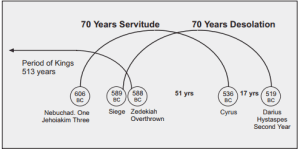
The “Seven Times” and the Times of the Gentiles
Concluding at this point the general review of the two 70-year periods, their beginnings and endings, as well as their significance, it falls in proper order here to call to mind again the 2520 years or “times of the Gentiles,” as this period stands related to the two 70-year eras. It is remembered that the period of “seven times” is mentioned twice in the Scriptures: first, in the book of Daniel, where it is applied to Nebuchadnezzar; and second, in the book of Leviticus, where it is applied to the nation of Israel. In connection with Nebuchadnezzar the statement is made: “Let seven times pass over him” (Daniel 4:16). Inasmuch as Nebuchadnezzar attained universal dominion at the very beginning of his reign, and is continually spoken of from that time as Jehovah’s servant (Jeremiah 25:9, 27:6, Daniel 2:37,38), it seems very appropriate to commence the seven times which were to pass over him who was the head of the Gentile dominion from the time he became the head of the image, which was at the very beginning of his great- ness. Accepting BC 588 as the date of Zedekiah’s overthrow, this would place the beginning of Nebuchadnezzar’s kingdom in the autumn of BC 607, or nominally BC 606. Twenty-five hundred and twenty years from that date would terminate in 1914. Therefore, we should expect some event in 1914 as marking a change in the Gentile governments of the world, or something that would materially affect them. We are all witness of the fact that with that date the world as it had been running along for quite a while took on a sudden change, and that since that time the great transition period, the epoch of change, has been in process, during which the Kingdom of our Lord will be established in the earth. The “strong man” is being bound and dispossessed and the rightful owner is coming in.
Seven Times Also Upon Fleshly Israel
But there was a period of “seven times” in connection with the children of Israel, a period of chastisement, which began with the overthrow of the typical crown and kingdom under Zedekiah, during which “Jerusalem” was to be trodden down of the Gentiles, and at the close of which we should expect that Jerusalem will arise from the dust of centuries, and the kingdom be fully restored to Israel (Acts 1:6). There is strong evidence that the Gentile times began to be fulfilled, as has been noted, in the fall of 1914, and that 2520 years from 588 BC, namely in 1933- 1934, the seven times pronounced upon the children of Israel would fully run out. Just as the Jews began to be “trodden down of the Gentiles” by Nebuchadnezzar the first year of his reign, 606 BC, and were fully trodden down 19 years later at the destruction of Jerusalem in 588, so the times of the Gentiles began to be fulfilled in 1914 and we would logically expect that 19 years later, 1933- 1934, would bring us to a very important era. In other words, the Gentile “seven times” indicates where the lease of power or right to rule expired, while the Jewish “seven times” indicates when the exercise of power or power to rule will cease. The two applications of the “seven times” are, therefore, tabulated as follows.
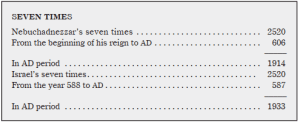
Isarel’s “Double” and the “Parallel Dispensations”
Another section of our chronological system is what has been designated as Israel’s “Double” and the “Parallel Dispensations.” The “double” has heretofore been understood as applying to two equal time periods of 1,845 years, the first measuring from the death of Jacob to the year 33 AD, and the other from that year to 1878 AD thus “folding” the two periods, as a book, upon the midway date of 33 AD. The “hinge” has been located as the day upon which Israel’s King rode into Jerusalem upon the ass five days prior to the crucifixion. On the first fold was written a record of God’s “favor” upon fleshly Israel for 1,845 years, while upon the last fold or page in this double entry ledger is indicated an equal period of “disfavor.” In connection with this “double” it has been concluded that the Jewish and Gospel Dispensations are of exactly the same length, and that certain dates within each era parallel one another.
It will be recalled that the presentation of this feature lays especial emphasis upon the fact that three different Prophets have mentioned the “double,” it being stated that this was, no doubt for the encouragement of the faith of God’s people at this time, and the further point is stressed that this “double” serves as a proof of the correctness of the application of other time prophecies.
The question properly arises, How does the 19 years’ discrepancy in connection with the times of the Gentiles affect or disarrange this feature? In seeking the answer we shall not attempt to force matters by wresting any Scripture or straining any point. It is to be acknowledged of course that finding a period of 19 years short in connection with the close of the period of the kings and the commencement of the 70 years of servitude, the result must be that the time from Jacob’s death to AD 33 is 19 years shorter than was supposed. According to the previous reckoning it was regarded as 1845 years in length. Now with the correction of 19 years that same time will not be found to be longer than 1826 years; and 1826 years onward from AD 33 takes us approximately to 1859 as being a double or equal period of time to that of the Jewish Age, and there is, of course, nothing whatever to mark that year in any such manner. A harmonization of the situation is seen we believe by looking further, and in recognizing from all the facts and circumstances that Israel’s period of favor extended beyond our Lord’s crucifixion, even to AD 70.
An Appointed Time
Let us observe now the exact Scriptural reference wherein the thought of Israel’s double or the parallel dispensations are intimated. The first Prophet to mention Israel’s “double” was Isaiah (40:1,2):
“Comfort ye, comfort ye My people, saith your God. Speak ye comfortably to Jerusalem, and cry into her that her warfare is accomplished, that her iniquity is pardoned; for she hath received of the Lord’s hand double for all her sins.”
We observe that this is a message of comfort to Jerusalem. Thus it is a matter that concerns fleshy Israel, for “Jerusalem” seems to always refer to the earthly phase of the kingdom, the heavenly phase being spoken of as the “New Jerusalem.” At a certain time the “warfare” of Jerusalem is accomplished. The marginal rendering makes it, “appointed time,” in lieu of “warfare.” With this thought in connection with the “double,” it will be seen that the double involves a definite, foreordained period of time — Jerusalem’s appointed time of warfare is accomplished (Hebrew: “filled out”), and thus she has experienced a certain “double” (Hebrew: “fold”) at the Lord’s hand. There can be no question, therefore, after carefully pondering this prophecy, that the “double” relates to a time period during which Jerusalem is punished for iniquity or sin.
The next prophecy with respect to the “double” is found in Jeremiah 16: 14-18:
“Therefore, behold, the days come, saith the Lord, that it shall no more be said, The Lord liveth that brought up the children of Israel out of the land of Egypt; but, The Lord liveth, that brought up the children of Israel from the land of the north, and from all the lands whither He had driven them; and I will bring them again into their land that I gave unto their fathers. Behold, I will send for many fishers, saith the Lord, and they shall fish them; and after will I send for many hunters, and they shall hunt them from every mountain, and from every hill, and out of the holes of the rocks. For Mine eyes are upon all their ways; they are not hid from My face, neither is their iniquity hid from Mine eyes. And first I will recompense their iniquity and their sin double.”
Here, again, the reference is plainly to fleshly Israel, whose sin and iniquity are not hid from the Lord, but who will bring them again into their own land from every place whither He has driven them. This is indeed a message of comfort for Jerusalem. But the Lord is careful to state that before they are returned to their own land they must experience a “double” on account of their iniquity and sin. The Hebrew word “mishneh” (a different word from the one used by Isaiah) which is here rendered “double” means “repetition.” The thought would be that Israel will experience an “appointed time” which would be a repetition, or duplicate period, of one preceding; and taking into consideration the word “kephel” used by Isaiah, which is translated “double,” meaning “fold,” it can be under- stood that the duplicate period follows immediately the preceding one, since it is as a “fold” upon it. The Prophet Jeremiah, therefore, fixed the end of the double, the “appointed time,” as when the Lord gathers Israel from all the lands whither He had driven the Jews. This could not have reference to deliveries preceding the First Advent, but must be applied to the wonderful regathering awaiting them at the time of the Second Advent.
Beginning of Israel’s Punishment
The end of the “double” being established by Jeremiah, we next consider the third prophetic utterance regarding this matter, in which the beginning of the appointed period is referred to (Zechariah 9:9-12).
“Rejoice greatly, O daughter of Zion; shout, O daughter of Jerusalem; behold thy King cometh unto thee; He is just, and having salvation; lowly, and riding upon an ass, and upon a colt, the foal of an ass, and I will cut off the chariot from Ephraim, and the horse from Jerusalem, and the battle bow shall he cut off; and He shall speak peace unto the heathen; and His dominion shall be from sea to sea, and from the river to the ends of the earth. As for thee also, by the blood of thy covenant I have sent forth thy prisoners out of the pit wherein is no water. Turn you to the stronghold ye prisoners of hope; even today do I declare that I will render double unto thee.”
This prophecy of Zechariah takes its stand at the time when Jesus, the King of the Jews, rode into Jerusalem upon the ass, which was on Sunday preceding his crucifixion. He presented himself as King to the Jewish nation. He was the stronghold. He wanted the prisoners to turn unto him for protection. “O Jerusalem, Jerusalem, that killest the prophets, and stonest them which are sent unto thee how often would I have gathered thy children together, even as a hen gathereth her chickens under her wings, and ye would not!” They would not turn unto the stronghold. Consequently, a declaration is made to the effect that “I will [still future] render double unto thee.” In fulfilment of this part of the prophecy, we note from the latter part of the 23rd chapter of Matthew that Jesus further said: “Behold, your house is left unto you desolate.” Because they refused to turn to the stronghold, to get under the wings, they would have a double, which Jesus interprets to mean that their “house” would be desolate. Notice further, that Jesus too speaks to Jerusalem. But Jesus also is prophesying, as the context of Matthew 23 will show, both preceding and following the statement that the Jewish house was left desolate, for He continues to say that “ye shall see Me no more until that day when ye shall say, Blessed is he that cometh in the name of the Lord.” The Jewish house, as a matter of fact, was not desolate on that very day, although it was full of corruption and iniquity. The desolation (utter ruin) was impending, for Jesus had just prophesied certain things to come upon the generation then living: “All these things shall come upon this generation.” Thus, the words, “is left unto you desolate,” must be understood to take a future standpoint (the immediate future in this case) as prophecy often does. We are not left to speculate that this is a prophecy pertaining to the future, because Jesus himself, further on, throws light upon the subject. The record of Luke embraces this prophecy in the 13th chapter. Then in Chapter 21, wherein is recorded the great prophecy of our Lord concerning the end of the Jewish and Gospel Ages, verse 20 reads: “And when ye shall see Jerusalem compassed with armies, then know that the desolation thereof is nigh.” In this way Jesus himself shows when the “double” was to begin. The “double” being identified with the desolation of the fleshly house is thus shown to begin immediately following the time when Jerusalem would be encompassed with armies. These armies were those of the Roman Empire, under Titus (previously under other leaders), which brought about the desolation of Jerusalem in the year 70. On this historic fact all seem to be in agreement as to the date.
Even Today I Declare
From this standpoint it can he appreciated that the “desolation” or the “double” did not begin on the day Jesus offered himself to Jerusalem as the stronghold, the king, but rather that it was on that day the “declaration” was made: “Even today do I declare (not “Even today I will”) that I will (future tense) render double unto thee.” Consider in this connection the words of Jesus a few days later upon the cross, spoken to the thief: “Verily I say unto thee today, thou shalt be with Me in paradise.” But the thief was not to go to paradise with the Lord on that day. It was merely that the fact was declared on that day. It seemed very unlikely that the Lord would ever be a king in paradise. From all outward appearances then, his declaration could never be realized. Contrast this occasion with that of only five days previous. Jesus is riding into Jerusalem and the multitude is hailing him as king. Then a little further on he says: “Your house is left unto you desolate — even today do I declare that I will render double unto thee.” Yet the kingdom seemed imminent. On the one occasion he in substance said: “On this dark day, when it seems that I have not a friend in the world, I say unto you that I will have a kingdom and that you will be with me there.” On the previous occasion: “This is a triumphal day; it seems that I am about to be a king, that the kingdom is to be restored to Israel, but I declare unto you nevertheless that I will render double unto you.” At about this time he cursed the fig tree and it withered away. But the “appointed time” will be accomplished and the fig tree will put forth leaves.
The Period of the “Double”
The double began with the desolating of the Jewish house in the year 70. It ends by the regathering of the Jewish house in Palestine. Our expectations heretofore were that in the year 1915 the Jewish house would be set up. We have found that the chronological reckoning upon which this was based was “off” to the extent of 19 years; that this event is not really due to take place until 19 years later than the year 1915, namely 1934. Is it not more reasonable to calculate that the “double” began in 70 AD, and will end in 1934, thus making it a period of 1864 years (1934 minus 70 equals 1864)? Here comes an important test: Since this is a “double” or “fold” and is also shown to be a “repetition” of a previous period, can it be shown that the first fold is also 1864 years in length. Measuring back 1864 years from 70 AD, brings us exactly to the death of Jacob, at which time the Jewish house was established, when Jehovah ceased to deal with certain individuals alone, but began to accept the whole family or house of Jacob as his chosen inheritance. The chronological table showing this first fold of 1864 years is as follows:
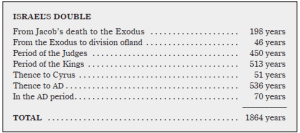
This presentation of the matter shows that the “double” does not relate so much to a period of “favor” or “disfavor” as it does to a time of national existence, when there is such thing as a Jewish house or polity, and then to a time when that house is desolated, utterly ruined, during which there is no Jewish nation. It involves a question of “Nationalism.” During the time preceding AD the Jews were often taken captive, but their nation was not destroyed until the year 70. It previously existed in some form or other from the days following the death of Jacob. At the time of the First Advent it was a subject nation, but since 70 AD it has not been a nation in any sense or degree. The Jewish people have been scattered to the four winds and there will be no Jewish nation again until the “double” is accomplished.
Parallel Ages
Nor is there any Scriptural evidence that the time of Israel’s national existence or the Law Dispensation must be exactly the same length as the period commencing AD 33 and reaching unto the end of this Age. The matter of the “double” should be confined to the limits wherein it has been placed by Scripture. It is manifest to all that many of us in the past have been disposed to make pictures and parallels of various items and incidents that were never intended to bear any such significance. Our safer course now seems manifest — to require a definite “thus saith the Lord” for our conclusions in this as well as in every other matter of spiritual truth.
What is there to be said about the parallels? How can it be shown that the Jewish and Gospel Ages are the same in length? It is believed that enough has already been set forth to show that this matter of the “double” is strictly a Jewish proposition, that it refers exclusively to “Jerusalem.” At least, that is the way the Scriptures present the matter, and there does not seem to be any Scriptural evidence to support the thought that the “double” has any bearing upon the history of the “New Jerusalem” or for supposing that what is known as the Gospel Age is exactly the same in duration of time as the so-called Jewish Age.
The Gospel Age, considered as beginning with the preaching of the Gospel at the First Advent, is longer than either the period of Israel’s national existence or the Law Dispensation. The Law Dispensation could not begin with the death of Jacob because the Law was not yet dispensed at that time. The Law was given by Moses, 198 years after the death of Jacob, and it ended with the cross of Christ. The period of the Law, therefore, was much shorter than the period of national existence.
Is This a Further Chronological Prediction?
It is found interesting in this connection to observe the suggestion that has been made with reference to Genesis 15:8,9 — that it is intended as a symbolical picture and is highly suggestive of a chronological prediction — the thought being that this picture given to Abraham indicates that it would be eleven symbolic years from the time that he entered Canaan until he would receive it for his inheritance. The suggestion contains the thought that these eleven years stand for 3,960 (11 times 360) literal years. The revision of the chronology herein presented preserves the force of the above suggestion in a manner that is entirely harmonious. Measuring these years upon our revised scale of chronology we have it thus: