
3:1 – “And unto the angel of the church in Sardis write; These things saith he that hath the seven Spirits of God, and the seven stars; I know thy works, that thou hast a name that thou livest, and art dead.”
“Sardis” was the short period which yet remained before the great Reformation of Luther’s day.
“Sardis is said to mean that which remains, as if it signified a useless remnant, something out of which life or virtue had gone. The nominal church during this period had the appearance of being what it was not, having a form of godliness without its power. Sardis was the remains of the true church, which had been driven into the wilderness; but when the persecution began to subside, her zeal also abated. Persecution has always developed the vigor of the church.
“Many today have the Sardis characteristics. To such there is a fatal warning in Rev. 3:3. Seven times our Lord’s second coming is described as being thief-like, stealthy. Only to those who are watching is the approach of a thief known. Those who are asleep will be awakened only after he has taken full possession, after his work of destruction has progressed. Although they may then arouse themselves, it is too late. They have been overtaken. Thus our Lord will be present, but invisible and unknown – except to the watchers – for some years after his arrival; and his presence will be recognized by the sleepers only as the noise of spoiling the strong man’s house gradually increases. Then slowly will they realize what it is and what the outcome will be.
“The reason why many Christians cannot recognize our Lord’s Parousia – presence – is that they are looking for a fleshly Christ, visible to the fleshly eye, and making an imposing demonstration which they cannot mistake. Failing to realize the fact that spiritual bodies cannot be seen by human eyes without a miracle, they cannot understand how he can be present while ‘all things continue as they were since the beginning of creation.’ (2 Pet. 3:3, 4) Thus they are unable to understand ‘the signs of the times,’ revealing his return.” (R5992:3)
Anent the Sardis Church
“Thyatira was specially commended for her works. (Rev. 2:19) Sardis for the opposite – ‘I have found no works of thine fulfilled before my God’ (R.V.)” (R491:6, W. I. Mann)
“‘I now thy works,’ said the Savior, addressing this Church of Sardis and its star or messenger. No particular evil is mentioned as existing in her midst, but if we are correct in applying the message prophetically to the period just prior to the great Reformation epoch, we may be sure that there was existing in this Church a combination of all those evils that we have found recorded in the other messages. The unequal yoking up with the world, the purely worldly spirit, so prevalent in the age represented by the Church of Pergamos, controlling in her councils; the wicked, corrupt teaching of that ‘woman Jezebel,’ together with her persecuting spirit, pictured by Thyatira, had reached the condition called by the Savior ‘the depths of Satan.’ The professing Church on earth had become wholly corrupt – indeed, ‘dead’, and this was the state of the visible Church in the period just prior to the great Reformation.” (The Revelation of Jesus Christ – Streeter, Vol. 1, p. 188)
The “angel” to the “Sardis” church we believe, was John Wycliffe, concerning whom we read:
“It was in 1378 A.D., the year of the ‘Great Schism of the West,’ when two popes were elected, one in Rome and the other in Avignon, that Wycliffe came out as the great Doctrinal Reformer. Workman, in Dawn of the Reformation, p.172, writes: ‘Wycliffe’s spiritual earnestness was shocked, his theory destroyed by the spectacle of two popes each claiming to be the sole head of the Church, each labelling the other as Antichrist. To Wycliffe, the year of the schism, 1378, was the critical year of his life. He first urged both popes should be set aside as having little in common with the Church of the Holy God. From this position of neutrality he quickly passed into one of antagonism to the Papacy itself.’
“In his Medieval Church History, Archbishop Trench says: ‘Gregory XI died on 27th March, 1378, and the Papal Schism broke out. The year 1378 marked the turning-point in Wycliffe’s career. Hitherto he had concerned himself with matters of mixed ecclesiastical and political import, but henceforth he devoted himself exclusively to doctrinal matters and came out as the Reformer. He began in earnest the translation of the Bible into English, and took the next decisive step by an open attack, forced upon him by his studies of the Bible, against Transubstantiation. The effect was immediate. The University itself turned against him. He was forbidden to teach. Ever afterwards he did, in nearly all his writings introduce in some way a statement of his view upon Transubstantiation.’
“Wycliffe thus attached the very bulwark of Antichirst’s stronghold, for the gross and blasphemous doctrine of Transubstantiation, or the sacrifice of the Mass, annuls the true sacrifice of Jesus Christ. Because of this setting aside of Christ’s ‘continual sacrifice’ by its substitution of the false sacrifice of the Mass, the Papal system became in God’s sight the ‘Desolating Abomination.’ (Dan. 11:31 – See C99-104)” (Great Pyramid Passages – Edgar, Vol. II, p. 187)
John Wycliffe
“John Wycliffe (1320-1384) became the leader of a strong reform movement that spread over England and certain parts of the Continent. This movement contended that the reform must aim, not merely at correction of outward corruptions of the Church, but also at the removal of the hidden causes. The movement addressed itself to the people rather than to the learned, the reformers, Wycliffe and Hus, proclaiming the Biblical doctrine of justification by faith in the crucified Savior. The Bible was acknowledged as the only source of truth. Emphasis was placed on the invisible Church at the expense of the visible Christian community. The pope was not believed infallible, and his bulls and decrees had no authority except as they were based on Scripture. The clergy were not to rule but to serve and help their people. Wycliffe declared the pope to be Antichrist. He declared that the bread and wine in the Lord’s Supper were not changed into the body and blood of Christ. He gave England the first complete version of the Bible in the English language … He also sent out lay evangelists to instruct the people. Wycliffe was condemned by Pope Gregory XI in 1377, but the English Parliament protected him. He retired to his parish at Lutterworth where he died … in 1401 heresy was made a capital offence in England, and the mere possession of Wycliffe’s writings was punishable by death. Wyclifism was suppressed by force.” (A History of the Christian Church – Qualben, p. 193)
“The Council of Constance (May 5, 1415) condemned his doctrines, and in 1428 his remains were dug up and burned; the ashes were cast into the adjoining river Swift, which as Fuller prosaically, and Wordsworth poetically, remark, conveyed them through the Avon and the Severn into the sea, and thus disseminated them over the world.” (McClintock & Strong’s Encyclopedia, Vol. 10, p. 1043)
“These things saith he that hath the seven spirits of God.” Thus, does the Lord identify himself to the “Sardis” church.
“The epistle being sent to a languishing ministry and church, they are very fitly put in mind that Christ has the seven spirits, the Spirit without measure and in perfection, to whom they may apply themselves for the reviving of his work among them.” (Matthew Henry’s Commentary)
“and the seven stars” (which he holds in his right hand (Rev. 1:20), are, of course, the seven special messengers or “angels” whose life and work he controls and supervises in the interests of his Church. (R3570:2)
He continues, “I know thy works, that thou hast a name that thou livest and art dead.” Of course this is not commendatory; and evidently, the “works” here spoken of, are the same as those referred to in verse 2, which for this portion, is in the Rotherham Translation, rendered, “I have not found thy works fulfilled before my God,” for “thou hast a name that thou livest, and art dead.” Surely, those of “Sardis” to whom this part of the message of the Lord was addressed, were no better than their counterpart, the scribes and Pharisees of Jesus’ day, whom he called, “whited sepulchers,” appearing quite beautiful without, but inwardly filled with dead men’s bones, and all manner of uncleanness! (Matt. 23:37)
“The chief sect of the Jews called themselves God’s holy people (the meaning of the word Pharisee), and the whole nation stood on a plane of outward morality which the Lord declared was in his sight a farce. He called the leaders whited sepulchers, inwardly full of corruption. He told them that while they washed the outside of the cup they left it filthy within; that while they made broad their phylacteries and prayed in public, in their heart they were far from a condition of holiness or love – so far that they would be willing to wrongfully take a home from a poor widow if the outward forms of the law permitted and if the transaction would not bring too much reproach. (Matt. 23:14, 23-28) It is much the same today; there is an outward gloss or veneer that in many cases is hypocritical, an outward form of worship, a drawing near with the lips while the heart is far from him, busy with fashion and dress and pleasure and money-making idolatries, if not with grosser sins.
“Our Lord prayed that his true followers might be kept by heavenly power free from such conditions – out of sympathy with them, not of them. And we believe this has been true all down throughout the Gospel age. We believe that the Lord’s prayer has been fulfilled, and that his scattered little flock, the branches of the true vine, have flourished in heart, spiritually, keeping up a separate life entirely, from the nominal system, which is only a part of the world.” (R3552:2)
3:2 – “Be watchful, and strengthen the things which remain, that are ready to die: for I have not found thy works perfect before God.”
The “Sardis” church had fallen so extremely low, spiritually, that there wasn’t much of real life remaining in it. There were those among them who had commenced nobly, the good “works” of faith and consecration unto the Lord, but who had because of a measure of carelessness and indifference, fallen asleep by the wayside – their “works” still unfinished, incomplete before God. There were others also, a very small remnant of true saints of the Lord; and these it was for whom the “angel” was admonished to watch over and strengthen. And so we find, that though John Wycliffe’s message may in some senses have been a very general one for all of “Sardis” – “awake thou that sleepest, and arise from the dead … walk circumspectly, not as fools, but as wise … understanding what the will of the Lord is” (Eph. 5:14-17); there must also have been a very special one for the faithful, aside from which, his own life and faithfulness, must have been a strengthen- ing portion too!
3:3 – “Remember therefore how thou hast received and heard; and hold fast, and repent. If therefore thou shalt not watch, I will come on thee as a thief, and thou shalt not know what hour I will come upon thee.”
Again the Lord directs his remarks to those of the period who were disregarding his Word of Truth; and heeding rather, the creeds formulated by Councils – the sophistries of mere men. It should be carefully noted that one of the preachments of John Wycliffe was that the Bible should be recognized as tThe only source of the Truth. Some of “Sardis” once believed this, but had been beguiled by “Jezebel’s priests of Baal!”
“Their love and understanding of the Scriptures had evidently decreased. They were warned to ‘Remember how thou hast received and heard, and hold fast and repent.’ God’s Word is spiritual food. He who continually feasts upon it will grow vigorous, healthy and powerful. He who neglects to eat, or fails to digest this living bread must be weak and sickly; remaining at best, only a spiritual dwarf, powerless to discern ‘the signs of the times,’ ignorant of what the Lord is doing, or what his plans are.” (R492:1, W. I. Mann)
Our Lord continues, “If therefore, thou shalt not watch, I will come upon thee as a thief, and thou shalt not know what hour I will come upon thee.” This was not yet the time for the church to know more particularly about the time of our Lord’s second advent. However, the consecrated, regardless of the period in which they may be living, should so live as if that coming was imminent. This, we believe, is the import of the Lord’s message, warning, that if they failed to watch, he would come, yea he would even be present, and they would be unaware of it. The tThief enters, while the inmates of the house are asleep.
“Many today have the Sardis characteristics. To such there is a fatal warning in Rev. 3:3. Seven times our Lord’s second coming is described as being thief-like, stealthy. Only to those who are watching is the approach of a thief known. Those who are asleep will be wakened only after he has taken full possession, after his work of destruction has progressed. Although they may then arouse themselves, it is too late. They have been overtaken. Thus our Lord will be present, but invisible and unknown – except to the watchers – for some years after his arrival; and his presence will be recognized by the sleepers only as the noise of spoiling the strong man’s house gradually increases. Then slowly will they realize what is and what the outcome will be.” (R5993:3)
3:4 – “Thou hast a few names even in Sardis which have not defiled their garments; and they shall walk with me in white: for they are worthy.”
Once more, the Lord calls to mind the faithfulness of the few – “a few names even in Sardis,” who “have not defiled tTheir garments.” For the time being, these “garments” were the property of their Redeemer, and represented his righteousness imputed to them, thus covering, as it were, their “filthy rags.” We are not told just how the “angel” of this “Sardis” period delivered the Lord’s message to this church, but we consider it very likely that he reminded them of the words of the Apostle, “Pure religion and undefiled before God is this … to keep himself unspotted from the world.” (Jas. 1:27) The keeping of these “garments” unspotted from the world, would reflect their sincere desire to ever remain worthy of the grace and favor of God, thus bestowed upon them. Without these “garments” they could never appear at the “marriage of the King’s Son.”
“… we are, by reason of obedient faith in the sacrifice, reckoned as covered before the divine eyes with the merit of him who ‘bought us with his own precious blood,’ which merit is symbolically represented as a linen garment, Christ’s righteousness, instead of the filthy rags of our own righteousness. While covered by this robe, we may by faith exercise all the privileges and opportunities, which could be ours if the robe were actually our own – instead of merely a loaned or imputed robe, the property of our Redeemer. So long as by faith we are trusting in the great sacrifice for sin, and seeking to walk worthy of the Lord, this robe is ours, to have and to enjoy; but to lose this faith would be to lose all the advantages which come with the robe and which continue only to the wearers.
“The object of the granting of these robes at the present time (not to the whole world, but only to the true believers) is that they may constitute, for those who accept them ‘wedding garments,’ giving the wearers a right to a place at the ‘marriage of the King’s Son.’ …
“This ‘wedding garment’ when presented to us is clean and white, representing the absolute purity and spotlessness of our Lord’s holiness; and the instructions to each one who receives the robe is ‘to keep his garments unspotted from the world.’ This command is equivalent to our Lord’s injunction, ‘Be ye perfect, as your Father in heaven is perfect’ a standard to which we are seeking to attain, but whose absolute attainment in an imperfect body, and surrounded by the world, the flesh and the devil, is admitted in the Scriptures and proved by experience to be impossible. But as the robe covers all the repented-of blemishes of the past, so it likewise covers the unintentional imperfections of the present; so that only those things to which we give more or less mental consent are reckoned as ours – either good or evil. Thus seen, under this arrangement it is possible for the Lord’s people to walk so carefully, so circumspectly (looking all around) at every step, as to keep his garments unspotted from the world.” (R2160:2)
Additional Thoughts on the “Garments” to be kept “Undefiled”
“This garment, if it would be a wedding garment, must be spotless, clean and white – ‘without spot, or wrinkle, or any such thing.’ (Eph. 5:27) In James 1:27 the Apostle urges us to keep ourselves unspotted from the world, which implies a possibility of having our robe of Christ’s righteousness spotted. This does not signify that anything we could do could destroy the work of Christ, or make of none effect his sacrifice for sins, nor blemish it. The robe signifies that share of Christ’s merit which has been freely appropriated to us by him with the Father’s consent. If, through receiving of the spirit of the world, we blemish or sully this wedding garment we shall be unfit to be of the bride class, and be rejected; and yet we might say that in our present imperfect condition and many unfavorable surroundings and besetments it would be a miracle if we should never come so closely in contact with evil as to spot our garment or wrinkle it. (Compare Jude 23; Rev. 3:4; 16:15)
“However, we find that God’s gracious provision in Christ is not only that our Lord Jesus’ sacrifice was a sufficient one for all of our imperfections of the past, prior to our acceptance with the Lord, but that it is a sufficient one also for any unintentional blemish or weakness or misstep that may come to us through our own imperfections or the weaknesses of others, after we become the Lord’s children. In other words, we are not only provided with the robe covering all the past, but provided also in the same sacrifice of Christ with a spot-remover, and any who through weakness or temptation stumble by the way and soil their garments are to be restored by their brethren ‘in a spirit of meekness, remembering themselves also, lest they should be tempted.’ … All who are in the right attitude of heart, appreciating the purity of the robe, appreciating the Bridegroom and his favor, appreciating the great King and appreciating the honor of being called to the marriage, will be very careful indeed to guard against spots and wrinkles, and very careful also that if any should get upon their robes they should be as quickly as possible removed. This work of mutual helpfulness on the part of the Lord’s consecrated people is represented as ‘the bride making herself ready’.” (R2782:6)
And the Lord adds, “they shall walk with me in white: for they are worthy.” Not only would these faithful saints of the “Sardis” period, then be privileged to walk with Him in white (i.e., in the imputed righteousness of Jesus), but if they continued faithfully, they would as overcomers be privileged to so walk with Him in the glory of the Kingdom; the “white raiment” then representing their own righteousness (Rev. 19:8); for, having crystallized the character-likeness unto Jesus, they would indeed “be wortThy!”
“… it is not sufficient that we have the imputation of our Savior’s righteousness. This imputation is only a temporary arrangement. We need to come to the place where we shall have a righteousness of our own. Our flesh is imperfect; as St. Paul says, we cannot do the things which we would. In spite of our best endeavors things are bound to go more or less wrong. But we are to prove ourselves overcomers – ‘more than conquerors.’ The Lord has arranged that at the conclusion of our trial, at the end of the present life, all the overcomers shall receive tThe new body of actual purity. Thus, the Apostle says, we shall ‘be clothed upon with our house which is from heaven.’ So our raiment will be changed from a garment of imputed perfection, our justification by faith, to that which represents actual perfection. At the resurrection we shall receive that body of inherent purity, without blemish, without spot, which is here pictured as ‘white raiment’.” (R5669:2)
3:5 – “He that overcometh, the same shall be clothed in white raiment; and I will not blot out his name out of the book of life, but I will confess his name before my Father, and before his angels.”
Here the Lord reiterates the promise to the effect that the overcomer will be clothed in white raiment; but he adds this, that This name will not be blotted out of the book of life.
“… the Lord ‘will not blot out his name out of the book of life,’ in which are written the names of all those who become truly the Lord’s people, those who have made with the Lord ‘a covenant by sacrifice,’ all who renounce their wills, who present their bodies a living sacrifice. The name of each of these is recorded, entered in the Lamb’s book of life, when he starts to live the new life, and to demonstrate his loyalty. Just as these are clothed with the robe of Christ’s righteousness in advance of being actually tested, so their names are written in that book in advance of being actually tested. If they do not remain faithful, their names will be blotted out of that book of life. But if they are faithful their names will not be blotted out of the book of life; and they will attain all those glorious things which are promised to those who love him supremely. (Rev. 21:7)
“More than this, the Lord says, ‘I will confess their names before my father and before his angels.’ The intimation here is that the overcomers will have such characters that the Lord will not be ashamed of them, but will be pleased to own them in the presence of the Father and the holy angels. We are to be ‘changed from glory to glory,’ into the likeness of our Lord. (2 Cor. 3:18) In the end, these overcomers will each be so grandly developed that the Lord will not be ashamed to confess any of them and to say, Here is one of my followers. Here is another. They have walked in my footsteps and have overcome. But he will be ashamed of any who are ashamed of him. Of such he says, ‘Whosoever shall be ashamed of me and of my words, of him shall the Son of Man be ashamed, when he shall come in his own glory and in his Father’s, and of the holy angels.’ (Luke 9:26)
“It is not a matter of favoritism, but of character development. If they will not endure to the end, if they do not prove overcomers, they will not be fit for the kingdom and association with their Lord.” (R5669:4)
Anent the Eventual White Raiment
“Under the symbol of white raiment the Lord throughout his Word represents the righteousness of those whom he accepts as his people. Their righteousness in the future state will be personal righteousness or holiness; and the guarantee of this is the promises that all who are accounted worthy, as ‘overcomers’ of the world to be join theirs with Christ in the heavenly kingdom, will in the resurrection be granted new, perfect, spiritual bodies, free from sin and impurity of every kind, and fully in harmony with their new wills or characters developed during the trial-time of this present life. That will be the time of which the Apostle speaks, saying, ‘When that which is perfect is come, that which is in part shall be done away.’ Those who attain to that glorious condition are symbolically represented as being clothed in white linen, representing their personal purity, completeness and perfection at that time: as it is written, ‘to her [the bride, the victorious church] was granted that she should be arrayed in fine linen, clean and white; for the fine linen is the righteousness of saints.’ (Rev. 19:8)” (R2159:3)
The overcomers being the ‘Elect’ or ‘Very Elect’
“The Scriptures abound with references to the ‘elect’ and the ‘very elect’: the latter expression implying that the word ‘elect’ may be understood as applying to all those who come into a certain condition of relationship with God, in which they have the hope, or prospect, of immortality, being members of the glorified Church, though they have also the possibility of falling away, and thus of ceasing to be of the elect class. In other words, all of the consecrated class accepting the high calling of God to the New Creation are counted as of the elect when their names are registered in the Lamb’s book of life and when a crown is apportioned to them; but as unfaith- fulness may lead to the blotting out of these names and the giving of their crowns to others (Rev. 3:5, 11) so they would then cease to be of the elect Church. The ‘very elect,’ on the contrary, would mean those who would ultimately attain to the blessings to which God has called the faithful in this Gospel Age – those who ‘make their calling and election sure’ by faithfulness to the terms and conditions thereof, even unto death.” (F165)
The Book of Life
“The special book of life that is open at this present time is the one in which the names of all the overcomers of this Gospel age are written. When we take the step of consecration and are begotten of the holy Spirit, it is appropriate that we should be reckoned as belonging to the family of God …
“This recording has been going on throughout this present age. This means that those whose names are therein written are not only members of the family of God, but also members of the bride class. In order to maintain this position, they must be overcomers.” (R5377:5)
3:6 – “He that hath an ear, let him hear what the Spirit saith unto the churches.”
This admonition is the same for all “seven churches in Asia” – and though it was directed separately and independently to each of the “churches” in the ultimate it is but the one church in its seven stages of development. What is it that the Spirit saith unto the churches? Is it not this: Be thou faithful in your sufferings for me, for the truth, for righteousness sake, even should this mean your death; be an overcomer, and you shall share my glory with me? (Rom. 8:17; 2 Tim. 2:12; 1 Pet. 4:16)
3:7, 8 – “And to the angel of the church in Philadelphia write; These things saith he that is holy, he that is true, he that hath the key of David, he that openeth, and no man shutteth; and shutteth, and no man openeth. I know thy works: behold, I have set before thee an open door, and no man can shut it: for thou hast a little strength, and hast kept my word, and hast not denied my name.”
These words of Jesus: “These things saith he that is holy, he that is true, he that hath the key of David, he that openeth, and no man shutteth; and shutteth, and no man openeth.” were originally spoken by Isaiah in his prophecy of Isa. 22:22, where the application is made to Eliakim (God establishes) who in due time replaced Shebna, the then incumbent of a position of authority. It seems to me, that Eliakim, was here intended by Jahweh (Jehovah) to typify Christ Jesus in due time to be given the position of authority over God’s Kingdom. (See Phil. 2:5-11; Rev. 3:7)
Yea, the “heathen” kingdoms over which Lucifer once exercised a usurped authority, and which he once offered to Jesus, if he (Jesus) would just bow down and worship him (Lucifer) (Luke 4:5-7) Jahweh (Jehovah) has already promised unto Jesus, upon his request. (Psa. 2:8)
“Philadelphia means brotherly love, as is well known. This stage of the church’s history evidently began at the Reformation; and there are many still living who possess the characteristics described.” (R5993:4)
There is for this “church” no word of condemnation. Perhaps this is because “Jezebel’s” time to repent (Rev. 2:21) – 360 years from about 1160 A.D., to 1520 A.D., – had run out: and save for the allusion to those who call themselves “Jews” and are not, this part of the “Philadelphia” church is completely ignored in deference to the little remnant of faithful saints who were called to be “body members” of the great High Priest – a holy brotherhood, partakers all of one anointing. (Psa. 133:1, 2) We believe, the “angel” or messenger to this “church” was Martin Luther. Concerning him we read:
“Frequently, in after years, as he contemplated the immense and unexpected consequences of this courageous attack, Luther was astonished at himself, and could not understand how he had ventured to make it. An invisible and mightier hand than his held the clue, and led the herald of truth along a path that was still hidden from him, and from the difficulties of which he would perhaps have shrunk, if he had foreseen them, and if he had advanced alone and of his own accord. ‘I entered into this controversy,’ said he, ‘without any definite plan, without knowledge or inclination; I was taken quite unawares, and I call God, tThe searcher of hearts, to witness’.” (D’Aubigne’s History of the Reformation, p. 99)
Biographical Sketch on Martin Luther
“1483-1546. German religious reformer, born in Eisleben; father of the Reformation in Germany. M.A., Erfurt (1505). Became an Augustinian friar; ordained priest (1507); lectured in Wittenberg on dialectics, physics, and the Scriptures (1508). On mission to Rome (1510-1511), where he was unfavorably impressed by conditions. Professor of Biblical exegesis, Wittenberg (1511-1546). Began to preach the doctrine of salvation by faith rather than works; attacked the church’s sale of indulgences; nailed to the church door at Wittenberg (Oct. 31, 1517) his 95 theses questioning the value of the indulgences and condemning the means used by the agents in selling them. Publicly defended his position in appearances before a chapter of his own Augustinian order (May, 1518) and before Cardinal Legate Cajetan (October, 1518); appealed from the pope to a general council of the church. Publicly debated the issue in Leipzig with the theologian Johann Eck (July, 1519), and went further than the mere indulgence issue by denying the supremacy of the pope, by asserting that the act of the church council in condemning John Huss had been wrong. Publicized his arguments by pamphlets: An Address to the Christian Nobility of the German Nation, The Babylonian Captivity of the Church, The Liberty of a Christian Man. Excommunicated by Pope Leo X (bull issued June 15, 1520); publicly burned the bull. Appeared before Diet of Worms (April 17 and 18, 1521); Diet passed the Edict of Worms, putting Luther under the ban of the Empire. Luther’s friend, Frederick of Saxony, concealed him for safety in a castle at Wartburg (1521- 1522); there he wrote his pamphlet On Monastic Vows and translated the New Testament from Greek into German. Returned to Wittenberg (1522) and devoted himself to organization of the church he had inaugurated. Married Katherina von Bora (1525), a former nun. Translated the Old Testament, and wrote many commentaries, catechisms, etc.” (Webster’s Biographical Dictionary)
“We may understand the message better if we recall the condition of Rome when the Reformation began. She claimed to be the only holy and true. She claimed to have the sure mercies of David, the throne of the kingdom of the Lord; with power to bind or loose; to open or shut the gates of heaven; to be the only true synagogue; the only true recipient of the favor and love of God; to be the city of God; the only one having a right to bear his name.
“‘These things saith he that is holy, he that is true, he that hath the key of David, he that openeth, and no man shall shut; and shutteth, and no man shall open.’
“He who speaks has not given his prerogatives to fallible men. He lent the keys to Peter to open the doors to both Jews and Gentiles. Peter preached the opening sermon to the Jews on Pentecost, and to the Gentiles in Caesarea probably three-and-a-half years after. (Acts 2:10) But Peter fell asleep and the Master holds the keys. He it is who shall unlock the gates of hades and of death and shall free the long bound captives. No ‘successor of St. Peter’ ever has or ever can. If they had the power, they would have tried it long ago.” (R504:2, W. I. Mann)
“There is considerable similarity between the work begun on Pentecost and that of Luther and his friends. The Reformation was, in a sense, the beginning of a new era, a dawning of light where all had been darkness, the separation of the true from the false, and a new start in the way of truth. No doubt all the powers of Satan were exerted to close the door then opened; but ‘he that is true’ had said, ‘which no man can shut.’ Compared with the mighty hosts of their enemies, the little band of Reformers had but ‘a little strength’; but they knew that they had the truth, and they fully trusted the Giver. Thus the Master could say, ‘Thou hast kept my word, and hast not denied my name.’
“During the Philadelphia period, especially during the first and last phases of it, the faithful have either been obliged to come out of the nominal temple or have been cast out for their straight testimony. The reward promised them is that they will be, not simply an unimportant part, but a vital one – a pillar in the true and eternal Temple – a part of which cannot be removed while the structure exists. During their trial state their names were cast out as evil. They were branded as infidels and heretics. They were not recognized as children of God, as citizens of the heavenly country, as Christians. All this is to be reversed. ‘The Lord knoweth them that are his,’ and in due time will fully and eternally acknowledge them.” (R5993:5)
Anent Luther and other Reformers
“Luther, Knox, Melancthon, Zwingli, Calvin and others of their time, though still befogged by the errors of Antichrist, which for many centuries held the world as under a mesmeric power, made remarkable progress out of the darkness toward the full, clear light. When all the circumstances of their time are realized, it cannot be denied that they were remarkable men, and that they not only took a courageous step, but a long one in the right direction. The trouble is that those who since have followed these leaders, have taken their names as sects, without having their spirit of reform. So far from continuing the reform movement, each party or sect set itself against all light, truth, and reformation in advance of what its leader had seen and advocated. Hence reform almost ceased with the reformers of the sixteenth century. What progress has since been made, has been in opposition, not only to Papacy, but to professed Protestants as well.
“This, indeed, was the basis of conflict between the early reformers. Zwingli in Switzerland, was a representative of some who took their stand for full liberty; but he not only denied the authority of the pope to rule the church, but denied also his author- ity to appoint civil rulers in the name of God. He claimed for the people the right to elect their rulers, as we do in this great Republic. Here Luther wavered for a time as to what course to pursue, when he saw that the reform, fully carried out, would not only take away the authority of the pope, but also the authority of all princes and kings of earth appointed by him. While retired for ten months in Wartburg Castle under the hiding and protection of Elector Frederick, Luther reflected on the situation carefully; then he came forth to oppose Zwingli, Carlstadt and others under whose preaching the images in the churches were being dashed to pieces and the Mass abolished. His plea was moderation. He cooled the rising ardor of the Germans, and with Melancthon turned the German Reformation into the channel which it finally took. The German princes on the one hand glad to be freed from their abject bondage to Papacy, and on the other hand glad to escape the growing tendency of teachings such as Zwingli’s, recognized in the teachings of Luther and Melancthon a way of escape from both, which would still preserve their powers, and even increase them. From policy, therefore, many of the German princes embraced the Lutheran cause, which prospered, while the yet more thorough reformers and their works went down.
“Why did not God forward the greater and purer views? it may be asked. Because it was not then due time, we answer. But slowly, after three centuries, thinking people will admit that Zwingli and Carlstadt were much nearer the truth, much more thorough teachers of reform than Luther. D’Aubigne’s History (Vol. 3, p. 243) upon this subject, cautiously, but forcibly remarks: ‘Notwithstanding his opposition to Papacy, Luther had a strong conservative instinct. Zwingli, on the contrary, was predisposed to radical reforms. Both these divergent tendencies were needed. If Luther and his followers had been alone in the work, it would have stopped short in its progress; and the principle of reformation would not have wrought its desired effect’.” (R1094:2-4)
“Martin Luther visited Rome during the reign of Leo X, and the profligacy, corruption and licentiousness that he witnessed at the Papal court destroyed forever his former reverence for the sacred authority of Popes and Councils. For the decree of the Lateran Council he seems to have entertained a special contempt. In his Defense, prop. 27, ‘Adversus Execrabilem Antichrist Bullam,’ (Luther’s Works, Vol. 2, folio 107, Wittenberg 1562) published in 1520, he said:
“‘I permit the Pope to make articles of faith for himself and his faithful – such as ‘the soul is the substantial form of the human body,’ ‘that the soul is immortal,’ with all those monstrous opinions to be found in the Roman dunghill of decretals.” (R3602:5)
So much for the Reformation and the Reformers. Now, here is what one of Papacy’s sincere, but utterly deceived dupes has to say about the Reformation:
“The day will come when Faith will remember the Reformation as a youthful rebellion of boys in the early experience of Catholicism in the world; and scholars will study the sects as they now study the vagaries of the Semi-Pelagians, and the Cathari, and the Arians. The Communists will come to look very much like the old Goths and the Vandals. We then, we Catholics of the Post World War II will be remembered as the early Fathers of Christianity when we shall have joined with the bones of the Faithful buried in the catacombs.” (The Hour Glass – by Father John W. Lynch, p. 71)
“I Know Thy Works”
“Thus the Master could say, Thou ‘hast kept my Word, and hast not denied my name.’ Luther’s declaration at the Diet at Worms, as he stood alone before the princes of Germany, and the stern emperor Charles V., are worthy of a Paul, and illustrative of the text. ‘Unless,’ said he, ‘I shall be convinced by Scriptures, (for I can put no faith in popes and councils, as it is evident they have frequently erred and even contradicted each other); unless my conscience shall be convinced by the Word of God, I neither will, or can recant, since it is unworthy of an honest man to act contrary to his own conviction. Here I stand; it is impossible for me to act otherwise – so help me God’.” (R504:3, 5)
3:9 – “Behold, I will make them of the synagogue of Satan, which say they are Jews, and are not, but do lie: behold, I will make them to come and worship before thy feet, and to know that I have loved thee.”
“Jews” who are Not Jews
“‘He is not a Jew which is a Jew outwardly, neither is that circumcision which is outward in the flesh: but he is a Jew which is one inwardly, and circumcision is that of the heart.’ (Rom. 8:28, 29) And again, the words of our Lord in addressing his church: ‘I know the blasphemy of them which say they are Jews, and are not, but are of the synagogue of Satan.’ (Rev. 2:9; 3:9)” (R2443:1)
“No doubt there are those occupying pulpits who may esteem themselves as really the ministers of God, and be thus esteemed by others, who do not honor his Word. We are told that some of the ministers of Satan are thought to be ministers of God. (2 Cor. 11:13-15; Rev. 2:2; 3:9) … Some of them say that God is simply the God of nature. And others, again, say that they believe in God, but do not believe in the Scriptures.” (R5259:1)
3:10 – “Because thou hast kept the word of my patience, I also will keep thee from the hour of temptation, which shall come upon all the world, to try them that dwell upon the earth.”
With the close of the Gospel age, comes the ‘hour of temptation,’ which is to come upon all the world of mankind, to try them. It will, of course, not exclude the Church; and it will reveal who in the Church, have been the faithful followers of the Lord – the saints; and will, even, cause those of the “synagogue of Satan” – those who have claimed to be “Jews” but are not, and who have long persecuted the saints, and made war on them (Rev. 13:7) to worship, yea, to pay homage and obeisance at their feet. (Rev. 3:9) The Lord will thus show forth, whom it is that The has loved, throughout all of the Gospel age. (Rev. 3:10) However, this trial, the “hour of temptation” is not to come upon those of the “Philadelphia” period, because of the severity of the trials already endured, and in which they kept the word of his patience (endurance – Moffatt).
“… persistent, patient faith of the true saints of God is what we think is referred to here by keeping ‘the word of my patience.’ The general hour of temptation, therefore, would not come upon them, but upon those who came after them – the Laodicean church. The Philadelphia church, which had patiently passed through so severe a trial of their faith, would not be subjected to the later test.” (R5718:2)
The Teachings of the Higher Criticism
“Evolution theory of science comes properly under the criticism of the Apostle when he speaks of ‘science falsely so-called,’ which contradicts the divine Word, and sets it at naught, preferring the traditions of men and the light of human intelligence rather than the light of divine revelation. Yet… we must not be surprised at this great trial and testing of faith, which is to prove all them that dwell upon the face of the whole earth. (Rev. 3:10)” (R2835:6)
3:11 – “Behold, I come quickly: hold that fast which thou hast, that no man take thy crown.”
“The text … is a prophecy by Jesus himself. Picturing the seven stages of his church, the Master used these words in addressing one of them. There is, nevertheless, an appropriateness in all of the Lord’s counsel at any time. So we now, as well as those who were particularly addressed, may find instruction in our text.
“Our text addresses not the world, not the nominal church – but the true church. The true church, having turned away from sin, having accepted Christ, having given their hearts to God, through Christ having been accepted of the Father and begotten of the holy Spirit, are children of God: and as the apostle says, ‘If children, then heirs, heirs of God and jointheirs with Christ’ our Lord. (Rom. 8:17) A crown of glory is set apart for each son thus received of the Father, and the name of each is recorded in the Lamb’s book of life.” (R5532:2, 3)
“Let No Man Take Thy Crown”
“Our Lord’s exhortation, ‘Hold fast … that no man take thy crown,’ seems to imply not only the limited number of crowns, but that ultimately, in the end of this age, there would come a time when those who had not faithfully lived up to their covenant would be rejected, and that others at that time would be in waiting for their crowns.” (Rev. 3:11)” (F95)
“So far as God is concerned, the whole matter is settled. But so far as the church is concerned, it still remains for them to fulfill their covenant. Having presented their bodies a living sacrifice to God, acceptable through Christ, they are to continue in that attitude – day by day gladly presenting their bodies, willing to endure, to suffer, to be anything and everything that God would be pleased to have them be. All who do this continue to grow in character-likeness to the Lord Jesus; and all such will thereby make their calling and election sure.” (R5532:3)
As is quite evident, the retaining of this crown was contingent upon those of the “Philadelphia” period, holding fast what they already had – the Truth, and the comfort of the Scriptures; and the Lord sweetly added the comforting thought, that it would not be too much longer for them to wait, for “Behold, I come quickly (speedily – Emphatic Diaglott)” i.e., soon. (Rev. 3:11)
3:12 – “Him that overcometh will I make a pillar in the temple of my God; and he shall go no more out: and I will write upon him the name of my God; and the name of the city of my God, which is New Jerusalem, which cometh down out of heaven from my God: and I will write upon him my new name.”
“God proposes a new name for his people – his church – the bride, the Lamb’s wife. As Jesus was our Lord’s name and he became the Christ, the Messiah, so all who become members of his body come under his new name, and are recognized of the Lord and may be recognized of each other as members of the Christ (Rev. 3:12); and again, the Lord, prophetically speaking of Christ, says, ‘This is the name whereby he shall be called, The Righteousness of Jehovah’ (Jer. 23:6); and again, speaking of the bride of Christ, we read, ‘This is the name by which she shall be called, The Righteousness of Jehovah.’ (Jer. 33:16) The name of the bridegroom is given to his bride – ‘They shall be mine, saith the Lord, in that day when I make up my jewels.’ (Mal. 3:17) And those who will get this new name, we may be sure, will all be called upon to demonstrate that they will be overcomers. They must all pass approval before the Lord for their faith and their persistency in holding to him and his gracious promise – the Oath-Bound Covenant.” (R3970:5)
“A city is a symbol of a kingdom or dominion, and so God’s Kingdom is symbolized by the New Jerusalem, the new dominion coming from heaven to earth. At first it will consist of only the spiritual class, the Bride of Christ, which, as seen by John, will gradually come down to earth; that is, it will gradually come into power as the present empires break in pieces, during the Day of the Lord…
“Glorious City of Peace! whose walls signify salvation, protection and blessing to all who enter it, whose foundations laid in justice can never be moved, and whose builder and designer is God! It is in the light which will shine from this glorious city (kingdom) of God that the nations (people) will walk on the highway of holiness, up to perfection and to full harmony with God. (Rev.21:24)” (A295)
Rev. 14:1 – “And I looked, and lo, a Lamb stood on mount Sion, and with him an hundred forty and four thousand, having his Father’s name written in their foreheads.”
Rev. 22:4 – “And they shall see his face; and his name shall be in their foreheads.”
The New Name
“… after the Church is glorified … ‘We shall be like him’ – members of his Body. ‘And this is the name wherewith she shall [then] be called [her Lord’s name], The Righteousness of Jehovah.’ (Jer. 33:16; 23:6)” (T102)
The New Jerusalem
“The Apostle here (Gal. 4:26) uses a figure of speech which is common in the Scriptures, and in which a city is referred to as the mother of its inhabitants … The citizenship of the saints is in heaven – in the heavenly Jerusalem, which will not be built until the first resurrection. By faith we look forward and speak of that promised condition and of our citizenship therein.
“The church is developed under the same covenant mother as was Christ; for we are his members. His was a covenant of sacrifice. ‘Gather my saints together unto me; those that have made a covenant with me by sacrifice.’ (Psa. 50:5) The man Christ Jesus entered into a covenant with the Father, which meant the sacrifice of his flesh, his earthly nature. As a reward for this sacrifice, the Father made him a new creature of the divine nature – ‘far above angels,’ constituting him the great Messiah who shall bless the world.
“Carrying out the Father’s plan, our Lord imputes his merit to such as now follow his example, and walk in his footsteps, performing the same covenant of sacrifice. If these are faithful, they will share in the great work of Messiah in blessing the world, and will constitute the New Jerusalem, the Millennial kingdom. By faith we are its children. Even now, our citizenship is in heaven.” (R5246:1, 4)
“… the New Jerusalem … ‘coming down from heaven as a bride prepared for her husband’ – beautiful, pure, gorgeous, resplendent. The City represents the Church in glory, this being indicated by the declaration that it was like unto a bride prepared for her husband, and the further demonstration is in the fact that the angel who called to John, saying, ‘Come, I will show you the bride, the Lamb’s wife,’ showed him tThe New Jerusalem descending, etc. (Rev. 21:9, 10)” (R3570:6)
3:13 – “He that hath an ear, let him hear what the Spirit saith unto the churches.”
There have always been identified with the Church, those with ears to hear, but who were not always willing to “hear,” that is, to do the Spirit’s bidding. Thus, the admonition to each of the churches separately, and to all of them collectively, has been to pay earnest heed to the things heard – holding tThem fast, lest at any time they should slip away; for how could they escape the second death, if they neglected the so-great salvation! (Heb. 2:1, 3)
3:14 – “And unto the angel of the church of the Laodiceans write: These things saith the Amen, the faithful and true witness, the beginning of the creation of God.”
The “Laodicean” church was the last of the “seven churches which are in Asia” to be addressed by the Lord. It represented the period which began about A.D. 1874, and will continue until the last member of the Christ has attained his glorification. It, therefore, represents the church of today. It should be noted that whereas the “Philadelphia” church’s message ignored almost com- pletely the nominal portion thereof; in the “Laodicean” church’s message, it is not ignored, yet there is nothing but condemnation and rejection meted out unto it.
“Laodicea is interpreted to mean ‘a tried, or judged people.’ The description shows us that they were tried and found wanting. If we understand Christ’s meaning in this message, it is sent particularly to those who profess his name, but deny the truth which he himself here represents. Let those who read this special message do so with special care.” (R5993:5)
“We should not look for light where little remains but the fading reflection of a former glory. The sickly hue which now appears is only the smoke illuminated by the piercing rays from the Hand which, high upon the wall, is writing, ‘MENE, MENE, TEKEL, UPHARSIN.’ (Dan. 5:25-29) Unknown to the Laodicean church, our Lord has returned. He has stood at the door and knocked. Had they been awake, they would have heard. Our Lord clearly foretold that he would come as a thief; but he did not tell at what hour.
“While the nominal church is still seemingly in power, while the old glory still hangs about her, while it is still respectable and honorable to be a church member, the Little Flock of truth-seekers are despised and rejected. They are covered with reproach because they dare to point out the faults of a worldly church. They are looked down upon by her who sits as a proud queen, lifted up in order that she may have the greater fall. (Rev. 18:7,21)” (R5992:6)
“The servant at the end of the age, at the time of the Master’s coming, if found faithful, would be especially blessed, and be given a general charge respecting the spiritual food to the Lord’s family, the ‘meat in due season’.” (R5400:2)
We believe C. T. Russell to have been the “angel” or messenger to this church. Let it be noted how faithfully he carried the message of the Lord to this nominal church:
“In 1877 Pastor Russell called a meeting of all the ministers of Allegheny and Pittsburgh, showed them the Scriptures which indicated our Lord’s presence and urged them to investigate and proclaim the message. All of the ministers of the two cities were present; all of the ministers of the two cities refused to believe. In the same year he determined to give up secular work and devote his entire time and fortune to the work indicated in the Scriptures as incident to the close of the Gospel Age and change of dispensation … In 1881, 1,400,000 copies of Food For Thinking Christians were distributed free at the doors of the Protestant churches in the United States, Canada and Great Britain on three consecutive Sundays, by A.D.T. messenger boys.” – Obituary.
Pastor Russell’s Teachings
“He clearly taught and proved his teachings by the citation of Scripture authority – that man does not possess an immortal soul, that he is a soul and is mortal; that the wages of sin is death – not eternal torment; that death came upon man as the just penalty for the violation of God’s law; that death means the destruction of man; that God, in his goodness, has provided the great ransom price whereby man may be delivered from the bondage of sin and death; that God’s beloved Son, Jesus, became a man and grew to manhood’s estate, was put to death as a man and raised again from the dead a spirit-being, possessing the divine nature; that by his death and resurrection Christ Jesus provided and produced the ransom-price for man’s deliverance and restoration; that Jesus Christ, by the grace of God, tasted death for every man; that every man in God’s due time must, therefore, have a fair trial for life, and to this end there shall be a resurrection of all the dead; that Jesus Christ ascended into heaven and must come the second time; that the period of time elapsing between the first and second coming of the Lord is devoted to the election of the members of the body of Christ, taken from amongst men; that the requirements for election to that exalted position are, full faith in the shed blood of Jesus as the ransom price, a full consecration to do the Father’s will even unto death; that all who thus are consecrated and begotten of the holy Spirit and are overcomers shall have part in the chief resurrection, and be exalted to positions in the heavenly kingdom of God and participate with Christ Jesus in his Millennial reign for the blessing of all the families of the earth; that during the thousand-year reign of Christ all of the dead shall be awakened, and given a fair and impartial trial for life or death; that under said reign the wilfully disobedient shall be everlastingly destroyed, while those obedient to the righteous rule of Christ shall be fully restored to human perfection of body, mind and character; that during this Millennial reign the earth shall be brought to a state of Edenic Paradise, and made fit as a place habitable for perfect man; that man, fully restored to perfection, will inhabit the beautiful earth in all the ages to come.” (R5997:5, 6)
“… that the Church is the Temple of the living God, peculiarly His workmanship. Its construction has been in progress throughout the Gospel Age – ever since Christ became the world’s Redeemer and Chief Corner Stone of His Temple, through which, when finished, God’s blessings shall flow to all people who find access to him. That meantime the chiseling, shaping, polishing of consecrated believers in Christ’s Atonement for sin progresses, and when the last of these living stones, ‘elect and precious,’ shall have been made ready, the great Master Workman will bring all together in the First Resurrection. Then the Temple shall be filled with the glory of the Lord, and be the meeting place between God and men throughout the Millennium.
“… affirm the pre-existence of Jesus as the mighty Word of God, Logos or Spokesman – ‘tThe beginning of tThe Creation of God,’ ‘the first-born of every creature,’ the active agent of the Heavenly Father, in all His mighty creative works. ‘Without him was not anything made that was made.’
“… the personality of the Holy Spirit is the Father and the Son; that the Holy Spirit proceeds from both, and is manifested in all who receive the beget- ting of the Holy Spirit and thereby become sons of God … the resurrection of Christ – that he was put to death in the flesh but quickened in the Spirit … deny that he was raised in the flesh … the basis for hope, for the Church and for the world, lies in the fact that ‘Jesus Christ, by the grace of God, tasted death for every man’ – ‘gave himself a Ransom for all’.” (R1701:1)
The message comes from the “Amen.” Literally, this word means “true,” or “truth;” and we do know that Jesus did identify himself with the truth. (John 14:6) In a more general sense the word means also “so be it,” “truly,” and “indeed.” Yet it has sometimes been used as the equivalent of a strong affirmative, having almost the strength of an oath! Jesus seems to have used it in this sense during his earthly ministry, to wit: John 1:51; 5:24, 25, etc. Here, in Rev. 3:14, he calls himself the “Amen,” and lest there be any doubt as to its significance, he adds, “tThe faithful and true witness, the beginning of the creation of God.”
This, of course, implies that he had an existence before any of those who now call themselves the witnesses and mouthpieces of God. If any one could know Jehovah’s mind – his plans, and purposes, surely, it would be he who had been in fellowship with him even before the world was; yea, he who himself was the beginning of his creation – the “first-born of every creature.” (Col. 1:15) Only he, could be a “faithful and true witness” of these matters. The Plan of God had become so confused, confounded and distorted, that the Saints living in the “Laodicean” period needed a restatement of it. The Lord gave them exactly this, when he had his “angel” write for them, “The Plan of the Ages,” published by C. T. Russell, in A.D. 1886.
There were also other things which “Jezebel’s” priests had twisted and distorted, among which was that of the incarnation. It is true, the Apostle John did say that he who was in the beginning with God, was “made flesh” (σαρξ ¦γgνgτο); and that this Logos was a God (Θgοl), a mighty one; but he did not say that he was identified with the God (τον Θgον), and therefore was a possessor of the divine nature. In the Apostle John’s Revelation, he has Jesus specifically saying, I am “the beginning of the creation of God,” which means that unlike the Father (God), he himself was a creature, i.e., a created being! This too, did the Lord lay upon his “angel” or messenger, to set aright:
“‘The Beginning of the creation of God.’ What think ye of Christ? Whose Son is he?’ (Matt. 22:42) This question has had many answers. More Bible and less hymn book theology would have made the subject clearer to all. The doctrine of the trinity is totally opposed to Scripture, and has not even one reasonable text to support it when the well known interpolation of (1 John 5:7) is discarded and when (John 1:1) is properly understood. We suggest that any reader who does not see this subject clearly should read carefully and prayerfully the 17th chapter of St. John’s Gospel.” (R5992:2)
John 1:1 – “In the beginning was the Word, and the Word was with the God, and the Word was a God. The same was in the beginning with the God.”
“What ‘beginning’ is here referred to? Surely not the beginning of the existence of Jehovah, the God, the Father; because he is ‘from everlasting to everlasting,’ and never had a beginning. (Psa. 41:13; 90:2; 106:48) But Jehovah’s work had a beginning, and it is to this that reference is here made – the beginning of the creation. The statement, thus understood, implies that our Lord Jesus, in his pre-human existence, as the Logos, was with the Father in the very beginning of creation. This confirms the inspired statement that the Logos himself was ‘the beginning of the creation of God’: this is the precise statement of the Apostle, who assures us that our Lord is not only ‘the Head of the body, the Church,’ and ‘the first-born from the dead,’ but also the beginning of all creation – ‘that in all things he might have the pre-eminence.’ His words are: ‘He is the image of the invisible God – first-born of all creation; because by him were all things created, those in the heavens and those on the earth, visible and invisible – whether thrones, or lordships, or governments, or authorities: all things were created by him and for him, and he precedes all things, and in him all things have been permanently placed.’ (Col. 1:15-18) Here also the word of prophecy concerning the Only Begotten, not only declaring his coming exaltation as King of earthly kings, but describing him as already Jehovah’s firstborn, saying, ‘I will make him, my first-born, higher than the kings of the earth.’ (Psa. 89:27) Note also that our Lord (referring to his own origin), declares himself to be, ‘The faithful and true witness, the beginning of the creation of God.’ – (Rev. 3:14)” (E86, 87)
A. V “the beginning of the creation of God”
A. S “the beginning of the creation of God”
R. S. V “the beginning of God’s creation”
The following translations are all more or less in accord with this rendering: Berkeley, Confraternity, Diaglott, Fenton, Montgomery, New World, Phillips, Rotherham, Weymouth; but the following have rendered the text (evidently to support the so-called Trinitarian view) as follows:
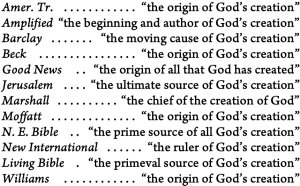
The New World Translation renders the text: “the beginning of the creation by God”
The Beginning of the Creation of God
“The Logos, the beginning of the creation of God, called also by Isaiah, the Wonderful, Counselor, the Mighty God, etc., (Isa. 9:6) we find described by Solomon, and represented under the name of Wisdom, yet with all the details which harmonize the statement with the account given by John the Evangelist (John 1:1, 18), as follows:
“‘Jehovah possessed me in the beginning of his way, before his works of old. I was set up from everlasting, from the beginning, or ever the earth was [formed]. When there were no depths [seas] I was brought forth: when there were no fountains abounding with water. Before the mountains were settled, before the hills, was I brought forth; while as yet he had not made the earth, nor the fields, nor the highest part of the dust of the world. When he prepared the heavens I was there: when he set a compass upon the face of the depth: when he established the clouds above: when he strengthened the fountains of the deep; when he gave to the sea his decree, that the waters should not pass his command: when he appointed the fountains of the earth: then was I by him, as one brought up with him; and I was daily his delight, rejoicing always before him.’ (Prov. 8:22-30)” (E92)
“This glorious One … the Logos, the Word, the Message, the Expression of God. In the Old Testament he is symbolically referred to as ‘Wisdom’ (Prov. 8:22-30): ‘Jehovah possessed Me in the beginning of His way, before His works of old … Then I was by Him, as one brought up with Him, and I was daily His delight, rejoicing always before Him.’
“This mighty One, personified as Wisdom, is declared by St. Paul to be ‘the First-born of all creation.’ (Col. 1:15-18) The Psalmist similarly refers to Him as Jehovah’s ‘First-born, higher than the kings of earth.’ (Psa. 89:27) Jesus refers to Himself as one who had a prehuman existence, saying, ‘Before Abraham was, I am.’ (John 8:14, 23, 52, 58) The glorified ascended Christ, in Apocalyptic vision, declared the same great truth, that He was ‘the beginning of the creation of God.’ (Rev. 3:14) And again He declared, ‘I am the First and the Last.’ (Rev. 1:17; 2:8)” (SM491)
It is interesting to note that George M. Lamsa, in his translation of the Bible from “ancient eastern manuscripts” renders the following verses of Proverbs 8, as:
22 – “The LORD created me as the first of his creation; before all of his works.”
30 – “I together with him was establishing them, and daily I was his delight, rejoicing always before him.”
Anent Jesus and the Logos
“The Scriptures do not explain how the spark of life belonging to the spirit being known as the Logos became transferred to the human plane. When our Lord was thus changed, he merely took the step of getting ready to become the sacrifice for sinners. In his pre-existent state he could not have given the corresponding price for Adam.” (R5064:2)
“Our Lord’s statement, ‘Before Abraham was, I am’ (John 8:58), serves to identify the man Jesus with his previous condition as the Logos before he was made flesh and dwelt among us.…
“‘Jesus Christ, the same yesterday, and today, and forever.’ (Heb. 13:8) This statement would not identify our Lord with his previous condition; for in his pre-existent state, he was not Jesus. He was called Jesus at his birth. He became Jesus Christ at his baptism.” (R5065:5)
The Nominal Church Not a Faithful and True Witness
“… by declaring himself ‘the Faithful and True witness, the beginning of the creation of God,’ he implies that she is not a faithful witness for the truth, and in acknowledging the supremacy of the Father as his Creator, shows his opposition to the man-made dogma of the trinity.” (R718:4, W. I. Mann)
3:15, 16 – “I know thy works, that thou art neither cold nor hot: I would thou wert cold or hot. So then because thou art lukewarm, and neither cold nor hot, I will spue thee out of my mouth.”
One of the strongest evidences in support of our belief that Pastor Russell was the “angel” or messenger to the “Laodicean” church, lies in the fact that he was the only one who knew of the nominal church’s rejection by the Lord, and immediately began to make this known.
“It was in the spring of 1879, that seeing clearly the parallelism between the nominal Jewish church and the nominal Gospel church, we were enabled to know where the latter was finally rejected of the Lord and spewed out of his mouth (Rev. 3:16) no longer to be his mouthpiece. We saw that this was due in 1878, as the parallel of the rejection of the Jewish church, when Jesus just prior to his crucifixion, wept over them and said, ‘Your house is left unto you desolate’ – the Jewish church was there likewise cast off, or spewed from his mouth.
“We were led to see very clearly that the nominal church of the Gospel age, is the Babylon (confused, mixed condition of worldly mindedness and lukewarm Christianity) described in Rev. 18:2-4.
“This spewing out, or casting off, of the nominal church, as an organization in 1878 – we then under- stood, and still proclaim to be the date of the commencement of Babylon’s fall, as recorded there. And since then we feel ourselves led of the spirit, through the unfolding of this portion of the word of truth to say in the name of the Lord, to all God’s true children in Babylon: ‘Come out of her my people, that ye be not partakers of her sins and receive not of her plagues.’ This seems to accord wonderfully with the second message – ‘Babylon is fallen’. (Rev. 14:8)” (R304:2)
The Rejection of the Nominal Church
“God’s Word reveals the fact that the nominal church, after its fall from his favor and from being his mouthpiece (Rev. 3:16) will gradually settle into a condition of unbelief, in which the Bible will eventually be entirely ignored in fact, though retained in name, and in which philosophic speculations of various shades will be the real creeds. From this fall the faithful sealed ones will escape; for they will be ‘accounted worthy to escape all these things that shall come to pass, and to stand’ – not fall, in the time of the Lord’s presence. (Luke 21:36)” (C167)
Rev. 18:4 – “And I heard another voice from heaven, saying, Come out of her, my people, that ye be not partakers of her sins, and that ye receive not of her plagues.”
See comments under Rev. 18:4!
The Laodicean The Nominal Church of Today
“The message to the Laodicean stage of the church pictures the nominal church of today as our Lord sees her. In one sense she is not cold. She has much zeal, but not according to knowledge. She has organized her armies, developed her machinery and multiplied her stores; but yet the enemy does not fall before her. She claims that her principal object is to convert sinners, to bring forth spiritual children. The Prophet puts these words into the mouth of nominal Christians when they awake to a knowledge of the situation: ‘We have been with child, we have been in pain, we have as it were brought forth wind; we have not wrought any deliverance in the earth; neither have the inhabitants of the earth fallen.’ (Isa. 26:16-18) This is said after they have realized the presence of the Lord.” (R5993:6)
3:17,18 – “Because thou sayest, I am rich, and increased with goods, and have need of nothing; and knowest not that thou art wretched, and miserable, and poor, and blind, and naked: I counsel thee to buy of me gold tried in the fire, that thou mayst be rich; and white raiment, that thou mayest be clothed, and that the shame of thy nakedness do not appear; and anoint thine eyes with eyesalve, that thou mayest see.”
“‘I am rich.’ I have all the spiritual light that exists in the world. I have gotten riches; have still more enriched myself; have much goods laid up for many years. I have all that is worth having, and need no more. ‘I sit a queen, and am no widow, and shall in no wise see mourning.’ Of course she cannot recognize her own picture, she is ‘blind.’ ‘And knowest not that thou art the wretched one,’ etc. Just as the Jewish house fell, because they knew not the time of their visitation (Luke 19:44) so must their counterpart of this dispensation. The visitation (presence) of the Lord is a stone of stumbling and a rock of offence to both the houses of Israel. (Isa. 8:14; Heb. 3:5, 6) The fleshly house failed to recognize his presence in the flesh; the spiritual house refuse to acknowledge his presence in a spiritual body. Just as he could be seen by the eye of flesh in his first visitation, so must he be recognized in this only by the eyes of our understanding – the only spiritual eyesight we now possess. When we are made like him, by and by, we shall see him as he is.
“If she is so blind that she cannot recognize her own condition and location, how can it be expected that she could see his. When she has learned his, she will recognize her own, and it will be ‘pitiable, and poor, and naked’.” (R505:5, W. I. Mann)
“Laodiceans look upon their material prosperity, and the numbers of wealthy people associated with their confederating denominations, and count their money and their donations by millions, and say, ‘We are rich as never before.’ Alas! that they do not realize that these are earthly riches of the kind which our Lord declares are no evidence of his favor during this Gospel age, but rather to the contrary. And they see not the true riches which the Lord admires, and which are the foretaste of his favor and the coming Kingdom wealth.
“And so the Lord declares to Laodicea, ‘TThou knowest not tThat tThou art wretcThed and miserable and poor and blind and naked.’ She is poor, in that she has so little of the Master’s spirit, so little of the Truth and the spirit of the Truth. The only riches which God can recognize are those which he promised to, and bestows upon his people in this present time. Laodicea is blind, in that the god of this world hath blinded her perceptions of God’s character and plan and is leading her further away from confidence in his Word, under the guidance of her chosen and well paid lords and masters, the clergy, who under the name of Higher Criticism and Evolution are rapidly taking away from her every good possession and thing which would be estimable in the sight of the Lord, and who are thus denuding her, making her naked, taking from her the robe of Christ’s righteousness, and leading her to trust, not in the precious blood of the redemption, the death of the Redeemer, but to trust in an evolutionary process which needs no Savior, which denies an atonement for sin, yea, denies that there is, or has been any sin to make atonement for; and claims, on the contrary that humanity has ground for pride in its own progress, which will be quite sufficient eventually to bring them every desired blessing, without any Savior and without his Kingdom, which God has promised as the hope of the groaning creation. (Rom. 8:19-23)
“Laodicea is indeed counseled to buy the true gold, the true riches of the Lord, and to use eye salve that she may see, and to put on the garment of Christ’s righteousness, that she may not be put to shame; but we have no intimation in the Scripture that she will give any heed to this counsel; on the contrary, the intimation is that more and more she will become a Babel of confusion, and that she will go down with the political and financial systems of this present age, in the great time of trouble with which this age will terminate, and which will fit and prepare mankind for the Kingdom of God’s dear Son, and its reign of righteousness. ‘When the judgments of the Lord are abroad in the earth, the inhabitants of the world will learn righteousness.’ (Isa. 26:9)” (R2763:1, 2, 4)
The Pride of Nominal Christendom!
“…with few exceptions, the attitude of all Christendom is that of pride, self-righteousness and self-complacency … manifest to the most casual observer. She still saith in her heart, ‘I sit a queen, and am no widow, and shall see no sorrow.’ She still glorifies herself and lives deliciously. She says, ‘I am rich and increased in goods, and have need of nothing,’ and does not realize that she is ‘wretched and miserable, and poor, and blind, and naked.’ Nor does she heed the counsel of the Lord to buy of him (at cost of self-sacrifice) gold tried in the fire (the true riches, the heavenly riches, ‘the divine nature’), and white raiment (the robe of Christ’s imputed righteousness, which so many are now discarding, to appear before God in their own unrighteousness), and to anoint her eyes with eye-salve (complete consecration and submission to the divine will as expressed in the Scriptures), that she might see and be healed. (Rev. 3:18)” (D41)
GOLD is the symbol for that which is Divine; be it Jehovah-God himself; His Attributes; His Life, His Nature; His holy Spirit; or Divine Truth, of which He is the originating source. It will, of course, be recalled that the Candlestick which graced the ancient Tabernacle’s Holy, and represented the “deeper aspects” of His Truth (God’s Word – T16; 22) was made of gold. (Exod. 25:36; 37:17)
FIRE, is the well-recognized symbol for destruction.
If then we assume that the “gold” which the Laodicean Church was to buy, represents Divine Truth, the possession of which maketh “rich,” then the fact that it was “tried in the fire” must have reference to the fire of the Adversary’s hatred and jealousy, which from the beginning has sought to destroy it. It will be recalled that Adam was told by Jehovah God, that, “in the day thou eatest thereof, thou shalt surely die.” (Gen. 2:17); but that
Satan, in his endeavor to destroy, or make of non-effect that bit of divine truth, declared to Eve, “Ye shall not surely die.” (Gen. 3:4) When Jesus, in due course, came (and He was the embodiment of the Truth), (John 14:6), Satan tried frantically, in devious ways, to frustrate the Divine Purposes. Divine Truth is Indestructible!
We note, this gold, the Divine Truth, which in a sense centers in “precious promises” whereby some might be made partakers of the divine nature (2 Pet. 1:4), was indeed tried in the fire of the Adversary’s hatred and jealousy, as set forth above. Since all things are of the Father, and by the Son, it is not strange that the Laodicean Church should be counselled to buy this “gold,” from the Lord. And, by way of this divine Truth, she who is really “wretched, and miserable, and poor, and blind, and naked” (Rev. 3:17), might become “rich” in the grace and favor of God; and “clothed” in white raiment (the imputed righteousness of Jesus) thus no longer be “naked” but “clothed”! Then too, she might seek to obtain the “eyesalve” of meekness with which to anoint her eyes, so that she might “see” clearly the things of the Spirit, esteeming all things else “of trifling worth.” But the price or cost for this purchase would be consecration, i.e., complete self-surrender! But “… with few individual exceptions, the attitude of all Christendom is that of pride, self-righteousness, and self-complacency is manifest to the most casual observer. She still saith in her heart, ‘I sit a queen, and am no widow, and shall see no sorrow.’ She glorifies herself and lives deliciously. She says, ‘I am rich and increased in goods, and have need of nothing,’ and does not realize that she is ‘wretched, and miserable, and poor, and naked.’ Nor does she heed the counsel of the Lord to buy of him (at the cost of self-sacrifice) gold tried in the fire (the true riches, the heavenly riches, ‘the divine nature’), and white raiment (the robe of Christ’s imputed righteousness, which so many are now discarding, to appear before God in their own unrighteousness), and to anoint her eyes with the eyesalve (complete consecration and submission to the divine will as expressed in the Scriptures), that she might see and be healed. Rev. 3:18” (D41)
3:19 – “As many as I love, I rebuke and chasten: be zealous therefore, and repent.”
“‘As many as I love [as many as are honest and at heart loyal to God] I rebuke and chasten’.” (R1372:1)
“The words translated rebuke and chasten, are in the Greek much more forcible than here appears. The first means reproach, disgrace; put to shame, dishonor. The latter, to train or educate like a child or youth. What a call! No wonder that the proud and conceited teachers of popular churches cannot hear the call. No wonder that some who have seen and heard refuse to follow ‘the path their leader trod.’ ‘As many as I love, I disgrace and train: be zealous, therefore, and repent.’
“‘What poor despised company
Of travelers are these,
Who walk in yonder narrow way
Along the rugged maze?
Ah, these are of a royal line,
All children of a King!
Heirs of immortal crowns divine,
And lo! for joy they sing’.”
(R505:6, W. I. Mann)
3:20 – “Behold, I stand at the door, and knock: if any man hear my voice, and open the door, I will come in to him, and will sup with him, and he with me.”
“Unknown to the Laodicean Church the Lord has returned. He stands at the door. He could not do this if he were not present. He has not been always there, as some think. To Sardis he said, ‘I will come’; to Philadelphia, ‘I come quickly’; to Laodicea, it is rap, rap, rap. Awake; let me come in. Do they hear?” (R506:1, W. I. Mann)
“‘Behold the Bridegroom.’ This is the announcement which we are now giving – Not, Behold the Bridegroom cometh, but ‘Behold the Bridegroom’! already here, present, knocking gently with the prophecies to arouse the Virgins, but not to arouse the world. (Rev. 3:20) This is the reading of the oldest Greek manuscripts, which omit ‘cometh.’ Our Lord says, ‘If any man hear my voice [knock] and open the door, I will come in to him, and sup with him.’ This message to the present Laodicean phase of the church, intimates very clearly (1) that the ‘knock’ and ‘voice’ will be inaudible to natural ears, and heard only by the ears of the understanding, the hearing of faith;
(2) that it will not be a denominational knock or call (as to Adventists, Presbyterians, etc.), but (3) that it will be a knock that must be heard individually, and responded to individually; ‘any man’ who hears the ‘knock’ or ‘voice’ if he so wills, may exercise faith, open the door of his understanding, and realize his Lord’s second presence.
“The man who never hears the ‘knock’ is evidently not counted worthy to hear it. But those who hear are just as evidently not compelled to respond and to accept the present, knocking King: hence he says, if the hearing one open the door, I will come in. However, only those who recognize the ‘knock,’ and who respond and by faith open to the Lord and receive him as their present King – only these are to have the great blessing of spiritual nourishment – the feast of ‘meat in due season,’ ‘things new and old,’ which the Master promised to provide at that time to strengthen the faithful for the judgments, trials, testings and siftings which must ‘begin with the house of God.’ ‘I will come in to him, and sup with him, and he with me.’ (Rev. 3:20; Luke 12:37)” (R2978:4, 5)
3:21 – “To him that overcometh will I grant to sit with me in my throne, even as I also overcame, and am set down with my Father in his throne.”
Once again the dear Lord reminds us that the promises belong to the overcomers only! And all of these promises ought to inspire us, not merely to earnestly contend for the faith once delivered to the saints (Jude 3), but also to strive sincerely to make our calling and election sure. (2 Pet. 1:10)
“Listen to some of the blessed and inspiring promises with which the Father and the Son cheer the Bride: ‘Thine eyes shall see the King in his beauty.’ (Isa. 33:17) Ye ‘shall be mine, in that day when I make up my jewels.’ (Mal. 3:17) ‘I will give thee to eat of the hidden manna, and I will give thee a white stone (a precious token of love), and in the stone a new name written (the name of our Bridegroom, henceforth to be our name) which no man knoweth saving he that receiveth it.’ (Rev. 2:17) ‘Lo, I am with you alway.’ (Matt. 28:20) ‘And if I go away, I will come again, and receive you unto myself, that where I am, there ye may be also (and he has come, he is even now present, and will soon receive us unto himself forevermore).’ (John 14:3) ‘Ye have not chosen me, but I have chosen you.’ (John 15:16) ‘Be thou faithful unto death, and I will give thee a crown of life.’ (Rev. 2:10) ‘To him that overcometh will I grant to sit with me in my throne.’ (Rev. 3:21)
“Precious promises are these, wonderful words of life! Let us count them over and over again, that all their sweet significance may sink deep into our hearts and bring forth their blessed fruitage in our lives. May they cheer us in every dark and trying hour and reinforce our waning powers with renewed vigor, courage and zeal, that we may press along the narrow way until indeed ‘our eyes shall see the King in his beauty.’ What wondrous treasures do we thus find laid up in heaven for us, because we have left the world and all its delusive fancies and aspirations and have laid hold upon the things eternal! And while this glorious inheritance is to be the possession of all the faithful, the Apostle intimates clearly that our heavenly treasure may be augmented by special zeal and faithfulness under the peculiar trials of the present time.” (R5863:1, 2)
“To Him That overcometh”
“The third great dispensation … is to be composed of many ages, ‘The Ages to Come.’ The first of these, the Millennial age … is the only one concerning which we have any definite information. It is the thousand years during which Christ will reign over and thereby bless all the families of the earth, accomplishing the ‘restitution of all things spoken by the mouth of all the holy prophets.’ (Acts 3:19-21) During that age, sin and death shall be forever blotted out for ‘Christ must reign till he hath put all enemies under his feet.… The last enemy that shall be destroyed is death,’ Adamic death. (1 Cor. 15:25, 26) That will be the great reconstruction period. Associated with Christ Jesus in that reign will be the Church, his bride, his body, even as he promised, saying, ‘To him that overcometh will I grant to sit with me in my throne, even as I also overcame, and am set down with my Father in his throne.’ (Rev. 3:21)” (A222, 223)
The Reward to the Overcomer!
“Blessed are the overcomers! ‘To him that overcometh will I grant to sit with me in my throne, even as I also overcame, and am set down with my Father in his throne.’ (Rev. 3:21)
“What a reward is this which is held out as an incentive and inspiration to urge us on to noble and heroic effort! – to reign with Christ, to be his Bride and joint-heir, his beloved and confidential companion through all eternity, and to be partakers of his divine nature and glory. These promises are freighted with an ‘exceeding and eternal weight of glory,’ which ‘eye hath not seen, nor ear heard; neither hath it entered the heart of man; but God hath revealed it unto us (brought it within the range of our appreciation) by his Spirit.’ The words sound hollow and meaningless to those who have no appreciation of spiritual things, but to the consecrated children of God who are faithfully striving to meet the conditions upon which the fulfillment depends, and who have therefore a good hope, they are exceeding precious, and fill their hearts with joy unspeakable and full of glory.” (R1719:2, 3)
Patient Endurance – Its Present Reward
“This is the special reward of those who are running the race with patient endurance in the present time, in the Laodicean period. While it was not our privilege to escape the hour of temptation, it is our privilege to have a counter-balancing special blessing as a result of living in the time of our Lord’s parousia (presence). We may have His fellowship, His instruction, His dispensing of spiritual food which is now ‘meat in due season,’ in a manner and to a degree in which none of the faithful of past periods enjoyed these. But as we might expect, this greatest favor is correspondingly offset by the subtlety and severity of the trials of this hour of temptation coming upon the whole world. If ever patient endurance was necessary, it is necessary now.” (R2792:3, 4; Manna Dec. 3)
3:22 – “He that hath an ear, let him hear what the spirit saith unto the churches.”
“So the warning voice goes forth to ‘him that hath an ear to hear.’ We are in the time of the last or Laodicean stage of the great nominal gospel church of wheat and tares. (Rev. 3:14-22) She is upbraided
for her lukewarmness, pride, spiritual poverty, blindness and nakedness, and counseled to forsake quickly her evil ways before it is too late. But the Lord knew that only a few would hearken to the warning and call; and so the promise of reward is given, not to the whole mass of those addressed, but to the few who still have an ear for the truth, and who overcome the general disposition and spirit of Babylon – ‘To him that overcometh will I grant to sit with me in my throne, even as I also overcame, and am set down with my Father in his throne. He that hath an ear (a disposition to hearken to and heed the word of the Lord), let him hear what the Spirit saith unto the churches.’ But upon those who have no ear, no disposition to hear, the Lord will pour his indignation.” (D41)