
15:1 – “And I saw another sign in heaven, great and marvellous, seven angels having the seven last plagues; for in them is filled up the wrath of God.”
Perhaps it is well to be reminded here, that John, in many of these apocalyptic visions represents the Church throughout the whole of the Gospel age; and sometimes more particularly, the last, the “feet members” of the body of Christ, living in the end of the age. The scene before us belongs to this latter period, for the pouring out of the seven vials of the wrath of God, is surely identified with the sounding of the seventh trumpet, which began sounding in 1874. (Rev. 11:15-18)
It is possible that the “seven angels” who pour out the vials of God’s wrath upon the earth, is none other than the one, elect Church – the “little flock.” The term “seven angels” is thus to indicate the perfection and completeness of this “little flock” in the eyes of Jehovah God! The closing scenes of the Gospel age are reflected in Psa. 149:7-9, where, speaking of this elect company, the prophecy declares that they are –
“To execute vengeance upon the heathen, and punishments upon the people; to bind their kings with chains and their nobles with fetters of iron; to execute upon them the judgment written.”
And, to show that all of the “little flock” will be thus involved, those already on the spirit plane (partakers of the divine nature), and those still sojourning in the flesh – the Psalmist, under divine inspiration adds, “this honor have all the saints.” (Psa. 149:9)
Kingdom Work – Both Sides of the Veil
“This does not signify, that there may not be a part of the kingdom work begun while some of the members of Christ are still in the flesh. Indeed some Scriptures seem to imply that there will be a kingdom work done this side the veil, while a work of still greater magnitude and authority is progressing on the other side of the veil. We read, ‘Let the saints be joyful in glory; let them sing aloud upon their beds.’ This seems to imply, as we have mentioned before, that there is a special work to be done while these saints still have beds, while they are in a condition of repose – ‘not tossed to and fro, and carried about by every wind of doctrine,’ but fully at rest in God’s great plan. The Scripture goes on to say that they have a two-edged sword in their hands – this is the Word of God. They use it as the sword of the Spirit. This would not be true of them on the other side of the veil. They would have no use for a sword there. The Scriptures also declare that the high-sounding praises of God are upon their lips. This too, seems to be applicable to those this side the veil.” (R5631:6)
Commenting on Rev. 19:14 – “the armies of heaven,” Bro. Russell had this to say:
“We know not why this prophecy speaks of heavenly armies – in the plural. We merely suggest that the heavenly army may possibly be in two divisions –one of this side of the veil, the other on the other side of the veil. We are waiting to see, and merely watching while we wait, and noting with possibly greater care our Father’s Word. We may be sure that if any commission be given to the Lord’s people to execute judgment this side of the veil it would be so explicit as to leave no room for doubt, remembering that the divine requirement throughout the age has been that the saints of God shall be subject to the powers that be. Any change of this order to the effect that we should execute judgments upon them will need to be very positively and very clearly understood before being executed.
“Just how the kings and nobles – financial, political and social – will be bound, and just what kind of fetters of strength will be used, we may not know until qualified; but the outworking of all these will be, as expressed in Psa. 149:9, ‘to execute upon them the vengeance written: this honor have all of God’s saints.’ Whether we participate in this work on this side of the veil or on the other side makes no difference to us. In any event, whatever we shall do at any time under the guidance of the Lord’s holy Spirit will be in harmony with justice and all the time intermingled with sympathetic love. None except those possessing and controlled by this, the holy Spirit of God, will ever be permitted participation in the kingdom glories and power.” (R5451:4)
As is indicated in the passage, the vials represent the wrath of God, as it is to be poured out, or visited upon the last generation in the dispensation, which, as it were, is to be held accountable for all the righteous blood having been shed throughout the Gospel age, as were the Jews of Jesus’ day. (Luke 11:50, 51) The vials of wrath to be poured out are the seven last plagues!
“The Wrath of God”
“But the Scriptures declare that the punishments upon the Jews which culminated in the destruction of Jerusalem in A.D. 70 were, some of them, for sins committed long before. Notice Jesus’ words, ‘The blood of all the Prophets, which was shed from the foundation of the world, shall be required of this generation; from the blood of Abel unto the blood of Zacharias, who perished between the Altar and the Temple.’ (Luke 11:50, 51)
“Wherein was the justice in exacting all that of the people living in the close of that Age? We reply that those people had far more responsibility than all who preceded them. They had a great Light amongst them, shining from Jesus and the early saints. In their treatment of these light bearers, crucifying them and variously injuring them, upon that last generation of the Jewish Age ‘wrath came to the uttermost.’
“The Bible intimates that similar aggregations of punishment are to be expected in the end of this Gospel Age. The great Time of Trouble, or Day of Wrath is the ‘recompense of the controversy of Zion’ – the saints, the true Church. For eighteen hundred years Jesus has prophetically declared that the Kingdom class would suffer violence; and the violent have usurped the place of the true by force.
“… the sin of their persecutors must be liquidated, even though the persecutors themselves will all eventually be forgiven. From this viewpoint, the ‘Time of Trouble such as was not since there was a nation’ and which is now beginning gradually to be consummated, will be the squaring of God’s ac- counts with the world, preparatory to handing the Kingdom over to Messiah for the blessing of all.” (OV345, 346)
The Ten Egyptian Plagues
“… these plagues upon Egypt were intended to foreshadow, to illustrate the plagues with which this Gospel age will end, the first three and ‘the seven last plagues.’ (Rev. 15:1)” (F175)
“It is well worthy of note that the first three plagues were shared by the Israelites as well as by the Egyptians, but in the succeeding plagues, as Moses pointed out in advance, the Israelites were spared. The land of Goshen was protected.” (R5272:2)
“Noting that these ten plagues prefigured the time of trouble in the end of this age, we are not surprised to find similarly ten plagues mentioned in connection with the time of trouble portrayed in
Revelation as constituting the consummation of this present age and this ‘present evil world.’ There the first three plagues are called the woe trumpets, and following them come the ‘seven last trumpets.’ The first three apparently affect all, the last seven are restricted to those who are in opposition to the Lord. And so it was in the plagues of Egypt: the first three affected the Israelites as well as the Egyptians, but from the last seven the Israelites were exempted.” (R3994:4)
15:2-4 – “And I saw as it were a sea of glass mingled with fire: and them that had gotten the victory over the beast, and over his image, and over his mark, and over the number of his name, stand on the sea of glass, having the harps of God. And they sing the song of Moses the servant of God, and the song of the Lamb, saying, Great and marvellous are thy works, Lord God Almighty; just and true are thy ways, thou King of saints.¹ Who shall not fear thee, O Lord, and glorify thy name? for thou only art holy: for all nations shall come and worship before thee; for thy judgments are made manifest.”
The “victors” (the Church of the Gospel dispensation – the saints) who stand atop of the “sea of glass mingled with fire” we are told sang a song – the “song of Moses and the Lamb.” And, while it is true, that all of God’s saints have sung this song, the “sea of glass mingled with fire” is indicative of the fact that only such saints as are living in the end of the age, during the “time of trouble” are a part of this vision of John’s; and these are said to sing above it!
“These overcomers sing a song. A song symbolizes a beautiful and harmonious expression. It is the song of Moses and the Lamb. That is, the song, or preaching of these overcomers is in perfect accord with the Law and the Gospel. It is the same which Jesus (the ‘Lamb’) taught, and which Moses taught in the Law and types. Not only does the description of the overcomers indicate that they are but a little fragment of the nominal Church, but the words of the song teach us the same – that the class who proclaim these things are few.” (R497:3)
“… the sea of glass mingled with fire.… Sea … we understand to symbolize the masses of the people, and fire, the judgment, or trouble.… Above the troubled people are the overcomers – calm, serene, untroubled. Their position shows that their standing is by faith. (Matt 14:29) To the eyes of faith all is transparent as glass.” (R497:3)
1 Greek: ethnon = nations
The Song Which the Saints Now May Sing!
“The word ‘song’ has a wider meaning than simply a musical cadence: it is used in the Scriptures and elsewhere to indicate a joyful message of any kind. For instance, we say, referring to the Gospel, the knowledge of the divine plan, ‘Thou hast put a new song into my mouth, even the loving-kindness of our God.’ And it is a fact that those who have tasted that the Lord is gracious, those who have received the joy which no man can take from them, those who have tasted of the grace of God in Christ, will not only rejoice and literally sing musical songs with their lips, but they will also rejoice to have their entire lives a song of praise and thanksgiving unto God. The song will bubble over on every occasion, wherever hearing ears are found: so fully will the cleansed, justified and consecrated heart appreciate God’s goodness and so greatly will it desire to:
‘Tell the whole world these blessed tidings, And speak of the time of rest that nears’.” (R2232:2)
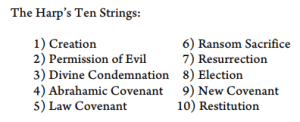
The “harps” of these overcomers, as already suggested (Rev. 14:2, 3) are the Scriptures themselves, the Old and New Testament.
“Only those who have learned to play upon the harp of God, who have all its strings attuned to perfect harmony, can properly render this ‘Song of Moses and the Lamb.’ Never until today has it been possible to produce such melody from this wonderful harp; for never before have all its chords been properly placed and attuned. Now its music is entrancing! Then let us take this wonderful harp of the ages, and as we sweep its chords, let us sing with the spirit and with the understanding this wondrous, glad new song.” (R5441:6)
The “Harp of God”
“… the harp of God, we believe to be the Bible, its many strings or chords are the Law, Prophets, Psalms, Gospels, etc.” (R497:5)
“… thank God! we find that harmony existing, so that the Scriptures of the Old and New Testament constitute what the Lord himself designates ‘the harp of God.’ (Rev. 15:2) And the various testimonies of the Law and the prophets are the several chords of that harp, which when tuned by the holy Spirit dwelling in our hearts, and swept by the fingers of the devoted servants and searchers after divine truth, yields the most enchanting strains that ever fell on mortal ears.” (F233)
The Harps on the Willows in Babylon
“Many of the Lord’s dear children in mystic Babylon’s captivity, have sat down beside her rivers so defiled by the mire of worldliness and error, and wept when they remembered God’s favor to Zion in times past. They laid aside the harps of God, hanging them on the willows that wept over the grave of truth in Babylon. They that carried them away captive (the Babylon system) require of them a song and mirth, saying, ‘Sing us one of the songs of Zion.’ Yes, Babylon would like to see Zion’s captives happy beside her muddy stream; and in the midst of her worldliness, would like to hear an occasional song of Zion, that she might boast of the Lord’s favor. But ‘how shall the captive daughters of Zion sing the Lord’s song in a strange land?’ (Psa. 137:1-6) To all such we cry: Take down your harps from the willows: flee out of Babylon into full liberty of thought and expression; tune your harps and sing the song of Moses and the Lamb. Sing of God’s mighty love and the ‘restitution of all things which God hath spoken by the mouth of all of his holy prophets’.” (R497:6)
(See Psa. 33:2, 3; 92:3; 144:9; Rev. 14:1-3; 15:2-3)
As for the words of this song that the overcomers sing:
“The words of the song are given, or the leading points of the preaching which will be done by the overcomers – ‘Saying, Great and wonderful are Thy works, O Lord God, the Omnipotent.’ Alas! how few are sufficiently acquainted with God’s plans to recognize the fact that they are great and wonderful. Very few can sing this first note of the song, and fewer yet can sing it to its close. The second note is, ‘Righteous and true are Thy ways, O King of nations.’ (Diaglott) Look at this; we can sing of the righteousness and justice of God’s dealing with the nations, since we have come to see how He has permitted evil and death to come upon all, as a lesson, to teach us to appreciate life and righteousness. We can see righteousness, justice, mercy, and love in God’s dealing, since we see in His Word that there is to be a ‘restitution of all things which God hath spoken by the mouth of all His holy Prophets since the world began.’ (Acts 3:21) Who, but those who see the restitution to be accomplished in the next Age, could sing this part of the song? Not one: Christendom in general fears to think of God’s justice in dealing with the nations in general, the great majority of whom have gone down into death without any knowledge of the only name whereby we must be saved. The righteousness, and justice, and love of God’s dealing, can be seen only by looking at the work of the next, as well as that of the present and past Ages. Yes indeed, we rejoice to proclaim to all who have an ‘ear to hear’ – Just and true are Jehovah’s ways in ruling the nations.
“The next note is in perfect harmony with the last – ’Who shall not fear, O Lord, and glorify Thy name? since Thou alone art bountiful.’ Our great Creator’s every dealing is an act of favor – even the evil which man was permitted to bring upon himself is to be overruled for good; and we ask ourselves the question, Who shall not fear and glorify God when, in the coming age, His wonderful goodness is manifested, and when the knowledge of the Lord shall fill the whole earth? We would be inclined to believe that every one should praise His love everlastingly, were it not that Scripture clearly discloses a Second Death, which tells of some who will be accounted worthy of it.
“‘For all the nations shall come and worship in Thy presence, because Thy righteous acts are manifested.’ This is the last note of the song, and is full of force and meaning. How few are proclaiming, either publicly or privately, this part of the song. Some believe that many of the nations now dead are in a place of mental or physical torture, there to remain to all eternity. Others claim that they are dead, and will never again have life; others that those who are dead will be raised from death to pass a mock trial, and be destroyed. But how few can sing this song of restitution, declaring that all nations shall yet come from death, and shall worship their Lord and Re- deemer, when brought to a knowledge of the Truth. (1Tim. 2:4) Even Sodom, a nation long since de- stroyed, shall come and worship. (Ezek. 16:48-63)” (R497:3)
The “Song” … Restitution!
“All who are true Watchmen can at this time see clearly, as one man, and can together harmoniously sing the new song of Moses and the Lamb – the song of restitution, so clearly taught, not only in the Law of Moses, which was ‘a shadow of the good things to come,’ but also in the clearer revelation of the Lamb of God contained in the writings of the New Testament, saying, ‘Just and true are Thy ways.’ ‘All nations shall come and worship before Thee.’ (Rev. 15:3, 4)” (C237)
“Who Shall Not Fear Thee?”
“The righteous dealings of God will bring a sure penalty to every one in proportion to his degree of knowledge and wilfulness, but it will bring a just, and not an unjust penalty, and it will be remedial–with a view to the recovery of the penitent and his everlasting blessing. Otherwise it will terminate in his ever- lasting destruction. (2 Thes. 1:8, 9)” (OV170)
15:5-8 – “And after that I looked, and, behold, the temple of the tabernacle of the testimony in heaven was opened: And the seven angels came out of the temple, having the seven plagues, clothed in pure and white linen, and having their breasts girded with golden girdles.
And one of the four beasts gave unto the seven angels seven golden vials full of the wrath of God, who liveth for ever and ever. And the temple was filled with smoke from the glory of God, and from his power; and no man was able to enter into the temple, till the seven plagues of the seven angels were fulfilled.”
The true Church, throughout the Gospel age, has been made up of “overcomers” (Rev. 2:7, 11, 17, 26; 3:5, 12, 21), many of whom were also “victors” over the beast and his image, etc. (Rev. 15:2) To these, as already suggested, it was granted that they might learn and sing the new song – the Song of Moses and the Lamb! (Rev. 15:3) And, as prophetically foretold, all of them (those already glorified, as well as those still sojourning in the flesh) are to have part in executing “vengeance upon the heathen,” and “punishments upon the people,” and in the “binding of their kings with chains and their nobles with fetters of iron.” (Psa. 149:7-9)
It was Bro. Russell’s thought, back in 1883, that this whole company – the Temple Class (1 Cor. 3:16) was to be represented by the “feet members” of the Christ (those still in the flesh), whom John – (who “tarries” – as Jesus prophetically declared “he” might – speaking of a John class – John 21:22) – now sees as the “seven angels” appearing in the ecclesiastical “heaven” with the seven plagues filled with the wrath of God, to be visited upon the world of mankind.
“Since it is the saints who are to ‘execute the judgments written’ (Psa. 149:9), we interpret these ‘seven angels’ to mean the saints – the living saints, they being the representatives or active agents of the entire company – as ‘the feet of Him.’ It is the feet, or last part, who sing the restitution song of Moses and the Lamb, above the sea mingled with fire. ‘How beautiful are the feet of Him that bringeth good tidings, that publisheth peace that saith unto Zion, Thy God reigneth.’ (Isa. 52:7) These same feet as representatives on earth of the entire body, are to pour out the seven vials, or be associated more or less directly, with the judgments coming. These are clothed with white linen; these have kept their wedding garments; they are robed in the righteousness of Christ ‘justified by his blood.’ They are the servants of God; the girdle representing a servant, and the gold of it representing divinity. They, as the servants of God, have a divine service to accomplish.” (R498:1)
It is possible that, as the years of the Harvest moved along, Bro. Russell’s view, as here expressed, may have undergone some slight modifications. We do know that in his latest writings, especially with regard to Psa. 149:7-9 he seemed reasonably sure that all the saints were to take part in this work; nor was he sure as to how, i.e., in what manner the living saints were to participate. (R5451:1-5)
“This honor have all his saints” (Psa. 149:9)
“We know not why this prophecy (Rev. 19:14) speaks of heavenly armies – in the plural. We merely suggest that the heavenly army may possibly be in two divisions – one on this side of the veil, the other on the other side of the veil. We are waiting to see, and merely watching while we wait, and noting with possibly still greater care our Father’s Word …
“Just how the kings and nobles – financial, political and social will be bound, and just what kind of fetters of strength will be used, we may not know until qualified; but the outworking of all these will be, as expressed in Psa. 149:9, ‘to execute upon them the vengeance written; this honor have all the saints.’ Whether we participate in this work on this side of the veil or on the other side makes no difference to us.” (R5451:4)
So, what and if, God should grant one part of the Christ, the major role, and to the other the minor, in the closing scenes of this drama of the Age; in the ultimate, will it not be the Christ (Jesus, and all the “overcomers” of the Gospel age) who usher in the new order – the new heavens and the new earth for the world of mankind, thus, becoming their blessers? (Gen. 22:18)
And now we are told as to who it is that gives unto these seven angels the golden vials filled with the wrath of God: it was one of the “living ones.” We believe it to be Divine JUSTICE! Among other things, surely there has been the cry of much righteous blood shed throughout the Age, “How long, O Lord, holy and true, dost thou not judge and avenge our blood on them that dwell on the earth?” (Rev. 6:10)
“… the martyrs of the past, ‘the souls under the altar,’ are represented symbolically as crying out for the vindication of justice, saying, ‘How long, O Lord, holy and true, dost thou not judge and avenge our blood upon them that dwell on the earth!’ They were bidden to wait until others of their brethren should be similarly killed, when the guilt of all will be avenged. (Rev. 6:9-11)” (R5462:6)
The true Temple – the “cleansed Sanctuary Class” (see comments on Rev. 10:11; 11:1, 2), as represented in the “seven angels” is pictured as coming out of the nominal church temple – the ecclesiastical temple, “open” to let these come out, in response to the call, “Come out of her, my people.” (Rev. 18:4) This very “coming out” is, in a sense, a part of the judgment of God, which begins with the house of God (1 Pet. 4:17), separating first of all, the wheat from the tares (R605:6), and secondly, and as a result of this, judgment falls upon the nominal temple, and it is filled with confusion!
“The term judgment may be properly applied to the process of trial or to the result of trial – the decision or verdict. In the former sense the judgment of the
Church began over eighteen hundred years ago, and has been progressing ever since. But in the latter sense, it is due in the end or harvest of the Gospel age. Hence the separating of wheat and tares, and also of the ripe and unripe wheat, now going on.
“And if the judgment of the Church, as to who is fit or unfit to receive the Gospel prize offered to us, has begun, what shall the end or decision of this judgment be concerning them that had a hearing ear, that did once hear with gladness and appreciate the Gospel and then, for various reasons, did not obey it – the ungodly, not necessarily vicious and in direct opposition and defiance of God, but those claiming to be his and yet not fully obedient. There are very many such.” (R605:6)
The True Temple – The Cleansed Sanctuary Class
“In his wisdom, God did not overpower them with the great flood of light now granted to the saints. Gently he led them on, step by step, cleansing them first from the papal pollutions which still clung to them. And as God thus drew them, the Sanctuary class followed on, recognizing the voice of the Good Shepherd in the accents of truth which exposed the old errors, until 1846, which prophecy marks as the date when a nucleus of the ‘holy people,’ the ‘Sanctuary,’ would become free from the errors of Papacy, cleansed of defilements, and ready to replace the unclean theories of men with the clean and beautiful principles of truth, on which the Lord and the Apostles had founded the Church. Gradually they were led to expect the great culmination of blessing when the Lord himself should come, in the harvest of the age. Their diligent study of God’s Word, and commendable desire to know what even the angels desired to look into (1 Pet. 1:12), were greatly blessed, though their desires were not fully granted.
“A faithful few were thus instructed in the Word of truth, filled with the spirit, purified and more fully separated from the world, purged of pride and, through the discipline of the disappointment of 1844, brought to more humble reliance upon God;
… until the watchers at the end of the ‘1335 days’ (1874, harvest time) received, and were sent forth to announce to all the Sanctuary class, the glad message, ‘Behold the Bridegroom’!” (C123)
Separating Wheat from Tares!
“It should be a great encouragement to us all to find so clearly expressed in the type what we had vaguely and indistinctly hoped for, viz., that the Lord’s people of the Royal Priesthood on this side the veil are being used of him in various ways in the accomplishment of his purpose of separating the people of God from others – the wheat from the tares.” (R4060:5)
The Real Temple Class
“… the chiseling, shaping and polishing of consecrated believers in Christ’s atonement for sin, progresses; and when the last of these ‘living stones,’ elect and precious,’ shall have been made ready, the great Master Workman will bring all together in the First Resurrection; and the Temple shall be filled with his glory, and be the meeting place between God and men throughout the Millennium. (Rev. 15:5-8)” (“To Us The Scriptures Clearly Teach” – R1750:1; 5822:1)
“When they had all gone out of the temple, it was filled with smoke, so that none could enter it. The temple symbolizes the nominal church. The coming of the messengers out of the temple symbolizes the coming of the overcomers out of the nominal church. When all such have come out, the temple (church) will be so full of smoke (confusion), that no man would care to go into it. It was ‘with smoke from the glory of God and from his power’; that is, the overcoming class, shows the deformity and confusion of man-made creeds. As the truth, though rejected, shines out with increasing glory, the whole nominal temple is seen to be full of smoke – confusion and darkness; and all who remain in it become so blinded by it, that they cannot see the glory of God either as displayed in his Word, or its fulfillment in passing events.
“The messengers are now nearly all out, and already the smoke or confusion in the church is considerable. Few care to enter even now.… The nominal church will be in this confusion until the seven plagues are poured out; during that time the Babylon, or confusion element, will be destroyed, and the cleansed temple of truth be again opened to receive justified believers – then as heirs of the earthly promises.” (R498:1)