“The Messages of our glorious Lord, sent through the Apostle John and given to us in the symbols of the book of Revelation, are as truly the Savior’s messages as those uttered during his earthly ministry and those subsequently sent us through the apostles.
“The book of Revelation was written at a time when severe persecution was upon the infant church – near the close of the first century, probably A.D. 93-96, in the reign of the Emperor Domitian, though some date it nearly thirty years earlier, in the reign of Nero. No matter – in either case it was written at a time of special peril and severe persecution. For a time the Lord allowed the truth to become well planted and to take root; the gifts of miracles and other gifts in the church at that time assisted in this matter.
“For a time, although there were persecutions of individuals such as are recorded in Acts, the believers as a whole were not subjected to the severest of trials at first. It was when the truth began to spread, and had not only the enmity of the Jews, but also of the Greeks, that emperors and governors found favor with the masses by persecuting the followers of Jesus. And for aught we know, so it will be in the not far distant future. For a long time the pure truth has been hidden from men, and worldliness in the form of godliness has had the upper hand in influential circles; but doubtless, as the troublous times the Scriptures predict for the end of this age draw closer, those who will stand firm for the word of the Lord’s testimony may expect to be made the scapegoats under various pretexts. We shall not be surprised to find a considerable measure of persecution against all the children of the light, who will walk up to the light, developed within the next seven years. John, the beloved disciple, in some measure or degree typified or represented the last living members of the little flock. Doubtless this was the meaning of our Lord’s statement, ‘If I will that he tarry till I come, what is that to thee?’ John did not tarry, but a class whom he in some respects illustrated are represented to tarry – a class who see with the eyes of their understanding the visions and revelations which John saw in symbols in a trance.
“John at the time of the trance vision was a prisoner, exiled to the Isle of Patmos, a penal colony of those days – an island almost uninhabitable, rocky, barren. The crime for which he suffered this banishment was his faithfulness as a mouthpiece of the Lord. At the time he must have been between sixty and ninety years of age, supposing that none of our Lord’s disciples were younger than himself at the beginning of his ministry. If his exile in any degree symbolized ostracism, which the Lord’s followers may expect in the close of this age – a complete isolation from others and a treatment implying that they are prisoners – we may take comfort in the thought that as the Lord’s favor and revelations to John more than offset his persecutions, so the opening of the eyes of our understanding and the granting to us of greater lengths and breadths and heights and depths of knowledge and appreciation of our Lord and his plan will far more than offset the various experiences which in his providence he may permit to come upon us. His assurance is that all things shall work together for good to those who love God, to the called ones according to his purpose. Whoever rests his faith securely upon his promise may indeed with the Apostle Paul count all tribulations as loss and dross for the excellency of the knowledge of Christ Jesus our Lord.” (R3568:3; 3569:1)
1:1, 2 – “The Revelation of Jesus Christ, which God gave unto him, to shew unto his servants [Gr. doulos – bond servants; Siniatic MS., Saints] things which must shortly come to pass; and he sent and signified [signified] it by his angel unto his servant John: Who bare record of the word of God, and of the testimony of Jesus Christ, and of all things that he saw.”
The Revelation here referred to as “The Revelation of Jesus Christ” is not the revelation of Jesus himself, but the revelation by God of His eternal purposes as given to Jesus after he had proved himself worthy of it; i.e., not until he had fulfilled his consecration in death itself. This revelation is thus represented in “the book” (scroll) of Rev. 5:1, 2, 7-9.
“Jesus had not proven himself worthy of this great honor when he made his consecration, but when he had finished his course in death he was then worthy to receive glory, honor, and power. After his resurrection and ascension the scroll was given into his hands to be opened. This means that the divine plan as a whole was here made known to him – for he already had knowledge of much of this – but all things were given him to unloose. There had been some things that our Lord did not know. He had said, ‘Of that day and hour (of his second coming) knoweth no man; no, not the angels in heaven, nor the Son, but my Father only.’ (Mark 13:32) A part of the plan was written on the outside of the scroll, and a part was written on the inside. The things that were sealed were not proper to be understood by our Redeemer until he had received the all-power, after his resurrection. The execution of God’s plan was then given into his hands” (R5943:5)
“And our Lord’s revelation, which God gave him after he had passed into glory, he sent and signified (signified – told in signs, symbols, etc.) to his Church, through This servant John. (Rev. 1:1) We are also told that the prophecies given aforetime by holy men of old were given, not for themselves, nor for others of their day and age, but exclusively for the instruction of the Christian Church. (1 Pet. 1:12)” (B203)
John the Revelator
John 21:22 – “Jesus said unto him [Peter], If I will that he tarry till I come.”
“As we have seen, John, the revelator represented those favored members of the Church who, living in this end of the Gospel age, are granted the privilege of seeing and appreciating more and more the things which he saw in symbol.” (R3572:4)
The Angel of Rev. 1:1
While we do not think it too important – else the Lord would have indicated who the angel was by whom he signified the vision to John – we suggest that it may have been the angel Gabriel, who was sent of the Lord to give similar skill and understanding to Daniel of old (Dan. 8:16; 9:21), as he is here to John on the Isle of Patmos.
Our reason for suggesting this is, that what the Book of Daniel is to the Old Testament, the Book of Revelation is to the New Testament; both are apocalyptic!
The “Angel of The Lord”
The “angel of the Lord” appeared to Joseph. (Matt. 1:20, 21)
To Zachariah (the priest at the Temple at Jerusalem) the “angel of the Lord,” was Gabriel (Luke 1:19), and likewise the “angel of the Lord” that appeared to Mary, at Nazareth, was the same Gabriel! (Luke 1:28)
In the prophecies of Daniel, Gabriel is identified as “the man,” (Dan. 8:16; 9:21) for angels thus frequently appeared as men. (Gen. 18:1, 2)
Gabriel means “man of God.”
1:3 – “Blessed is he that readeth, and they that hear the words of this prophecy, and keep those things which are written therein: for the time is at hand.”
“…the last book of the Bible – Revelation, written about A.D. 96. The introductory words announce it as a special revelation of things not previously understood. This proves conclusively that up to that time, at least, God’s plan had not been fully revealed. Nor has that book ever been, until now, all that its name implies – an unfolding, a REVELATION. So far as the early church was concerned, probably none understood any part of the book. Even John, who saw the visions, was probably ignorant of the significance of what he saw. He was both a prophet and an apostle; and while as an apostle he understood and taught what was then ‘meat in due season,’ as a prophet he uttered things which would supply ‘meat’ in seasons future for the household.
“During the Christian Age, some of the saints sought to understand the Church’s future by examining this symbolic book, and doubtless all who read and understood even a part of its teachings were blessed as promised. (Rev. 1:3) The book kept opening up to such, and in the days of the Reformation was an important aid to Luther in deciding that the Papacy, of which he was a conscientious minister, was indeed the ‘Antichrist’ mentioned by the Apostle, the history of which we now see fills so large a part of that prophecy.” (A27-28)
“I do not know myself whence these thoughts arise. In my opinion, the work is not yet begun, so far as the great ones at Rome they are mistaken in looking for the end. I will send you what I have written, in order that you may judge whether I have guessed rightly that the Antichrist of whom St. Paul speaks now reigns in the court of Rome. I think I shall be able to show that he is worse nowadays than the Turks themselves.” (Martin Luther)
“‘I will stir up the bile of this Italian beast,’ said Luther. He kept his word. In his reply, he proved by the revelations of Daniel and St. John, by the epistles of St. Paul, St. Peter, and St. Jude, that the reign of Antichrist, predicted and described in the Bible, was the Papacy.” (Excerpts from History of the Reformation by D’Aubigne, p. 153, 215)
“John was instructed to write, to make clear, to make plain to us and to all God’s people, the things already brought to his attention, and other things subsequently to be brought to his attention; to the intent that all of God’s people might be enabled to comprehend with all saints the lengths and breadths and heights and depths of the love of God, which passeth all understanding, and which can only be received through revelation from God. And here let us note the force of John’s expression (Rev. 1:3) to the effect that there is a blessing upon those who read this revelation, even though they do not understand, and a special blessing upon those who hear and understand the words of this prophecy, and keep or conform their lives to the things that are written therein.” (R2827:5)
1:4 – “John to the seven churches which are in Asia: Grace be unto you, and peace, from him which is, and which was, and which is to come: and from the seven Spirits which are before his throne.”
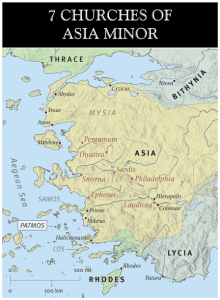
John, who had previously written a Gospel, and three Epistles, here merely identifies himself as John, being undoubtedly, well known and recognized in, and by, these congregations whom he is about to address. These congregations, seven in number, were in what was then known as Asia; but which we of today would call Asia Minor – near the southeastern part of Europe, and to the southwest of Asia proper.
“… in harmony … with the rest of the book, ‘the seven churches which are in Asia’ must be symbolic; and as the book is chiefly history written beforehand, they must symbolize seven successive stages in the history of the Christian church, covering the period between the first advent and the second coming of Christ. The fulfillment, we think, proves the correctness of this position.” (R5992:2)
The meaning of the word “Asia” is “muddy”!¹ Perhaps this was intended to indicate that the Church of Jesus Christ throughout its seven stages of development would be situated where the “waters of truth” would not be very clear and clean; being often mixed with the defiling influences of human philosophies, traditions and the precepts of men. And who is there that will deny that this has been the case?
“The word Asia means muddy or boggy. Anyone doomed to a long journey through a wild bog would, we think, before he got through, have a tolerably correct idea of the pathway of the church during the past 1800 years; especially if the greater part was travelled in comparative darkness – what with pitfalls and treacherous ground, with will o’the wisps and fog, it would prove a hard journey. True, the church has always had a polar star, but the mists of the Babylonian mystery had nearly hidden it.” (R336:2, W. I. Mann)
“Muddy” … Contamination!
“… the period of the church’s purity and fervor, before she left her first love. But as time passed, and the expected Lord came not, the love of many waxed cold and their hopes turned in other directions. Then, as Christianity became formalistic, Grecian philosophers came into the church, and the doctrines of Christ became blended with heathen mythologies, producing the great apostasy, or falling away from the true faith foretold. (2 Thes. 2:3) Nevertheless, there was always a faithful, though small minority, who clung to the truth; for the Lord has never left his truth without witnesses.” (R1093:4)
“Many things in Christianity commended it to the Greek philosophers of the time.… They were…teaching a future, eternal life, and were glad to find Christians teaching the same: the difference being that the philosophers (Plato and others) taught that eternal life is a human quality, and inherent power in mankind – deathlessness, immortality, whereas the Christians taught that eternal life was not inherent in man but a gift of God through Christ, intended only for those who accept him. (Rom. 2:7; 5:15, 21; 6:23; 2 Cor. 9:15)” (E285)
The Apostle Paul seems to have anticipated just such a contamination, such a pollution of the “waters of truth” when he declared that after his departing “grievous wolves” would enter in, not sparing the flock (Acts 20:29); yea, even of themselves, would arise men speaking perverse things to draw disciples after them (Acts 20:30); in fact, he even recognized that the “mystery of iniquity” was then already at work! (2 Thes. 2:7)
“This Mystery of Iniquity (‘Babylon,’ Confusion, Christendom) the Apostle Paul declares was already beginning to work amongst the Lord’s people in his day; but the working was evidently but slight until after the death of Paul and the other apostles. While the apostles remained with the Church they were able to point out some of the false teachers through whom the Adversary was seeking privily, privately, secretly, to bring in damnable heresies to undermine the faith and to turn the faithful aside from the hopes and promises and simplicities of the Gospel. (2 Pet. 2:1) The Apostle Paul speaks also of some of these in general terms, as beginning the workings of iniquity: but he names some of them personally, Hymenaeus and Philetus, et al., ‘who concerning the truth have erred,’ etc., ‘overthrowing the faith of some.’ (2 Tim. 2:17) Respecting these false teachers and their errors, he again warned the Church through the elders at Ephesus, especially pointing out that these would flourish after his death – grievous wolves, they would not spare the flock. (Acts 20:29) This last is remarkably in accord with our Lord’s prediction in the parable. (Matt. 13:25, 39) Our Lord clearly shows that these false teachers and their false doctrines were the agencies of the Adversary who sowed the tares amongst the wheat that he and the apostles had planted. He says, ‘While men (the special servants, the apostles) slept, an enemy came and sowed tares’.” (F201)
Not long after the Apostles “fell asleep,” about the middle of the second century, attempts were made “to reconcile Christian doctrine with the speculations of Greek and Oriental philosophy,” (Outline of Christian History – Allen, p. 19); and as Kurtz says, “at a very early period Greek philosophy got mixed up with Christianity.” (Church History Vol. 1, p. 66)
¹“Asia. G.773. Medium – Middle; full of mud; Orient; the East; aurora: – Asia Minor, (Acts 2:9)” (Dictionary of Bible Proper Names – compiled by Cyrus A. Potts)
“Asia, (muddy, boggy)” (Emphatic Diaglott: Alphabetical Appendix to the New Testament)
Then too, the so-called Church Councils have done much to defile and pollute the waters of divine truth; but perhaps the most defiling and devastating thrust of all, has come from the “higher critics” who from Christian pulpits, and in Theological Seminaries, are casting grave doubts upon the authenticity of the Scriptures as the revealed Word of God!
Higher Criticism and the Bible “Higher criticism has much responsibility in connection with the growing lawlessness of the world. ‘The Law of the Lord is perfect, converting the soul’ – transforming the being. The higher critics in all of our colleges and seminaries are doing a terribly destructive work, in comparison to which the work of Voltaire, Thomas Paine and Robert Ingersoll were as nothing. It is safe to say that three-fourths of all the graduates of all colleges within the last thirty years have been unbelievers in the Bible, and that their influence has been used persistently to undermine the faith of others. The errors which led them to infidelity are liable to influence others. The Bible itself is a study, and only what it teaches should be believed whether favorable to or contrary to our former creeds.” (R4923:5)
Lest there be any mistake as to who it was giving the message to the churches, John gives the greeting of “Grace be unto you and peace,” as coming from him: “which is, and which was, and which is to come.” But just who could this be?
The Father
Exod. 3:14 – “And God said unto Moses, I AM THAT I AM: and he said; Thus shalt thou say unto the children of Israel, I AM hath sent me unto you.”
Psa. 90:2 – “… even from everlasting to everlasting, thou art God.”
“I AM THAT I AM (Eheyeth asher Eheyeth): These words have been variously understood. The Vulgate translates EGO SUM QUI SUM, I am who I am. The Septuagint … I am he who exists. The Syriac, the Persic, and the Chaldee preserve the original words without any gloss. The Arabic paraphrases them, The Eternal, who passes not away; … It is difficult to put a meaning on the words; they seem intended to point out the eternity and self-existence of God.” (Adam Clarke’s Commentary; Exod. 3:14)
“… the meaning of Jehovah is underived existence, HE IS, or I AM BECAUSE I AM, the God of Abraham, of grace, and truth, and love; self-existence, eternity.” (Smith’s Bible Dictionary)
“The sacred name is derived from the verb ‘to be,’ and so implies that God is eternal … and that he is the Absolute, i.e., the Uncaused One.” (Zondervan Pictorial Bible Dictionary)
“The Almighty God has appropriated to himself and declared his name to be Jehovah, which signifies the ‘Self-Existing One’ or ‘The Immortal One’.” (E40)
The Son
Rev. 3:14 – “These things saith the Amen, the faithful and true witness, the beginning of the creation of God.”
Col. 1:15 – “Who is the image of the invisible God, the first-born of every creature.”
Rev. 11:17 – “We give thanks, O Lord God Almighty, which art, and wast, and art to come; be- cause thou hast taken to thee thy power, and hast reigned.”
Because of the fact that the following verse (Rev. 1:5) begins with the words, “And from Jesus Christ …” some have concluded that it is the Father who is There referred to. We do not agree, believing rather that it is Jesus, for the exact same words occur in verse 8, but are there preceded by “I am Alpha and Omega,” which surely designates him who was the very beginning of the creation of God (Rev. 3:14); and also his last direct creation – the one to whom all the rest of God’s creation was committed. (Col. 1:16)
and –
“The Apostle Paul adds his testimony in the same line, saying, He ‘is the image of the invisible God, the first-born of all creation; for by him were all things created.… All things were created by him and for him.’ (Col. 1:15) The heavenly Father had no beginning, but is from everlasting to everlasting the same. Our Lord’s great honor is shown in that he was not only the first of God’s creation, but the last.” (R1514:6)
That he is also in this verse 8, called “the Almighty,” seems only to indicate that the prophecy of Isa. 9:6 – to the effect that he was to be “the mighty God” – was fulfilled when the Father gave to him “all-power … in heaven and in earth.” (Matt. 28:18) The phrase, “and from Jesus Christ” of verse 5 seems here merely to have been used for emphasis: a similar instance occurs in 1 Thes. 3:11, which in the Diaglott is rendered, “God himself even the Father,” instead of “God himself and the Father,” as per the Authorized Version.
The Father cannot properly be referred to as, he “who was,” or he “who is to come,” for he IS from “everlasting to everlasting.” With the Father there is no past, and there will be no future, but only, and ever, an eternal present! The Psalmist was right when he declared, “Before the mountains were brought forth or ever thou hadst formed the earth and the world, even from everlasting to everlasting, God, thou art.” (Psa. 90:1)
Accordingly, we believe, that this greeting, this salutation, comes from Jesus –
“which is” – now the “express image” of the Father’s person (Heb. 1:3), having been “highly exalted” (Phil. 2:9) and made a partaker of the divine nature (2 Pet. 1:4), and
“which was” – in the beginning, as the WORD with God (John 1:1); and as God’s active agent, he was the creator of all things. (John 1:3) He thus Thad a glory with the Father before the world was (John 17:5); which glory he left, when he who was rich became poor (2 Cor. 8:9), when he “emptied” himself – made himself “of no reputation” (Phil. 2:7) and became the man Christ Jesus, in order that he might give himself a “ransom for all.” (Matt. 20:28; 1 Tim. 2:6) Then, being found in fashion as a man, he “Thumbled himself, and became obedient unto death, even the death of the cross.” (Phil. 2:8) This merited for him, the Father’s exaltation (Phil. 2:9), and
“which is to come” – to establish God’s Kingdom, for which we have long prayed, “Thy Kingdom come, Thy will be done on this earth as it is in heaven.” (Matt. 6:10) Yea, he will come “with ten thousands of his saints” (Jude 14), as the glorified Kingly Priest “after the order of Melchizedek” (Heb. 5:10; 7:17, 24-27); and as “the Seed of Abraham” to bless all the families of the earth. (Gen. 22:17,18)
John continues, “and from the seven Spirits which are before his throne” – a symbolism, no doubt, of the one holy Spirit of God, variously defined in the Scriptures as:
“‘The Spirit of God,’ ‘The Spirit of Christ,’ ‘The Spirit of Holiness,’ ‘The Spirit of Truth,’ ‘The Spirit of a Sound Mind,’ ‘The Spirit of Liberty,’ ‘The Spirit of the Father,’ ‘The Holy Spirit of Promise,’ ‘The Spirit of Meekness,’ ‘The Spirit of Understanding,’ ‘The Spirit of Wisdom,’ ‘The Spirit of Glory,’ ‘The Spirit of Counsel,’ ‘The Spirit of Grace,’ ‘The Spirit of Adoption,’ ‘The Spirit of Prophecy’.” (E167)
“Seven” is identified with what is divine in its nature, therefore it is that which is perfect and complete by divine standards. And as the “seven churches” represent but the one church in its seven stages, so too, the “seven Spirits” here represent the one holy Spirit of God in its manifold aspects and operations. Thus do these “seven Spirits” represent –
“… the divine will, influence, or power, exercised any and everywhere, and for any purpose in harmony with the divine will, which, being a holy will, implies that the steps and operations of the holy Spirit will be in harmony with holiness. God exercises his spirit or energy in many ways, using various agencies in accomplishing various results.” (E182)
We are also to understand –
“… these various expressions as descriptive of the spirit, disposition and power of one God, our Father; and also the spirit, disposition and power of our Lord Jesus Christ, because he is at one with the Father.” (E168)
This Spirit of the Lord, emanating from the throne, is everywhere present:
“Whither shall I go from thy spirit? or whither shall I flee from thy presence? If I ascend up into heaven, thou art there: if I make my bed in hell, behold thou art there. If I take the wings of the morning and dwell in the uttermost parts of the sea, even there shall thy hand lead me.” (Psa. 139:7-10)
Thus is the Spirit of God, the Spirit of the Lord, like an all-seeing eye:
“… seven eyes, which are the seven spirits of God sent forth into all the earth.” (Rev. 5:6)
“We are to recognize also that the eyes of the Lord are upon all his people and upon all their interests, to note their tears and their joys, their trials and difficulties and their prosperity, to care for all their interests.
“In this symbolical picture the eye of the Lord is represented as seven or complete all-seeing, everywhere, all-knowing. This is our confidence, this is our rejoicing.” (R3651:5)
Thus also is this Spirit of God like a lamp whose rays of light, can, and ultimately will dispel all darkness:
“… seven lamps burning before the throne, and they are the seven Spirits of God.” (Rev. 4:5)
1:5 – “And from Jesus Christ, who is the faithful witness, and the first begotten of the dead, and the prince of the kings of the earth. Unto him that loved us, and washed us from our sins in his own blood.”
As already suggested, we believe this phrase is here used for emphasis to amplify, as it were, the thought expressed in verse 4 concerning him “which is, and which was, and which is to come,” and who by his own sacrifice, made possible for the Church, the indwelling of that holy Spirit, and its ultimate access into the very presence of God. (Heb. 10:19, 20) It has reference to him who as our Advocate, has borne a “faithful witness” unto the Father, on our behalf. (Heb. 9:24) Accordingly, he is “the faithful witness.”
However, it is important also to note the witness he bore for the heavenly Father, while he lived here among men; which faithful witness he could not have given without faithfulness and loyalty to that divine will.… Already at the age of twelve, he would be about his Father’s business; i.e., his Father’s house (Luke 2:49); and on reaching the proper age according to the Law, he lost no time in consecrating and dedicating himself to the doing of his Father’s will. (Luke 3:21, 23; Heb. 10:7, 9) Let it be carefully noted that throughout all of his ministry he declared that his words and works were not his own, but the Father’s (John 5:19, 30; 6:38; 7:16, 28; 9:4; 12:4-9);
and in, and by his death, he bore witness – a faithful witness to the Father’s love. (John 3:16) Truly, John was right in declaring him to be “the faithful witness.”
As a reward for his faithful witnessing to the Father’s love, he was highly exalted, and given a name that is above every name (Phil. 2:6-11); and this, by way of the resurrection from the dead; yea, he was the “first-born from the dead.” (Col. 1:18 Diaglott; 1 Cor. 15:20; Acts 26:23) Thus verse five (Rev. 1:5) –
“… clearly teaches what the creeds of Christendom ignore, and what is in direct antagonism to their statements; namely, that the risen Christ was ‘the first-born of the dead.’ That is to say, our Lord was the first to experience a resurrection in the full sense of the word, the first to experience a resurrection to perfection and eternal life. Although some before him were temporarily awakened, they relapsed again into death; for they were only partial illustrations of resurrection, to assure men of the divine power to accomplish it fully in the due time appointed of God.” (R5991:3,6)
The Name Jesus – “Yahshua!”
“Jesus,” however, is the English equivalent of the Greek Ἰησοῦς which in turn is the translation of the Hebrew “Yahshua!” Unfortunately, there is always something lost in the translation.
When the risen Lord Jesus overtook Saul of Tarsus on the Damascus road still breathing out threats upon the followers in the “Way” (Acts 22:4), the latter heard a voice from heaven in the Hebrew tongue, saying, “Saul, Saul, why persecutest thou me?” (Acts 26:12-14) To this Saul responded with, “Who art thou, Lord?” to which he received this answer (in the Hebrew tongue) “I am Jesus!” (Acts 26:15) However, since this was in the Hebrew tongue, the Lord must have called himself “Yahshua,” which means “Yahweh (Jehovah) is the Savior.”
In E33, Bro. Russell had this to say:
“Jehovah God claims for himself the authorship of the great plan of Atonement.… In harmony with this are numerous statements of the Scriptures, ‘I am Jehovah thy God, the Holy One of Israel, thy Savior.’ Again, ‘I am Jehovah, and beside me there is no Savior.’ ‘I Jehovah am thy Savior and thy Redeemer, the Holy One of Jacob.’ And again, ‘I am Jehovah thy God from the land of Egypt, and thou shalt know no God but me; for there is no Savior beside me.’ Again, ‘To the only wise God, our Savior, be glory and majesty, dominion and power, both now and ever, amen.’ Again, ‘We trust in the living God, who is the Savior of all men, especially of those that believe.’ (Isa. 43:3, 11; 60:16; Hosea 13:4; Jude 25; 1 Tim. 4:10; Titus 1:3; 2:10)”
And, aside from this, it should be carefully noted, that Jesus while he was here on the earth, never did claim anything that he said or did to be his own. Note, if you will, his own words to this effect:
John 7:16 – “My doctrine is not mine, but his that sent me.”
John 14:24 – “The word which ye hear is not mine, but the Father’s which sent me.”
John 9:4 – “I must work the works of him that sent me.”
John continues, “and the prince of the kings of the earth.” The term prince, as here used, has the significance of a ruler or sovereign.
“… we have Christ Jesus our Lord … the one who, through faith and obedience to the Father, has prevailed, has overcome the world and the flesh and the Adversary, and has received the divine blessing as the result of his struggle. He has been highly exalted and is declared now to be prince or ruler of the kings of the earth. He has sat down with the Father in his throne. (Rev. 1:5)” (R2866:1)
Thus is Jesus designated the “prince” – but who are the “kings”? Surely not the world of mankind, for the kingdom will not be turned over to them until the end of the Millennial age! This then leaves only the Saints – the Church, and it is in harmony with this thought that we read in Rev. 5:10; 20:6 of those who are to be made Kings and Priests, and are to reign with the glorified Jesus for a thousand years. (See also Rev. 1:6)
“… a government is suggested in the Bible, and there it is accurately described and positively promised and waits only for the selection of God’s Church – to be its kings and priests as joint-heirs with Immanuel. (Rev. 5:10; 20:6)” (D425)
“All are to be awakened from Adamic death as though from sleep, by virtue of the ransom given: this will be the first step in restitution blessings. They will then be under the care, charge, supervision, of the Royal Priesthood, whose experience with sin, and with victory over sin, in this Gospel age, will well fit and prepare them to be patient and helpful toward those over whom they will reign, as Kings as well as Priests. (Rev. 5:10)”(E478)
Rev. 5:10 – “… and didst make them to the God of us a kingdom and priests, and they will reign on [over ?] the earth.” (Marshall’s Translation)
Here John, for himself, and for you and me, bursts into a paean of praise and glory, unto him, Jesus, “who loved us” so much, that in a particular sense, he gave his life for us! (Gal. 1:4; Titus 2:14; Eph. 5:25) and “washed us from our sins in his blood.”
“That it was the death of the man Christ Jesus, his ‘blood,’ that secured our release from sin and death, is most unequivocally stated in many scriptures, and can only be repudiated by denying the inspiration of the Scriptures, or by ‘wresting the Scriptures,’ or by ‘handling the Word of God deceitfully.’ (1 Pet. 1:2; Acts 4:12; 20:28; Rev. 5:9; Heb. 13:12)” (E446)
“… our Lord Jesus, after his resurrection, ascended up on high and appeared in the presence of God ‘for us,’ on our behalf; for he ‘bought us with his own precious blood’ – with the merit of his sacrifice of earthly rights. He could have bought the world just as easily, but he followed the divine plan and bought the Church. ‘Christ loved the Church and gave himself for it.’ (Eph. 5:25)” (R4528:2)
1:6 – “And hath made us kings and priests unto God and his Father; to him be glory and dominion for ever and ever. Amen.”
The Kingdom and Priests!
“made us kings and priests unto God and his Father”
(KJV)
“made us a kingdom, priests to his God and Father”
(RSV)
“made us to be a kingdom, to be priests unto his God and Father”
(ASV)
“made us a kingdom of priests for his God and Father”
(An. Amer. Tr.)
“made us a kingdom and priests serving his God and Father”
(Beck)
“made us into royalty, into priests of God, even his Father”
(Berkeley)
“made us to be a kingdom of priests unto his God and Father”
(Montgomery)
“made us a kingdom of priests to his God and Father”
(Phillips)
“made us a Kingdom of Priests in the service of God his Father”
(20th Century)
“formed us into a kingdom, to be priests for his God and Father”
(Weymouth)
“made us a kingdom of priests for his God and Father”
(Williams)
“and formed us into a kingdom (a royal race), priests to His God and Father”
(Amplified)
“made us a kingdom of priests to serve His God and Father”
(Good News Bible)
“made us a line of kings, priests to serve his God and Father”
(Jerusalem)
“gathered us into This kingdom and made us priests of God his Father”
(Living Bible)
“made us a spiritual kingdom to God his Father”
(Lamsa)
“established us a Kingdom, priests to God and his Father”
(Fenton)
“made us (to be) a kingdom – priests unto his God and Father”
(Rotherham)
“made us to be a kingdom, priests to his God and Father” (New World Tr.) “made us a kingdom every member of which is a priest to his God and Father”
(Barclay)
“made for us a Kingdom – Priests for his God and Father”
(Emphatic Diaglott)
“made us a kingdom, priests to the God and Father”
(Marshall)
Exod. 19:6 – “And ye shall be unto me a kingdom of priests.” (KJV; Leeser; JPS)
John’s song continues, “and hast made us kings and priests unto our God.” Most modern translators have rendered this text with the sense of “hast made us a kingdom, priests to his God and Father.” It is true, this rendering is more in accord with its correlative passage in the Old Testament (Exod. 19:6) wherein the promise to Israel was that if they would hear his voice and keep his covenant, they would be unto God, “a kingdom of priests,” “a royal priesthood,” as it were. (1 Pet. 2:9) Nor does this thought of a kingdom of priests belittle the thought of the kingship of the saints! Royal means kingly – thus they will be a kingly order of priests, after the order of Melchizedek – to reign with Christ their “Prince” (Rev. 1:5) for the thousand years. (Rev. 20:6)
“… the present mission of the Church is the perfecting of the saints for the future work of service; to develop in herself every grace; to be God’s witness to the world; and to prepare to be kings and priests in the next age.” (Eph. 4:12; Matt. 24:14; Rev. 1:6; 20:6) (R5822:2, 5)
“It will be the Kingdom of the saints, in that they are ‘a royal priesthood’ (Rev. 5:10) shall reign and judge and bless the world in conjunction with their Lord, Jesus. (Rom. 8:17, 18)
“The Kingdom class proper will consist only of our Lord and his ‘elect’ of the Gospel age, to whom he said: ‘Fear not, little flock, it is the Father’s good pleasure to give you the kingdom.’ Of these, also, the Lord said to the Prophet Daniel, ‘The Kingdom and dominion, even the majesty of the Kingdom under the whole heaven shall be given to the people of the saints of the Most High, whose Kingdom is an everlasting Kingdom, and all rulers shall serve and obey him.’ (Dan. 7:27)” (D618)
“Aaron, robed and anointed, represented the entire Christ – the complete Seed of Abraham, in which God is about to bless all the families of the earth. But let us not forget that we have been viewing the Great Deliverer from God’s standpoint, and with him looking down to the time of his manifestation – the dawn of the Millennial Day, when all the members shall have come into the Body, and when the ‘holy oil’ shall have run down ‘to the skirts of his garments,’ anointing every member. (Lev. 10:7) Then he will begin the work of blessing mankind. For the glorious reign of this Kingly Priest we constantly pray, ‘Thy Kingdom come, thy will be done on earth’.” (T38)
John, through the indwelling of the holy Spirit, had evidently become so like God, that he felt even as God himself did about Jesus’ worthiness of everlasting glory and dominion; and so he expresses himself: it is on this note – “to him be glory and dominion for ever and ever” that his song ends.
There is a prophecy bearing on our King’s glory and dominion in one of the psalms attributed to Solomon. It tells us –
“… of the glorious reign of the risen and ‘highly exalted Son of God, whose coming presence shall be like rain upon the mown grass, and as showers that water the earth’ – ‘times of restitution,’ truly.
“How wide shall be his dominion? Oh, says the Psalmist, ‘He shall have dominion from sea to sea and from the river to the ends of the earth.’ (Psa. 72:8) Yes, ‘as truly as I live,’ saith the Lord, ‘the whole earth shall be filled with the glory of the Lord.’ (Psa. 72:19)” (R1414:6; 1415:1)
Isa. 9:6, 7 – “For unto us a child is born, unto us a son is given: and the government shall be upon his shoulder: and his name shall be called Wonderful, Counselor, The mighty God, The everlasting Father, the Prince of Peace. Of the increase of his government tThere sThall be no end, upon the throne of David, and upon his Kingdom, to order it, and to establish it with judgment and with justice from henceforth even forever. The zeal of the LORD of hosts will perform this.”
The “Amen” with which John’s hymn of praise is actually concluded, is here an “affirmation and approbation; so it shall be, and so it ought to be.” (Clarke)
1:7 – “Behold, he cometh with clouds; and every eye shall see him, and they also which pierced him: and all kindreds of the earth shall wail because of him. Even so, Amen.”
Of course, it is Jesus himself, who is specifically referred to here – “Behold The cometh with clouds; and every eye shall see him,” for John adds, “and they also which pierced him.” This latter clause could apply to Jesus only.
However, as Enoch of old prophesied, the saints shall be with him (Jude 14) when he comes; and with him will constitute The Christ – the “Seed of Abraham” (Gal. 3:29), through whom all nations are to be blessed. (Gen. 22:18)
“Christ and the glorified church, made ‘partakers of the divine nature,’ will be spirit beings, invisible to men. Our Lord’s presence will be manifested to the world by exhibitions of power and great glory. He will not be visible to natural sight, but to the eyes of understanding, as these shall open to an appreciation of the great changes which earth’s new Ruler shall effect. His presence and his righteous authority will be recognized in both the punishments and the blessings which will flow to mankind from his reign.
“Our King will reveal himself gradually. Some will discern the new Ruler sooner than others. But ultimately ‘every eye shall see [Greek, horao, discern] him.’ But ‘The cometh with clouds.’ And while the clouds of trouble hang heavy and dark, when the mountains – kingdoms of this world – are trembling and falling, when the earth – organized society – is being shaken and disintegrated, some will begin to realize that Jehovah’s Anointed is taking to himself his great power and is beginning his work of laying justice to the line and righteousness to the plummet. For he must reign until he shall have put down all authority and laws on earth which are contrary to those controlling in heaven.” (R5992:1,4; B138)
“It is doubtless this same blessing of all the people – salvation from death and its sting, sin – that Paul refers to, saying, ‘Unto Them That LOOK For Him Shall He Appear The Second Time Without Sin [not again as a sin-offering, and without contamination from those sins borne for sinners] unto Salvation.’ (Heb. 9:28) The world has seen the Priest – Head and Body – suffer as a sin-offering during this age; Jesus was manifested to the Jews in the flesh (as a sin-offering), and as Paul could say, so can all followers in his footsteps say, ‘Christ is manifest in our mortal flesh.’ (2 Cor. 4:11) As the whole Christ has thus been manifest and has suffered in the flesh, so they shall also be ‘glorified together’ before the world; ‘for the glory [the blessing and salvation] of the Lord shall be revealed, and all flesh shall see it together.’ When he shall appear, we also shall appear with him in glory. (Col. 3:4)
“But this great High Priest of the world will be recognized only by ‘them that look for him.’ If he were to appear a flesh-being, in the sky or elsewhere, it would be an appearance to all, whether looking for him or not; but we have already seen that the Scriptures teach that the Head has been perfected as a spirit being, and that his ‘little flock’ will be made ‘like him,’ spirit beings, of the divine nature, which no man hath seen nor can see. (1 Tim. 6:16) We have seen that the way in which the world will see the glorified Church will be by mental perception, in the same sense that a blind person may properly be said to see. In the same sense we now see the prize, the ‘crown of life,’ ‘while we look not at the things which are seen but at the things which are not seen [by physical sight]; for the things which are seen are temporal, but the things which are not seen are eternal.’ (2 Cor. 4:18) It is in this way that the entire Church of this age has been ‘looking unto Jesus’; thus ‘we see Jesus.’ (Heb. 2:9; 12:2) Thus, with the eyes of their understanding, the ‘Watchers’ discern the second presence of the Lord in its due time, by the light of the divine Word. And later on the world, every eye, shall see him in similar manner, but by the light of the ‘flaming fire’ of his judgments. (2 Thes. 1:8)” (T84-85)
The Clouds
“The ‘clouds of heaven’ well represent the confusion in general. The world for a time will be in ignorance of his presence. But gradually they will come to know that they are in the time of trouble, the day of wrath, in which this age is to close. Then they will mourn. The whole world will be mourning. If the world has mourned in the past, much more shall we expect it to do so when the trouble will be general. In the midst of that trouble, they will gradually learn of the grace of God. Human selfishness, they will find, has been so overruled as to lead up to the glorious kingdom of Messiah, through which are to come all the blessings which God has promised.” (R5269:5)
We are told by John that “they also which pierced him” would “see” him. There is much talk today to the effect that it was not the Jews, but the Romans that crucified and “pierced” our Lord. But surely, the Romans would never have done so, had the Jews not turned him over to them, when they themselves cried out “Crucify him.” (Mark 15:12-15) Israel then, and ever since, rejected him who “came to his own” but was not received by them. (John 1:11; Isa. 53:1-3) Yes, Israel must assume this responsibility; but how comforting it is to know that the Lord promised: “… I will pour upon the house of David, and upon the inhabitants of Jerusalem, the spirit of grace and of supplications; and they shall look upon me whom they have pierced, and they shall mourn for him, as one mourneth for his only son, and shall be in bitterness for him, as one that is in bitterness for his first- born.” (Zech. 12:10)
“… through the Prophet, God has assured us that in due time all the blind eyes will be opened and all the deaf ears will be unstopped. (Isa. 35:5) To the Jew first, and also to the Gentile, will eventually come a full knowledge of the grace of God through Christ. It will then be for them to accept or reject intelligently. The rejectors will be wicked in a sense that none of the world are wicked now, because their wrong- doings are largely based upon ignorance and superstition. When brought to the full light, their crisis, or judgment, will be to everlasting life if they accept and obey the Lord, or to everlasting death if they sin against and wilfully reject the light and opportunities of that blessed Millennial day.
“Respecting the Jews in that coming time, it is written that they shall look upon him whom they pierced, and mourn because of him; and that the Lord at that time will pour upon them the spirit of prayer and of supplication. (Zech. 12:8-10) But that return of God’s favor to natural Israel will not come until spiritual Israel shall first have been completed. Bible Students believe that we are now at the dawning of the new dispensation, that the Church class will soon be completed and glorified with the Savior in his kingdom, and that then, forthwith, God’s mercy will begin to operate toward the Jews again. This seems to be the clear teaching of St. Paul in Rom. 11:25-32.” (R5832:3, 4)
Zech 12:10 “… and they shall look upon me whom they have pierced.”
“‘Mr. Rabbinowitz says that Jews have kept up great questionings and controversies about the meaning of Zech. 12:10. They will not admit that it is Jesus whom they have pierced, hence the dispute as to who is meant. Mr. Rabbinowitz points out that the word used consists of the first and last letters of the Hebrew alphabet, Aleph Tay, and adds: ‘Do you wonder, then, that I was filled with awe and astonishment when I opened to Rev. 1:7, 8 and read these words of Zechariah quoted by John, ‘Behold, he cometh … and every eye shall see him, and they also that pierced him,’ and then heard the glorified Lord, saying ‘I am the Alpha and Omega.’ Jesus seemed to say to me, ‘Do you doubt who it is who you have pierced? I am the Aleph Tay, the Alpha Omega’.” (R1948:4)
Messiah’s Glorious Kingdom
“The Apostle tells of this, saying, ‘Him hath God highly exalted, and given him a name which is above every name’ – a title and honor, a distinction, a place above all others. (Phil. 2:9-11) He was received into glory; and all the angels of God worshipped him whom the Father had thus exalted to his own right hand, giving him, additionally to what he had resigned, glory and immortality – the divine nature. Well can we understand the acclaim of the heavenly ones: ‘Worthy is the Lamb that was slain to receive power, riches, wisdom, strength, honor, glory and blessing.’ (Rev. 5:12)
“But there is more glory yet to come to the great Redeemer. Those who crucified him, yea, all the world of mankind, for whom he tasted death, are yet to be made aware of his great sacrifice on their behalf and of the great honor and high exaltation which came to him as a result. He is to be the world’s King of Glory and is to reign for a thousand years. As verse 10 (Phil. 2:10) declares, eventually every knee on the earth will bow, and every tongue will acknowledge him; and all others not willing thus to recognize and obey him are to be destroyed from amongst the people as ‘natural brute beasts.’ (2 Pet. 2:12; Jude 10) ‘And it shall come to pass, that every soul which will not hear that Prophet shall be destroyed from among the people.’ (Acts 3:23) And all this glorifying of the Son will directly be to the Father’s glory; for the entire plan of salvation is of the Father and through the Son, as the Apostle assures us. (1 Cor. 8:6)” (R5847:2, 4)
“And all kindreds of the earth shall wail because of him.” This clearly teaches:
“… that at the time of our Lord’s second advent the world will be far from converted to God; for ‘all kindreds shall wail because of him.’ Some Scriptures taken disconnectedly seem to teach that the world will be converted before his return; but when God’s Word and plan are viewed as a whole, these will be found to favor the opposite view – that Christ comes before the conversion of the world and for the very purpose of converting all mankind; and that the glorified church of the Gospel age shall share with her Lord and Head in his reign, which is God’s appointed means of blessing the world.” (R5991:6; 5992:1)
“… the testimony of the Scriptures … that at the time of our Lord’s second coming the world will be far from converted to God; that ‘In the last days perilous times shall come, for men shall be lovers of pleasure more than lovers of God’ (2 Tim. 3:1-4); that ‘Evil men and seducers shall wax worse and worse, deceiving, and being deceived.’ (2 Tim. 3:13)
… The Master’s special warning to his little flock: ‘Take heed to yourselves lest that day come upon you unawares, for as a snare shall it come on all them [not taking heed] that dwell on the face of the whole earth.’ (Luke 21:34, 35) Again, we may rest assured that when it is said, ‘All kindreds of the earth shall wail because of him,’ when they see him coming (Rev. 1:7), no reference is made to the conversion of sinners. Do all men wail because of the conversion of sinners? On the contrary, if this passage refers, as almost all admit, to Christ’s presence on earth, it teaches that all on earth will not love his appearing, as they certainly would do if all were converted.” (A90)
“As the trouble increases, men will seek, but in vain, for protection in the ‘dens’ and caves, the great rocks and fortresses of society (Free Masonry, Odd Fellowship, Trade Unions, Guilds, Trusts, and all societies secular and ecclesiastical), and in the mountains (governments) of earth; saying, ‘Fall over (cover, protect) and hide us from the face of him that sitteth on the throne, and from the wrath of the Lamb; for the great day of his wrath is come.’ (Rev. 6:15-17)” (B139)
“Even so, Amen.” What John has said concerning the “Coming One” is, of course, prophetic: it indicates that the Lord’s presence will in the beginning, not necessarily induce joy! The “clouds” of the time of trouble, the guilt complex of those who “pierced” him, the wailing of the kindreds of the earth, bespeak much to the contrary. But, without these, the very purpose of the Lord’s return would fail. Therefore, these things must be: they are the necessary prelude to the blessings to follow. And so, John says, “Even so, Amen” – yes Lord, so let it be!
1:8 – “I am Alpha and Omega, the beginning and the ending, saith the Lord, which is, and which was, and which is to come, the Almighty.”
“The beginning and the ending”
“the Almighty”
“I am Alpha and Omega, the beginning and the ending, saith the Lord (God – Κυριοl Ò Θεοl), which is, and which is to come, the Almighty (παντοκρατωρ).”
The words “the beginning and the ending,” according to the Tischendorf New Testament, while appearing in the Sinaitic MS., do not appear in the Alexandrine. Most modern translators (Rotherham, Weymouth, Goodspeed, Wilson, Marshall, and Montgomery) have eliminated them from the text. Both the American Standard and the Revised Standard versions have dropped them also. However, Lamsa, in his translation from the ancient Syriac “Peshitta” and Knox, in his translation from the Latin Vulgate, have retained them.
Seemingly, it ought not make any difference one way or the other, since the significance of alpha and omega, is really “the first and the last” – the beginning and the ending of the Greek alphabet. Bro. Russell, perhaps on the basis of the Tischendorf New Testament, accepted them as genuine. (R1514:3, 6)
In the Old Testament, JEHOVAH is referred to as “the first and the last” as follows:
Isa. 41:4 – “I the LORD [Jahweh], the first and (with) the last. I am he.”
Isa. 44:6 – “I am the first, and I am the last, and beside me there is no God [elohim].”
However, this is not in the same sense in which the term is applied unto Jesus, who in his prehuman existence was “the beginning of the creation of God [theos]” (Rev. 3:14), “the first-born of every creature,” (Col. 1:15); thus, the only direct creation of Jehovah-God, and also the last! (SM491) As concerning Jehovah-God, the term is used in the sense that the great “I AM” (Exod. 3:14) has always been, and there was none before Him, nor ever will be after Him! In other words, HE is the only (such) God, and thus do we read in Isaiah (Green’s translation):
Isa. 44:6 – “Thus says Jehovah [Jahweh] the King of Israel, and his [Israel’s] redeemer, Jehovah [Jahweh]; I [am] the first and the last; and no God [elohim] exists except me.”
Only Jesus is referred to in the Scriptures as the Alpha and Omega, and this only in the New Testament. (Rev. 1:8; 21:6; 22:13) However, in the Old Testament, in Zech. 12:10, there is a prophetic reference to Jesus, as declaring:
“… and they shall look upon me whom they have pierced.”
It just so happens that the word “me” is spelled with but two letters – the Hebrew “aleph” and “tau”– the first and the last letters in the Hebrew alphabet – a very close correspondency to the alpha and omega of the Greek alphabet, also there the first and the last! (See R1948:4) Accordingly, it would seem quite logical to consider the “beginning and the ending,” and “the Lord, which is, and which is to come,” and “the Almighty” of Rev. 1:8, as having reference to Jesus, and not to Jehovah-God, per se. (See R1514:3, 6)
When Jesus was here on the earth, he already was an image of Jehovah-God, the heavenly Father (John 14:9-11); yet, even more so after his resurrection from the dead. (Col. 2:9; but see also T124)
It is true, in the Old Testament, the Hebrew term used in connection with Jehovah (Jahweh), though it is not His name, is “el shaddai” (Almighty – Exod. 6:3); but the term used in connection with Jesus, though it is not His name either – is “gibbor” (mighty – Isa. 9:6). However, one of the names that God did use “I AM” (Exod. 3:14) was used by the Logos (as the honored servant of Jehovah-God) Jesus, in his prehuman state. Concerning this, Bro. Russell said the following:
“… if the name were to be applied to another it would merely indicate that such servant was highly esteemed by Jehovah and really treated for the occasion as a steward or representative – commissioned to exercise divine power as well. In Exod. 3:2, we are distinctly informed that the one representing Jehovah and using his most distinguished name ‘I am’ was ‘the angel (messenger) of Jehovah.’ That this honored messenger was ‘the Word’ of John 1, (John 1:1), our Lord Jesus in his prehuman estate, we do not for a moment question. But the highest and most honored messenger should not be confounded with the one whom he represents and in whose name he speaks and whose power he exercised and bestowed upon Moses.” (E43)
The name of Jehovah-God appears nowhere in the New Testament; but the name Jesus does frequently. The term God (Θεοl) occurs quite often, sometimes having reference to the Father (Matt. 3:9; John 1:1), and sometimes to the Son. (John 1:1; 20:28) Under these circumstances one must be guided by the context to know which is referred to.
The position of the one who once was the Logos, and later the man Christ Jesus, is quite different now since his exaltation. He is now more aptly called “the express image of his [the Father’s] person.” (Heb. 1:3) Shortly before his ascension into heaven, he declared unto his disciples –
(Matt. 28:18) – “all power is given unto me in heaven and in the earth.”
Actually, the word (ἐξουσία) rendered “power” should more correctly have been rendered “authority” though in the ultimate, the meaning is about the same! Yet the exercise of this power was purposely delayed until the “due time” for its exercise would arrive. (D621-622) The Greek word “pantokrator” (παντοκράτωρ) occurs ten times in the New Testament; and in nine instances it has been rendered “almighty,” in the Authorized Version, and once “omnipotent.” Eight of the nine instances occur in the Revelation. Here, as in the case of the Greek word “theos,” (Θεοl) as to whether it is the Father or the Son that it should be applied to, has to be determined by the context. The meaning of the Greek word is according to Young’s Analytical Concordance… “all powerful.” Since the “all power” (authority) of the Almighty God (Jehovah) has been committed to Jesus (Matt. 28:18) He very often becomes the Father’s representative in its exercise. The following is a quote from D622:
“‘We give thee thanks, O Lord God Almighty, which art to come, because thou hast taken thy great power, and hast reigned.¹ (Represented in Christ – ‘All things are of the Father,’ and ‘all things are by the Son,’ his honored representative) and (as a consequence of the reign begun) the nations were angry, and thy wrath is come, and the time of the dead, that they should be judged, and that thou shouldest give reward unto thy servants the prophets, and to the saints, and to them that reverence thy name, small and great; and shouldest destroy them which corrupt the earth.’ – (Rev. 11:17, 18)” (D622, 623)
¹ “Thy God reigneth”: (Isa. 52:7) “These with their message are clearly pointed out by the prophet as the ‘feet’ or last members of the body of Christ in the flesh, when he says: ‘How beautiful upon the mountains (kingdoms) are the feet of him that bringeth good tidings of good, that publisheth salvation (deliverance); that saith unto Zion, Thy God* reigneth.’ (The reign of Christ, which shall bring deliverance, first to Zion, and finally to all the groaning creation, is begun.)” (C236)
* “Thy God” (Hebrew – Elohim) in the Authorized Version applied to JEHOVAH (Gen. 1:1); Abraham (Gen. 23:6); Moses (Exod. 7:1); Judges (Exod. 21:6); Angels (Psa. 8:5); Saints (Psa. 82:6); Other gods (Psa. 86:8); JESUS (Isa. 52:7). (See also F67, 68)
The following is an excerpt taken from E78:
“The Blessed and Only Potentate, the King of Kings and Lord of Lords, who only Hath Immortality”– 1Tim. 6:15, 16
“Many consider this passage to signify that at his appearing, at his second advent, our Lord Jesus will exhibit or make known to the world the Heavenly Father’s greatness. But although that view has some reasonable aspects, we incline on the whole to apply the statement to the glory and honor of Christ – dating from the beginning of the Millennial age. True, he will cause all who accept his way to recognize Jehovah God also, but this will not be at his appearing, but at the close of his reign, when he shall ‘deliver the Kingdom to God, even the Father.’ (1 Cor. 15:24-28)
“To apply the passage to the Father would be to deny that our Lord possesses immortality, whereas the Scriptures explicitly teach that he and all who share in the First Resurrection obtain therein immortality and that thus the Father, who hath life-inherent (self- existence – immortality), gave to the Son that he should have life-inherent (self-existence – immortality). (1 Cor. 15:42-44, 53, 54; John 5:26)
“But to apply this Scripture to the Son seems to fit every condition perfectly, and by no means ignores the Father, Jehovah – nor proves that our Lord Jesus is the Father, Jehovah; for we are in all such cases to remember the invariable rule laid down by the inspired Apostle – namely, that in comparisons, honors, etc., mentioned respecting the Son, the Father is always excepted as being inexpressibly above all comparisons. His words are, ‘It is manifest that The (the Father) is excepted,’ and not to be considered under or subject to our Lord Jesus and the various powers conferred by the Father upon him. For when the Son shall have subdued sin in the world, ‘then shall the Son also himself be subject unto him (the Father) that did put all things under him (the Son).’ (1 Cor. 15:27)” (E78-79)
It seems to us this application applies also to the passages considered in connection with Rev.1:8! (R1514:3,6)
The Alpha and Omega
The word “me” in the Hebrew text of Zech. 12:10, “… they shall look upon me whom they have pierced.” is spelled with but two letters – א ת (aleph and tay), which are the first and the last letters of the Hebrew alphabet, and correspond to A and Ω the Greek letters for alpha and omega. Is this a mere coincidence? (See R1948:4)
“In them John tells the same story that our Lord tells us over and over again (See Rev. 1:8, 11, 17; 2:8; 3:14; 21:6; 22:13), that he is the beginning and the ending, the first and the last, of the creation of God.” (R1514:3, 6)
The “Almighty”
If Jehovah God is always accepted as being beyond comparison, then such titles as “Kings of Kings,” “Lord of Lords,” and the “Almighty,” may properly be applied to the glorified Christ Jesus. (See 1 Cor. 15:27, 28; R2747:6; 1 Tim. 6:15; Rev. 17:14; R1514:6; 1515:1)
Once again, John would identify the One who is about to give his last direct message to the Church (the seven churches which are in Asia), but this time he does so with Jesus’ own words, which according to the most ancient manuscripts (the Sinaitic included) are, “I am the Alpha, and the Omega.” The words, “the beginning and the ending,” may well be an interpolation, for they do not appear in either the Sinaitic or Alexandrine MSS. Griesbach, Lachmann, Tischendorf, Tregelles, Alford and Wordsworth all agree, they should be omitted. However, whether or not these words are spurious, the sense of them is retained in the “Alpha” and “Omega,” which being the first and the last letters respectively – the beginning and the ending of the Greek alphabet, and signify that our Lord Jesus Christ was both the beginning and the ending of God’s direct creation. (Rev. 3:14; John 1:3; Eph. 3:9)
“The Apostle Paul adds his testimony in the same line, saying, He ‘is the image of the invisible God, the first-born of all creation: for by him were all things created.… All things were created by him and for him.’ (Col. 1:15) The heavenly Father had no beginning, but is from everlasting to everlasting the same. Our Lord’s great honor is shown in that he was not only the first of God’s creation, but the last. From this we are to understand that the great Jehovah did not directly employ his own power in creating either men or angels; but that he delegated his power to his Only-begotten Son, using him as his honored agent and representative in every case, in every respect giving him the pre-eminence over all others; second only to himself.” (R1514:6)
The words which follow, according to the Sinaitic Mss., are “saith the Lord the God.” Many of the modern translations render this, “says the Lord God” – dropping the definite article “the” from before the word God, as being unnecessary. This much, however, is certain, the One speaking is both Lord (Κυριοl), i.e., Master, and a God (Θεοl), i.e., a mighty one, especially since his exaltation, he now being a possessor of the divine nature.
“LORD GOD” and “Lord God”
In the Old Testament one frequently comes upon the expression “LORD God” (e.g., Gen 2:7). The first part of this term is really the proper name of God – “Jehovah.” In the original Hebrew, this name appears as a tetragrammaton – four letters with no vowels corresponding to JHVH (Jahveh). This name of God being sacred, no one dared pronounce it; and on coming upon it would read it “LORD” (Heb. Adonai). This latter word, also, often occurs in the Hebrew text, when its significance is merely lord or master. At such times it is rendered “Lord,” (in our common version Bibles) with only the first letter capitalized. Thus the expression “LORD God” (Jehovah God) belongs to the Father alone. However, even in Old Testament times, the Logos, as his messenger or angel – coming in his name, might use the Father’s name to identify himself. (Gen. 18:1; Exod. 3:3-15)
“… we are distinctly informed that the one representing Jehovah and using his most distinguished name, ‘I am,’ was ‘the angel [messenger] of Jehovah.’ That this honored messenger was ‘the Word’ of John 1:1, our Lord Jesus in his prehuman estate, we do not for a moment question. But the highest and most honored messenger should not be confounded with the one whom he represents and in whose name he speaks and whose power he exercised.” (E43)
In the New Testament, the name of God never occurs. He is called “Father,” “God,” and “Lord.” But the term Lord God as used in the New Testament does, therefore, not necessarily refer to the Father, but more often to Jesus Christ. One must then be guided solely by the context. In Rev. 1:8 and 22:5, it would seem in the light of the context that this term “Lord God” (Κυριοl Ò Θεοl) should be applied to Jesus; for not only is he still the Father’s chief representative, but he has also been highly exalted by him, and made a partaker of his (i.e., God’s) own nature – the divine nature!
“… which is, and which was, and which is to come.” We cannot be too sure that these words here, are the words of Jesus himself, for it is possible that they are a gloss given by John. Nor does it really matter, for regardless as to who spoke them, Jesus is the One “which is, and which was, and which is to come” as already suggested in the comments on Revelation 1:4.
The Almighty
“… although our Redeemer had always occupied the place of honor in the heavenly courts, it was not until his faithful obedience to the Father had been tested to the extent of his changing nature to that of man, and then giving himself as fallen man’s ransom, that he received his present unexcellable glory and honor. It is since his resurrection that the message has gone forth, ‘all power in heaven and in earth is given unto me.’ (Matt. 28:18) Consequently it is only since then that he could be called the Almighty (as in Rev. 1:8). The heavenly Father has always been almighty, and this all-power or all-might was never given to him, but was his eternal possession. But now that he has given the same power to his Only-begotten and well- pleasing Son, our Saviour, both we and angels delight to know it, and delight to honor him whom the Father has so highly honored, and whom he has instructed us to honor, saying: ‘That all should honor the Son, even as they honor the Father’.” (R1514:6; 1515:1)
1:9 – “I John, who also am your brother, and companion in tribulation, and in the kingdom and patience of Jesus Christ, was in the isle that is called Patmos, for the word of God, and for the testimony of Jesus Christ.”
“Instead of adding loud and boastful titles to his name, as Reverend, Bishop, Overseer of all the Churches in Asia Minor, we find John introducing himself as ‘Your Brother,’ as the companion of all saints in tribulation and in the kingdom, and in the patient endurance of Jesus Christ. He was sharer with Christ, as a member of his body in his afflictions, in his endurance, and prospectively a joint-heir of the same glory. It is generally understood that John had already been severely persecuted, and that at the time of this vision he was in banishment on the little island in the Mediterranean Sea called Patmos – a penal island where convicts were worked in the quarrying of marble, etc. Yet John himself, with remarkable modesty, passes over not only his previous service for the truth, which had brought him his persecution, but also lightly passes over the persecution itself, merely noting that he was in the island of Patmos because of his fidelity to the word of God and the testimony that Jesus was the Christ.
“This simplicity, this absence of boastfulness so noticeable in the writings of all the apostles, commends them and their words to our attention, and marks them as being in the ministry not for the gratification of vanity, or seeking earthly rewards of any kind; but simply as the servants of God, who delighted to do his will, and to tell the good tidings, to the utter ignoring of themselves, excepting insofar as mention of themselves and their affairs might be necessary and helpful to the church. All the Lord’s followers do well to note this characteristic of the Master, and of those whom he specially chose to be his followers and our exemplars. In proportion as we attain to the Lord’s spirit it will similarly manifest itself in our sentiments and in all our conduct.” (R2826:3, 4)
“For a time, although there were persecutions of individuals such as are recorded in Acts, the believers as a whole were not subjected to the severest of trials at first. It was when the truth began to spread, and had not only the enmity of the Jews, but also of the Greeks, that emperors and governors found favor with the masses by persecuting the followers of Jesus. And for aught we know, so it will be in the not-far-distant future. For a long time the pure truth has been hidden from men and worldliness in the form of godliness has had the upper hand in influential circles; but doubtless, as the troublous times the Scriptures predict for the end of this age draw closer, those who will stand firm for the word of the Lord’s testimony may expect to be made the scapegoats under various pretexts. We shall not be surprised to find a considerable measure of persecution against all the children of the light, who will walk up to the light, developed within the next seven years. John, the beloved disciple, in some measure or degree typified or represented the last living members of the little flock. Doubtless this was the meaning of our Lord’s statement, ‘If I will that he tarry till I come, what is that to thee?’ (John 21:22) John did not tarry, but a class whom he in some respects illustrated are represented to tarry – a class who see with the eyes of their understanding the visions and revelations which John saw in symbols in a trance.” (R3568:3, 6)
John Representing the Church Living in End of Age
“John the revelator represented those favored members of the Church who, living in this end of the Gospel age, are granted the privilege of seeing and appreciating more and more the things which he saw in symbol.” (R3572:3,4)
“John at the time of the trance vision was a prisoner, exiled to the isle of Patmos, a penal colony of those days – an island almost uninhabitable, rocky, barren. The crime for which he suffered this banishment was his faithfulness as a mouthpiece of the Lord. At the time he must have been between sixty and ninety years of age, supposing that none of our Lord’s disciples were younger than himself at the beginning of his ministry. If his exile in any degree symbolized ostracism, which the Lord’s followers may expect in the close of this age – a complete isolation from others and a treatment implying that they are prisoners – we may take comfort, in the thought that as the Lord’s favor and revelations to John more than offset his persecutions, so the opening of the eyes of our understanding and the granting to us of greater lengths and breadths and heights and depths of knowledge and appreciation of our Lord and his plan will far more than offset the various experiences which in his providence he may permit to come upon us. His assurance is that ‘all things shall work to- gether for good to those who love God, to the called ones according to his purpose.’ Whoever rests his faith securely upon his promise may indeed with the Apostle Paul count all tribulations as loss and dross for the excellency of the knowledge of Christ Jesus our Lord.” (R3568:6; 3569:1)
Patmos
“Because of his faithfulness in believing and teaching the Word of God and the testimony of Jesus Christ, John had been banished to the lonely and sterile Isle of Patmos; but the place of his exile was made glorious with the presence of the Lord and the manifestation of his grace, not only to his faithful Apostle, but also to all of the church through him.” (R1598:3)
“The Roman demand of emperor worship as a token of loyalty to the empire, in the latter part of the reign of Domitian threatened the church with destruction and must have tempted many to compromise.” (An Encyclopedia of Religion – by Ferm, p. 661)
Domitian was the Roman Emperor from A.D. 81-96!
1:10, 11 – “I was in the spirit on the Lord’s day, and heard behind me a great voice, as of a trumpet, Saying, I am Alpha and Omega, the first and the last: and, what thou seest, write in a book, and send it unto the seven churches which are in Asia; unto Ephesus, and unto Smyrna, and unto Pergamos, and unto Thyatira, and unto Sardis, and unto Philadelphia, and unto Laodicea.”
“I was in the Spirit on the Lord’s day, and heard behind me a great voice, as a trumpet.”
Presumably, “John referred to the first day of the week, now generally called Sunday. It is peculiarly to us the Lord’s day – the day on which our Lord rose from the dead, and on which all the promises of God’s Word received life, and our hopes through Christ were quickened. We may see in the expression also a reference to the Millennial age, called in the Scriptures frequently, ‘The day of Christ.’ We today, according to our understanding of chronology, are living in the early dawn of this day of Christ, and it is here and now properly that we begin to see the wonderful things of the divine character and plan. But to see these things, to understand these things, we must be in the spirit. Only those who have become new creatures in Christ Jesus can be expected to understand and appreciate spiritual things, and this is the class whom John represented. As John heard a voice behind him and looked in that direction, so we who now are having the realities find that message is behind us, and turn and look toward the past to see the fulfillment of the various features of the divine plan and to hear and understand the message given to his people by the risen Lord.” (R3569:2)
“John’s attention was first attracted by the trumpet-like voice of Christ from behind him. The fact that the location is mentioned at all implies that it has a special symbolic meaning. It signifies that the beginning of this message was not in John’s day, nor from some future time, but that the things to be revealed had already commenced, and were already to some extent in the past; the voice from behind going clear back, as some of the features of the book show, to the time of our Lord’s earthly ministry.
The trumpet voice directed that its message should be written and sent to the seven churches named.” (R2826:4)
Living “In The Spirit”
“The expression, ‘I was in the spirit on the Lord’s day,’ we understand to mean that on that day (the first day of the week) John was specially filled with the holy Spirit of love and adoration and joy in God as to be mentally lifted above his surroundings and out of the thoughts and feelings of the old nature; so that, forgetting for the time the things of time and sense, there came to his soul an overwhelming sense of the divine presence and favor. To such a condition his circumstances were peculiarly favorable, isolated as he was from all human intercourse, and alone with God. His was not a sickly sentimentalism causing him to shirk the duties and responsibilities of active life and impelling him to that of a recluse. No; far from it. He had been active, faithful and loyal to God and zealous for his cause; and when the enforced seclusion came as a penalty for such faithfulness, he rejoiced also in this ‘tribulation,’ this privilege of enduring hardness as a good soldier; and from his sense of the divine approval, both of his faithfulness in activity and of his patience in this enforced inactivity and seclusion, sprang the joy which only those know who have endured something for Christ’s sake and experienced the fellowship of his suffering.
“In such times of tribulation the Lord’s presence and comfort are most precious to his saints, and they begin to learn what it means to live ‘in the spirit’ – above the world, and hence to a great extent unaf- fected by its conditions.
“Thus, as the Apostle drew near to the Lord, the Lord drew near to him; and on this occasion, as there was a special message to be conveyed to the Church, this beloved and faithful disciple, being in the proper attitude of mind and heart, ‘a broken and emptied vessel’ fit for the Master’s use, was the chosen and honored instrument. And, therefore, he was permitted to see and hear, in symbolic visions, the wonderful things which God had to reveal to his Church.” (R1598:6; 1599:1)
“Saying, what thou seest, write in a book, and send it unto the seven churches; unto Ephesus, and unto Smyrna, and unto Pergamos, and unto Thyatira, and unto Sardis, and unto Philadelphia, and unto Laodicea.” The words, “I am Alpha and Omega, the first and the last,” do not appear in the Sinaitic Manuscript.
“The words, ‘I am Alpha and Omega, the first and the last,’ are not found in the oldest Greek manuscripts and are properly omitted in the Revised Version. These words, however, do occur in the Greek MSS. (Rev. 1:8; 21:6)” (R3569:2)
“Ancient MSS. omit the words … ‘churches which are in Asia.’1 There were seven churches in Asia Minor corresponding to those mentioned by name in this connection; but while this revelation may have been applicable to them in some manner or degree it was evidently in but a small measure. Those seven churches of Asia Minor, we understand were chosen of the Lord as symbols representing seven different epochs in the history of the one true church of Christ, from Pentecost day until the gathering to the Lord of the last grain of wheat in the end of this Gospel harvest.” (R2827:4)
“There are many reasons for concluding that while the messages were given to the seven churches specified and were applicable to them, they should properly have a still wider application to the whole church of Christ, the number seven representing completeness and the order representing different epochs in the history of the church. Thus the church at Ephesus would represent the condition of the church in the Apostle’s days at the time of the writing of the messages, while the Laodicean church would represent the church in our day – in the end of this Gospel age. The other churches would correspondingly represent different epochs intermediate, between the beginning and now. To think otherwise would be to attach more importance to those seven comparatively small churches of Asia Minor than they would seem to have deserved, and would have implied an ignoring of other churches more numerous and more influential than they; as, for instance, the churches at Jerusalem, Antioch, Corinth, Colosse, Philippi, Thessalonica, etc. Furthermore, the details of the messages given to these seven churches apply to and fit historically the one church of the living God, over every member and branch of which the Lord has a care. This thought, that the seven represented completeness, we find emphasized in the other symbolical representations – in the seven golden candlesticks, the seven stars, etc.” (R3569:2, 3)
Accordingly, it appears that quite definite periods or epochs can be assigned, chronologically, to these “seven churches” as follows:
“Ephesus covers the period during the lives of the apostles; Smyrna, the time of the Pagan persecution, reaching to about 325 A.D., when Constantine became Emperor of Rome and declared in favor of Christianity. Pergamos embraces the transition period during which the Papacy had its rise; Thyatira, the space during which the true church was in the wilderness, and the apostate church sat as a queen and lived deliciously with the kings of the earth. Sardis includes a short interval just before the Reformation; Philadelphia, the period from the Reformation until recent times; and Laodicea, the nominal church of today.” (R5992:3)
¹ While the words “which are in Asia” are missing from Rev. 1:11, according to some ancient Greek MSS., they do appear at Rev. 1:4! “In Asia” = “muddy.” See comments under Rev. 1:4
Why these Seven Churches in Asia Minor?
“… we are given the names of the cities to which the messages were sent. Seven cities then existing, and which remain (some in ruins) until the present. Whether the condition of these local churches in John’s time was such as would be specially and respectively blessed by these messages, we know not; but it seems evident that these cities were chosen from a peculiarity in their names which fitted God’s purpose.” (R336:1, W. I. Mann)
“The Son of Man is seen ‘clothed in a garment down to the foot’ – a long, full-flowing robe such as was worn by kings and priests; not the dress of the common people. And he was girded about the paps (not about the loins as one about to toil or run, but about the paps as one in the repose and dignity of sovereignty) with a golden girdle.” (R1599:2, 4)
“Seven, as a symbolic number, represents perfection or completeness, and thus the seven candlesticks, the seven churches, represent the complete church, and this union of seven as one was most beautifully typified in the golden candlestick (lampstand) of the ‘Holy’ of the Tabernacle and subsequently of the Temple. The candlestick or lampstand was one, but there were seven branches or lights; while in this symbolical picture of the Church in Revelation each is represented separately, and our Lord’s messages are directed to the seven churches of the seven epochs separately; nevertheless, in reality the Church is all one. (1 Cor. 12:12) The union and the separateness are merely as we view the matter from two different standpoints. It is the one high priest who cares for all the lamps, and the one holy oil that in every stage of the Church has given light to all of the consecrated class, the ‘Royal Priesthood,’ who have access to the ‘Holy Place’ and are seated with Christ in heavenly places (conditions). (Eph. 2:6)” (R2827:2)
“In Revelation the same candlestick or lampstand is brought to our attention, but the parts are separated – the union, the relationship between them, being supplied by our Redeemer, the antitypical High Priest. The lampstand symbolized the Lord’s nominal people of this Gospel age, including his ‘members.’ It holds forth the light of life, the light that shines in darkness and which he directed should be so let shine before men that they might see our good works and glorify the Father in heaven.… It is to be noted that the lampstand represents the nominal church of Christ rather than the true. This is shown by the fact that in the Lord’s addressing each of these lampstands or churches The finds fault with the many and approves the few, especially so in the last, the seventh, the Laodicean church of our day.” (R3569:4)
“His head and hair as white as wool and snow tell us of his wisdom, and that he is the ‘Ancient of Days’; they speak also of splendor and purity. His eyes, like a flame of fire, tell us in symbol that our Master is all-seeing, omniscient; that he is not deceived by outward forms or ceremonies, but can and does read every thought and intent of the heart. The contemplation of his glance should of itself purge and purify our hearts to the extent of ability, to put far from us everything which would have his disapproval.” (R3569:5)
“… the Word of the Lord … the sword of the Spirit, ‘sharper than any two-edged sword.’
“How heart-searching is the Word of God when we get to understand it – not merely as a compendium of rules and regulations, but when we come to catch the spirit of it, when we come to see that its requirement is love out of a pure heart, first to the Father, secondly to our Lord and Head, and thirdly to all his brethren, fourthly to the world in general, groaning and travailing in pain, waiting for the glorious blessings of the coming day, and fifthly, sympathetically toward our enemies also, realizing that they are warped and twisted and blinded through the deceit- fulness of sin and through the machinations of the great adversary.” (R3570:5)
1:12-16 – “And I turned to see the voice that spake with me. And being turned, I saw seven golden candlesticks; And in the midst of the seven candlesticks one like unto
the Son of man, clothed with a garment down to the foot, and girt about the paps with a golden girdle. His head and his hairs were white like wool, as white as snow; and his eyes were as a flame of fire; And his feet like unto fine brass, as if they burned in a furnace; and his voice as the sound of many waters. And he had in his right hand seven stars; and out of his mouth went a sharp two-edged sword: and his countenance was as the sun shineth in his strength.”
“And I turned to see the voice that spake with me.” We must not forget that what John saw, was not in this instance, Jesus himself; but a vision in which the reality was symbolically represented:
“Visions are not realities, though they symbolically represent them. This is true, whether the vision come, as Daniel de scribes his, as ‘visions of my head upon my bed,’ or whether they come in broad day-light, as with the transfiguration scene, which our Lord declared was a vision. (Matt. 17:9) The visions granted to John, recorded in the Book of Revelation, are in no sense and in no part to be understood as realities, and this is the significance of John’s statement, ‘I was in the Spirit on the Lord’s day’ – in a trance.” (R2826:1)
The Seven Golden Candlesticks
“Turning and looking, John saw in symbol as we may now see with the eye of faith and understanding. He saw one like a Son of man; (like a man – like a priest, as implied by the clothes described) walking amongst seven golden candlesticks, caring for them, trimming the wicks, seeing to the supply of oil, etc. We see that our Lord Jesus, our glorified Master, although absent from us, has been present with his church throughout the past eighteen centuries and more, protecting the interests of his cause and directing in respect to all of his people’s affairs, especially inspecting and caring for the church as a light bearer, a candlestick. Alas, how poor the wicks sometimes have been, how feeble the light that has sometimes shone out into the darkness, how much of trimming has been necessary and how much more may yet be necessary!” (R3569:3, 4)
“The seven churches are distinct in their several characteristics, but one in their blended light.” (F. B. Meyer)
“… when in Rev. 1:13, the Savior is seen ‘in the midst of the candlesticks,’ ‘girt about the paps with a golden girdle,’ we are to understand by it that our heavenly High Priest is there engaged in actual ministry for us.” (Edersheim, The Temple, p. 73)
The Care of the Candlestick!
“The lights were to be trimmed and replenished every morning and evening by the High Priest – Aaron, and his sons who succeeded him in office. (Exod. 27:20, 21; 30:8) So our High Priest is daily filling us more and more with the mind of Christ, and trimming off the dross of the old nature – the wick through which the holy spirit operates.” (T116)
Exod. 27:21 – “Aaron and his sons shall order it from evening to morning before the LORD.”
Rev. 1:13 – “And in the midst of the seven candlesticks one like unto the Son of man, clothed with a garment down to the foot, and girt about the paps with a golden girdle.”
“We are not to regard the word-picture of verses 13-16 as a portrait of our Lord in glory. It is a symbolical picture merely. He will not look as here described when we see him as he is and behold his glory. This symbolical picture, nevertheless, has precious lessons for us, more useful than an attempt
to describe to our minds the appearance of our Lord as a spirit being, ‘dwelling in light which no man can approach unto,’ and which we cannot appreciate until we shall be ‘changed’ and be like him and see him as he is.” (R3569:5)
“Turning to see the one who addressed him John beheld seven golden candlesticks (lamp-stands), and standing in the midst of these one having the resemblance to a son of man – not the Son of man … What John saw in vision was not understood by him to be the Lord’s glorious body, nor even a representation of it, except in the sense that it was a symbolical representation.
“For instance, the head, with its white hair, corresponding to the Ancient of Days of Daniel’s vision (Dan. 7:9), is not to teach us that our Lord in glory has a form of a man, and hairs that are white, but merely suggestive and symbolic of venerableness, of knowledge, experience, wisdom. The fiery or electric glance of the eyes should similarly be understood symbolically to represent penetrating intelligence, and ability to see and to know everything pertaining to his people, his church. The moutTh, from which proceeded the sharp two-edged sword is not to tell us that this is the appearance of our Lord in glory, but merely to symbolize to us that his words in his church are to be as the sword of the Spirit, which the Apostle declares to be sharper than any two-edged sword, discerning the thoughts and intents of the heart, dividing and classifying his people, and separating from his elect every impure thing and every unacceptable element. His voice, as the sound of many waters, might be understood to mean that the Lord could and did speak to his Church sometimes as the voice of musical rippling waters of the brook, and sometimes as the roaring of the sea; or the many waters might be understood as signifying peoples, nations, and languages, as elsewhere explained in this book, and that thus our Lord, present with his church, would speak to her and through her by many tongues, in many languages – the latter view seems to us the more reasonable.
“The hand, in which were seven stars, is similarly to be understood as a symbolical part of the vision, representing the Lord’s power in his church. The stars, as he explains (Rev. 1:20; 2:1, 8, 12, 18), are the angels or messengers or special servants of the church in each epoch. The intimation is that the Lord would recognize in This church, in each of its seven stages or developments, one representative to whom The would specially address himself, and through whom The would specially instruct the church, and whom he would specially hold or keep as his instrument by his own power or hand. This would not necessarily mean that one individual of the church must be used of the Lord, even should he become unfit for service, but would imply that one servant would be recognized in each epoch. If that servant for any cause or in any manner seemed to be an unsuitable one, another might take his place and be the star or messenger of the church of that epoch.
“The whole body was covered, hidden from sight, with a robe, only the head, the hand and the feet being exposed to view, thus agreeing with the explanation given us by the Apostle Paul (1 Cor. 12:12-31) in which he represents the whole Church as being the body of Christ and members in particular, but pointing out that some of the members of the Church may occupy the position of an eye or an ear or a tongue, and others the position of feet. Thus the Lord would be present with his people by his spirit dwelling in them, using different members of the body to accomplish for his body different services. The feet, described as like furnace-refined copper would represent those members of the body who serve, in the sense of carrying forward, financially and otherwise, the Lord’s work. Copper is a symbol of humanity, and this copper being furnace-refined would seem to say that those who belong to the body of Christ, and whom the Lord would use in his service, ‘the feet’ members of the body, must, in their contact and dealings with the world, be refined, purified, clean – ‘be ye clean, that bear the vessels of the Lord’s house.’ The feet would thus represent the living members of the body, all down through this age; and the refining process to each and all will be fiery trials.
“Thus understood, the figure of a son of man (a human figure) in the midst of the seven candlesticks, etc., symbolically represented Christ standing criti cizing, judging, directing, in the midst of his Church, upholding his chosen stars or ministers, and represented in the various members by his people, is an impressive picture, full of instruction, leading us to expect the Lord’s guidance in all the affairs of his Church, and to realize that things are not happening to her haphazardly. To so recognize that the Lord’s people in every part of this age have been ‘feet’ members of the body, carrying forward his work, is not to contradict our previous application of Isa. 52:7, which merely represents the ‘feet’ members of the present time, and identifies them as the ones who declare unto Zion, ‘Thy God reigneth’ – in this manner distinguishing these from their predecessors in the pilgrim way.” (R2826:5; 2827:1)
“The countenance of the majestic one present amongst the candlesticks is represented as being like lightning. This reminds us of Daniel’s description of the holy one who communicated the message of God to him upon one occasion; it reminds us of Paul’s description of the great light that he saw on his way to Damascus, which represented to his understanding the glorified Lord shining above the brightness of the sun at noonday.” (R3569:6)
The Lord’s “Body”
“Having described the head, John mentions the hands and feet. The remainder of the body was covered with a garment which reached from the head to his feet. This may possibly represent the fact that the glory of Christ was manifested in his own person, in his own ministry and in that of his twelve apostles, his representatives, and that with their death the body of truth was almost completely veiled through-out the eighteen centuries intervening until now, in the end of the age, the feet members will be illuminated by the truth and shine forth – not like the Head, but as polished brass. When we think of the great advantage every way which we of the present age possess, we are inclined to say, what manner of persons ought we to be in all holiness and God-likeness. We have the focused rays of divine inspiration and revelation from the past 6,000 years shining upon us with almost burning brightness, how it should consume in us all the dross of selfishness, how it should purify us, how humble it should make us, how we should be even in our flesh polished, bright, luminous representatives of the glorious Head and members of the Christ!” (R3569:5, 6)
The “Ancient of Days” (Rev. 1:13, 14; Dan. 7:9, 13, 22)
In Daniel’s prophecy, Jehovah God is spoken of as “the Ancient of days.” In the same prophecy, our Savior, Christ Jesus, is spoken of as “the Son of man,” who comes to, and is brought before the Ancient of days, to receive, as it were, “dominion and glory.” (Dan. 7:13, 14) This thought is most beautifully set forth in the following citation:
“The transfer of the kingdom from the fourth beast, which for its appointed time was ‘ordained of God,’ to the fifth kingdom, under the Messiah, when its appointed season has come, is described by the Prophet in these words: ‘And behold, one like the Son of man came with the clouds of heaven, and came near to the Ancient of days, and they brought him near before him. And there was given to him (the Christ – Head and body complete) dominion, and glory, and a kingdom, that all people, nations, and languages should serve him. His dominion is an everlasting dominion which shall not pass away, and his kingdom that which shall not be destroyed.’ This the angel interpreted to mean that ‘the kingdom and dominion, and the greatness of the kingdom under the whole heaven, shall be given to the people of the saints of the Most High, whose kingdom is an ever-lasting kingdom; and all dominions shall serve and obey him.’
“Thus seen, the dominion of earth is to be placed in the hands of Christ by Jehovah (‘the Ancient of days’), who shall ‘put all things under his feet.’ (1 Cor. 15:27) Thus enthroned over God’s kingdom, he must reign until he shall have put down all authority and power in conflict with the will and law of Jehovah.” (A260, 261)
In the Old Testament times, it frequently happened that the messenger of Jehovah – our Lord Jesus, in his prehuman existence as the Logos, used the name of him, whom he represented. We quote:
“It is suggested that when it is recorded that Jehovah appeared to Abraham (Gen. 18:1), and again to Moses (Exod. 3:3-15), it must have been Christ Jesus in his prehuman condition; and hence that the name would be his. We answer that such reasoning is unwarranted: and if the name were applied to another it would merely indicate that such servant was highly esteemed of Jehovah and really treated for the occasion as a steward or representative – commissioned to exercise divine power as well. In Exod. 3:2, we are distinctly informed that the one representing Jehovah and using his most distinguished name, ‘I am,’ was ‘the angel [messenger] of Jehovah!’ That this honored messenger was ‘the Word’ (John 1:1), our Lord Jesus in his prehuman estate, we do not for a moment question, but the highest and most honored messenger should not be confounded with the one whom The represents and in whose name he speaks and whose power he exercised and bestowed upon Moses.” (E43)
In the revelation afforded John, the fulfillment of Daniel’s prophecy is brought to our attention – the exaltation of Jesus; and his worthiness to receive “power, and riches, and wisdom, and strength, and honor, and glory, and blessing.” (Rev. 5:12) However, our Lord Jesus is himself described much as Jehovah – the Ancient of days, in Dan. 7:9. We read in Rev. 1:13, 14 “… one like unto the Son of man, clothed with a garment down to the foot … his head and his hairs were white like wool, as white as snow; and his eyes were a flame of fire.” Commenting on this, Bro. Russell had this to say:
“We are not to regard the word-picture of Rev. 1:13-16 as a portrait of our Lord in glory. It is a symbolical picture merely. He will not look as here described when we see him as he is and behold his glory. This symbolical picture …
“His head and hair as white as wool and snow tell us of his wisdom, and, that he is the ‘Ancient of days’; they speak also of splendor and purity. His eyes like a flame of fire, tell us in symbol that our Master is all- seeing, omniscient; that he is not deceived by out- ward forms or ceremonies, but can and does read every thought of the heart.” (R3569:5)
So, Jesus is not really the “Ancient of days,” (though in many respects very much like him – Heb. 1:3) for in Dan. 7:13, 14 he, as “one like unto the Son of man is brought near and before the Ancient of days.” Perhaps in this connection, it will be well to bear in mind the fact that now, as never before, our Lord Jesus “who being the brightness of his [Jehovah’s] glory,” is also the “express image of his [Jehovah’s] person.” And, as the angel of old bore the name of Jehovah, the One whom he represented, so too, this messenger (Christ Jesus) is himself worthy to be identified with the Ancient of days, whom he still represents. Surely, by virtue of being the “beginning of the creation of God” (Rev. 3:14), the “first-born of every creature” (Col. 1:15), he is more “Ancient of days” than any other creature; but Jehovah-God is not a creature; and because of this, as the creator of them all, HE IS THE “ANCIENT OF DAYS.”
But, should one still wish to call Jesus, the “Ancient of days,” then Jehovah-God must be considered “excepted” as also in 1 Tim. 6:16 (R2747:4-6) since “the Father is always excepted as being inexpressibly above all comparisons.” (E79)
Some have noted that Bro. Russell (A260) applies the term “the Ancient of days” to the Christ – head and body, complete. Since the Church could not possibly be as ancient as the angelic hosts, just what could Bro. Russell have meant? Perhaps he had reference to the Church as the Lamb’s Wife, as sharing his name (or title), as set forth in Tabernacle Shadows. (T102) “And this is the name wherewith she shall [then] be called [her Lord’s name], The Righteousness of Jehovah.” (Jer. 33:16; 23:6)
The Lord and This Messengers
“It is this one whom we thus know, thus recognize as the instructor and caretaker of the candlesticks, the churches; whom we are to recognize also as having in his right hand, in his favor as well as in his power, seven stars – the angels or messengers of the seven churches. These stars apparently represent special ministers or servants of the church. In Rev. 12:1 the church is pictured as a woman crowned with twelve stars. These stars evidently represent the twelve apostles as the special lights of the church. Similarly, in the picture before us, the seven stars which the Lord holds in his right hand seem to represent special light-bearers in the church in each of the seven phases or developments. That they are held in his right hand seems to teach us that these should be considered as in some special sense under the Master’s guidance and protection and care in the interest of the churches which they represented.
“It will be noticed that the messages to the various churches are all addressed to these stars or messengers or angels of the churches, as though he would have us understand that the appropriate message for each appropriate time or epoch in the church’s
experience would be sent by the Lord through a particular star or messenger whom The would particularly commission as This representative. Our Lord himself is represented by the great light of the sun, and his special messengers in the church throughout the entire period are consistently enough represented as stars.” (R3570:4)
The “Stars”
“It is this one whom we thus know, thus recognize as the instructor and caretaker of the candlesticks, the churches; whom we are to recognize also as having in This right hand – in This favor, as well as in his power, seven stars – the angels or messengers of the seven churches. These stars apparently represent special ministers or servants of The church. In Rev. 12:1 the church is pictured as a woman crowned with twelve stars. These stars evidently represent the twelve apostles as the spiritual lights of the church. Similarly, in the picture before us, the seven stars which the Lord holds in This right hand seem to represent special light-bearers in the church in each of the seven phases or developments. That they are held in his right hand seems to teach us that these should be considered as in some special sense under the Master’s guidance and protection and care in the interests of the churches which they represented.” (R3570:2, 4)
The twelve stars (Rev. 12:1) would represent the following apostles:
Peter (a k a Simon), Andrew, James, John, Philip, Bartholomew (a k a Nathanael), Thomas, Matthew, James (a k a the Lord’s brother), Lebbaeus (a k a Thaddaeus), Simon (a k a the zealot), and Paul!
We believe that the seven messengers (“stars”) to the seven churches in “Asia Minor,” to have been as follows:
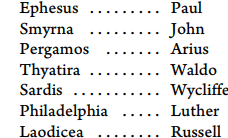
Of these, the first two, Paul and John, were of the duly inspired Apostles; the remaining five, Arius, Waldo, Wycliffe, Luther and Russell, though not divinely inspired, were nevertheless divinely appointed, and overruled in the matter of their utterances and writings, in the interests of the true church!
1:17, 18 – “And when I saw him, I fell at his feet as dead. And he laid his right hand upon me, saying unto me, Fear not; I am the first and the last: I am he that liveth, and was dead; and, behold, I am alive for ever- more, Amen; and have the keys of hell and of death.”
“So great was the splendor that John fell as dead when he beheld it, just as Daniel fell prostrated and was like a dead man in the presence of the mighty one whom he saw, and just as Saul of Tarsus fell down before the majesty displayed to him. So symbolically with us, when once we get a glimpse of the glories of the divine character through the divine plan, when once we get a true view with the eyes of our understanding of him with whom we have to do, as the great heart-searcher and caretaker of his church, we fall before him humbled to the dust, realizing that we are imperfect, that we cannot stand before our Master, that we are unworthy of his favor and blessing. But as he touched John gently, raising him up, so he has spoken to us comfort, peace and love, assuring us that we have not an High Priest that cannot be touched with a feeling of our infirmities, but, on the contrary, one who is able to sympathize and merci- fully to assist, one who has bought us with his own precious blood, who has accepted us and will number us as his body members, so long as we abide in him, seeking in our hearts to know and to do his will.
“His comforting assurance to us is: (1) ‘Fear not.’ The same message that the Father sent us through the prophet Isaiah, saying, ‘Their fear of me is not of me, but is taught by the precepts of men.’ (Isa. 29:13) This lesson, ‘Fear not,’ is one of the first that we must learn. We cannot come into close sympathy with our Lord and be taught of him respecting other features of his plan until we learn this lesson, ‘Fear not,’ until we learn to have confidence in him as the one who loved us and bought us with his precious blood, and whose purposes toward us continually are for our welfare and, if we submit ourselves to his guidance, to bring us off conquerors and more than conquerors. (2) ‘I am the First and the Last.’ We must recognize our Lord as the one who was the beginning of the creation of God and the end of it, the one by whom were all things, the one who is next to the Father, his very representative in everything pertaining to the affairs of the universe. (3) We must recognize him as the one who was dead, the one who really died for our sins, but who was really raised out of death by the power of the Father. (4) We must realize that he is alive forevermore, that death has no more dominion over him, that the work is finished, that neither sacrifices of the mass nor death in any other sense or form has dominion over him nor ever will have, nor will ever be needed; his work is perfect, and, as he cried on the cross, ‘It is finished.’ (5) We must recognize that he has the keys, the authority, the power over the tomb, to deliver from it all who are there imprisoned. We must also realize that he has the ‘key,’ the power over death, so that those whom he liberates from the prison-house of death, the tomb, like those who have not yet gone into it but who are under the sentence of death, may all be ultimately delivered, set free
from the dominion of sin and death, delivered into the full liberty of the sons of God, righteousness and life eternal.” (R3569:6)
Those “Seeing” Him Falling as Dead!
“Not all, but only those who fall as dead before the Lord, who recognize their own nothingness, who, in the language of this symbolical book, are beheaded, or lose their own wills, accepting the will of the Lord instead (Rev. 20:4) – these alone are ever able to fully receive this message from the Lord appreciatively. From these fear is cast out; and they alone may know that our Lord was the first-born of all creation, and the last; that he was the beginning of Jehovah’s work, and the end of it, and that all beings and things were made by or through him, and that ‘without him was not one thing made that was made.’ (John 1:3) These also may know, fully appreciate, understand, that the Lord now liveth, and in order to appreciate this they must understand that he was dead for parts of three days – not merely apparently dead, but actually dead – his soul poured out unto death, made an offering for sin. (Isa. 53:10-12)” (R2827:4)
The Only Direct Creation of God the Father!
“… he was not only the beginning of the creation of God, and the first-born, but additionally his Only Begotten Son, and … all other creations were by and through him; we find a beautiful corroborative statement in our Lord’s own words, saying: ‘Fear not, I am the first and the last; I am he that liveth and was dead, and behold I am alive forevermore.’ And again, ‘These things saith the first and the last, which was dead, and is alive.’ (Rev. 1:17; 2:8) In no other sense or way than as the ‘Only’ direct creation of God, through whom all else was created, could our Lord be the first and the last of God’s creation. Any other view, therefore, would be an incorrect one, and in conflict with…the…Scriptures.” (E93)
1:19,20 – “Write the things which thou hast seen, and the things which are, and the things which shall be hereafter; The mystery of the seven stars which thou sawest in my right hand, and the seven golden candlesticks. The seven stars are the angels of the seven churches: and the seven candlesticks which thou sawest are the seven churches.”
The Greek text here reads, “Write, therefore, the things.”
“There appears to be no excuse whatever for the translators of our Common Version to have omitted the word therefore from this text – an omission that no previous translator had made. No question has ever been raised as to the right of this word to a place in the text. ‘With what intention the illative particle is used is perhaps best referred to what immediately goes before: Seeing that I am this mighty One, the first and the last, who was dead and am alive, do thou, therefore, write; for the things declared by Me are all steadfast and sure’.” (The Revelation of Jesus Christ, Streeter, p. 98)
“The things which thou hast seen, and the things which are” perhaps, has reference to what John had already experienced; and which, in a sense, was in the past; but which, nevertheless, still engaged his attention!
“And the things which shall be hereafter.” Quite evidently, the things which had thus far engaged his attention, the “seven stars,” and the “seven golden candlesticks,” were to remain, as it were, a part of an ever expanding vision. So, there was now, first to be made known unto him “the mystery of the seven stars” which the Lord held in his right hand; and of “The seven golden candlesticks.”
“The seven stars” the Lord declared “are the angels [messengers] of the seven churches.”
“The stars he explains (Rev. 1:20; 2:1, 8, 12, 18) are the angels or messengers or special servants of the Church in each epoch. The intimation is that the Lord would recognize in his Church, in each of its seven stages or developments, one representative to whom he would specially address himself, and through whom The would instruct the Church, and whom he would hold or keep as his instrument by his own power or hand.” (R2826:6)
“‘In This right hand,’ signifies … in his favor as well as in his power … should be considered as in some special sense under the Master’s guidance and protection and care in the interest of the Churches they represented.” (R3570:4)
But who are these “seven stars”? Since the Scriptures do not definitely name these “angels”; and with exception perhaps, for the Laodicean period, Bro. Russell has given no clues as to whom they may have been; the matter is now one more or less of conjecture, wherein we cannot afford to be dogmatic. However, as we do with other Scriptural prophecies, on finding certain well-attested, historical facts, fully in harmony with these prophecies, we accept them as fulfilled; so we may do here.
A suggestion has been made as to who these seven messengers are; and since history bears out the fact that the particular work each did; the particular truth (dog- mas, doctrines, etc.) he declared; and the particular time in which he lived, all coincide with what was prophetically foretold of them (Rev. 2:1-3:22), we accept the list as being correct. (List of seven names on previous page)
The “Church” Periods
We cannot be absolutely positive with regard to the beginning and ending, or the length of any of these “church” periods, since the Scriptures themselves do not specifically inform us. The dates here suggested, therefore, as to the beginning and the ending of the respective periods, are mere approximations:
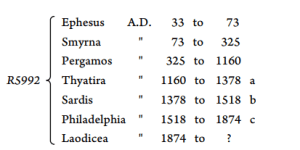
a. First translation of Bible into French, about A.D.1160
b. First translation of Bible into English, about A.D.1380
c. First translation of Bible into German, about A.D.1534
The Chronological Periods
“To give a bird’s-eye view of the arrangement, we would notice their chronological position. Ephesus covers the period during the lives of the apostles; Smyrna, the time of the Pagan persecution, reaching to about 325 A.D., when Constantine became Emperor of Rome and declared in favor of Christianity. Pergamos embraces the transition period during which the Papacy had its rise; Thyatira, the space during which the true church was in the wilderness, and the apostate church sat as a queen, and lived deliciously with the kings of the earth. Sardis includes a short interval just before the Reformation; Philadelphia, the period from the Reformation until recent times; and Laodicea, the nominal church of today.” (R5992:3)
“We are not to think of the different epochs represented in the messages to the various churches as being exact periods, as though there was a particular instant of beginning and a particular instant of closing. Rather we are to understand each to be a general period, which laps over the one on the other.” (R5718:1)
While Bro. Russell believed that these messengers to the “seven churches,” were all individuals, to whom God, through Christ Jesus, had given a personal responsibility toward his Church (R2826:6), and that he, himself, was the messenger of the Laodicean period, he was too modest openly so to declare it. Yet, one can find it, if he looks for it, tenderly and graciously hidden away in the following excerpt from his pen:
“The revelation being complete, John fell down before the angel who had given him the revelation to offer him worship. This might signify that in the end of this Gospel age as the whole Church, the John class, comes to see the unfolding of the divine plan there might be a spirit or disposition among them to do too much honor to the one used of the Lord in communicating to them the divine light now due.” (R3572:4)
¹ See also Bible Teachings in Nature, MacMillan, p. 8
The Pleiades, “Seven Stars” (See Job 38:31 margin)
In the constellation Taurus, there is a group of stars called the Pleiades. To the ancients they were known as “the seven stars.” In fact, they are referred to in Job 38:31, where Job is asked, “Canst thou bind the sweet influences of the Pleiades?” In the Authorized Version, the margin reads, “the seven stars.”
Some have felt that the Pleiades represent the center of God’s universe; that life, energy, power, etc., emanate from there. Hence the query, “Canst thou bind the sweet influences of the Pleiades?” We believe there is some- thing more that needs to be said about these “seven stars.” Could they in some way represent the seven “angels” or messengers, which are held in the right hand of our Lord (Rev. 1:20) and from whence sweet influences of divine truth and love emanate for the blessing of the Church of God! Nor is there anything that can really thwart this holy influence of these “seven stars” – for they lie, as it were, far beyond the reach of man! “Clouds” – earthborn clouds – may at times have obscured their light, but their benign influences have never ceased to penetrate through them.
In passing, we might say that there are many more than seven stars in this group, which the telescope has revealed; but the ancients saw only seven of them; and to many, the unaided eye revealed only six. We suggest, that while God has placed “seven messengers” in a special place with regards to the guidance and enlightenment of the Church, there have undoubtedly been many other “stars” who have assisted in this direction, but they were not to be as conspicuous as “the seven stars.”
“It is now ascertained that the sun also is in motion, carrying with it its splendid retinue of comets, planets, its satellites and theirs, around some other and vastly mightier center. Astronomers are not yet fully agreed as to what or where that center is. Some, however, believe they have found the direction of it to be the Pleiades, and particularly Alcyone, the central one of the renowned Pleiadic stars. To the distinguished German astronomer, Prof. J. H. Maedler, belongs the honor of having made this discovery. Alcyone, then, as far as science has been able to perceive, would seem to be ‘the midnight throne’ in which the whole system of gravitation has its central seat, and from which the Almighty governs his universe…” (C327)¹
“From the clearer astronomical knowledge of our day, it has been ascertained that while the planets of our solar system revolve around the sun, yet there are vast numbers of other suns each having its own retinue of planets, which with their satellites are revolving around it as a center. Furthermore, science declares that there is a far mightier center, around which these countless millions of suns revolve, accompanied by their planets and satellites. This great center seems to be associated with the Pleiades, particularly with Alcyone, the central star of this renowned group. For this reason the suggestion has been made that the Pleiades may represent the residence of Jehovah, the place from which The governs the universe. This thought gives new force to the question which the Almighty asked the patriarch Job: ‘Canst thou bind the sweet influences of the Pleiades, or loose the bands of Orion? Canst thou bring forth the constellations of the Zodiac in their season?’ (Job 38:31, 32)” (R5710:2)
“So far as he (Job) was concerned, the question, ‘Canst thou bind the sweet influences of Pleiades?’ might have referred to what was then the common belief – viz., that the genial weather of spring was somehow caused by the peculiar position of the Pleiades in the sky at that season; as if God had simply said, ‘Canst thou hinder or retard the Spring?’ It remained for modern science to make a grander and wider application of it, and to show in this, as in other instances, that the Bible is so framed as to expand its horizon with the march of discovery – that the requisite stability of a moral rule is, in it, most admirably combined with the capability of movement and progress. If we examine the text in Job 38:31 in the original, we find that the Chaldaic word translated in our version Pleiades is Chimah, meaning literally a hinge, pivot, or axle, which turns round and moves other bodies along with it. Now, strange to say, the group of stars thus characterized has recently been ascertained, by a series of inde- pendent calculations – in utter ignorance of the meaning of the text – to be actually the hinge or axle round which the solar system revolves. It was long known as one of the most elementary truths of astronomy, that the earth and the planets revolve around the sun; but the question recently began to be raised among astronomers, ‘Does the sun stand still, or does it move round some other object in space, carrying its train of planets and their satellites along with it in its orbit?’ Attention being thus specially directed to this subject, it was soon found that the sun had an appreciable motion, which tended in the direction of a lily-shaped group of small stars, called the constellation of Hercules. Toward this constellation, the stars seem to be opening out; while at the opposite point of the sky their mutual distances are apparently diminishing – as if they were drifting away, like the foaming wake of a ship from the sun’s course.
“When this great physical truth was established beyond the possibility of doubt, the next subject of investigation was the point, or center round which
the sun performed this marvelous revolution; and after a series of elaborate observations and most ingenious calculations, this intricate problem was also satisfactorily solved – one of the greatest tri- umphs of human genius. Prof. J. H. Meadler of Dorpat found that Alcyone, the brightest star of the Pleiades, is the center of gravity of our vast solar system – the luminous hinge in the heavens round which our sun and his attendant planets are moving through space.” (Bible Teachings in Nature, Hugh Macmillan, p. 7, 8)
“And the seven candlesticks which thou sawest are the seven churches.” These seven candlesticks are first brought to our attention in Rev. 1:12, 13, as the symbol- ism for the “seven churches,” i.e., the seven stages in the development of the one, the Gospel age Church!
“… in his last great message to the Church our Lord pictures seven golden candlesticks or lampstands separated from one another, and explains that these represented the seven stages or epochs of the Church symbolized by the seven congregations in Asia.” (R3650:6)
“In Revelation the same candlestick or lampstand is brought to our attention, but the parts are separated – the union, the relationship between them, being supplied by our Redeemer, the antitypical High Priest. The lampstand symbolized the Lord’s nominal people of this Gospel age, including This ‘members.’ It holds forth the light of life, the light that shines in darkness and which he directed should be so let shine before men that they might see our good works and glorify the Father in heaven…It is to be noted that the lampstand represents the nominal church of Christ rather than the true. This is shown by the fact that in the Lord’s addressing each of these lampstands or churches The finds fault with the many and approves the few, especially so in the last, the seventh, the Laodicean church of our day.” (R3569:4)
Next in John’s account of the vision is the record of the messages to be addressed to the seven churches in Asia Minor, by way of their respective “angels.” With three notable exceptions the messages have seven major divisions, as follows:
(1) The Salutation
(2) Identification of the Speaker
(3) Commendation
(4) Condemnation
(5) Admonition
(6) Entreaty
(7) Promise to the overcomers.
The exceptions are: Smyrna and Philadelphia, for whom there is no condemnation; and Laodicea, for whom there is only condemnation!