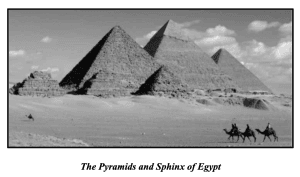
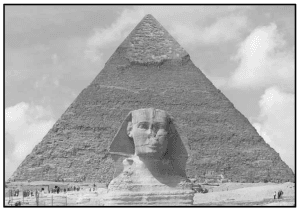
Now back to the main flaw in the “curse of Ham” myth. The centuries-old bigotry that the Black people are doomed to be servants of Shem and Japheth is not true. It is claimed to be based on the genealogy of Noah’s descendants listed in Genesis 9 and 10. We have found that nothing in Genesis 9 and 10 says that Ham or all of Ham’s descendants would be the servants of Ham’s brothers, Shem and Japheth and their descendants, which would be the remainder of mankind. The Hamites, many of whom were dark skinned, were not scripturally doomed to be the servants of the descendants of Shem and Japheth as has been claimed.
If this were true, you would expect that after the death of Noah the descendants of Shem and Japheth would excel in the advancement of civilization. But, as Adam Clarke, a noted Bible commentator and an ardent believer in the “curse of Ham,” had to concede, (Vol. 1, p. 83), this never happened. He conceded that the first great empires like Babylon, Assyria, and Egypt, and the republics of Sidon, Tyre, and Carthage, were founded by Hamites. All of this time, the Shemites and Japhethites maintained a simple pastoral and agricultural life.
Genesis 10:6 tells us that Cush, who all agree was black, was the first son of Ham. Then we read: “And Cush begat Nimrod: he began to be a mighty one in the earth. He was a mighty hunter before the LORD: wherefore it is said, ‘Even as Nimrod the mighty hunter before the LORD.’” Genesis 10:8,9. Grasp this. Nimrod, supposedly a lowly Hamite, “is a mighty one in the earth.” It is generally agreed by Bible scholars that Nimrod was a Black man. And where does this supposedly lowly Hamite have his kingdom? In Africa? No!
Genesis 10:10 reads—“And the beginning of his [Nimrod’s] kingdom was Babel and Erech, and Accad, and Calneh, in the land of Shinar.” Daniel 1:1,2 identifies the land of Shinar as the land of Babylon. And where does this supposedly lowly Hamite have his kingdom? In the Land of Shinar! Here is a Hamite ruling not in Africa but in Babylon, which was to become one of the greatest empires in the history of the world.
The descendants of Ham were not confined to Africa. Ham’s grandson Nimrod and his clan first chose to settle in the Tigris-Euphrates river valley around major rivers—the Tigris and Euphrates in Mesopotamia, Asia Minor. By the time Nimrod, the son of Cush, had become of age, he established himself as a “mighty one in the earth.” The Jerusalem Targum has this to say about him:
He was powerful in hunting and in wickedness before the Lord, for he was a hunter of the sons of men, and he said to them, ‘Depart from the judgment of the Lord, and adhere to the judgment of Nimrod!’ Therefore it is said: ‘As Nimrod [is] the strong one, strong in hunting and wickedness before the Lord.’
McClintock and Strong’s Cyclopedia observes:
Nimrod, the mighty hunter of the earliest imperialist power, is the grandest name, not only of the children of Ham, but in primeval history. He seemed to have been deified under the title of Bilu-Nipru, or Bel-Nimrod.
Josephus wrote:
Now it was Nimrod who excited them to such an affront and contempt of God. He was the grandson of Ham, the son of Noah, a bold man, and of great strength of hand. He persuaded them not to ascribe it to God, as if it were through his means they were happy, but to believe that i t was their own courage which procured that happiness. He also gradually changed the government into tyranny, seeing no other way of turning men from the fear of God, but to bring them into a constant dependence on his power. He also said he would be revenged on God, if he should have a mind to drown the world again; for that he would build a tower too high for the waters to reach. And that he would avenge himself on God for destroying their forefathers.
Now the multitude were very ready to follow the determination of Nimrod, and to esteem it a piece of cowardice to submit to God; and they built a tower, neither sparing any pains, nor being in any degree negligent about the work: and, by reason of the multitude of hands employed in it, it grew very high, sooner than any one could expect; but the thickness of it was so great, and it was so strongly built, that thereby its great height seemed, upon the view, to be less than it really was. It was built of burnt brick, cemented together with mortar, made of bitumen, that it might not be liable to admit water.
When God saw that they acted so madly, he did not resolve to destroy them utterly, since they were not grown wiser by the destruction of the former sinners; but he caused a tumult among them, by producing in them diverse languages, and causing that, through the multitude of those languages, they should not be able to understand one another. The place wherein they built the tower is now called Babylon, because of the confusion of that language which they readily understood before; for the Hebrews mean by the word Babel, confusion…
Sir Walter Raleigh’s History of the World (1634) shows a map in which the Caspian Sea was once known as the ‘Marde Bachu,’ or the Sea of Bacchus (Nimrod). One of the chief cities of Assyria (modern Iraq) was named Nimrud, and the Plain of Shinar, known to the early Syrians as Sen’ar, was itself once known as the Land of Nimrod. Iraqi and Iranian Arabs speak his name with awe even today (1634 AD), and such is the notoriety of the man that his historical reality is quite beyond dispute.
Imagine the Caspian Sea, the largest inland body of water, was named after Nimrod, supposedly an inferior Hamite. Look at a map. Here we have Nimrod and his fellow Hamites, East of Africa and North of Arabia in what is modern Iraq, Iran, Syria and Turkey. Nimrod a Hamite ruling over the decendants of Shem. A further proof that the so-called “curse of Ham” is not true.
Another British writer Charles Wentworth Dilke in his book, The Athenaeum (1870) confirmed all of this:
A Cushite [Nimrod], and therefore a Hamite, founded this first world-monarchy or tyranny. Another Hamite power arose simultaneously in Egypt. A branch of the Cushites seem to have gone eastward, and spread over India. But another branch spread through the South of Arabia, and, crossing into Africa, came into contact, sometimes into alliance, and sometimes into collision with the Egyptian monarchy. The eastern empire is noticed particularly, because it intruded into Shemitic ground, and aimed continually at extending its sway over the nations descended from Shem.
The Caspian Sea, once known as the “Sea of Bacchus” (Nimrod)
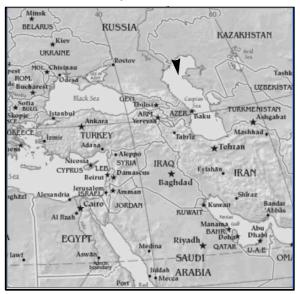
Notice the broad geographical spread of the descendants of Ham outside of Africa. Also, the eastern Hamitic empire actually conquered nations descended from Shem. What irony! We hear about the so-called “curse of Ham”—Hamites being the servants of Shem’s and Japheth’s descendants. Here we have the descendants of Shem and Japheth in the then known world as the servants of Ham. A further proof that the so-called “curse of Ham” is not true.
George Smith, of worldwide fame as an Assyriologist, writing in 1876, verifies that: …in the BC 1100 to 800, we have in Egypt many persons named Nimrod, showing a knowledge of the mighty hunter there.’ (Chaldean Genesis, p. 313). Nimrod was probably the most notorious man in the ancient world who is credited with instigating the Great Rebellion at Babel, and founding features of paganism, including … astrology and human sacrifice. Moreover, there is much evidence to suggest that he himself was worshipped from the very earliest times. His name, for example, was perpetuated in those of Nimurda, the Assyrian god of war; Marduk, the Babylonian king of the gods; and the Sumerian deity Amar-utu. His image was likewise incorporated very early on in the Chaldean zodiac as a child seated on his mother’s lap, and both mother and child were worshipped, she as the Queen of Heaven, and he as her erstwhile sacrificial son, the precursor of today’s worship of the Madonna and Child.
Nimrod was also worshipped by the Romans under the name of Bacchus, this name being derived from the Semitic bar-Cush, meaning the son of Cush. A mountain not far from Ararat, has been called Nimrud Dagh (Mount Nimrod) from the earliest times since the Flood, and the ruins of Birs Nimrud bear the remains of what is commonly reputed to be the original Tower of Babel. The Caspian Sea was once called the Mar de Bachu, or Sea of Bacchus [Nimrod], as is witnessed by the map appearing in Sir Walter Raleigh’s History of the World, published in 1634. One of the chief cities of Assyria was named Nimrud, and the Plain of Shinar, known to the Assyrians as Sen’ar and the site of the Great Rebellion, was itself known as the Land of Nimrod. Iraqi and Iranian Arabs still speak his name with awe, and such was the notoriety of the man that his historical reality is beyond dispute.
Thus we see it is generally recognized by scholars that Nimrod, a black man, a frowned upon Hamite, dictatorially ruled over the then known world including the descendants of Shem and Japheth. What a decisive knockout blow to the “curse of Ham” theory.
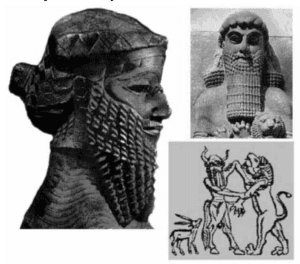
The Chaldee paraphrase of 1 Chronicles 1:10 says: “Cush begat Nimrod, who began to prevail in wickedness, for he shed innocent blood, and rebelled against Jehovah.” [Appendix 28 from The Companion Bible]