
Have you ever heard of the ancient empire named Nubia? Probably not. Why? It was a Black empire. And Black prejudice has lingered since the 16th century, especially in the US, so that ancient Black history was marginalized. After all, how could you own Black slaves and read about noble Black ancient history? Therefore, racial prejudice wiped the Black Nubian Empire off the pages of history. The ancient Black Kingdom of Nubia, also known as Kush, occupied what is now northern Sudan.
“Black Is Beautiful”
During the civil rights movement, “Black is Beautiful” was a cultural movement in the 1960s that began in the United States by African Americans. It later spread to much of the Black world. For the most part, the emphasis of the 1960s “Black is Beautiful” movement was on physical appearance. But the following quotes describing the beauty of ancient Black people were especially used to denote the inner beauty of character.
Timothy Kendall was the main activist to re-establish the Black Race to its legitimate place in history for the world to view and esteem. A Harvard University graduate in archaeology and frequent writer for the National Geographic magazine, he proved the existence and dominant role the Black Nubian/Kush Empire played in the ancient world, which was in what today is Sudan. The following are quotes from his writ- ings. Some of these quotes are the words of ancient heathens who could not know Jehovah, since some of them date back to the Patriarchal Age when only Noah, Abraham, Isaac and Jacob had fellowship with Jehovah. Whether you agree with these quotes is not the point. The purpose of these quotes is to reflect what the White Race thought of Black people in ancient times in contrast to our post-AD 1600s Black Slavery Era.
Whether we take it literally or not, I have frequently come across this ancient quote about the black Nubian Empire that has been repeated by Kendall and many others.
Greek traditions told of Memnon, a legendary Nubian king who had fought in the Trojan War; they spoke of Nubia’s people, who were the “tallest and handsomest on earth,” and whose piety was so great that the gods preferred their offerings to those of all other men. They also knew that historical Nubian kings had once conquered Egypt and ruled it for sixty years and that their dynasty was counted as Egypt’s Twenty-fifth. The Greeks, however, did not call these people “Nubians” or “Kushites,” as we do today; they called them Aithiopes [“Ethiopians”], which in Greek meant “Burnt-Faced Ones.” They knew perfectly well that Nubians were black-skinned, as are the Sudanese of the same regions today.
The first Black nation to become an empire was Nubia. Diodorus Siculus was a noted Greek historian, who wrote his monumental universal history Bibliotheca Historica of 68 Volumes between 60 and 30 BC. Although White, he devoted one chapter of his work extolling the Black Race above the White Race and spoke of other historians sharing his views about the Black Race. Diodorus Siculus stated “that by reason of their piety toward the deity they had never experienced the rule of an invader from abroad.”
Also, Diodorus Siculus’ review of ancient history indicates that the Black Race was at the highest state of freedom and peace with one another. Although many powerful rulers had made war against them, not one of these had succeeded in his undertaking.
Cambyses, for instance, who made war upon them with a great force lost all his army…. Semiramis, had become renowned in battle but after advancing a short distance into Ethiopia [Nubia], gave up.
Other ancient White historians also observed the Black Race excelled in ancient times. These words are eloquent indeed compared to the descriptions of Blacks during the Slavery Era that began in the 1600s, when the Blacks were considered sub-human in order to justify slavery that provided cheap labor to the Whites.
Ancient Nubia Discovered By Shovel and Hid by Prejudice
An article in National Geographic Magazine by Timothy Kendall states:
So remote was the northern Sudan that scientific archaeology could not take place there until the British seized control of the country in 1898 and opened it up with the completion of the Cairo-Khartoum Railway. The first major excavations [of Nubia] were undertaken by famed Egyptologist George A. Reisner (1867-1942), whose team, sponsored by Harvard University and the Museum of Fine Arts, Boston, would first excavate Kerma in 1913, the Gebel Barkal Temples from 1916-1920, and all the royal pyramids of Kush between 1917-1924. Almost single-handedly, Reisner laid the foundations of Nubian history, reconstructing it from the Bronze Age to the dawn of the Christian era. It was a towering achievement, almost unparalleled in the annals of archaeology. …
Nubian cultures, he reasoned, were not as developed as the Egyptian because the people were of mixed race, yet by virtue of their relationship to the superior Egyptian race, they were elevated far above the “the inert mass of the Black races of Africa.” This was Reisner at his worst. Such unabashed racist interpretations, widely published in scholarly journals at the time and accepted as gospel by the popular press, [today they offend and embarrass all of us]…
Reisner, very much a product of his time [racist], seems to have had an unconscious need to believe that his Kushite/Nubian kings were “White” (or “White men” in darker skin, or Dark men with “White souls”) in order to make them and their culture more worthy of study to himself and more acceptable to the contemporary scholarly and museum-going public—and perhaps even to his financial backers at the Museum of Fine Arts….
Over fifty years later Kendall observed, The empire over which they presided was greater in extent than any ever achieved in antiquity along the Nile Valley. Their kings [Black Nubian kings ruling over Egypt] were said never to have condemned prisoners to death; they forgave their enemies and allowed them to retain their offices; they also actually gave public credit for achievement in their inscriptions to individuals other than themselves. Such characteristics among other ancient monarchs of Egypt or the Near East are unheard of, and we can only assume these were native [Black] Nubian qualities. Yet for Egyptologists of the first half of the 20th century, the fact that they were “Negro” marked this period as the lowest level to which Egyptian civilization had sunk in all its history.
In addition to proving the so-called “curse of Ham” is false, I wanted to show our African brethren what a noble heritage they have. Black Nubia was the region located along the Nile River in what is now Egypt beginning in the north at the city of Aswan, Egypt, and extending southward to Khartoum in Sudan. (See the map at beginning of chapter on page 20.) The territory decreased and extended according to wars and political negotiations. Besides trading with the Egyptians, archaeologists observed that what they called the Kerma culture, named after their capital, Kerma, Nubia, had established regular trade routes into the interior of Africa.
All of Africa’s luxury goods were imported into Kerma and from there passed through a series of middlemen to the islands of the eastern Mediterranean Sea and far beyond. The goods included the exotic animals, leopards and giraffes, as well as their skins; ivory in the form of elephants’ tusks; ostrich eggs and feathers; hardwoods such as ebony; and gold in vast quantities.
Actually, Nubia was much richer than Egypt in gold and other mineral deposits, and local craftsmen soon were able to utilize these deposits to craft a variety of items that became highly sought after in Egypt and elsewhere. Through this wealth built up by the exchange of goods, the black Nubians became exceedingly rich.
It hardly sounds like the “curse of Ham” was adversely affecting these luxurious and wealthy black, Nubian Hamites.
Two Hamites Found Two Great Empires
Remember, Kush, the first son of Ham, according to God’s genetic code was evidently Black and his Black family developed into the nation of Kush and/or Nubia, which was a nation of Blacks. Many claim the Hebrew word Kush means “black.” Whereas, as we have seen, Ham’s second son, Mizraim, was light skinned and his descendants founded Egypt, a people of lighter skin but not white. Here we have the two oldest empires in human history bordering each other. One is Brown (Egypt) and one is Black (Nubia), but they are both the descendants of Ham, not Shem or Japheth. If the lighter skinned Egyptians are indeed Hamites, which they are, the so-called “curse of Ham” is a sad delusion that has caused untold misery to millions.
Far from serving Shem and Japheth, the Egyptian Hamites were actually ruling over some descendants of Shem and Japheth. Again disproving the “curse of Ham” theory.
In the give and take between Nubia and Egypt, the Egyptians at times controlled parts of Nubia. But there were periods when the Black Nubian kings actually conquered their lighter skinned brothers in Egypt. Consequently, there were Black Pharaohs. History records there were seven.
The last four Pharaohs of Egypt were Black Nubian Kings who conquered Egypt and took Egypt to its cultural heights. (See National Geographic, February 2008 — “The Black Pharoahs.”)
The Nubian Pharaohs: Black Kings on the Nile
In 2003, a Swiss archaeological team working in northern Sudan uncovered one of the most remarkable Egyptological finds in recent years. At the site known as Kerma (in Nubia) archaeologist Charles Bonnet and his team discovered a ditch within a temple from the ancient city of Pnoubs in Nubia, which contained seven monumental black granite statues that portray the seven Black Nubian kings who ruled over both Egypt and Nubia. How they conquered Egypt is remarkable!
Today Nubian pyramids—greater in number than all of Egypt’s—are awesome spectacles in Sudan’s Desert.
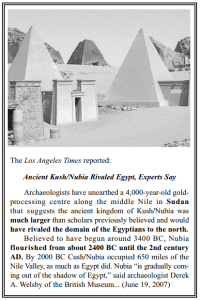
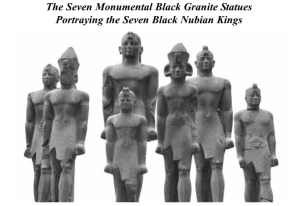 In the year 730 B.C., Piye the Black King of Nubia declared:
“Harness the best steeds of your stable,” he ordered his commanders. The magnificent civilization that had built the great pyramids had lost its way, torn apart by petty warlords. For two decades Piye had ruled over his own kingdom in Nubia, a swath of Africa located mostly in present-day Sudan. But he considered himself the true ruler of Egypt as well, the rightful heir to the spiritual traditions practiced by pharaohs. Since Piye had never actually visited Lower Egypt, some did not take his boast seriously.
North on the Nile River his soldiers sailed. At Thebes, the capital of Upper Egypt, they disembarked. …By the end of a year-long campaign, every leader in Egypt had capitulated—including the powerful delta warlord Tefnakht, who sent a messenger to tell Piye, “Be gracious! I cannot see your face in the days of shame; I cannot stand before your flame, I dread your grandeur.” … [Then Piye] loaded up his army and his war booty, and sailed southward to his home in Nubia, never to return to Egypt again.
As the black king of Nubia and black Pharaoh of Egypt, Piye reigned for 35 years until his death in 715 BC.
The ancient world was devoid of racism. At the time of Piye’s historic conquest, the fact that his skin was dark was irrelevant. Artwork from ancient Egypt, Greece, and Rome shows a clear awareness of racial features and skin tone, but there is no evidence that darker skin was seen as a sign of inferiority. Only after the European powers colonized Africa in the 19th century did Western scholars pay attention to the color of the Nubians’ skin, with unfortunate results.
When Piye died, his brother Shabaka became the king of Nubia and the black Pharaoh of Egypt who “solidified the 25th dynasty by taking up residence in the Egyptian capital of Memphis. … Shabaka lavished Thebes and the Temple of Luxor with building projects…Through architecture as well as military might, Shabaka signaled to Egypt that the Black Nubians were here to stay.”
The Assyrians and Hezekiah
Here the Bible and ancient history coincide. To the east, the Assyrians were fast building their own empire. When they marched into Judah, a young Black Nubian prince, Taharqa, perhaps 20, the son of the great pharaoh Piye, decided to defend the Jewish State. At the city of Eltekeh, the two armies met. Although the Assyrian emperor, Sennacherib, bragged lustily that he “inflicted defeat upon them,” young Taharqa managed to hold his own.
When the Assyrians massed against Jerusalem, the embattled King Hezekiah, hoped his Black Egyptian allies would come to the rescue. But the Assyrians issued a taunting reply, immortalized in 2 Kings 18:21:
“Thou trustest upon the staff of this bruised reed [of] Egypt, on which if a man lean, it will go into his hand, and pierce it: So is [the Black] Pharaoh king of Egypt unto all that trust on him.”
2 Kings 18:9 (YLT):
“And he [Sennacherib] heareth concerning Tirhakah king of Cush [St. #3568 Nubia and/or the black Pharaoh], saying, ‘Lo, he [Tirhakah] hath come out to fight with thee [Sennacherib].”
All scholars agree that the two names Taharqa and Tirhakah refer to the same person, Piye’s son. Then, according to 2 Kings 19:35,36:
“And it came to pass that night, that the angel of the LORD went out, and smote in the camp of the Assyrians an hundred fourscore and five thousand: and when they arose early in the morning, behold, they were all dead corpses. So Sennacherib king of Assyria departed, and went and returned, and dwelt at Nineveh.”
The Assyrian army retreated. Were they struck by a plague? Many scholars suggest it was actually the alarming news that Taharqa, the black Nubian Pharoah, was advancing on Jerusalem. The Assyrians referred to Piye’s son Taharqa as “the one accursed by all the great gods.” All we know for sure is that Sennacherib abandoned the siege and galloped back in disgrace to his kingdom, where he was murdered 18 years later, apparently by his own sons.
So sweeping was Taharqa’s influence on Egypt that even his enemies could not eradicate his imprint. During his rule, to travel down the Nile from Napata to Thebes was to navigate a panorama of architectural wonderment.
The four black Nubian kings ruled over all of Egypt for three-quarters of a century as that country’s 25th dynasty. The Black pharaohs reunified a tattered Egypt and filled its landscape with glorious monuments, creating an empire that stretched from the southern border at present-day Khartoum all the way north to the Mediterranean Sea. They stood up to the bloodthirsty Assyrians, saving Jerusalem in the process.
Think of it! Four Black Nubian kings, so-called lowly Hamites, ruled over the territories of the combined empires of Egypt and Nubia. This was the greatest empire in the world at that time. What a blow to the so-called “curse of Ham” theory!
2013 Confirmation
The January/February, 2013 edition of the highly acclaimed Biblical Archaeology Review (BAR) refers to Judah’s involvement during Hezekiah’s time (Isaiah 30:1-5; 31:1-3) with Egypt, which had been conquered and ruled by the Black Nubian kings, and observes: “They had taken Egyptian culture to new heights.” This is proof-positive. In 2013 BAR, the current authority on ancient history, verified and extolled the rule of the Black Nubian kings over Egypt.
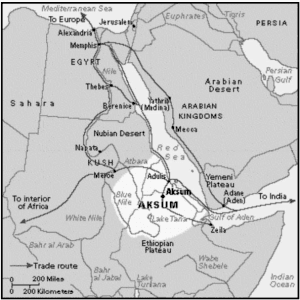
Map of the Aksumite Empire