The Black Kingdom of Aksum or Axum was located south of Black Nubia, on the Horn of Africa, situated high on a plateau 7,200 ft. above sea level. At the height of its prosperity, it became the mighty Aksumite Empire. Legend has Aksum founded by Menelik, son of Solomon and the Queen of Sheba.
Covering the area of modern Ethiopia and Eritrea it was an important trading nation in Northeast Africa that continued from 100–940 AD. Prior to this the same area was called D‘mt, a Black kingdom or nation in the same Ethiopia region during the 10th to 5th centuries BC. By then it had already developed irrigation schemes, used plows, grew millet, and made iron tools and weapons. Thus D‘mt, was an advanced Black civilization from the 10th-5th centuries BC. Then as the proto-Aksumite nation from the 4th century BC, D‘mt gradually achieved prominence until it became the Empire of Aksum by the 1st century AD.
An International Trading Hub
The first mention of Aksum was in a Greek guidebook written around AD 100, “Periplus of the Erythraean Sea.” It describes Zoskales thought to be the first king of Aksum. Under Zoskales and the other rulers, Aksum seized territory along the Red Sea and the Blue Nile in Africa. The rulers also crossed the Red Sea and took control of the Southwest Arabian Peninsula. Here we have black Hamites in Aksum ruling over Arabs, descendants of Shem in Arabia, which disproves the “curse of Ham” theory.
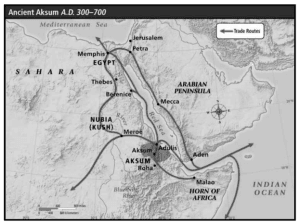 Map Showing Aksumite Trading Routes
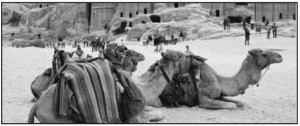
Aksum Controls International Trade
Aksum’s location and expansion made it a hub for overland caravan routes to Egypt and Nubia.
Access to sea trade on the Mediterranean Sea and Indian Ocean helped Aksum become an international trading power. Traders from Egypt, Arabia, Persia, India, and the Roman Empire crowded Aksum’s chief seaport, Adulis. Look at the map and follow the trade routes.
Throughout the Roman Empire, Aksum traded salt, ivory, cloth, brass, iron, gold, glass, olive oil, and wine. Animal traders bought giraffes and elephants. Actually Aksum took over a good portion of the Arabian Peninsula.
No wonder Mani (AD 216-276) a Persian prophet declared Aksum one of the four great powers of his time along with Persia, Rome, and China. Yes, Aksum, a lowly Hamite nation surpassed most Shemite and Japhethite nations in world trade, again disproving the “curse of Ham” theory. The Aksumite rulers facilitated trade by minting their own currency. Aksum established its hegemony over the declining Black Empire of Kush/Nubia which we considered in the last chapter. Aksum regularly entered the politics of the kingdoms on the Arabian Peninsula, eventually extending its rule over the region with the conquest of the Himyarite Kingdom, consisting of Yemen and part of Arabia.
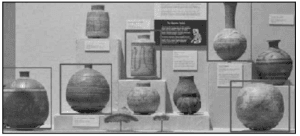 Pottery from Meroe
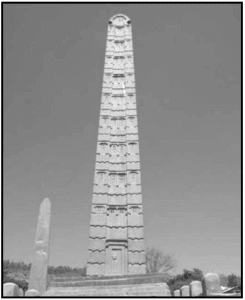 King Ezana’s Stele in Axum
Converted to Christianity
Under the reign of King Ezana (AD 330-356) ancient Black Aksum became the first major empire to convert to Christianity. In the early 4th century AD, Ezana spread his realm north and east, conquering the Nile Valley kingdom of Meroë, becoming ruler over part of both Asia and Africa. As a result of Ezana’s expansions, Aksum bordered the Roman province of Egypt. He constructed much of the monumental architecture of Aksum, including the reported 100 stone obelisks, the tallest of which loomed 98 feet over the cemetery in which it stood and weighed 517 tons.
Imagine gravestones up to 98 feet tall constructed by lowly Hamites. In the 7th century the Muslims, who originated in Mecca, sought refuge from Quraysh persecution by travelling to Aksum, a journey famous in Islamic history as the First and Second Hijra.
Aksum’s ancient capital, also called Aksum, was in northern Ethiopia. The Kingdom used the name “Ethiopia” as early as the 4th century.
Aksum at its Height
K. Kris Hirst, famed Aksum archaeologist, observed:
Without doubt, Aksum’s most impressive remains are the royal tombs and their fabulous markers, the ‘stelae’ or obelisks. Even the plain examples are impressive, cut from hard local granite. But truly staggering is a series of six carved examples. These seem to depict the dead rulers’ palaces—their tombs lay beneath, and it was our good fortune to be the discoverers of this underground world. The stelae— or so we may conjecture—were the stairways to heaven for the kings of Aksum. At the base are granite plates with carved wine-cups for offerings to the spirit of the deceased. The largest stela is certainly among the biggest single stones ever quarried by human labor. [What these so-called lowly Hamites couldn’t do!] It testifies to the magnificent self-esteem of the unknown ruler who had it extracted and dragged several kilometers to its final site, and to the skill and artistry of those who prepared and decorated it. Over thirty-three meters tall, the stele represents a thirteen story tower, with elaborate window-tracery, frames, lintels, beam-ends, even a door with a bolt.
Aksum flourished until the 6th century AD, maintaining its trade connections and a high literacy rate, minting its own coins, and building monumental architecture. A stratified society was in place in Aksum, with an upper elite of kings and nobles, a lower elite of lower status nobles and wealthy farmers, and ordinary people including farmers and craftsmen. Palaces at Aksum were at their peak in size, and funerary monuments for the royal elite were quite elaborate. A royal cemetery was in use at Aksum, with rock-cut multi-chambered shaft tombs and pointed stelae. Some underground rock-cut tombs (hypogeum) were constructed with large multi-storied superstructures. Coins, stone, clay seals and pottery tokens were used. All this by lowly Black Hamites!
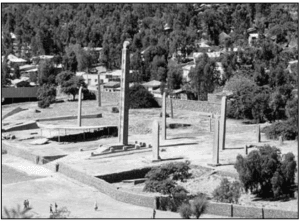 The Royal Tombs and their Fabulous Markers,
the ‘Stelae’ or Obelisks.
With the rise of the Persian Empire in the 6th century AD, the Arabic world redrew the map of Asia and excluded the Axumite civilization from its trade network, and Aksum fell in importance. But the 2013 Encyclopædia Britannica observed, “Aksum continued to dominate the Red Sea coast until the end of the 9th century, exercising its influence from the shores of the Gulf of Aden to Zeila on the northern coast of Somaliland (modern Somalia and Djibouti).”
The black Hamite Empire of Aksum, one of the five largest empires in the world at that time, with unprecedented engineering skills in many areas disproves the unscriptural “curse of Ham” theory.
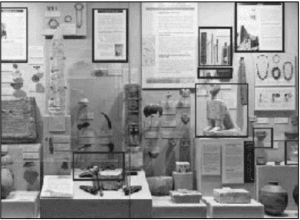 Coins, Pottery, Jewelry, Clay Seals, and More from Meroe (Courtesy of the Oriental Institute)