
“And he had power to give life unto the image of the beast, that the image of the beast should both speak, and cause that as many as would not worship the image of the beast should be killed. And he causeth all, both small and great, rich and poor, free and bond, to receive a mark in their right hand, or in their foreheads: and that no man might buy or sell, save he that had the mark, or the name of the beast, or the number of his name. Here is wisdom. Let him that hath understanding count the number of the beast: for it is the number of a man; and his number is six hundred threescore and six” (Revelation 13:15-18).
We now come to the consideration of a vision that seems to relate to the closing events of the history of the Protestant sects, and which doubtless up to the present time has had but a partial fulfillment. This is recognized by some of the later expositors who see Protestantism’s fallen condition and are separated from it. Mr. Russell was amongst these; note the following written in 1915:
“When the earthquake, or revolution, so prominently mentioned in the Scriptures [Revelation 16:18], shall have come, that, no doubt, will be the time when the kings and the captains of industry, of finance and of politics will in self-defense greatly exalt the power of religious leaders. Then we may expect that the Federation of Churches will exercise a power in the world such as has not been since the days of Papal supremacy. In the symbolic language of Revelation, that will be the time in which the ‘image of the beast’ will have life and work great wonders, threatening, commanding, in the name of Heaven (Revelation 13:11-18).”
That this expositor at that time believed that the “image of the beast” began to meet its fulfillment some years previous to the time he wrote these words, will be seen from the following language:
“We have already pointed out a general organization of ‘the image of the beast’ effected in 1846, and are waiting for what in the symbol is referred to as the ‘giving of life to the image.’ ”
In order to understand this symbolic vision, which in some of its features evidently describes the most prominent events connected with the closing scenes of the Gospel Age now terminating, it will be helpful, indeed necessary, to have a clear understanding of the present state of Christendom as it is viewed from the Divine standpoint. The reason for this is that it has been from out of these conditions, undoubtedly, that the image of the beast has been rising, and that its symbolic actions have been and will continue to be gradually meeting their fulfillment. It is also quite essential to be acquainted with the prophetic utterances of Christ and the Apostles that portray Christendom’s (both Roman Catholic and Protestant) present fallen condition. Let us therefore refresh our minds with a brief summary of the present condition of Christendom as it appears from the standpoint of enlightened Bible students, who have an understanding of the true mission and work of the Church in this Gospel Age.
Western Christendom is divided into two parts, Roman Catholicism and Protestantism. The Papacy since 1870 has ceased to be a “head” of the symbolic beast, in the Scriptural sense of that term, for the reason that then it ceased to exercise even a limited civil or political authority — no longer since then having a territory of its own over which it has an autocratic control in either civil or religious matters. It lost every vestige of civil authority, when in 1870 it was obliged to surrender the city of Rome to Victor Immanuel. As an ecclesiastical system, however, it is still the most powerful and the most united of any religious system in the world, and at the present time it is anticipating that soon it will regain its former power. In this respect, and as noting Protestantism’s attitude towards Rome, the “mother,” the words of a noted Protestant clergyman of New York, uttered on the occasion of an Inter-church conference recently, are very significant:
“When an official of the Roman Church was approached on the question of cooperating with Protestant Churches in this movement [of world evangelization], he pointed out that while Roman Catholicism was united, Protestantism is going in every direction. He observed that when Protestantism has found itself sufficient to unite, it will be time to suggest cooperating with a united Roman Church. So it is (this clergyman proceeds to say) that the world today looks eagerly to the Protestant Churches, and listens for their message; pre- eminently for the necessity of a united Protestantism.”
This unity, according to this Protestant (?) clergyman, has not been fully perfected as yet, although from the rapid advances that have been made since the great war, it seems evident that it will very soon be accomplished. When this is completed, the next logical step will be to imitate Papacy and appoint an administrative head. In this respect the Protestant Episcopal Church in the United States has already patterned after Papacy. This Church, in the United States, is an offshoot of the Church of England, only differing from that Church in that its form of government was changed when the colonies separated from England after the American Revolution. This was done in order to conform to the United States Constitution. At this time the king of England ceased to be the head of the Protestant Episcopal Church in the United States. It has, however, recently (doubtless a step in the furtherance of a “united Protestantism”) felt the necessity of appointing a head. We quote in evidence of this from the Boston Herald of December 9, 1919:
“The city of New York is to become to the Protestant Episcopal Church in America what the city of Rome is to the Roman Catholic Church. Instead of a Pope it is to have a presiding bishop, chairman of a council, which will correspond in many of its functions to the College of Cardinals. The entire Episcopal Church under the American flag, with its almost 2,000,000 communicants, is to be administered from the Episcopal ‘Vatican’ in the Metropolis, just as is the entire Roman Communion with its almost 300,000,000 communicants from the chair of St. Peter in the Eternal City on the Tiber. … One striking difference between the Episcopal ‘presiding bishop’ and Pope Benedict XV is that Bishop Gailor is elected only for a term of six years, whereas the occupant of the Vatican throne is elected for life.”
As further showing the state of Christendom, we note that the only govern- ment today in Western Christendom that possesses the characteristics of a “beast,” in the sense in which an ecclesiastical and civil government is a symbolic “beast” — the civil ruler being the head of the church — is that of Great Britain. The influence of this great church government extends into its colonies which are scattered all over the world. The English government has for some centuries past been reckoned as Protestant. While the influences of true Protestantism have for about two centuries caused this professed Christian government to be very “lamb-like” in its claims and exercise of religious authority, there has nothing occurred, legislatively, to deprive this ruler of his title as Supreme Head of the Church of England. The religious church system of this government claims apostolic succession, and therefore is the only one at the present time except Papacy that can fulfill the symbolism and give “life” (so-called Divine authority) to the “image of the beast.” This image of the beast (organized united Protestantism) is rapidly developing out of present conditions, preparatory to a fulfillment of all the requirements of this vision. We have in the previous chapter identified this great ecclesiastical and civil government of England with that of the two-horned lamb-like beast portrayed in verses 11-14.
The Image of the Beast Now in Evidence
In the foregoing we have given a brief synopsis of the condition of Christendom at the present time, for the reason, as already stated, that out of these various elements and conditions it seems quite evident to many prophetic students that this image of the beast has begun and is being rapidly developed. We remark here that the word image, as used in this expression, means likeness; that is, similar in its claims and use of power to that of Papacy. In previous verses of this chapter we find that the beast of which this image is to be a likeness is the one mentioned in verses 3 and 14, as having one of its “heads” mortally wounded, which, however, was afterwards healed.
We have previously indicated that this beast represented the ten kingdoms of Western Europe under its Papal head, and that the Papal head is the one referred to; also that the Reformation Movement of the Sixteenth Century, as well as the further effects of that Movement in 1799, accomplished this wounding of the Papal head, from which a partial recovery was realized. We also found that in 1870 it received a wound, from which, up to the present time, it has not recovered.
The present state of Protestant Christendom and its rapid unification points to Protestantism, civil and ecclesiastical, as that, out of which the symbolic image of the beast is to rise. Indeed it has already begun to fill up some of the require- ments. Before proceeding to give evidence that this is the correct interpretation, or make application of the vision, we inquire, What would be required to constitute Protestantism an image of Papacy, or of the Papal beast? The answer is, Protestantism in becoming an image would be expected to indicate its own rejection and disownment of much of the truth respecting the Divine Plan, and its acceptance of a perversion of the things pertaining to God; thus, following methods and proceedings like that of the beast of which it is an image. In speaking of such a state of Protestantism, we desire to be understood as referring to the great system itself, and not necessarily to all of its individual membership. This rejection, so far as it relates to Protestantism as a system, has evidently taken place, and is proved by the following:
(1) In its ceasing, as a system, to protest against Roman Catholic usurpation of Divine authority and its false doctrines, etc.; because it did vigorously protest against Papacy at one time, the name Protestant came to be used in connection with the Reformation Movement.
(2) In its failure to acknowledge openly the unscripturallness of many of its own false doctrines; these are stated in certain articles of the Evangelical Alliance, formulated at the time of its organization in London in 1846. This Alliance was made up of representatives of practically all denominations existing at that time.
(3) In its quite general rejection of the Scriptural teaching that the ransom sacrifice of Christ has secured for all mankind, in a due time appointed by God, a full, fair trial for eternal life.
(4) Indeed, in its almost universal rejection of the great doctrine of atonement for sin.
(5) In its erroneously claiming itself to be the Kingdom of God, established by Christ, that is to bring the promised righteousness and peace foretold by the ancient Prophets. This Kingdom was proclaimed by Christ and his Apostles, and according to their teaching it was to be introduced only by his Second Advent.
(6) In its substitution at the present time of the teaching of moral, social, industrial, political, and other reforms, for the preaching of the good news of the coming of the Kingdom, which alone is to be the remedy for all humanity’s present woes and evils.
(7) In its unbelief in, and its despising of “the sure word of prophecy,” and its consequent blindness to the “signs of the times.”
(8) In its desire and efforts at the present time to bring about a union with Roman Catholicism.
(9) In its boasting of its own self-sufficiency and large following.
All of these things and others which might be mentioned mark its fall from God’s favor.
The next thing that would be required to constitute an image of Papacy would be a manifestation of a desire on the part of the different divisions of Protestantism for some central head or council possessing Divine authority to settle doctrinal questions of dispute, and thus decide who and what is orthodox. We note that it would be quite reasonable to suppose that the beginning stage of such a movement would be similar to that which began to take place in St. Paul’s day, and which in later times resulted in Papacy’s claim to headship. Now it is a well known fact of history that the beginning stage of such a movement occurred in 1846 in the organization of what is known as the Evangelical Alliance. It is also true that there has been a class of Christians, small in numbers to be sure, who have kept separate from the false doctrines that have been held by, and are so characteristic of the various denominations constituting the Evangelical Alliance.
It is proper and fair to say here, however, that no doubt the object of many who were instrumental in calling that conference of Protestants was a good one; and had the conference been satisfied with the adoption of some of the articles that were formulated to constitute a bond of union, it would have been commend able to God, and would have assisted to an obtainment of a deliverance from many grievous errors, and an advancement to a knowledge of the truth as it is in Christ. No true Christian could object to the following:
“Article 1: The Divine inspiration, authority, and sufficiency of the Holy Scriptures.
“Article 2: The right and duty of private judgment in the interpretation of the Holy Scriptures.
“Article 6: The justification of the sinner by faith alone” (International Encyclopedia).
Some of the other Articles, however, were so erroneous, viewed from both the standpoint of the Scriptures as well as the standpoint of sanctified reason, that the comparatively few intelligent Bible Christians of those times could neither accept, subscribe to, nor support them. Of these are:
“Article 3: The unity of the Godhead, the Trinity [so called].
“Article 8: The immortality of the soul … and the eternal punishment [torment] of the wicked” (International Encyclopedia).
The first session of this conference “was formed in Free Mason’s Hall in London, England, August 19-23, 1846, at a meeting of about 800 persons — Episcopalians, Presbyterians, Independents, Methodists, Baptists, Lutherans, Reformed, Moravians, and others” (International Encyclopedia).
In commending some of the work accomplished by the Evangelical Alliance since its organization, we have the very significant statement from the same authority:
“These instances are sufficient to show that the power of Christian public sentiment, as expressed by the Alliance, already [1895] commands respectful hearing everywhere, and must ultimately be universally obeyed.”
Regarding the significance of this movement of the Protestant denominations as bearing on a partial fulfillment of this vision of the image of the beast, and the effects of the Alliance at the time and since upon intelligent, enlightened Chris- tians, the following words are very instructive:
“Thus 1846 AD … found an unorganized nucleus of Christians, who not only agreed with the ‘Disciples’ regarding simplicity of church government, the discarding of all creeds but the Bible, and the abolition of all titles by its minis- ters, but with the ‘Baptists’ relative to the outward form of baptism, and with Luther in regarding the Papal system as the Man of Sin, and the degenerate church the mother of harlots and abominations. These, standing aloof from any compromise or affinity with the world, taught vital piety, simple trust in the omnipotent God, and faith in His unchangeable decrees; and, in addition, while recognizing Christ as Lord of all, and now partaker of the Divine nature, they were guarded against the unscriptural as well as the unreasonable theory that Jehovah is His own Son and our Lord Jesus is his own Father; and they began to see that eternal life and immortality are not present possessions, but are to be expected only as gifts of God through Christ in the resurrection.
“And, as though God would arrange that thereafter there should always be a class representing His Sanctuary cleansed, kept separate from the various sects, this very year 1846 witnessed the organization of Protestant sects into one great system, called The Evangelical Alliance. This organization, mindful of the new views (of the cleansed Sanctuary) clearly defined its faith in human immortality, adding it as the ninth article of its creed. Thus it separated, and has since kept separate from other Christians, a company of God’s children — the Lord’s cleansed Sanctuary — a sanctuary of truth. And to this cleansed Sanc- tuary class other meek and faithful children of God have been added daily ever since; while from it have been eliminated such as lose the spirit of meekness and love of the truth. To maintain their standing as the cleansed Sanctuary, against organized opposition and great numbers, becomes a severe test of courage and faith, which only a few seem able to endure: the majority follow the course of their predecessors, and endeavor to make themselves respectable in the eyes of the world” (C. T. Russell).
We will now consider the special characteristics described in the symbols of this vision of the image of the beast, for it is only by an understanding of their meaning that we will be able to discover what has been fulfilled, and to discern those things that await fulfillment. One of the most significant things mentioned is that when this image is fully developed, it will “both speak, and cause that as many as would not worship the image of the beast [bow down to its decrees] should be killed.” The meaning of this is that it will assume and exercise authority in both civil and religious matters. This will require a union of church and state. The assumption and exercise of such authority would mark it as having symbolical beast qualities. This, we have noted in a previous chapter, was a power usurped and exercised by Papacy in the Dark Ages, and still claimed by it. To be an image or a likeness of Papacy, therefore, would require cooperation in some very marked way on the part of organized Protestantism with the civil governments in a similar exercise of power. Clothing with such power is described in the symbol as “giving breath [life] unto the image.”
Concerning how this “life” is to come, and its likeness to Papacy’s once exercise of power, Mr. Russell’s words written in 1910 will be deeply interesting at this time. The words referred to are a comment on an incident that took place at that time at a clerical conference of ministers of different denominations in New York, presided over by the Protestant Episcopal Bishop, David Greer. All the speakers were advocating and pledging themselves to work for a union of Protestant churches. We quote the account of the incident referred to:
“Speaking for Presbyterians, the Revelation Dr. George Alexander, moderator of the New York Presbytery, declared they stand ready to meet Episcopalians half way. Bishop Greer had mentioned the moderator by name, saying he wished he might have the privilege of laying on of hands upon such a leader as he. Replying, the veteran Presbyterian leader said he would not seriously object.”
Mr. Russell’s comment follows:
“Here we have exactly what we have been looking and waiting for since 1881, when we announced the Federation of the Protestant Churches to be set forth in the Bible as one of the prominent features of the harvest of this Gospel Age. We then pointed out that the attempt to organize Protestantism, first made in 1846 through the Evangelical Alliance, would reach consummation soon. We pointed to the Scriptures which indicate that this Protestant Federation will so consid- erably resemble the Roman Catholic Institutions as to properly deserve to be called its ‘image,’ and that the ‘image’ already existed in a disorganized condi- tion, as represented in the terms of Protestant orthodoxy and their cooperation with Catholicism. We pointed out that the important matter waited on and neces- sary to the power and activity of the Protestant ‘image’ is the ‘life’ which it is to receive from the Protestant Episcopal System.”
Speaking of the time when this apostolic (?) succession will be conferred, he further remarks:
“Then, they think, we will present to the world a large system and a bold front and command their attention to the voice of the Church and the Voice of God coming down through the ‘apostolic succession’ — just as the Catholics do — a mild ‘image’ of Catholicism, but full of its power and vigor To us the Scriptures indicate that the prosperity of the Federated Protestant ‘image’ will for a little time be so great, so pronounced, and its arrogance become so great that the sympathy of the masses will be entirely alienated and turned into bitterness.”
Since these words were written, in the light of history unveiling prophecy, the correctness of this writer’s interpretation of the vision is becoming more and more confirmed. Concerning developments in the social and political world that would hasten rapidly the vitalizing of the “image,” his words written at an earlier date than this (1910) are now under present conditions very significant and more confirmatory of the correctness of the interpretation:
“Meantime Socialism (which, although not so intended by its best and ablest leaders, is incipient anarchy, because even its best propositions would prove unworkable under present selfish conditions) will be making strong headway throughout Christendom, and will be causing more and more perplexity to the great, the rich, the mighty, the wise, the influential, according to the course of this world. The quickened ‘image’ will be closely related to the chief captains of industry, finance and politics, and the dread of Socialism and irreligion and anarchy will draw them more and more closely together and make each the more energetic in support of the other.
“As a result of these conditions we may expect an increasing disregard of the rights and constitutional prerogatives of all who are not directly active supporters of the powers that be, political, financial, and religious. The freedom of speech and freedom to circulate literature will be greatly abridged, under the plea that such abridgment is necessary for the public welfare, which in some respects will be the truth. Anything not fully in line with the rulers of that time will be reckoned as in opposition; and … will probably come under the ban with those of Socialism — though their teachings be as opposite as the poles. The period following will seemingly be the time when the door will be closing — and opportunities for service will be increasingly diminished, though opportunities for suffering for the Truth’s sake may increase.”
The effects of this giving of life to the image of the Papacy, will be to “cause all who will not worship the image [bow down to it] to be killed.” While this feature was fulfilled in both a literal and symbolical sense by Papacy (that is, Papacy did both literally and symbolically kill), yet we would expect the symbolical feature to be the one more particularly described in the image. Regarding this we quote further from the above author:
“Doubtless, some of the first enactments will be against anarchy, social evils, immoralities, etc., and be very gratifying to all lovers of peace and order. Subse- quently, however, we may be sure that this power will be exercised against Socialists, as being of a class calculated to disturb the public peace and to unsettle the present order of things. Still further along, all who are dissenters from the Church confederation will come under the ban and under the pressure, with a realization that liberty of thought on religious subjects has much to do with all liberty, and with the thought that the repression of liberty must mean the suppression of all religious teaching along independent lines, or, as we say, Scriptural lines. …
“So far as we are concerned these restrictions and suppressions must not move us [true Christians] to an abandonment in any degree of the wisdom that cometh from above, which is first pure, then peaceable, easy of entreatment and full of mercy and good fruits.”
Lift up our Heads and Rejoice
The advice given to the Lord’s consecrated by this wise teacher, concerning how such suppressive measures should be received, and how the Lord’s true people should conduct themselves when these times will be ushered in, is worthy of very careful consideration:
“Instead of feeling even angry with those who would use restraint, we must be prepared to regard their course as our Lord regarded the course of those who suppressed him, and his answer to Pilate must satisfy us. His words were, ‘Thou couldst have no power at all against me except it were given thee from above.’ (John 19:11). If the power for suppression is given by our Lord, it will mean to us the good tidings that the Kingdom is very near at hand, and all the more we will lift up our heads and rejoice, knowing our deliverance is at hand, and that just a little further, after the great storm of anarchy, the Sun of Righteousness shall shine forth clearly and gloriously to the blessing of all the families of the earth, under the administration of the Kingdom of God’s dear Son, of which, by the grace of God, we hope to be members.”
As further illustrating the meaning of this symbolical killing, we quote:
“The worship and the killing are symbolic as well as the image, and this signifies that all who will not bow to the decrees of the Evangelical Alliance shall be esteemed as heretics, shunned and cast out by all who are Orthodox (?), i.e., all who worship its decrees. To be cut off from any one church now implies dismemberment from all orthodox churches; which implies of course, that you are a heretic, and not at all a son of God. To those of us who regard only the heavenly organization, and who look for the smile of the true Head of the Church only, and who accept His Word as the only limitation of faith and knowledge, such cannot worship either the beast or his image, after they come to realize it, but will ‘worship God’ only.”
The fulfillment of the vision in this latter respect is in operation and has been for some time past; the false doctrines keeping all who love and are determined to encourage and support only truth, outside of these sectarian organizations. Concerning in what way the two-horned beast, the Church of England, caused the formation of the image, the position set forth below seems well taken:
“She advised this by her example. From the year 1800 to 1846 was a time in which great numbers of new sects arose, whereas before that they were few and prominent. This gave rise to uneasiness among the various older denominations, who wondered whereunto this thing would lead. As the Bible came to be read more and more by the masses, occasional individuals would feel free to preach what they thought it taught, regardless of denominational creeds and the views of older sects. As a consequence Protestants were fast splitting up into fragments. They began to say, By what means shall we check and stop this disposition to individual thought and opinion relative to the teachings of Scripture? They wanted to stop the very thing God desired, viz.: that each individual should be free and independent of restraint, with his faith based, not on the views of others, not on the decisions of councils or presbyteries, nor in the decision of the Pope, nor in the things approved of the head of the English Church, but in the Word of God.
“The question came — How can we restrain these preachers? This was a quandary to all except the Roman and Episcopal Churches, since these both claimed the ‘apostolic succession,’ and that this by ordination conferred upon their ministers special power and authority to preach and to administer the ‘Sacraments’; hence that no others had a right to do so, but were clerical pretenders. Other denominations could not claim this continuation of apostolic power through their preachers, but simply set them apart by prayer, consequently those of one denomination could not object, that the preachers of other denominations, as well as all laymen, were not as truly authorized of God to expound the Scriptures as their own clergy.
“But the example of the Church of England showed what a prestige she had by reason of the voice of authority with which she commanded a reverence for her clergy and her teachings. The teaching by example was not lost. The various denominations felt a necessity for some common Standard of Doctrine which would be supported and upheld by all of them, and thus give prestige to their teachings, and bring the combined influence of all against any further advance in knowledge or the development of any different phase of Truth. Thus they would protect themselves by being able to say — The combined opinion of all Protestants is against you; therefore you are heretics, and therefore we will shun you. This was done by the formation in 1846 of the ‘Evangelical Alliance.’ It was stated to be one of the objects of the Alliance (and we believe the principal one) to ‘Promote between the different Evangelical denominations an effective cooperation in the efforts to repel common enemies and dangers.’ …
“It is far from my wish to say that they purposely combined against the unfolding of truth, nor would I say this of Papists. But I do say, that by their action they were following Papacy’s tactics, and that in that Alliance they did make the ‘image of the beast.’ …
“How much the image resembles the Papal beast may be judged from the fact that Papacy acknowledged the image — owned it as a creditable likeness — by the Pope’s sending ‘Greetings’ to the last [at the time of this writing] meeting of the ‘Evangelical Alliance’ — 1879. Strange to say the delegates to the Alliance had so far lost sight of the principles and doctrines which led to the protests against the Papal Church (that it was the Harlot Church — Antichrist and Man of Sin, mentioned in the Scripture), that they actually felt flattered by the Pontiff’s notice, instead of becoming alarmed and examining how and why he who is ‘The (chief) Antichrist,’ should feel pleased to greet them as fellows. A promi- nent Presbyterian minister present at the above named meeting mentioned the ‘Pope’s Greeting’ with evident pleasure and satisfaction” (C. T. Russell).
We now consider another feature in which this great Federation has been becoming and will more and more become an image to Papacy. This feature is contained in the words:
“And he causeth all, both small and great, rich and poor, free and bond, to receive a mark in their right hand, or in their foreheads: and that no man might buy or sell, save he that had the mark, or the name of the beast, or the number of his name” (verses 16,17).
The meaning of this symbolism is thus most reasonably explained:
“All classes of Christians must bow; all must, in some way, give evidence of their support of the image and consecration to its interests and laws; either a public, open profession of being members of the Alliance, and hence supporters (mark in forehead) or at least a giving of some assistance and influence to the principles of image organization — (the right hand support). …
“The buying and selling refers to dealing in spiritual things. None may be recognized as having any right to teach or preach or baptize or administer the emblems of our Lord’s death, except those licensed to do so by some orthodox member of the image. And acts of such persons (unlicensed] are not counted valid.”
In summing up the conclusions thus far in the interpretation and application, the following words from the same authority are very helpful to a comprehensive understanding of the vision:
“These things fit together wonderfully; nor should it surprise us that in giving an account of the Church and its later times, all three of these great systems should be mentioned thus by our Lord. The English church system is certainly a beast in the same sense as Papacy was, with the different characteristics noted; and the Evangelical Alliance is certainly a perfect image of it. It is what in politics or business would be termed a ‘ring’ — a religious ring or monopoly, organized to hinder others from going into the work of truth-seeking.”
The Mysterious Number of the Beast
We now, in conclusion, come to the consideration of what is meant by the “number of the beast.” A solution of this seems to be required to prove that one has the correct interpretation of this whole vision of the thirteenth chapter, as the words of St. John imply:
“Here is wisdom. Let him that hath understanding count the number of the beast: for it is the number of a man; and his number is six hundred threescore and six” (verse 18).
A very important matter connected with the solution of this enigma is to determine which of the two wild beasts is referred to — the ten-horned wild beast, which under its Papal head represented Papacy, or the two-horned beast which represented, as we understand, the church government of England. It is generally understood to refer to the former. The following interpretation is submitted as being very reasonable:
“There are three Latin words inscribed on the Pope’s crown, Vicarius Filii Dei, the Vicarious Son of God. This title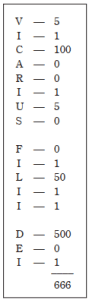 attached to the Pope would seem to be an illegitimate one. He is not the vicarious Son of God; he is not the vicar of Christ; he is not reigning instead of Christ; and therefore every intimation to the effect that he is the substitute or representative of Christ in reigning power would seem to be that much of a blasphemy. Not that the Pope and the Catholics understand that they are blaspheming. I presume they feel fully confident that this is all very true of him. But to our understanding it is untrue, and he is in a false position, and is really Antichrist, or the counterfeit Christ, as the Bible would express the matter.”
The numerical signification and the sum of these letters, “Vicarius Filii Dei,” is shown in the accompanying formula.
We give in this connection a very interesting dissertation on this matter from an exposition written in 1828:
“Mention having been made of the ‘number of the beast’ or ‘the number of his name’ (for they are both the same), the Prophet proceeds to inform us what the number is, leaving us from the number to collect the name, verse 18 — ‘Here is wisdom. Let him that hath understanding count the number of the beast.’ It is not therefore a vain and ridiculous attempt to search into this mystery, but on the contrary is recommended to us upon the authority of an Apostle.
“ ‘For it is the number of a man’; it is a method of numbering practiced among men; as ‘the measure of a man’ (Revelation 21:17) is such a measure as men commonly make use of in measuring. It was a method practiced among the ancients to denote names by numbers; as the name Thouth or the Egyptian Mercury was signified by the number 1218. St. Barnabas, the companion of St. Paul, in his epistle discovers in like manner the name of Jesus crucified in the number 318. It hath been the usual method in all God’s dispensations for the holy Spirit to accommodate his [its] expressions to the customs, fashions, and manners of the several ages.
“Since then this art and mystery of numbers was so much used among the ancients, it is less wonderful that the ‘beast’ also should have his number, ‘and his number is six hundred and sixty-six.’ Here only the number is specified; and from the number we must, as well as we can, collect the name. Several names possibly might be cited, which contain this number, but it is evident that it must be some Greek or Hebrew name; and with the name also the other qualities and properties of the beast must all agree. The name alone will not constitute an agreement; all other particulars must be perfectly applicable; and the name also must comprehend the precise number 666.
“No name appears more proper and suitable than that famous one mentioned by Irenaeus, who lived not long after 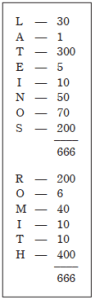 St. John’s time, and was the disciple of Polycarp, the disciple of John. He saith, that ‘the name Lateinos contains the number of 666; and it is very likely, because the last kingdom [fourth empire of Daniel 7] is so called, for they are Latins who now reign; but in this we will not glory’; that is, as it becomes a modest and pious man, in a point of such difficulty, he will not be too confident of his explication. Lateinos with ei is the true orthography, as the Greeks wrote the long i of the Latins, and as the Latins themselves wrote in former times. No objection therefore can be drawn from the spelling of the name, and the thing agrees to admiration.
“For, after the division of the empire, the Greeks and other orientalists called the people of the Western Church, or Church of Rome, Latins; and as Dr. Henry Moore expresses it, they Latinize in everything. Mass, prayers, hymns, litanies, canons, decretals, bulls, are conceived in Latin. The Papal councils speak in Latin … Nor is the Scripture read in any other language under Popery, than Latin. Wherefore the Council of Trent commanded the vulgar Latin to be the only authentic version. In short all things are Latin; the Pope having communicated his language to the people under his dominion as the mark and character of his empire. They themselves indeed choose rather to be called Romans, and more absurdly still, Roman Catholics; and probably the Apostle [John], as he hath made use in some Hebrew names in this book [Revelation], as ‘Abaddon’ (Revelation 9:11), and ‘Armageddon’ (16:16), so might in this place likewise allude to the name of the Hebrew language. Now Romith is the Hebrew name for the ‘Roman beast,’ or Roman kingdom; and this word, as well as the former word Lateinos contains the just and exact number 666” (Thomas Newton, Dissertations on the Prophecies).
The numerical signification of these letters, and the sum of the same, is found in the accompanying form.
The reader will bear in mind that in this enumeration, in the Greek word Lateinos we give the corresponding numerals represented by the Greek letters, and in the case of the Hebrew word Romith, the numerals represented by the Hebrew letters.
As we shall meet in later visions of the Revelation the expressions, beast, image of the beast, mark of the beast, and number of the beast, descriptive of systems or characteristics which the last company of saints will have to over- come in order to be accounted worthy of kingdom honors (see Revelation 14:9, 15:2, 20:4), it is necessary to keep in mind what these systems and characteristics are:
(1) The beast, representing the Papal head, or Papal system, to which the ten kingdoms once gave their support, and which in our day they have turned against.
(2) The image of the beast, representing organized Protestantism in some way united to the civil governments, and in sympathy with Papacy.
(3) The mark of the beast, representing the fear, reverence, manifested on the part of professed Christians in a feeling that in some way they must recognize or support as Divine institutions these professed, united religious systems, or any that make the claim of being the channel through which alone truth can flow. To have the mark, does not in any way require a union with Papacy itself, but it does require that they, like Papacy’s followers, would have a fear to be separated from these human church systems or organizations, or a feeling that they must belong to or support them as Divine institutions.
It will, we believe, be very interesting and profitable to close the present chapter with one of the very last utterances of Mr. Russell:
“As our own eyes of understanding have opened, we have sought to show to the Church, and to the world as far as possible, the great Divine Plan of the Ages — wonderful, beautiful, far superior to anything human! Bible students the world over are reading the Bible and the signs of the times in a new light; for God’s own time has come for lifting the veil of ignorance and darkness which for so long He has permitted Satan to put before our eyes. To our understanding the present war is pictured in the Bible, as due to begin in 1914. It is a great ‘wind.’
“Following the great war, the Bible teaches, a great earthquake — social revolution — will take place. In connection with that earthquake will come an exaltation of religious sects, Catholic and Protestant, on the side of the kings and princes — political, social, financial, religious. Next will come the down- fall of all present religious systems. Speedily the symbolic ‘fire’ of the Bible will consume the earth — anarchy. Following the anarchy quickly will come the long-promised Kingdom of God, for which Christians have prayed, saying, ‘Thy Kingdom come,’ most of them with but little conception of the true meaning of their words. During the reign of that Kingdom, ‘a still small voice,’ the Message of Truth and Grace, will come to all mankind. The world’s uplift will progress; and the knowledge of the glory of the Lord shall gradually fill the whole earth. The longed-for haven of rest will then be attained, ‘the desire of all nations.’
“All the true disciples of Jesus will see and hear in this present ‘due time.’ ‘My sheep hear my voice,’ said the Master. If any, therefore, are in Babylon and do not hear the voice of the Lord now calling them out of this great apostate system, our plain inference is that they are not his true sheep. This does not mean that all will hear at the same moment. Some are dull of hearing; they may not be living very near to the Lord. But so surely as they are his sheep they will hear; and so surely as they are following in his steps they will hear clearly, and obey promptly.”
Let us clearly understand what is meant in its fullest sense by the “mark of the beast.” It is a characteristic of Papacy’s followers. Let us be very sure that we are real, true Protestants, not alone against Papacy’s claims, but against any who make claims of a similar character, and in some way seek to enforce them.