Many people have had the opportunity to express some final words just prior to death. Their words usually indicated what was especially important to them.
[—TOC Heading:Heading 3—]
FAMOUS LAST WORDS
the last words uttered by P.T. Barnum were, “How were the receipts today at Madison Square Garden?” From these brief comments we see what was on his mind, right up until the end. Not very inspirational words, were they?
A French grammar expert by the name of Dominique Bouhours said, “I am about to — or I am going to — die: either expression is correct.” Proper grammar was obviously so important to this man that they were on his lips as he was about to pass away.
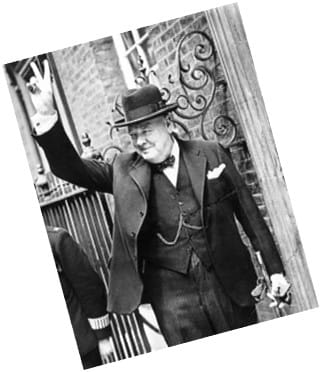
Before slipping into a coma, the last words of Winston Churchill were, “I’m bored with it all.” It’s easy to understand that statement given the fact that he led England through one of the most traumatic periods of history. Lying in bed wasn’t so exciting for such a brilliant man.

In the last words of Queen Elizabeth, we get a glimpse of how precious life was to her. She said, “All my possessions for a moment of time.” She understood the value of life and how precious every moment is. Sometimes we don’t get that until it’s about to be taken away.
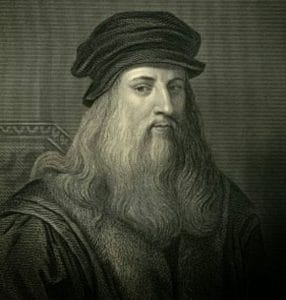
This next one may be a bit of a surprise: the last words by one of the greatest artists who has ever walked the earth. Leonardo da Vinci said this. “I have offended God and mankind because my work did not reach the quality it should have.” Those are the words of a true perfectionist, but not many people would agree with him.
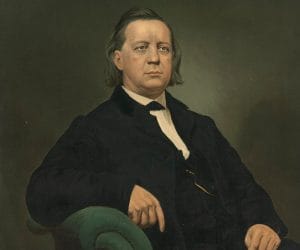
On his death bed, evangelist Henry Ward Beecher said, “Now comes the mystery.” In some ways, that is very true, even for Christians. Heaven is a mystery, but one that we will understand if we are faithful. At the moment of death there will be a change as described by the Apostle Paul, “in a moment, in the twinkling of an eye,” and then we will understand what Heaven is really like. It’s something we should look forward to with great anticipation.
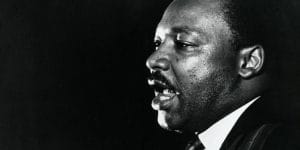
Martin Luther King Jr. gave many wonderful sermons. One of them is called I Have Been to the Mountaintop. Although unknown to him, it was to be his final sermon, given on the day before his assassination. In it, he implies he had a feeling his life would be short. He seemed to sense that he wouldn’t be around much longer. Wouldn’t you have loved to sit down with this man and tell him about God’s kingdom? Perhaps we would ask him what he meant when he said, “I have been to the mountaintop.”
It’s possible that he meant someday all men would have equal rights and opportunities in this world, that social injustice would be done away with. That certainly was the focal point of his work. He encouraged his listeners that they would someday get to the “Promised Land,” even if he wasn’t with them. He demonstrated great faith when he said that he didn’t fear any man because he believed in the coming of the Lord.
These are morally courageous words. He was assassinated for what he stood for and the social changes he advocated. These are also principles of God’s kingdom. We can’t necessarily endorse his religious theology as a southern Baptist, but his vision of a better day for civil rights has changed the world, and has helped prepare it for the greater mountaintop of God’s kingdom.
It’s inspiring to know that his next experience will be in God’s kingdom, and won’t he be thrilled at what he finds? No government afraid to act, no authorities trying to enforce discriminating laws, a place where all are treated fairly and equally, not only under the law, but in society as well.

BIBLICAL EXAMPLES OF LAST WORDS
JOSPEH
Let’s go to some of the Biblical examples of parting words. We’ll begin by examining the few words expressed by Joseph, found in Genesis 50:24-26. We see earlier in the chapter the pure heart of Joseph and why his last words are so significant:
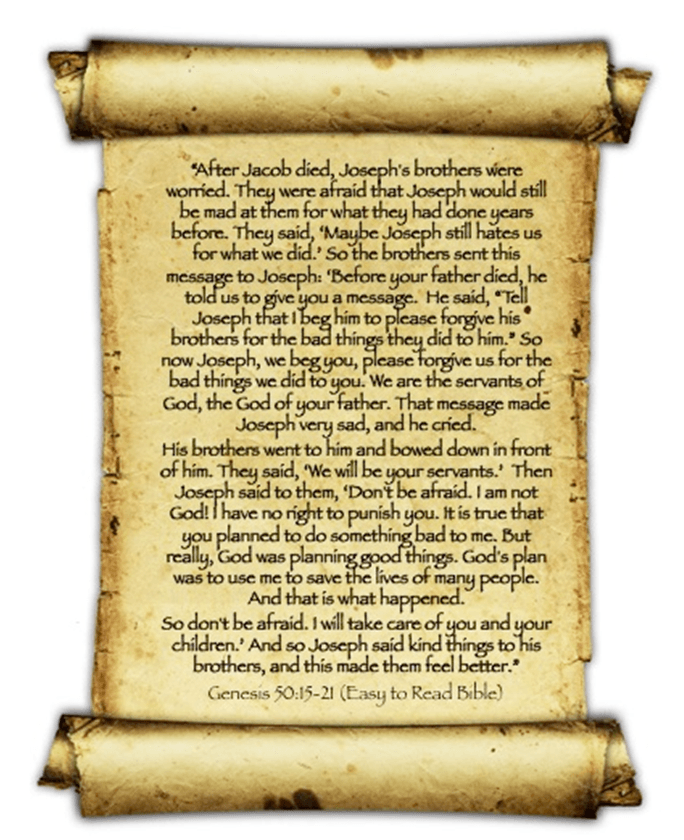
Joseph cried when he read the letter from his brothers, but what touched him so much? Perhaps it was because his father had just died. Notice that they didn’t say, “our father asked us to give you a message.” They said, “Your father asked us to give you a message.” You can see they were using his deep love for Jacob to gain Joseph’s sympathy. But, in addition to that, maybe he was moved because after all that he had done for them, they still didn’t trust him.
When we look for Joseph’s sympathetic heart we go back to verse 1 of this same chapter where, at Jacob’s death, “…Joseph fell on his father’s face and wept over him and kissed him.” He had a similar reaction years earlier when Jacob first came to Egypt. In Genesis 46:29 it says, “Then Joseph prepared his chariot and went up to meet Israel his father in Goshen. He presented himself to him and fell on his neck and wept on his neck a good while” (Genesis 46:29).
 Here are three separate occasions where Joseph’s emotions are deeply stirred. This is a man with a tender heart, and a tender heart will usually be a forgiving heart. The brothers didn’t need to try and gain his sympathy. They already had it. When put in the same position that Joseph had with his brothers many people would not have been so forgiving. Not only does he forgive them and hold no grudge, but he had already given them the lush pastures of Goshen where their flocks would prosper and where they would be safe and could stay separated from Egyptian influence.
At the end of chapter 50 of Genesis it says:
“When Joseph was near death, he said to his brothers, ‘My time to die is almost here. But I know that God will take care of you and lead you out of this country. God will lead you to the land he promised to give Abraham, Isaac, and Jacob.’ Then Joseph asked his people to make a promise. Joseph said, ‘Promise me that you will carry my bones with you when God leads you out of Egypt.’ Joseph died in Egypt when he was 110 years old…” (Genesis 50:24-26).
These brief comments were his parting words to his family. And, of course, years later the descendants of Joseph’s brothers kept the promise made to Joseph and carried his bones with them when they left Egypt under the leadership of Moses.
It’s interesting that Joseph didn’t give a long sermon about how they should never have been jealous of him or sold him into slavery. In fact, he does just the opposite. He assures them that God would take care of them and someday lead them out of Egypt, back to the land of their fathers. What a great reminder to coming generations that their lot was not in Egypt, but in the Land of Promise with Abraham, Isaac and Jacob.
Paul mentions this as an act of faith in Hebrews 11, where he says, “By faith Joseph, at the end of his life, made mention of the exodus of the Israelites and gave directions concerning his bones” (Hebrews 11:22). The reason this was an act of faith was because during Joseph’s life, the Israelites had a very comfortable existence in Egypt. It would have been easy to stay there and enjoy all the benefits of an advanced civilization, and they did for a while.
But Joseph had the wisdom to foresee that it wouldn’t always be good for them in Egypt, that their real blessing could come only from the promises made to their forefathers. And so, in his parting words he pointed them to the Promised Land, not only as a place they could one day be free of their oppressors, but a place where God would use them to fulfill the Abrahamic Promise.
This forward-looking perspective is a common theme when people of faith offer their parting words. Jacob had made the same request to Joseph. He had him swear that when he died, he would be buried in Canaan. And upon the death of Jacob, Joseph went to Pharaoh and said this:
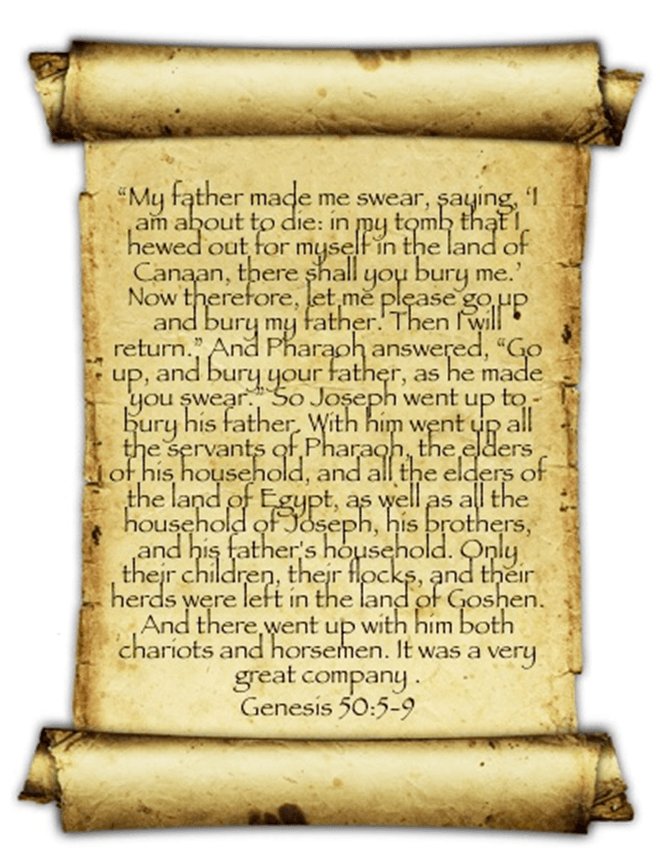
This journey once again demonstrated the great integrity of Joseph in keeping his word to Jacob. It was also a fantastic witness to the Egyptians and the fact that all the servants of Pharaoh and all the elders of Egypt went with Joseph to Canaan to bury Jacob indicates the love and respect they had for Joseph.
Later when Joseph gives his parting words, it’s no wonder that he also made his brothers promise to take his bones to Canaan. Joseph’s desire to be buried in Canaan demonstrated that the Land of Promise was connected to the words of promise given by God.
And yet after all of Joseph’s experiences, at the end of verse 15, Joseph reassured his brothers that he didn’t hate them. It tells us, “Joseph said kind things to his brothers, and this made them feel better.”
 Kindness is not often associated with Joseph. Often it is faith, wisdom, patience, administrative ability, and even forgiveness that are focused on, but kindness is like the cherry on top. It’s a special quality, that isn’t always necessary, but something that comforts and makes others feel good. Kindness is a Christ-like quality that looks at others and wants to bless them and make them feel loved and appreciated. We see the effect it had on the brothers when it says, “it made them feel better.”
Joseph was not a man who was going to hurt them, but on the contrary, a man who had their best interests at heart. Even when he was dying he thought of them. How reminiscent this is of our Lord, when on the cross, asked John to care for his mother.

JOSHUA
Let’s move on to the parting words of Joshua. They’re found in Joshua the 23rd chapter. Joshua had a sterling, almost flawless, character.
Before we read his words, let’s look at something from the first chapter, where Joshua is about to replace Moses as the new leader of Israel. We see a similarity between God’s encouragement in chapter 1 with the last words of Joshua.
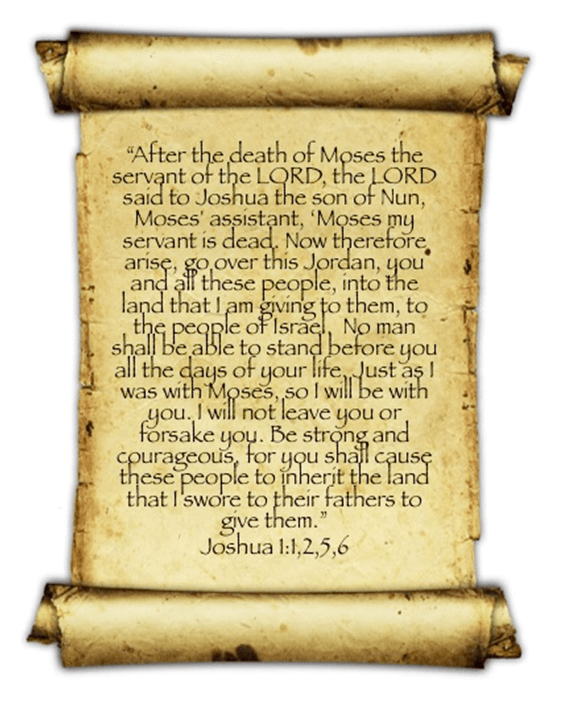 Being the successor to Moses could have been a little overwhelming for Joshua. These were big shoes to fill. Even God called him Moses’ assistant. So it’s possible that Joshua needed these reassuring words from God to know that he could do it, and that God would help him. Notice now the similarity of these words to Joshua’s own advice when he gave his parting words to the Israelites. He actually did this twice. The first time is found in the 23rd chapter of Joshua and then he does it again in the 24th chapter where it looks like he had gone to a different location, to Shechem.
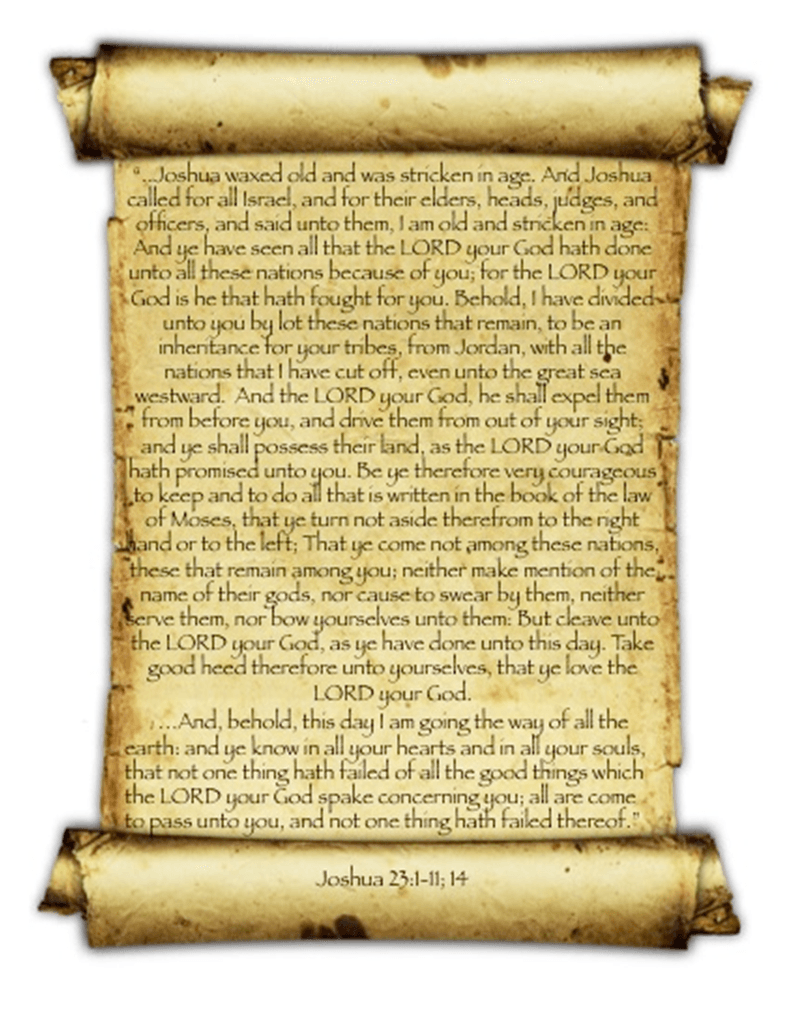 Notice the similarity between what Joshua said here and what God had said to Joshua in chapter one. God had said to Joshua, “No man shall be able to stand before you all the days of your life. Just as I was with Moses, so I will be with you. I will not leave you or forsake you. Be strong and courageous..” (Joshua 1:5, 6).
Then, many years later, Joshua said to Israel, “Ye shall possess their land, as the LORD your God hath promised unto you. Be ye therefore very courageous to keep and to do all that is written in the book of the law of Moses” (Joshua 23:5, 6)
Why would they have to be courageous to keep everything written in the Law? Perhaps because sometimes it would mean standing alone against popular trends, or it meant being faithful to the Law when others were not. Or, it also could have meant keeping their faith in God was a vital part of their existence, no matter what challenges they faced. It’s easy to let our relationship with God slide when other things try to pull us away from Him.
These words should hit us in the heart. Let us, as followers of Christ, be courageous as we face the things that can draw us away from the Lord or discourage us. Be mentally strong as energy diminishes with age. No matter what our experiences may be, let it always be our heart’s desire to serve and please Him. That’s the spirit of Joshua’s words for us today.

“…ye know in all your hearts and in all your souls, that not one thing hath failed of all the good things which the LORD your God spake concerning you; all are come to pass unto you, and not one thing hath failed” (Joshua 23:14).
What a precious reminder to Israel of how the Lord had helped them and delivered them, not only from Egypt, but from the perils of conquering their enemies in the Promised Land. This principal Joshua describes is an attribute of God; of all the good things He promises, not one of them ever fails. He is loyal to the promises He makes. And that’s a message for us as well. But it can be easy to forget it and get caught up in the worries and stresses of life. If we focus on the things that God has promised us, all these other things become insignificant.
 In chapter 24, Joshua then goes to Shechem. There he likewise gathers the people and says basically the same thing he said in chapter 23, but he adds probably the most famous words he ever spoke. In verse 15 he says:
“And if it seem evil unto you to serve the LORD, choose you this day whom ye will serve; whether the gods which your fathers served that were on the other side of the flood, or the gods of the Amorites, in whose land ye dwell: but as for me and my house, we will serve the LORD” (Joshua 23:15).
Choose you this day whom ye will serve. Joshua laid before the people the fact that they had a choice. They could choose to serve other gods. But would it be the god of those who Jehovah had conquered for them before entering the land? Or would it be the gods of the Amorites, some who still dwelled in the land, but who God had also delivered into their hands? In other words, “Would you rather serve the gods whom Jehovah has conquered, or would you rather serve the Almighty?” It was excellent reasoning.
“And the people answered and said, God forbid that we should forsake the LORD, to serve other gods… And it came to pass after these things, that Joshua the son of Nun, the servant of the LORD, died, being an hundred and ten years old… And Israel served the LORD all the days of Joshua, and all the days of the elders that outlived Joshua, and which had known all the works of the LORD, that he had done for Israel” (Joshua 24:15, 16, 29, 31).
Joshua was a man who left such an example of commitment that his influence spanned multiple generations. When he said, “as for me and my house, we will serve the LORD,” he had already done that. His life had exemplified what a man of faith should be. But now it was for his posterity to carry on the legacy.
This is a great lesson for parents. We cannot control what our children do when they become adults, but we have them for the formative years of life. If we plant the seeds of serving the Lord early in life, and make it natural to serve, it will help them for all eternity. And so Joshua really did have a sterling character. He fulfilled his commitment to God, to his people and to his family, all indications of true heart loyalty.
He fulfilled his commitment to God, to his people, and to his family. You can’t ask for more than that.


DAVID
Now we get to David. At the end of Psalm 72 it says, “The prayers of David the son of Jesse are ended” (Psalm 72:20). This Psalm was probably the last thing David ever wrote. Later Psalms attributed to David may have been found and added by Hezekiah or others who helped organize the book after David’s death.
Like Joseph and Joshua, the parting words of David reveal what was on his heart. The chapter is titled “A Psalm for Solomon.” David’s last prayer, his last song, his parting words, were for his son Solomon. But why Solomon—why not his other sons? Well, Solomon was special. God had chosen him to succeed David as king of Israel. He was to be a symbol of our Lord’s kingdom reign. And David knew that Solomon would be faced with extraordinary challenges, as he took over the kingship of Israel.
David said:
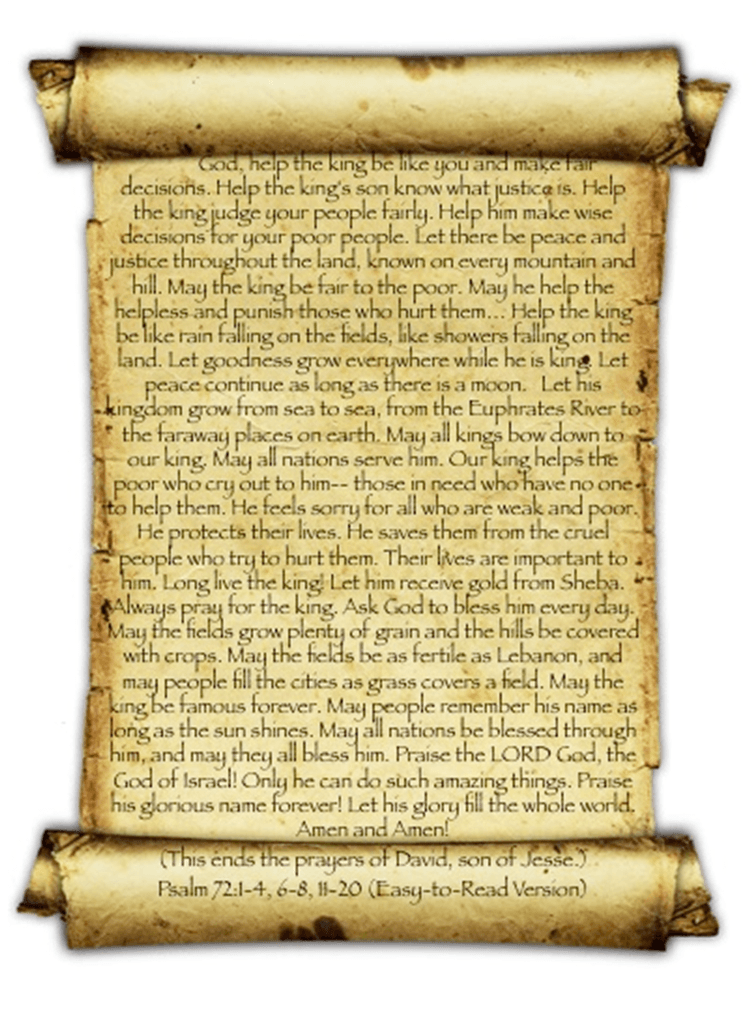
This is an amazing prayer. How could Solomon ever hope to live up to it? David, even as an old man, has an incredible idealistic mentality. He desires the new king to make fair and wise decisions, to understand justice, to bring peace throughout the land, to consider and protect the poor, to have a universal kingdom where all kings bow to Solomon and serve him, and all nations are blessed through him.
And then, he adds the important caveat that only the Lord can do these amazing things. As great as Solomon’s reign was to be, he was never able to live up to this lofty standard. It’s possible that David knew Solomon’s reign would be a picture of the reign of Christ, where all these things are possible.
When we read this wonderful description of the ideal society it reminds us of how important and special our calling to God through Jesus really is. Most reasonable people who read this chapter would agree that this would make a great world, a place that many, like Martin Luther King Jr., have been trying to achieve.
But, as David indicated, only the Lord can make it happen. And so, remember, as we do our little part today in whatever the Lord asks us to do, we are taking part in the real solution for the world’s problems. We are working for the ideals described in this chapter. David’s words remind us of all that. We can be part of the solution.


STEPHEN
The next individual lived under very different circumstances when he offered his parting words. His name was Stephen. We read about him in the 6th and 7th chapter of Acts. He was the first deacon appointed in the ecclesia at Jerusalem. But he did much more than serve as a deacon. Here’s what it says about him in Acts 6:
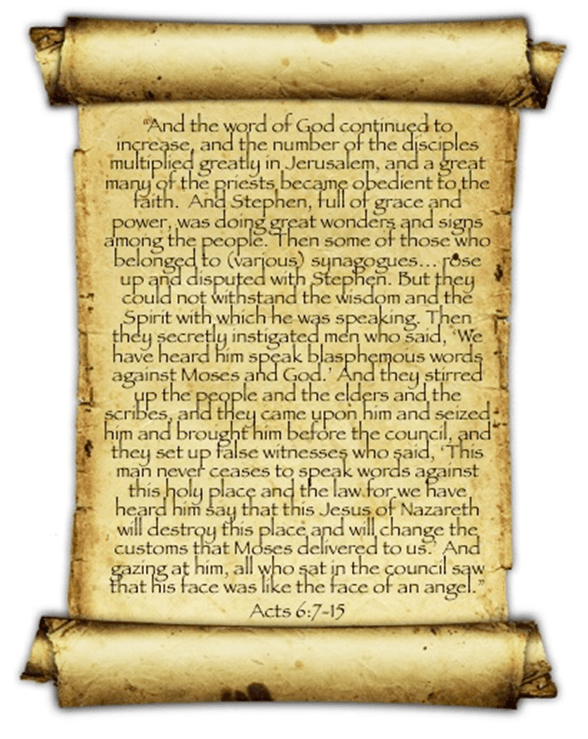
Obviously, there was something very special about this brother. Not only did he display extraordinary courage in witnessing to a hostile crowd, but he did it without resentment. Christian commentator Charles Russell said about verse 15, “The peace and joy of his heart shone from his eyes and so illuminated his whole countenance… his face was so wonderfully lit up with the indwelling of joy.”
The only reason he could be in such a disposition of mind was if he believed in what he was saying with all his heart, and understood what a privilege it was for him to be speaking about the Truth. When asked if the accusations of blasphemy were true, he gave a short sermon on the history of Israel. He starts with Abraham, Isaac and Jacob. He mentions Joseph and Moses and Joshua, David and Solomon. And he connects the temple that Solomon had built with his criticism of the Pharisees by saying that God doesn’t dwell in buildings made with hands. So their defense of an institution, that had become entrenched in ritualism and did not consider the development of the heart, was corrupt.
And then he gets very specific. He said:
“‘You stiff-necked people, uncircumcised in heart and ears, you always resist the Holy Spirit. As your fathers did, so do you. Which of the prophets did your fathers not persecute? And they killed those who announced beforehand the coming of the Righteous One, whom you have now betrayed and murdered, you who received the law as delivered by angels and did not keep it.’ Now when they heard these things they were enraged, and they ground their teeth at him. But he, full of the Holy Spirit, gazed into heaven and saw the glory of God, and Jesus standing at the right hand of God. And he said, ‘Behold, I see the heavens opened, and the Son of Man standing at the right hand of God.’ But they cried out with a loud voice and stopped their ears and rushed together at him. Then they cast him out of the city and stoned him… And as they were stoning Stephen, he called out, ‘Lord Jesus, receive my spirit.’ And falling to his knees he cried out with a loud voice, ‘Lord, do not hold this sin against them.’ And when he had said this, he fell asleep.”
Acts 7:51-60
The things he said cost him his life. But, not really. In fact, just the opposite is likely the case. His zeal and overflowing joy in serving the Lord was a mark of Christ-likeness. Therefore he may have lost his earthly life, but received a spiritual reward. When he said, “Lord Jesus, receive my spirit,” he was expressing confidence that a higher authority than the Sanhedrin would grant him a better life than the one being taken away.
 It’s amazing that in one of the purist expressions of Agape (unconditional) love he could say, “Do not hold this sin against them.” What an example of applying the Lord’s instructions when he said, “…pray for those who despitefully use you and persecute you” (Matthew 5:44). As strongly as Stephen condemned their sins, so strongly did he love them. Here’s a living example of the way it should be done. So, like we saw in Joseph, here, in Stephen, we see a merciful heart.
JESUS
There are other examples of parting words. Our Lord spent five entire chapters, recorded in John 13-17, giving parting words to his disciples:
 He prepared them for his death, as best they could understand at the time.
 He expressed of importance of humility when he washed their feet.
 He told them about the many mansions in his Father’s house and that they could get there through him.
 He also told them they would do greater things that he had done, if they were faithful.
 He explained that he and the Father were one in purpose and that
 after he left them, the Holy Spirit would come and sanctify them.
 He emphasized the importance of love and prepared them for the persecution to come when he said, “A servant is not greater than his master. If they persecuted me, they will also persecute you” (John 15:20).
 And finally, he told them the grief they would experience at his death would turn to joy when they understood the reason for his death and the fact that he was alive again.
Through it all, their hope for eternal life would be rekindled.
Like the other examples we have looked at, even though his death was imminent, Jesus’ thoughts were for the welfare of others. This is saintly thinking.

WHAT ABOUT YOU?
What would you say if you were giving your parting words? Maybe we can learn from these examples.
 From Joseph, we could remind others that “our lot is not in Egypt.” Though there are many tempting things out there in the world, our deliverance from the things that hold us in bondage will only come from God, and so that’s where our dedication should be. Also from Joseph, remember to be kind to others, to comfort them and do good things for them. This is a godly quality.

From Joshua, we learn that not one thing the Lord has promised will ever fail. So, trust in the promises. Make them the focal point of your life. Have the courage to stand against the crowd and live a consecrated life. Create a home environment conducive to spiritual growth and where serving the Lord will be natural.

From David, remember the grandeur of the reign to come, when all the world will be at peace, and appreciate the fact that we have been invited to be part of the solution to all the world’s problems. It’s not because we’re so great. But as David said, “Only God can do such amazing things.”

From Stephen, allow the truth to be such an influence on us that we will serve with such joy that it will shine through everything we do. Forgive those who don’t appreciate us or even abuse us. If we can do that from the heart, then the Gospel message has done its work in us.
Jesus spoke of so many things it’s next to impossible to summarize them all. But from each example we are reminded to look forward in hope to the great prospects that lies ahead and let that inspire us to faithfulness.
And so, let us remember and honor all of the good people who have been to the mountaintop and seen the ideals of the Promised Land, and who will be thrilled when they see the reality.