
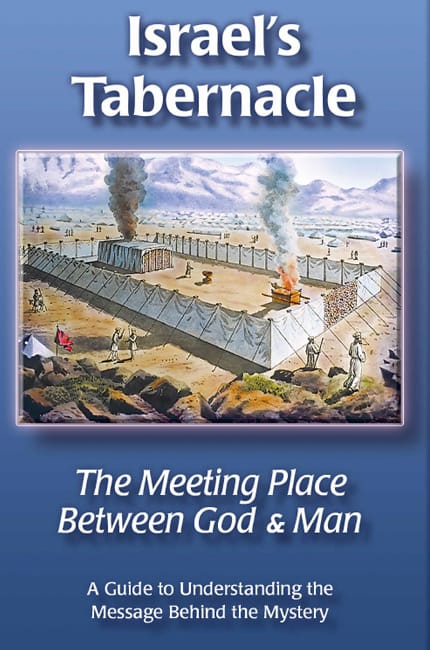
22 page full color booklet
The tabernacle was an Old Testament mobile temple that God had directed the Israelites to build. It was moved from place to place as they journeyed through the wilderness for forty years. It symbolically depicts the sacrifice of Jesus and his faithful followers. This booklet describes the overall layout as well as each article of furniture, and their symbolism. Every Christian sholuld be aware of the beautiful details that God provided of the future ages of sacrifice and blessing.
Weight: 1.5 oz
Dimensions: 8.5 × 5.5 × .6 in
The booklet Israel’s Tabernacle explores the profound spiritual significance of the Tabernacle that God instructed Moses to construct in the wilderness. Far more than a physical place of worship, the Tabernacle is revealed as a rich and divinely inspired symbolic structure — a blueprint outlining God's plan for redeeming humanity. Every detail, from its layout and materials to its furnishings and priestly rituals, points forward to the redemptive work of Jesus Christ and the steps toward full reconciliation between God and man. The entire system, the booklet argues, was designed not just for ancient Israel but as a teaching model for believers of all ages.
God’s intention for the Tabernacle is clearly stated in Exodus 25:8: “Let them make me a sanctuary; that I may dwell among them.” This declaration expresses God’s desire to live among His people, but human sin required that access to His presence be mediated through sacrifice and priestly intercession. Thus, the Tabernacle served both as a physical meeting place and as a profound teaching tool, revealing God’s holiness, humanity’s need for atonement, and the process of spiritual reconciliation.
The Tabernacle was a portable sanctuary composed of three main areas, each representing stages in a believer’s spiritual journey.
The first area, the Court, was accessible to all Israelites and housed two primary elements: the Brazen Altar, used for burnt sacrifices, and the Laver, used for washing. This outer area represented the initial steps of faith and justification — the acknowledgment of sin and acceptance of cleansing through sacrificial atonement. It symbolized the beginning of the journey toward God, where belief in His redemptive promise initiates spiritual transformation.
The second area, the Holy Place, could be entered only by consecrated priests. Within it stood the Golden Candlestick, symbolizing the illumination of the Holy Spirit; the Table of Shewbread, representing nourishment through the Word of God; and the Golden Altar of Incense, illustrating the prayers of the faithful rising to heaven. This area depicted the sanctified life of believers — those who dedicate themselves in service to God and grow through continual spiritual enlightenment and communion.
The innermost area, the Most Holy Place, also called the Holiest of All, contained the Ark of the Covenant and the Mercy Seat. Only the High Priest could enter this sacred space, and only once a year on the Day of Atonement. It represented direct fellowship with God and the glorified condition awaiting faithful overcomers. This place of divine presence symbolizes the goal of the Christian journey — full unity with God and participation in His divine nature.
The Levitical priesthood played a central role in the Tabernacle services, particularly the High Priest, who symbolized Jesus Christ in His role as Redeemer and Mediator. The High Priest entered the Most Holy on behalf of the people, interceding and offering blood for their sins — a clear picture of Christ’s once-for-all atonement and continual intercession.
The regular priests, or underpriests, typify the faithful followers of Christ — the Church — who are called to lives of consecration, service, and future glorification. Their duties throughout the year symbolized the ongoing redemptive work of Christ and His Church, culminating in the restoration of all things and the reconciliation of the world to God.
Sacrifices were the heart of Tabernacle worship and conveyed essential spiritual lessons. Animal sacrifices, required by law, portrayed substitutionary atonement, affirming the principle that “the wages of sin is death” and that a life must be given to redeem another. The daily burnt offerings on the Brazen Altar represented full surrender and the continual need for cleansing.
The Day of Atonement, as described in Leviticus 16, stands out as the most significant ritual. It involved two goats: the Lord’s Goat, which was sacrificed, and the Scapegoat (Azazel), which was released into the wilderness. These goats symbolize two distinct elements of atonement — the former representing the faithful followers of Christ who suffer with Him, and the latter representing the eventual removal of sin and Satan’s ultimate accountability. This dual ceremony underscored both the cost of redemption and the promise of a future free from evil.
The entire Tabernacle structure serves as a powerful metaphor for the believer’s spiritual journey. Entering the Court represents the first step — placing faith in Christ’s sacrifice and receiving justification. Ministering in the Holy Place corresponds to a life of sanctification, where the believer grows through prayer, the Word, and the influence of the Holy Spirit. Entering the Most Holy Place symbolizes glorification — the ultimate reward of the faithful who endure the narrow path of consecration and become partakers of the divine nature. Through these stages, the Tabernacle illustrates the Christian path from initial belief to full spiritual maturity and union with God.
At the heart of the Tabernacle stood the Ark of the Covenant, the most sacred object, containing the Ten Commandments (God’s moral law), Aaron’s rod that budded (signifying divine authority), and a golden pot of manna (God’s faithful provision). Covering the Ark was the Mercy Seat, the very place where God’s presence dwelt and where atonement blood was sprinkled.
This symbolism reveals the balance of justice and mercy in God’s plan. While the Law resides within the Ark, it is covered by the Mercy Seat, indicating that divine mercy triumphs over judgment through Christ’s sacrificial work (James 2:13). Here, God’s holiness and love meet, providing a profound picture of the gospel.
The Tabernacle was not just a relic of Israel’s worship—it was a shadow of heavenly realities, as affirmed in Hebrews 8:5, which calls it a “copy and shadow of heavenly things.” It prefigured a greater spiritual Tabernacle, one not made with hands, which is currently being constructed by Christ through His Church. The ultimate fulfillment of the Tabernacle’s promise is found in Revelation 21:3, where God declares, “Behold, the tabernacle of God is with men,” pointing to a future when God dwells permanently with redeemed humanity in perfect harmony.
The booklet concludes by affirming that Israel’s Tabernacle is more than an ancient religious artifact — it is a divinely inspired teaching model that maps out God’s redemptive plan for humanity. Through its detailed design, rituals, and priesthood, the Tabernacle reveals how Jesus Christ and His followers are building the true spiritual house where God will eternally dwell. Its message transcends time, calling all who believe to a journey of faith, consecration, and glorification — leading to full reconciliation between God and man.


