The word “Gospel” is found 98 times in the King James Version of the Bible. Sometimes it’s hidden; for example in Luke 2:10, “And the angel said unto them, Fear not: for, behold, I bring you good tidings of great joy, which shall be to all people.” The words “I bring good tidings” are from one Greek word and means to announce good news. There are about 126 times that the word “Gospel,” in one form or another, appears in the New Testament. It literally means a good message, good news, glad tidings.
(All scriptures are quoted from the King James Version, unless otherwise indicated.)
Galatians 3:8 reads, “And the scripture, foreseeing that God would justify the heathen through faith, preached before the Gospel unto Abraham.” However, the word “Gospel” is not found in the Old Testament.
QUESTION 1
How was it, then, that Abraham had the concept of the Gospel preached to him?
Genesis 12:3— “…in thee [Abraham] all families of the earth will be blessed.”
Genesis 18:18— “…all the nations of the earth shall be blessed in him [Abraham].”
Genesis 22:18— “And in thy seed shall all the nations of the earth be blessed; because thou [Abraham] hast obeyed my voice.”
Even though these scriptures may not mention the word Gospel, they clearly tell us about a time when ALL the families, or nations, of the earth will be blessed. But who is Abraham’s seed? Abraham was the father of Isaac, and Isaac the father of Jacob. Jacob’s family would become the nation of Israel.
When God said to Abraham, “I will make of thee a great nation,” (Genesis 12:2) He could only have meant Israel, as we see clearly from the scriptures and from history.
God even made a covenant with Israel through Moses. In Deuteronomy 28:1, 2 (above), God goes into detail about what that meant. God was willing to set them above all the nations of the earth, and they would be prosperous if they kept God’s commandments. These promises were not offered to any other nation. Israel must have been that “great and mighty nation” that God spoke of in Genesis 18:18. Surely, this was Israel’s Gospel, so to speak.
Israel had some trouble keeping God’s commandments. In Exodus 32:4 they began worshiping a molten calf. Worshiping idols became a problem for Israel after this time but God did not break His covenant. Because He loved them, He punished them when they turned away from the covenant they had made with Him. They needed some discipline, but God did not desert them.
 By the time Jesus arrived on the scene, the leadership in Israel had become quite corrupt. In Matthew 23:14, the leadership groups in Israel found ways to get around the Law. They were supposed to take care of the widows, but instead they swindled them.
Jesus challenged these groups. Here was a perfect man (although they didn’t know that), who showed the scribes and Pharisees that what they were doing was not in accordance with the Law of Moses. The contrast of his lifestyle with theirs, and the fact that he was gaining followers, worried them and made them mad. They sought to kill him.
Now we are introduced to another part of Abraham’s seed. We read in Galatians 3:29, “And if ye be Christ’s, then are ye Abraham’s seed, and heirs according to the promise.”
The leaders were so fearful of losing their power and wealth that they couldn’t see what was right before their eyes. When Jesus realized that the Jews would never change their ways (as a nation), he said in Matthew 23:37,38 (New International Version), “O Jerusalem, Jerusalem, you who kill the prophets, and stone those sent to you, how often I have longed to gather your children together, as a hen gathers her chicks under her wings, but you were not willing. Look, your house is left to you desolate.”
This prophecy came true—the Jews revolted against the Roman Empire in 66 AD, and in 70 AD the Romans destroyed the second temple and most of Jerusalem. This caused the Jews to be scattered throughout the world—their “house was left in desolation.”
Shortly after Jesus’ death, the first Gentile convert, Cornelius, and his family became Christians in Acts 10. Jews and Gentiles alike converted to Christianity. The second part of Abraham’s seed was being established.
QUESTION 2
Was the nation of Israel to remain desolate forever?
The Apostle Paul answers that question succinctly and beautifully in Romans 11:1, 2.
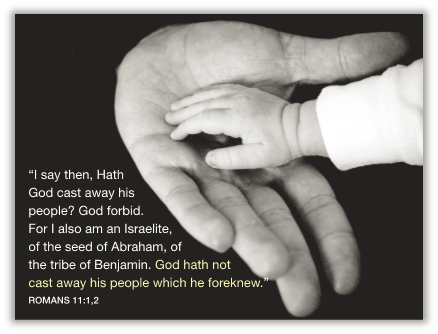
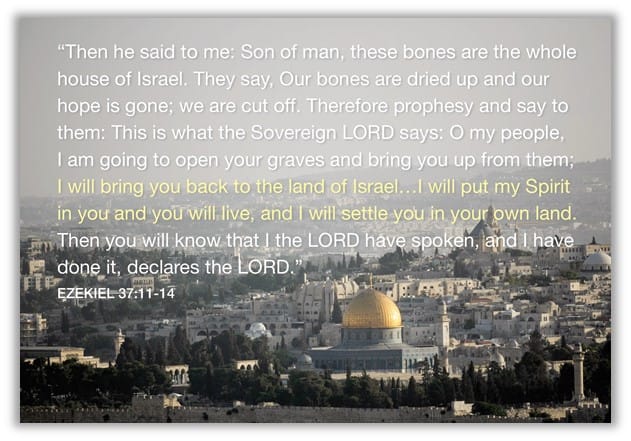
God loves the nation of Israel. He told the Jews that they would get all of the land promised to them centuries earlier. In fact, there is a prophecy about that in Ezekiel 37:1-10. This is the story of Israel. They were cast off, scattered among the nations, and they had no more rights to the land nor status among the nations. Nationally speaking, they were nothing but a valley of dead, dry bones. We know that this prophecy is about Israel as seen in verses 11-14.
Good news for Israel! Might we say the Gospel of Israel?
The Zionist Movement started in the late 1800’s, and it grew amidst many trials. On May 14, 1948, Israel became a nation again. Not only did the rest of the world accept it, they helped make it happen. Israel today still does not have all the land promised in Numbers 34, but they will never be uprooted from their land again.
Go back to the time when Jesus was on the earth as a perfect man. He taught his disciples principles to live by, rather than the strict rules of the Law. When a lawyer asked Jesus which was the greatest commandment, he replied in Matthew 22:37-40, “Thou shalt love the Lord thy God with all thy heart, and with all thy soul, and with all thy mind. This is the first and great commandment. And the second is like unto it, Thou shalt love thy neighbour as thyself. On these two commandments hang all the law and the prophets.”
Again, let’s look at Luke 2:10, “… I bring you good tidings of great joy, which shall be to all people.” The words “good tidings” here are the same Greek word that is translated “Gospel” elsewhere. Until now, we have been talking about good news for Israel. This scripture changes that. Did Luke say, Fear not: for, behold, I bring you good tidings of great joy, which shall be to all Christian people? Or, to all good people? No, Luke was quite clear when he recorded these words that he meant, “to ALL people.” The Gospel is not just for Israel, or just for Christians. It is for everyone who has ever lived!
Earlier we mentioned part of Galatians 3:8. Now let’s look at the whole text: “And the scripture, foreseeing that God would justify the heathen through faith, preached before, the Gospel unto Abraham. In thee shall all nations be blessed.” The Apostle Paul equated the Gospel with the blessing of all the nations on earth.
QUESTION 3
How will all the nations be blessed?
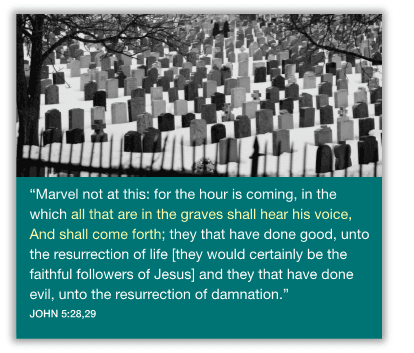
That’s a wonderful promise, but we have a little problem — millions of people are dead. Many of them died before Jesus walked the earth as a man, and before Luke and Paul wrote of the glad tidings to all.
How will all people, even those that have died, receive the promised glad tidings of great joy to all people? Look at John 5:28,29: these two verses show us how important Bible study is. That last phrase, “and they that have done evil, unto the resurrection of damnation,” is from the King James Version. The word “damnation” sounds pretty scary. What does it mean? The Greek word that “damnation” was translated from in this text is krisis, and Strong’s Concordance defines it as “decision…by extension, a tribunal.” Vine’s Expository Dictionary says: It denotes the process of investigation, the act of distinguishing and separating. Hence a judging, or a passing of judgment upon a person or thing.
The King James Version is one of the few that uses the word “damnation” in this text. Most versions use the word “judgment.” The first group mentioned in John 5:29 (“they that have done good”) is referring to the faithful followers of Jesus. Revelation 2:10 tells us that they will receive a “crown of life.”
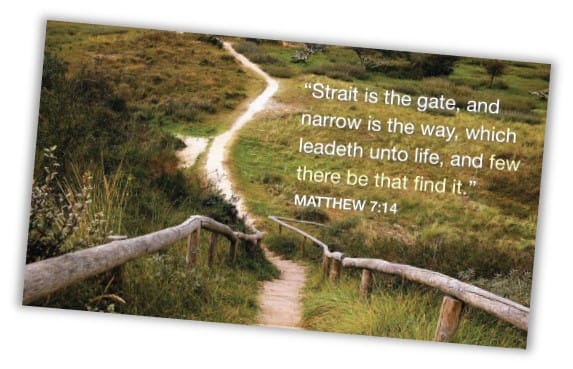 This group of faithful ones is called a “little flock” in Luke 12:32. And in Matthew 7:14 we read that, “Strait is the gate, and narrow is the way, which leadeth unto life, and few there be that find it.” John 5:28,29 clearly mentions two groups — “they that have done good,” and “they that have done evil.” The word evil seems a little strong here. Young’s Concordance defines it as worthless. Vine’s says, primarily denotes slight, trivial, blown about by every wind. Again, we learn in Revelation 2:10 that those who do good receive a heavenly reward. However, Psalms 14:3, 53:3, and Romans 3:12 all say, “there is none that doeth good, no, not one.” These thoughts don’t seem to match. The only answer is that these faithful ones in John 5:29 are reckoned good by God through the blood of Christ.
QUESTION 4
But what about those in the group who are referred to in John 5:29 as having done evil?
Obviously that will be a very large group. We know from this text that they will be resurrected to judgment — but what does that mean?
As we look at this, let’s keep in mind the various scriptures that tell us that all the nations of the earth will be blessed. All of them. Often times, Christian groups teach that John 5:29 means that those who have done evil will be judged guilty and will burn in hell forever. But that explanation doesn’t harmonize with the verses that say God will bless all people. Let’s look at this a bit closer:
1 Corinthians 6:2 says, “Do ye not know that the saints shall judge the world?” That is one job that the completed church will have — judging the rest of the world. But what will they judge? Clearly they can’t judge behaviors and mindsets that people had before the resurrection, because we are told in Matthew 7:1 to, “Judge not, that ye be not judged.”
Even Jesus told us that he did not judge the world before the resurrection of all, as we see in John 12:47, “And if any man hear my words, and believe not, I judge him not: for I came not to judge the world, but to save the world.” And He did indeed save the world.
We learn more about this time of judging in Isaiah 26:9, “When thy judgments are in the earth, the inhabitants of the world will learn righteousness.” That doesn’t sound like a bad or scary thing. In fact, it sounds like a major blessing!
God’s kingdom will be on top of, or chief over, all the kingdoms (mountains and hills) of this world. Micah says that God’s kingdom will be exalted, and people shall flow unto it. Do we see that happening today? Maybe in some areas, but worldwide it appears that most people are flowing away from it. The text tells us that when the people are flowing to God’s mountain, “he will teach us of his ways, and we will walk in his paths.” Is God teaching everyone in the world right now? Is everyone walking in His paths? No, not even close. And we would expect that.
Earlier we read in Matthew 7:13 about the strait gate and that only a few would find it. It’s starting to become clear in the Micah text, that he is talking about a future time. A time referred to in other places as God’s kingdom. And what else is God going to do during that time? Micah 4:3 says, “And he shall judge among many people.” And so we see that teaching and judging will be happening during God’s kingdom, which will be at a future time. Since we are not supposed to judge before the resurrection, the only conclusion is that the world will be judged on their progress during that judgment time — not on things they did before they are resurrected.
However, Christians are judged before they die. 1 Peter 4:17 reads, “For the time is come that judgment must begin at the house of God.” Peter said that nearly two thousand years ago. God has been judging Christians since that time. Then in the same verse, Peter asks the question that you may be asking yourself right now: “…and if it first began with us [Christians], what shall the end be of them that obey not the Gospel of God?” That’s a great question.
We have already quoted scriptures that show all people, good and bad, will be resurrected. To answer Peter’s question, let’s look at a few more: 1 Corinthians 15: 22, “For as in Adam all die, even so in Christ shall all be made alive.”
Paul tells us in Acts 24:15 that, “…there shall be a resurrection of the dead, both of the just and unjust.” When it comes to justification there are only two options — one is either justified or not. Paul says it doesn’t matter in this case, for all will be resurrected. That certainly sounds like good news to me!
 In Acts 15:16 Paul says After this. We ask, after what? Verse 14 says, “Simeon [Peter] hath declared how God at the first did visit the Gentiles, to take out of them a people for his name.” After this process has been completed; when the bride of Christ (those few who truly followed Jesus) is complete, then our Lord will rebuild the tabernacle of David.
Here is the point, in verse 17: “That the residue of men [everyone else, those not of the church] might seek after the Lord, and all the Gentiles, upon whom my name is called, saith the Lord, who doeth all these things.”
When the bride of Christ is complete, in other words, when all those who have been “faithful unto death” (Revelation 2:10) are in heaven with our Lord, who then will be the residue of men? Surely, there must be a resurrection for all people. For if they were not resurrected how could they seek after the Lord?
Many today teach that the residue, or everyone who was not resurrected to receive a heavenly reward, will burn in hell fire forever. Others teach that this group will go into a second death from which there is no resurrection. But how would people in either of those situations be able to seek after the Lord? What do the scriptures say?
In Ecclesiastes 9:10 we are given the definition of death. It says, “Whatsoever thy hand findeth to do, do it with thy might; for there is no work, nor device, nor knowledge, nor wisdom, in the grave, whither thou goest.“ That does not sound like dead people are in the agony of flames. It sounds like they are in a condition of being unconscious to everything.
That was the warning to Adam regarding the forbidden fruit. God said to him in Genesis 2:17, “in the day that thou eatest thereof thou shalt surely die.” It most clearly does not say, in the day that thou eatest the forbidden fruit you will burn forever and ever with no chance for repentance and no chance of getting out of that situation.
Romans 12:17, Thessalonians 5:15, and 1 Peter 3:9 all instruct the Christian to not “render evil for evil”; Matthew 5:39 and Luke 6:29 tell us that if someone strikes you on the cheek you should “turn the other cheek”; Matthew 5:44 says, “But I say unto you, Love your enemies, bless them that curse you, do good to them that hate you, and pray for them which despitefully use you, and persecute you;” and we read in Luke 6:27, “But I say unto you which hear, Love your enemies, do good to them which hate you.”
QUESTION 5
If God is going to torture His human enemies that die without having believed, why would He teach us to LOVE our enemies and not retaliate for evil done to us?
God loves His enemies so much that He is willing to resurrect the worst of the worst, the unjust as well as the just, and give them an opportunity to gain eternal life.
Isaiah 45:18, “For thus saith the LORD that created the heavens; God himself that formed the earth and made it; he hath established it, he created it not in vain, he formed it to be inhabited.”
This is why most Christians pray the way Jesus taught us, “your kingdom come, your will be done on earth as it is in heaven.” (Matthew 6:10, NIV) Heaven is perfect; earth will become perfect; and earth is where the evil group from John 5:29 will be resurrected to.
Revelation 20:6, “Blessed and holy is he that hath part in the first resurrection [of Jesus’ faithful followers]: on such the second death hath no power, but they shall be priests of God and of Christ, and shall reign with him a thousand years.” If everyone else, that is, the residue of men, are agonizing in hell fire at that time, or are lifeless in their graves, who is it that Christ and his church will be reigning over? These faithful ones are not going to be sitting idly on clouds playing their harps! There will be work to do in order to bring mankind up to perfection. The work of teaching and judging.

Isaiah 35:8, in the Leeser Translation, describes what will be happening in the earth during the reign of Christ. This highway will be for the “unclean.” This highway is the learning process for mankind. Remember we read in Micah, “he will teach us of his ways.” Continuing on in verse 9 of Isaiah 35, we see that “no lion shall be there.” Satan, the roaring lion, will be bound for a thousand years while mankind is learning about God, His plan, and His character — while they are on the highway of holiness. Satan will not be able to deceive the nations during the whole thousand years of the kingdom. (See Revelation 20:3).
But, that does not mean that everyone who has ever lived will continue on after the thousand years. Revelation 20:7,8 tells us: “As the sand of the sea,” or, in other words, no one knows how many.
Revelation 20 continues with some seemingly scary language. Verse 9: “And they [Gog and Magog, followers of Satan] went up on the breadth of the earth . . . fire came down from God out of heaven, and devoured them.” When a living creature is devoured, it is eaten in full, it is consumed. It is dead. So the human beings that follow Satan, even after a thousand years of learning righteousness, will be destroyed and cease to exist.
Verse 10: This text is written much like the rest of Revelation, in symbolic language. And, much like Acts 3:23, it signifies complete and utter destruction. “And it shall come to pass, that every soul, which will not hear that prophet, shall be destroyed from among the people.” Verse 10 continues, “and shall be tormented day and night for ever and ever.” That does sound scary. The word tormented is an interesting word. Young’s Concordance defines it as, to try, test, or torment. Vines’ Dictionary says primarily, to rub on the touchstone, to put to the test, then to examine by torture.
We believe that the memory of Satan and his evil ways will be remembered forever and will be a touchstone for ages to come. Satan, and all who willingly followed him, will have been tested and tried, and the world will forever know why they were destroyed.
Revelation 20:14 seems a bit peculiar: “And death and hell were cast into the lake of fire. This is the second death.” A couple of things come to our attention here. Death and hell are concepts. They are not things that one can hold in one’s hands.
QUESTION 6
If the lake of fire is an eternal, torturous hell, how is it that the concepts of death and hell can be cast into a lake of fire and be tortured?
Also, if hell and the lake of fire are the same thing, how is it that hell can be cast into itself? What would be the point?
The lake of fire here actually represents total destruction. The point is that after the little season (Revelation 20:3), Satan and all who knowingly choose to follow him — even after all the teaching and direction of Christ and his bride, and a thousand years without Satan — will be destroyed from among the people. They will have thumbed their noses at the wonderful blessings from the Lord with full knowledge of the consequences.
Revelation 21:4, “And God shall wipe away all tears from their eyes; and there shall be no more death, neither sorrow, nor crying, neither shall there be any more pain: for the former things are passed away.” If death is an ongoing torture, then death never ends. But, the text says, “there will be no more death” because it will have been destroyed. Mankind will live to eternity. Just the way God originally intended.
ONE LAST QUESTION
If Christ died for all, shouldn’t all benefit?