
“Everyone who wants to live a godly life in Christ Jesus will be persecuted.” 2 Timothy 3:12
John and Charles Wesley were sons of an Anglican minister and his deeply religious wife who lived in England. There were nineteen children in the family, and Bible stories and Scripture reading were a vital part of their growing up years in the early 1700s.
When their father became somewhat older, John left Oxford College to assist him in the parish. In the meantime, Charles, still at Oxford, formed a club with two other students to have Bible studies that would be helpful to the Christian life. It was called a “Holy Club.” The members learned to live regular and orderly lives. Some students made fun of them; some called them “Methodists” and the name stuck.
In 1735 the two brothers sailed to America to answer a call for missionaries. Charles fell ill and returned to England. By 1738 John, too, was back in England, his mission work considered a failure. However, John had been impressed with some German Moravians who showed a quiet trust in God even throughout a dangerous storm during their journey aboard ship. He learned much from them about Christian behavior and appreciated their deep and complete faith in God.
The Wesleys returned to the simplicity of the early church in preaching, class gatherings, and Bible studies. They were strongly opposed by those of other faiths who sometimes drove cattle among the worshippers to interrupt their meetings. John Wesley was a great preacher, which only caused others to stir up hostility and mob action against him.
In 1784 John Wesley broke with the Church of England, and founded the Methodist Church. Charles Wesley was the hymn writer for Methodism. He wrote thousands of hymns, a great many of which are still being sung today.
A precious Bible truth uncovered by Wesley was that of God’s love in Free Grace. His favorite Scripture was Revelation 22:17, “The spirit and the bride say, Come . . . take the free gift of the water of life.” However he did not see the full extent of this truth— that in the kingdom all mankind will have the opportunity to have life on earth forever. Charles Wesley preached in London until his death in 1788. In 1791 John Wesley died in London in his eighty- seventh year. The influence of his teachings was very great.
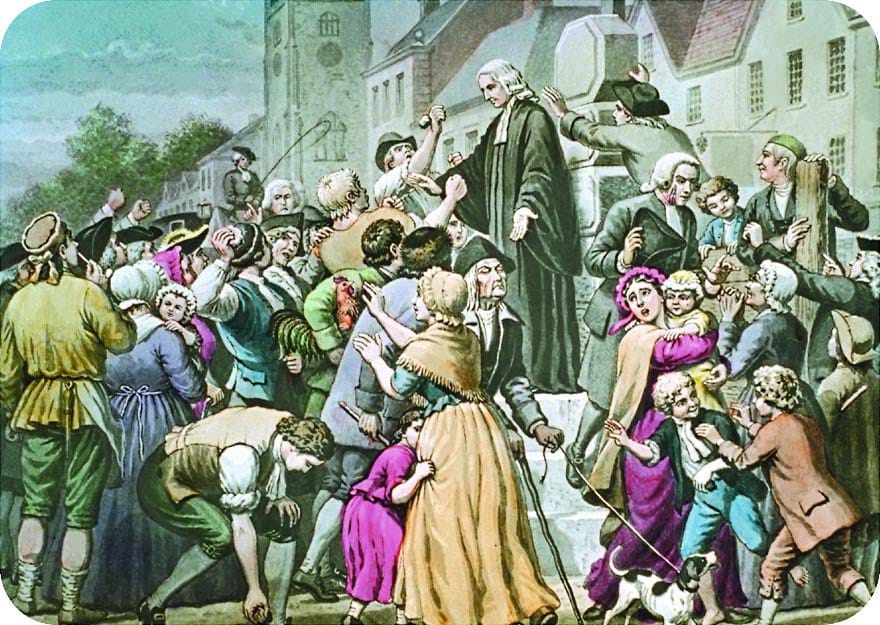 Often there was hostility against John Wesley, a great preacher.