“The Lord is nigh unto them that are of a broken heart.”
Psalm 34:18
God knows the grief and sorrow you may feel at the loss of your loved one. Pain so deep it may seem to numb you to the world. Broken ties so tender you may doubt you will ever be the same. Finding peace can be elusive and prayers to God often seem unanswered.
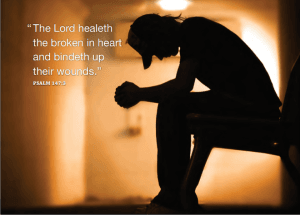
What comfort can we offer that will ease your sorrow? Human philosophies are empty and traditional religion brings little consolation. But what the Bible offers is real and gives hope based on a true understanding of God’s ultimate plan for His creation. Every perplexing question concerning life, death and the hereafter is fully explained and God’s love is revealed. There is a balm for the soul and healing for the broken-hearted in the many promises God has made. “The Lord’s loving kindnesses indeed never cease for His compassions never fail. They are new every morning. Great is Thy faithfulness.” (Lamentations 3:22, 23)
Some of the questions you may be currently struggling with find good and reasonable answers in the word of God. Why do people die? Why does a loving God permit suffering and death? Will I ever see my loved one again?
Why Do We Die?
Mankind was not designed to die but was made to live forever in health and happiness upon the earth. Adam was created in God’s image and commanded to multiply and fill the earth. (Genesis 1:27-28) A beautiful garden home was given to him, planted with many fruit-bearing trees providing perfect food capable of sustaining his perfect life forever. But Adam’s life was dependent upon one simple condition: God required his obedience. So, a simple test of obedience was devised. Adam must not eat the fruit of just one of the many trees in the garden. God said, “In the day that thou eatest thereof, thou shalt surely die.” (Genesis 2:17)

God knew Adam would fail, simply because he was untested, having no previous contact with sin and its consequences. This test was an act of love that would be for man’s ultimate blessing. Because of Adam’s sin, his posterity is now experiencing painful consequences, sickness, suffering, sorrow and death.
This is described by the Apostle Paul in Romans 5:12. “Where- fore, as by one man sin entered into the world, and death by sin; and so death passed upon all men, for that all have sinned.” In describing inherited sin the Prophet David said, “Behold, I was shapen in iniquity, and in sin did my mother conceive me.” (Psalm 51:5).
An Escape from Death
However, God did not abandon mankind to such a hopeless condition. He has provided a glorious escape from sin and death. His method of bringing salvation to the world is described in Hosea 13:14.“I will ransom them from the power of the grave; I will redeem them from death: O death, I will be thy plagues; O grave, I will be thy destruction.”
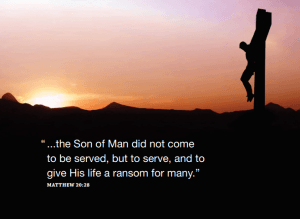
What did God mean when He said, “I will ransom them from the power of the grave?”The word “ransom” means “a correspond- ing price,” or an “equivalent price.” This refers to how Jesus Christ came to earth as a perfect man to be an exact equivalent to the perfect man Adam. But, unlike Adam, Jesus was obedient to God. In describing Jesus, the Apostle said,“…Being found in fashion as a man, he humbled himself, and became obedient unto death, even the death of the cross.” (Philippians 2:8) He sacrificially gave up his perfect human life as a “corresponding price” to offset the forfeited life of Adam.This free gift canceled the death penalty, not only on Adam, but on his posterity, as well. This redemptive work is described in Romans 5:18. “By the offense of one (Adam), judgment came upon all men to condemnation; even so by the righteousness of one (Jesus) the free gift came upon all men unto justification of life.”
The “corresponding price” which Jesus gave and the conse- quent blessing of the world is plainly stated in 1 Corinthians 15:21-22, “For since by man came death, by man came also the resurrection of the dead. For as in Adam all die, even so in Christ shall all be made alive.” This amazing statement says All will be made alive.There are no exceptions. Whether Christian, Jew, Arab, Hindu, Buddhist or Atheist, every descendant of Adam is promised a resurrection in God’s Kingdom. As a reward for his faithful sacri- fice, Jesus was raised to life as a spirit being.“For to this end Christ both died, and rose, and revived, that he might be the Lord both of the dead and living.” (Romans 14:9) Jesus has now been granted the power and authority to call the dead from their graves.
A Firm Basis of Hope
This doctrine of the Ransom is the grandest and most meaningful teaching in the Bible. It is the basis of hope and consolation for the world because it guarantees a resurrection. It assures us that there will be a joyful reunion of all families and the opportunity of living forever in health and happiness. It may seem hard to believe that our loved ones will be with us someday. When the Apostle Paul preached this message, he was challenged, and in his defense of the resurrection he said, “Why should it be thought a thing incredible with you, that God should raise the dead?” (Acts 26:8) The Almighty creator of man can certainly re-create him if He so desires. Viewed from this standpoint the resurrection of all is a concept we can surely believe. Jesus said, “Marvel not at this: for the hour is coming, in which all that are in the graves shall hear His voice, and shall come forth.” (John 5:28-29)
A Demonstration of Resurrection
When he was on earth, Jesus gave a wonderful demonstration of his power. A man named Lazarus and his sisters, Mary and Martha, were friends of Jesus. On one occasion when Jesus was away, Lazarus became seriously ill. His sisters sent word to Jesus, expecting him to return and heal their brother. But Jesus did not return at once, and Lazarus died. Jesus knew what had happened and said to his disciples, “Our friend Lazarus is sleeping; but I go that I may wake him out of sleep.” But his disciples misunderstood. “Then said his disciples,‘Lord, if he sleeps, he shall do well.’ How- beit Jesus spoke of his death; but they thought that he had spoken of taking rest in sleep.Then said Jesus unto them plainly,‘Lazarus is dead.’” (John 11:11-14) Jesus used sleep as a way of describing death. It is a temporary unconsciousness from which there will be an awakening.
Upon his return, Martha met Jesus and said, “Lord, if you had been here, my brother would not have died.” Jesus answered, “Thy brother shall rise again.” “I know that he shall rise again, in the resurrection at the last day,” responded Martha. Her answer reflected Jesus’ teaching that there would be a resurrection, at the last day.
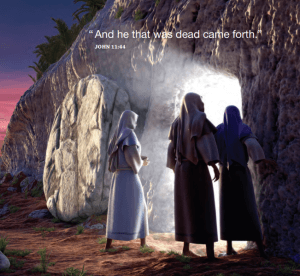
When Jesus saw Mary and the other women weeping he was so moved that he wept with them. He asked to be taken to the tomb and after praying to his heavenly Father,“He cried with a loud voice, ‘Lazarus, come forth!’ And he that was dead came forth.” After lying in his tomb for four days Lazarus walked out, alive again! We can well imagine the joy that filled the hearts of Mary, Martha and the others. This wonderful experience was but a glimpse of the joy that awaits mankind in Christ’s Kingdom. Countless prophecies of kingdom blessings will become realities as they mirror the words of Jesus.“Verily, I say unto you, the hour is coming when the dead shall hear the voice of the Son of God; and they that hear shall live.” (John 5:25)
The raising of Lazarus is recorded for our consolation when we, like Mary and Martha, experience the loss of a loved one. We can take comfort in knowing that he has the power to raise the dead, and has promised to do just that. The text in 1 Thessalonians 4:13 alludes to this fact when the apostle writes, “I would not have you to be ignorant, brethren, concerning them which are asleep; that ye sorrow not even as others which have no hope. For if we believe that Jesus died and rose again, even so them also which sleep in Jesus will God bring with him.” Hope for the resurrection helps us to sorrow differently from others who have no hope. Death is merely a temporary condition.
No Torment in Death
Some manmade creeds teach that at death the unsaved go into a place of torment. Be assured the doctrine of eternal torment is not taught in the Bible. It is based on mistranslations and misunderstanding of certain passages of Scripture. It is entirely contrary to the loving character of God. Would any normal person torture a child or even, for a moment, hold his hand over a flame? Would any sane person even torment an animal in this way? Certainly not. Eternal torment is a terrible charge against God. His thoughts and sensibilities are so much higher than ours. As a parent is kind, loving and merciful to their children, so God is all these to His hu- man family. His mercy is described in Isaiah 55:7-9,“Let the wicked forsake his way, and the unrighteous man his thoughts; and let him return unto the Lord, and He will have mercy upon him…for He will abundantly pardon. For my thoughts are not your thoughts, neither are your ways my ways, says the Lord for as the heavens are high- er than the earth, so are my ways higher than your ways, and my thoughts than your thoughts.”
The false gods of Baal and Molech were once worshiped by burning children alive. God was so incensed by this act of barbarity that He considered it a sinful abomination, totally contrary to His will. He said, “They have built also the high places of Baal, to burn their sons with fire for burnt offerings unto Baal, which I commanded not, nor spoke it, neither came it into my mind.” (Jeremiah 19:5) In Jeremiah 32:35 He repeats His statement saying, “Neither came it into my mind, that they should do this abomination…” His condemnation of such cruelty is a clear indication that He would never create a place of eternal torment, something more evil than the burning of children.

A Special Consolation
A great tragedy is recorded when the wicked King Herod, at- tempting to kill the baby Jesus, slew all the children in Bethlehem two years old and under. For every slain child, there was a heart- broken mother mourning for the tender life cut short. (Matthew 2:16-18)
This incident was foretold by the Prophet Jeremiah. The mothers who would lose their children he refers to as “Rachel.” “Thus says the Lord, ‘A voice was heard in Ramah; lamentation and bitter weeping; Rachel weeping for her children refused to be comforted for her children, because they were not.’” (Jeremiah 31:15-17) In response to such sorrow, God gives the comforting assurance that those lost in death will return to their families. “Thus says the Lord, ‘Refrain thy voice from weeping, and thine eyes from tears; for thy work shall be rewarded, and they shall come again from the land of the enemy (death). And there is hope in thine end, that thy children shall come again to their own border.’” (Jeremiah 31:15-17) An added comfort is offered by the Prophet Isaiah. “No more shall there be in it an infant that lives but a few days.” (Isaiah 65:20 – Revised Version) There will be renewed joy as every mother who has lost a child will see that child grow to full maturity in God’s kingdom.

The Bible Hell
There is something terribly wrong with the teaching of the creeds with respect to hell. The truth is that the “hell” of the Bible is simply the condition of death—the grave.
The Old Testament was originally written in Hebrew, while the New Testament was written in Greek. The place of the dead is described by the Hebrew word sheol, and the Greek word hades, both of which signify, the hidden, covered, unconscious condition of death—the grave, and nothing more. For example, in Psalm 16:10 there is a prophecy concerning Jesus: “Thou wilt not leave my soul in hell (sheol); neither wilt thou suffer thine Holy One to see corruption.” The Hebrew word sheol (translated “hell”) clearly signifies the grave into which Jesus was to go, and from which he was to be resurrected. In the New Testament, the Apostle Peter quotes this very prophecy as having been fulfilled in the death and resurrection of Jesus. Since the New Testament was written in Greek, the word hades is used in place of sheol: “Thou wilt not leave my soul in hell (hades), neither wilt thou suffer thine Holy One to see corruption.” (Acts 2:27) This demonstrates that the Greek word hades is equivalent to the Hebrew word sheol. These words should have been translated “grave” because Jesus, who was holy, harmless and separate from sinners, could not have been condemned to a place of torment.
Sheol (hell) is described in the following scriptures: As a state of “darkness” (Job 10:21), a place of “silence” (Psalm 115:17), and a condition of “forgetfulness” (Psalm 88:11-12). Ecclesiastes 9:10 states there is no “knowledge nor wisdom” in sheol. “For the living know that they shall die: but the dead know not anything.”
(Ecclesiastes 9:5) Describing a man’s death, the Psalmist says, “His breath goes forth, he returns to his earth; in that very day his thoughts perish.” (Psalm 146:4) There can be no torment in such a condition. The dead are at rest, awaiting the resurrection. These are Biblical descriptions of sheol, where there is no consciousness or thought.
The meaning of sheol and hades was perverted by unscrupulous theologians during the Dark Ages. Their object was to frighten people into subservience. The blasphemous doctrine of eternal torment was then incorporated into many Christian creeds and is widely believed today.
This was accomplished by the inconsistent method of how sheol and hades were translated into English. When a righteous person died, the translators used the word “grave.” When an unrighteous person died, it was translated that he went into “hell.” However, in the original Hebrew, everyone, whether righteous or unrighteous, went to sheol. They simply ceased to live, going into the condition of death.
The meaning of sheol is thus hidden by unreliable translations. In Genesis 37:35 the patriarch Jacob, thinking his son Joseph was dead, mourned for him, saying, “I will go down into the grave (sheol) unto my son.” In this case the translators properly used the word “grave” instead of “hell” to translate sheol. It would have been absurd for the righteous man Jacob to join his beloved son Joseph in a place of torment. The inconsistency of translation has resulted in much confusion.
The Expectation of Job
Another example of the proper meaning of sheol relates to the Old Testament character Job. He was a godly man, with great riches and a good family. Suddenly, one misfortune after another occurred. All his children were killed in a terrible storm, and in a separate experience, he lost his entire fortune. Then, he was stricken with painful boils and could not lie still, sleep, or even rest. His wife insisted that he “curse God and die.” (Job 2:9) Job was in such physical pain and mental distress that he finally wished he had never been born. “And Job spoke and said, ‘Let the day perish wherein I was born…Why died I not from the womb? For now, should I have lain still and been quiet. I should have slept. Then had I been at rest.’” (Job 3:2-3, 11, 13) Job did not know why these troubles had come upon him, but felt for some reason God was angry with him. To be relieved from his suffering he prayed for death. In his request, he expressed his hope for a resurrection. “O that thou would hide me in the grave; that thou would keep me secret until thy wrath be past; that thou would appoint me a set time, and remember me! If a man die, shall he live again? All the days of my appointed time will I wait, till my change come. Thou shalt call, and I will answer thee. Thou will have a desire to the work of thine hands.” (Job 14:13-15)

Job understood the plan of God to awaken our loved ones and prayed to rest in the grave himself until called forth in the resurrection. God lovingly holds everyone in His memory and will bring them back to life and to happier times. He has appointed the “set time” for the resurrection during the Millennial Age, the Kingdom of God under Christ. The scriptures clearly teach that our loving God is not a God of fear and torment.
A God of Mercy
The Bible describes God’s character in tender terms. The Psalmist writes, “The Lord is merciful and gracious, slow to anger, and plenteous in mercy. He will not always chide neither will He keep His anger forever… For as the heaven is high above the earth, so great is His mercy toward them that fear (reverence) Him. As far as the east is from the west, so far hath He removed our transgressions from us. Like as a father pities His children, so the Lord pities them that fear (reverence) Him. For He knows our frame; He remembers that we are dust.” (Psalm 103:8, 9-14) God is a father who shows mercy to his children! He knows what we are going through when we lose a loved one. He is sympathetic and offers help and comfort through His word.
Love is an attribute of God’s character. He is merciful even to his enemies. Jesus said,“Love your enemies…that ye may be the children of your Father which is in heaven; for He makes His sun to rise on the evil and on the good, and sends the rain on the just and on the unjust.” (Matthew 5:44-45) Jesus also said, “Be ye therefore merciful, as your Father also is merciful.” (Luke 6:36) This is not describing a being who would unmercifully and eternally torment millions. As explained by Solomon, death is a condition through which we shall all pass. “All go unto one place; all are of the dust, and all turn to dust again.” (Ecclesiastes 3:20) The dead are at rest, awaiting a resurrection.

The Experience with Sin
One of the questions proposed at the beginning of this booklet was, “Why does a loving God permit suffering and death?” The Bible offers a satisfying answer to this reasonable question. While contemplating the suffering of mankind, Solomon wrote, “I have seen the travail, which God hath given to the sons of men to be exercised therewith.” Ecclesiastes 3:10
The purpose of exercise is to make one stronger. The wise man is saying the travail of sin makes us stronger. But how? Are we better because of the experience with sin? The answer is “Yes! We will be.” This concept has opened an avenue of understanding God’s plan that is truly remarkable. Were it not for the resurrection this would be a difficult question to answer. However, the resurrection gives us a perspective on the wisdom which allows us to suffer for a time. Through experience we are coming to understand something that Adam could not appreciate. He could not have understood the consequences of disobedience, and therefore sin was a real temptation. But in the resurrection, with the memory of sin, our race will be equipped to see the value of God’s laws and we will learn to trust Him.
The minds of all those who passed through this life will have the recollection of what it was like to live with sin and its results. We are being taught to have a moral sense of right and wrong. This can be seen in the very name given to the tree from which Adam and Eve were forbidden to eat. It was called the “Tree of the Knowledge of Good and Evil.” God’s design has been to teach, through life’s experiences, the difference between good and evil. When presented with similar choices faced by our first parents, most will choose to do right and obey God. Living for a time with sin was the only way to have these principles ingrained in our hearts. With these lessons in mind, God, as a wise father, saw that in the end we would be stronger and more resilient to sin.
Thy Kingdom Come
“So abundant was God’s grace which He lavished upon us, when He made known to us the secret of His will. And this is in harmony with God’s merciful purpose for the government of the world when the times are ripe for it – the purpose which He has cherished in His own mind of restoring the whole creation to find its one head in Christ; yea things in heaven and things on earth, to find their one head in him.” (Ephesians 1:7-10, Weymouth translation)
This thrilling passage reveals that God intends to establish a new world government. Jesus referred to this when he prayed, “Thy kingdom come, Thy will be done on earth as it is done in heaven.” (Matthew 6:10) God’s grand purpose is to restore our race to the perfection lost in The Garden of Eden. “For the earth shall be full of the knowledge of the LORD, as the waters cover the sea.” (Isaiah 11:9)
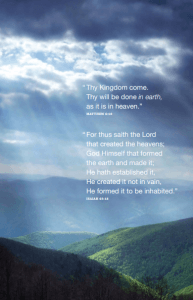
“And many people shall go and say, ‘Come ye, and let us go up to the mountain of the LORD, to the house of the God of Jacob; and he will teach us of his ways, and we will walk in his paths: for out of Zion shall go forth the law, and the word of the LORD from Jerusalem.’” (Isaiah 2:3)
The knowledge of this coming kingdom and the purpose of our current experiences gives our lives greater meaning and hope. God has promised the restoration of all life under the headship of Christ.
Some Changed to Spirit Nature
Besides this earthly salvation, there is a heavenly salvation, also based on Jesus’ ransom.Those who partake of this heavenly salvation experience a change of nature, from human to spirit beings. They die as humans, and are resurrected to the divine nature, characterized by immortality. Like Jesus, they attain to the heavenly kingdom. The Apostle Paul refers to this change of nature. “It is sown in corruption, it is raised in incorruption, it is sown in weakness, it is raised in power. It is sown a natural (hu- man) body, it is raised a spiritual body…And as we have borne the image of the earthly, we shall also bear the image of the heavenly. Now this I say, brethren, that flesh and blood cannot inherit the kingdom of God…We shall all be changed…For this corruptible must put on incorruption and this mortal must put on immortality.” (1 Corinthians 15:42-44, 49-51, 53) These are the ones to whom Jesus said, “In my Father’s house are many mansions…I go to prepare a place for you…that where I am, there ye may be also.” (John 14:2-3) These are also referred to as “holy brethren, partakers of the heavenly calling.” (Hebrews 3:1)

This heavenly salvation is described as, “The prize of the high calling of God in Christ Jesus.” (Philippians 3:14) Jesus opened the way, which is called, “a new and living way.” (Hebrews 10:20)
The Cost of Discipleship
The way to the heavenly kingdom is not easy. Jesus described it saying, “For the gate is narrow and the way is hard that leads to life, and those who find it are few.” (Matthew 7:14 – English Standard Version) Jesus also said, “No man can come unto me except the Father who hath sent me draw him.” (John 6:44) The one drawn then accepts Jesus as his personal Savior and is justi- fied in the sight of God. His sins are covered by the merit of Jesus’ sacrifice. He dedicates his life to the service of God, obeying the Apostle’s injunction in Romans 12:1, “I beseech you brethren, by the mercies of God, that ye present your bodies a living sacrifice, holy, acceptable unto God, which is your reasonable service.” All human hopes, ambitions and prospects are laid aside in exchange for this heavenly call.These are then led by the holy Spirit of God, and become spiritual sons of God.“For as many as are led by the Spirit of God, they are the sons of God.” (Romans 8:14) Their goal then becomes to develop a Christ-like mind.These individuals are described as “new creatures.”“If any man be in Christ, he is a new creature. Old things are passed away; behold all things become new.” (2 Corinthians 5:17) Those called to this “high calling” follow the example of Jesus, laying down their lives in sacrifice and living in accordance with his teachings.
A Mediator Between God and Man
“There is one God, and one mediator between God and men, the man Christ Jesus.” (1 Timothy 2:5)
As mankind comes back from the grave they will have the same mind, memory, and character as when they died. To be brought into harmony with the new kingdom conditions they will need assistance and further education in the ways of righteousness. Therefore, God has provided another remarkable feature of His plan, that of a mediator. The purpose of a mediator is to reconcile two opposing parties. The reconciling process will require the gradual removal of sin from every heart. Those who become part of the heavenly salvation are now being selected from the world in order to reign with Christ and be part of the Mediator during his Millennial Kingdom. Having lived upon the earth as humans and having first-hand knowledge of sin and death, they will share with Jesus the work of Mediator, being sympathetic and helpful in the great work of restitution.

This conclusion of God’s Plan will be a glorious undertaking, reaping bountiful results for our race. Those of mankind who learn the lessons and prove faithful to God will be granted eternal life here on earth, living in a perfect society. The faithful followers of Christ in this present age will be part of the heavenly class. God’s purpose will then be accomplished when a race of people freely choses to love and obey God. What a blessed condition will result through the wise and patient workings of God’s plan.


Precious Promises Bring Comfort
The promises of God are real and meant to strengthen our faith in Him. Let His promise of the resurrection and the restitution of our families be your strength and hope. Consider some of the many precious words God has given:
“Be of good courage, and He shall strengthen your heart, all ye that hope in the Lord.” (Psalm 31:24)
“Come unto me all ye that labor and are heavy laden, and I will give you rest. Take my yoke upon you, and learn of me; for I am meek and lowly in heart, and ye shall find rest unto your souls. For my yoke is easy, and my burden is light.” (Matthew 11:28-30)
“Blessed be God, even the Father of our Lord Jesus Christ, the Father of mercies, and the God of all comfort; Who comforts us in all our tribulation, that we may be able to comfort them which are in any trouble, by the comfort wherewith we ourselves are comfort- ed of God.” (2 Corinthians 1:3, 4)
“The peace of God which passes all understanding shall keep your hearts and minds through Christ Jesus.” (Philippians 4:7)
“Jesus Christ, who hath abolished death, and hath brought life and immortality to light through the Gospel.” (2 Timothy 1:10)
“They shall not hurt nor destroy in all my holy mountain (King- dom). For the earth shall be full of the knowledge of the Lord, as the waters cover the sea.” (Isaiah 11:9)
“He shall judge among the nations, and shall rebuke many peo- ple; and they shall beat their swords into plowshares, and their spears into pruning hooks. Nation shall not lift up sword against nation, neither shall they learn war anymore.” (Isaiah 2:4)
“No longer shall each man teach his neighbor and each his brother, saying, ‘Know the LORD,’ for they shall all know me, from the least of them to the greatest, and I will remember their sin no more.” (Jeremiah 31:34 RSV)
“The wilderness and the solitary place shall be glad for them; and the desert shall rejoice and blossom as the rose. Then the eyes of the blind shall be opened, and the ears of the deaf shall be unstopped. Then shall the lame man leap as an hart, and the tongue of the dumb sing. And a highway shall be there, and a way, and it shall be called the way of holiness. No lion shall be there, nor any ravenous beast shall go up thereon; but the redeemed shall walk there. And the ransomed of the Lord shall return and come to Zion, with songs and everlasting joy upon their heads. They shall obtain joy and gladness, and sorrow and sighing shall flee away.” (Isaiah 35:1, 5, 6 8-10)
“And I heard a great voice out of heaven, saying, Behold, the tabernacle of God is with men; and He will dwell with them, and they shall be His people, and God Himself shall be with them, and be their God. And God shall wipe away all tears from their eyes; and there shall be no more death, neither sorrow nor crying, nei- ther shall there be any more pain, for the former things are passed away. And He that sat upon the throne said, Behold, I make all things new.” (Revelation 21:2-5)