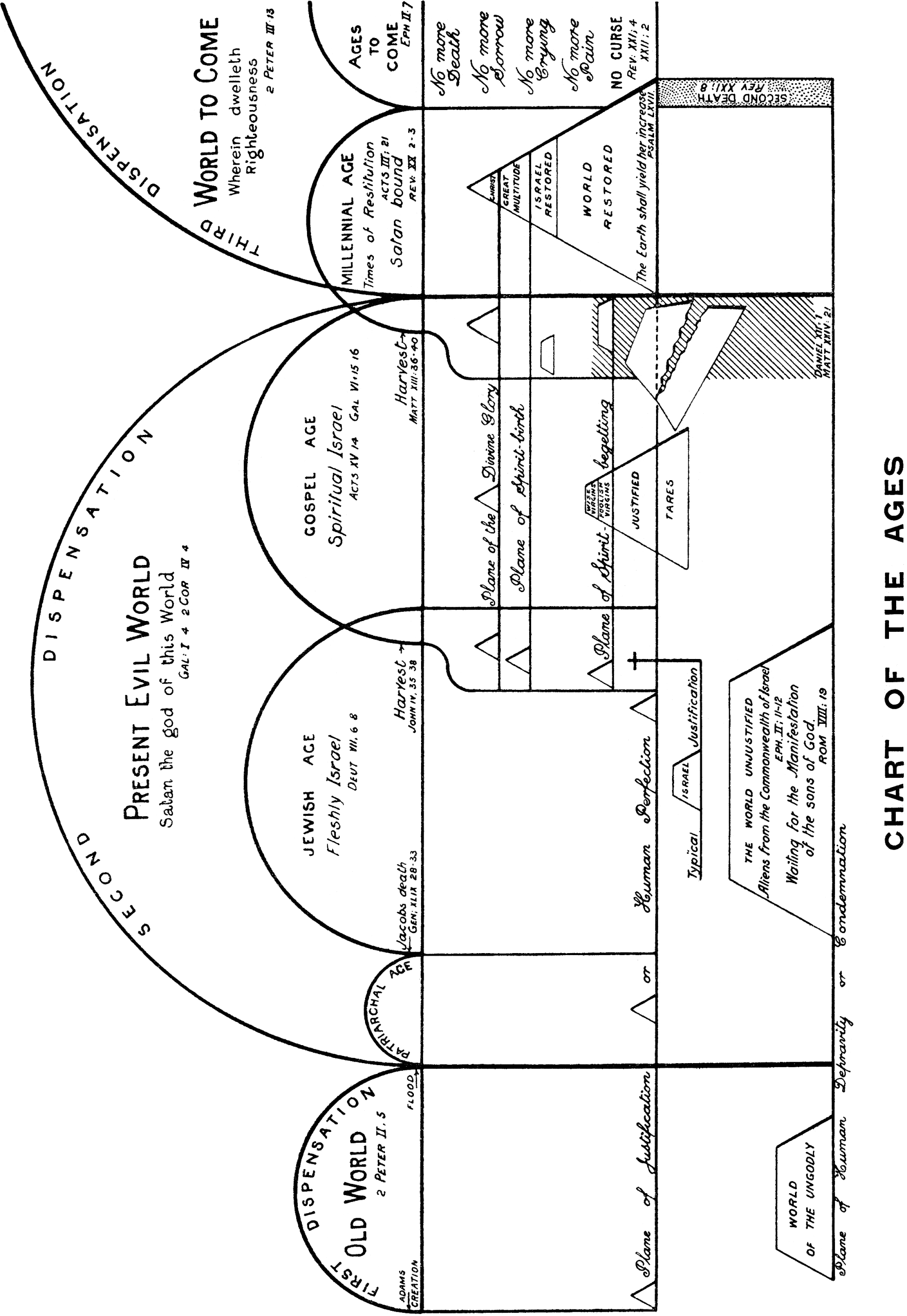
An Allegory of the Divine Plan of the Ages
It has been written that Abraham had two sons, one from the bondwoman, and one from the freewoman. Now, the one from the bondwoman was born according to the flesh; but he of the freewoman was through the promise. Which things are an allegory; for these represent two covenants.–Gal. 4:22-31
HAD it not been for this authoritative statement of the Apostle, would it have occurred to us that Abraham’s two wives are allegorical of two covenants?
Our attention having been drawn to this fact, we find, when we study Abraham’s career, that his whole life history is an allegory. All the events of his life were overruled and recorded in such a manner, that they form in their sequence a living picture, epitomising the complete Plan of the Ages. As Bible students know, the Scriptures abound with such illustrations. They are all designed by our loving heavenly Father to strengthen our faith; to make the glorious Plan of the Ages appear so real, that we can believe in it as firmly as that tomorrow will dawn.
“Allegory” is not an English, but a Greek, word. Translated into English it reads: “adapted to another meaning.” While Abraham enacted his life in a natural way, and apparently without restriction, yet, in God’s providences, every incident and event, and every person that came into his life, was adapted to mean some feature in the Plan of God.
Thus Abraham himself enacted the part of God. (Rom. 4:17; also Isa. 51:2) His two wives, as we have seen, represented God’s two covenants–Sarah the original oath-bound covenant, or covenant of Grace, and Hagar the law covenant. His children by these wives represented God’s children, fleshly and spiritual, which He begat through His two covenants. Isaac typified the Spiritual Seed, Christ head and body, sons of God begotten through the original oath-bound covenant; and Ishmael typified the nation of Israel, the progeny of the law covenant. These two covenants may therefore be likened to two wives, God being their husband.
Each journey of Abraham from place to place represented God changing to a new phase of His foreordained Plan. Every action of Abraham pictured some definite dealing of God with mankind. And the persons with whom Abraham came into con- tact typified particular features of the LORD’S scheme of salvation.
Nearly fourteen chapters of the book of Genesis are devoted to the life history of Abraham–namely, chapters 12 to 25. We notice that the first three chapters present, allegorically, a general outline of the three great Dispensations into which the Divine Plan of the Ages is divided. The succeeding chapters enter into the details of the various Ages, and especially describe God’s dealings with His covenanted people during these periods. (See the Chart of the Ages.)
Remember that, in the allegory, Abraham always represents God, who is the real Father of the faithful. (Rom. 4:17)
The First Dispensation,
or “world of the ungodly,” as it is named by the Apostle Peter, began with the creation of Adam, and ended with the flood.
Chapter 12 of Genesis is an allegorical sketch of this first dispensation.
Gen. 12:1-3. Now the LORD had said unto Abram, Get thee out of thy country, and from thy kindred, and from thy father’s house, unto a land that I will show thee: 2) And I will make of thee a great nation, and I will bless thee, and make thy name great; and thou shalt be a blessing: 3) And I will bless them that bless thee, and curse them that curseth thee; and in thee shall all families of the earth be blessed.
The first three verses show how Abraham was called to leave his own country and enter into another land, where he would become a great nation, and get a great name. He would also become a blessing, and bless all the families of the earth.
God cannot lie, and these promises will be fulfilled. But while on the surface the Scriptures seem to centre the hope of the world in Abraham and in the seed whom he begat through his wife Sarah, we perceive that this is only a little earthly picture of the true hope of the world. For although addressed to Abraham, God was in reality applying the promises to Himself. He, personally, would (1) beget a great nation, (2) and would glorify Himself and make His own name great, (3) and through Him all the world would receive a blessing.
Gen. 12:4-9. So Abram departed, as the LORD had spoken unto him; and Lot went with him: and Abram was seventy and five years old when he departed out of Haran. 5) And Abram took Sarai his wife, and Lot his brother’s son, and all their substance that they had gathered, and the souls that they had gotten in Haran; and they went forth to go into the land of Canaan; and into the land of Canaan they came. 6) And Abram passed through the land unto the place of Sichem, unto the plain of Moreh. And the Canaanite was then in the land. 7) And the LORD appeared unto Abram, and said, Unto thy seed will I give this land; and there builded he an altar unto the LORD, who appeared unto him. 8) And he removed from thence unto a mountain on the east of Beth-el, and pitched his tent, having Beth-el on the west, and Hai on the east: and there he builded an altar unto the LORD, and called upon the name of the LORD. 9) And Abram journeyed, going on still toward the south.
Abraham descended from Haran to Canaan. Both countries are mountainous, but Haran is much higher than Canaan. Sarah and Lot accompanied Abraham. In the symbolisms of the Scriptures, a mountain represents a kingdom; and we find that, in the allegory, Lot is a type of mankind. In this we see God coming down with His original (Sarah) covenant from the high heavenly kingdom, to establish a lesser kingdom on earth at the creation of Adam.
The definite promise made to Abraham: “Unto thy seed will I give this land”–Canaan (verse 7), indicates not only that Abraham’s seed would get the land, but much more important, that God’s Seed would possess the earth when mankind attained to the glorious liberty of the children of God at the end of the Millennium.
Abraham built an altar and called upon the name of the Lord who appeared to him. This represents Adam, originally the earthly image of God, having perfect communion with God during the period of innocence in the garden of Eden.
Gen. 12:10. And there was a famine in the land: and Abram went down into Egypt to sojourn there; for the famine was grievous in the land.
Now, a famine implies lack of bread and consequent starvation, followed by death. Was there a famine in God’s earthly kingdom? Yes. When Adam transgressed there began immediately a famine, not of bread nor of thirst for water, but of hearing the words of the Lord. For man shall not live by bread alone, but by every word that proceedeth out of the mouth of God. (Amos 8:11; Matt. 4:4) Adam did not obey the life-sustaining words of his Creator, and therefore he and the whole human race in him famished and died. (Rom. 5:12) The scene was changed. Paradise, the kingdom of God on earth, fell and became the kingdom of Satan, with sin, sorrow, and death. The “world of the ungodly” was inaugurated. This terrible change was typified by Abraham journeying (with Sarah and Lot) from the mountainous country of Canaan, down south to the almost sea-level land of Egypt. The Scriptures use Egypt as a figure of the sinful world.
Is it consistent with the facts to say that Abraham represents God at this stage? For how can God be said to have gone down with the world into its sinful condition? The episode narrated in the remaining verse of this 12th chapter of Genesis shows how the allegory sustains this thought. First, let us quote the verses:
Gen. 12:11-20. And it came to pass, when he was come near to enter into Egypt, that he said unto Sarai his wife, Behold now, I know that thou art a fair woman to look upon: 12) Therefore it shall come to pass, when the Egyptians shall see thee, that they shall say, This is his wife: and they will kill me, but they will save thee alive. 13) Say, I pray thee, thou art my sister: that it may be well with me for thy sake; and my soul shall live because of thee. 14) And it came to pass, that, when Abram was come into Egypt, the Egyptians beheld the woman that she was very fair. 15) The princes also of Pharaoh saw her, and commended her before Pharaoh: and the woman was taken into Pharaoh’s house. 16) And he entreated Abram well for her sake: and he had sheep, and oxen, and he asses, and men- servants and maidservants, and she asses, and camels. 17) And the LORD plagued Pharaoh and his house with great plagues because of Sarai Abram’s wife. 18) And Pharaoh called Abram, and said, What is this that thou hast done unto me? why didst thou not tell me that she was thy wife? 19) Why saidst thou, She is my sister? so I might have taken her to me to wife: now therefore behold thy wife, take her, and go thy way. 20) And Pharaoh commanded his men concerning him: and they sent him away, and his wife, and all that he had.
Were it not that we perceive an allegorical purpose in this peculiar episode in Abraham’s life, we might be at a loss to understand why it should be mentioned. The holy writers of God’s Word were great economists of space, and always had a definite reason for every utterance. Besides which we remember that God Himself supervised all the holy records, and nothing was allowed to be inserted in His Word unless it would serve a useful purpose. Apart from the allegorical picture there is no apparent reason why this episode should be included in the Bible. We just draw attention to this, because it is a good example of how an incident, unimportant in itself, has a deep meaning when recognised as an allegorical sketch.
Briefly stated, this part of the allegory simply teaches that God kept secret the means by which He intended to bring into existence the “Seed” which was destined to bless all the families of the earth. God reveals His secrets only when, in His wisdom, He knows that the appropriate time has come. He knew that His wisest plan was to hide the true relationship of His oath-bound covenant to Himself (even as Abraham hid the fact that Sarah was his wife), and to permit Satan and his angels, typified by Pharaoh and his princes, to make the attempt of blessing the world and thus try to glorify themselves. Satan did not desire to be the god of a dying world. To the woman he had said: “ye shall not surely die.” But when he saw death reigning, he attempted to instill new life into the death-doomed race by causing the angels, the sons of God, to marry the “daughters of men.” (Gen. 6:1-4) This was Satan’s attempt to bless the world, and bring glory to himself. But he failed.
God had two reasons for hiding His covenant: (1) that it might never thereafter be claimed by any of His angelic creatures that Christ’s sacrifice was unnecessary, and that His work of salvation could have been done by them if only they had had the opportunity; (2) that the loyalty of the angels might be tested. Such of the angels as fell from their “first estate” by mingling with the human family, have ever since been kept in restraint unto the judgment of the great day.–Jude 6; 2 Pet. 2:4
The plagues which came upon Pharaoh and his house typified the calamities brought upon angels and men through their vainglorious attempt to appropriate God’s covenant to them- selves. The result of their folly was increased degradation and sorrow, terminating with the Deluge.
The Second Dispensation,
or “Present Evil World,” which began with Noah and his family after the drying up of the flood, and ends with Christ’s Second Advent, is allegorically sketched in Genesis, chapter 13 to chapter 14 verse 12.
Gen. 13:1-4. And Abram went up out of Egypt, he and his wife, and all that he had, and Lot with him, into the south. 2) And Abram was very rich in cattle, in silver, and in gold. 3) And he went on his journeys from the south even to Beth-el, unto the place where his tent had been at the beginning, between Beth-el and Hai; 4) Unto the place of the altar, which he had made there at the first: and there Abram called on the name of the LORD.
The return of Abraham to Canaan pictures the regeneration after the flood. Abraham represents God, and Lot represents restored mankind. Later on, as we shall see, Lot represents that portion of the human race with which God had special dealings –namely, the nation of Israel.
Gen. 13:5-13. And Lot also, which went with Abram, had flocks, and herds, and tents. 6) And the land was not able to bear them, that they might dwell together. 7) And there was a strife between the herdmen of Abram’s cattle and the herdmen of Lot’s cattle: and the Canaanite and the Perizzite dwelled then in the land. 8) And Abram said unto Lot, Let there be no strife, I pray thee, between me and thee, and between my herdmen and thy herdmen; for we be brethren. 9) Is not the whole land before thee? separate thyself, I pray thee, from me: if thou wilt take the left hand, then I will go to the right; or if thou depart to the right hand, then I will go to the left. 10) And Lot lifted up his eyes, and beheld all the plain of Jordan, that it was well watered every where, before the LORD destroyed Sodom and Gomorrah, even as the garden of the LORD, like the land of Egypt, as thou comest unto Zoar. 11) Then Lot chose him all the plain of Jordan; and Lot journeyed east; and they separated themselves the one from the other. 12) Abram dwelt in the land of Canaan, and Lot dwelt in the cities of the plain, and pitched his tent toward Sodom. 13) But the men of Sodom were wicked and sinners before the LORD exceedingly.
The Apostle tells us that mankind, when they knew God, glorified Him not as God, neither were thankful. Therefore, as they did not like to retain God in their knowledge, God gave them over to a mind void of judgment. (Rom. 1:21-32) At no period in earth’s history did men know God more fully than during the years following the flood. One would have expected that the lesson of the great flood, which taught God’s righteous judgment against sin, would have been a lasting one. With such a demonstration of God’s power, it would be only reasonable to suppose that mankind would no longer strive against Him, and against His servants the prophets and saints. But not so. Like Lot, they preferred their own way to the way of God. They chose the course of pride, fulness of bread, and abundance of idleness. And thus, seeing that they could not dwell together in peace, God allowed mankind to separate themselves from Him, even as Abraham permitted Lot to go his own way toward Sodom. God does nothing without a reason – His desire is to prove to men through bitter experience the folly of their conduct.
Gen. 13:14-18. And the LORD said unto Abram, after that Lot was separated from him, Lift up now thine eyes, and look from the place where thou art northward, and southward, and eastward, and westward: 15) For all the land which thou seest, to thee will I give it, and to thy seed for ever. 16) And I will make thy seed as the dust of the earth: so that if a man can number the dust of the earth, then shall thy seed also be numbered. 17) Arise, walk through the land in the length of it and in the breadth of it: for I will give it unto thee. 18) Then Abram removed his tent, and came and dwelt in the plain of Mamre, which is in Hebron, and built there an altar unto the LORD.
While God promised Abraham the whole land of Canaan (figurative of the world–see Rom. 4:13), and a posterity as numerous as the dust of the earth, we perceive that this promise has a deeper significance. Though mankind, like Lot, chose the wayward course, God’s original covenant will be fulfilled nevertheless. The world will yet be His, and will be thickly populated with His own children, all in complete harmony with Himself. “For thus saith the Lord that created the heavens; God himself that formed the earth and made it; he hath established it, he created it not in vain, he formed it to be inhabited.” (Isa. 45:18) Thus when men fell away from God soon after the flood (as typified by Lot separating from Abraham and pitching his tent toward the sinful city Sodom), God reminded Himself of His own oath-bound covenant to bless the world in due time by reclaiming it from its sinful condition through His Seed.
Gen. 14:1-12. And it came to pass in the days of Amraphel king of Shinar, Arioch king of Ellasar, Chedorlaomer king of Elam, and Tidal king of nations; 2) That these made war with Bera king of Sodom, and with Birsha king of Gomorrah, Shinab king of Admah, and Shemeber king of Zeboiim, and the king of Bela, which is Zoar. 3) All these were joined together in the vale of Siddim, which is the salt sea. 4) Twelve years they served Chedorlaomer, and in the thirteenth year they rebelled. 5) And in the fourteenth year came Chedorlaomer, and the kings that were with him, and smote the Rephaims in Ashteroth Karnaim, and the Zuzims in Ham, and the Emims in Shaveth Kiriathaim, 6) And the Horites in their Mount Seir, unto El-paran, which is by the wilderness. 7) And they returned, and came to En-mishpat, which is Kadesh, and smote all the country of the Amalekites, and also the Amorites, that dwelt in Hazezon-tamar. 8) And there went out the king of Sodom, and the king of Gomorrah, and the king of Admah, and the king of Zeboiim, and the king of Bela (the same is Zoar:) and they joined battle with them in the vale of Siddim: 9) With Chedor- laomer the king of Elam, and with Tidal king of nations, and Amraphael king of Shinar, and Arioch king of Ellasar; four kings with five. 10) And the vale of Siddim was full of slimepits; and the kings of Sodom and Gomorrah fled, and fell there; and they that remained fled to the mountain. 11) And they took all the goods of Sodom and Gomorrah, and all their victuals, and went their way. 12) And they took Lot, Abram’s brother’s son, who dwelt in Sodom, and his goods, and departed.
The details of these verses have significance in connection with various features of God’s Plan, the narrative as a whole is an allegorical outline of the last portion of the Second Dispensation– namely, the period of the Seven Times of the Gentiles. Lot here represents not mankind as a whole, but the one representative nation of Israel, with which God had particular dealings. The four kings with Chedorlaomer as leader who overthrew Sodom and Gomorrah, and captured foolish Lot with all his goods, represent the four Gentile universal empires, headed by Nebuchadnezzar, who in 606 B.C. overthrew the apostate kingdom of Israel, and carried captive the children of Israel with all their goods. Since then the Israelites have been subject to the Gentile nations, and have been waiting for God to deliver them.
The Third Dispensation
is introduced in Gen. 14:13-16. We shall first quote these verses:
Gen. 14:13-16. And there came one that escaped, and told Abram the Hebrew; for he dwelt in the plain of Mamre the Amorite, brother of Eshcol, and brother of Amer: and these were confederate with Abram. 14) And when Abram heard that his brother was taken captive, he armed his trained servants, born in his own house, three hundred and eighteen, and pursued them unto Dan. 15) And divided himself against them, he and his servants, by night, and smote them, and pursued them unto Hobah, which is on the left hand of Damascus. 16) And he brought back all the goods, and also brought again his brother Lot, and his goods, and the women also, and the people.
These verses picture how God and His anointed company, the spirit begotten Church, every member of which had been born in God’s own house and has been instructed by Him, will smite “Babylon the Great” in the dark night of trouble which ends the Second Dispensation, and ushers in the Third Dispensation. And as Abraham and his trained servants, all born in his house, rescued Lot and his goods, so will God and His specially trained and anointed company restore Israel with all their possessions, and also the world of mankind in general.
It is remarkable that of all Abraham’s servants the name of one only is recorded–Eliezer. But more remarkable still, if we add together the numerical value of each Hebrew letter in the name Eliezer, we find the total is exactly 318.* The ancient Hebrews, like the Greeks, used the letters in their alphabet to denote numbers, so that, reckoned in this way, every word had a numerical value. Apparently, therefore, only one name among all Abraham’s 318 servants required to be recorded, because this name represented the complete number. The reason is evident, for as an allegorical personage Eliezer represented the Holy Spirit; and the 318 trained servants accompanying Abraham typified the Christ, head and body, all those who have been anointed with the Holy Spirit, in company with God overthrowing the Gentile nations on the completion of their lease of power, the end of their “Seven Times.”
Gen. 14:17-20. And the king of Sodom went out to meet him after his return from the slaughter of Chedorlaomer and of the kings that were with him, at the valley of Shaveh, which is the king’s dale. 18) And Melchizedek king of Salem brought forth bread and wine: and he was the priest of the most high God. 19) And he blessed him, and said, Blessed be Abram of the most high God, possessor of heaven and earth: 20) And blessed be the most high God, which hath delivered thine enemies into thy hand. And he gave him tithes of all.
When the evil systems of the Second Dispensation are finally overthrown in the great trouble which follows the expiry of the Gentile Times, and Israel, represented by Lot, is restored to favour, even the world, as represented in the king of Sodom, although formerly evil at heart, will recognise God as the mighty avenger and conqueror who has liberated them from bondage, especially the bondage of the grave. It will be in the “King’s Dale” that restored mankind will meet God and do Him honour, even as the king of Sodom met Abraham in this valley. For the King’s Dale is the valley of Jehoshaphat, or the valley of the Kedron, which runs along the east side of Jerusalem (known in Abraham’s
* Regarding the number of Abraham’s servants, Hastings’ Bible Dictionary states under the caption “Number”–“The number 318 is the equivalent of Eliezer, if the numerical values of the different letters of this name are added together: 1+30+ 10+70+7+200=318. It would be a strange coincidence if the number of Abraham’s ‘trained servants’ stood in such a relation to ‘Eliezer,’ the only name known to us of a trained servant of Abraham. Hence Rashi said long ago, ‘Our fathers said, Eliezer it was, alone, and this (318) is the Gematrical number of his name.’ ” day as Salem) and this valley is recognised as a type of the Adamic death, from which a resurrection is assured because of the sacrificial work of the great high priest, Christ. (The valley of Jehoshaphat is a great cemetery; and every Jew, as well as the Mohammedans, desires to be buried in this valley, as they firmly believe that it is here that the resurrection of the dead is to take place, and where they will meet God. This valley is the valley of the “dry bones” referred to by Ezekiel in the 37th chapter, where the dead are pictured in graphic language as coming to life once more. Absalom’s “Pillar” can be seen in this valley at the present day.–See 2 Sam. 18:18)
Christ, head and body, the great High Priest after the order of Melchizedek, will also be there, and will “meet God” and offer to Him the flesh and blood of his atoning sacrifice, represented by the bread and wine which Melchizedek offered to Abraham in the king’s dale. According to God’s own arrangement, the successful sacrificial work of Christ gives him the right to kingly and priestly authority; and even as Abraham recognised Melchizedek when he received the bread and wine from him, and gave him tithes, so God will recognise Christ as a Priest for ever after the order of Melchizedek, and will hand over the reins of government into his exclusive keeping until the work of the Millennial reign is accomplished, and all the dead have been raised to perfect life, and the Adamic curse finally rolled away. In all this Christ will bless God, because he will bring honour to His great Name. And after the Millennial work is complete, the Son will hand over the Kingdom to the Father, that the Father may be all in all, even the Son becoming subject to Him. (Thus when we keep strictly to the allegorical picture, we are not doing violence to the statement in Heb. 7:7.)
Gen. 14:21-24. And the king of Sodom said unto Abram, Give me the persons, and take the goods to thyself. 22) And Abram said to the king of Sodom, I have lift up mine hand unto the LORD, the most high God, the possessor of heaven and earth, 23) That I will not take from a thread even to a shoelatchet, and that I will not take anything that is thine, lest thou shouldest say, I have made Abram rich: 24) Save only that which the young men have eaten, and the portion of the men which went with me, Aner, Eshcol, and Mamre: let them take their portion.
Those who have allied themselves with God will get their portion of the spoil (Isa. 53:12), but God Himself will take nothing; for is He not the possessor of heaven and earth? God gives, but takes nothing; nor will He be debtor to any man. Who can make Him rich? And the children of God must also give and not take, nor be debtor to any except to love others.
After presenting this general outline of the Plan of the Ages, we find that the allegory of Abraham’s life history, as continued from the 15th chapter of Genesis, enters into the details of the Plan. Everything recorded is not to be regarded in an allegorical sense; merely the principal or outstanding features are to be so recognised. This is the method pursued by the Apostle when telling us that Abraham’s two wives were allegorical of two covenants–he does not regard every minute incident in connection with Abraham’s wives as necessarily having connection with the picture, but treats the narratives broadly. We remember that many separate purposes are served by every feature of the Divine record–“wheels within wheels.”
As the Bible does not give much information about the “Old World of the Ungodly,” so also in the further unfoldings of the allegorical sketch, it passes on to the account of the first Age of the Second Dispensation without more than a passing reference to the First Dispensation. We find that
The Patriarchal Age
is dealt with in the 15th chapter of Genesis, which we here quote:
Gen. 15:1-21. After these things the word of the LORD came unto Abram in a vision, saying, Fear not, Abram: I am thy shield, and thy exceeding great reward. 2) And Abram said, Lord GOD, what wilt thou give me, seeing I go childless, and the steward of my house is this Eliezer of Damascus? 3) And Abram said, Behold, to me thou hast given no seed: and, lo, one born in my house is mine heir. 4) And, behold, the word of the LORD came unto him, saying, This shall not be thine heir; but he that shall come forth out of thine own bowels shall be thine heir. 5) And he brought him forth abroad, and said, Look now toward heaven, and tell the stars, if thou be able to number them: and he said unto him, So shall thy seed be. 6) And he believed in the LORD; and he counted it to him for righteousness. 7) And he said unto him, I am the LORD that brought thee out of Ur of the Chaldees, to give thee this land to inherit it. 8) And he said, Lord GOD, whereby shall I know that I shall inherit it? 9) And he said unto him, Take me an heifer of three years old, and a she goat of three years old, and a ram of three years old, and a turtledove, and a young pigeon. 10) And he took unto him all these, and divided them in the midst, and laid each piece one against another; but the birds divided he not. 11) And when the fowls came down upon the carcases, Abram drove them away. 12) And when the sun was going down, a deep sleep fell upon Abram; and, lo, an horror of great darkness fell upon him. 13) And he said unto Abram, Know of a surety that thy seed shall be a stranger in a land that is not theirs, and shall serve them; and they shall afflict them four hundred years; 14) And also that nation, whom they shall serve, will I judge: and afterward shall they come out with great substance. 15) And thou shalt go to thy fathers in peace; thou shalt be buried in a good old age. 16) But in the fourth generation they shall come hither again: for the iniquity of the Amorites is not yet full. 17) And it came to pass, that, when the sun went down, and it was dark, behold a smoking furnace, and a burning lamp that passed between those pieces. 18) In the same day the LORD made a covenant with Abram, saying, Unto thy seed have I given this land, from the river of Egypt unto the great river, the river Euphrates. 19) The Kenites, and the Kenizzites, and the Kadmonites, 20) And the Hittites, and the Perizzites, and the Rephaims, 21) And the Amorites, and the Canaanites, and the Girgashites, and the Jebusites.
Till Abraham’s day, 427 years after the flood, and 2,081 years after the fall of Adam, God’s Holy Spirit, typified by Eliezer, had been striving with men to convince them of their evil ways, and raise them out of their degradation. But as it was without beneficent effect, God said to Noah: “My spirit shall not always strive with men.” (Gen. 6:3) God’s law, though largely effaced by the fall, was still written in man’s nature, and it was to this that God appealed by His spirit; for the law is spiritual, as the Apostle declares. (Rom. 2:14, 15) This spirit could not always strive with men, but must ultimately become so effaced as to no longer prevent them from going headlong into destruction. Clearly, then, the Holy Spirit of God, as represented by Eliezer, could not be the heir of the promise, the one who would inherit all things and bless all the families of the earth. And thus, just as God informed Abraham that Eliezer could not be his heir, but that he would have a seed of his own who would inherit the promises, so God, by this allegorical picture informs us that it is not by the Holy Spirit, but by His beloved Son Jesus Christ whom He Himself would beget, that all the blessings of restitution shall be accomplished. And this Son was not to be an earthly Seed, but a heavenly spiritual Seed, like the stars of heaven for multitude–a multitudinous Seed, composed of Jesus Christ the head, and the members of the Church His body.
The sign which Abraham received in confirmation of God’s promise that his seed would possess the land, is a hidden prophecy of the time when the Christ, typified by Isaac, would know He would possess the world. For if we regard the years of the covenant-witnessing animals as prophetic, we find that the aggregate ages of these five animals point to the date when the present great world-war began, which is the commencement of the active overthrow of the Present Evil World by the invisible spiritual Kingdom, that the world may thus become the possession of the Christ. Reckoning the ages of the two birds as one year each, the aggregate ages of the five animals is eleven years. If we regard these eleven years as prophetic, they represent a period of 11 times 360= 3,960 years. This period, dated from the year 2045 B.C. when the covenant was first made with Abraham, terminates in the year 1914-1915 A.D., the date of the end of the Times of the Gentiles.
The remarkable catalogue of ten nations, which ends this 15th chapter of Genesis (verses 19-21) is a hidden reference to the ten “toes” of the great image which, Daniel informs us, are to be destroyed by the “stone” Kingdom. (Dan. 2:31-46) For before God’s spiritual Seed can fully possess the world, He must first dispossess its present Gentile occupants, the ten divisions of the “Holy Roman Empire.” Observe that Abraham’s question was not: “When shall I inherit it?” but: “Whereby shall I know that I shall inherit it?” This word “whereby” has, in the Hebrew, the meaning of “by what.” The thought is: “By what (event) shall I know?”–“What is the sign?” Keeping to the allegorical picture, God, as represented by Abraham, knew that He and His Seed would inherit the Kingdom when the foretold great time of trouble broke out in 1914, the date indicated prophetically by the ages of the animals used in sealing the promise. His Seed now also know that they will enter into full possession of the world, over which they will reign as spiritual Kings and Priests; because they see the present complete governmental powers now being dashed in pieces as a potter’s vessel. This is a sure sign to the faithful that the promise is being fulfilled. The number “ten,” when connected with government, represents complete governmental power; and as the ten nations enumerated in verses 19 to 21 of this 15th chapter of Genesis were in complete possession of the promised inheritance in the days of Abraham, so the antitypical inheritance has up till 1914 been possessed by the complete governmental powers of the Gentiles (as represented by the ten “horns” of the fourth “beast” seen in Daniel’s vision, and the ten “toes” of the great Gentile image seen in vision by Nebuchadnezzar). The Israelites were constantly reminded of God’s determination to drive out the nations, that He might fulfil His promise to Abraham (Josh. 23:9, 10); therefore, when in the days of Joshua the ruling powers began to be driven out, the fleshly seed of Abraham knew they would inherit the land. So, also, when the Spiritual Seed now see the complete governmental powers of the Present Evil World, typified by the original ten nations in Canaan, being driven out of their rulership, it is a sign to them. They know that, in the words of Revelation 11:15: “The kingdom of this world is become the Kingdom of our Lord, and of His Christ.” There is also an indication that the special covenant regarding the land in verse 18 of this 15th chapter of Genesis, will begin to be fulfilled with the fleshly Israelites in 1925, ten years after the beginning of the fulfilment of the spiritual phase of the promise (according to the point of time given at the end of the 16th chapter).
The Law Dispensation
is allegorically dealt with in Genesis, chapters 16 to 19 inclusive.
Gen. 16:1-16. Now Sarai Abram’s wife bare him no children: and she had an handmaid, an Egyptian, whose name was Hagar. 2) And Sarai said unto Abram, Behold now, the LORD hath restrained me from bearing: I pray thee, go in unto my maid; it may be that I may obtain children by her. And Abram hearkened to the voice of Sarai. 3) And Sarai Abram’s wife took Hagar her maid the Egyptian, after Abram had dwelt ten years in the land of Canaan, and gave her to her husband Abram to be his wife. 4) And he went in unto Hagar, and she conceived: and when she saw that she had conceived, her mistress was despised in her eyes. 5) And Sarai said unto Abram, My wrong be upon thee: I have given my maid unto thy bosom; and when she saw that she had conceived, I was despised in her eyes: the LORD judge between me and thee. 5) But Abram said unto Sarai, Behold, thy maid is in thy hand; do to her as it pleaseth thee. And when Sarai dealt hardly with her, she fled from her face. 7) And the angel of the LORD found her by a fountain of water in the wilderness, by the fountain in the way to Shur. 8) And he said, Hagar, Sarai’s maid, whence camest thou? and whither wilt thou go? And she said, I flee from the face of my mistress Sarai. 9) And the angel of the LORD said unto her, return to thy mistress and submit thyself unto her hands. 10) And the angel of the LORD said unto her, I will multiply thy seed exceedingly, that it shall not be num- bered for multitude. 11) And the angel of the LORD said unto her, Behold, thou art with child, and shalt bear a son, and thou shalt call his name Ishmael; because the LORD hath heard thy affliction. 12) And he will be a wild man; his hand will be against every man, and every man’s hand against him; and he shall dwell in the presence of all his brethren. 13) And she called the name of the LORD that spake unto her, Thou God seest me: for she said, Have I also here looked after him that seeth me? 14) Wherefore the well was called Beer-lahai-roi; behold it is between Kadesh and Bered. 15) And Hagar bore Abram a son: and Abram called his son’s name, which Hagar bare, Ishmael. 16) And Abram was fourscore and six years old, when Hagar bare Ishmael to Abram.
God at the first did not indicate to Abraham that the son whom he would beget would be by Sarah, and as it seemed as if the heir was not intended to come through her, Abraham took Hagar, Sarah’s bondmaid, and begat Ishmael. The antitype of the interval between God’s covenant with Abraham, and the birth of Ishmael (between 10 and 11 years), is the long period of 2,553 years which elapsed between the creation of Adam, and the “birth” of the nation of Israel when it entered the promised land under Joshua. During all of that long period it must have seemed as if God’s original oath-bound Covenant, typified by Sarah, was barren indeed. (Gal. 4:21-31) But the Law Covenant, to which God bound Himself, at once conceived and brought forth in due time the nation of Israel, the fleshly seed typified by Ishmael, “a wild man whose hand was against every man, and every man’s hand against him;” for the nation of Israel has indeed been thus peculiarly marked amongst the nations of earth. During all the Jewish Age from the entering of the nation into the inheritance of the land of Canaan, till the first advent of Jesus Christ, the “Sarah Covenant” still remained barren. But when Jesus was raised from the dead, the “Head” of the great spiritual Seed of promise was born through the Sarah Covenant; and during the Gospel Age the “Church of the firstborn” have been selected member by member to complete the antitypical Isaac, the Seed of God Himself, in whom all the promises centre.
We understand through the times and seasons of the Scriptures, that in 1878 A.D. those who slept in Christ arose in the First Resurrection.*
The 17th chapter of Genesis continues the allegory of the Law Dispensation:
Gen. 17:1-27. And when Abram was ninety years old and nine, the LORD appeared to Abram, and said unto him, I am the Almighty God: walk before me, and be thou perfect. 2) And I will make my covenant between me and thee, and will multiply thee exceedingly. 3) And Abram fell on his face: and God talked with him, saying, 4) As for me, behold, my covenant is with thee, and thou shalt be a father of many nations. 5) Neither shall thy name any more be called Abram, but thy name shall be Abraham; for a father of many nations have I made thee. 6) And I will make thee exceedingly fruitful, and I will make nations of thee, and kings shall come out of thee. 7) And I will establish my covenant between me and thee and thy seed after thee in their generations for an everlasting covenant,
* We find that there is a time-parallel between the births of the natural seeds of Abraham, and the two nations, fleshly and spiritual, which those two seeds typify. According to the notes of time given in the narrative, Ishmael was born between 10 and 11 years after Abraham received the covenant from God on first entering the land of Canaan, or say 10e years. It was 25 years interval between the covenant and the birth of Isaac the true seed. (Gen. 12:2-4; 21:5) As we have noticed already, the entering of Abraham into Canaan with Sarah when he received the covenant, was allegorical of God coming down to earth with His oath-bound Covenant, and creating Adam as head of His earthly kingdom (Adam being typified by Lot). Until Jesus Christ was raised from the dead, the “Sarah Covenant” was barren, and until 1878 A.D. the members of the Church, the “Body” of Christ, were not born from the dead (and even now the “feet” members still await their birth). But in 1575 B.C. the Hagar Covenant brought forth her fleshly seed, when they crossed Jordan and entered as a nation into their own country. The intervals between the covenant with Abraham and the births of Ishmael and Isaac, are in the same proportionate ratio as the long periods between the creation of Adam 4128 A.D. and the entrance of the fleshly seed into their land as a nation in 1575 B.C.; and the entrance of the spiritual Seed or Holy Nation into their heavenly inheritance in 1878 A.D. (Or, to state the ratio: As 25 years is to 10e years, so is 6006 years to 2553 years–the ratio is the same.)
to be a God unto thee, and to thy seed after thee. 8) And I will give unto thee, and to thy seed after thee, the land wherein thou art a stranger, all the land of Canaan, for an everlasting possession; and I will be their God. 9) And God said unto Abraham, Thou shalt keep my covenant therefore, thou, and thy seed after thee in their generations. 10) This is my covenant, which ye shall keep, between me and you and thy seed after thee: Every man child among you shall be circumcised. 11) And ye shall circumcise the flesh of your foreskin; and it shall be a token of the covenant betwixt me and you. 12) And he that is eight days old shall be circumcised among you, every man child in your generations, he that is born in the house, or bought with money of any stranger, which is not of thy seed. 13) He that is born in thy house, and he that is bought with thy money, must needs be circumcised: and my covenant shall be in your flesh for an everlasting covenant. 14) And the uncircumcised man child whose flesh of his foreskin is not circumcised, that soul shall be cut off from his people; he hath broken my covenant. 15) And God said unto Abraham, As for Sarai thy wife, thou shalt not call her name Sarai, but Sarah shall her name be. 16) And I will bless her, and give thee a son also of her: yea, I will bless her, and she shall be a mother of nations; kings of people shall be of her. 17) Then Abraham fell upon his face, and laughed, and said in his heart, Shall a child be born unto him that is an hundred years old? and shall Sarah, that is ninety years old, bear? 18) And Abraham said unto God, O that Ishmael might live before thee! 19) And God said, Sarah thy wife shall bear thee a son indeed; and thou shalt call his name Isaac: and I will establish my covenant with him for an everlasting covenant, and with his seed after him. 20) And as for Ishmael, I have heard thee: Behold, I have blessed him, and will make him fruitful, and will multiply him exceedingly; twelve princes shall he beget, and I will make him a great nation. 21) But my covenant will I establish with Isaac, which Sarah shall bear unto thee at this set time in the next year. 22) And he left off talking with him, and God went up from Abraham. 23) And Abraham took Ishmael his son, and all that were born in his house, and all that were bought with his money, every male among the men of Abraham’s house; and circumcised the flesh of their foreskin in the selfsame day, as God had said unto him. 24) And Abraham was ninety years old and nine, when he was circumcised in the flesh of his foreskin. 25) And Ishmael his son was thirteen years old, when he was circumcised in the flesh of his foreskin. 26) In the selfsame day was Abraham circumcised, and Ishmael his son. 27) And all the men of his house, born in the house, and bought with money of the stranger, were circumcised with him.
After the nation of Israel, born of the Law Covenant, had entered into their inheritance, God gave them judges, and later, kings, as His representatives in the earthly kingdom. But it soon became apparent to the honest-hearted among the people, that the Law would make nothing perfect, and that it was not possible that the blood of bulls and of goats could take away sins. Hagar did not represent the covenant, nor Ishmael the Seed, which could bring blessing. When this became evident, God then proclaimed, for the first time, His intention to bring forth the Seed of promise by the Sarah Covenant. He sent prophets during the Jewish Age who foretold (as God foretold Abraham in the allegory) that not only would He (God) be a “great father” (which is the meaning of the name Abram)–that is, not only would He be the father of the Jewish nation alone, but that He would be the Father of many nations (the meaning of the name Abraham). Through these prophets He also foretold (as in the allegory) that His original oath-bound Covenant (represented by Sarai) would no longer be a source of contention (the meaning of the name Sarai), but would become a source of happiness, a princess or queen (which is the significance of the name Sarah). That His Covenant, like Sarah, would soon bring forth a “son indeed,” a great Deliverer, who would bring blessings to all.
The circumcision on the 8th day pointed to the great 8th Millennial Day when all the children of God (Abraham) will be circumcised in heart and blessed with everlasting life and communion with God.
Gen. 18:1-33. And the LORD appeared unto him in the plains of Mamre: and he sat in the tent door in the heat of the day: 2) And he lifted up his eyes and looked, and, lo, three men stood by him: and when he saw them, he ran to meet them from the tent door, and bowed himself toward the ground, 3) And said, My Lord, if now I have found favour in thy sight, pass not away, I pray thee, from thy servant: 4) Let a little water, I pray you, be fetched, and wash your feet, and rest yourselves under the tree: 5) And I will fetch a morsel of bread, and comfort ye your hearts; after that ye shall pass on: for therefore are ye come to your servant. And they said, So do, as thou hast said. 6) And Abraham hastened into the tent unto Sarah, and said, Make ready quickly three measures of fine meal, knead it, and make cakes upon the hearth. 7) And Abraham ran unto the herd, and fetched a calf tender and good, and gave it unto a young man; and he hasted to dress it. 8) And he took butter, and milk, and the calf which he had dressed, and set it before them; and he stood by them under the tree, and they did eat. 9) And they said unto him, Where is Sarah thy wife? And he said, Behold, in the tent. 10) And he said, I will certainly return unto thee according to the time of life; and, lo, Sarah thy wife shall have a son. And Sarah heard it in the tent door, which was behind him. 11) Now Abraham and Sarah were old and well stricken in age; and it ceased to be with Sarah after the manner of women. 12) There- fore Sarah laughed within herself, saying, After I am waxed old shall I have pleasure, my lord being old also? 13) And the LORD said unto Abraham, Wherefore did Sarah laugh, saying, Shall I of a surety bear a child, which am old? 14) Is any thing too hard for the LORD? At the time appointed I will return unto thee, according to the time of life, and Sarah shall have a son. 15) Then Sarah denied, saying, I laughed not; for she was afraid. And he said, Nay; but thou didst laugh. 16) And the men rose up from thence, and looked toward Sodom; and Abraham went with them to bring them on the way. 17) And the LORD said, Shall I hide from Abraham that thing which I do; 18) Seeing that Abraham shall surely become a great and mighty nation, and all the nations of the earth shall be blessed in him? 19) For I know him, that he will command his children and his household after him, and they shall keep the way of the LORD, to do justice and judgment; that the LORD may bring upon Abraham that which he hath spoken of him. 20) And the Lord said, Because the cry of Sodom and Gomorrah is great, and because their sin is very grievous; 21) I will go down now, and see whether they have done altogether according to the cry of it, which is come unto me; and if not, I will know. 22) And the men turned their faces from thence, and went toward Sodom: But Abraham stood yet before the Lord. (Note: the remaining verses give an account of how Abraham interceded for Sodom, and how the Lord promised that he would not destroy it if even so few as ten righteous persons were found there.)
In this 18th chapter of Genesis, two important things are foretold by the three angels: (1) That Sarah would have the promised son at the appointed time; and (2) that Sodom would be destroyed. The three angels represent three means by which God had communicated to the Jewish nation during their Age, that (1) The great Messiah would come at the due time, and (2) that the apostate kingdom of Israel would be destroyed because of its wickedness. (See Ezek. 16:47-50.) These three means by which God foretold these two great events, were (1) the typical reign of Solomon, (2) the Law, and (3) the prophets. The heat of the day is the time when the sun is high in the heavens, and symbolises well the reign of Solomon when the typical people of God, the children of the Law Covenant, reached the zenith of their favour with Jehovah. Solomon himself is the well-known type of the Royal Seed, Christ, in His glory, and thus foreshadowed the coming Messiah. But toward the latter part of his typical reign, Solomon fell away into idolatry, and on his death the kingdom was largely wrested from his heir. His kingdom was divided, and thus practically fell. The reign of the antitypical Solomon will never fall; the fall of Solomon’s kingdom rather foreshadowed the overthrow of the whole Jewish nation and kingdom in 606 B.C., and again in 70 A.D.
The law of Moses also, by means of its types and shadows, foretold the coming of the great Prophet and Priest the great Deliverer; and also the destruction of the kingdom and nation because of their evil which was even greater than the evil of the Sodomites.
The prophets likewise foretold of these two events.
It is generally understood that one of the three angels who appeared before Abraham was the Lord Jesus in his prehuman existence. In this appearance of the Lord and the two angels before Abraham, we are reminded of the vision on the Mount when Jesus was transfigured, and Moses and Elias, representing the law and the prophets, communed with him before God, and spake of his coming glory.–Matt. 17:1-9; 2 Pet. 1:16-18
Gen. 19 is rather long to quote. Briefly summarised, this chapter details how two angels came to Sodom at even; and Lot, who was sitting at the gate, invited them to stay with him during the night. They ate unleavened bread. The Sodomites hearing of the two strangers in Lot’s home, demanded that they should be delivered up. Lot refused, and the angels struck the rabble with blindness, so that they could not see the door. The angels then foretold of the destruction of Sodom because of its great wickedness, and urged and then compelled Lot and his wife, and his two daughters to flee from the place. “And it came to pass, when they had brought them forth abroad, that he said, Escape for thy life; look not behind thee, neither stay thou in all the plain; escape to the mountain, lest thou be consumed.” And Lot besought them to let him escape into the little city of Zoar, and his request was granted. “The sun was risen upon the earth when Lot entered into Zoar. Then the Lord rained upon Sodom and upon Gomorrah brimstone and fire from the Lord out of heaven. And he overthrew those cities, and all the plain, and all the inhabitants of the cities, and that which grew upon the ground. But his wife looked back from behind him, and she became a pillar of salt.” Later, Lot, fearing to dwell in Zoar, went up to the mountain and dwelt there with his two daughters. The Moabites and the Ammonites were born of these two daughters.
While in the allegory we are still dealing with the Law Dispensation, we know that what took place in that Age was typical of the realities of the Gospel Age. In the typical Law Age, the destruction of Sodom allegorically represented the overthrow of the kingdom of Israel in 606 B.C.; and in a secondary sense it might also be regarded as representing the complete overthrow of Israel as a nation in 70 A.D. But since these two important events, through the overruling providence of God, occurred as figures of the much greater downfall of Christendom now begun, so the destruction of Sodom by fire and brimstone from heaven fore- shadowed in the fullest degree the everlasting destruction of Christendom at the end of the Gospel Age. That this application is correct there is no doubt, for Jesus himself connected the destruction of Sodom with the overthrow of the Present Evil World. (See Luke 17:28-32.) In the 11th chapter of Revelation, also, Christendom is spiritually called Sodom. In this 11th chapter of Revelation “two witnesses” are prominently mentioned. In the symbolisms of this book these two witnesses represent the Old and New Testaments, which warn the Spiritual Israelites to flee from the destruction of Christendom, just as Lot was warned by the two angels to escape out of Sodom before the fire and brimstone came down. In this connection, therefore (and in strict accordance with the words of Jesus), Lot, while in the allegory primarily representing fleshly Israel, also more fully represents the true Church, the spiritual Israel; and Lot’s wife represents the Great Company.*
* The series of Pastor Russell’s “Studies in the Scriptures” are specially recommended to everyone.
When considering the general outline of the Divine Plan of the Ages as allegorically presented in chapters 12 to 14 of Genesis, we saw that the overthrow of Sodom by Chedorlaomer also pictured the overthrow of Israel in 606 B.C. Here again certain incidents connected with that earlier overthrow of Sodom, have an illustrative bearing upon the destruction of the Spiritual Sodom. In the 10th verse of Genesis 14, we read that the kings of Sodom and Gomorrah fell in the vale of Siddim, which was full of petroleum pits (not slimepits). The Hebrew for slimepit could also have been rendered “bitumen,” which is petroleum hardened by evaporation and oxidation. The material, also known as asphalt and pitch, which is very inflammable, burning like bright coal, is cast up to the surface of the Dead Sea in great masses by earthquakes. (This was especially noted in the earthquakes of 1834 and 1837.) In the opinion of many competent authorities, Sodom was situated at the southern end of the Dead Sea, at a place now covered by the water. The “slimepits” being now covered by the water of the Dead Sea, would account for the floating masses of bitumen after earthquakes had loosened them from the pits. One writer says that these floating lumps of bitumen sometimes spontaneously burst into flames. This phenomenon may have been the origin of the prophet Isaiah’s graphic description of the destruction of Idumea, when he says that its streams would be turned into pitch. The land of Idumea, inhabited by the descendants of Esau or Edom, stretches southward and westward from the southern end of the Dead Sea. Idumea is one of the well known types of Christendom, as all Bible students are aware. In Isa. 34:1-10 the prophet in highly figurative language forcefully depicts the utter destruction of Christendom, the spiritual Idumea. Its “streams,” the channels of commerce by which the life of a country is sustained, would be turned into inflammable pitch, its dust into brimstone, and its land into burning pitch, and the smoke thereof would ascend for ever. When Sodom was destroyed in the days of Abraham, he saw the smoke of the country going up as the smoke of a furnace. (Gen. 19:28) Thus the fiery overthrow in the vale of Siddim, that highly inflammable region which afterwards was included in the land of Idumea, well illustrated the fiery overthrow of the spiritual Sodom, or spiritual Idumea; for the coming social revolution, likened to a great earthquake, will loosen elements in the figurative “streams” of Christendom which will burst into the destructive fire of anarchy, and will utterly consume the present order of things. (See 2 Pet. 3:10-12.) The “smoke” (remembrance) of this great destruction will never fade–it will be an everlasting lesson.
It says that the “sun was risen upon the earth” when Lot escaped into the little city Zoar. (Gen. 19:23) Later, when the vengeance of God was poured upon Sodom, Lot fled from Zoar to the mountain. As a city symbolises “a religious government backed by power and influence” (see “Studies in the Scriptures,” Vol. IV, page 25), Zoar must represent the small organisation which is backed by the power of God, and is composed of those in present Truth, the spirit begotten sons of God organised for the active spread of the message of the kingdom during the “harvest” period of the Age. In the dawn of the Millennial morning this kingdom class have obeyed the summons to come out of the antitypical spiritual Sodom, preparatory to ascending beyond the veil to the heavenly Kingdom (mountain).
And Jesus said: “Remember Lot’s wife!” She looked back, and was therefore turned into a pillar of salt. As salt is a preservative, and as a pillar is frequently used as a memorial, so we would understand that the pillar of salt into which the disobedient wife of Lot was turned serves as an everlasting memorial of warning to all who have freed themselves from Churchianity, or Babylon the Great.
Since Lot here represents the Israel of God, his two daughters represent fleshly Judah and Israel, who, like spiritual Israel, have been captive in Christendom during the whole of the Gospel Age. Just as Lot, after escaping to the mountain, begat through his daughters the Moabites and the Ammonites, so the Christ, head and body, when glorified in the heavenly Kingdom, will give life to the Gentiles through Judah and Israel, who will then be the ministers of the Word of life.
The Seven Times of the Gentiles
is referred to in the allegory of the 20th chapter of Genesis, which we here quote:
Gen. 20:1-18. And Abraham journeyed from thence toward the south country, and dwelled between Kadesh and Shur, and sojourned in Gerar. 2) And Abraham said of Sarah his wife, She is my sister: and Abimelech king of Gerar sent, and took Sarah. 3) But God came to Abimelech in a dream by night, and said to him, Behold, thou art but a dead man, for the woman which thou hast taken; for she is a man’s wife. 4) But Abimelech had not come near her: and he said, Lord, wilt thou slay also a righteous nation? 5) Said he not unto me, She is my sister? and she, even she herself said, He is my brother: in the integrity of my heart and innocency of my hands have I done this. 6) And God said unto him in the dream, Yea, I know that thou didst this in the integrity of thy heart; for I also withheld thee from sinning against me: therefore suffered I thee not to touch her. 7) Now therefore restore the man his wife; for he is a prophet, and he shall pray for thee, and thou shalt live: and if thou restore her not, know thou that thou shalt surely die, thou, and all that are thine. 8) Therefore Abimelech rose early in the morning, and called all his servants, and told all these things in their ears: and the men were sore afraid. 9) Then Abimelech called Abraham, and said unto him, What hast thou done unto us? and what have I offended thee, that thou hast brought on me and on my kingdom a great sin? thou hast done deeds unto me that ought not to be done. 10) And Abimelech said unto Abraham, What sawest thou, that thou hast done this thing? 11) And Abraham said, Because I thought, Surely the fear of God is not in this place; and they will slay me for my wife’s sake. 12) And yet indeed she is my sister; she is the daughter of my father, but not the daughter of my mother; and she became my wife. 13) And it came to pass, when God caused me to wander from my father’s house, that I said unto her, This is thy kindness which thou shalt show unto me; at every place whither we shall come, say of me, He is my brother. 14) And Abimelech took sheep, and oxen, and menservants, and womenservants, and gave them unto Abraham, and restored him Sarah his wife. 15) And Abimelech said, Behold, my land is before thee: dwell where it pleaseth thee. 16) And unto Sarah he said, Behold, I have given thy brother a thousand pieces of silver; behold, he is to thee a covering of the eyes, unto all that are with thee, and with all other: thus she was reproved. 17) So Abraham prayed unto God, and God healed Abimelech, and his wife, and his maidservants; and they bare children. 18) For the LORD had fast closed up all the wombs of the house of Abimelech, because of Sarah Abraham’s wife.
As in the allegory the overthrow of Sodom in the days of Abraham primarily represented the overthrow of the apostate kingdom of Israel in 606 B.C. by Nebuchadnezzar, the king of Babylon, so the allegory continues in the 20th chapter of Genesis to deal with the period immediately following that overthrow – namely, the Seven Times of the Gentiles. King Abimelech taking Sarah into his house, believing her to be Abraham’s sister, reminds us of the similar incident recorded in the 12th chapter in connection with Pharaoh and his princes. In the former case Pharaoh and his princes represented Satan and his evil angels; but in this case, Abimelech and his house represent Nebuchadnezzar and the Gentiles generally, who in 606 B.C., after the overthrow of God’s typical earthly kingdom, sought to govern the world, and thus bring blessing upon all the families of the earth. In other words, they sought to do all that God’s original oath-bound covenant, as typified by Sarah, is destined to do. But as Abraham did not divulge to Abimelech that his sister Sarah was also his wife, so God in His wisdom hid the full truth that He alone is bound to His original Covenant, and that He alone has the right and power to bring into existence the great Seed who will bless the world with good government, peace, and contentment. Abraham did not tell a lie when he said that Sarah was his sister; he withheld the truth that she was also his wife. So God, who cannot lie, does not disclose His secrets until the due time. After He has allowed angels, and then men, to learn by bitter experience that they are unable to bless the world, He will then disclose the fact that He is the husband of the Sarah Covenant of blessing. Neither angels nor men will hereafter ever be in a position to claim that the sacrifice of Christ was unnecessary (for through death and resurrection the Christ, the spiritual Seed of Abraham, is born of the oath-bound covenant); for all will then have had the opportunity to try to bring forth this Seed, but have only brought disaster upon themselves, as did Pharaoh and his princes, and later Abimelech and his house, in their misappropriation of Abraham’s wife, Sarah. In hiding the truth for a season, God demonstrates His wisdom, and proves that His thoughts and ways are as high above those of angels and men, as the heavens are above the earth.
In the allegory we read (in verse 3 of this 20th chapter of Genesis) how the Lord appeared to Abimelech in a dream, and declared to him Sarah’s true relationship to Abraham. This reminds us of how the Lord similarly appeared in a dream to Nebuchadnezzar, and told him that “the most high ruleth in the kingdom of men, and giveth it to whomsoever he will.” (Dan. 4:32) But it was not until the typical “seven times” of madness had passed over the head of Nebuchadnezzar, that he realised the full significance of God’s warning. And neither will the world fully comprehend their inability to rule and bless until, the great “Seven Times of the Gentiles” having passed, the rude awakening, the time of “shaking” now in progress, makes them rub their eyes and see clearly their former madness. They will then extol the most high, and praise Him for their returned reason (lost for them by Adam through his disobedience). And God will not hold the Gentiles responsible for their misrule, but will forgive them, knowing that in the integrity of their hearts they believed they could rule and bless the world. They have not known that the covenant of blessing belongs to God alone.
In the 14th and 15th verses it says that Abimelech restored Sarah to Abraham, and gave him great riches, and told him to dwell where he pleased. As Abimelech in himself represents, in the allegory, the Babylonian empire headed by Nebuchadnezzar, the restoration of Sarah and the riches and freedom he gave to Abraham, represent: (1) God resuming His right to His own Covenant in 536 B.C., when the typical 70 years’ dominion of Babylon ended; and (2) at that date God’s chosen people, the Israelites, were restored to their native land, (3) laden with gifts from the Gentiles, preparatory to the birth of Jesus Christ, the promised Seed of the Covenant. In the fuller sense this illustrates how, after the lease of dominion permitted to “Babylon the Great” (Christendom) comes to the full end, God resumes His right to the Covenant, and brings forth into the spiritual realm the great Christ, head and body complete. Then the blessing of all the families of the earth will at once commence with the restoration to their native land of the captive Israelites, laden with gifts from the Gentiles.
The Harvest Period of the Jewish Age
is dealt with in the 21st chapter of Genesis. We shall quote this chapter in sections, and show the allegorical meaning as we proceed:
Gen. 21:1-9. And the LORD visited Sarah as he had said, and the LORD did unto Sarah as he had spoken. 2) For Sarah conceived, and bare Abraham a son in his old age, at the set time of which God had spoken to him. 3) And Abraham called the name of his son that was born unto him, whom Sarah bare to him, Isaac. 4) And Abraham circumcised his son Isaac being eight days old, as God had commanded him. 5) And Abraham was an hundred years old, when his son Isaac was born unto him. 6) And Sarah said, God hath made me to laugh, so that all that hear will laugh with me. 7) And she said, Who would have said unto Abraham, that Sarah should have given children suck? for I have born him a son in his old age. 8) And the child grew and was weaned: and Abraham made a great feast the same day that Isaac was weaned. 9) And Sarah saw the son of Hagar the Egyptian, which she had born unto Abraham, mocking.
After having fully demonstrated that the angels could not bless the world with everlasting life (as typified by Pharaoh and his princes’ misappropriation of Sarah); and that the Holy Spirit was not the means of blessing (as typified by the rejection of Eliezer as Abraham’s heir); and that fleshly Israel was not Abraham’s true Seed (as typified by God’s refusal to recognise Ishmael as the child of promise); and that the Gentile nations were not capable of bringing peace and contentment to mankind (as typified by Abimelech’s mistake in appropriating Sarah); God at last brings forth His true spiritual Seed, Jesus Christ, through His own oath-bound Covenant (as typified by Sarah now having born to Abraham the long promised son Isaac). And as Ishmael persecuted Isaac, so the fleshly Israelites persecuted Jesus Christ during the time of his ministry.
Gen. 21:10-21. Wherefore she said unto Abraham, Cast out this bondwoman and her son: for the son of this bondwoman shall not be heir with my son, even with Isaac. 11) And the thing was very grievous in Abraham’s sight because of his son. 12) And God said unto Abraham, Let it not be grievous in thy sight because of the lad, and because of thy bondwoman; in all that Sarah hath said unto thee, hearken unto her voice; for in Isaac shall thy seed be called. 13) And also of the son of the bondwoman will I make a nation, because he is thy seed. 14) And Abraham rose up early in the morning, and took bread, and a bottle of water, and gave it unto Hagar, putting it on her shoulder, and the child, and sent her away: and she departed, and wandered in the wilderness of Beersheba. 15) And the water was spent in the bottle, and she cast the child under one of the shrubs. 16) And she went, and sat her down over against him a good way off, as it were a bowshot: for she said, Let me not see the death of the child. And she sat over against him, and lifted up her voice, and wept. 17) And God heard the voice of the lad; and the angel of God called to Hagar out of heaven, and said unto her, What aileth thee, Hagar? fear not; for God hath heard the voice of the lad where he is. 18) Arise, lift up the lad, and hold him in thine hand; for I will make him a great nation. 19) And God opened her eyes, and she saw a well of water; and she went, and filled the bottle with water, and gave the lad drink. 20) And God was with the lad; and he grew, and dwelt in the wilderness, and became an archer. 21) And he dwelt in the wilderness of Paran: and his mother took him a wife out of the land of Egypt.
Prompted by the counsel of His Covenant, God cast out the Law Covenant and its children, even as Abraham at the dictates of Sarah cast out Hagar and Ishmael; for the Israelites under bondage to the Law could not be fellow heirs with the children of the Grace Covenant. (Gal. 4:30) But God heard the cry of Ishmael in his cast-off condition; and as He had already promised Abraham that Ishmael would become a great nation with twelve princes, He directed Hagar to bring water to Ishmael from the well of Beer-sheba. So, God has not altogether cast off His people whom He foreknew, for they are still beloved for the Father’s sake; they are Abraham’s seed according to the flesh. (See verse 13.) The Old Law Covenant has been able to supply the cast-off Nation of Israel with sufficient water of truth, to sustain them in their wilderness condition during the Gospel Age, during their “double” of disfavour, and they will yet become a great nation.
Gen. 21:22-34. And it came to pass at that time, that Abimelech and Phichol the chief captain of his host spake unto Abraham, saying, God is with thee in all that thou doest: 23) Now therefore swear unto me here by God that thou wilt not deal falsely with me, nor with my son, nor with my son’s son: but according to the kindness that I have done unto thee, thou shalt do unto me, and to the land wherein thou hast sojourned. 24) And Abraham said, I will swear. 25) And Abraham reproved Abimelech because of a well of water, which Abimelech’s servants had violently taken away. 26) And Abimelech said, I wot not who hath done this thing: neither didst thou tell me, neither yet heard I of it, but to day. And Abraham took sheep and oxen, and gave them unto Abimelech; and both of them made a covenant. 28) And Abraham set seven ewe lambs of the flock by themselves. 29) And Abimelech said unto Abraham, What mean these seven ewe lambs which thou hast set by themselves? 30) And he said, For these seven ewe lambs shalt thou take of my hand, that they may be a witness unto me, that I have digged this well. 31) Wherefore he called that place Beer-sheba; because there they sware both of them. 32) Thus they made a covenant at Beer-sheba: then Abimelech rose up, and Phichol the chief captain of his host, and they returned unto the land of the Philistines. 33) And Abraham planted a grove in Beer-sheba, and called there on the name of the LORD, the everlasting God. 34) And Abraham sojourned in the Philistines’ land many days.
Just as Abimelech did not know that his servants had violently taken away the well of water which belonged to Abraham, this illustrates in the allegory that the princes of this world did not know that their servants had crucified the Lord of glory, thus taking away the “Well” of the water of truth. Nevertheless, God will reprove them for this cruel work: for the Gentiles are partly held responsible with the Jews for violently taking away the Son of God.
The seven ewe lambs represent the complete Church, the Lord’s sheep, who witness the fact to the world that it is God who has “digged this well,” Beer-sheba, the “Well of the oath.”
The everlasting God, having established his oath-bound covenant with the Gentiles, to take out of them a people for His Name, prolonged His visit among them for “many days”– namely, the whole length of the Gospel Age. The selection and setting apart of the Church (the ewe lambs) is a witness to the integrity of God that He will not deal falsely with the Gentiles during his sojourn among them.
The next three chapters of Genesis–namely, chapters 22 to 24, deal with the
Gospel Age.
As the sacrifice of Jesus Christ is the central point of the whole plan of salvation, still another chapter is devoted to it. The account here given in the 22nd chapter shows God’s part in the sacrifice. Though the Jews and the Gentiles were more or less responsible, in that they acted of their own free will, nevertheless they could not have committed the cruel deed had God not permitted it, and had Jesus not been a voluntary victim. Hence, God was the great First Cause. This is shown not only by the allegory contained in this chapter, but also by the words of the Lord Himself: “The cup which my Father hath given me [not the cup which Judas, or the Jews or the Romans had given him] shall I not drink it?”–John 18:11
Gen. 22:1-6. And it came to pass after these things, that God did tempt Abraham, and said unto him, Abraham: and he said, Behold, here I am. 2) And he said, Take now thy son, thine only son Isaac, whom thou lovest, and get thee into the land of Moriah; and offer him there for a burnt offering upon one of the mountains which I will tell thee of. 3) And Abraham rose up early in the morning, and saddled his ass, and took two of his young men with him, and Isaac his son, and clave the wood for the burnt offering, and rose up, and went unto the place of which God had told him. 4) Then on the third day Abraham lifted up his eyes, and saw the place afar off. 5) And Abraham said unto his young men, Abide ye here with the ass; and I and the lad will go yonder and worship, and come again to you. 6) And Abraham took the wood of the burnt offering, and laid it upon Isaac his son; and he took the fire in his hand, and a knife; and they went both of them together.
The sacrifice of his Son Jesus Christ, His only Son whom He loved more than all else, demonstrated as nothing else could do the infinite wisdom and love of God, and also established His immutable justice as the sure foundation of all His purposes. The three days’ journey represents the three thousand-year days of this Gospel Age, required for the complete sacrifice of the Christ, head and body. It was early in the fifth day after the fall of Adam, that Jesus Christ came, and it will be early in the seventh day that he will complete the sacrifice of his body, the Church.
Gen. 22:7-19. And Isaac spake unto Abraham his father, and said, My father; and he said, Here am I, my son. And he said, Behold the fire and the wood: but where is the lamb for a burnt offering? 8) And Abraham said, My son, God will provide himself a lamb for a burnt offering: so they went both of them together. 9) And they came to the place which God had told him of; and Abraham built an altar there, and laid the wood in order, and bound Isaac his son, and laid him on the altar upon the wood. 10) And Abraham stretched forth his hand, and took the knife to slay his son. 11) And the angel of the LORD called unto him out of heaven, and said, Abraham, Abraham; and he said, Here am I. 12) And he said, Lay not thine hand upon the lad, neither do thou anything unto him: for now I know that thou fearest God, seeing thou hast not withheld thy son, thine only son from me. 13) And Abraham lifted up his eyes, and looked, and behold behind him a ram caught in a thicket by his horns; and Abraham went and took the ram, and offered him up for a burnt offering in the stead of his son. 14) And Abraham called the name of that place Jehovah-jireh: as it is said to this day, In the mount of the LORD it shall be seen. 15) And the angel of the LORD called unto Abraham out of heaven the second time, 16) And said, By myself have I sworn, saith the Lord, for because thou hast done this thing, and hast not withheld thy son, thine only son: 17) That in blessing I will bless thee, and in multiplying I will multiply thy seed as the stars of the heaven, and as the sand which is upon the sea shore; and thy seed shall possess the gate of his enemies; 18) And in thy seed shall all the nations of the earth be blessed; because thou hast obeyed my voice. 19) So Abraham returned unto his young men, and they rose up and went together to Beer-sheba; and Abraham dwelt at Beer-sheba. (Note: It is not necessary for the allegory to quote the remaining five verses of this chapter.)
It appears that, just as Abraham had not previously informed Isaac his son that it was he who was to be offered in sacrifice, so God had not told His Son Jesus Christ of the necessity of his sacrifice, until the time had come. In withholding this information from him until the due time, God exhibited His tender love for His Son, in not paining him with suspense for a longer time than was necessary; and also demonstrates the confidence which the Father had in His Son’s faithfulness; for God’s whole plan was dependent on His knowledge that Jesus Christ would gladly walk in obedience to His will.
Abraham’s reception of Isaac from the Altar as from the dead, was a figure of the resurrection of the antitypical Isaac. (Heb. 11:19) The infinite power of God was manifested in the raising of Jesus Christ from the dead.
As a reward for his willingness to sacrifice his beloved son, which was the culminating and supreme test of Abraham’s faith, God not only repeated once more His promise to bless him and to multiply his seed as the stars of heaven and as the sand which is upon the seashore, but on this occasion He confirmed it by an oath; and for the same reason, though also, perhaps, partly because of Isaac’s obedience to his father’s will, He added for the first time: “Thy seed shall possess the gate of his enemies, and in thy seed shall all the nations of the earth be blessed.” So certain now was Abraham’s confidence in God that, though the Apostle states that he died without having received the promise (Heb. 11:39), nevertheless the same Apostle in the same letter to the Hebrews (Heb. 6:15) declares in reference to this stage in Abraham’s history: “After he had patiently endured, he obtained the promise.”
Whether Abraham understood the matter or not, we now see that he obtained the promise only in a tentative sense. In the antitype, the heavenly Father, when He has patiently endured the continuance of evil for six thousand years, and has received the antitypical Isaac, Christ, head and body, from the dead, will actually obtain the promise, for then His beloved Son will have proved himself the rightful heir of the Covenant, and will at once possess himself of his enemies’ gate (the vital part in all ancient walled cities), and commence the glorious work of blessing all the nations of the earth, the Jews first and afterwards the Gentiles.
The 23rd chapter of Genesis gives the account of the death of Sarah; and of the purchase by Abraham of the cave of Machpelah in which to bury her. Jesus Christ in himself is the Seed of the Sarah Covenant; when he was raised from the dead he became heir of all things, and the Church, his joint-heirs, were representatively in him from the time of his resurrection. God’s oathbound Covenant is called an everlasting covenant, but when it brought forth this Seed (Christ and his “body” members in him), it died or ceased to exist as a Mother. This view of the oneness of Christ and the Church which is his body is in accordance with the allegorical picture we have considered up till now. Hereafter we have another and distinct illustration of the union of Christ and the Church–namely, that of husband and wife, as represented by Isaac and Rebecca.
The 24th chapter of Genesis records with many details the selection of Isaac’s bride Rebecca. According to the chronology, Sarah died three years before the marriage of Isaac and Rebecca. It was after the death of his mother Sarah that Isaac’s future bride was sought for. The three years between the death of Sarah and the marriage of Isaac and Rebecca represents the period of the Gospel Age, at the end of which the great antitypical marriage will take place. During this long period the Holy Spirit, like Eliezer, has been searching for the bride, and having now found her the marriage is soon to be consummated. The Church, the “Lamb’s wife,” will now soon be fully united to Jesus Christ, and will see him as he is, receive his name, which is above every name, and enter into his mother Sarah’s tent–that is, into the privileges and opportunities for blessing the world promised in the Abrahamic Covenant represented by Sarah.–Gal. 4:24
The Millennial Age
is allegorically represented in the 25th chapter of Genesis, verses 1 to 10.
Gen. 25:1-10. Then again Abraham took a wife, and her name was Keturah. 2) And she bare him Zimran [etc.]. 5) And Abraham gave all that he had unto Isaac. 6) But unto the sons of the concubines, which Abraham had, Abraham gave gifts, and sent them away from Isaac his son, while he yet lived, eastward, unto the east country. 7) And these are the days of the years of Abraham’s life which he lived, an hundred threescore and fifteen years. 8) Then Abraham gave up the ghost, and died in a good old age, an old man, and full of years; and was gathered to his people. 9) And his sons Isaac and Ishmael buried him in the cave of Machpelah, in the field of Ephron the son of Zohar the Hittite, which is before Mamre; 10) The field which Abraham purchased of the sons of Heth: there was Abraham buried, and Sarah his wife.
After the death of Sarah and the marriage of Isaac, Abraham took to himself a third wife, whose name Keturah signifies incense, and by whom he had many sons (the names of whom are given in verses 2 to 4 of the 25th chapter). This illustrates the fact that in the Millennial Age, after the Sarah Covenant has done its work of bringing forth the heir of the promise, and the marriage of Jesus Christ and the Church his bride has taken place, the heavenly Father will, by a new covenant represented by Keturah, give life to many nations, and so justify the name Abraham (Father of many nations) by which He had called Himself.
And just as Abraham gave all that he had to Isaac, so God gives all things to Christ. Abraham’s other sons had no part or lot with Isaac. He gave them gifts and sent them away eastward. So fleshly Israel and the other restored nations will have no part or lot with the “Holy Nation,” the Israel of God. The others will receive earthly gifts with eternal life. It is interesting to note that the great Jewish historian, Josephus, states (in Ant. 1:15-1) that the descendants of Keturah took possession of Troglodytis–that is, the country of cave dwellers. They appear, therefore, to have inhabited caves and holes of the earth, thus contrasting themselves with the descendants of Isaac, who were tent dwellers.
Abraham’s death exactly one hundred years after being bound by the original Covenant, indicates that God’s great work of salvation will be complete at the exact date appointed by Himself from the beginning.
In the succeeding chapters of Genesis we have an account of the life history of Isaac and Rebecca; and we find in this history another allegory of many of the outstanding features of the Divine Plan of the Ages. Isaac now takes the place of his father Abraham, and represents God; while Rebecca takes the place of Sarah and represents the original oath-bound Covenant of blessing. The firstborn of Isaac and Rebecca, Esau, takes the place of Ishmael in representing the fleshly house of Israel, while Jacob in his turn takes the place that Isaac held, and represents, in this allegorical picture, the spiritual Israel. Esau had the birthright and should have inherited the promises, but being a “profane” or worldly person, he sold this right to Jacob his brother. So, the Jewish nation had the first opportunity of becoming heir to God (here represented by Isaac), but being earthly they could not appreciate spiritual things, and thus sold their birthright to the Jacob class who became the spiritual Sons of God.
From another standpoint: just as there were two literal nations composed of the descendants of Esau and Jacob, namely, the Edomites and the Israelites, both of which dwelt in territory adjoining (Mount Seir, the country of the children of Esau, run- ning from the south of Judea southward), so during the Gospel Age there have been two antitypical “nations” in the spiritual sense–an Edomite class who had the spiritual birthright as heirs of God, but who have sold it for earthly things; and the true Israelites indeed, who have supplanted the other class and have thus by their faith in God’s promises become heirs of all things. For this reason, God has said: “Jacob have I loved, but Esau have I hated.”–Romans 9:13
When Isaac was bestowing his blessings upon Jacob and Esau, he represented God in His attribute of justice demanding a sacrifice. We read that Isaac was blind; and justice is personified by a human figure blindfolded, and having a sword in one hand, and balances in the other. Justice is impartial, and so long as things are rectified and made equal (balanced), does not respect the person of the one who makes things equal. Thus, the justice of God was violated when Adam sinned, and therefore the penalty of disobedience had to be paid. Jesus Christ offered to sacrifice his human life as an offset to Adam, and so meet the demands of justice. The “Esau” class had the opportunity of participating in this sacrifice (as represented by Isaac desiring his son Esau to bring him “savoury meat” such as his soul loved, that he might eat and be satisfied). But the account shows how Jacob, who had previously bought the birthright from Esau, presented to his father savoury meat prepared by his mother Rebecca, and how Isaac, not seeing who presented the meat, ate and was satisfied. The Jacob class, who have respect to the birthright and desire to receive God’s blessing, have recognised that God demands a sacrifice (savoury meat) before He can bestow His blessing. They have, therefore, in harmony with the arrangement of God in Christ Jesus, presented their bodies a living sacrifice, holy, acceptable unto God; and God has “eaten” this offer of a sweet savour and has been satisfied–His justice has been recognised and met. The Esau class have not been willing to sacrifice themselves, having preferred the things of this earth and despising the promises of God.
There is a similarity in a number of the incidents of the life of Isaac and of his father Abraham; and in studying these incidents we find that they represent much the same things in the Divine Plan. For instance, in chapter 26 of Genesis, Abimelech, king of the Philistines, mistakes Rebecca as the sister of Isaac, instead of regarding her as the wife of Isaac. This recalls the similar mistake made by Abimelech in the case of Abraham and Sarah, and illustrates the same thing–namely, the mistake made by the Gentiles in thinking that they could produce the seed which was destined to bless the world. But we have indicated enough to show that Isaac’s life history can also be viewed as an allegory of the Divine Plan; and we believe it will repay careful study by every student of God’s Holy Word. There is a rich mine in the life history of these ancient worthies, and those who dig bring to light many beautiful gems of truth, which beautify the Christian character by stimulating to faithfulness and joyful service. How good the Lord is in giving us so many faith inspiring confirmations of His glorious Plan of the Ages. Do we doubt His ability and power to bring every feature of His Plan into effect? Not if we read His “Living Word” rightly.
The Glorious Day
The night is spent, the morning ray
Comes ush’ring in the glorious day,
The promised time of rest.
Hark! ’tis the trumpet sounding clear;
Its joyful notes burst on the ear,
Proclaiming tidings blest.
The harvest of the earth is ripe;
The dead who sleep in Christ awake
In likeness of their Lord.
To life immortal they arise,
Inheritors of Paradise,
Where death finds no abode.
Stupendous scene! Those men of old,
Prophets who have the story told
Of this transcendent day;
The patriarchs, apostles, too,
Who lived and died with this in view,
In glorious array.
Now entered into their reward,
Those faithful servants of the Lord
Have not served him in vain;
A band of heaven’s royalty,
In glory and in majesty,
O’er all the earth they reign.
– Hymns of Dawn 289