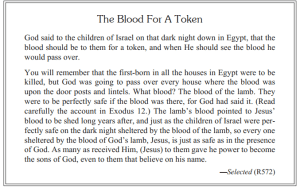
This was and yet is among Israelites one of the most important of their religious observances. It was the first feature of “the Law” given them as a typical people.
The ceremony, as originally instituted, is described in Exod. 12. A lamb without blemish was slain, its blood was sprinkled on the doorposts and lintels of the house, while the family within ate the flesh of the lamb with unleavened bread and bitter herbs. On that night (the fourteenth of the first month, Jewish time), because of the sprinkled blood and the eaten lamb the first-born children of Israel were passed over, or spared from the plague of death which visited the first-born of the Egyptians. On this account, and because on the next day Israel marched out from Egyptian bondage—free—therefore, by God’s command (Exod. 12:14), they commemorated it every year on its anniversary.
The Israelite saw only the letter of this ceremony, and not its typical significance. So, too, might we have been in similar darkness had not the Holy Spirit of God given us the key to its meaning by inspiring the Apostle to write the words (1 Cor. 5:7): “CHRIST OUR PASSOVER IS SACRIFICED FOR US; THEREFORE LET US KEEP THE FEAST.”
Our attention being thus called to the matter by the Spirit, we find other Scriptures which clearly show that Jesus, “the Lamb of God,” was the antitype of the Passover lamb, and that his death was as essential to the deliverance of “the Church of the first-borns” from death, as was the death of the typical lamb to the first-borns of Israel. Thus, led of the Spirit, we come to the words and acts of Jesus at the last Passover which he ate with his disciples.
God is very exact, and the slaying of the typical lamb, on the fourteenth day of the first month, foreshadowed or typified the fact that in God’s plan Jesus was to die at that time. And, it is remarkable, that God so arranged the reckoning of time among the Jews that it was possible for Jesus to commemorate the Passover with the disciples, and himself be slain as the real “Lamb” on the same day. [The Jewish day, instead of reckoning from midnight to mid- night as usually reckoned now, commenced at six o’clock in the evening and ended at six the next evening.] Thus Jesus and the disciples, by eating the Passover, probably about eight o’clock, ate it “the same night in which he was betrayed,” and the same day in which he died—thus every jot and tittle should be and was fulfilled.
Just five days before his crucifixion Jesus presented himself before them, to be received or rejected—when he rode to the city on the ass, fulfilling the prophecy, “Behold, thy king cometh unto thee” (Matt. 21:5), and fulfilling, at the same time, that feature of the Passover type which provides that the lamb must be received into the houses five days before the time of its killing. (Exod. 12:3) Thus Jesus made his last presentation to Israel as a nation, or house, five days before the Passover, as we read: “Then Jesus, six days before the Passover, came to Bethany. … On the next day [five days before] much people that were come to the feast, when they heard Jesus was coming to Jerusalem … went forth to meet him.” (John 12:1, 12, 13) Then it was that their king came unto them—sitting upon an ass’s colt. Then it was that he wept over them and declared, “Your house is left unto you desolate.” “Ye shall not see me hence- forth till ye shall say, Blessed is he that cometh in the name of the Lord.” (Matt. 23:38, 39)
Jesus knew the import of the Passover, but the disciples knew not. He was alone; none could sympathize, none could encourage him. Even had he explained to the disciples, they could not have understood, or appreciated his explanation, because they were not yet begotten of the Spirit. Nor could they be thus begotten until justified from Adamic sin—passed over, or reckoned free from sin by virtue of the slain Lamb, whose shed blood ransomed them from the power of the destroyer—death.
Thus alone—treading the narrow way which none before had trod, and in which he is our Fore-runner and Leader—what wonder that His heart at times was exceeding sorrowful even unto death. When the time had come they sat down to eat the Passover, and Jesus said unto the disciples: “With desire I have desired to eat this Passover with you before I suffer. I say unto you, I will not any more eat thereof until it be fulfilled in the kingdom of God” (Luke 22:15,16). Doubtless he longed to have them understand how it would BEGIN to be fulfilled, a little later on in that very day, by the slaying of the real Lamb.
Probably one reason he specially desired to eat this Passover with them was, that he there designed breaking the truth of its significance to them to the extent they could receive it; for, “As they did eat, Jesus took bread, and blessed, and brake it, and gave to them, and said, Take (eat), this is my body.” (Mark 14:22) “This is my body, which is given for you: THIS DO in remembrance of ME.” “And he took the cup and gave thanks and said, Take this and divide it among yourselves. … This cup is the new covenant, in my blood, which is shed for you.” (Luke 22:17-20)
We cannot doubt that the design of the Master was to call their minds from the typical lamb to himself, the antitype, and to show them that it would be no longer proper to observe a feature of the Law which he was about to fulfill. And the bread and wine were to be to them thereafter the elements which, as remembrancers of him, would take the place of the lamb. Thus considered, there is force in his words, “This do in remembrance of ME”—no longer kill a literal lamb in remembrance of a typical deliverance; but, instead, use the bread and wine, representatives of my flesh and life—the basis of the real deliverance—the real passing over. “Hence, let as many as receive me and my words henceforth do THIS in remembrance of me.”
Thus our Lord instituted his Supper as the remembrancer of his death, and as a substitute for the Passover as observed by the Jews. Is it asked why Jesus ate of the typical lamb first? We answer that he was born under the dominion of the Law, and must observe its every requirement. Since he made an end of the Law, nailing it to his cross, we are free from Law, as relates to either the Passover or the Lord’s Supper— its substitute—but we are of those who es- teem it a privilege to celebrate each year the anniversary of our Lord’s death; to DO THIS in remembrance of him—“for even Christ our Passover is slain, therefore LET US keep the feast.”
It would be difficult to determine just when or why this impressive season for the commemoration of our Lord’s death was ignored, but it was, doubtless, as an “expediency.” Doubtless zealous teachers thought that the great Teacher had made a mistake, and that it was “expedient” to have it oftener than once a year; and all seem to have understood Paul to teach that it made no difference how often it was observed when he said: “As often as ye eat this bread and drink this cup, ye do show the Lord’s death till he come.” (1 Cor. 11:26) But a careful study of all Paul said on the subject should convince all that this was not the case. In the context he tells them (verse 23) that he delivered to them that which he also received of the Lord: “That the Lord Jesus, the same night in which he was betrayed, took bread,” etc. Here notice not only that the time selected by Jesus seemed the most appropriate, but that it was so appropriate that Paul was informed, by a special revelation from the Lord, that this was instituted the night he was betrayed.
How often could the Church break that bread and drink that cup as a proper memorial of the Lord’s death? Surely only on its anniversary. In the same way, when American independence is celebrated, it is on its anniversary—the Fourth of July. It would be considered peculiar, at least, if some should neglect July fourth and celebrate it at sundry inappropriate times. And if speaking of the fourth of July, we should say, as often as ye thus celebrate ye do show forth the nation’s birth, who would understand us to mean several times a year? Likewise, also, the Lord’s Supper is only properly a celebration on its anniversary.
Some think that they find records in Scripture which indicate that the early Church ate the Lord’s Supper every First-day. To this we answer, that if this were true we should have no more to say on the subject; but where is the record? We are referred to Acts 20:7: “Upon the first day of the week, when the disciples came together to break bread, Paul preached unto them,” etc. But is there any evidence that the bread was broken as a remembrancer of the Lord’s death? If so, why was it never called the Lord’s Supper, and why was the wine omitted? Was the cup not as important an emblem as the bread? Because it is written that Jesus was known to the two disciples at Emmaus (Luke 24:30) in the “breaking of bread,” who will claim that that was more than an ordinary meal? Who will claim that they were eating the Lord’s Supper? No one.
So far from being an appropriate time for the commemoration of our Lord’s death, the first day of the week, or Lord’s day, would be most inappropriate. Instead of being set apart or used by the early Church to commemorate Jesus’ death and the sorrowful scenes of the Lord’s Supper, Gethsemane and Calvary, it was to them a glad day—a day of rejoicing and hosanna’s, saying, “THE LORD IS RISEN INDEED.” Hence its name and general observance by the Church as a day of worship and praise.
The seeming custom of breaking bread every Lord’s day, perhaps had its rise in the fact that disciples were few and came sometimes long distances to meet together on the Lord’s day, and socially ate a meal together. Perhaps, too, a blessed association of thought and interest lingered round the breaking of bread on the first day, when they remembered how repeatedly Jesus manifested himself to them on that day—after his resurrection—and how it was while they were eating that he made himself known. (Luke 24:35)
Even the faint traces of this once estab2lished custom in the Church—of celebrating the anniversary of the Lord’s death and resurrection—which the Roman and Episcopal Churches still observe, after an accommodated fashion, on “Good Friday,” has been almost lost sight of by the other sects.
It has been the custom of many of the WATCH TOWER readers to DO THIS in remembrance of our Lord’s death on its anniversary. Believing that it properly takes the place of the type—the Passover—we reckon it according to Jewish, or lunar time, and hence frequently on a different date from “Good Friday,” which is reckoned on solar time. The Passover this year comes on Lord’s day, April 22nd, at six P.M.; hence the time answering to the hour of Jesus’ death would be three o’clock, P.M., of that day, and the time for the eating of the Lord’s Supper would be about seven to eight o’clock of the Saturday evening pre- ceding April 21st. It should be remembered that the Lamb was slain the day before the Feast of Passover commenced. It will be celebrated as usual. We should, as heretofore, seek to follow the example of the first Communion service—using unleavened bread1 and wine—whilst we talk together of their significance and value.
1. Unleavened bread may be procured through any Hebrew family.
The Import Of The Emblems
It might be profitable to some to point out the significance of the broken loaf and the cup.
Of the bread, Jesus said: “It is my flesh”
—i.e., it represents his flesh—his humanity which was broken or sacrificed for us. Unless he had sacrificed himself—his humanity for us—we could never have had a resurrection from death—could never have had a future life; as he said, “Except ye eat the flesh of the Son of Man … ye have no life in you.” (John 6:53)
Not only was the breaking of Jesus’ body thus the providing of a bread of life, of which if a man eat he shall never die, but it was also the opening of the narrow way to life and the breaking, or unsealing, of truth, as a means of aid to walk the narrow way which leads to life. And thus we see that it was the breaking of him who said, “I am the way, the TRUTH and the LIFE; no man cometh unto the Father but by ME.” (John 14:6)
Hence, when we eat of the broken loaf, we should realize that had he not died— been broken for us—we should never have been able to come to the Father, but would have remained forever under the curse of Adamic sin and death, and should never have been made acquainted with the way, the truth, the life, or the Father.
Another thought: the bread was un- leavened—without leaven. [Leaven is corruption, an element of decay or decomposition.] Leaven is a type of sin and the de- composition, decay and death which sin works in mankind; so, then, this type declares that Jesus was free from sin—a lamb without spot or blemish—“holy, harmless, undefiled.” Had Jesus been of Adamic stock, had he received the life principle in the usual way from an earthly father, he, too, would have been leavened, as are all other men, by Adamic sin; but his life came direct from God—hence he is called the bread from heaven. (See John 6:41) Let us, then, appreciate the bread as pure, un-
leavened, and so let us eat of him; eating and digesting truth, and especially this truth; appropriating by faith his righteousness to ourselves by which we realize him as the way and the life.
The Apostle, by divine revelation, communicates to us a further meaning of the bread, and shows that not only did the loaf represent Jesus, individually, as our head, etc., but that, after we have partaken thus of him, we may, by consecration, be associated with him as parts of one loaf (one body) to be broken for, and become food for, the world. (1 Cor. 10:16) This same thought of our privilege as justified believers, sharing now in the sufferings and death of Christ, and thus becoming joint- heirs with him of future glories, and associates in the work of blessing and giving life to all the families of the earth, is ex- pressed by the Apostle repeatedly and un- der various figures; but when he compares the Church to the loaf now being broken as a whole, as Jesus was individually, it furnishes a striking and forcible illustration of our union and fellowship with our Head. He says, “Because there is one loaf we, the many [persons] are one body; for we all partake of the one loaf.” “The loaf which we break, is it not a participation of the body of the Anointed one?” (1 Cor. 10:16, 17— Diaglott)
The wine represents the life given—the sacrifice—the death. “This is my blood (symbol of LIFE given up in death) of the new covenant, shed for many FOR THE RE- MISSION of sin;” “Drink ye all of it.” (Matt. 26:27, 28)
It is by the giving up of his life as a ransom for the life of the Adamic race, which sin had forfeited, that a right to LIFE comes to men. (See Rom. 5:18, 19). Jesus’ shed blood was the “ransom for all,” but his act of handing the cup to the disciples, and asking them to drink of it, was an invitation to them to become partakers of his sufferings, or, as Paul expresses it, to “fill up that which is behind of the afflictions of
Christ.” (Col. 1:24) “The cup of blessing, for which we bless God, is it not a participation of the blood [shed blood—death] of the Anointed one?” (1 Cor. 10:16—Diaglott) Would that all could realize the value of the cup, and could bless God for an opportunity of suffering with Christ that we may be also glorified together. (Rom. 8:17)
Jesus attaches this significance to the cup elsewhere, indicating that it is the cup of sacrifice, the death of our humanity. For instance, when asked by two disciples a promise of future glory in his throne, He answered them: “Ye know not what ye ask; are ye able to drink of the cup that I shall drink of?” Wine is also a symbol of joy and invigoration: so we will share Jesus’ glories, honors and immortality—when we drink it new with him in the kingdom.
Let us then, dearly beloved, as we surround the table to commemorate our Lord’s death, call to mind the meaning of what we do, and see to it that we feed on Him; and, when strengthened by the living bread, let us drink with him into his death. “For if we be dead with him we shall live with him; if we suffer we shall also reign with him.” (2 Tim. 2:11, 12)
Who May Commune?
Every member of Christ—even one alone with the Master may commemorate—but, so far as possible, all members of the one loaf should meet together. Ceremonious formality would be out of place— but, “Let all things be done decently and in order.”
Another thought: while it is proper that we should thus commemorate “Our Passover,” or its anniversary, yet it should not be forgotten, that in a sense we eat and drink, and have this sacred fellowship with our Lord every day and every hour. The night in which Israel ate of their Pass- over lamb, with “bitter herbs,” typified the entire Gospel Age; and their deliverance from Egypt followed in the morning. So with us, we eat of our Lamb with the bitter trials and afflictions of evil in the present age—but joy cometh in the morning—our deliverance from earth and the dominion and oppression of evil. The morning already is dawning, let us hasten the more to “fill up that which is behind of the afflictions of Christ.” (Col. 1:24)
The Apostle Paul seems to enforce the ideas we have just presented relative to the meaning of this ordinance, and shows the necessity of a proper appreciation of its meaning. He warns (1 Cor. 11:27-30—Diaglott), that “whoever may eat the bread and drink the cup of the Lord unworthily will be an offender against the body and blood of the Lord. But let a man examine himself, and thus [with an understanding and appreciation of its significance] let him eat of the bread and let him drink of the cup; for he eats and drinks judgment [condemnation] to himself who eats and drinks not discriminating [appreciating] the Lord’s body. Through this [lack of a proper appreciation of the true import— that it signifies our sharing in the sufferings and death of Christ—for this reason] many are weak and sickly among you, and many sleep.”
The truth of Paul’s remarks we can each bear witness to. Many in the Church, not only of the nominal Church, but many members of the true Church, “whose names are written in heaven,” are weak and sickly, and many have gone asleep entirely, become dead to spiritual things, and, as dead branches, are cut off from the vine—the overcoming Church (John 15:2).
If, then, we would become strong and full of spiritual vigor, and “not sleep as do others,” when we annually ratify our covenant, let us examine ourselves, and thus let us partake of the sufferings and the emblems, that in due time we may partake of His glory also.
The Lord’s Supper
For even Christ our Passover is sacrificed for us: therefore let us keep the feast.” 1 Cor. 5:7, 8
Each year, as the anniversary of our Lord’s death recurs, it seems necessary to restate the propriety of its commemoration—not only for the sake of new readers, but also to refresh the memory of all by calling these precious truths to mind.
The Passover was, and yet is among Israelites, one of the most important of their religious observances. It was the first feature of “the Law” given them as a typical people.
The ceremony, as originally instituted, is described in Exodus 12. A lamb without blemish was slain, its blood was sprinkled on the doorposts and lintels of the house, while the family within ate the flesh of the lamb with unleavened bread and bitter herbs. On that night (the fourteenth of the first month, Jewish time), because of the sprinkled blood and the eaten lamb, the firstborn of Israel were passed over, or spared, from the plague of death which visited the firstborn of the Egyptians. On this account, and because on the next day Israel marched out from Egyptian bondage—free—therefore, by God’s command (Exodus 12:14), they commemorated it every year.
The Israelites saw only the letter of this ceremony and not its typical significance. So, too, might we have been in similar darkness had not God given us the key to its meaning by inspiring the Apostle to write (1 Cor. 5:7): “CHRIST OUR PASSOVER IS SACRIFICED FOR US.”
Our attention being thus called to the matter, we find other scriptures which clearly show that Jesus, “the Lamb of God,” was the antitype of the Passover lamb, and that his death was as essential to the deliverance of “the Church of the first-born” from death as was the death of the typical lamb to the first-born of Israel. Thus, led of the Spirit, we come to the words and acts of Jesus at the last Passover which he ate with his disciples.
God is an exact timekeeper, and the slaying of the typical lamb on the fourteenth day of the first month foreshadowed or typified the fact that in God’s plan Jesus was to die at that time. And God so arranged the reckoning of time among the Jews that it was possible for Jesus to commemorate the Passover with the disciples and himself be slain as the real “Lamb” on the same day. The Jewish day, instead of reckoning from midnight to midnight as usually reckoned now, commenced at six o’clock in the evening and ended at six the next evening. Thus Jesus and the disciples, by eating the Passover probably about eight o’clock, ate it “the same night in which he was betrayed,” and the same day in which he died. Thus every jot and tittle should be, and was, fulfilled.
Just five days before his crucifixion, Jesus presented himself to Israel as their king—to be received or rejected—when he rode to the city on the ass, fulfilling the prophecy, “Behold, thy king cometh unto thee” (Matt. 21:5), and fulfilling at the same time that feature of the Passover type which provides that the lamb must be received into the houses five days before the time of its killing (Exod. 12:3). Thus Jesus made his last and formal presentation to Israel as a nation, or house, five days before the Passover, as we read: “Then Jesus, six days before the Passover, came to Bethany. … On the next day [five days before] much people that were come to the feast, when they heard Jesus was coming to Jerusalem … went forth to meet him.” (John 12:1, 12, 13) Then it was that their king came unto them “sitting upon an ass’s colt.” Then it was that, unreceived, he wept over them and declared, “Your house is left unto you desolate.” “Ye shall not see me henceforth till ye shall say, Blessed is he that cometh in the name of the Lord.” (Matt. 23:38, 39)
Jesus knew the import of the Passover, but the disciples knew not. He was alone; none could sympathize, none could encourage him. Even had he explained to the disciples, they could not have understood or appreciated his explanation, because they were not yet begotten of the Spirit. Nor could they be thus begotten until justified from Adamic sin—passed over, or reckoned free from sin—by virtue of the slain Lamb, whose shed blood ransomed them from the power of the destroyer, death.
Thus alone, treading the narrow way which none before had trod and in which he is our Forerunner and Leader, what wonder that his heart at times was exceedingly sorrowful even unto death. When the hour had come, they sat down to eat the Passover, and Jesus said unto the disciples: “With desire I have desired to eat this Passover with you before I suffer. I say unto you, I will not any more eat thereof until it be fulfilled in the kingdom of God.” (Luke 22:15, 16) Doubtless he longed to have them understand how it would begin to be fulfilled a little later on in that very day by the slaying of the real lamb.
Probably one reason he specially desired to eat this Passover with them was, that he there designed breaking the truth of its significance to them to the extent that they could receive it; for, “As they did eat, Jesus took bread, and blessed and brake it, and gave to them and said, “Take (eat), this is my body.” (Mark 14:22) “This is my body, which is given for you: This do in remembrance of me.” “And he took the cup and gave thanks and said, “Take this and divide it among yourselves. … This cup is the new covenant, in my blood, which is shed for you.” (Luke 22:17-20)
We cannot doubt that the design of the Master was to call their minds from the typical lamb, to himself, the antitype, and to show them that it would be no longer proper to observe a feature of the Law which he was about to fulfill. And the bread and wine were to be to them thereafter the elements which, as remembrancers of him, would take the place of the typical lamb. Thus considered, there is force in his words, “THIS DO in remembrance of ME”— no longer kill a literal lamb in remembrance of a typical deliverance, but, instead, use the bread and wine, representatives of my flesh and life, the basis of the real deliverance, the real passing over. Hence, let as many as receive me and my words henceforth “DO THIS in remembrance of me.”
Thus our Lord instituted his Supper as the remembrancer of his death, and as a substitute for the typical Passover Supper as observed by the Jews. Is it asked why Jesus ate of the typical lamb first? We answer that he was born under the Law, and must observe its every requirement. Since he at Calvary fulfilled the Law, that “Covenant” is no longer in force even, upon Hebrews.
It would be difficult to determine just when or why, this impressive season for the commemoration of our Lord’s death began to be ignored, but it was, doubtless, as a matter of expediency, resulting from that compromising spirit which early began to mark the great falling away, which Paul foretold. Christian people generally, judging mostly from the varied practice of the Nominal Churches with regard to it, suppose that it really makes little or no difference when the Lord’s Supper is celebrated. And under this impression, without much thought or examination, they interpret the words of Paul in 1 Cor. 11:26 (“as often”) to mean an indefinite time. It reads, “As often as ye eat this bread and drink this cup, ye do show the Lord’s death till he come.” But a careful study of the context gives conclusive evidence that this was not the case, but that a definite time was referred to. He tells them (verse 23) that he delivered to them that which he also received of the Lord: “That the Lord Jesus the same night in which he was betrayed, took bread, etc.” Here notice not only that the time selected by Jesus seemed the most appropriate, but that it was so appropriate that Paul was informed, by a special revelation from the Lord, that this was instituted the night he was betrayed.
How often could the Church break that bread and drink that cup as a proper memorial of the Lord’s death? Surely only on its anniversary. When American Independence is celebrated, it is on its anniversary—the Fourth of July. It would be considered peculiar, at least, if some should neglect that day and celebrate it at sundry inappropriate times. And if, speaking of the Fourth of July, we should say, As often as ye thus celebrate ye do show forth the nation’s birth; who would understand us to mean several times a year? Likewise, also, the Lord’s Supper is only properly a celebration on its anniversary, and once a year would be “as often” as this could be done.
Some think that they find records in Scripture which indicate that the early Church ate the Lord’s Supper every First day of the week. To this we answer, that if this were true we should have no more to say on the subject; but where is the record? We are referred to Acts 20:7: “Upon the first day of the week, when the disciples came together to break bread, Paul preached unto them,” etc. But is there any evidence that the bread was broken as a remembrancer of the Lord’s death? If so, why was it never called the Lord’s Supper, and why was the wine omitted? Was the cup not as important an emblem as the bread? Take a similar expression: Jesus was known to the two disciples at Emmaus in the “breaking of bread.” (Luke 24:35) Who will claim that that was more than an ordinary meal? Who will claim that they were eating the Lord’s Supper? No one.
So far from being an appropriate time for the commemoration of our Lord’s death, the first day of the week would be most inappropriate. Instead of being set apart or used by the early Church to commemorate Jesus’ death and the sorrowful scenes of the Lord’s Supper, Gethsemane and Calvary, it was to them a glad day, a day of rejoicing, reminding them of the fact that “THE LORD IS RISEN INDEED.” Hence the appropriateness of the name Lord’s Day, and of its observance by the Church as a day of worship and praise.
The seeming custom of breaking bread on the First day, perhaps, had its rise in the fact that the disciples were few, and came sometimes long distances to meet together, and socially ate their meal together. Perhaps, too, a blessed association of thought and interest lingered round the “breaking of bread” on the First day, when they remembered how repeatedly Jesus manifested himself to them on that day— after his resurrection—and how it was while they were eating that he made himself known. (Luke 24:35, 43; John 20:19; 21:12)
Even the faint traces of this once established custom in the Church—of celebrating the anniversary of the Lord’s death and resurrection—which the Roman Catholic and Episcopal Churches still observe, after an accommodated fashion, on Good Friday and Easter Sunday, has been almost lost sight of by others.
It has been the custom of many of the WATCH TOWER readers to “DO THIS” in remembrance of our Lord’s death on its anniversary. Since it properly takes the place of the Jewish type, we reckon it according to the Jewish, or lunar time; and hence generally on a different date from “Good Friday” and Easter, which, following the same method of reckoning, but not exactly, commemorates the Friday and Sunday near the actual lunar date. The Lord’s Supper anniversary this year will be on Sunday evening, April 18th, about 8 o’clock; Monday afternoon following being the anniversary of the crucifixion; and the Passover festival week as observed by Hebrews commencing at 6 P.M. of that day.
The teaching of Paul, in 1 Cor. 11:26, is not that we should discontinue this simple and impressive ordinance which commemorates the death of our Paschal Lamb, and symbolizes also our share in his death, as soon as we learn of his glorious advent. Since it is a calling to mind of these facts, and an annual reminder and renewal of our covenant to sacrifice with him, it is proper that it should be observed until, in this time of his presence, we are changed to his glorious likeness—until we drink the new wine of joy with him in the kingdom. (Matt. 26:29)
The Import Of The Emblems
It might be profitable to some, to point out the significance of the broken loaf and the cup.
Of the bread Jesus said: “It is my flesh;” that is, it represents his flesh, his humanity which was broken or sacrificed for us. Unless he had sacrificed himself for us, we could never have had a resurrection from death, to future life; as he said, “Except ye eat the flesh of the Son of man … ye have no life in you.” (John 6:53)
Not only was the breaking of Jesus’ body thus to provide bread of life, of which if a man eat he shall never die, but it also opened the “narrow way” to life, and broke or unsealed and gave us access to the truth, as an aid to walk the narrow way which leads to life. And thus we see that it was the breaking of him who said, “I am the WAY, the TRUTH, and the LIFE; no man cometh unto the Father but by ME.” (John 14:6)
Hence, when we eat of the broken loaf, we should realize that had he not died— been broken for us—we should never have been able to come to the Father, but would have remained forever under the curse of Adamic sin and in the bondage of death.
Another thought: the bread was unleavened. Leaven is corruption, an element of decay, hence a type of sin, and the decay and death which sin works in mankind. So, then, this symbol declares that Jesus was free from sin, a lamb without spot or blemish, “holy, harmless, undefiled.” Had Jesus been of Adamic stock, had he received the life principle in the usual way from an earthly father, he, too, would have been leavened, as are all other men, by Adamic sin; but his life came unblemished from a higher, heavenly nature, changed to earthly conditions, hence he is called the bread from heaven. (John 6:41) Let us then appreciate the bread as pure, unleavened, and so let us eat of him; eating and digesting truth, and especially this truth; appropriating by faith his righteousness to ourselves we realize him as both the way and the life.
The Apostle, by divine revelation, communicates to us a further meaning in this remembrancer. He shows that not only did the loaf represent Jesus, individually, but that after we have partaken thus of him, (after we have been justified by appropriating his righteousness), we may, by consecration, be associated with him as parts of one loaf (one body) to be broken for, and in a like manner to become food for the world. (1 Cor. 10:16) This same thought, of our privilege as justified believers to share now in the sufferings and death of Christ, and thus become joint-heirs with him of future glories, and associates in the work of blessing and giving life to all the families of the earth, is expressed by the Apostle repeatedly and under various figures; but when he compares the church, as a whole to the “one loaf” now being broken, it furnishes a striking and forcible illustration of our union and fellowship with our Head. He says, “Because there is one loaf we, the many [persons] are one body; for we all partake of the one loaf.” “The loaf which we break, is it not a participation of the body of the Anointed one?” (1 Cor. 10:16, 17—Diaglott)
The wine represents the life given by Jesus the sacrifice—the death. “This is my blood (symbol of LIFE given up in death, of the new covenant, shed for many, FOR THE REMISSION of sins;” “Drink ye all of it.” (Matt. 26:27, 28)
It is by the giving up of his life as a ransom for the life of the Adamic race, which sin had forfeited, that a right to life comes to men. (Rom. 5:18, 19) Jesus’ shed blood was the “ransom for all,” but his act of handing the cup to the disciples and asking them to drink of it was an invitation to them to become partakers of his sufferings, or, as Paul expresses it, to “fill up that which is behind of the afflictions of Christ.” (Col. 1:24) “The cup of blessing, for which we bless God, is it not a participation of the blood [shed blood—death] of the Anointed One?” (1 Cor. 10:16 — Diaglott) Would that all could realize the value of the cup, and could bless God for an opportunity, sharing it with Christ, that we may be also glorified together. (Rom. 8:17)
Jesus attaches this significance to the cup elsewhere, indicating that it is the cup of sacrifice—the death of our humanity. For instance, when asked by two disciples a promise of future glory in his throne, he answered them: “Ye know not what ye ask; are ye able to drink of the cup that I shall drink of?” On their hearty avowal he answered, “Ye shall indeed drink of my cup.” Wine is also a symbol of joy and invigoration: so we share Jesus’ joys in doing the Father’s will now, and shall share also his glories, honors, and immortality—when we drink it new with him in the Kingdom.
Let us then, dearly beloved, as we surround the table to commemorate our Lord’s death, call to mind the meaning of what we do; and, being invigorated with his life and strengthened by the living bread, let us drink with him into his death and be broken in feeding others. “For if we be dead with him, we shall live with him; if we suffer, we shall also reign with him.” (2 Tim. 2:11, 12)
Who May Partake
It is left open for each to decide for himself whether he has or has not the right to partake of this bread and this cup. If he professes to be a disciple, his fellow disciples may not attempt to judge his heart—God alone reads that with positiveness. And though the Master knew beforehand who would betray him, nevertheless one who had “a devil” was with the twelve.
Because of its symbolism of the death of Christ, therefore let all beware of partaking of it ignorantly, unworthily, improperly—not recognizing through it “the Lord’s body” as our ransom, else the breaking of it in his case would be as though he were one of those who murdered the Lord, and he in symbol would “be guilty of the body and blood of the Lord.” (1 Cor. 11:27–29)
“But let a man examine himself,” let him see to it that in partaking of the emblems he realizes them as the ransom price of his life and privileges; and furthermore that he, by partaking of them, is pledging himself to share in the sufferings of Christ and be broken for others; else otherwise, his act of commemoration will be a condemnation to his daily life before his own conscience—“condemnation to himself.”
Through lack of proper appreciation of this remembrancer which symbolizes not only our justification but also our consecration to share in the sufferings and death of Christ, the Apostle says “many are weak and sickly among you, and many sleep.” (1 Cor. 11:30) The truth of this remark is evident; a failure to appreciate and a losing sight of the truths represented in this supper are the cause of the weak, sickly, and sleepy condition of the church. Nothing so fully awakens and strengthens the saints as a clear appreciation of the ransom sacrifice and of their share with their Lord in his sufferings and sacrifice for the world. “Let a man examine himself, and so let him eat of that bread and drink of that cup.”
“This Do In Remembrance of Me”
“Then came the day of unleavened bread when the passover [lamb] must be killed. … the chief priests and the scribes sought how they might kill him. And Jesus sent Peter and John, saying, Go and prepare us the passover that we may eat. … And when the hour was come he sat down, and the twelve apostles with him. And he said unto them, With desire I have desired to eat this passover with you before I suffer: for I say unto you, I will not any more eat thereof, until it be fulfilled in the kingdom of God. And he took the cup and gave thanks, and said, Take this and divide it among yourselves: for I say unto you, I will not drink of the fruit of the vine until the kingdom of God shall come. And he took the bread and gave thanks, and brake it and gave unto them, saying, This is my body which is given for you: this do in remembrance of me. Likewise also the cup after supper, saying, This cup is the new testament in my blood which is shed for you.”—Luke 22:7, 2, 8-20
Such is the simple account of the institution of the Lord’s Supper, as recorded by Luke; and again, as the appointed time draws near, we call to mind the words, “This do in remembrance of me.” And in compliance with that request, we will again commemorate our Passover by the repetition of the simple ceremony thus instituted by our Lord.
Monday afternoon, March 26th, 1888, will be the anniversary of our Lord’s death at Calvary—the 14th day of the first month, Jewish time, which begins at sunset of the previous evening. Sunday evening, March 25th, will therefore be the anniversary of our Lord’s Supper, instituted in commemoration of his death as the antitypical paschal Lamb—“the Lamb of God which taketh away the sin of the world.”
On that occasion the church at this place will meet at our usual upper room, No. 101, Federal Street, Allegheny (side entrance), at 7:30 o’clock P.M., and we most cordially invite to meet with us all who love our Redeemer and who appreciate the ransom sacrifice which we meet to celebrate. Provision will be made for the entertainment of those from a distance. Let as many as can meet with us. A number of meetings will be arranged for several days following, which will afford a favorable opportunity for inquiry regarding the plan of the ages. Since all the consecrated are ministers of the truth, it behooves all who can to avail themselves of the opportunities which these conferences afford, for the more thoroughly equipping of themselves for their respective fields of usefulness.
But we are aware of the fact that only a few can assemble here; nevertheless, let all the faithful in Christ Jesus, in every place, “Do this in remembrance” of God’s Lamb who redeemed us by the sacrifice of himself. Such, in every place, should assemble together, even if there be but two or three of like precious faith. And even the solitary ones may break the bread and partake of the wine, in heart communion with the Lord and with the scattered fellow members of the one body yet in the flesh.
Christians in this matter, as on many other points, have left the teachings of the Word and the example of the early church, and follow various customs as to the time of its observance. Few observe it as a “supper” at all, Protestants in general selecting for convenience the noon hour instead of the evening. Some commemorate the Lord’s death every Sunday, some once a month, and some once in three months. They seem to regard the time and frequency as a matter of indifference, and they might reason, If it is a good thing to do, why not do it often—even daily. To this, others would reply, and truly: It would lose much of its solemnity and force. And so it does as they now celebrate it. Those who celebrate every Sunday mistake the record in Acts 2:42, 46 and 20:7, 11. They surely err in supposing these occasions to be the Lord’s Supper. They undoubtedly refer to a common usage in the early church of eating a plain meal together when they gathered every first day of the week from distant places, just as it is the custom now in country places, except that they all ate together and made it more of a “love feast.” These “feasts of charity,” or love feasts, are referred to by Jude (verse 12), in which he shows that all who partook were not brethren indeed. The institution of these love feasts was not by any command of our Lord or of the apostles, but, like the celebration of the first day of the week, seems to have been the spontaneous prompting of grateful hearts. The early church thus celebrated the resurrection of our Lord (not his death) every week, and the breaking of bread in their love feast was probably a pleasant reminder of the fact that the Lord was made known to the disciples at Emmaus and on other occasions after his resurrection in the breaking of bread—at their ordinary lunch. (Luke 24:29, 30, 42; John 21:12, 13) They thus celebrated both his resurrection and the opening of their eyes to know him. But they neither used wine (no less important than the bread in the celebration of the Lord’s Supper), nor did they call it the Lord’s Supper, nor observe it with special solemnity, but rather with thankfulness and joy. “They did eat their meat with gladness and singleness of heart,” “breaking bread from house to house,” (Acts 2:46) and, for a time, daily.
Those who celebrate the “supper” at noon on Sunday once a month or once a quarter have no plea for their custom except that St. Paul said, “As oft as ye do this,” etc. (1 Cor. 11:23, 25), which they think gives liberty for doing it when they please. On the contrary, the apostle uses the word “As oft” in the sense of whenever. “Whenever ye do this” carries the mind to the context to see what is referred to. We find Paul in the context referring to the “same night in which he [our Lord] was betrayed,” and the bread and wine there and then instituted by our Lord as his remembrancers, to take the place of the typical Passover eaten by the Jews. Paul wrote to those who well knew the Jewish custom and how often it was celebrated, so that “as oft,” or whenever, to them signified each time—each anniversary.
The Lord’s Supper was designed to supplant the annual commemoration of the typical passing over of Israel’s first-born, whose lives were saved through the blood of the typical lamb. Such an event could only be properly celebrated on its anniversary, which our Lord and his disciples and all the Jews strictly observed. They no more thought of celebrating it at any other time than Americans think of celebrating the signing of their Declaration of Independence on any other day than the fourth of July.
It was the custom of the early church to celebrate it, as we do, on the fourteenth day of the first month, Jewish time, as the Lord indicated; and though there was a great falling away from the original purity of faith, which commenced even in the days of the apostles, this custom was still retained by some Christians down to the fourth century, when it was peremptorily abolished by the Council of Nice, when the great falling away, predicted by the apostles, had partially developed the great system of error afterward known as the Papacy.
On this point we quote the following from Mosheim’s Church History (see page 523). He says, “There arose toward the close of this [the second] century, between the Christians of Asia Minor and those of other parts, particularly such as were of the Roman church, a violent contention. … The Asiatic Christians were accustomed to celebrate … the institution of the Lord’s Supper and the subsequent death of the Redeemer, on the fourteenth day of the first Jewish month. … This custom they stated themselves to have derived from the Apostles Philip and John.”
But let no one misunderstand us to teach, that those who have commemorated the Redeemer’s death at inappropriate seasons are therefore condemned of our Lord. No, thank God, the Gospel church is not placed under Law, but under grace, in this as in every matter. And those who in heart sincerity have so partaken of the emblems of our Lord’s body and blood, while they may suffer loss in the sense that the occasion by its too frequent remembrance has lost some of the power it was designed to have on their hearts, have nevertheless not been spurned by him whose sacrifice for sins they thus confessed. But surely, when the intent of our Lord’s words is grasped, all the fully consecrated will gladly comply with his arrangement, assured that it is best and most appropriate; as well as most acceptable to him of whom it is a remembrancer.
The Symbols Considered
Not only has the proper time been lost sight of, but the true meaning of the symbols, wine and unleavened bread, has also been obscured by the spiritual darkness of the “dark ages.” Trinitarian errors, which in the third century were introduced into Christianity from heathen philosophy, have done much to warp and twist the minds of God’s children, and to hinder clear views of the sacrifice which our Redeemer gave as our ransom price.
The typical lamb by which the Children of Israel foreshadowed Christ and the coming deliverance, (except the blood which was sprinkled upon the house as a protection—an atonement) was eaten by all. So with the emblems by which we are instructed to remember the real lamb. The bread is to be eaten by all; the wine may only be partaken of by a few. The bread and wine symbolize the body and blood of our Lord. Our Lord as a man was the living bread [literally, bread of life] which came down from heaven to give life to the world. The illustration is perfect: Mankind is dying for want of life and needs some food so full of life-producing quality that it will arrest the wasting of death, and repair and restore to the original perfection lost in Adam. Men have sought panaceas, elixirs, life restorers, in every quarter—in animal and vegetable food, in minerals, and in chemistry; but all in vain; no such “bread of life” has ever been found. But when men had for four thousand years sought in vain, the true bread of life came from heaven, of which, if a man eat (partake or appropriate to his use, as it is his privilege to do) he shall live forever. That is, if by faith in the means which God has provided to accomplish his redemption, he accepts the favor of life, he can have it on those terms, and those only. This our Lord symbolically termed eating his flesh.
Notice how perfect is the illustration.
The Son of God as a heavenly or spiritual being, as he was at first, was not bread for man, and had he given his spiritual body as bread, we of a different nature (human), could not have appropriated it, just as that which would nourish and perfect a tree (viz., air, moisture, and earth) would not perfect men because of a different nature. Man is of human or flesh nature; hence if the spiritual Son of God would give to dying men the bread of life, it must be flesh, full of life-giving nutriment.
The preparation for this was the change of the Son of God from spirit to flesh. To this end he humbled himself, when he was “made flesh and dwelt among us.” (John 1:14) The flesh was to be the life-giving bread; and since he who had been in the heavenly or spirit state had become earthly or human, being made flesh, it is truly said that this bread came down from heaven, from the heavenly or spirit condition to the earthly or human nature. This is the bread of life of which a man may eat and not die. (John 6:50)
We have now found the bread of life, but how shall we eat him? We cannot eat anything that is alive, nor would anything that dieth of itself [by disease] be fit for food. So if our Lord had died what is called a natural death, it would have proved that he was a sinner like other men; for death is the penalty of sin, and hence to partake of him would have given no new life. So then we see that there was no way to give us this life-food or “bread of life” except by the sacrifice of the man Christ Jesus, who did not die because his life, like ours, was forfeited, but who gave himself a ransom, a corresponding price, a substitute for all—for Adam and all who lost life through him. His life in the flesh—his example and counsel, teachings, etc.—could not give life any more than music would keep alive a starving man. We may study and try to follow his perfect example, but we cannot do it perfectly because we are dying and lack strength. We need life, life-producing food, and he became flesh for the very purpose of providing us this life supply which we could get in no other way.
So when speaking on the subject to his disciples, he told them that the killing of the lamb was needful, so that they could eat of him, saying, “It behooveth the son of man to suffer.” Had he remained with them in the flesh, their teacher, they would indeed have been greatly blessed, but could never have gotten life. Hence he said, “The Son of man goeth as it is written of him,” and “It is expedient FOR YOU;” “for if I go not away (If I remain flesh, if I do not submit myself in sacrifice and thus carry out the Father’s plan for your redemption), the Comforter will not come.” You cannot in any other way than by my sacrifice, and by partaking of me, escape from condemnation and come into harmony and acceptance with God, so as to be recognized of him as sons, and as such be granted life.
So, then, it is a mistake to suppose that truth is the bread of life, and that the eating of truth will justify us, or give us a right to life. It is a mistake to suppose that to believe the sermon on the mount and other of our Lord’s sayings would give life. Truths they were, and good for food after and with the Lamb, but INDIGESTIBLE without it. Those very truths were indigestible to many, and acted as emetics rather than as nourishing food, and “many went back and walked no more with the Lord.” Even the twelve got little nourishment from our Lord’s teachings until after the Lamb was slain, and they by faith had eaten of that life-giving food. Then, under the strength and vigor of the life, they were able to find sweetness and strength in all things whatsoever the Master had spoken unto them. The eating of the Lamb, by the new life which it brought, restored them again to fellowship with God; and receiving the adoption and spirit of sonship, they were thereby enabled to appreciate and appropriate to their strengthening, truths in general, as “meat in due season.”
Our Lamb was slain for us, on our behalf, because he was the bread of which all must eat, to have life, and because we could not eat him until he gave himself. Now, what did he give, and what do we eat? We answer, his flesh. But what is meant by this, his flesh? We showed above, that he “became flesh,” (John 1:14) i.e., he became human. So then, to give his flesh, means to give himself, at that time a human being. Whatever he possessed therefore in the way of human rights and privileges, under God’s law, he there resigned in our interest—that the human family which has no rights or privileges, having lost all those in Adam its representative, might receive back all of these rights and privileges and liberties. Adam’s family was all in him when he sinned and lost life, and every right and privilege of sonship, and so we all are sharers in that one loss. So now corresponding full and sufficient rights belong to the new man, “the man Christ Jesus,” who as a perfect and uncondemned being exchanged his higher rights for men’s lower rights which Adam had forfeited. And when this one then gives himself and lays down all that he has (Matt. 13:44) in the interest and for the use of the condemned race, we see that the giving of his flesh for the life of the world (John 6:51) means the handing back to dying men of the life, liberties, and privileges lost. And the eating of his flesh would consequently mean, the appropriating to his own use by the eater, of all the rights, liberties, and life which the perfect sinless “man Christ Jesus” possessed—no more, and no less.
1. Really there is no such thing as natural death. In God’s arrangement life is the natural condition and death comes as a violation of natural life—as a consequence or penalty for disobedience, sin. However, natural death, may be considered an allowable expression when referring to the fallen, condemned race, because it is the natural result of sin, common to all human sinners. So our Lord could not have died by disease, etc., unless he had sinned, in which case his flesh would have been far from life-giving. Nor could his life be taken, except as he chose to give it as our ransom price, and that his flesh might impart life to us.
What he gave up when he died, is ours—it is free to every child of Adam. But it will give life, etc., only to such as eat, i.e., by faith appropriate, those rights and privileges, freely given unto us of God, through the redemption which is in Christ Jesus.
If a man becomes leprous, not only he, but all in him, i.e., all his unborn posterity are affected. So it was with Adam and his children: we were “born in sin” and under its penalty, death, as the natural law of our being. Now consider that if a medicine or bread of life, a sure cure for leprosy were provided, to do good, it must be received into the system and appropriated, else no cure would result. So it is with Christ and the condemned and dying sinner. Not only must the bread contain the elements he needs, and be made accessible to him, but he must eat, or by faith appropriate it, if he would be freed from his malady of sin and its curse of condemnation to death. And as each child born a leper would need to eat for himself, and the family could not all be cured by any one of them taking the medicine or life food, so it is with sinners, each must eat for himself of the life-giving flesh of the Lamb of God, which taketh away the sin of the world. It is for every man; hence every sinner must have an opportunity to eat and live, and none can be cured and brought to life (perfection) without eating this bread of life. None can eat it ignorantly (though many eat its symbol ignorantly); hence none of the heathen have yet had a chance to eat and live, and since all must come to the knowledge of this truth, this of itself would be a proof of the judgment (trial) to come, in the great Millennial Day; for it must be testified to all IN DUE TIME (1 Tim. 2:4-6) in order that all, if they will, may eat and live forever. Since only the few come to even an imperfect knowledge of the truth, in this age, it is evident that God’s “due time” for spreading this great feast before the world, is “in the morning,” in the Age of Restitution, the Millennium, when the knowledge of the Lord shall fill the whole earth. (Hab. 2:14; Isa. 25:6)
In the Millennial age, men as they shall accept of Christ as God’s lamb and their ransom price, will be permitted to partake of his perfections, physical, mental and moral; and as they do so, and conform to his teachings, they will gradually return to perfection, to all that was lost in Adam, attaining full perfection at the close of that age, or else for willful disobedience be entirely and forever cut off from life in the second death, for which there is no antidote, no bread of life, no cure.
We, the church, who receive this bread of life now, and eat or appropriate it, do not experience a gradual restitution of our human powers to perfection, nor in any measure our restitution to human rights and privileges, etc. Ours is only reckoned, and not actual. By faith only, we can and do eat of the flesh of our Redeemer, accepting by faith (contrary to sight) human rights and liberties and life from the sacrifice made by our Lord. Mankind who will live in the next age will have sight as an aid to their faith; for they will feel their gradual physical improvement as they take the steps of faith and obedience. But none can walk by sight now, hence fewer and most select is the “little flock” now being chosen out from the world, to be the Bride and joint-heir of Christ in the Kingship and Priesthood of the age to come. To eat the Lamb we must realize his purity, his perfection, his spotlessness, and his RIGHT to all God’s favors prepared for man. We must see, too, that he has sacrificed, surrendered up, all these human rights and privileges in order that all these blessings might be restored to the fallen and condemned race, and thus permit all to come back to a standing and fellowship with God, which he does not grant to condemned creatures.
But why should any be permitted to eat thus of his flesh (his human perfections, rights, etc.) beforehand—before the general time for spreading the feast for all? Ah! there is a very precious truth there; there lies covered from view of the world “the exceeding riches of his grace, toward us who are in Christ Jesus.” Let us look at it.
The blood, symbolized by the wine, represents death; “the blood is the life” of anything; and when it is “shed,” or taken from it, it implies the death of the creature. So the shed blood of Christ signifies the death of Christ—the life given up for the sins of the world. In the typical Passover, the Lamb was eaten, but the blood was not. No Israelite was allowed to eat blood. This was symbolic of how all are to eat the flesh of the Son of man but all are not to drink or partake of his death. Those to whom our Lord gave the wine as representative of his blood, were invited to partake of and share in his death, which was proper, because they were to be members of his body; and not only he, the Head, should taste death for every man, but we his body should be “made conformable to his death” (Phil. 3:10), and become dead with him. (Rom. 6:8) The “cup” then is the symbol of death—by partaking of it (intelligently) we pledge our lives even unto death in the service of our Lord and Redeemer. Whether or not we shall be found worthy of restitution and lasting life depends on our eating (accepting and appropriating) his flesh; but whether we shall be found acceptable as members of his body, his bride and joint-heir, depends upon whether after eating his flesh by faith in the present age, we shall drink of his “cup,” consecrate ourselves entirely to his service—unto death. This being true, how appropriate that the giving of the wine was after the eating of the bread, and to those only who had eaten it. This teaches, in harmony with all the Scriptures, that only those who are justified from all sin by faith in the merit and sacrifice of the Lamb of God (and no others) are invited to crucify their (justified) humanity and share in the afflictions of Christ in this age, and in his glory which shall follow in the Millennial age and the eternity beyond.
Only those who both eat his flesh (appropriate his merits—justification) and drink his blood (share with him in his sacrifice by rendering their justified humanity a sacrifice to his service) dwell in him, as members of the one “body of Christ,” as members of the “true vine.” (John 6:56) Only such (verse 53) can have inherent life: that is, life independent of all conditions—Immortality. (See Vol. 1, Chap. 10.)
The balance of mankind, by eating (appropriating) the sacrificed rights of the “man Christ Jesus,” obtain a dependent life, which will be supplied to the willing and obedient everlastingly.
These must all be first brought to a knowledge of the Lord, of the sacrifice which he gave, and of the justification and restitution provided in it, and may then partake of it freely and live. Of such, it is written, “He that eateth of this bread (without sharing “the cup”) shall live for ever,” and “He that eateth me, even he shall live by me”—a dependent life, supplied to all who rely upon Christ, the life-giver, for it. The distinction is, that the Gospel church now being selected—the body of Christ—will, with the Head, have immortality, inherent life, and will be the source of supply to the world, who will come to this fountain for life, and live thereby.
We notice also the statement of the apostle that “He that eateth and drinketh unworthily—not discerning the Lord’s body—eateth and drinketh condemnation to himself.” (1 Cor. 11:27-29) The import of this is, that to all who fail to recognize Christ’s sacrifice for their sins, the eating of those emblems implies their guilt as his murderers, in the same sense that the Jews cried out, “His blood be upon us and on our children.” As the Jews made themselves guilty of innocent blood (death), so do all who now by eating the emblems say, his blood is upon us—unless they discern the Lord’s body and blood as their ransom. To all who do not recognize it as their ransom—it signifies condemnation as sharers of the guilt of the breaking of his body and shedding of his blood, seeing that to them it speaks no forgiveness—no remission of sins.
The common translation improperly renders the above damnation, whereas it should be condemnation. Yet to the great mass of those who ignorantly do this unworthily, i.e., without properly recognizing the meaning of the emblems and the value of the Lord’s death which they symbolize, there is no actual blood-guiltiness but merely a symbolic guilt. In symbol or figure they break the Lord’s body and take his blood upon them. The symbol rightly understood speaks peace and forgiveness of sins, and fellowship with the Lamb, but not understood it could only be interpreted, under the Law, as a symbolic confession of murder. But as it is all symbolic, the condemnation could only be symbolic condemnation. Only such as come first to a knowledge of the ransom effected by the Lamb of God which taketh away the sin of the world, can really come under the actual condemnation which the improper use of this symbol signifies.
The drinking of the cup of suffering and death, for his sake—the sacrificing—must all be done in the present age. When the age of glory opens, all the sufferings of Christ will be in the past, both those of the Head and those of every member of his body. When the prophets spake of the sufferings of Christ and the glory that should follow (1 Pet. 1:11), they spake truly, of the entire Christ including the smallest and last member. When the glory ushers in, the drinking of the blood will be at an end, as well as all opportunity to share in that “high calling” as joint-heirs with Christ. Then the entire Christ of which our Lord is head, and we the members in particular, will have been broken and sacrificed, and the feeding of the multitude of earth will begin to be an actual fact. Restitution will then begin to be realized by mankind. We now have it imputed to us by faith, in order that in this time for sacrificing we may do so; for none can give himself a sacrifice with Christ, who has no right to life to surrender. Therefore we are first granted to partake of Christ’s merits by faith, and by faith to find access to the Father, and acceptance in the Beloved, in order that we might receive the “high calling”; an invitation to become joint-sacrificers with Christ, and to drink of his cup, that we may also be joint-heirs of the glory to be revealed when the “body” is completed and the sacrificing over.
To the consecrated, therefore, the emblems (bread and wine) are not only remembrancers of the Lord’s sacrifice, but also of their own covenant to share the sacrifice with him, if by any means they might fulfill the conditions and be accounted worthy to be “made partakers of the divine nature,” and to be with our Lord and Redeemer, his “joint-heirs” and co-workers in blessing all people.
Paul calls our attention to this feature of the commemoration, saying: “The loaf which we break, is it not the communion [fellowship] of the body of Christ [the “little flock,” the Church, of which our Lord is the head]? The cup of blessing which we bless, is it not the communion [fellowship] of the blood of Christ [the entire anointed company]? For we, though many [members], are one loaf and one body, for we all share in that one loaf.” (1 Cor. 10:15-17)
All must eat of the flesh of our Lord Jesus: i.e., they must partake of those human rights and privileges which his sacrifice secured for all, either in this age by faith, or in the next age actually, else they will have no life-rights, either to make sacrifice of now, or to enjoy (without the privilege of sacrificing them) hereafter. So then we urge all believers to “DO THIS”; and to do it intelligently. While using the emblems, accept and apply and appropriate fully the justification from all sin and the right to life which God holds out through the Lamb of God, and in no other name or way. And especially let all believers who have been immersed with Christ into his death, and thus into membership in his “body” (Rom. 6:3, 4), do this, remembering their justification through his blood and renewing their covenant to be dead with him as partakers of the new, the divine nature.
So far as possible meet with such as you can recognize as fellow-members of the same body, and exclude no believer in the ransom. Arrange for the meeting long enough beforehand. It matters not which of your number shall pass the emblems, even Judas may have assisted at the first celebration. Remember that “all ye are brethren” and privileged to serve one another in any matter as you have ability and opportunity. In honor prefer one another; but do not allow false modesty to prefer tares above wheat among you.
The grace of our Lord Jesus be with you all. May the occasion be one of great blessing and profit.
Anniversary Of Our Lord’s Death
For the sake of new readers we mention that it is our custom to commemorate our Lord’s death once a year, upon the recurrence of its anniversary.
To all who truly realize that the “wages of sin is death”—and that the ransom given for all, by our dear Redeemer, was his life—his death, his cross, must always be the central point of interest from which all our hopes of future life and blessing emanate. All such will esteem it a privilege to commemorate the dying love, the redeeming love, the enduring love, the powerful love manifested at Calvary. Greater love hath no man than this, that a man lay down his life for his friends. But the love of God is specially commendable, as beyond all other loves in that it was while we were yet sinners and enemies, that Christ died for us, the just for the unjust, that he might lead us to God; that he might have the right and opportunity of effecting human restitution to the state of perfection and harmony with God, forfeited by Adam’s transgression.
As foreseeing this desire in his loyal followers, and as indicating his approval of it, and the propriety of it, our Lord instituted that very simple, yet very impressive remembrancer known as “The Last Supper.” It was instituted the day before the beginning of the Passover Festival—in the same night in which he was betrayed, and in the same day in which he was crucified—the 14th day of the month Nisan.
The Hebrews reckoned their day differently from what we do. With them it began at sunset or at 6 o’clock P.M. Thus it was that our Lord and the apostles could eat the Last Supper probably about 8 o’clock, then go to the Garden of Gethsemane, to Pilate and Herod and be crucified the same day in the afternoon. Probably it was in view of the fact that both the symbolic supper in commemoration of our Lord’s death, and the death itself, might be upon one and the same day, that the Hebrews had the custom mentioned, of reckoning the 24-hour day as beginning with the night. Again, the night represents the dark period of sin, and sleep in death, to be followed by the glorious and everlasting day, of resurrection and heavenly light and blessing, which begins with the rising of the Millennial Sun of Righteousness with healing in his beams.
The fact that the Lord instituted his memorial supper of bread and wine as taking the place of the Paschal Supper of the literal lamb, coupled with the fact that the Passover lamb and the deliverance from Egypt which followed the eating of it, were typical of the Lamb of God and the deliverance of all who partake of his merits, leads us to recognize the propriety of commemorating on its anniversary, the death of its antitype, “the Lamb of God who taketh away the sins of the world,” as the only intended and proper and significant time. We believe too, that this was what our Lord intended to be understood by his words, “As oft as ye do this, do it in remembrance of me;” i.e., as often as ye celebrate this Passover Supper, henceforth, you who believe in me as the antitype, the Lamb of God, should think of me and the real passing over due at the resurrection, and not any longer do this in commemoration of the typical lamb and the typical deliverance from Egypt.
Christians in every age have recognized the propriety of celebrating in some manner this great event of Calvary, and the purchase of the life of the world there effected; and many commemorate “Good Friday” and “Easter Sunday” in remembrance of the crucifixion and resurrection. But as for celebrating the Lord’s death in the Supper, upon its anniversary, the very commemoration which he approved, that has been lost sight of for now nearly sixteen hundred years. It was dropped from policy, for two reasons: First, because of the animosity engendered between professed Christians and Jews: to cut the cord which would link the new religion with the old, for fear of the influence of other Jewish rites and customs over Christians; and secondly, because when Papacy had general control the “Sacrifice of the Mass” (which claims to be a fresh sacrifice of Christ repeatedly) was substituted for the one and true death, which alone and once for all time, taketh away the sins of the world.
Protestants coming out of papal darkness generally saw enough to lead them to reject the Mass—“the abomination”—and to re-establish the Lord’s Supper in much of its early simplicity. They are in doubt, however, as to how often it is proper to celebrate it; some doing so every Sunday, some monthly, some quarterly, etc.
Scripture evidence upon the subject, however, removes all doubts and conjectures, and presents the ordinance in its primitive simplicity, and full of typical significance. As this subject was treated at some length in Reprint 1013, we refer new readers to the article, “This Do in Remembrance of Me,” in that number. We have a few copies on hand which we will be pleased to supply gratis, to such as are desirous of studying the subject from this standpoint.
It is our custom to celebrate this event on its anniversary as reckoned by the Jews—the reckoning followed by the apostles and the early church in general—lunar, not solar time. Following the lunar time exactly, as the early church did, the celebration may fall upon any one of the days of the week. This year it will be upon Sunday evening, April 14th (after six o’clock). At six o’clock of that evening, the 14th day of the Hebrew month Nisan begins, and lasts until Monday evening at six o’clock, where the 15th of Nisan commences the first day of the seven days festival of the Jews, called the Feast of Passover. We, however, do not celebrate their feast, neither do we use the literal lamb. Ours is the antitypical, the true Lamb of God, of whom the bread and wine are but emblems. And by and by we shall celebrate the antitype of their seven days feast of rejoicing, when all of God’s people (all who have and will come into harmony with him, typified by Israel), shall have passed the Red Sea of sin and its consequence, death, and stand on its further shore; and when Satan and all his willing followers with their slings and spears and chariots of evil devise, who now seek to hold in bondage the first-born (the church) and all who desire to follow them and to serve the Lord, shall be finally and everlastingly overwhelmed in death—the lasting or second death. These and their final destruction were typified by Pharaoh and his horsemen, overwhelmed in the Red Sea. From that calamity all who were under the blood of the Lamb were saved—not only the first-born saved (spared) in that night (the present Gospel age), but also all the hosts of the Lord who followed their lead the next (the Millennial) morning.
Wherever two or three or more believers in the efficacy of the precious blood of our Lamb can do so, let them not forget to assemble themselves and “do this” in remembrance of him who did so much for us. But while desirous of thus meeting as many members of the Lord’s body as possible, do not urge any, nor feel that numbers, or the presence of any particular one of your company, is essential; indeed meet the Lord alone and celebrate his great sacrifice if you can find no others near you who would enjoy the privilege with you.
1. Those who commemorate Good Friday, Easter Sunday, etc., also reckon by lunar time, but not exactly, for they take for their anniversaries the Friday and Sunday nearest to the exact lunar date.
Think not that the handling and commemorating of this simple ordinance belongs to a special class, called the “clergy,” as some teach and as many believe. The Lord recognizes no such caste among his true followers, but declares, “all ye are brethren, and one is your Master, even Christ.” All ye are ministers (servants) of Christ; all ye are preachers (declarers) of the good tidings, showing it in your cheerful words and looks and deeds, as well as telling it with your tongues and pens and through the printed page; all ye are priests, not of human ordination, but by divine acceptance as members of the body of our great High Priest—“the High Priest of our order”—“the Royal Priesthood” “after [like] the order of Melchizedek.” (Matt. 23:8; Rev. 1:6; Heb. 3:1; 4:14; 7:21)
But while not seeking the company of any but the consecrated, be not close-communionists; attempt not to decide the rights of others at the Lord’s table. If some of whom you disapprove draw near and desire to commemorate, remember that one at the table with the Lord was a deceiver and that very night betrayed him for money. If the Lord endured Judas, until the devil whom he served led him to “go out,” so can you wait for the separation to come voluntarily, on the part of a similar class now.
It has been the custom of the church at Allegheny to invite all who can do so to meet with us here, to celebrate, and so far as possible to entertain those who come from a distance; and this invitation is warmly extended again, this year. Come, all who can; that we may celebrate our Redeemer’s sacrifice, and in the three days following contemplate its fulness and sufficiency—as regards the consecrated church now, and as regards “all the families of the earth” shortly. Wait not for any further or private invitation. All who come will be welcomed, and this is your special invitation. But, let none come with bitterness of heart, or pride, or vain-glory; but with hearts overflowing with love to the Redeemer, and full of desire to know him, and to know his will and plan and our respective privileges therein more perfectly, let us meet.
Decide as soon as possible whether you can probably come. If you think you will come, please write us a letter or postal card on this one subject alone. Give your address very plainly and mention if others will be with you, what railroad you will take, and when you expect to arrive here.
In reply to inquiries, whether there will be an opportunity during the meeting for water baptism (in symbolization of the real baptism or immersion into Christ—into his death) we would say, Yes! good opportunity. Both the “Baptists” and the “Disciples” have kindly placed their baptistries, robes, etc., at our disposal, for several years past. So many as feel that they have already been immersed into Christ, and are desirous of following the example of the Lord and the apostles, in the water symbol, will have the opportunity afforded them in the afternoon of Sunday, April 14th. All such are requested to study the subject carefully with their Bible, Concordance and Reprints p. 1539. Twenty-three rejoicingly availed themselves of this privilege just before our last Anniversary Supper. But we urge no one to thus openly confess his consecration. Nor do we make it a test of fellowship: we believe, however, that sooner or later the fully consecrated will be led to see the beauty and propriety of the water-symbol, and that whenever seen it becomes a test of the depth of our consecration, the reality of our death with Christ to the world and its opinions.
The bread used by the Lord was unleavened bread, bread made without yeast rising, much like water crackers but in large thin sheets. If you can procure such bread from a Hebrew family, do so; or if more convenient use water crackers. Not that it is essential to have bread made without yeast, for “we are not under Law” but controlled by love and privilege in this, as in the matter of the time of observing the supper. But as we desire to observe at the proper time, when we see its special appropriateness, so in the matter of the bread, when we see it to be a symbol or representation of our Lord’s body, and when we learn that leaven or yeast is used in the Scriptures as a symbol of corruption and sin, we naturally desire to use as pure a bread-symbol as we can conveniently obtain, to represent the pure One—holy, harmless, undefiled, and separate from the race of sinners.
The wine used by our Lord, to represent his shed blood, we have no doubt was made (as “orthodox” Hebrews still make their Passover wine) without any yeast or leaven being added to the grape juice to hasten fermentation. But nevertheless it was fermented wine; the elements of fermentation inhering in the grape juice, led by slower process to fermentation and clarification, and thus it became “wine.” But while it is clear to us, that the wine used by our Lord at the Supper, was pure wine (but not simple grape juice, which would not keep without fermentation from fall to spring) and of the same sort mentioned elsewhere in Scripture, an excess of which would make drunk (Eph. 5:18; John 2:10; Luke 5:39), still, we feel convinced, as we view the havoc made by the adulterated wines and liquors of commerce, and the wrecking of health and homes which it has accomplished and is accomplishing, that our Lord would neither use those adulterated and injurious wines as a symbol of his precious life-giving blood, nor any other, even pure wine, calculated to awaken or revive an appetite for alcoholic liquors. We believe that he would regard in this matter the growing weakness of our dying race. And when we thus judge of our Lord’s sentiments on the subject, and reflect that the celebration of his death in the use of emblems is not a command, but a privilege, we see that as it would not be wrong for us to use leavened bread, so it would not be a wrong, nor a neglect of the ordinance, for us to use something that will not tempt any, as a substitute for the wine; especially as this principle is strongly inculcated by the apostle, who says, “It is good neither to eat flesh, nor to drink wine, nor any thing whereby thy brother stumbleth, or is offended, or is made weak.” “If meat make my brother to offend, I will eat no flesh while the world standeth, lest I make my brother to offend.”—Rom. 14:21; 1 Cor. 8:13
What can we use instead of wine? We can do as the Hebrews used to do during the Passover week in which all leaven was forbidden them under the law. If their supply of wine ran short and they could obtain no more into which they were certain that no leaven or yeast had been put to hasten fermentation, they made of raisins a substitute for wine, equally a “fruit of the vine.” We can all easily do the same. Get the common raisins, which are strongest in sugar, and after stewing them in a little water strain off and use the juice. And will not this be as really a “fruit of the vine” as though it were real wine? Therefore while not claiming that our Lord and the apostles used raisin-juice or grape-juice, but the real wine, we believe that because of our climate, and the push, drive and fast living of our day, and the present weakness of self-control among men, the Lord would approve our use of the raisin-juice fruit of the vine, rather than real wine, because of the changed circumstances.
The Lord’s Supper
MATTHEW 26:17-30
“This do in remembrance of me.” Luke 22:19
Various are the theories throughout Christendom respecting the Lord’s Supper
—its meaning and the proper time for its observance. Most Christian scholars recognize the fact that it was instituted as the antitype of the Jewish Passover. Amongst the older churches, Roman and Greek Catholic, Episcopal, etc., there is an attempt made to celebrate our Lord’s death as a memorial on its annual recurrence. Originally the celebration was according to Jewish calculations, on the fourteenth day of the first Jewish month, Nisan—the day on which the Jews kill the typical Passover lamb. Subsequently, however, a change in the method of calculation was made so as to commemorate our Lord’s death on the nearest Friday and his resurrection on the Sunday—Good Friday and Easter Sunday. With the younger denominations of Christendom this custom has generally fallen into disuse, probably with a desire to put as much difference as possible between Protestant customs and ceremonies, and those of Catholics. As a consequence of this we find that the majority of Protestants fail to associate the Lord’s Supper with the Jewish Passover, and fail to appreciate the fact that the death of the Jewish lamb celebrated annually on the fourteenth of Nisan typified the death of our Lord Jesus on the same date, the latter being the antitype, the fulfillment of the type.
Nor are they wholly without excuse in this oversight, for we are to remember that while the older churches celebrate our Lord’s death upon its anniversary, they introduced other ceremonies resembling the Memorial, but not authorized in the Scriptures, nor in anything pertaining to the type. For instance, to the average Catholic mind, as well as to the Protestant, the Catholic Mass is merely a commemoration of our Lord’s death; but this is not its true significance. The Mass, rightly understood, from a theological standpoint, is a fresh sacrifice, and not merely a commemoration of the one sacrifice at Calvary. Protestants, misinterpreting it to be a repetition of the Lord’s Supper, have come to believe that from the earliest times the Memorial Supper was celebrated at any convenient season. Hence we find among Protestants a variety of views on the subject, some partaking of it weekly, others monthly, and others quarterly, as each esteems to be the most desirable, most profitable.
We hold that no such irregularity was ever intended by the Lord or by the apostles—that our Lord instituted it at the particular time, on the particular day of the year, that was proper; and that the words, “As oft as ye do this” had reference, not only to the bread and the cup, but also the time—the general incident commemorated. We will not here attempt to go into detailed expose respecting the Roman Catholic doctrine of the Mass, but merely refer our readers to Vol. 3, pages 98-104, remarking incidentally that to the informed Catholic, Greek or Roman, the Mass is in no sense of the word a commemoration of the original sacrifice of Christ. The claim is that the first sacrifice of Christ was sufficient for sins that are past, but not for subsequent sins, and that God has given authority to the properly ordained bishops and priests to representatively create Christ afresh on any occasion, and then to sacrifice him afresh for any special sin or sins—High Mass for particular sins of an individual, Low Mass for general sins of a congregation.
The claim of Catholicism is that the blessing of the priest transforms the ordinary wafer and wine into the actual body and blood of Christ, who is thus re-created thousands on thousands of times every year, by thousands of priests, and re-sacrificed for thousands and thousands of sins. We, of course, object to all this as being thoroughly anti-christian, and the majority of orthodox Protestants will give their cordial assent. Nevertheless, those who organized new Protestant denominations seem to have entirely overlooked this matter when they use this frequency of the Mass in the older churches as an excuse for a frequency of commemoration of the Lord’s Supper. However, the majority of Protestants seem to have been well aware that great frequency of observance (as in the Mass) would be unwise, unprofitable; and hence the majority commemorate only three or four times a year, believing the service to be thereby rendered more impressive and solemn to all who participate. We hold that the original method, of celebrating our Lord’s death on its anniversary, is still more solemn, still more impressive; besides which it has the sanction of the Scriptures, which we claim no other method has.
Other Misconceptions, Based Upon Scripture
Our so-called “Disciple” and “Plymouth Brethren” friends and others who have adopted the custom of celebrating our Lord’s death every Lord’s Day—on the first day of the week—seem to us to have fallen into a serious blunder. The inappropriateness of such celebrations is manifest in several ways: first they celebrate it on Sunday, which is itself the memorial of our Lord’s resurrection, a totally different thing—a joyous Easter occasion. And losing sight of the importance of the date, it is not remarkable that they have likewise lost sight of the proprieties respecting the time of the day—that as originally instituted it was partaken of at night, whereas the usual custom is to commemorate in the morning or in the afternoon.
We are not to suppose that these Christian friends adopted their weekly custom without any reason whatever; but noticing the reasons they give we find them quite insufficient. It is their claim, for instance, that the statements of Acts 2:42, 46; 20:7, which speak of the disciples coming together on the first day of the week “to break bread,” refer to the Memorial Supper. To the contrary, we hold that these first-day-of-the-week gatherings were Love-feasts, and never intended to take the place of nor in any sense to represent our Lord’s Memorial Supper. It will be noticed that in these various accounts nothing whatever is said of “the cup,” representing our Lord’s blood, and which must be considered as important a part of the symbol as the unleavened bread, which represented his body. The Love-feasts appropriately took place on the day which celebrates the Church’s joy in her Lord’s resurrection, and no doubt were all suggested by the circumstances of the first Sunday—the day of our Lord’s resurrection, on which occasion he was known to the two at Emmaus in the breaking of bread, and later in the evening to the eleven as they sat at meat, saying, “Peace be unto you,” and causing their hearts to burn within them. (Luke 24:30, 31; John 20:19) Our Lord’s Supper, on the contrary, was evidently intended to be a reminder of his death and of our covenant as members of his body to have fellowship in his sufferings.
The First Celebration Of The Lord’s Supper
Our lesson points us to the first institution of this memorial, indicating that it was celebrated on the day before the Passover proper began—on the fourteenth day of Nisan. The Law respecting the Passover was very exact. The lamb was to be taken into the house on the tenth day of Nisan, was to be killed on the fourteenth, and was to be eaten during the night before the dawn of the fifteenth. In the antitype Jesus offered himself to the nation on the tenth, but they, except his faithful few, neglected to receive him, and on the fourteenth he was crucified. It was in the same Jewish day in which he was crucified that he ate the Passover mentioned in our lesson, and later on he was betrayed. (The day with the Jew began at sundown and lasted until the next evening.) There can be no doubt from the account that our Lord and his disciples ate the Passover Supper on the day preceding the one on which the Jews in general ate it; for in John’s Gospel we read (18:28; 19:14) that when our Lord was before Pilate in the Judgment Hall, which was after he had eaten the Passover, the Pharisees, his accusers, had not yet eaten it—nor would they eat it until the evening after his crucifixion.
One Evangelist records that our Lord said to his disciples, “With desire have I desired to eat this Passover with you before I suffer.” It was his last commemoration of the Jewish rite, which as a Jew he was bound to observe legally, fully. We may not know positively the particular hour of the fourteenth day at which our Lord and the disciples partook of the Passover, but probably it was near midnight, when after the Passover had been eaten our Lord instituted the new memorial of his own death, the Lord’s Supper, substituting it for the Passover supper of the Law, and intimating this in his words, “Henceforth, as oft as ye do this do it in remembrance of me.” “This” represented the antitypical Lamb, “the Lamb of God, which taketh away the sin of the world,” and doing this—breaking the bread and drinking of the fruit of the vine—showed forth our Lord’s death and not any longer the death of the type, because the antitype had now come, and in this same day, a few hours later, he would be killed, crucified. Our Lord was thus laying a deep and broad basis for the new institution, his Church, and separating it from the Jewish type by pointing out to the believers himself as the antitype, and the higher meaning connected therewith—the deliverance of all true Israelites, not from Pharaoh, but from Pharaoh’s antitype, Satan, the deliverance of all the first-born of God’s people from death into life more abundant—eternal life. All who see clearly the type should realize that it could never pass away until its antitype had come, and the antitype of the killing of the Passover lamb must occur on its anniversary, the fourteenth day of Nisan. Hence the significance of the Scriptural statement that “they could not take him because his hour was not yet come.” (John 7:30; 8:20) God had foreseen the entire matter, and had forearranged everything pertaining to it, and the type had marked it most definitely. We no longer celebrate the type, but believing that the antitypical sacrifice of the Lamb of God has taken the place of the type, we as Christians “do this” in remembrance of the antitype; for, as the Apostle says, “Even Christ our Passover [Lamb] is slain; therefore let us keep the feast.” (1 Cor. 5:7, 8)
It was while the Lord and his apostles were eating the Passover Supper, the typical roast lamb, that our Lord said to them, “One of you shall betray me.” John tells us that our Lord was “troubled in spirit,” manifested emotion, at the time he said this. His emotion was not caused, we may be sure, by the matter of his betrayal, for he evidently foreknew the particulars as well as the fact of his death. The cause of his sorrow, we may reasonably suppose, was the thought that one of those whom he had so tenderly kept and cared for should now prove so ungrateful, unthankful, unholy—evidently his sorrow was for Judas. His statement drew forth from the disciples inquiries, “Lord, is it I?” Or rather, as the Greek word would seem to indicate, the question signified, Lord, do you mean to accuse me? I am not the one, am I? And the disciples in general were sorrowful too. It was well, perhaps, that they should pass through this experience at this time, as they evidently needed it all, in order to prepare them for the trying times just before them.
Judas, of course, asked the same question with the rest, for not to have asked it would have implied that he admitted his guilt. Our Lord’s answer was that it was one who supped with them, and dipping the sop he gave it to Judas, who forthwith went out. (John 13:25-30) So far from these incidents melting the heart of Judas and leading him to change his course before it was too late, they seem to have aroused in him a malevolent spirit, just as divine mercy toward Pharaoh, in the stopping of the plagues, hardened his heart. Instead of resisting the Adversary’s suggestions Judas entertained them more and more, until he was filled with the Satanic spirit, “Satan entered into him” fully, completely—took possession of his heart as an instrument of evil, and it was doubtless because he felt out of place in such society that he went out.
It thus seems probable that Judas was not with the others when our Lord washed their feet, and subsequently instituted with the bread and the fruit of the vine the memorial of his death. It was better that he should be absent; and so it would be preferable, where possible, that only the true, loyal, devoted disciples of Christ should meet together to celebrate his death on its anniversary. Nevertheless, let us remember that we are not competent to judge the heart, and hence in coming to the memorial table all should be invited to come who trust in the precious blood of Christ for redemption and who profess a full consecration to the Lord. Let us leave it to divine providence to scrutinize those who profess to be fellow-disciples.
Primary Signification Of The Bread And The Cup
In presenting to the disciples the unleavened bread, as a memorial, our Lord gave a general explanation, saying, “Take, eat; this is my body.” The evident meaning of the words is, This symbolizes or represents my body. It was not actually his body, because in no sense of the word had his body yet been broken; in no sense would it have been possible for any to have partaken of him actually or antitypically then, the sacrifice not being as yet finished. But the picture is complete when we recognize that the unleavened bread represented our Lord’s sinless flesh—leaven being a symbol of sin under the Law, and specially commanded to be put away at this time. On another occasion our Lord gave a lesson which interprets to us this symbol. He said, “The bread of God is he that came down from heaven and giveth his life unto the world. I am the bread of life.” (John 6:33, 35)
In order to appreciate how we are to eat or appropriate this living bread it is necessary for us to understand just what it was. According to our Lord’s explanation of the matter it was his flesh which he sacrificed for us. It was not his prehuman existence as a spirit being that was sacrificed, although that was laid down and its glory laid aside, that he might take our human nature. It was the fact that our Lord Jesus was holy, harmless, undefiled, separate from sinners, and without any contamination from father Adam, and hence free from sin—it was this fact that permitted him to be the Redeemer of Adam and his race—which permitted him to give his life a ransom for all, to be testified in due time. And when we see that it was the pure, spotless human nature of our Lord Jesus that was laid down on behalf of sinners, sacrificed for us, we see what it is that we are privileged to appropriate. The very thing which he laid down for us we are to “eat,” appropriate to ourselves: that is to say, his perfect human nature was given for us and redeemed Adam and all his race from condemnation to death—to a right to return to human perfection and everlasting life if they could. The Scriptures show us, however, that if God would consider all of past sins cancelled and should recognize us as having a right to return to human perfection, this still would not make us perfect nor give us therefore the right to everlasting life. In order for the race of Adam to profit by the redemption accomplished by our Lord’s sacrifice it is necessary that he should make a second advent, and then be to the whole world a Mediator, Prophet, Priest and King, to assist back to perfection and to harmony with God all who will avail themselves of the privileges then to be offered.
It is this same blessing which the Gospel Church in this age receives by faith from the Redeemer; viz., justification by faith—not justification to a spiritual nature, which we never had and never lost, and which Christ did not redeem; but justification to human nature, which father Adam did possess and lose, and which Christ did redeem by giving his own sinless flesh as our ransom-sacrifice. The partaking of the bread, then, means to us primarily acceptance and appropriation to ourselves, by faith, of justification to human rights and privileges secured by our Lord’s sacrifice of these.
Likewise the fruit of the vine symbolized our Lord’s life given for us—his human life, his being, his soul, poured out unto death on our behalf; and the appropriating of this by us signifies primarily our acceptance of restitution rights and privileges which the Lord has thus, at his own cost, secured for us.
The Secondary And Deeper Significance Of The Loaf And The Cup
As we have already seen, God’s object in justifying by faith the Church during this Gospel age in advance of the justification of the world through works of obedience, in the Millennial age, is for the very purpose of permitting those who now see and hear and appreciate the great sacrifice which Love has made on our behalf, to present their bodies living sacrifices, and thus to have part with our Lord in his sacrifice—as members of his body. This additional and deep meaning of the memorial our Lord did not refer to directly. It was doubtless one of the things to which he referred, saying, “I have many things to tell you, but ye cannot bear them now; howbeit, when he, the spirit of truth, is come, he will guide you into all truth, and show you things to come.”
The spirit of truth, speaking through the Apostle Paul, clearly explains the matter of this secondary and very high import of the memorial, for he says, writing to the consecrated Church: “The cup of blessing which we bless, is it not the participation of the blood of Christ? The bread which we break, is it not the participation of the body of Christ?”—to share with Christ as joint-sacrificers even unto death, that thereby they may be counted in with him also as sharers of the glory which he has received as a reward for his faithfulness. “For we being many are one loaf and one body.” (1 Cor. 10:16, 17) Both views of this impressive ordinance are important: it is necessary that we should see, first of all, our justification through the Lord’s sacrifice. It is proper then, that we should realize that the entire Christ is, from the divine standpoint, a composite body of many members, of which Jesus is the Head, and that this Church as a whole must be broken, and that in this respect each member of it must be a copy of the Lord Jesus and must walk in the footsteps of his sacrifice. We do this by giving our lives, “laying down our lives on behalf of the brethren,” as Christ laid down his life for all. It is not our spiritual life that we lay down, even as it was not our Lord’s spiritual life that he laid down in sacrifice; but as he sacrificed his actually perfect being, so we must sacrifice our justified selves, reckoned perfect but not actually so. Likewise the cup represents suffering. It is one cup, though it be the juice of many grapes, even as it is one loaf, though it be from many grains. The grains cannot maintain their individuality and their own life if they would become bread for others; the grapes cannot maintain themselves as grapes if they would constitute the life-giving spirit; and thus we see the beauty of the Apostle’s statement, that the Lord’s people are participants in the one loaf and one cup.
Our Lord distinctly declares that the cup, the fruit of the vine (nowhere is this cup described as wine, though it may have been) represents blood, hence life; not life retained, but life shed or given, yielded up, sacrificed life. He tells us that it was for the remission of sins, and that all who would be his must drink of it—must accept his sacrifice and appropriate it by faith. All who would be justified through faith must accept life from this one source. It will not do to claim an immortality outside of Christ; it will not do to declare that life is the result of obedience to the Law; it will not do to claim that faith in and obedience to any great teacher will amount to the same thing, and bring eternal life. There is no other way to attain eternal life except through accepting the blood once shed as the ransom price for the sins of the whole world. There is no other name given under heaven or amongst men whereby we must be saved. Likewise there is no other way that we can attain to the new nature than by accepting the Lord’s invitation to drink of his cup, and be broken with him as members of the one loaf, and to be buried with him in baptism into his death, and thus to be with him in his resurrection to glory, honor and immortality. (Rom. 6:3-5; 8:17)
The Celebration In The Kingdom
As usual our Lord had something to say about the Kingdom. It seems to have been associated in his every discourse; and so on this occasion he reminds those to whom he had already given the promise to share in the Kingdom if faithful, of his declaration that he would go away to receive a Kingdom and to come again to receive them to share it. He now adds that this memorial which he instituted would find its fulfillment in the Kingdom. Just what our Lord meant by this might be difficult to positively determine, but it seems not inconsistent to understand him to mean that as a result of the trials and sufferings symbolized there will be a jubilation in the Kingdom. “He will see of the travail of his soul and be satisfied.” He will look back over trials and difficulties endured in faithful obedience to the Father’s will, and will rejoice in these as he shall see the grand outcome in the Kingdom blessings which will come to all mankind. And the same jubilation will be shared by all his disciples who drink of this wine, first in justification and secondly in consecration, and who suffer with him. They are promised that they shall reign with him, and when the reign is begun and when the Kingdom work has been established, looking back they as well as he will praise the way that God has led them, even tho it be a “narrow way,” a way of sacrifice, a way of self-denial.
Our Lord’s faith stood the test of all these trying hours which he knew to be so near to the time of his apprehension and death. The fact that he rendered thanks to God for the bread and for the cup are indicative of a joyful acquiescence in all the sufferings which the breaking of the bread and the crushing of the grapes implied. He was satisfied already with the Father’s arrangement, and could give thanks, as by and by he will greatly rejoice. In line with this was the singing of a hymn as they parted, a hymn of praise, no doubt, thanksgiving to the Father that his course was so nearly finished, and that he had found thus far grace sufficient for every time of need.
The Memorial Supper This Year
The anniversary of our Lord’s death will this year fall, according to Jewish reckoning, on Wednesday, April 3. Consequently, the appropriate time for celebrating his memorial would be on the “same night in which he was betrayed,” the night of Tuesday, April 2—not immediately at six o’clock, but later on, allowing time for certain necessary preparations then, and for certain examination of the meaning of the symbols and considering the whole subject afresh, now.
According to custom, the Church at Allegheny will meet on this anniversary date to celebrate the great transaction by which we were bought back from condemnation, and to celebrate also our consecration to be dead with Christ, if so be that being dead with him we shall be sharers also in his resurrection, the first resurrection, to glory, honor and immortality.
We recommend that the dear friends in various parts of the world neglect not this precious memorial, which is so full of meaning to all who intelligently appreciate it. We do not advise gathering together in large companies, but rather that each little company or band meet together as is their usual custom; for this seems to have been the method in the early Church. Let us keep the feast in joy of heart, and yet with due appreciation of its solemnity, not only as relates to our Lord’s sacrifice for us, but also as relates to our own covenant of sacrifice to be dead with him. We recommend that all the leaders of the little companies of the Lord’s people make arrangements to obtain, if possible, unleavened bread (from some Hebrew family, possibly) and either unfermented grape juice or raisin juice, or other fruit of the vine, as may be decided. Our recommendation is against a general use of wine, as being possibly a temptation to some weak in the flesh. However, we recommend that provision be made for those who conscientiously believe that wine was meant to be used. As satisfying to the consciences of some it might not be amiss to put a small amount of fermented wine into the unfermented grape or raisin juice.
We recommend that these little gatherings be without ostentation—yet decently, orderly, quietly, let us come together, full of precious thoughts respecting the great transaction we celebrate, rather than with our attention much taken up with forms and ceremonies. Let us in this, as in all things, seek to do that which would be pleasing to our Lord, and then we will be sure that it will be profitable to all who participate.
We have already intimated that none are to be forbidden who profess faith in the precious blood and consecration to our Savior’s service. As a rule there will be no danger of any accepting the privilege of this fellowship who are not earnest at heart. Rather, some may need to be encouraged, since wrong views, we believe, are sometimes taken of the Apostle’s words respecting those who “eat and drink damnation to themselves, not discerning the Lord’s body.” (1 Cor. 11:29) For the sake of these timid ones, who, we trust, will not forego the privilege of commemorating this great transaction, we would explain that to our understanding the class mentioned by the Apostle is composed of those who fail to realize the real import of the sacrifice, and who merely recognize it as a ceremonious form. They eat and drink condemnation because, if they would investigate the matter, they would clearly see the terms upon which the Lord is accepting the “little flock” being chosen in this Gospel age. Their failure to do this brings a measure of condemnation, reproof; they are more responsible than others of the world who know nothing of the Lord, his sacrifice, etc.
Let us, when we celebrate this grand memorial, not forget to give thanks to the Lord for our justification, and also for the grand privilege we enjoy of being fellow-sacrificers with our Redeemer, and filling up that which is behind of the afflictions of Christ. And while sorrowful and thoughtful, meditative and full of heart-searchings on this occasion, let us, as did the Lord, triumph through faith and go forth singing praise to him who called us out of darkness into his marvelous light, and who has privileged us thus to have fellowship in the great transaction now in progress.
The Last Supper
MATTHEW 26:17-30
Jesus and the apostles came to Bethany, near Jerusalem, that they might eat the Passover Supper in the holy city, and that our Lord might suffer at the hands of his enemies, as he had foretold his disciples—that thus he might accomplish an atonement for the sins of the people. His arrival was just a week before his crucifixion. The following day at the supper Mary anointed him. On the next day he rode on the ass into Jerusalem, was not received, wept over the city, and said, “Your house is left unto you desolate.” On the following day he visited the temple, driving out the money changers with the scourge of cords. The next day he gave his last public teaching in the temple, declaring himself to be the light of the world. Every night he seems to have returned to Bethany to the house of Lazarus and Martha and Mary, which was also the home of himself and the apostles whenever they were in that vicinity. The next day, Wednesday, the Lord remained in Bethany in retirement, and on Thursday sent two of his disciples to make ready the Passover, which was eaten by himself and the twelve that night—“the same night in which he was betrayed.”
The feast of Passover lasted a week, and was one of the most important celebrated under the Jewish arrangement. During that week, leaven, as a type of sin, was carefully put away from all the food and destroyed in every house, in intimation of the holiness and purity, the unleavenness, of the Lord’s people—spiritual Israel—typically represented by natural Israel. The whole week was a festival of rejoicing because of God’s deliverance of Israel from the bondage of Egypt. The feast-week began on the 15th day of the first month, Jewish reckoning, but it was preceded on the 14th by the killing of the lamb, and the sprinkling of its blood upon the doorposts of the houses, as a memorial of what took place in Egypt on the night in which the Lord spared the first-born of Israel under the blood and slew the first-born of the Egyptians, and thus made the latter willing to let his people go free. It was for the eating of this memorial lamb on the night previous to the beginning of the Passover feast-week that our Lord sent his disciples to make ready, as explained in our lesson.
Luke tells us that it was Peter and John who were sent on this mission, and Mark tells us that they were to know the man at whose house the feast would be held by his carrying a pitcher of water. It has been surmised by some that the house was that of Mark’s mother, Mary, and that the upper room thus used was the same one in which the apostles subsequently met and where the pentecostal blessing was poured out upon them. We do know that it was at the house of this Mary that many gathered to pray for the release of Peter from prison. It was a “large upper room” and was already prepared with a suitable dining couch of proper dimensions. It has been surmised that Jesus took this indirect way of indicating the place that Judas might not be informed until the time for the gathering, so that there might be no interruption of the feast and our Lord’s subsequent discourses, recorded in John 14:17, on the part of those who were seeking his apprehension. Peter and John made ready the Passover in the sense of furnishing and preparing the lamb, the unleavened bread, bitter herbs and the fruit of the vine, and in the evening at the appropriate time the entire company gathered for the celebration.
A Lesson In Humility
Luke only records (22:24-30) that there was strife amongst the apostles on this occasion, though John (13) also implies this. We are not to suppose that the apostles were actuated wholly by ambition and selfishness. We may well suppose that the strife was for position of nearness to the Master because of their love for him. The Lord improved the opportunity to give them a most wonderful discourse, which doubtless lasted them through the remainder of their lives. They had arrived late in the afternoon, over dusty roads, and, not being of the wealthy class, no servants were there to receive them and to wash their feet; and instead of thinking to do this one for another, to their mutual comfort, they had been striving with one another for favored positions at the table, John evidently gaining the most desired position next to the Master—possibly accorded him because he was not only a relative, and one whom Jesus specially loved, but also because he was the youngest of their number.
The customs of olden times differ from those of the present in many respects. In eating they reclined on a couch surrounding a table. They leaned on their left elbow and used the right hand for conveying food to the mouth; thus their heads were brought comparatively close together, while their feet extended out behind over the couch. Apparently permitting the dispute to run its course and the supper to begin, Jesus arose, and going behind them began to wash the feet of one after another of them. Such a service rendered to them by the Master was of course a severe reproof. They should have thought of washing his feet and each other’s and now probably wished that they had done so, but at the time each was apparently intent upon establishing the fact that he was in no degree inferior to the others. They had forgotten so soon the lesson of a short time before—that he who would be greatest amongst them should be servant of all. Our Lord here had the opportunity of illustrating this very matter: he was willing to serve them all, was continually serving them all in the spiritual things, and hence they regarded him truly and properly as their Master; but now he showed them his humility to the extent that he was willing to serve them in the most menial capacity also. Valuable lesson! May it never lose its import amongst the Lord’s true followers. Some, however, have erred in supposing that this became an institution or ordinance similar to the Lord’s Supper and baptism: to our understanding the lesson to be conveyed by this symbol, and its application to each of us at any time and at any place, would be that we should seek to render some useful service to the brethren regardless of how menial it might be, and that so doing to them it would be reckoned of the Lord as though done unto him.
“Better That He Had Not Been Born”
It was while they were at supper that Jesus, appearing very sorrowful, gave as an explanation that it would be one of his own chosen twelve that would betray him and thus become accessory to his death—one of those who dipped with him in the dish, partaking of the same supper, the same bread, the same roasted lamb. Then he pointed out that although this was all written, and thus no alteration would be found in respect to the divine plan, nevertheless it signified a very gross breach of friendship—one sad to contemplate. It really made no difference to the Lord, so far as his intention and consecration were concerned, whether he were apprehended by the rulers without any betrayal or whether the betrayal were by a comparative stranger or by a disciple: the fact would make no change in the divine arrangement; but it was a cause for great sorrow that it should be one who had been a bosom friend and disciple.
“It had been good for that man if he had not been born,” implies to us that, from the Lord’s standpoint, Judas had already experienced so large a measure of knowledge and opportunity for better things that his responsibility for his act was complete, and that there would be no hope for him at any time in the future. We will certainly have no objection to it if the Lord should find some excuse for granting Judas a further opportunity for correcting his character, but we see no Scriptural reason for thinking there will be such further opportunity.
From our standpoint it appears as though he sinned against great light, experience and knowledge—contact with the Lord and under the power of the holy Spirit—one of those commissioned to heal diseases and cast out devils in the name of the Lord, and as his representative, and using his power. His end was a sad one: every suicide by his act confesses his wish that he had never been born.
“Lord, Is It I?”
Another account tells us that each of the disciples inquired of the Lord, “Is it I?” and last of all Judas. The others felt sure that they had nothing to do with it and wished the Lord to confirm their innocency, and the eleven having asked and no response from the Lord indicating their culpability, the implication would be that Judas was the one; yet such was his spirit of bravado that he also asked the Master, “Is it I?” Jesus answered him, “Thou hast said,” or “It is you.” How noble was the Lord’s reproof; he could have scarcely said less—not a threat, not an imprecation, not a manifestation of bitterness, but merely an expression of sorrow and of pity. What a lesson for us! Our enemies are to be pitied, not hated; to be blessed as far as we are able, but never to be cursed. It is well for all of Jesus’ disciples to watch and pray against any Judas-like disposition to sell the Lord or his Truth or his brethren for money or other selfish considerations. Knowing that there will be others of the Judas class, let us guard our hearts and ask, “Lord, is it I?”
While they were eating the Passover Supper prescribed by the Jewish Law, or rather while they were still at the table after they had finished the supper proper, Jesus took some of the remaining bread—which in shape at least more particularly resembled what we today would call crackers—he blessed it, broke it and gave it to his disciples saying, “Take, eat, this is my body.” Another evangelist adds, “broken for you.” Romanists and some Protestants claim that in consequence of the form of this statement, “this is my body,” and the next statement, “this is my blood,” we should understand that whenever the memorial bread and fruit of the vine have been consecrated they are changed from being bread and wine and become the actual body of Christ and his actual blood. We dissent from this as being most unreasonable and most untrue; the bread and the wine merely symbolized or represented the body and blood of our Lord. In absolute proof of this note the fact that our Lord at the time he used these words had not yet been broken and his blood had not yet been shed. Hence to have used these expressions in any other way than the way we do use them, namely, as meaning that the bread and the wine represented his body and his blood, would have meant to misrepresent the truth—to have falsified; and we cannot perceive that this was done or would have been proper to have been done by the Lord or any of his followers.
The bread, as our Lord explained, represented the bread from heaven—his flesh which he sacrificed for the sins of the world. He invites all of his followers to eat of it, and we partake of his flesh when we appropriate to ourselves the blessings, the mercy, the grace secured by the breaking of his body. We thus appropriate to ourselves the benefits of the sacrifice which secures to us the forgiveness of sins and reconciliation with the Father.
“The Blood Of The New Covenant”
He took the cup and gave thanks and gave it to the apostles, saying, “Drink ye all of it, for this is my blood of the New Covenant which is shed for many for the remission of sins.” This represents my blood—it will continue to represent my blood with you and with all my dear followers at all times, and will be to you on such occasions a reminder of my death and of the covenant which was thus sealed between God and sinners by myself as the great Mediator between God and man.
The New Covenant or New Testament sealed by the blood of Christ is the one that is mentioned throughout the Old Testament and referred to by the Apostle in his letter to the Hebrews (8:6-13; 10:29; 12:20). It supersedes the Law Covenant. The latter, mediated through Moses, provided that whosoever would do the commandments of the Law should have everlasting life; but the New Covenant provides for mercy, and, recognizing the fact that in our fallen condition we cannot do the things we would, the Mediator of the New Covenant, by his death on behalf of the people, is able to keep Justice whole and yet deal with us according to our intentions instead of according to our actual accomplishments, and meanwhile to lift mankind up, up, up, out of degradation to that plane or condition of being where they will be able to do perfectly all the good desires of true and honest hearts.
The Apostle Paul shows us that this bread and cup had a still further and broader signification. He it was who had so clear an understanding of the “mystery”—Christ in you—that we are members of the mystical body of Christ, participators now in his sufferings, and, if faithful, to be members of his glorious body and participators also in his glory. From this standpoint, as the Apostle explains, the broken loaf represents not only the breaking of the Lord Jesus personally, but the breaking of all his mystical members throughout this Gospel age; and the drinking of the cup was not only his own participation in death that he might thus seal the New Covenant on behalf of mankind, but that his invitation to us to join with him in partaking of the cup, “Drink ye all of it,” implied that we could have participation with him in the sufferings and death in the present time—participation with him in the inauguration of the New Covenant conditions during the Millennial reign. How grand is the thought, how deep, how broad! What a wonderful privilege that we should be permitted to fill up that which is behind of the afflictions of Christ and to look forward to a participation in his glories in the future. From this standpoint we see fresh force in his word to the apostles noted in a previous lesson, namely, “Are ye able to drink of the cup that I shall drink of, and be baptized with the baptism that I am baptized with?” As not every one is worthy to be invited to such participation, so also not every one who is invited will so appreciate the privilege as to participate in this matter joyfully and gratefully. Let us each resolve and say to the Lord, as did James and John, “Lord, we are able”—we are willing. By thine aid we will come off conquerors and more than conquerors.
The New Wine—The Joys Of The Kingdom
Our Lord declared that he would no more participate in the fruit of the vine until he would drink it new in the Kingdom. The thought is not that he would drink new or unfermented wine in the Kingdom with them, but that until in the Kingdom the new or antitypical thing represented in the wine would not be fulfilled. When the Kingdom shall come all the sufferings and trials of the present time will be past, the treading of the winepress, the winemaking, will all be over, and instead the wine shall be that of joy and exhilaration, representing the joys and the blessings beyond imagination or expression that will be the portion of all those who truly have fellowship with our Redeemer in the sufferings of this present time and also in the glories that shall follow. The Kingdom time is very close at hand now—certainly 1800 years and more nearer than it was when our Lord spoke these words—and the evidences of its steady inauguration are multiplying on every hand. Our hearts should be proportionately rejoicing in anticipation and we should proportionately be faithful in the present time in the drinking of the cup of sorrow, suffering, shame and contumely, and thus testifying of our love and our loyalty.
Following this was the discourse which has blessed so many of the Lord’s people down through intervening centuries recorded by John (chapters 15, 16, 17). Then they sang a hymn and went out to the Mount of Olives—to the Garden of Gethsemane and to fresh trials upon all of the disciples. So it has seemed to us that with every recurrence of the Memorial season, and every fresh symbolization of our pledge to the Lord, come fresh trials, fresh testings, fresh siftings upon the Lord’s people. Who shall be able to stand? Let us hold fast the confidence of our rejoicing firm unto the end, hold fast the faithful Word, hold fast the exceeding great and precious promises, hold fast to our Passover Lamb, our Deliverer!
Our “Passover” Memorial
Every year this celebration of our Redeemer’s death seems more full of meaning and more impressive. The very fact that the date changes, and must be reckoned after the Jewish method of calculation, adds to the impressiveness, and brings afresh to our minds the various details of the Pass- over type and their fulfillment in the death of the Lamb of God—“Christ our Passover is sacrificed for us.” (1 Cor. 5:7)
The severe bondage of Israel under Pharaoh, the god or ruler of Egypt, calls to mind the bondage of corruption under which “the whole creation groans,” being burdened under the reign of Sin and Death; and Pharaoh fitly typified Satan, “the god of this world.” In the deliverance of all Israel under the leadership of Moses we see the deliverance, the liberation, of all who reverence God and his Laws under the leadership of the greater than Moses—Christ, head and body, during the Millennium. In the overthrow of Pharaoh and his hosts we see the type of the destruction, in the Second Death, of Satan and all who follow his course. These anti-typical blessings are all the pictured results of the anti-typical Pass- over, of which Christ is the central figure.
The Lamb Slain
The Scripture which refers to our Lord as the Lamb slain from before the foundation of the world indicates to us that all the details of this Passover were clearly in the mind and plan of God, not only since the Fall of Adam under the death sentence, but from long before Adam’s creation. It thus assures us that although the Justice of God only was manifested for centuries, although divine Love was not “manifested” until the first advent of Jesus, nevertheless Love was in God’s heart toward his creatures—from the beginning.
As the Passover deliverance represented the Millennial blessing, so the Passover night represented this Gospel Age, in which all who trust in God wait for his salvation—in which the entire “household of faith” feeds on the unleavened bread of Truth, mingled with the bitter herbs of trial and testing, waiting for the Morning—in which the Church “of the first-born,” under the protection of “the blood of the Lamb,” is passed over from condemnation to justification, from death to life. Ah! there it is! For that reason we keep a continual feast of rejoicing in the Lord, feeding on our Lamb and unleavened bread and herbs. For this reason, also, we keep the annual Memorial of all this, “for even Christ our Passover is sacrificed for us, therefore let us keep the feast.” (1 Cor. 5:7)
It was this that our Master enjoined upon all his disciples, saying, “As often as ye do this, [as, year by year, ye shall frequently, before my second coming, do this] do it in remembrance of me—and no longer in remembrance of the typical lamb and the typical passing over of the typical first-born of typical Israel.
For centuries the Adversary blinded the Lord’s people to this simple custom of the early Church, persuading them first of all that the Romish Mass was the same thing, and later that the quarterly, monthly and weekly celebrations of Protestants would do as well. How much we were losing under those we never knew until graciously brought to see the truth respecting “Christ our Passover, sacrificed for us,” on whose account we, “first born,” celebrate.
We will no longer be defrauded of the blessing our Lord designed for us. We will “keep the feast.” And so surely as the consecrated believers of this age are the “Church of the first-born,” so surely will there be a deliverance later of all of the household under the lead of the first-born (Christ), even as the type showed. And that the after-born delivered by Moses will ultimately consist only of the obedient the Apostle clearly shows. (Acts 3:23)
“In The Same Night”
How much more impressive and inspiring it is to celebrate an important matter on its anniversary—to recall the deeds and words and looks, and place ourselves with the chief actors of that greatest of all dramas which over eighteen centuries ago ended at Calvary. It even strengthens our general faith in divine providence to note that the very day, the very hour, as well as the very year of this tragedy God had pre- determined, so that although previously the Jews sought to take him to put him to death, no man laid hands on him, because “his hour was not yet come.” The precise time of this great event had not only been typified for centuries with careful precision as to the very day, but our Lord with equal exactness declared “Mine hour is come,” and when instituting the bread and wine Memorial of his own death as the antitypical lamb he waited, “and when the hour was come he sat down” with his disciples to eat the Passover Supper, saying, “With desire have I desired to eat this Passover with you before I suffer.” (Luke 22:15)
“Let Us Keep The Feast”
With equal carefulness to that shown by our Lord and his apostles, let us keep the feast, the Memorial of his death, as he directed—not at any time, morning, noon or night, but only as a Supper—not any day, but only on its anniversary—if we would “do this,” rather than commemorate some- thing else, on some other date.
This year, Monday, April 17th, will correspond to the day on which our Lord was crucified, from 9 a.m. until 3 p.m. when he died, crying, “It is finished.” He was laid in Joseph’s new tomb before 6 p.m., and the next day (beginning at that hour) was the first day of the Feast of Passover celebrated by the Jews, corresponding this year to Tuesday, April 18th. We celebrate nothing in common with our Hebrew friends, but refer to their date by way of making clear the date on which we locate our Lord’s death and its Memorial Supper of the preceding evening.
Our Lord instituted the Memorial Supper, which he requested his followers to celebrate, after six o’clock on the evening before he was crucified, “in the same night in which he was betrayed.” This, however, as we have previously shown, was on the 14th of Nisan, the very same day on which he died—God having provided the Jews a custom for counting their days from 6 p.m. to 6 p.m., from sundown to sundown.
Washing One Another’s Feet
Jesus and his disciples, being Jews, were obligated to keep the Jewish Passover Supper, and ate together a literal lamb, with herbs and unleavened bread, and wine; but we are no longer interested in those typical matters, which have forever passed away by being fulfilled in Christ. It was after the Jewish Passover Supper that our Lord instituted the new, the Memorial Supper, commemorative of his own sacrifice for the first-borns, and of their joint-sacrifice with him, as we shall show.
Whether the washing of his disciples’ feet by our Lord was after the Passover Supper and before the Memorial Supper or after the latter, we can not be too positive, but apparently it was the latter (Matt. 26:26); and was intended as an example in humility and a lesson to the apostles who seem still to have had a spirit of rivalry for preeminence. In any event the feet washing was not a part of the Memorial, nor do we understand it to have been enjoined as a custom amongst our Lord’s disciples, though we have no quarrel with those who think differently and choose to wash each other’s feet literally. To our understanding, the lesson was that our Lord’s followers were not to shun any service, however menial, that would enable them to assist or comfort one another. Performing this service today is usually far from a convenience to those who practice it, whereas other comforting services are often neglected.
“This Is My Body”
Apparently it was just when the regular Jewish Passover Supper was ended that our Lord took some of the left-over unleavened bread, blessed it, broke it into pieces, and gave them to his disciples saying, “Take, eat; this is my body given for you; this do in remembrance of me.” (Matt. 26:26; Mark 14:22; Luke 22:19)
These words “This is my body” have caused endless disputes for centuries amongst the Lord’s people, the basis for the dispute being the Roman Catholic doctrine of the Mass, which claims that under the priest’s blessing the bread is changed into the actual flesh of Jesus, which the priest then adores and proceeds to break (a fresh sacrifice) for the sins of those for whom the Mass is said. To have this procedure resemble that of our Lord, great stress is laid on the words, “This is my body,” thereby to prove the body in the bread and the possibility of its sacrifice. But the whole matter is very quickly settled when we remember that our Lord had not yet died when he said these words. Hence he must have meant, “This bread represents my body,” for any other interpretation or meaning would have been untrue—for he was still flesh, his change not having yet come in any sense.
Taking our Lord’s words in their simple obvious sense, how beautiful is their lesson. Unleavened (pure) bread henceforth would at this Memorial represent our Lord, the bread from heaven, of which we may eat and have everlasting life. The next thought is that this heaven-supplied “bread” must be “broken” in order to be appropriated. And so we see that it was necessary not only for our Lord to come from heaven as the “bread;” but necessary also that he be broken in death—sacrificed for our sins— ere we could appropriate his merit and enjoy everlasting life.
“The Blood Of The New Covenant”
The “fruit of the vine” was next introduced as a part of this Memorial of our Lord’s loving sacrifice. He explained that it represented his blood—“The blood of the New Covenant, shed for many for the remission of sins.” (Matt. 26:28) What a reminder this is of the ransom-price necessary and paid on behalf of the sins of the world. The broken bread taught a part of the lesson, the “cup” taught the remainder of it. We not only need nourishment, strength, assistance to come back to God and his favor, but we need the precious blood—the life of our Lord as our redemption price to release us from the condemnation of Jus- tice.
The Lord’s disciples must, by faith partake of (appropriate) both the “bread” and the “cup,” or they cannot be one with him. More than this: the Apostle shows that there is another subsequent view of this Memorial. We who thus eat and drink— who thus partake of our Savior’s merits— are reckoned in with him as his “members,” as his “body,” being broken; and our lives sacrificed in his service under his direction are counted as a part of his sacrifice. The Apostle’s words are: The cup of blessing which we bless, is it not the communion [common-union] of the blood of Christ? The loaf which we break, is it not the common union of the body of Christ? For we being many are one loaf, and one body, because we are all partakers of that one loaf [Christ].” (1 Cor. 10:16, 17)
Ah, yes! How deep are the Lord’s lessons and the deeper we look the more beauty we see, the eyes of our understanding opening more and more as we appreciate and heartily obey. “Let us keep the feast” in both senses, then: (1) Appropriating and feasting on the great work done for us by our Redeemer and the riches of grace granted us through him; and (2) Appreciating our privilege of joint-sacrifice with our Redeemer— laying down our lives in his service, for the brethren, etc., and thus “filling up that which is behind of the afflictions of Christ.” (Col. 1:24)
Left behind, not because our Lord could not suffer enough for all, nor because his sufferings were not sufficient for all, but because he wished to have us with him to share his nature and his glory, and only by suffering with him and as his members could we be allowed to share his glory, honor and immortality.
“Show Forth The Lord’s Death”
We exhort all the Lord’s brethren every- where to join us in observing the Lord’s Memorial on its proper anniversary, as above stated. Gather with as many as profess faith and consecration—urge not others. Let us meet in twos and threes and larger groups as opportunity permits. Take a day or two off if necessary to assemble with brethren nearest you. Do not let monetary considerations decide everything. One spiritual feast with the Lord and those who celebrate his Memorial in sincerity is worth more to us than several meals of natural food. Man shall not live by earthly bread alone, but specially by the bread from heaven.
Even the solitary ones who cannot possibly meet with even one more should celebrate. “Soda biscuits” are unleavened bread and will do very well—though if you live near a Hebrew family they will be pleased to sell you an unleavened loaf (cracker) for a cent or two. As for “fruit of the vine:” it is advisable to put away a bottle of grape juice every summer; but if you have none you can stem raisins and use the juice, which will be “fruit of the vine” as truly as any other.
But do not let us allow preparations for the Memorial to so fill our thoughts that the real meaning of the emblems will be forgotten. On the contrary, let us give as much of the preceding and the succeeding days as possible to prayer, and to meditation on the stupendous events memorialized, and feed upon the Living Bread in our hearts with thankful joy.
We again recommend that after the season of communion, while partaking of the symbolic bread and cup, the meetings all close as did the one our Lord conducted as an example. “They sang a hymn and went out.” Let us do the same. Omitting our usual greetings, etc., let us keep our thoughts with the Lord in Gethsemane, at the High Priest’s Court, before Pilate, before Herod, before Pilate again—beaten, condemned to death, carrying his cross, crucified—for our sins. These thoughts are sure to make us appreciate our Lord the more and to hate sin the more, and thus will help us to realize better “what manner of persons we ought to be in all holy conversation and godliness.”
“The Passover Must Be Killed”
LUKE 22:7
The term Passover amongst the Jews was frequently applied as the name of a festival week, otherwise called the Feast of Passover, beginning on the fifteenth day of Nisan. But we must not confound this with the frequent references to the Passover found in the Scriptures when the word feast is not used, which generally referred to the lamb that was killed, the Passover. For instance, we read, “Then came the day of unleavened bread, when the Passover must be killed.” Again, our Lord sent disciples to inquire of a friend, “Where is the guest-chamber, where I may eat the Passover with my disciples?” Again we read, “And they made ready the Passover.” When our Lord sat down with the disciples to eat of the lamb he said, “With desire I desired to eat this Passover with you before I suffer. For I say unto you I will no more eat thereof until it be fulfilled in the Kingdom of God.” (Luke 22:7, 11, 13, 15, 16)
While the Jews still apparently think more of the Passover week than of the Passover lamb, we, on the contrary, and in harmony with the example of our Lord and the apostles, have special respect for the lamb, which typified the “Lamb of God which taketh away the sin of the world,” and under whose blood of sprinkling we who now believe—namely, the “Church of the First-Born”—are passed over or spared in advance of the world.
God’s arrangements for the Jews were typical and full of valuable lessons for us who belong to antitypical or Spiritual Israel. In the type the Lord provided for two great religious occasions amongst his people, the one at the beginning of the secular year and the other at the beginning of the religious year. The religious year began in the spring, counting from the first new moon after the vernal equinox, approximately April 1st, but varying because of the difference between lunar and solar time. It was in connection with this, the beginning of their religious year, that the Lord appointed the Passover—the killing and eating of the Passover lamb on the 14th day, to be followed by a Passover week of unleavened bread. The civil year with the Jews began six months later, in the seventh month, approximately October 1; and it was in connection with this civil year that the Atonement Day sacrifices were appointed, in connection with the Feast of Tabernacles or Booths, in which the Israelites called to mind their wilderness journey on leaving Egypt en route for Canaan.
These two great religious celebrations pictured the same lesson from different standpoints: the first emphasized more particularly the passing over of the first-born, who subsequently were represented in the tribe of Levi, at whose head stood the priesthood. Although the type seems to carry forward and to picture the deliverance of all Israel through this priestly tribe, to which Moses belonged, yet specifically, particularly, in detail, it dealt merely with the deliverance, the blessing, of the priestly tribe, the first-born. The other type, in the seventh month, more particularly pictures the atonement for the sins of the whole world, the forgiveness and reconciliation of all mankind who desire to be reconciled to God; nevertheless, in connection with this Atonement Day sacrifice, the special favor of God to the Church is also represented as preceding the blessing coming upon the world, reconciliation for the Church’s sins being represented in the first sacrifice of the Day of Atonement, while the sacrifice for the sins of the world in general was represented in the second offering.
“Christ Our Passover”
There is a force and meaning in the Apostle’s expression, “Christ our Passover is sacrificed for us,” which is not generally appreciated. (1 Cor. 5:7) Our Lord is not the world’s Passover, but the Church’s Passover. All Israel prefigured or represented the world of mankind, and the bondage of the whole people represented all mankind under the bondage of sin and death, the great taskmaster in the type being Pharaoh, in the antitype being Satan. Deliverance is desired for all, and the Lord’s arrangement is ultimately to deliver all. The Apostle so explains when he writes, “The creature itself also shall be delivered from the bondage of corruption into the glorious liberty of the sons of God.”
But the Apostle divides the groaning ones into two classes, saying, “The whole creation groaneth and travaileth in pain together until now”—“waiting for the manifestation of the sons of God.” (Rom. 8:19, 21, 22) His reference here is to the world of mankind whose deliverance from the bondage of Satan and the power of sin and death will only come through the manifestation of the glorified Church, the Christ in glory and power, as God’s Kingdom ruling the world. The Apostle also mentions the Church of the First-Born in her present condition, saying, “But ourselves also, who have the first-fruits of the Spirit, do groan within ourselves, waiting for the adoption, to wit, the deliverance of our body.” Both classes have an experience of groaning, both classes have an experience of waiting, but they wait for different things. The latter, the Church of the First-Born, waits for her deliverance as the body of Christ through a share in the First Resurrection. According to the divine promise, the former, the world, waits until the Church class shall have been perfected, glorified, empowered, and shine forth as the sun in the Kingdom of their Father for the blessing of all the families of the earth, for the uplifting of all who desire divine favor on divine terms.
Look now at the type: notice that it is not all Israel that is in danger from the destroying angel, but only the first-born. Only the first-born of the Egyptians were slain. Hence it was only the first-born of the Israelites that were spared or passed over. These first-born ones, protected by the blood of the lamb, the Lord declared to be specially his; and, with a view to marking them out and keeping them as a special, peculiar people, an exchange was made whereby the first-born of all the tribes were exchanged by the Lord for the one tribe of Levi, which he accepted as specially his and which in the type represents the household of faith. Out of this household of faith, in turn, a priestly family was selected, which typified Christ our High Priest and the Church his body, the under priesthood, the Royal Priesthood. So, then, those who perceive the matter clearly see that the Passover has to do only with the household of faith. It is in full accord with this that the Lord’s Supper, which antitypes the eating of the lamb, is not offered to the world, but is strictly and exclusively an institution for the household of faith.
“Let Us Keep The Feast”
Seeing in the type the slain lamb, its blood sprinkled upon the posts and lintels of the home and its flesh eaten with bitter herbs, we apply this in the antitype and see Christ the antitypical Lamb, see that his blood sprinkled upon our hearts cleanses them from a consciousness of evil and gives us an assurance of our being PASSED OVER, of our being spared, of our being granted life through his blood. This sprinkling represents our justification by faith; and the subsequent eating of the lamb with bitter herbs is represented in the antitype by our consecration, our par- taking of Christ, our participation with him in his sufferings and self-denials— also represented by the bitter herbs, which give zest to our appetite and encourage us to partake more and more abundantly of the Lamb. All who believe the testimony, all who trust in the precious blood, are passed over, and, more than this, are expecting a general deliverance of the whole people, of all who love God, who desire to do him reverence and service. So many as thus believe realize themselves pilgrims and strangers under present conditions, looking for a better country, even the heavenly Canaan. All this was represented in typical Israel, for while eating the lamb on that night of Passover they stood staff in hand, girded for a journey. Likewise the Lord’s faithful today should realize themselves pilgrims and strangers, having no continuing city, but setting their affections on things above.
The Lord’s Supper
All Christian people to some extent discern what we have above stated to be the basis or foundation for the commemoration of our Lord’s death, usually designated the Lord’s Supper, the Communion, the Eucharist, and by WATCH TOWER readers usually known as the Memorial. The difficulty seems to be that the majority of Christian people are not sufficiently critical and persistent in their study of the Word, and that for this reason their faith and hope—not only upon this subject but upon all religious subjects—are more or less confused, indefinite. To us the minis- try appear to be considerably to blame in that they have not sufficiently taught the Word of the Lord but too frequently the traditions of men, indeed preaching chiefly to the world and comparatively little to the Church of the First Born—the passed-over ones, passed from death unto life, adopted into God’s family as sons.
This indistinctness of view respecting our Lord’s sacrifice as our Passover Lamb slain for us is well represented by the con- fusion of thought respecting the appropriate times for commemorating our Lord’s death. As we look throughout Christendom we find Protestants generally observing the celebration, observing the Memo- rial, not upon its anniversary but as irrespective of it, as though they had no knowledge of the relationship between the typical Passover and the antitypical one which our Lord enjoined upon us to celebrate. Some, therefore, have Communion every four months, some every three months, some monthly, some weekly, all except the latter considering it a matter of convenience and expediency, and not observing this special and appropriate annual observance. Our brethren of the Christian denomination, otherwise styled Disciples, hold tenaciously to a weekly observance, because they read in the book of Acts of weekly meetings of the Lord’s people in commemoration of his resurrection, at which they had “breaking of bread.” Not seeing the principles involved they have too hastily concluded that a communion service would be the only proper breaking of bread amongst the Lord’s people.
On the contrary, we see that as the early Church remembered that our Lord after his resurrection made himself known on several occasions in connection with breaking of bread—as at Emmaus and again in the upper room—they were glad to meet together on the first day of the week as a fresh reminder of the joys of that resurrection day which meant so much to them and to us all. There is no suggestion anywhere that these were anything more than ordinary meals or love-feasts, such as we often have at the conclusion of a general convention. There is no intimation that in so doing the early Church thought they were keeping the Passover the first day of the week, because Christ our Passover was slain and because we have been passed over by the mercy of God through faith in his blood of sprinkling. There is no intimation that they considered this the Lord’s Supper—there is no suggestion anywhere of the cup, which was an equally important feature with the bread in the Lord’s Memorial Supper.
One Error Led To Another
The beginning of this carelessness respecting the annual celebration of our Lord’s Memorial is easily traced. The early Church observed the matter annually, and this annual celebration is still preserved in the older Christian churches, Roman Catholic, Greek Catholic, Episcopal, etc., all of which celebrate Good Friday, as the memorial of this slaying of Christ our Passover. But to them the whole matter has lost much of its vital importance. The sacrifice of the mass—a gross error introduced somewhere about the third century—has drawn to itself the special interest which still should center in the annual Memorial and the great sacrifice which it commemorates. In the sacrifice of the mass it is held that the priest officiating, by the pronouncing of three sacred Latin words, works a miracle upon the bread and wine, by which they are transformed and become actually the flesh and blood of Jesus. Thus the officiating priest claims to make a fresh sacrifice of Christ, and as a priest to offer a fresh atonement for the particular individual sins represented in the mass, sinners for whom the mass is performed. Thus the hearts of mankind have been turned away from the one atonement sacrifice for sins, by which all believers were passed over once and forever, and have their gaze attracted to the priest and the mass and the blessings and the holy water, etc., etc. No wonder the Lord in his Word refers to this as the “Desolating Abomination” set up in his Church, his Temple. (Dan. 11:31. Vol. 3, Chaps. 3, 4.)
As the Protestants received their earliest conceptions of religious matters from Roman Catholicism, with which they were originally identified, it is not surprising that many of the errors of that system clung to them, and blinded the eyes of their understanding as respects the deep import of many of the spiritual teachings of God’s Word. And this is true of the subject we are now discussing as well as of others. What we all should desire would be to have our minds freed from the errors of the “dark ages,” that we might see clearly the teaching of our Lord and the apostles, Moses and the prophets, the inspired instructors of the Church.
When The Hour Was Come
The entire Scriptural narrative pertaining to the Passover and pertaining to the Lord’s Supper, which was instituted as a substitute for it, by which his disciples might commemorate him as the antitype, all indicate particularity of time—that it must be celebrated, in the evening, not in the morning, not at noon nor in the afternoon, the common custom of various denominations of Christians. Our Lord and his disciples did not sit down to the Passover until even—the beginning of the fourteenth day of Nisan. And so all who recognize themselves as members of the household of faith, as members of the Church of the First-born, should be careful in following the Master’s guidance in this matter as well as in others. There is a blessing and meaning in it. It was the same night in which he celebrated, the one in which he was betrayed, that he took bread and brake and gave unto his disciples. We are still in that night, and the eating of that bread and the drinking of that cup are still in progress amongst the Lord’s disciples.
Our Lord, of course, was equally particular respecting the fourteenth day of the month as the proper time for the celebration—that all Israel might celebrate appropriately on the same day. But as for the proper beginning of the dating there was evidently less particularity. The Jewish method of reckoning, based upon the phases of the moon, was necessarily different from ours, and it was therefore very much less easy to determine an exact beginning for their month. Especially was this the case when the spring equinox had a bearing upon the matter, and when, as was the case with the Jews, another type demands that the Passover should come at the time of the harvest. All who have knowledge on the subject will admit that it would be practically impossible to fix dates for the beginning of the Jewish year by lunar time, in harmony with the harvest season, without there being room for dispute and difference of opinion. From our Lord’s standpoint all that was settled for the people by the decision of the Scribes, whose business it was to fix a date as the beginning of the new year, and the fourteenth day of that year became the established date for the Memorial. In other words, whether the Scribes fixed a date earlier or a date later would not have particularly mattered; the object was to have a uniform date and to recognize the fourteenth day of the first month at even.
So the matter remains today. We do not understand that any stress or hair-splitting is necessary in the ascertainment of the particular counting of the first day of the first month, Jewish time, but that there is appropriateness associated with a general commemoration upon the same day after sundown, a consensus of judgment as to which day shall be observed as the fourteenth of Nisan being all that is necessary and proper. In our issue of January 15 we have pointed out that this is one of the years in which the definite fixing of the first day of Nisan, the first day of the new moon after the spring equinox, seems to be difficult. We attach no importance to this, however, and have recommended the keeping of the Memorial on Sunday night, April 8. This is in harmony with the Jewish observance, and tallies with the fact that the full of the moon occurs on April 9, corresponding to Nisan 15. The important features to be remembered are: (1) that it be in the spring of the year, approximately at the Passover season; (2) that the date be uniformly observed; (3) that it be observed in the evening, to correspond with the original institution in Egypt and with our Lord’s subsequent Memorial institution.
In harmony with the foregoing the congregation at Allegheny, Pa., hopes to meet to commemorate the death of Christ, our Passover slain for us. We hope to hear later on that little companies all over the world celebrated at the same time. We meet not as Jews to remember the deliverance from Pharaoh and Egyptian bondage, but as antitypical Israelites seeking to escape the power of Satan and the dominion of sin. We meet not to eat literal lamb and bitter herbs and to commemorate the passing over in Egypt, but as Spiritual Israelites to recognize and commemorate the death of the Lamb of God as our Passover—to feast upon him, upon the truths which he gave us—to appropriate to ourselves the life rights which he gave up on our behalf.
More than this, as explained by our Lord, we not only will use the unleavened bread to represent the purity of his flesh broken for us, and the fruit of the vine to represent his blood shed for us, but also in the light of the Apostle’s explanation we perceive that it is a part of our privilege to be broken with Christ as a part of the same larger loaf, and to have fellowship in his cup of suffering and death as a part of the larger cup. From this double standpoint we view our relationship to the Lord, first as those whom he passes over, and secondly as those who join with him in the sacrifice, that we may have share also with him by and by in the great work of leading forth from bondage to sin and Satan all who will accept of the divine favor and liberty as the sons of God! How wonderfully grand is the privilege thus accorded us! No wonder the Apostle said—
“Let Us Keep The Feast”
Our feasting upon this bread which came down from heaven and which was broken for us is not merely for the special occasion of our assembling annually. Rather, that annual assembling which our Lord enjoins represents our experiences throughout the entire night of his absence, until he shall establish his Kingdom in the morning. It is for us to keep the feast, not merely in this special and commemorative manner once a year, but day by day, hour by hour, to feed upon the Lamb of God, to, by faith, realize and appropriate to ourselves his virtues and merits, and to grow in grace and knowledge and love and all the fruits and graces of the Spirit. Indeed, we remember the Master’s words to be in the nature of a command, “As often as ye do this, do it in remembrance of me.” There is no doubt in our minds now as to what we do in this annual celebration of our Lord’s death—we are keeping the feast because we have come to realize that Christ was slain for us as our Passover Lamb. Evidently no other time would be so appropriate as the anniversary. Whether that be reckoned by sun time or moon time, according to the days of the week or according to the days of the month, it is unquestionably an annual celebration; and as oft as we do it, every year as we do it, every year as the anniversary occurs, we do it not in remembrance of the type, but in remembrance of the grand antitype, Jesus, our Redeemer.
We trust that the coming celebration will be one very full of interest and profit to all. We urge that none overlook the privilege, and assure all who participate with honest intention of heart, as recognizing the Lord and the cleansing power of his sacrifice and the consecration which we have made to him, that a special blessing will surely result from the keeping of this feast, from the memorializing of the great central fact upon which the entire plan of God for this age and for the next is built.
We urge that the dear friends remember that this Memorial may best be celebrated in little groups, and not by having various companies of the Lord’s people assemble together as in a convention. The Lord and his twelve apostles met alone, and this was after the pattern of the Jewish custom, each family alone. So each little group of the Lord’s people is a family, a brotherhood. If unleavened bread cannot be procured, soda biscuits are easily obtainable, and they are unleavened bread—that is, bread made without yeast. If grape juice be not obtainable, raisins may be stewed, and thus fruit of the vine may be obtained; or, if any consider it preferable, wine may be used. Just what our Lord used is not possible for us to determine: for our own part we prefer the unfermented fruit of the vine, lest the taste of fermented liquor should arouse a dormant appetite for strong drink and thus prove a snare to some who might partake. As we meet, we trust that each little company in prayer will remember all others of the Lord’s dear people everywhere, asking the Lord for more and more of his Spirit in all of our hearts, which will enable us all the more acceptably and the more completely to partake of his cup of suffering, of sacrifice, of death, and to be broken with him as members of the one life, the one Church, which is his body.
For the convenience of those desiring to symbolize their consecration to the Lord by baptism, such a service will be held in Bible House Chapel, Allegheny, on Sunday, April 8th, at 10 o’clock a.m. No doubt arrangements for baptism will be made by all the little congregations of the Lord’s people everywhere, and those desiring the service as preceding their joining in the Memorial service of the evening here should communicate their desires, if possible, in advance.
“This Do In Remembrance Of Me”
MATTHEW 26:17-30
While holding, in common with the great majority, that the Memorial Supper was instituted by our Lord on Thursday night in connection with his last celebration of the Passover, and that he was crucified on the next day, Friday, we have no contention with those who suppose that these events took place on other days of the week. We lay great stress on the fact there accomplished and its significance as the antitype of the Passover instituted by Moses, and as the finishing of our Lord’s great sacrifice for sins—the sins of the whole world. For these vital principles we are willing to contend earnestly, as they are part of “the faith once delivered to the saints”; but as respects the particular days of the week we will not contend, as in our estimation they are trifling matters, of no value, no consequence, and should therefore in no sense of the word disturb the minds or heart-fellowship of the Lord’s people.
Our lesson opens with our Lord’s instructions to his disciples as to where they should prepare for him and themselves, as a special and peculiar Jewish family, a place in which to celebrate the requirements of the Law in the type which pointed to our Lord Jesus as the Lamb of God. Respecting this supper our Lord himself said, “With desire have I desired to eat this Passover with you before I suffer.” He did not refer to the principal feast, which lasted a week from the 15th day of Nisan. He was referring to the roast-lamb supper, eaten with bitter herbs, which preceded the general feast, and which reminded them of their deliverance from Egypt, and became the basis of their subsequent rejoicing as a liberated people. The upper room was provided for this supper. Things were made ready, and at even, at sundown, after six o’clock, our Lord and the twelve assembled. One of the accounts
tells us that there was a dispute amongst the disciples respecting the more honorable positions at the supper, and that Jesus rebuked this ambitious spirit in them by washing their feet, thus illustrating his own humility of heart, his readiness to serve each and all of them. Thus he set them an example that he, whom they esteemed greatest amongst them, should be their principal servant, willing and ready to serve any and all.
“One Of You Shall Betray Me”
While they were eating Jesus remarked that one of them would betray him, and at once a spirit of sadness spread over the company, and each one—feeling it incumbent upon him to prove his innocence of such a charge—asked, “Lord, is it I?” With the rest, Judas also put this question, realizing that if he did not also ask, it would imply his acknowledgment that he was the one, and in response to his inquiry Jesus replied, “Thou hast said,”—that is to say, “Yes, I refer to you.” Another account tells us that Jesus answered the query by saying that the one for whom he would dip a sop would be the betrayer, and having dipped the sop—a piece of the lamb and a piece of the unleavened bread they were eating—Jesus gave it to Judas, thus indicating him without directly naming him. It would appear, too, that the other disciples up to this time had not learned to know Judas—that it was subsequently they ascertained that he was a thief, etc.
Amongst the Jews and Arabs deceit and betrayal were not so very uncommon, but there was a code of honor recognized according to which no one would eat the food of the person he would in any wise injure. As food was seasoned with salt, it was probably this custom that was known as the “covenant of salt”—the covenant of faithfulness. To succeed in having an enemy eat at your table or take of your food seasoned with salt was at that time amongst those people the equivalent of a pledge of his lasting friendship—that he would never do you injury. Apparently Judas was so lacking of a proper spirit that he did not even acknowledge and obey this custom of the time—to be loyal and faithful to the one whose bread he ate, of whose salt he partook. Hence our Lord’s words, “He that dippeth his hand with me in the dish, the same shall betray me.”
Nevertheless Jesus testified that his death was not a victory on the part of his betrayer and his enemies, but in harmony with what had been written of him before by the prophets. Nor are we to consider that Judas in this matter was merely fulfilling a prophecy irrespective of his own responsibility, his own wilfulness in the matter: such a thought is negatived by our Lord’s statement, “Woe unto the man by whom the Son of man is betrayed. It would have been better for that man if he had not been born.” These words leave no question, we think, that Judas had already enjoyed his full share in the great atonement work through the intimate opportunities he had of coming to a clear knowledge of the truth, and the corresponding responsibilities. Evidently his was the sin unto death—the Second Death. Hence, aside from any future existence we are to consider that his life was a useless, wasted one, and that its joys did not overbalance its sorrows and anguish when to the latter were added his subsequent despair and suicide.
“Take, Eat; This Is My Body”
It was after the Passover Supper, after the eating of the lamb with the herbs and unleavened bread, etc., that Jesus instituted the Memorial Supper which, with all of his followers, by his direction takes the place of the Passover Supper of the Jews. This was a new matter, and the apostles listened with interest to his words as he blessed some of the thin cakes of unleavened bread and then brake them and handed portions to each of his disciples, saying, “Take, eat; this is my body.” What could he mean? During their three years in his company they had learned that he spake in parables and dark sayings. On another occasion he had declared in their hearing that he himself was the bread which came down from heaven, of which if a man partook he would live forever. Now he was handing them some unleavened bread and said it was his body. They evidently understood him to mean that this bread to them would represent or symbolize his body, for he told them on this occasion that thenceforth they should do this in remembrance of him—thenceforth they should remember him as the slain lamb and use unleavened bread to represent his flesh, and partake of this instead of eating as previously of a literal lamb.
He could not have meant, as Roman Catholics and some Protestants believe, that the bread was by his blessing turned into his actual flesh, for he still had his flesh—he was not killed for about fifteen hours later. Hence all the arguments to this effect are foolishness and sophistry. When he said, “This is my flesh,” it was as much a figure of speech as when he said a little later, “I am the vine,” “I am the door,” “I am the Good Shepherd,” “I am the way, the truth and the life,” etc. The right, sane view of the Master’s words is apparent: he was represented in all these different ways. In the case under consideration the bread would represent him, his flesh, to his apostles and to all his followers throughout the Gospel age.
As bread stands for and symbolizes all food (indeed wheat is said to contain every element of nutriment in its proper proportion), so the teaching of this symbol is that whoever would have the life which Christ has to give must accept it as the result of his sacrifice. He died that we might live.
The rights and privileges which he surrendered voluntarily may be eaten, applied, appropriated by all who have faith in him and who accept him and his instructions—such are reckoned as having imputed to them the perfect human nature, with all its rights and privileges lost by Adam, redeemed by Christ. None can have eternal life except by the eating of this bread from heaven. This applies not only to believers of this present time, but also to those of the future age. Their life-rights and privileges must all be recognized as coming to them through his sacrifice. In a word, the bread representing our Lord’s body teaches our justification through the acceptance of his sacrifice.
“Drink Ye All Of It”
Next our Lord took a cup containing the fruit of the vine. We are not told that it was wine; therefore it is an open question whether it was fermented or unfermented, and in view of all the circumstances of our time and the requirements of the Lord’s Word, we may feel sure that unfermented grape juice or raisin juice will fulfill the terms of his injunction. Since it is never called wine, but merely the cup and the fruit of the vine, there is no room for disputation amongst the Lord’s followers. Each may be free to follow his own conscience in the matter of what kind of a fruit of the vine he shall use: for our part we prefer the unfermented as being less liable to do injury or to awaken dormant passions for drink in the Lord’s followers.
In connection with the cup the Lord said, “This is my blood of the covenant, which is shed for many for the remission of sins” (the two oldest Greek MSS. of the New Testament, the Sinaitic and Vatican, omit the word “New”). True, the New Covenant must be sealed with the blood of the Christ before it can go into effect, and it is not to go into effect until the opening of the Millennial age. But there was another Covenant—the old Covenant, the foundation Covenant of all covenants—namely, the Abrahamic Covenant, which was sealed by our Lord’s death. That it would be thus sealed was typically represented in the figurative death of Isaac at the hand of Abraham and his figurative resurrection from the dead. The Apostle assures us that Isaac represented our Lord Jesus, and also declares, “We, brethren, as Isaac was, are the children of promise”—the Oath-bound Covenant. (Gal. 4:28)
Applying our Lord’s words thus to the Abrahamic Covenant, which he was sealing or making sure, we see that it was by his death that he became the heir of that Covenant and all of its glorious provisions for the blessing of all the families of the earth. And from this standpoint we see a special meaning and force in Jesus’ words to his followers, “This is my cup, drink ye all of it.” Thus understood, the invitation to drink of the Lord’s cup signifies an invitation to all of his elect Church of this Gospel age to partake with him of his cup of suffering and death—to lay down their lives with him that they also might have a share with him in the coming glories of the Kingdom, which will be the divine channel for the fulfillment of the Abrahamic promise, the blessing of all the families of the earth.
While the eating of the bread and participation in the justification effected by our Lord’s death and by the acceptance of the same, will be necessary to the whole world if they would have the restitution blessings purchased by our Lord’s sacrifice, nevertheless the cup is not for the world but only for the Church, only for the consecrated of this Gospel age. “Drink ye all of it”—not only all of you drink of it but all of you drink all of it—leave none. There will be none of the sufferings of Christ left over for the coming age, no more suffering for righteousness’ sake will then be known to the world—only evildoers will suffer thereafter. Now is the time when whosoever will live godly shall suffer persecution, and when all of the Lord’s followers who would be loyal to him and counted worthy to share in his Kingdom glories must expect to drink of his cup. Hence again the Lord unites the two thoughts, saying, “Except ye eat the flesh and drink the blood of the Son of man, ye have no life in you.” Those who consecrate during the present time as the Lord’s disciples, to walk in his steps, must not only share in justification through faith, but must also share through sacrifice the cup if they would gain the life eternal promised to the elect who now forsake all to be his disciples.
New Wine In The Kingdom
In declaring, “I will not drink henceforth of the fruit of the vine until that day when I drink it new with you in my Father’s Kingdom,” our Lord implies a new wine under different conditions at some distant date. He thus confirmed in their minds what he had been teaching them for some weeks previously, namely, that he would not at this time set up his Kingdom, but that instead he would suffer, be crucified, and that they must expect also to suffer with him; and that by and by, when the Kingdom should be established and himself be in glory, his disciples should be with him in his throne. These new thoughts in their minds were confirmed by the lesson now given.
The cup in the present time must speak to them of the crushing of the grapes, the blood of the grapes, their Master’s blood, the life sacrificed, poured out, and their lives also sacrificed with him in his service, in his cause. But the sufferings of this present time were linked with the glory that should follow by the thought that all who would drink of the present cup of suffering, ignominy and death would also share in his cup of joy and blessing, glory and honor in the Kingdom. This same thought should be before our minds, and like the apostles of old it will help us more and more to look forward to the Kingdom as the time when suffering for the name of Christ shall cease, and when the glories shall follow and result in the blessing of all the families of the earth. Our Lord here identifies his Kingdom with his second advent, and in no sense of the word intimates that they would drink of this new wine at Pentecost, nor at the destruction of Jerusalem, nor at any other time but in that mentioned in the prayer which he taught them, saying, “Thy Kingdom come, thy will be done on earth as it is done in heaven.”
This should be the thought before our minds also: in waiting for the Kingdom we are waiting for the second coming of our Lord and his subsequent setting up of the Kingdom; that is, the resurrection change, the glorification of his faithful ones who must be with him and share his glory. No wonder the Apostle declared that he who hath this hope in him purifieth himself even as he is pure. (1 John 3:3) He that hath this hope of the new wine in the Kingdom, the participation with his Master in those glories and honors and blessed opportunities for uplifting the world of mankind, will take lightly, yea, joyfully, suffering, trials, sacrifices of this present time—yea, he will be glad to suffer with the Master that they also may be glorified together.
“For The Remission Of Sins”
So far as we are concerned, it is in vain that men teach that God forgives sins without exacting a penalty therefor from anybody. It is in vain that they claim that Christ was not the ransom price for the sinner, that it was not necessary that he should die, the Just for the unjust, in order that he might bring us back to harmony with God—in order that God might be just and yet justify the sinner. It is in vain, too, that they claim that it was sufficient that Jesus was a great teacher, by whose words the world should be saved. Our reply is in harmony with the Master’s statement here and elsewhere and the testimony of all the apostles, that it was necessary that Christ should die for our sins; that our sins could never have been forgiven by divine justice except through the divine arrangement by which he paid our penalty. To us it is a most precious thought, therefore, that our Lord’s blood was indeed shed for the remission of sins of the many. And it is also a precious thought to us that we are privileged to be so intimately associated with him as members of his body; that our little sacrifices covered by his merit are in God’s sight esteemed as part of the great sin sacrifice for the world; that as joint-sufferers with Christ we are permitted to drink of his cup and be immersed in his baptism into death.
It is equally vain for Evolutionists and Higher Critics to tell us that, so far from man falling from God’s likeness into sin and death, he has been on the contrary evolving upward step by step, from beastly conditions to where he now is. We believe them not. We hold fast the divinely inspired testimony that there was a fall, and that this made necessary the redemptive work; that Christ was the honorable servant of God, privileged and authorized to make atonement for the sins of the whole world; that he began this atonement work in the sacrifice of himself; that he has been carrying it on during this Gospel age by the sacrificing of the members of his body, and that he will soon complete it, when he, with all of his members glorified, shall during the Millennial age distribute to the world the blessings of that redemptive work, causing all to come to a knowledge of the Truth, of the love of God; that its height and depth and length and breadth are immeasurable, yea, all accomplished through him who loved us and bought us with his precious blood.
“In Remembrance Of Me”
The Apostle Paul, referring to this Memorial Supper, quotes our Lord as saying, “This do in remembrance of me,” and then adds, “As oft as ye eat this bread and drink this cup ye do show the Lord’s death till he come.” (1 Cor. 11:24-26) The thought is that we are to thus celebrate this great transaction until the time come for the Kingdom celebration of it with the new wine, the joy, the glory, the honors, which we are to share with him who loved us and bought us. The Apostle evidently does not mean merely until the parousia, the presence of the Lord to gather his servants and reward them, but rather until all shall have been gathered and the Kingdom class shall all thus have been set up and glorified.
The same Apostle in the same epistle (1 Cor. 10:16, 17; 12:12) emphasizes the thought of the unity, the oneness of the Church, with each other and with the Lord. He declares, “The loaf which we break, is it not the communion [the fellow- ship] of the body of Christ?” Are we not all as parts of one loaf broken with the Lord? “For we being many are one loaf and one body: for we are all partakers of that one loaf”; and again he adds, “The cup of blessing which we bless, is it not the communion [participation, fellowship] of the blood of Christ?” Assuredly this is the thought then, that from God’s standpoint there is the one great Messiah, the elect Head and the elect members of his body. These, as one loaf, constitute from God’s standpoint the bread of everlasting life for the world, and in order to fill this picture each and all must be broken, each and all must partake of the cup of Christ’s suffering and death before entering into his glory. And not until all these sufferings have been completed will the Lord’s time come for the new dispensation, the new day, the day of blessing instead of cursing, the day of restitution instead of dying, the day of uplifting instead of falling, so far as the world is concerned.
The Memorial Passover Supper
As heretofore announced, the date of the Memorial Supper Anniversary this year falls on Friday evening, April 22nd, after six o’clock, according to Jewish reckoning. The Christian Church originally kept this Passover Memorial as we now do, but in order to make the dates more regular, and also in order to draw the minds of Christians away from the thought of following the Jewish precedents too closely, the method of reckoning the date was slightly altered. Thus the Jewish reckoning let the Passover fall where it might as respects the days of the week. But the change made the anniversary of our Lord’s death to come always on a Friday, styled “Good Friday,” and his resurrection date always, therefore, to fall on the Sunday thereafter, “the third day,” styled subsequently Easter Sunday. The Jewish reckoning of time was by the moon as well as by the sun. Thus the majority of years with them had twelve months, but occasionally one would have thirteen months. The Jewish reckoning of the Passover date begins to count with the first New Moon after the Spring equinox, the Passover day thus coming on the full moon, fourteen days thereafter. Subsequently the Christian Church accepted the Friday near the first full moon after the Spring equinox, even though the moon was new before the Equinox. This explains the difference in dates this year, Good Friday, according to Catholic usage, falling on March 25, while the corresponding date, according to Jewish reckoning, will be April 23. We celebrate the Memorial on the evening preceding. Yet it is not the hour or day of our Lord’s death, but the fact that is chiefly important. This year such a Memorial service will be in order on Friday evening, April 22, after six o’clock (Nisan 14th). The next afternoon, Saturday, April 23, at 3 p.m., will correspond to the hour of our Lord’s death; the Jewish Passover Feast beginning three hours later. So much explanation for the satisfaction of the minds of all.
What We Memorialize
We memorialize four great matters:
(1) The death of our Lord Jesus as the Passover Lamb.
(2) Our relationship or participation with him in the sufferings of Christ, the death of Christ, as followers in his steps and sharers in his cup.
(3) We celebrate incidentally and prospectively the great deliverance which soon will follow this passing over of the present night-time. The deliverance will affect first of all those passed over, the Church—the “little flock” and the “great company,” the antitypes of the Royal Priesthood and the Levitical host or tribe. The deliverance of these will come in the morning, the resurrection morning, the Millennial morning.
(4) We also incidentally commemorate the great “feast of fat things” which will follow the passing over of the Church, when the passed-over ones shall be associated with their Lord in his heavenly Kingdom as the great antitypical Prophet, Priest, Judge, Mediator and King over all the earth, to bless and uplift the human family through the merit of the same precious blood which he now permits the passed- over ones to participate in sacrificially, after the imputation of its merit to them has made them worthy.
These different points should be kept in memory separate and distinct from each other if we would have the greatest blessing from this Memorial.
Looking unto Jesus as the “Lamb of God,” we behold his spotlessness—“holy, harmless, undefiled, separate from sinners.” We behold how “he was led as a sheep to the slaughter; and like a lamb dumb before his shearer, so opened he not his mouth.” (Acts 8:32) By speaking the word he could have resisted those who were intent upon his destruction. He assures us that no man took from him his life; that he laid it down himself—voluntarily. He laid it down not in obedience to the Father’s Law, for Justice could not demand sacrifice; but laid it down in accordance with the Father’s will, saying, “I delight to do thy will, O my God; thy law is written in my heart.” From this standpoint the Christian believer can rejoice greatly that the Redeemer spared not himself, but freely delivered himself up with the foreknowledge that in the Divine purpose the value of his sacrifice would ultimately redound, first for the benefit of his followers, and subsequently for the blessing of all the people. Hence in partaking of the broken, unleavened bread we memorialize the purity, the sinlessness, of him who gave himself to be, in God’s due time, the Ransom-Price for all of mankind. From this standpoint we realize that his shed blood signified that his death was necessary in order that our condemned humanity might be restored to life without infracting the Divine Law. Our hearts should pause here to appreciate, not only the love of our Lord Jesus Christ, but also the love of the Father, who designed the program; and the Justice of God thus exemplified; and the Wisdom of God in making the arrangement; and the faith also to grasp the Power of God, as it will ultimately be manifested in the full carrying out of all the glorious purposes and promises which we Memorialize.
The second point is scarcely less important to us than the first. The first blessing from the Redeemer’s sacrifice has been offered during this Gospel Age to such as have the “hearing ear” and the appreciative heart. This blessing is most astounding. It purposes a still further blessing to such of mankind as turn from sin and accept the grace of God in Christ by faith, and present their bodies living sacrifices, with full consecration, vowing to walk in the footsteps of Jesus. To all such, during this Gospel Age and until the completion of the elect number, the Redeemer will impute the merit of his sacrifice, in order to make their sacrifices acceptable in God’s sight—to the intent that they may suffer with him in the flesh, and share with him in the begetting of the Spirit now and in birth to the Spirit plane in the resurrection. Thus as his glorified “members” they may be associated with him in his Millennial Kingdom, when he shall act as “Mediator between God and men.” The word men here includes all not begotten of the holy Spirit to be New Creatures on the spirit plane.
Our partaking of the bread symbolically represents our partaking of the fleshly perfection of the man Jesus. We partake of his perfections by faith, and not actually. He gives us, not restitution to human perfection, but merely an imputation of his righteousness, his perfection, as covering in the Divine sight the blemishes, the imperfections, of our fleshly bodies, which we have tendered to God as living sacrifices.
When as our great Advocate the Redeemer imputes to our offering the merit of his sacrifice the Father accepts the same and begets the sacrificer to the new nature as a “member of the Body of Christ.” And since we are not at once perfected as New Creatures, but still have mortal flesh, the Father “adopts” us in a sense that includes our justified flesh and all of its interests.
It is only those who have thus partaken of the merit of Christ and whose sacrifice God has accepted that are directed in conformity to their Covenant of sacrifice to drink of his cup and to daily be immersed into his death.
“My Cup Of The New Covenant”
The cup is not ours, but the Lord’s. The life or sacrifice symbolized by the blood is not ours, but the Redeemer’s. We are merely given the privilege of drinking it, partaking of it. The blood of Jesus could have sealed the New Covenant between God and Israel, and on behalf of all mankind through Israel by the New Covenant, without being offered to us at all. The offering to us of the privilege of participation in the cup of Christ’s sufferings and death is therefore not to indicate that it was insufficient nor that we could add anything to it. It illustrates the grace of God—that he is willing to receive us and make us joint-heirs with our Lord and Savior, if we have his Spirit. The Spirit which actuated Jesus was a spirit of devotion to the doing of the Father’s will—to the smallest detail, and even unto death. Exactly this same spirit must be in all those whom the Father will now accept as members of his Bride, his Body, his Church in the heavenly glory. Hence the Redeemer emphasized the matter distinctly, saying that all who would sit with him in his Throne must drink of his cup of self-denial, self-sacrifice, and must be immersed into his death.
This is exactly what St. Paul points out to us, namely, that our Lord is the true Bread, the true Loaf, which came down from heaven, and that we are invited to be portions of the One Loaf, which ultimately will be the Bread of Life for the world during the Millennial Age. We not only partake of Christ, but, accepted by him according to the Father’s plan, we become members with our Lord in the larger Loaf, the multitudinous Christ. Hence, as St. Paul suggests, when we break this Bread together as a Memorial, we not only symbolize our Lord’s broken Body, but in a larger sense we symbolize the breaking of the Church and our own breaking or dying as members of that Church. “The loaf which we break, is it not the communion (the common union or participation) of the Body of Christ? For we, being many, are one Loaf, the one Body; for we are all partakers of that one Loaf.” (1 Cor. 10:16, 17)
The cup of the fruit of the vine to us means the sacrificed life of our Lord. But additionally, it reminds us that we, in becoming his disciples, accepted his invitation to share his cup. To us this means faithfulness in self-sacrifice as the Lord’s representatives, even unto death. “The cup of blessing which we bless (for which we give thanks as the greatest imaginable favor of God bestowed upon us), is it not the communion (the general union, the fellowship) of the Body of Christ?” Does it not represent our Lord’s sacrifice and our share with him in his sacrifice, by his invitation and in harmony with the Father’s pre-arranged Plan, in which he foreknew us with Jesus from before the foundation of the world?
Oh, what a depth of meaning attaches to the Communion Cup from this standpoint! Oh, what heart-searching should go with the accepting of it! How evident it is that this Communion Cup represents not merely turning from sin; not merely believing in Jesus; not merely preference for right over wrong, but chiefly the presentation of believers’ bodies living sacrifices to God: sacrifices considered holy, because of the imputation of Jesus’ merit, and which sacrifices God has accepted, begetting the offerer to the new nature as a New Creature! (Rom. 12:1)
No wonder the Apostle intimates that whoever lightly, irreverently, yet intelligently, partakes of this symbolic flesh and symbolic blood brings condemnation upon himself. It is of this blood, viewed from this standpoint, that the Apostle speaks in Heb. 10:29. He speaks of some who count the blood of the Covenant wherewith they were sanctified an unsacred or common thing—some who do despite to the spirit of grace, favor, which has called us with this high calling during this Gospel Age. The Apostle intimates that God’s providence for such would be the Second Death. We cannot understand the Apostle to mean that Church members who have never made a real consecration to God, who have never understood the real grace of God, the real privilege which they enjoy—that these should be subjects of the Second Death. The context, on the contrary, intimates that the persons referred to had at one time a clear understanding of the matter; that they had been “once enlightened”; that they had not only been justified by faith in the precious blood to approach God thus, but, on the basis of that justifying faith, they had gone on to sanctification—presenting their bodies living sacrifices. The text cited indeed declares that it refers to only such as despise the blood of the Covenant (the Cup we memorialize), with which they had previously been sanctified by the begetting of the holy Spirit when they agreed to “drink of Christ’s cup” in their consecration.
“Even Your Sanctification”
Our sanctification, which is the will of God and in harmony with which the present Gospel call is made, is effected not when we are “called,” nor when we begin to turn from sin, nor when we begin to hear and heed the voice of God, but when, under the influence of these blessings and mercies of God, we come to the point of full consecration—full discipleship, full surrender, full sacrifice of all of the earthly rights and privileges, that we might have instead thereof the spiritual blessings, the divine nature, joint-heirship with our Lord in his Kingdom. Is it asked who would despise such a favor as this? Who would repudiate the privilege of being joint-sacrificers with the Lord? Who would spurn “his cup” and “his baptism” into death in view of the privilege of being associated in the reward? The answer is that surely none would do so who still retain the spirit of begetting and faith-appreciation of the things not seen as yet—glory, honor and immortality. If, therefore, any who have once tasted of the heavenly gift and been made partakers of the holy Spirit and participated in the powers and privileges of the coming age—if they shall fall away, it is impossible to renew them again unto repentance.
We cannot read the heart. We cannot know, surely, who have seen beyond the first veil, and who have not. We cannot know absolutely who have committed the “sin unto death,” and who have not. We are not to judge one another. We are rather to accept one another’s expressions, provided the course of life corresponds—in that it is not symbolically represented by the injurious thorns and thistles. If, however, any should repudiate “the blood of the Covenant wherewith he was sanctified”—if any should claim that participation with Christ in this Memorial Cup is participation in something common or ordinary, and not participation in his great sacrifice, it would imply that he had lost his spiritual vision, his spiritual apprehension of the value of being a partaker of Christ’s cup—the blood of the Covenant, which shortly is to be sealed for Israel and through Israel for all the families of the earth who will come into harmony with its Divinely arranged terms. It may be possible that some who have professed to see the spiritual things, some who have professed a fulness of consecration even unto death, some who have professed to appreciate the participation in the breaking of the One Loaf and the drinking of the one cup of fellowship with Christ in his death, have never really appreciated these things. Perhaps they not only deceived us by their statements, but also deceived themselves.
Let us remember our Lord’s words, “By their fruits ye shall know them.” If those who once professed that they were sanctified, set apart, consecrated sacrificers as members of the Body of Christ and who partook of his cup of suffering and self-denial and then manifested a spirit of holiness and gave evidences of developing the fruits and graces of the spirit, we may safely consider that they were spirit-begotten. If these afterward repudiate the blood of the Covenant and view the privilege of partaking of Christ’s cup as something that is merely common or ordinary, but not exclusive and only for the members of Christ—if these now manifest no longer the fruits of the Spirit of God, but the fruits of the spirit of the Adversary, we may well fear for them that they not only have lost the light, but also lost the Spirit. We are not to expect that such would necessarily go to open deeds of violence, murder, robbery, etc. It would be sufficient evidence of their having lost the Spirit of the Lord if they should develop afresh the spirit of anger, malice, hatred, envy, strife. These St. Paul designates works of the flesh and of the devil.
True, a sanctified member of the Body of Christ might be overtaken in a fault, or act in a manner that would imply anger, but he certainly could not have malice and hatred. Besides, if overtaken in a fault, he would soon realize his difficulty and not only go with the fault to the throne of heavenly grace for forgiveness, but also go and make reparation and full apology to those wronged, injured, by the act. Whoever, therefore, indicates that his spirit has become a malicious one, gives evidence that he has already lost the Spirit of God and is “twice-dead, plucked up by the roots,” and belongs to the thorn and briar family and not to the vine.
“The Earnest Of Our Inheritance”
In our Memorial service let not our hearts merely meditate upon the sufferings of Jesus, nor merely upon the sufferings of the members of his Body as they walk in his footsteps to sacrificial death. On the contrary, let us receive a proper exhilaration of spirit from our participation in this cup. We read that Jesus rejoiced in spirit, and the Apostle urges all these who are drinking of the cup, saying, “Rejoice in the Lord; and again I say, Rejoice!” The Christian’s life is not a sad or morose one, but a most joyful one. He can even be joyful in tribulation, “knowing that tribulation worketh patience; and patience, experience; and experience, hope.” Knowing also that “our light affliction, which is but for a moment, work- eth for us a far more exceeding and eternal weight of glory”—beyond the veil. (Rom. 5:3, 4; 2 Cor. 4:17) We thus partake in the cup of suffering and joy which is an earnest of our inheritance, which we will receive at the Second Coming of our Lord and our gathering together with him—as his members and his Bride class. This rejoicing in spirit is necessary to our courage and zeal in the service of the Lord. Note the operation of it in St. Paul, who, with Silas, could sing praises to God in the prison with his feet in the stocks and his back lacerated. And so it should be with all Christ’s true followers in the narrow way. With the wound of every thorn, with the pain of every sharp arrow of bitter words with which we are assaulted for Christ’s sake, we may have joy unspeakable.
Joy Of The New Testament
A further joy may be ours as we gradually comprehend more and more fully the significance of this New Covenant or New Testament blood in which our Lord offers us an opportunity to participate. He imputes his merit and thus enables us to be dead with him. He thus passes the blood of the New Covenant through us, his members. But it is offered only to such as pledge themselves to be dead with Christ. Even then it is not given, but merely imputed or loaned to us to make good or worthy our offerings when the great High Priest as our Advocate presents them and accepts them in the Father’s name and grants us his Spirit of adoption.
These earthly rights which belong to our Lord Jesus alone, which are at his disposal, are to go by the New Covenant to natural Israel. (Jer. 31:31) “They shall obtain mercy through your mercy.” (Rom. 11:31) We may therefore rejoice in sympathetic anticipation of the blessings about to come to natural Israel, in which all mankind will have an opportunity of sharing. If their casting away at the beginning of this age was preparatory to our acceptance, how glad we may be that our acceptance will not mean their everlasting loss, but, on the contrary, that they will be profited through the blessing of Spiritual Israel, members of the great High Priest and Mediator and fully “qualified servants of the New Covenant.” (2 Cor. 3:6) Thus to Israel eventually will be given the earthly blessings and promises which God originally set apart for them, and which were typified under the Law Covenant and its typical Mediator Moses, who is like unto or a type of the great Mediator, the Christ of God, of which Jesus is the Head and the overcoming saints, his faithful followers, are accounted members. (Acts 3:22, 23)
Let us then appreciate this glorious Memorial more and more as the years go by, seeing in it expressed more and more of the “Love Divine all love excelling,” whose length and breadth and height and depth surpass all human comprehension.
“Let Us Keep The Feast”
We urge upon the Lord’s people who recognize the foregoing facts and signification to meet in the name of the Master as his “members,” and comply with his invitation, “Do this in remembrance of me,” and not as the Jews, in remembrance of the type; as St. Paul said, “As often as ye eat this bread, and drink this cup, ye do show the Lord’s death till he come” (1 Cor. 11:26): until at his coming he shall change the Church, which now is his Body of humiliation, to make it in the truest sense his glorious Body.
Again, we suggest that where the dear friends possibly can they meet together in little groups, and where this is impossible, they nevertheless should celebrate alone with the Lord. We do not urge large gatherings on such occasions, but the reverse—that each little group or company meet by itself as a separate organization of the Body of Christ. “Where two or three are gathered together in my name, there am I in the midst of them.” (Matt. 18:20)
The Congregation of Brooklyn Tabernacle will meet at No. 13-17 Hicks Street, Brooklyn. On the preceding Sunday there will be an immersion service. All who desire to participate will, if possible, please give word in advance. Friends from nearby cities will be accommodated with pleasure at this immersion service. But no Memorial Service invitation is given to distant friends. Individuals, however, who have no better opportunity at their homes will be welcomed at any of the classes anywhere.
The Coming Memorial Supper
“This do in remembrance of Me.” 1 Cor. 11:24, 25
The supper which our Lord instituted as a remembrancer of His great sacrifice for our sins, and not for ours only, but also for the sins of the whole world, is striking in its appropriateness and its simplicity. The world’s great men have always sought very different means of perpetuating their memories. In whatever way they would remind their followers of their merits and their greatness, it surely has not been by a reminder and commemoration of their death—especially if, as in our Lord’s case, it was a death of ignominy and shame, a death as a malefactor and criminal. Another, more probably, would have left instructions for medals to be struck commemorating some of his mighty works—such, for instance, as the awakening of Lazarus, or the stilling of the tempest on the sea, or the triumphal entry into Jerusalem, while the multitude strewed the way with palm branches, and cried, Hosanna to the King!
But our Lord chose as His remembrancer that which represented what was, in His and in God’s estimation, His mightiest work—His Sin-Offering on our behalf; and that which His real followers, and they alone, would appreciate more than any other feature of His mission. True, His followers would have appreciated something commemorative of His wonderful words or works, but the worldly also could have appreciated those things. But not so the value of His death as our Ransom-Sacrifice, the basis of our reconciliation and atonement, which has never yet been fully apprehended by any but the consecrated Little Flock—the Elect. And it was for these that the remembrancer was arranged and instituted. And though a Judas was present, he was given a sop, and went out from the others before the supper was ended; thus no doubt representing that in the close of this Age, before the Little Flock will have finished their part of having fellowship with their Lord in His sufferings, the sop of Truth will have become so strong as to drive forth from the company and communion of the faithful all who do not rightly appreciate and value the Ransom accomplished by the Lamb of God for the taking away of the sins of the world. (1 John 2:19)
Date Of The Paschal Supper
The date of the Paschal Supper at which the Jews ate a lamb, commemorative of their deliverance from Egyptian bondage and of the sparing of their first-born at that time, was of course calculated by the Jewish method of reckoning time, viz., lunar time. (Exod. 12:2-14) Instead of dividing the months as we do, they allowed the new moon to mark the beginning of a new month; and the difference between the sun time (solar time) and moon time (lunar time) was equalized by always beginning the new year with the appearing of the new moon about the Spring Equinox. In celebrating their religious festivals the Jews still maintain this method of reckoning. And since our Lord, the Apostles and the early Church followed this same rule for determining the date for the annual celebration of our Lord’s Last Supper, we also follow it.
The first new moon after the vernal Equinox is reckoned in Hebrew almanacs this year (1913) as being April 8th—probably Jerusalem observation. At 6 p.m. the day before begins the first day of the Jewish month Nisan, the first month of the Jewish sacred year. Beginning with the 1st of Nisan the Hebrews counted, and on the tenth day the Paschal lamb was chosen or selected from the flock. On the fourteenth day (the full of the moon) “between evenings” (at any time between 6 p.m. of the 13th and 6 p.m. of the 14th of Nisan) the lamb was to be killed and eaten. On the fifteenth day their Passover Feast began, lasting seven days, the first and the seventh days being observed as specially holy, as Sabbath days, or “high” days. (Exod. 12:16) On the sixteenth day, the omer of the first-fruits of the barley harvest was offered to the Lord, and fifty days after (Pentecost Day) they offered before the Lord two wave loaves. (Lev. 23:17)
These things done by the Jews every year were, as we have already seen, types of greater and grander occurrences. The choosing of the lamb on the tenth day typified how, if Israel would be blessed and recognized as the Church of the First-born in the antitypical Passover, they must accept Jesus then, five days before that Passover Feast, and four days before His crucifixion. And it evidently was on that very date that our Lord offered Himself finally to that nation—when, as their King, He rode into the city on the colt. (Compare John 12:12-16) They, however, neglected to receive the Lamb of God, were at once rejected, and ceased from being the typical first-born.
The 14th day (which this year [1913] will begin at 6 o’clock on the evening of Sunday, April 20th, and last until 6 p.m. of the 21st) was the day in which the Paschal lamb was to be killed and eaten; and the Hebrew counting of time (doubtless Divinely arranged for this very purpose) permitted the eating of the “Last Supper” upon the same day that the Lord was crucified. The Passover supper of lamb and herbs and unleavened bread (fulfilling the Law, which was not ended until the cross) was eaten shortly after 6 p.m. Then followed the institution of the Memorial Supper of bread and wine, representative of the body and blood of the antitypical Lamb. This thereafter, as often as the occasion returned (yearly), was to be observed by His followers instead of the eating of the literal lamb—as the commemoration of the antitypical Lamb and the greater passing-over of the antitypical First-born, which His blood effects.
The waving of the barley sheaf of first-fruits, on the 16th of Nisan (“the morrow after the Sabbath” or Passover Feast of the 15th—Lev. 23:5, 6, 11, 15-17), typified the resurrection of Christ our Lord, as “the first-fruits of them that slept.” (1 Cor. 15:20)
The two wave loaves offered on the fiftieth day, Pentecost, represented the presenting of the Church before God and its acceptance through the merit of the great High Priest, indicated by the anointing of the Holy Spirit at Pentecost. The Church really is but “one loaf” (1 Cor. 10:17), the two loaves representing the same thing as the two goats presented on the Day of Atonement. It indicated that although all presented were acceptable to God through Christ Jesus, He yet knew that all presented would not come up to the condition of faithfulness to the end. The two loaves represented, therefore, the two classes of the consecrated—the overcoming Little Flock, and the Great Company of the consecrated servants of God who do not make the “high calling” theirs, by overcoming the world as they might and should do.
- As the Sun is a symbol of Christ’s kingdom, so the Moon symbolized Israel as a nation. (Rev. 12:1) The 12 and sometimes 13 lunations symbolize the tribes of that nation. The moon was at its full at the time of Christ’s crucifixion. There it immediately began to wane and waned for as long as it had previously increased. So Christ’s death was the turning point between the two equal parts of Israel’s history. See Vol. 2, p. 218.
As those Jews who were unclean, and hence could not keep the Passover properly in its proper season, were permitted to do so on the 14th of the second month (at the full of the next moon—Num. 9:8-13), the lesson taught seems to be that all prevented (by ignorance) from accepting Messiah as their Redeemer, when offered to them, will have an opportunity of doing so when, in the Times of Restitution of all things, their nation (moon) shall again be full of blessings, in the latter Harvest. - (This footnote will be found at the bottom of the next page.)
The method of calculating the date for Good Friday and Easter Sunday in vogue among Episcopalians and Roman Catholics differs from the foregoing in this: They celebrate as Easter Sunday the first Sunday following the first full moon after the Spring Equinox, and the preceding Friday is recognized as Good Friday. This method of counting was instituted by the Council of Nice, A.D. 325, as instead of the Jewish method which we recognize. But the name “Passover” continued to be used (not Easter Sunday) for a long time; it was after Papacy had become established in political influence, and the ignorant pagans began to flock to the system which enjoyed the favor of the Government, that the name “Easter” was substituted for “Passover,” because about the same time as the Passover the pagans had been in the habit of celebrating the festival of their Easter goddess (Germanic Ostara)—Estera—goddess of Spring. This was one of the many methods adopted by an ambitious “clergy” for gaining numbers and influence.
Sometimes the two methods of counting, Jewish and Roman Catholic, indicate the same days, but not often; occasionally their results are nearly a moon or month apart.
The Jews will celebrate the Passover week as a “feast” beginning April 22nd (at 6 o’clock p.m., April 21st), the 15th of Nisan. We in the Memorial Supper do not celebrate the feast-week, but the day previous, the 14th of Nisan, beginning on the evening of April 20th, 1913, which is the anniversary of the proper date for killing and eating the Paschal lamb—the anniversary of the death of our Lord Jesus, the true Lamb of God, because of whose sacrifice the “Church of the First-born” passes from death unto life—to be completed in the First Resurrection. The antitype of the Passover Feast-week is found in the rejoicing of heart of all the First-born of true Israel—the seven days signifying the perfection or completeness of the joy and the salvation.
We have given the details as to the counting as a general answer to many questions on this subject, and not because of any weighty importance or bondage attaching to the exact anniversary day. We recognize no such bondage upon those made free by Christ. For though desirous of observing the Memorial Supper properly, upon its proper anniversary, as intended by our Lord when He said, “This do ye [every time you celebrate this yearly memorial] in remembrance [lit., for commemoration] of Me,” we esteem it more as a privilege than as a duty; and if we should err in the matter of selecting the day, through ignorance or misunderstanding, we believe the Lord would accept our good intentions and forgive the error and grant His blessing. Indeed, we believe that the Lord owns and accepts the good intentions of many of His children who, because of erroneous teachings and human traditions, select various other times and seasons for celebrating this memorial of His death, instead of its anniversary, which He designated. Similarly we would sympathize with the patriotic intentions of the man who should “celebrate” the independence of the United States three, four, or fifty times a year, forgetful of the date, or ignorant of the fact that the Fourth of July is the anniversary of the event, and was appointed as the appropriate date for celebrating it.
- The use of the word Easter in Acts 12:4 is a mistranslation; it should be rendered Passover.
—See Revised Version.
(Text of footnote #2, previous page.)
Here is the strongest possible confirmation of the correctness of the position taken in Vol. 2—that our Lord was not three full 24-hour days in the tomb, but only parts of the three days and nights; that He was crucified on the day corresponding to our Friday afternoon, and arose on what corresponded to our Sunday morning. The showing of this type, that the Paschal lamb was to be killed sometime during the 14th of Nisan, and the wave-offering of the sheaf of first-fruits was to occur on the 16th, should settle the matter for all. It agrees with the repeated statement (1 Cor. 15:4; Luke 24:46) that our Lord rose on “the third day, according to the Scriptures.” This Scripture concerning the first-fruits is the only type which we recall as in any way pointing out the time of our Lord’s resurrection. Then, too, the fact that history, as represented in the traditions and customs, points out Good Friday and Easter Sunday as celebrations of our Lord’s death and resurrection, should have some weight on so trivial a matter, unless some motive or reason for misstating the dates can be assigned. The only Scripture seeming to oppose all these facts is the declaration that our Lord would be three days and three nights in the earth; and the only explanation that can be offered to this is, that the expression is used in a general and not in a specific manner, the nights being mentioned to preclude the idea of any cessation of death until the third day. Thus understood, the expression would signify that during portions of three days and nights our Lord would be in the tomb. At all events the evidence is overwhelming that He died on the 14th of Nisan, and rose on the 16th—the third day after.
This, like other truths long buried under the rubbish of the Dark Ages, God is now making clear to His people. And all who are truly His people are anxious for the truth and the right upon this, as upon all other subjects revealed in God’s Word.
Ye Do Shew Forth The Lord’s Death
“For I received from the Lord what I also delivered to you—that the Lord on the night in which He was delivered up took a loaf, and having given thanks, broke it and said, ‘This is that body of Mine, which is broken on your behalf; this do ye in My remembrance.’ In like manner also, the cup, after the supper, saying, ‘This cup is the New Covenant in My blood; this do ye, as often as ye may drink, for My remembrance.’ For as often as you may eat this bread or drink this cup you declare the death of the Lord till He come.” (1 Cor. 11:24-26)
There is no necessity for discussing with honest minds what is and what is not meant by the expression—the Lord’s death. Some, in an anxiety to get away from the doctrine of the Ransom, or rather, in their anxiety to get away from the logical deductions associated with the doctrine of the Ransom, are claiming, regardless of all Scripture to the contrary, that our Lord Jesus had two deaths, one when He came into the world, and the other at Calvary; and that the death of “The Man Christ Jesus, who gave Himself a Ransom for all,” at Calvary, was of small importance as compared with the other. They seem willingly ignorant of the fact that the Scriptures declare, “In that He died, He died unto sin once”; and that that one death, and the only one ever referred to by our Lord or His Apostles, was the death at Calvary.
The Apostles declare that He spoke of the death which He should accomplish at Jerusalem. This one and only death of our Redeemer is what is symbolized by this remembrancer—His body, His flesh, broken for us, and of its merits and life all who would have life everlasting must partake. “Let no man deceive you by any means,” on this important question.
But as water-baptism is not the important baptism, but only the symbol representing the real, so partaking of the emblematic bread and wine is only the symbol of the more important feast—our appropriation of the merit of Christ, which secures to us eternal life through His broken body and shed blood. Thus by faith accepting His finished sacrifice, and by similar faith, as instructed by Him, appropriating to ourselves all the merits and perfections and rights which The Man Christ Jesus possessed and laid down in death for us, we really feed our hearts upon the Bread of everlasting Life, the Bread which God sent to us from Heaven. This is the true Bread, the eating of which gives everlasting life. This is, primarily, what the literal bread symbolizes and signifies to all who partake of it rightly and intelligently. It is a memorial of the ransom of Adam and his family from the bondage of sin and death.
The Bread And The Cup
Another thought: the bread was unleavened. Leaven is corruption, an element of decay, hence a type of sin, and the decay and death which sin works in mankind. So, then, this symbol declares that our Lord Jesus was free from sin, a Lamb without spot or blemish, “holy, harmless, undefiled.” Had He been of Adamic stock, had He received His life in the usual way from any earthly father, He, too, would have been leavened with Adamic sin, as are all other men; but His life came unblemished from a higher, Heavenly nature, changed to earthly conditions; hence He is called “the Bread from Heaven.” (John 6:41) Let us then appreciate the pure, unleavened, undefiled Bread which God has provided, and so let us eat of Him—by eating and digesting the Truth, and especially His Truth—appropriating to ourselves, by faith, His Righteousness; and let us recognize Him as both the Way and the Life.
The Apostle, by Divine revelation, communicates to us a further meaning in this remembrancer. He shows that not only did the loaf represent our Lord Jesus, individually, but that after we have thus partaken of Him (after we have been justified by appropriating His righteousness), we, by consecration, become associated with Him as part of the one, broken Loaf—food for the world. (1 Cor. 10:16) This suggests the thought of our privilege as justified believers to share now in the sufferings and death of Christ, the condition upon which we may become joint-heirs with Him of future glories, and associates in the great work of blessing and giving life to all the families of the earth.
This same thought is expressed by the Apostle repeatedly and under various figures, but none of them more forceful than this, that the Church (which is Christ’s Body, see Col. 1:24), with their Head, is the “one Loaf,” being broken, during the Gospel Age. It is a striking illustration of our union and fellowship with our Head.
We quote: “Because there is one loaf we, the many [persons], are one body; for we all partake of the one loaf.” “The loaf which we break, is it not the participation of the body of the Anointed One?” (1 Cor. 10:16, 17—Diaglott)
The “fruit of the vine” represents the sacrificed life given by our Lord. “This is My blood [symbol of life given up in death] of the New Covenant, shed for many, FOR THE REMISSION of sins.” “Drink ye all of it.” (Matt. 26:27, 28)
It was by the giving up of His life as a Ransom for the life of the Adamic race, which sin had forfeited, that a right to LIFE may come to men through faith and obedience, under the New Covenant. (Rom. 5:18, 19) The shed blood was the “Ransom [price] for ALL,” which was paid for all by our Redeemer Himself; but His act of handing the cup to the disciples, and asking them to drink of it, was an invitation to them to become partakers of His sufferings, or as St. Paul expresses it, to “fill up that which is behind of the afflictions of Christ.” (Col. 1:24) It was the offer to us that if we, after being justified by faith, voluntarily partake of the sufferings of Christ, by espousing His cause, we will be esteemed by God members of the Body of Christ, as well as sharers in the sufferings of Jesus. (2 Tim. 2:12; Acts 9:1-5) “The cup of blessing, for which we bless God, is it not a participation of the blood [shed blood—death] of the Anointed One?” (1 Cor. 10:16—Diaglott) Would that we all might realize the value of the “cup,” and could bless God for an opportunity of sharing with Christ His “cup” of sufferings and shame! All such may be assured that they will be glorified together with Him. (Rom. 8:17)
Our Lord also attached this significance to the “cup,” indicating that it signified our participation in His dishonor, our share in His sacrifice—the death of our humanity. For instance, when asked by two of His disciples for a promise of future glory in His Throne, He answered them: “Ye know not what ye ask. Are ye able to drink of the cup that I shall drink of?” On their hearty avowal He answered, “Ye shall indeed drink of My cup.” The juice of the grape not only speaks of the crushing of the grape till blood comes forth, but it also speaks of an after refreshment; and so we who now share the “sufferings of Christ” shall shortly share also His glories, honors and immortality—when we drink the new wine with Him in the Kingdom.
“Till He Come”
What is the full significance of this expression?
Since our Lord who instituted the Memorial Supper placed no limit upon its observance, this expression by the Apostle is not to be understood as limiting the length of time in which it will be appropriate to commemorate the death of our Lord Jesus, our Ransom-Sacrifice, and our consecration with Him to sacrifice. Rather, he is showing that it was not to be considered a limited arrangement, for a few years, but was to be continually observed until the Lord’s Second Coming. Looking down to and speaking of the Second Coming of our Lord, the Apostle includes in his expression the gathering and exaltation with Christ of His Church, or Kingdom, to rule and bless the world. This is even yet a common and proper way of speaking of matters so closely identified and so dependent one upon the other. The Christ, Head and Body, is coming, to rule the world in power and great glory. The presence of the Lord or Head is necessary first; then comes the change of the sleeping members of His Body, the sifting of the living members, and their gradual gathering together unto Him.
Even though the Kingdom may be considered as begun from the time the King began the exercise of His great power (Rev. 11:17) in 1878, it will not be “set up,” in the full sense of the word, until the last member of the Kingdom has been changed or glorified—until the breaking of the Loaf, The Christ, Head and Body, is completed. While one member suffers, the Body suffers; while one member is unglorified, the Kingdom is not fully come into power and dominion.
It is the Coming of Christ, as including the full exaltation of His Church or Kingdom, that the Apostle evidently meant when he said, “As often as you may eat this [Passover] bread and drink this cup, you declare the death of the Lord [as your hope and confidence] till He come.” The same thought of the Kingdom glory being the end of the symbol may be gathered from our Lord’s own words on the occasion of the institution of the Memorial—“I will not drink henceforth of this fruit of the vine, until that Day when I drink it new with you in My Father’s Kingdom.” (Matt. 26:29) And surely, if it were ever proper and expedient for those who believe that our Lord’s death was the Ransom-Price to confess it—to show it forth as the basis of all their hopes—it is now, when this foundation doctrine of God’s Word is being traduced and misrepresented.
Appreciating The Privilege
We urge that none neglect this annual privilege, for any reason. There is a special blessing in its observance. If you incline to feel discouraged, go partake of the broken loaf, asking the Lord for a fresh realization of your justification, and a fresh appreciation of your consecration to be broken (sacrificed) with Him, as members of the one Loaf—His Church, His Body.
Let us not forget that the Memorial is meaningless or worse unless thus accepted and appreciated. But let nothing hinder us—neither sins, nor coldness, nor feelings of unworthiness. Go to the Lord and make a clean breast of all your shortcomings. Go to your brethren, or any whom you have wronged—make full acknowledgment, whether they acknowledge faults toward you or not. Get yourself right with your Lord, and so far as possible with every man, and then eat—yea, feast upon the rich provision the Lord has made for all who accept, now or in a later “due time.”
Such a heart-searching and cleansing, we remember, was shown in the Passover type given to the Jews. Before they gathered to eat their Passover lamb they searched everywhere throughout their habitations, for anything containing leaven or putrefaction, bones, crusts, everything. These all were burned—destroyed. So must we fulfill the antitype, and “put away the old leaven” of anger, malice, hatred, strife. (1 Cor. 5:7, 8)
But remember that this kind of leaven of sin cannot be thoroughly put away unless it be burned; and only love can burn it out—Heavenly love, the Love of God. If we have that love shed abroad in our hearts, it will consume everything of the opposite character—jealousy, hatred, evil speaking, etc. Put off all these, urges the Apostle, and put on Christ and be filled with His Spirit. Do not be discouraged. But learn the lesson and start again with fresh resolutions and increased appreciation of the fact that of yourself, without the Master’s aid, you could never gain the prize. He knows this better than do we, and says, “Without Me, ye can do nothing.” It was because of our need that the Father thus arranged for us. “Be of good courage!” is the Master’s word to all who are longing and striving to be of the class called “conquerors.”
Your Adversary The Devil
Temptations seem to be specially permitted at this season of the year. “Roots of bitterness” seem to sprout and grow always, but at this season with ten-fold vigor. Let us remember that Love, not Knowledge, is the final test of our discipleship. “A new commandment I give unto you, that ye love one another.” It was because the Apostles had not enough love for one another that they disputed as to which should be the greatest in the Kingdom, and were so determined not to stoop to one another that they neglected also to wash the Master’s feet, and gave Him the opportunity even in menial things to be servant of all. It was this wrong spirit—this lack of the Lord’s Spirit—that made them susceptible to the Adversary’s power, and led Ju- das to betray, and Peter to deny the Lord’s Anointed.
Let us then take heed to ourselves, and watch and pray and be very humble and very loving, lest we fall into temptation. Not since that time, probably, has our great Adversary been more alive than now to do injury, or to entrap or to stumble the followers of Jesus.
Let all who hold fast the confidence of faith in His precious blood [His sacrificed life] as the Propitiation [satisfaction] for our sins, and not for ours only, but also for the sins of the whole world, be more zealous and fervent than ever before in confessing this great truth; “for even Christ our Passover [Sacrifice] is slain; therefore, let us keep the feast.” None of the nominal first-born shall be passed over and become members of the Church of the First-born in glory, none except those who, during this night, abide under the blood, and partake of the merits of the Lamb of God which taketh away the sin of the world—just as in the type.
Who May Partake?
The Lord’s Supper is not for the world, not for merely nominal believers, but only for those who, (1) accepting of Christ as their Redeemer and Sin-Bearer, are (2) consecrated to Him and His service. But it is not for us—nor for any man or set of men—to decide who may and who may not partake. It is our duty to point out from the Word of the Lord what are the proper qualifications for participation in the “cup” and in the “loaf,” and then to say as did the Apostle, Let every man examine himself, and then, if he think proper, let him par- take. (1 Cor. 11:28)
Now that God’s people are emerging from the errors of the Dark Ages, when this Memorial can be more clearly understood, the judging or examining of one’s self can be more thorough than ever before. Let each ask himself:
(1) Do I believe the Scripture teaching that I, as a member of the human family, was under that condemnation to death which passed upon all because of original sin?
(2) Do I believe that my only hope of escape from that condemnation of sin and death was through the Ransom-Sacrifice of The Man Christ Jesus, my Lord?
(3) Do I believe He gave Himself—His flesh and blood, His humanity—as my Ransom-Price, pouring out His soul unto death, making His soul a Sin-Offering (Isa. 53:10, 12) on our behalf?
(4) Do I see that the consecration to death, made at Jordan when He was baptized, was fulfilled by His sacrifice of Him- self for mankind, which, beginning there, was finished on the cross when He died?
(5) Do I see that the rights under the Law, which He secured by obedience to it (the right of lasting life and the dominion of earth), were what He through that same sacrifice bequeathed to the fallen, dying race—to as many as shall ultimately accept the blessings under the conditions of the New Covenant?
(6) Do I see that His flesh and blood, thus sacrificed, stood for, represented, those blessings and favors which they purchased?
(7) Do I see that the partaking of the bread and wine, symbols of His flesh and blood, signifies my acceptance of those favors and blessings which the flesh and blood of my Lord bought for me and for all?
(8) And if I do thus heartily accept the Ransom thus memorialized, do I consecrate my entire being—my flesh and blood, justified through faith in that Ransom—to the Lord, to be broken with Him, to suffer with Him, to be dead with Him?
If we can answer these questions affirmatively, we clearly or fully discern the Lord’s body, give credit to His meritorious Sacrifice, and may eat—should eat—“Eat ye all of it.”
Those, however, that deny that a Ransom for sin and sinners was required and given, who feel that they need not to par- take of Christ’s merit, who deny that the merit of one can be imputed to another, who have cast off the Wedding-Garment of Christ’s Righteousness, who feel “happier” and “freer” in the filthy rags of their own righteousness, and who now consider the precious blood wherewith they were once sanctified a not-holy, or an ordinary thing—such we advise to stay away from memorializing that in which they no longer believe; for they would merely be adding hypocrisy to unbelief. For such to partake, is to add condemnation to themselves and their no-ransom theories.
The Word Of God, The Truth
But, better still, let us advise all who have merely been entrapped into this error, by the sophistries promulgated through various channels by the great Adversary, to reject all vain human philosophies, and to receive again the simple Word of God, the truths therein set forth—that all are fallen, and that the only way open for our reconciliation and restitution consistent with the Divine Law and sentence was the giving of the full and exact corresponding Price or Ransom for our sins; that in no other way could He be just and yet justify sinners. Let them recognize the fact that our Lord Jesus, as the Lamb of God, bore the full penalty for our sins in His own body on the tree—that He gave a full Ransom for all.
The philosophy is very plain, but if some cannot grasp it, at least let such grasp the fact that God declares it to be so, and let them return unto the Lord, and He will abundantly pardon. Let them ask for the guidance of the Spirit, and the anointing of the eyes, that they may be able to comprehend, with all saints, this, the Foundation of all the Grace of our God in Christ. Thus in true acceptance of the broken body and the shed blood—realizing that the Sacrifice was for their sins, and that the blood shed [life given] seals the pardon for all—let them commemorate the greatest event of history, the shedding of the precious blood, the sacrifice of the precious life of God’s dear Son for our sins. Nevertheless, we know from God’s Word that these words or any words will not succeed in turning back to the Way, the Truth and the Life those who have wilfully and knowingly gone out from under the “blood of sprinkling.” There will be no pass-over for them. “It is impossible to renew them again unto repentance.” (Heb. 6:4-10; 10:26-30) We well know that even these words of loving admonition and these faithful references to the words of Inspiration will be attributed to hatred, malice, envy and every wicked feeling on our part, instead of to the real motive—a desire to serve the Lord and the Truth, and any brethren or sisters unwittingly stumbling. Many in the past have partaken of the emblems of the Lord’s body and blood without fully appreciating the philosophy of the Ransom, who nevertheless did so with reverent appreciation of the fact that the death of our Redeemer had purged us from our guilt and relieved us from its penalty. Such discerned the real significance of the Memorial, though, because of gross errors associated with the Truth, they did not discern its simple philosophy as many of us may now do.
Only The Baptized
But some Baptist brother will perhaps remark: You have forgotten to mention baptism as a necessary qualification to partaking of the Memorial Supper.
No, we have not forgotten baptism. We agree with you that the baptism is necessary—that the Memorial Supper is only for the Church; and that baptism is necessary before one can belong to the Church. But we differ with you as to what the Church is. We hold that the Baptist church is not the Church. Like all other churches organized and governed by fallen men, the Baptist church contains “tares” as well as “wheat”; but the Church contains wheat only. Surely no one will claim for any sect of Christendom that his sect contains all the “wheat” and no “tares.” But the Church, “whose names are written in Heaven,” includes all the “wheat,” and has not a “tare” on its roll. This is the one Church which our Lord established, and of which all the Elect must become members—the Church passed-over—“The Church of the Firstborn ones, whose names are written in Heaven.” (Heb. 12:23)
Nor can we admit your claim with reference to baptism. The Scriptural view is still more exclusive than yours. You have in the membership of the Baptist church some who would be far from acceptable as members of the “Church of the Firstborns.” They passed your test of waterbaptism, but they have not passed the test of the greater baptism which is required of all members of the Church whose names are written in Heaven. The real baptism is a baptism into Christ’s Body—the Church—by a baptism or immersion into Christ’s death, and a resurrection therefrom in His likeness. Water immersion is a beautiful symbol of the real immersion of the human will into the will of Christ, a beautiful illustration of a full sacrifice even unto death; but it is only an illustration or symbol—just as the bread and wine of the Supper are not the real life-giving elements of our Lord’s sacrifice of which we are to eat, but merely their symbols.
We agree, therefore, that none but the Church, the immersed, should partake of the Supper; but we recognize as really immersed all whose wills are dead and buried in the will of Christ, and who, as New Creatures in Him, are risen to walk in newness of life, while waiting for the consummation of their course in literal death, and their awakening as actual new beings in the First Resurrection. All such, whoever and wherever they may be, are the real members of Christ’s Body, the Church, whether they have performed the enjoined water-symbol or not. Of course, when such consecrated ones, dead to their own wills and alive only to the will of Christ, come to see that our Lord’s admonitions include the symbol of water immersion or burial, as well as the burial of their wills, they will be glad to follow and to obey their Head and Lord in all things—especially when as infants they were not “believers,” and they now know that a drop of water could not in any degree symbolize burial and resurrection. Such as see the value and beauty of this injunction of God’s Word should, if possible, be buried in water also (as our Lord and His Apostles showed us) before partaking of the Memorial Supper. See Vol. 6, Study 10, “The Baptism of the New Creation.”
Of course, we cannot hope that only true “wheat” will present themselves at the Lord’s table; we expect that some “tares” will come also, as Judas was present at the first gathering. But since we cannot judge the heart, nor separate the “wheat” from the “tares,” we fulfill the whole duty when we “declare the whole counsel of God” as revealed in His Word on this subject, and should leave the decision as to whether or not he partake to each individual who professes faith in the atoning blood and consecration to the Redeemer.
How To Partake
If there are in your neighborhood others of God’s consecrated people besides yourself, you should know it. Your faithful love for them and for the Truth should have led you to seek them out to bless them with the Truth shortly after you yourself received it. If there are such with whom you can have communion and fellowship, invite them to join you in the Memorial, but not if you know them to be deniers of the Ransom, lest you assist in bringing additional condemnation upon them.
Meet with few or many, as circumstances will permit, but better far with a few who can enter with you into the spirit of the Memorial, than with a throng devoid of that spirit of fellowship and union in Christ.
Provide for the occasion, if possible, unleavened bread (or crackers), such as the Lord used, and such as Hebrews now use; because the pure, sweet, unleavened bread best symbolizes the sinless flesh of the Lamb of God, who knew no sin (of which leaven is a symbol), who was holy, harmless, undefiled and separate from the race of sinners. Provide some drink from “the fruit of the vine,” as the Lord directed. Undoubtedly He and the disciples used light wines, and we regard wine as unquestionably the more appropriate symbol. But since our Lord did not stipulate wine, but merely the “fruit of the vine,” we can conceive no objection that can be urged against the strained juice of boiled raisins, which are dried grapes. And surely this would be “the fruit of the vine” as really as wine is.
We do not urge this raisin-liquor upon any who feel a conscientious desire to use wine; we merely remind all that our circumstances, climate, habits, etc., differ greatly from those of the early Church, and we very much doubt if our Lord would have us symbolize His blood with many of the intoxicating wines of our day—especially in view of the fact that some of the saints may have inherited weakness of the flesh, which one taste might reenkindle into a great temptation. “Let each judge not to cast a stumbling-block before his brother.” If wine is conscientiously preferred, choose a light wine, or mix a little wine with the raisin-juice.
The Memorial service should be very simple—it is chiefly a season of communion. Have a table in the midst of the assembly for the bread and wine. After the singing of a hymn, one of the brethren should, in a few chosen words, express the object of the service and read a few verses from the Scriptures on the subject. Another might then give thanks for the Bread of Life, the broken body of our Lord; after which the unleavened bread (or soda biscuit if more convenient) should be passed to all the communicants. An opportunity for remarks on the Bread of Life might here be given, or an extract from Vol. 6, Study 11. Then a prayer of thanks for the “cup,” and for the precious blood symbolized in it, should be offered, and the cup of “fruit of the vine” passed. Here an opportunity might be given for remarks on the precious blood. But avoid discussions at this meeting. However appropriate to contend earnestly for the faith on other occasions, this is not such an occasion. This is a meeting for fellowship and communion with the Lord, our Redeemer and present King. If any seem contentious, let him have his say, and let the others refrain from discussion, that the holy moments of special communion with Himself, which the Master appointed for our blessing, be not marred.
Those who celebrate the Memorial with guileless, earnest hearts receive a great and refreshing blessing, and for this it is well to have seasons of quiet in the midst of the service, when no one will be speaking audibly and when the hearts of all can come very close to the Master in communion—in realization of His love, past and present, in renewing the pledge made to be His faithful follower even unto death, in considering how that pledge has been kept or violated during the year preceding, and in resolving afresh to run with patience the race for the prize of joint-heirship with our Lord, to which we are invited.
A beautifully appropriate hymn for closing the Memorial is No. 276 in our hymn-book. And it will surely add to our joy to realize that some of like precious faith in all parts of the world are celebrating the same great Sacrifice, thinking of the same gracious Lord, being comforted and encouraged by the same exceeding great and precious promises, resolving by the grace of the same gracious King to do greater service and to make greater sacrifices in His service and in the service of His people thenceforth, and closing with the same song of praise and worship.
“Sweet the moments, rich in blessing,
Thus before the cross we’ll spend;
Life and health and peace possessing
From the sinner’s risen Friend.”
Of the first Supper it is written: “They sang a hymn and went out.” Let us do the same. Let each go to his home with his heart full. We suggest the omission on this occasion of the usual, general and proper after-meeting greetings, and all commonplace remarks and thoughts. Thus we may prolong our communion and fellowship with the Master. Keep within sight of Him throughout the next day. Hear the clamor of the people against the guileless One. See them incited by the clergy of Jerusalem. See Him before Herod and his soldiers. See Him arrayed in robes of mock-royalty and crowned with thorns, then buffeted and spat upon.
See Him crucified as a criminal, and taunted with the very gracious deeds which He had performed—“He saved others, Himself He cannot save.” Remember that He could have saved Himself; that He could have asked for and would have received, “more than twelve legions of angels,” to deliver and protect Him; that He could have destroyed His enemies and vilifiers, instead of dying for them; and that our hope of a resurrection and everlasting life depended upon His willing offering of Himself as our Ransom-Price. Considering His love for us and for all, it will surely strengthen us as His followers to endure more and more hardness as good soldiers of the cross. Aye, let us consider Him who endured such contradiction of sinners against Himself, lest we become weary and faint in our minds, under the light afflictions now permitted for our trial and discipline, which, if faithfully endured, will work out a far more exceeding and eternal weight of glory.
The Celebration At Brooklyn, N.Y.
As usual, the Church at Brooklyn will celebrate “Christ our Passover slain for us.” All devoted believers in Jesus’ great Sin-Atonement are cordially invited to meet with us and partake of this Memorial—no matter how baptized, and no matter to which denomination they are attached, or whether free from all. The Lord’s Table is for all who are His.
Disabled or sick brethren can be supplied with the emblems at their homes by sending post-card request to the Brooklyn Tabernacle.
Two Passover Memorials
MARK 14:12-25
“As oft as ye eat this bread, and drink this cup, ye do proclaim the Lord’s death till He come.” 1 Cor. 11:26
The subject of today’s lesson is one of the most interesting features of Jesus’ earthly ministry. He knew that the Apostles did not know that this was to be His last supper with them. Although He had intimated the nearness of His death, His disciples had found it impossible to comprehend that any such disaster could be so near at hand as He had intimated. Jesus, however, with full consciousness of what it meant, was longing for the consummation of His work. It was probably on the very day at the close of which He and His disciples went to eat the Passover that Jesus said, “I have a baptism to be baptized with; and how am I in difficulty until it be accomplished!”—a baptism into death, which was finished the following day.
Peter and John were the two disciples sent to make ready the Passover. Evidently Jesus was at Bethany, at the home of Lazarus, when He sent this word. It is supposed that the large upper room in which the Passover was eaten by Jesus and His disciples was the same one in which the Apostles and others were gathered to await the Pentecostal blessing. This very room is still pointed out by tradition, but is controlled by Mohammedans, who are especially jealous of Christians.
In the evening of the same day, Jesus with the entire Twelve met in this room, all the preparations having been attended to. They met to celebrate the Jewish Passover at its appointed time. The lamb had been roasted, and the unleavened bread prepared, also the bitter herbs. Everything, we may be sure, was exactly in conformity with the original requirement; for Jesus and His Apostles were bound by every feature of the Jewish Law as much as were other Jews—the New Dispensation not yet having been ushered in. Every feature of the Law was binding up to the time of the Pentecostal blessing, which marked the Divine approval of the sacrifice of Jesus and the Divine acceptance of all those who had become His disciples by a full consecration.
Kingdom Honors Desired
So far from realizing that they were on the eve of a great tragedy, the Apostles believed that Jesus would very soon be enthroned as King. They remembered His promise that they should sit with Him in His Throne. This promise seemed so near of realization to them that they could think of little else but the degree of honor which they would have in the Kingdom. They seemed to feel that unless they contended stoutly for it, they would not get so honorable positions. Perceiving their attitude of mind, Jesus said to them, “The kings of the Gentiles exercise lordship over them; but ye shall not be so: but he that will be greatest amongst you, let him be as the younger; and he that is chief, as he that doth serve.”
These were new standards, difficult for them to understand; and apparently they are still difficult for the followers of Jesus to comprehend fully. The One who will be chief in the Kingdom will be the One who was the chief Servant in the flesh. This greatest Servant of all was, of course, the Lord Jesus Himself. But the Master intimates that the same principle holds good in respect to all of His followers. Whoever of them will most faithfully, most earnestly, most zealously, serve the brethren will thereby be increasing his favor with God, and be preparing himself for so much higher station in Messiah’s Kingdom.
With the thought that any menial service would signify admission of their unworthiness of a high place, the disciples made no arrangement for feet-washing, none wishing to assume the role of servant. In that sandy country feet-washing was almost a necessity when sandals were worn. By way of rebuke, Jesus arose from the table and performed this menial service for His disciples, telling them the import of the lesson—namely, humility—and intimating that no matter how humble a service they might be able to render to each other, they should be glad to render it.
The lesson is still with us, not as a form or ceremony to be performed, but as an illustration of a principle. Any humble act of service done to one of the Lord’s brethren corresponds to this feet-washing.
The Crisis In Judas’ Life
The Passover Supper proceeded—the eating of the lamb with the bitter herbs and the unleavened bread, which considerably resembled thick pancakes, and which was sometimes used instead of a spoon to sop up the essence of the meat. One of the Gospels declares that Jesus began to be heavyhearted, and then said, One of you Twelve, eating with Me as My guest, as a member of My family, is plotting My betrayal.
There may have been a double object in this statement. First, it would show the disciples that Jesus was fully aware of the premeditated betrayal. They would not, therefore, think that something had happened to Him unexpectedly, or out of the Divine Program. Second, our Lord may have meant this as a final reproof to Judas—to startle him, to cause him to think. At very best a traitor’s course is dishonorable, but doubly so when the traitor accepts the hospitality of the one against whom he is plotting and eats his bread.
Consternation spread amongst the disciples; and one after another they asked, “Is it I?” The import of this question would be, It is not I whom You have meant! Even Judas joined in the general inquiry, “Is it I?” The Apostle John was seated next to Jesus, and St. Peter beckoned to him that he should ask the Master who was meant. It was probably a whispered inquiry, heard by Jesus only. Our Lord’s whispered reply was, “It is the one to whom I will give a sop.” Presently, having prepared a special sop, a mark of special interest, He handed it to Judas. Thus St. John and St. Peter knew the affair.
Apparently it was but a short time after this that Judas withdrew, the record being that “Satan entered into him.” The spirit of the Evil One got complete control of him while he stopped, and weighed and balanced the matter of selling his best Friend for thirty pieces of silver. It is entirely probable, therefore, that Judas was not present when Jesus, a little later, instituted the Memorial Supper which Christians now celebrate.
The Signification Of The Memorial
The Memorial Supper which Jesus instituted is totally separate and distinct from the Passover Supper, and yet they are closely related; for the one was the type and the other its archetype, or higher type, with a still higher signification. In the one a literal lamb was used to typify Jesus, the Lamb of God; in the other, the archetype, the breaking of the bread represented the death of Jesus.
The Jews celebrated the birth of their nation and its deliverance from Egyptian bondage. This had its start in the passing over of their first-born when the tenth plague came upon the Egyptians. St. Paul shows us that the first-borns of Israel, spared in that Passover night, typified the Church of the First-borns, spared, or passed over, in the present time, while the night of sin prevails and before the morning of Messiah’s Kingdom is ushered in.
More and more Bible students are reaching the conclusion that the Memorial of Christ’s death should not be celebrated monthly or quarterly or weekly; but that it should be considered the archetype of the Jewish Passover, and should properly be celebrated annually, and at about the same time as the Jewish Passover.
We are not to understand that the Apostles comprehended the meaning of Jesus’ words when He explained to them the signification of the Supper which He instituted. Rather, as He had already foretold, the Holy Spirit brought these things to their attention and enabled them to comprehend their meaning, after they had received the Pentecostal blessing and enlightenment. Now we may see the import of Jesus’ words, “This is My body, broken for you.” We perceive that He could not have meant, as some have thought, that the bread was turned into His actual body and the wine into His actual blood. On the contrary, He still had His actual body and His actual blood. He could not, therefore, have meant more than to say, This bread symbolically represents My body, which is to be broken for you; and this wine represents My blood, which is to be shed for you tomorrow—My life given up.
Neither should we think that Jesus meant that special virtue would result to the disciples from the eating of that bread and the drinking of that literal cup. We should properly look far beyond these things, and see that He meant this: Only as you by faith partake of the merits secured by My death can you have the great blessing provided for you as My disciples. The Apostles believed that the death of Jesus was for their sins, and that it constituted the basis of their acceptance with the Heavenly Father. They realized that only as they appropriated the life of Christ would they be truly the recipients of all these blessings. St. Paul points out for us another important signification of this bread and cup. He declares the oneness of Christ and His Church. He tells us that there is but the one Loaf and the one Cup. Primarily, this Loaf was Christ Jesus; but in a secondary sense all the followers of Christ, after having been justified through His Sacrifice, are privileged to become members of His Body, parts of the one Loaf that is being broken. Likewise, after partaking of the merit of Christ’s blood, His sacrifice, all of His true followers are counted as members with Him and as participators in that one Cup.
Hear the Apostle’s words: “The cup of blessing which we bless, is it not the communion of the blood of Christ? The bread which we break, is it not the communion of the Body of Christ? For we being many are one Bread, and one Body; for we are partakers of that one Bread.” (1 Cor. 10:16, 17)
The Sealing Of The New Covenant
Jesus spoke of the cup, the fruit of the vine, as representing the blood of the New Covenant. The Law Covenant was the Old Covenant, which failed to bring the blessings to the Jews, because they could not keep it. Hence, also, they were not qualified to bless the other nations of the earth. But God promised a New Covenant, a better one, which would be introduced by a new and higher, or superior, Mediator than Moses. That New Covenant, God declares, will accomplish what the old Law Covenant failed to accomplish; for the New Law Covenant will be inaugurated by Messiah, its Mediator, at His Second Advent. His Kingdom, established in power and great glory, will rule, bless and instruct mankind, and will “take away the stony heart and will give a heart of flesh” to all who will respond to those blessed opportunities.
Jesus’ death constituted the blood which seals, or makes efficacious, that New Covenant. But mark further: The Church is not to be blessed under that New Covenant of the Millennial Age, which will be inaugurated at the Second Coming of Jesus, at the establishment of His Kingdom. The Church is to be blessed in advance of that New Covenant. Indeed, their consecrated lives (blood), accepted by our Lord, are counted in as a part of His own sacrifice, which seals the New Covenant. Hence the New Covenant cannot be fully sealed until the entire Body of Christ, which is the Church, shall have shared with Him in the drinking of His Cup—in the sacrifice of earthly rights, privileges, life itself.
The Covenant Of Sacrifice
Meantime, we see that Jesus and the Church receive their reward neither under the Law Covenant nor under the New Covenant, but under a special Covenant, called a Covenant of Sacrifice. Reference is made to this Covenant of Christ and the Church in the Psalms, where the Lord is represented as saying, “Gather My saints together unto Me, those who have made a Covenant with Me by sacrifice.” (Psa. 50:5) The gathering of those who enter into this special Covenant of Sacrifice with the Lord has been in progress for now over eighteen hundred years. We have every reason to believe that the sacrifice is nearly completed, and that soon all the sacrificers, members of the Body of Christ, will be glorified, changed by the power of the First Resurrection and will enter into the joys of their Lord, according to His promise: “To him that overcometh will I grant to sit with Me in My Throne.”
Our Lord indicated that He would no longer drink of the Cup; nor did He. His work, His drinking of the Cup, was finished the next day, on Calvary. There He completed the drinking of the Cup which the Father had poured for Him. The Father has poured the same Cup for all the followers of Jesus; and they must drink of His Cup, as well as partake of the merits of His broken Body, if they would be His joint-heirs in the Kingdom, soon to be established.
This was the import of our Lord’s words to St. James and St. John, His disciples, when they asked for special places in the Kingdom. Jesus asked, “Are ye able [willing] to drink of the Cup that I shall drink of, and to be baptized with the baptism that I am baptized with?” They heartily declared their willingness. Jesus assured them that they should have their request; that if they were willing, He would see to it that they would drink of His Cup. And so it is with all of His followers. The Scriptures assure them, saying, “All things shall work together for good to them that love God, to the called ones according to His purpose.”
The Blood Of Sprinkling Of The Passover
“When He seeth the blood the Lord will pass over the door and not suffer the destroyer to smite you.” Exodus 12:23
The Passover season, as celebrated by the Jews, draws near—beginning this year on the 30th of March (the 15th day of Nisan actually starting at 6 p.m. Monday, March 29th). But the interest of Christians centers especially in the slaying of the lamb, which preceded this Passover Feast. The Passover lamb was slain on the 14th day of the month Nisan, which date this year begins at 6 p.m. Sunday, March 28th. The Memorial of the death of the antitypical Passover Lamb, our Lord Jesus, which is celebrated on the same date, will therefore be observed by us on the evening of Sunday, March 28. How much we regret that while millions of Christians and Jews will in some formal ceremonies and in a perfunctory manner celebrate this great event of history, but few of either religion discern the real significance of the celebration!
The Passover Instituted
Could the minds of all these be awakened thoroughly to its true significance, a religious revival would be started such as the world has never yet known. But, alas! as the Apostle declares, the god of this world has blinded the minds of many; and even some whose eyes of understanding are partially opened St. Peter describes as being blind and unable to see afar off, or holden and unable to see the deep things of God in respect to these ceremonies, which have been celebrated in the world for now more than 3500 years. And, by the way, it must be admitted even by Higher Critics and agnostics in general that an event so prominently marked, so widely observed for so long a time, must have a foundation in fact. There must have been just such an occurrence in Egypt; the first-born of Egypt must have perished in that tenth plague, and the first-born of Israel must have been preserved from it—all who observed the injunction to remain under the blood—else this widespread celebration of the event would be inexplicable.
We need not remind you of the particulars connected with the institution, except to say that the Israelites were held in a measure of serfdom by the Egyptians, and that when the time, in the Lord’s providence, arrived for their deliverance, their masters sought selfishly to maintain their bondage, and refused to let them go forth to the land of Canaan. One after another the Lord sent during the year nine different plagues upon the people of Egypt, relieving them of one after another when their king craved mercy and made promises which he afterwards broke. Finally, the servant of the Lord, Moses, announced a great, crowning disaster—that the first-born in every family of Egypt would die in one night, and that in the home of the humblest peasants as well as in the home of the king there would be a great mourning, as a result of which they would be glad finally to yield and let the Israelites go—yea, urge them to go, and in haste—lest the Lord should ultimately bring death upon the entire people if their king continued to harden his heart and resist the Divine mandate.
The first three plagues were common to all in Egypt, including the district in which the Israelites resided. The next six plagues affected only the district occupied by the Egyptians. The last, the tenth plague, it was declared, should be common to the entire land of Egypt, including the part apportioned to the Israelites, except as the latter should show faith and obedience by providing a sacrificial lamb, whose blood was to be sprinkled upon the sides and the lintels of their doorways, and whose flesh was to be eaten in the same night, with bitter herbs and unleavened bread, the eaters standing staff in hand and girded ready for the journey—with full expectancy that the Lord would smite the first-born of the Egyptians with death and make them willing to let the Israelites go, and with full faith also that they would share in this calamity were it not for the blood upon their door-posts and lintels.
The Antitypical Passover Lamb
The Israelites were commanded to celebrate this Passover as the first feature of the Jewish Law and as one of their greatest memorials as a nation. As a matter of fact, we find that in some degree the Passover is celebrated by Jews in all parts of the world—even by those who claim to be agnostics and infidels. They still have a measure of respect for it as an ancient custom. But is it not strange that, with the bright minds which many of them possess, our Jewish friends have never thought it worth while to inquire into the meaning of this celebration? Why was the lamb slain and eaten? Why was its blood sprinkled upon the door- posts and lintels? Because God so commanded, of course; but what reason, motive, object or lesson was there behind the Divine command? Truly a reasonable God gives reasonable commands, and in due time will be willing that His faithful people should understand the significance of every requirement. Why are the He- brews indifferent to this subject? Why does prejudice hold their minds?
Although Christianity has the answer to this question we regret that the majority of Christians, because of carelessness, are unable to give a reason and ground for any hope in connection with this matter. If the Jew can realize that his Sabbath day is a type or foreshadowing of a coming Epoch of rest and blessing and release from toil, sorrow and death, why can he not see that similarly all the features of the Mosaic Law institution were designed by the Lord to be foreshadowings of various blessings, to be bestowed in due time? Why can it not be discerned by all that the Passover lamb typified, represented, the Lamb of God, that its death represented the death of
Jesus, the Messiah? and that the sprinkling of its blood symbolizes, represents, the imputation of the merit of the death of Jesus to the entire Household of Faith, the passed-over class?
Blessed are those whose eyes of faith see that Jesus was indeed “the Lamb of God that taketh away the sin of the world”— that the cancellation of the world’s sin is effected by the payment of Adam’s penalty— that as the whole world lost the favor of God and came under the Divine sentence of death, with its concomitants of sorrow and pain, it was necessary before this sentence or curse could be removed that a satisfaction of Justice should be made; and that therefore, as the Apostle declares, Christ died for our sins—the Just for the unjust, that He might bring us back to God. Thus He opened up “a new and living way”—a way to life everlasting.
“A Kind Of First-Fruits”
Those familiar with the Bible have noticed that therein the Church of Christ is called “the Church of the First-born,” and again “a kind of First-fruits unto God of His creatures.” (Heb. 12:23; Jas. 1:18; Rev. 14:4) This implies others ultimately of God’s family later born—the after-fruits. Christian people seem to have overlooked these Scriptures so far as making application of them is concerned, and have generally come to believe that only those who are of the First-fruits will ever be saved, that there will be no after-fruits. But let us look at this type of the Passover—let us notice that it was God’s purpose to save all Israelites, and that as a nation they represented all of mankind that will ever come into harmony with God and be granted eternal life in the Land of Promise.
Let us notice also that there were two passovers. There was a great one, when the whole nation by Divine power was miraculously delivered by the Lord and led by a sand-bar across the channel of the Red Sea especially prepared for them by the accentuation of winds and tides. That picture, or type, shows the ultimate deliverance from the power of sin and Satan of every creature who will ultimately come into accord with the Lord and desire to render Him worship—not an Israelite was left behind.
But that passover at the Red Sea is not the one we are discussing particularly on this occasion—not the one whose antitype we are about to celebrate. No; the event which we celebrate is the antitype of the passing over, or sparing, of the first-borns of Israel. Only the first-borns were endangered, though the deliverance of all depended upon the salvation of the first-borns. Applying this in harmony with all the Scriptures, we see that the First-fruits unto God of His creatures, the Church of the First-borns, alone, are being spared at the present time—being passed over—those who are under the blood. We see that the remainder of mankind who may desire to enlist and to follow the great antitypical Moses when He shall ultimately lead the people forth from the bondage of sin and death are not now endangered—merely the First-borns, whose names are written in Heaven.
“The Church Of The First-Borns”
The First-born—the “Church of the First-Borns”—are those of mankind who in advance of the remainder have had the eyes of their understanding opened to a realization of their condition of bondage and their need of deliverance and of God’s willingness to fulfill to them His good promises. More than this, they are such as have responded to the grace of God, have made a consecration of themselves to Him and His service, and in return have been begotten again by the Holy Spirit. With these first-born ones it is a matter of life and death whether or not they remain in the Household of Faith—behind the blood of sprinkling. For these to go forth from this condition would imply a disregard of Divine mercy. It would signify that they were doing despite to Divine goodness, and that, having enjoyed their share of the mercy of God as represented in the blood of the Lamb, they were not appreciative of it.
Of such the Scriptures declare, “There remaineth no more a sacrifice” for their sins. They are to be esteemed as adversaries of God, whose fate was symbolized in the destruction of the first-born of Egypt.
We do not mean to say that the first-born of Egypt who died in that night and any of the first-born of the Israelites who may have departed from their homes contrary to command and died therefor, have gone into the Second Death. Quite to the contrary, we understand that all these matters were types, figures, illustrations, foreshadowings of matters on a higher plane, and that the realities belong to the Church of Christ during this Gospel Age since Pentecost. If we sin wilfully after we have received a knowledge of the Truth, after we have tasted of the good Word of God, after we have been made partakers of the Holy Spirit and thus members of the Church of the First-born—if we should then fall away, it would be impossible to renew us again to repentance; God would have nothing further for us; our disregard of His mercy would mean that we would die the Second Death. (2 Pet. 2:12; Jude 12)
From this standpoint the Church of the First-born, through the begetting of the Holy Spirit and the greater knowledge and privileges they enjoy every way, have a greater responsibility than the world, for they are the only ones as yet in danger of the Second Death. This is the lesson of the type and applies to Christians only.
By and by the night will have passed, the glorious morn of deliverance will have come, and The Christ, the antitypical Moses, Head and Body, will lead forth, will deliver all Israel—all the people of God—all who when they shall know will be glad to reverence, honor and obey the will of God. That Day of Deliverance will be the entire Millennial Age, at the close of which all evil and evil-doers, symbolized by the hosts of Egypt, will be utterly cut off in the Second Death.
“As Oft As Ye Do This”
The Apostle clearly and positively identifies the Passover lamb with our Lord Jesus, saying, “Christ our Passover is slain for us; therefore let us keep the feast.” (1 Cor. 5:7, 8) He informs us that we all need “the blood of sprinkling,” not upon our houses, but upon our hearts. (Heb. 12:24; 1 Pet. 1:2) We are also to eat the unleavened (unfermented, pure) bread of Truth, if we would be strong and prepared for the deliverance in the Morning of the New Dispensation. We also must eat the Lamb, must appropriate Christ, His merit, the value that was in Him, to ourselves. Thus we put on Christ, not merely by faith, but more and more to the extent of our ability we put on His character, and are transformed day by day into His glorious image in our hearts.
We are to feed upon Him as the Jews fed upon the literal lamb. Instead of the bitter herbs, which aided and whetted their appetites, we have bitter experiences and trials, which the Lord provides for us, and which help to wean our affections from earthly things and give us increasing appetite to feed upon the Lamb and the unleavened Bread of Truth. We, too, are to remember that here we have no continuing city, but as pilgrims, strangers, travelers, staff in hand, girded for the journey, we are en route to the Heavenly Canaan and all the glorious things which God hath in reservation for the Church of the First-born, in association with their Redeemer as kings and priests unto God.
Our Lord Jesus also fully identified Himself with the Passover lamb. On the same night that He was betrayed, and just preceding His crucifixion, He gathered His disciples into the upper room, saying, “With desire have I desired to eat this Passover with you before I suffer.” It was necessary that as Jews they should celebrate the Passover supper on that night—the saving of the typical first-born from the typical “prince of this world.” But as soon as the requirements of the type had been fulfilled, our Lord instituted a new Memorial upon the old foundation, saying, “As often as ye do this [celebrate the Memorial of the Passover season—annually] do it in remembrance of Me”! (1 Cor. 11:24, 25) Your Jewish neighbors, whose eyes of understanding have not been opened, will not appreciate the matter in its true antitypical sense, but you—who recognize Me as the Lamb of God, who in God’s purpose has been slain from the foundation of the world—who recognize that I am about to give My life as the world’s Redemption-price—will note this Passover season with peculiar and sacred significance that others cannot appreciate. Henceforth you will not celebrate any longer the type, but memorialize the Antitype, for I am about to die as the Lamb of God, and thus to provide the blood of sprinkling for the Church of the First-born, and meat indeed for the entire Household of Faith.
“This Is My Body, Broken For You”
That the Lord’s followers should no longer gather as the Jews had done previously to eat the literal Passover supper of lamb, in commemoration of the deliverance in Egypt our Lord shows by choosing new emblems—“unleavened bread” and the “fruit of the vine”—to represent Him as the Lamb. Thenceforth His followers, in accord with His injunction, celebrated every year His death as their Passover Lamb, until after the Apostles had fallen asleep in death, and a great falling away had confused the faith of nominal Christendom, producing the epoch known as the Dark Ages. Even during the Dark Ages the teaching that Christ was the antitypical Passover Lamb persisted, though the celebration of His death in the Passover Supper which Jesus instituted fell into disuse. It was crowded out by that most terrible blasphemy, which has deceived and confused so many millions of Christendom—the Mass—introduced by Roman Catholicism. This in the Scriptures is called “the abomination of desolation,” because of the disastrous influence it has had upon the faith and practice of the Lord’s people. Although Protestants in general have repudiated the Mass, as being wholly contrary to the teachings of Christ and the Apostles, nevertheless the practices of Protestants are largely influenced yet by that terrible error, from which they have only partially escaped.
The Mass Is Not The Eucharist
Many Protestants will innocently ask, Is not the Mass merely the Eucharist, the Lord’s Supper, under another name? O, no! we answer—it is wholly different! The Lord’s Supper celebrates the death of Christ accomplished at Calvary. The Mass represents a new sacrifice for sins made every time the Mass is performed. Our Roman Catholic friends believe that when the priest blesses the wafer it becomes the actual body of Christ in his hands, for the very purpose of sacrificing Him afresh. High Mass is a particular sacrifice of Christ for a particular sin of a particular individual. Low Mass is a sacrifice of Christ for the general sins of a congregation. Roman Catholics claim to believe in the merit of Christ’s sacrifice at Calvary—that it covered original sin, general sins that are past; but they claim also that the daily sins, shortcomings, blemishes of every individual, require to be cleansed by fresh sacrifices of Christ from time to time. Thus, from their standpoint, as represented in the Mass, and as practiced by the Roman Catholics and Greek Catholics and High Church Episcopalians, Christ is being sacrificed afresh all the world over every day. This in the Scriptures is called an “abomination” in God’s sight, because it disregards, sets at naught, the fact as stated in the Bible, that Christ dieth no more, “that by one sacrifice He hath perfected forever all who come unto the Father through Him.” (Rom. 6:9; Heb. 10:14)
It will be readily seen that the repeated sacrifices represented in the Mass would have the effect of nullifying or minimizing the value of the great Sacrifice at Calvary, represented in the Passover and in the Memorial Supper. How could those who had come to look especially to the Mass for the cancellation of their sins be expected to look with as deep concern and as high an appreciation as otherwise back to the antitypical Passover? While, therefore, the celebration of Good Friday has continued, the celebration of the Memorial Supper preceding it fell into disuse long ago.
As for Protestants, repudiating the dog- ma of the Mass as wholly unscriptural, they have abandoned it and returned to a celebration of the Lord’s Supper. Meantime, however, accustomed to the frequency of the Mass, they have considered it merely a matter of expediency how often the Lord’s Supper should be celebrated. Hence we find some celebrating it every four months, some every three months, some every month, and some every Sunday. This general laxity and failure to reach a common ground of conformity is due to two things: (1) Christian people generally have overlooked the fact that our Lord’s death was as the antitypical Passover Lamb, and that its celebration is the antitypical Passover Supper; (2) They have misunderstood our Lord’s words, “As oft as ye do this,” to mean, Do this as often as you please, whereas the words really signified, As often as you, My disciples (all of whom are Jews and accustomed to keeping the Passover), celebrate this occasion, do it in remembrance of Me—not in remembrance of the literal lamb and the typical deliverance from typical Egypt and its bondage through the passing over of the typical first-born.
Those who celebrate the Lord’s Supper weekly consider that they have Scriptural precedent for so doing because in the Bible we read that the early Church met together on the first day of the week and on such occasions had the “breaking of bread.” It is a great mistake, however, to confound such breaking of bread with the Memorial Supper, for the former was merely an ordinary meal. There is absolutely nothing in the record to indicate otherwise; the wine, the fruit of the vine, is not mentioned in connection with it, and the bread was not said to represent the broken body of our Lord. It was a cheerful social custom in the early Church to celebrate our Lord’s resurrection on the first day of the week, and this common social custom helped to unite the bonds of brotherhood and fellowship. In many places the Lord’s people follow this custom still. The Tabernacle congregation at Brooklyn has such a breaking of bread every Lord’s day between the afternoon and the evening services, as a convenience for those living at a distance, and especially as a desirable opportunity for extending fellowship amongst the Lord’s people.
The Date Of The Memorial Supper
As we all know, the Jews used the moon more than we do in the reckoning of their time. Each new moon represented the beginning of a new month. The new moon which came closest to the spring equinox was reckoned as the beginning of the ecclesiastical year, the first day of the month Nisan. On the fifteenth day of that month, the Feast of Passover of the Jews, lasting a week, began. That Feast of seven days rep- resented the joy, the peace, the blessing, which resulted to the first-borns of Israel from their passing over, and typified the complete joy, peace and blessing which every true Christian experiences through a realization of the passing over of his sins through the merit of Christ’s redemptive sacrifice. All true Christians, therefore, in their hearts have a celebration of this Feast of Passover continually—the completeness of the matter being represented in the seven days, seven being a symbol of completeness. Not seeing the matter from the same standpoint, the Jew thought less of the killing of the Passover lamb and the eating of that supper than he did of the week following it. But our Lord emphasized the importance of the killing of the Passover lamb when He announced Himself as its Antitype and when He invited us to celebrate His death on its anniversary, until, at His Second Coming, our entrance into the Kingdom would signify the complete fulfillment of all our blessings.
It would be a great blessing, doubtless, to many Christians if they could see this subject in its true light, could lay more weight upon the value of the death of Christ, and join more heartily in its celebration—on its anniversary, instead of at various other times and seasons, irregularly and without special significance. However, there have sprung up all over the civilized world little groups of the Lord’s people who are taking heed to this subject, and whose delight it is to celebrate the Master’s death according to His request— “As often as ye do this”—annually—“do it in remembrance of Me.” We believe that such a celebration brings special blessing to both heart and head. The nearer we come to the Divine requirements the greater is the measure of our blessing, the more closely are we drawn to our Master and Head, and to each other as members of His Body.
The date of the celebration this year will fall on March 28, after 6 p.m., because at that hour begins the 14th day of the month Nisan, according to the Jewish reckoning. We urge upon all of the Lord’s people everywhere to gather as may best suit their convenience in little groups or families to do this in remembrance of our Lord’s great sacrifice. The fact that it is the anniversary of His death makes the matter the more impressive.
“Lord Is It I?”
We recall the circumstances of the first Memorial, the blessing of the bread, and of the cup, the fruit of the vine, of our Lord’s exhortation that these represented His broken body and shed blood, and that those who are His followers should participate— not only feeding upon Him, but being bro- ken with Him, not only partaking of the merit of His blood, His sacrifice, but also in laying down their lives in His service, in cooperating with Him in every and any manner. How precious these thoughts are to those who are rightly in tune with the Lord! Following these thoughts they may think of the course of Judas, who, though highly favored, loved filthy lucre to the extent that he was willing to sell his Master, and was bold enough even while his treachery toward the Lord was being exposed to cry, “Is it I?” The very thought that any who had companied with the Lord could thus deny Him and betray Him to His enemies causes a proper loathing of such conduct, and should properly fill us with caution, if not with fear, lest in any sense of the word we should for the sake of honor or wealth or any other matter sell the Truth or any of its servants, the members of the Body of Christ.
Let our minds, then, follow the Redeem- er to Gethsemane’s Garden, and behold Him with strong cryings and tears praying to Him who was able to save Him out of death—expressive of the Master’s fear of death lest in some particular He might have failed to follow out the Father’s Plan and therefore be thought unworthy of a resurrection. We notice how our Lord was comforted by the Father through the angelic messenger with the assurance that He had faithfully kept His consecration vow and that He would surely have a resurrection as foretold. We behold how calm He was thereafter, when, before the High Priest and Pilate, and before Herod and Pi- late again—“as a lamb before her shearers is dumb so He opened not His mouth” in self defense. We see Him faithful, courageous, to the very last, and we have His assurance that He could have asked of the Father and had more than twelve legions of angels for His protection. But instead of petitioning for aid to escape His sacrifice, His petition was for aid to endure it faithfully. What a lesson for all His footstep followers!
An Occasion For Self-Examination
On the other hand, we remember that even amongst His loyal disciples the most courageous forsook the Lord and fled, and that one of them in his timidity even denied his Master! What an occasion is this for examining our own hearts as respects the degree of our faith, courage and willingness to suffer with Him who redeemed us! What an opportunity is thus afforded for us to buttress our mind with resolutions that by His grace we will not deny our Master un- der any circumstances or conditions—that we will confess Him not only with our lips but also by our conduct.
Next we are shocked with the thought that it was the Lord’s professed people, the Jews, who crucified the Prince of Life! Not only so, but that it was the leaders of their religious thought, the chief priests, scribes, Pharisees and Doctors of the Law rather than the common people. We hearken to the Master’s words, saying, “Marvel not if the world hate you; for ye know that it hated Me before it hated you”; and we see that He meant the religious world in our case also.
Drink Ye Of The Same Cup
The lesson to us, then, is not to be surprised if the opposition to the Truth and the persecutions of the light-bearers walking in the footsteps of Jesus shall come from the most prominent exponents of Christianity. This, however, should neither cause us to hate our opponents nor those who persecuted our Lord to the death. Rather we are to remember the words of the Apostle Peter—“I wot that in ignorance ye did it, as did also your rulers.” Ah, yes! ignorance, blindness of heart and mind, are at the bottom of all the sufferings of Christ—Head and Body. And the Father permits it to be so now, until the members of the Body shall have filled up that which is behind of the afflictions of Christ. With the completion of the membership of the Body of Christ, the very elect, and the completion of their testing as to faithfulness unto death, will come the conclusion of this Gospel Age—the resurrection change of the Church to be with and like her Lord. Then, as our Master declared, those who now partake of His bro- ken body and are broken with Him in the service of the Truth, those who now participate in His cup of suffering and self-denial, will by and by drink with Him the new wine of joy in the Kingdom—beyond the veil. (Matt. 26:29)
“Let Us Keep The Feast”
With that glorious Morning of the New Dispensation will begin the great work of the world’s release from the bonds of sin and death—the great work of uplifting. The Apostle Peter calls that great Epoch “The Times of Restitution of all things spoken by the mouth of all the holy Prophets since the world began.” (Acts 3:19-21) The thought before the minds of those who participate in this Memorial should be that expressed in the Apostle’s words, “If we suffer with Him we shall also reign with Him”; “If we be dead with Him we shall also live with Him”; “for the sufferings of the present time are not worthy to be compared with the glory that shall be revealed in us.” (Rom. 8:17, 18; Rom. 6:8; 2 Tim. 2:11, 12)
With these thoughts respecting the passing over of the sins of the First-born through the merit of the precious blood, we may indeed keep the Feast of the Passover with joy, notwithstanding trials and difficulties. So doing, and continuing faithful as the followers of Jesus, very soon we shall have the great privilege of leading forth the Lord’s hosts—all who ultimately shall hear and know and obey the great King—out of the dominion of sin and death, out of Egypt into Canaan. Yes, dear brethren, in the language of the Apostle, “Christ our Passover is slain for us; therefore let us keep the Feast.”
The Cup Of Joy In The Kingdom
On the occasion of the institution of the Memorial of His Death, the Master in His conversation with the Apostles, said: “But I say unto you, I will not drink henceforth of the fruit of the vine until that Day when I drink it new with you in My Father’s Kingdom.” (Matt. 26:29) Our Lord was here contrasting two great Days—the Day of suffering and the Day of glory. This Gospel Age has been the Day of suffering. The Millennial Age will be the Day of glory, and is especially spoken of as “the Day of Christ.”
The fruit of the vine, the literal cup, rep- resents two thoughts. The cup of wine is produced at the cost of the life of the grape.
The grape loses its own individuality. The juice is pressed out, and thus the fruit of the vine is made ready for use. The cup of wine—the juice of the grape—represents, however, not only the crushing of the grape, but also the exhilaration that comes as the result. So in our drinking of this literal cup. To us it symbolizes our Savior’s sufferings and death, and our own participation with Him in these sufferings. But wine also represents joy, gladness, and is thus used in the Scriptures. So in the sense in which the Lord used the words “fruit of the vine” in the text just quoted, it represented the joys of the Kingdom.
The Father marked out for our Lord Jesus in His earthly experience a certain specific course. This course constituted His Cup of suffering and death. But the Father promised Him that after He had drunk this Cup faithfully, He should be given a different Cup, a different experience—glory, honor and immortality. And then the Savior was authorized by the Father to make the same proposition to those who might desire to become His followers—that if they would suffer with Him, would drink His Cup of death with Him, then they should participate with Him in His future Cup of Joy.
By Way Of The Cross
“Whosoever will save his life shall lose it.” We are all to pass through the trying experiences represented by the wine-press. We are to lay down our lives in the Divine service. We are to submit ourselves to the crushing experiences, to be obliterated as humans, and to become New Creatures. “If we suffer [with Him], we shall also reign with Him”—not otherwise. So we joyfully accept the invitation to drink of His Cup. And not until the Cup has been drained to the last shall we receive the other Cup— the Cup of Kingdom joys. While our Lord had a great blessing in the obedience which He rendered to the Father, yet it was a trying time for Him down to the last moment, when He cried, “It is finished!” And so with the Church. We must drink all of the Cup.
We must endure all of the experiences. None of the Cup is to be left.
All the sufferings of Christ will be complete when the Body of Christ shall have finished its course. The new Cup of Joy was given our Lord when He was received up into glory. Then all the angels of God worshiped Him. Soon our Cup of Joy will be given to us. Surely there was a joyous time when the sleeping saints were awakened and entered into their reward and received the Cup of Blessings! (See Vol. 3, pp. 233- 240; Vol. 4, p. 622.) And one by one those who were alive and remained at the Coming of the Master are being gathered Home. Undoubtedly we shall all partake of this joy with them soon, if we are faithful. We believe the fulness of joy will not be reached until all the members of Christ are with Him beyond the veil. Then we shall share His Throne and partake of His glory. Then with our beloved Lord we shall drink of the new wine in the Kingdom; for the promise is to all His faithful saints.
“Not all the blood of beasts
On Jewish altars slain
Could give the guilty conscience peace
Or wash away the stain.
“But Christ, the Heavenly Lamb,
Takes all our sins away;
A Sacrifice of nobler name
And richer blood than they.
“My soul looks back to see
The burden He did bear,
While pouring out His life for me;
And sees her Ransom there.”
Thoughts On The Memorial Season
“For as often as ye eat this Bread, and drink this Cup, ye do show the Lord’s death till He come.” 1 Cor. 11:26
The Passover season, as celebrated by the Jews, is approaching, beginning this year on the 17th of April. But the interest of Christians in this season centers especially in the slaying of the lamb, which preceded the Passover Feast, and which typified the Lamb of God, Christ Jesus. Our celebration of this Passover season, therefore, relates to the great Antitype. At this time we as Christians commemorate the greatest event of all history, the sacrificial death of the Savior of the world.
We greatly regret that, while millions of professed Christians and Jews will in some formal ceremonies and in a perfunctory manner celebrate at that season this most important event, but few of either religion discern the real significance of the celebration. Could their minds be thoroughly awakened to its true significance, there would be a religious revival such as the world has never yet known. But, as St. Paul declares, “The god of this world hath blinded the minds” of many; and even some whose eyes of understanding are partially opened, St. Peter describes as being blind and unable to see afar off. They are unable to see the deep things of God in respect to these ceremonies, which have been celebrated for now more than three thousand years, in type and antitype.
The Israelites were commanded to celebrate the Passover as the first feature of the Law and as one of their greatest memorials as a nation. Therefore we find that in some degree the Passover is celebrated by Jews in all parts of the world, even by those who claim to be agnostics. They still have a measure of respect for the Passover as an ancient custom. But is it not strange that with the bright minds which many of our Jewish friends possess, they have never thought it worth while to inquire as to the meaning of this celebration?
Why was the Passover lamb slain and eaten? Why was the blood sprinkled upon the door-posts and lintels? Of course, God so commanded; but what was the reason, the motive, behind the Divine command— what lesson, what object? Truly a reasonable God gives reasonable commands; and in due time Jehovah will cause His faithful people to understand the significance of every requirement. If the Jew can realize that his Sabbath day is a type of a coming Epoch of rest and blessing, of release from toil, sorrow and death, why cannot he see that similarly all the features of the Mosaic institution were designed of the Lord to be foreshadowings of various blessings, to be bestowed “in due time”?
First-Fruits And After-Fruits
Blessed are those whose eyes can see that Jesus was indeed “the Lamb of God that taketh away the sin of the world”; that the cancellation of the world’s sin is to be effected by the payment of man’s penalty, by the application of Jesus’ sacrificial merit in due time for the sins of all mankind. Only the Church have as yet received of the merit of Jesus’ death. Greatly favored are those who can see that as the whole world lost Divine favor and came under Divine sentence of death, with its concomitants of sorrow and pain, so it was necessary that a satisfaction of Justice should be made before this sentence, or curse, could be re- moved; and that therefore, as the Apostle declares, “Christ died for our sins”—“the Just for the unjust,” that He might bring us back to God. Thus He opened up a new way—a way to life everlasting.
The Scriptures call the Church of Christ “the Church of the First-borns,” “a kind of First-fruits unto God of His creatures,” “the First-fruits unto God and the Lamb.” (Heb. 12:23; James 1:18; Rev. 14:4) These expressions imply that ultimately there will be others of God’s family later born; they imply after-fruits. Christian people in general seem to have overlooked these Scriptures, so far as making application of them is concerned, and have generally come to believe that only those are ever to be saved who are designated in the Bible as the First-fruits—that there will be no after-fruits.
But the Passover type indicates that it was God’s purpose to save all Israelites; and that as a nation they represented all of mankind that will ever come into harmony with God and be granted everlasting life in the Land of Promise. Let us note that there were two Passovers—the one in which only the first-borns were passed over; and an- other greater one at the Red Sea, when by Divine Power the whole nation of Israel was miraculously delivered and led across the channel of the Sea especially prepared for them by the accentuation of winds and tides. These passed over dry-shod and were saved; while the hosts of Pharaoh, representing all who eventually will go into the Second Death, were overwhelmed in the Sea. The passover at the Red Sea pictures the ultimate deliverance from the power of sin and death of every creature of Adam’s race who desires to come into accord with the Lord and to render Him worship, all who will ever become a part of Israel; for not one Israelite was left behind in Egyptian bondage.
Responsibility Of The First-Borns
But this passover is not the one which we are about to celebrate. We are to celebrate the antitype of the passing over of the first-borns of Israel by the angel, in the land of Egypt. Only the first-born ones of Israel were endangered on that night in Egypt, though the deliverance of the entire nation depended upon the salvation, the passing over, of those first-borns. So only the First-borns of the sons of God from the human plane, the Church of Christ, are now being passed over during this night of the Gospel Age; only these are in danger of the destroying angel. These are all under the sprinkled blood.
We see, in harmony with all the Scriptures, that the “Little Flock,” “the First-fruits unto God of His creatures,” “the Church of the First-borns,” alone is being spared, passed over, during the present Age. We see that the remainder of mankind who may desire to follow the great antitypical Moses, when in the Age to follow this He shall lead the people forth from the bondage of Sin and Death, are not now in danger of eternal destruction—only the First-borns.
The Church of the First-borns are those of mankind who, in advance of the remain- der of the race, have had the eyes of their understanding opened to a realization of their condition of bondage and their need of deliverance and to God’s willingness to fulfill to them all of His good promises. Furthermore, they are such as have responded to the grace of God, have made a full consecration of themselves to Him and His ser- vice, and in return have been begotten of the Holy Spirit. With these it is a matter of life or death whether or not they remain in the Household of Faith—behind the blood of sprinkling.
For this class to go forth from under the blood would imply a disregard of Divine mercy. It would signify that they were doing despite to Divine goodness; and that, having enjoyed their share of the mercy of God as represented in the blood of the Lamb, they were not appreciative of it. For such, the Scriptures declare, “There remaineth no more a sacrifice for sins”; “Christ dieth no more.” They are to be esteemed as adversaries of God, whose fate was symbolized in the destruction of the first-borns of Egypt. The Church of the First-borns, through the begetting of the Holy Spirit and the greater knowledge and privileges which they enjoy in every way, have a far greater responsibility than has the world; for they are the only ones yet in danger of the Second Death. This is the lesson of the Passover type, and applies only to true Christians.
By and by the night of sin and death will have passed away, the glorious Morn of deliverance will have come, and The Christ, the antitypical Moses, will lead forth, will deliver, all the people of God—all who, when they shall come to know, will be glad to reverence, honor and obey the will of God. That Day of Deliverance will be the entire Millennial Age, at the close of which all evil and evil-doers, symbolized by the hosts of Egypt, will be utterly cut off in the Second Death—destruction.
Jesus Our Passover Lamb
The Apostle Paul clearly and positively identifies the Passover Lamb with our Lord Jesus, saying, “Christ our Passover is sacrificed for us; therefore let us keep the feast.” He informs us that we all need the blood of sprinkling, not upon our houses, but upon our hearts. We are to partake of the Lamb; we must appropriate to ourselves the merit of Christ, the value of His sacrifice; we must also eat of the unleavened bread of Truth, if we would be strong and prepared for the deliverance in the Morning of the New Dispensation. Thus we put on Christ, not merely by faith; but more and more we put on His character and are transformed into His glorious image in our hearts and lives.
We are to feed on Christ as the Jews fed on the literal lamb. Instead of the bitter herbs, which aided and whetted their appetites, we have bitter experiences and trials which the Lord prepares for us, and which help to wean our affections from earthly things and to give us increased appetite to feed upon the Lamb and the unleavened Bread of Truth. We, too, are to remember that we have here no continuing city; but as pilgrims, strangers, staff in hand, we are to gird ourselves for our journey to the Heavenly Canaan, to all the glorious things which God has in reservation for the Church of the First-borns, in association with our Redeemer, as kings and priests unto God.
Our Lord Jesus also fully identified Himself with the Passover Lamb. On the same night of His betrayal, just preceding His crucifixion, He gathered His Apostles in the upper room, saying, “With desire have I desired to eat this Passover with you before I suffer.” It was necessary that as Jews they should celebrate the Passover Supper on that night—the night of the anniversary of the slaying of the Passover lamb in Egypt, of the saving of the typical first-borns from the typical “prince of this world”—Pharaoh—the same date on which the real Passover Lamb was to be slain. But as soon as the requirements of the type had been fulfilled, our Lord Jesus instituted a new Memorial upon the old foundation, saying, “Do this in remembrance of Me.”
Primary Signification Of The Bread And The Cup
We recall the circumstances of the first Memorial—the blessing of the Bread and of the Cup, the fruit of the vine; and our Lord’s declaration that these represented His broken body and shed blood, and that all His followers should participate, not only feeding upon Him, but being broken with Him; not only partaking of the merit of His blood, His sacrifice, but also laying down their lives in His service, in cooperating with Him in every and any manner, that they might later share all His honor and glory in the Kingdom. How precious are these thoughts to those who are rightly in tune with our Lord!
In presenting to the disciples the unleavened bread as a memorial, Jesus said, “Take, eat; this is My body.” The evident meaning of His words is, This symbolizes, or represents, My body. The bread was not actually His body; for in no sense had His body yet been broken. In no sense would it then have been possible for them to have partaken of Him actually or antitypically, the sacrifice not being as yet finished. But the picture is complete when we recognize that the unleavened (pure, unfermented) bread represented our Lord’s sinless flesh —leaven being a symbol of sin under the Law, and especially commanded to be put away at the Passover season. On another occasion Jesus gave a lesson which interprets to us this symbol. He said, “The Bread of God is He which cometh down from Heaven, and giveth life unto the world.” “I am the Bread of Life.” “I am the living Bread which came down from Heaven; if any man eat of this Bread, he shall live for- ever; and the Bread that I will give is My flesh, which I will give for the life of the world.” (John 6:33, 35, 51)
In order to appreciate how we are to eat, or appropriate, this living Bread, it is necessary for us to understand just what the bread signifies. According to our Lord’s explanation of the matter, it was His flesh which He sacrificed for us. It was not His prehuman existence as a spirit being that was sacrificed, although that was laid down and its glory laid aside, in order that He might take our human nature. It was the fact that our Lord Jesus was holy, harm- less, undefiled and separate from sinners—without any contamination from Father Adam, and hence free from sin—that enabled Him to become the Redeemer of Adam and his race, that permitted Him to give His life “a Ransom for all, to be testified in due time.” (1 Tim. 2:3-6)
When we see that it was the pure, spot- less nature of our Lord Jesus that was laid down on behalf of sinners, we see what it is that we are privileged to appropriate. The very thing that He laid down for us we are to “eat,” appropriate to ourselves; that is to say, His perfect human life was given to redeem all the race of man from condemnation to death, to enable them to return to human perfection and everlasting life, if they would; and we are to realize this and accept Him as our Savior from death. The Scriptures show us, however, that if God would consider all past sins canceled, and should recognize us as having a right to human perfection, this still would not make us perfect, nor give us the right to eternal life.
In order that any of the race of Adam might profit by the sacrifice of Jesus, it was necessary that He should rise from the tomb on the Divine plane of life, that He should ascend to the Father and deposit the sacrificial merit of His death in the hands of Justice, and receive from the Father “all power in Heaven and in earth.” As relates to the world, it was necessary also that in the Father’s due time He should come again to earth, a glorious Divine Being, then to be to the whole world a Mediator, Prophet, Priest and King, to assist back to perfection and to harmony with God all who will avail themselves of the wonderful privileges then to be offered.
It is this same blessing that the Gospel Church of this Age receive by faith in their Redeemer; namely, justification by faith— not justification to a spirit nature, which we never had and never lost, and which Christ did not redeem; but justification to human nature, which Father Adam possessed and lost, and which Christ redeemed by giving His own sinless flesh, His perfect human life, as our Ransom-sacrifice. The partaking of the unleavened bread at the Memo- rial season, then, means to us primarily the appropriation to ourselves, by faith, of justification to human life-right—a right to human life—with all its privileges, which our Lord at His own cost procured for us. Likewise the fruit of the vine symbolizes primarily our Savior’s life given for us, His human life, His being, His soul, poured out unto death on our behalf; and the appropriation of this by us also signifies, primarily, our acceptance of Restitution rights and privileges secured by our Lord’s sacrifice of these.
Deeper Significance Of The Loaf And The Cup
Now let us note that God’s object in justifying the Church by faith during this Gospel Age, in advance of the justification of the world by works of obedience in the Millennial Age, is for the very purpose of permitting this class who now see and hear, who now appreciate the great sacrifice which Love has made on man’s behalf, to present their bodies a living sacrifice, and thus to have part with the Lord Jesus in His sacrifice—as members of His Body.
This deeper meaning of the Memorial He did not refer to directly. It was doubtless one of the things to which He referred when He said, “I have yet many things to say unto you, but ye cannot bear them now; howbeit, when it, the Spirit of Truth, shall come, it will guide you into all Truth, and will show you things to come.” (John 16:12, 13)
This Spirit of Truth, the power and influence of the Father bestowed through Christ, speaking through the Apostle Paul, clearly explains the very high import of the Memorial; for St. Paul says, writing to the consecrated Church, “The Cup of blessing for which we give thanks, is it not the participation of the blood of Christ? The Loaf which we break, is it not the participation of the Body of Christ?”—the sharing with Christ as joint-sacrificers with Him even unto death, that thereby we might be counted in with Him as sharers of the glory which He has received as the reward of His faithfulness?—“For we, being many, are one Loaf and one Body.” (1 Cor. 10:16, 17—Emphatic Diaglott)
Both views of this impressive ordinance are very important. It is essential, first of all, that we should see our justification through our Lord’s sacrifice. It is proper then that we should realize that the entire Christ, the entire anointed company, is, from the Divine standpoint, a composite Body of many members, of which Jesus is the Head (1 Corinthians 12:12-14), and that this Body, this Church, as a whole must be broken—that each member of it must become a copy of the Lord Jesus and must walk in the footsteps of His sacrifice. We do this by laying down our lives for the brethren, as Jesus laid down His life— directly for His Jewish brethren, but really for the whole world, according to the Father’s purpose.
It is not our spiritual life that we lay down, even as it was not Jesus’ spiritual life that He laid down. As He sacrificed His actual, perfect being, His humanity, so we are to sacrifice our justified selves, reckoned perfect through Jesus’ merit, but not actually so. Likewise the Loaf and the Cup represent suffering. The grains of wheat must be crushed and ground before they can become bread for man; they cannot retain their life and individuality as grains. The grapes must submit to the pressure that will extract all their juices, must lose their identity as grapes, if they would become the life-giving elixir for the world. So it is with the Christ company, Head and Body. Thus we see the beauty and force of St. Paul’s statement that the Lord’s children are participants in the one Loaf and the one Cup. But it is His blood, the virtue of His sacrifice, that counts. Our blood has virtue only because of His merit counted to us, only because we are members of His Body.
Our Lord distinctly declares that the Cup, the fruit of the vine, represents blood; that is, life—not life retained, but life shed, given, yielded up—sacrificed life. He tells us that this life poured out was for the re- mission of sins; and that all who would be His must drink of it, must accept His sacrifice and appropriate it by faith. They must receive life from this source. It will not do for any to claim an immortality outside of Christ. It will not do to declare that life is the result of obedience to the Law. It will not do to claim that faith in some great teacher and obedience to his instructions will amount to the same thing and bring eternal life. There is no way to attain eternal life other than through the blood once shed as the Ransom-price for the whole world. “There is none other name given under Heaven or amongst men whereby we must be saved.” (Acts 4:12) Likewise there is no other way by which we can attain to the new nature than by accepting the Lord’s invitation to drink of His Cup, and to be broken with Him as members of the one Loaf, to be buried with Him in baptism into His death, and thus to be with Him in His resurrection to glory, honor and immortality. (Rom. 6:3-5; 2:7)
The Celebration In The Kingdom
On the occasion of the institution of the Memorial Supper, our dear Lord, as usual, had something to say about the Kingdom, the theme of His every discourse. Those to whom He had promised a share in the Kingdom if faithful, He reminded of His declaration that He would go away to receive a Kingdom and to come again and receive them to Himself to share in it. He now adds that this Memorial which He was instituting would find its fulfillment in the Kingdom, that He would no more drink of the fruit of the vine until He should drink it anew with them in the Father’s Kingdom.
Just what our Lord meant by this statement might be difficult to determine positively, but it seems not inconsistent to understand Him to mean that as a result of the trials and sufferings symbolized in His Cup, there will be jubilation in the King- dom. “He shall see of the travail of His soul and shall be satisfied.” He will look back over the trials and difficulties endured in faithful obedience to the Father’s will, and will rejoice in these as He sees the grand outcome—the blessings which will come to all mankind. This jubilation will be shared by all His disciples who have drunk of this Cup, first in justification, then in consecration and sacrifice with Him. These have His promise that they shall reign with Him; and when the reign shall have begun, when the Kingdom shall have been established, looking back they shall praise the way that God has led them day by day, even unto the end of their earthly course, and even though it has been a “narrow way,” a way of self-sacrifice, a way of self- denial.
Our dear Master’s faith stood the test of all these trying hours which He knew to be so near the time of His apprehension and death. The fact that He rendered thanks to the Father for the bread and the cup is indicative of a joyful acquiescence in all the sufferings which the breaking of the bread and the crushing of the grapes implied. Already He was satisfied with the Father’s arrangement. In line with this spirit was the singing of a hymn as they parted, a hymn of praise no doubt, thanksgiving to the Father that His course on earth was so nearly finished, and that He had found thus far grace sufficient for His need.
In considering the events of those solemn hours which followed the Memorial Supper, let us follow the Redeemer to Gethsemane, and behold Him “with strong cryings and tears” praying “unto Him who was able to save Him out of death”—expressive of our Master’s fear of death lest in some particular He might have failed to follow out the Father’s Plan, and therefore be thought unworthy of a resurrection. We note that our Lord was in some way comforted with the assurance that He had faithfully kept His consecration vow, and that He would surely have a resurrection as promised.
We behold how calm He was thereafter, when before the high priest and Pilate, and Herod and Pilate again. “As a lamb before her shearers is dumb, so He opened not His mouth” in self-defense. We see Him faithful, courageous to the very last; and we have His assurance that He could have asked of the Father and could have had more than twelve legions of angels for His protection. But instead of petitioning for aid to escape His sacrifice, He petitioned for help to endure it faithfully. What a lesson is here for all His footstep followers!
On the other hand, we recall that even amongst His loyal disciples the most courageous forsook the Master and fled; and that one of them, in his timidity, even denied his Lord! What an occasion is this for examining our own hearts as respects the degree of our own faith, our own courage and our willingness to suffer with Him who redeemed us! What an opportunity is thus afforded for us to buttress the mind with the resolution that we will not deny our Master under any circumstances or conditions— that we will confess Him not only with our lips, but also by our conduct.
Our Opposition To Be From Religious World
We are shocked with the thought that it was Jehovah’s professed people who crucified the Prince of Life! and not only so, but that it was the leaders of their religious thought, their chief priests, Scribes and Pharisees and Doctors of the Law, rather than the common people, who were responsible for this dreadful deed. We remember the Master’s words, “Marvel not that the world hate you; for you know that it hated Me before it hated you.” We see that He referred to the religious world; and realizing this, we know that it will be the religious world that will hate us, His followers. We are not to be surprised, then, that opposition to the Truth and persecution of the light-bearers should come from the most prominent exponents of so-called Christianity. This fact, however, should not cause us to hate either our own opponents or those who persecuted our Lord to the death. Rather we are to remember the words of the Apostle Peter respecting this matter: “I wot that in ignorance ye did it, as did also your rulers.” (Acts 3:17)
Ah, yes! Ignorance and blindness of heart and mind is at the bottom of all the sufferings of Christ—both Head and Body. The Father permits it to be so now, until the members of the Body of Christ shall have filled up that which is behind of the afflictions of their Head. (Col. 1:24) Soon, as our dear Lord declared, those who now partake of His broken body and are broken with Him in the service of the Truth, those who now participate in His Cup of suffering and self-denial, will drink with Him the new wine of joy in the Kingdom, beyond the veil. With that glorious Morning will begin the great work for the world’s release from the bonds of sin and death—the great work of uplifting, the “Times of Restitution of all things spoken by the mouth of all the holy Prophets since the world began.” (Acts 3:21)
The thought before the mind of each of those who participate in the Memorial ser- vice should be that expressed in the words of St. Paul, “If we suffer with Him, we shall also reign with Him; if we be dead with Him, we shall also live with Him”; “for our light afflictions, which are but for a moment,” “are not worthy to be compared with the glory that shall be revealed in us.” (Rom. 8:18) With these thoughts respecting the passing over of our sins as the First- borns through the merit of the precious blood, and our share with our blessed Lord in all His experience of suffering and of glory, we may indeed keep the Passover feast with joy, notwithstanding the trials and difficulties. So doing, continuing faithful as His followers, very soon we shall have the great privilege of leading forth the Lord’s hosts—all who ultimately shall hear and know and obey the great King—out of the dominion of sin and death, out of Egypt into Canaan.
The Coming Anniversary
According to custom, the New York and Brooklyn congregation will this year meet to celebrate the great event which is so full of precious significance to all the saints who have come into an appreciation of Present Truth. We recommend that the dear friends in various parts of the world neglect not this blessed Memorial. We do not advise the leaving of the smaller groups to meet with larger companies, but rather that each little company, or band, meet together as is its usual custom; for this seems to have been the course of the early Church. Let us “keep the Feast,” with joy of heart, but with due appreciation of its solemnity, not only as relates to our Lord’s sacrifice for us, but also as relates to our own covenant to be dead with Him. We recommend that the leaders of each company make arrangements to obtain unleavened bread, and either unfermented grape juice, or raisin juice, or other fruit of the vine. Our recommendation is against the use of fermented wine, as being a possible temptation to some weak in the flesh, though pro- vision might be made for any, if there be such, who conscientiously believe that fermented wine was meant to be used.
We recommend that these little gatherings be without ostentation. Decently, orderly, quietly, let us come together, full of precious thoughts respecting the great transaction we celebrate. Let us not have our attention too much taken up with forms and ceremonies. Let us in this, as in all things, seek to do that which would be pleasing to our Lord; and then we shall be sure that the service will be profitable to all who participate.
We have heretofore suggested that none are to be forbidden to partake of the emblems who profess faith in the precious blood and full consecration to the Lord. As a rule there will be no danger that any will accept the privilege of this fellowship who are not earnest of heart. Rather, some may need to be encouraged, since wrong views, we believe, are sometimes taken of the Apostle’s words concerning those who “eat and drink damnation (condemnation) to themselves, not discerning the Lord’s body.” (1 Cor. 11:29) For the sake of these timid ones, who, we trust, will not forego the privilege of commemorating this great transaction, we would explain that to our understanding the class mentioned by the Apostle is composed of those who fail to realize the real import of the sacrifice, and who recognize this service as a mere cere- monial form. The failure to investigate and learn what this signifies, brings condemnation, reproof.
We trust that the occasion will this year be a most precious and profitable one to all the saints. As we are approaching the end of our course, the great importance of our Calling, its responsibilities and privileges, should be impressed more and more upon our hearts and minds. We are living in wonderful times. We know not what a day may bring forth. Then let us walk with great carefulness, with great soberness, yet with joy and rejoicing, knowing that our deliverance draweth nigh; and that, if faithful, soon with our Beloved Bridegroom we shall partake of the wine of joy in His Kingdom and be forever with Him.