
4:1 – “After this I looked, and, behold, a door was opened in heaven: and the first voice which I heard was as it were of a trumpet talking with me; which said, Come up hither, and I will shew thee things which must be hereafter.”
“After this I looked,” signifies that the vision of the “seven churches which are in Asia,” having been completed, John’s attention was now drawn to another scene. It seemed to him “a door was opened in heaven.” Then, it was, that for a moment it was not so much what he saw, but rather, what he heard, that attracted him particularly; the “voice … as it were like that of a trumpet” talking with him; and this is what it said, “Come hit her, and I will show thee things which must be hereafter.”
In a sense, John represented the Church class, as it tarried till he come, all down through the Gospel Age.
“In the Book of Revelation we believe that John, personally, always symbolized the beloved disciples – the faithful in the Church – who are alive at the time required by the events described. We think the Master referred to this in John 21:22, 23: ‘If I will that he tarry till I come, what is that to thee? Follow thou me. Then went this saying abroad among the brethren, that this disciple should not die; yet Jesus said not unto him, He shall not die; but, If I will that he tarry till I come what is that to thee?’ If we observe the standpoint from which John sees each vision, we will know that of the class he represents.” (R528:3, 6, W. I. Mann)
The vision which John was about to “see” represented the progressive unfolding of the plan of God, as it would be revealed to the “John” class throughout the Age. It does not necessarily follow that all that John saw was to be in the future; only the perception and understanding of it, would be more or less, in the future. This seems to be the implication, we believe, of the words in the succeeding verse, ‘I was in the spirit.’ (Rev. 4:2) John, truly was in a trance – it was a vision for him; but for the Church it was to be the understanding granted to the members of the
body of the Christ; and this only, because they had been begotten of the holy Spirit, and therefore, could discern spiritual things. (1 Cor. 2:14) The holy Spirit, (heretofore referred to, or represented by, the “seven spirits of God” – Rev. 1:4, 3:1) would be the trumpet voice of the Lord Jesus, as it would speak, in the unfolding to them, of the mysterious plan of God; but ever glorifying the Son (John 14:16; 17, 26; 16:13, 14), who, of all of God’s creatures, was the only one who could bring it to pass, i.e., to fulfillment. (Rev. 5:5)
This process, therefore, had already begun, when at Pentecost, the holy Spirit was poured out upon the waiting disciples gathered together in the upper room. The “voice” to which John referred was, for the first time heard then, with the “sound from heaven, as of a rushing mighty wind,” (Acts 2:2), when they received for the first time the witness of the holy Spirit’s presence among them. (Acts 2:3, 4) The full and complete understanding of the whole plan of God, however, was to be reserved for those of the “John” class living in the very end of the Gospel Age.
4:2, 3 – “And immediately I was in the spirit: and, behold, a throne was set in heaven, and one sat on the throne. And he that sat was to look upon like a jasper and a sardine stone: and there was a rainbow round about the throne, in sight like unto an emerald.”
The invitation of the Lord to John was, “Come up hit her, and I will show thee things.” (Rev. 4:1) And John says, that on complying “Immediately I was in the spirit.” (Rev. 4:2)
So has it been with all the disciples of the Lord, who, being first justified by faith, have been invited by way of consecration (Rom. 12:1) to “come up hither,” i.e., to respond to the “heavenly calling” (Heb. 3:1), the “high- calling” (Phil. 3:14); and by complying, and being accepted, have found themselves “immediately in the spirit” – that is, spirit-begotten, and then able to see such things as “eye hath not seen, nor ear heard, neither have entered into the heart of man, the things which God hath prepared for them that love him” and which God reveals by his spirit, “for the Spirit searcheth all things, yea, the deep things of God.” (1 Cor. 2:9, 10)
What John saw, was “a throne set in heaven” and the One who sat on that throne. In the vision, he thus beheld Jehovah God, the Father, as the ruler of his Empire – the Universe. It can readily be realized that a description of one so altogether glorious, is entirely beyond the powers of any finite man; yet, John endeavors to do so by declaring that The “was to look upon like a jasper and a sardine stone”; intending by this description to symbolize, if possible, not only the glory of God, but also his character.
“The first object to meet the gaze of John is that of a glorious King seated on his throne. This is the Father, the ‘Ancient of Days.’ He is ‘to look upon like a jasper and a sardine stone.’ The jasper is supposed to mean the diamond. It is described as ‘most precious’ and ‘clear as crystal.’ Being the most brilliant gem, it fittingly symbolizes the glory of God; the light (luminary, or source of light) of the New Jerusalem. (Rev. 21:11-23) The sardine is a stone of a red color. We think it here symbolizes love, which is the underlying element in all God’s actions – tinging the glory through which it shines.” (R529:3, W. I. Mann)
John goes on to tell how the throne was circled by a rainbow – “in sight like an emerald.”
“The throne is encircled by a rainbow ‘like unto an emerald.’ A rainbow is the ‘token’ of a covenant. (Gen. 9:12-17) The green or emerald color probably symbolizes freshness and vigor; that God’s plans are, like nature in the springtime, filled with life, and continually developing and unfolding – blossoming into luscious fruit for the sustenance and pleasure of His creatures.” (R529:3, W. I. Mann)
Additional Comments Regarding The Rainbow of Rev. 4:3
“The rainbow was a seal and token of the covenant of providence that God made with Noah. This rainbow looked like the emerald, the most prevailing color was a pleasant green to show the reviving and refreshing nature of the new covenant.” (Barnes’ Notes)
“… a rainbow, completely encircling the throne. (See Diaglott) The rainbow in the vision was not such as is seen from the earth – an incomplete circle. This which the Apostle saw completely encircled the All-Glorious and Perfect One. Looking at this symbolical rainbow in the light of the Genesis account (Gen. 9:12-17), will assist us to understand its significance. There we learn that the rainbow is the token of God’s promise and agreement with the earth and mankind that there should never be an-other flood. The waters had just abated, and the sun for the first time was shining out through the last fragments of the mists and clouds as the storm of judgment was retreating. This it was that produced the rainbow effect, and seems to teach that the many troublous times portrayed by the visions throughout the Revelation, culminating at last in a general storm of judgment, will eventually be for man’s good, for his correction, for his everlasting blessing. It is through these troubles and severe experiences that the followers of Christ are developed and perfected and will finally be made joint-heirs with Him in His Kingdom for the blessing of all mankind. The rainbow then seems to announce that earth’s storms are to cease, and speaks of the hope of life, of peace and blessing to come out of the trials encountered by the true Church, and out of the final storm of judgment experienced by the world, all of which is in full harmony with the Divine promise of blessed refreshment and restitution for man and his home, the earth – a ‘new heavens and a new earth wherein dwelleth righteousness.’ – (2 Pet. 3:13)
“It is then manifest that the rainbow-encircled throne, in this aspect of the vision, describes Jehovah’s sovereignty in its general attitude and conduct towards man in redemptive grace, in providing deliverance for him from the slavery to sin and death. We have in the Scriptures several symbolic descriptions of God’s throne, but they differ widely in their surroundings from this one. The ‘emerald’ appearance of the rainbow (greenish in color) is significant of the ‘olive leaf’ of hope and promise that was brought to Noah by the dove when the waters of the flood were subsiding. The ‘emerald’ effect of the rainbow … seems to suggest the springing up of new life – the restitution times, subsequent to the closing scenes of this dispensation, after the Church is complete and the world has passed through its judgment – troubles. Then all nations shall come and worship before God. (Rev. 15:4)” (The Revelation of Jesus Christ – Streeter, Vol. 1, p. 267-268)
At the end of this Age, there must of needs be another deluge – a deluge of truth. The Prophet says, “Judgment
… will I lay to the line, and righteousness to the plum- met; and the hail [righteous judgment] shall sweep away the refuge of lies, and the waters [truth] shall overflow the hiding place.” (Isa. 28:17) When these “waters” have done their work of destroying the old order, the “sun of righteousness” – the light of God’s favor, will appear in the “heavens” and by virtue of this there will be the “rainbow” – his everlasting covenant, giving assurance that never again will He permit sin to defile the habitable of man. (See A303)
4:4 – “And round about the throne were four and twenty seats: and upon the seats I saw four and twenty elders sitting, clothed in white raiment; and they had on their heads crowns of gold.”
“Around the throne of God are seen twenty-four thrones, on which are seated twenty-four elders. Many opinions have been given in regard to who these symbolize. With the present light we present the following: it is clear that, being symbolic, they cannot be individual saints. It cannot well be the Church of the firstborn, as they appear under another symbol. It is unlikely that they represent angels.
“There have been, as we count, twenty-four prophets that have prophesied of ‘things pertaining to the kingdom of God.’ Their testimonies1 here seem to be personified, exalted and enthroned …
“These twenty-four witnesses for God, while now more or less despised and disbelieved, will yet be proved true and faithful, and will thus be … exalted in the sight of all men.… As yet, we only are enabled thus to see them. They are clothed in white, denoting purity. The crowns of gold symbolize their divine authority.” (R529:3, 4, W. I. Mann)
The “Twenty-Four Elders”: Personifications of the Testimonies of 24 prophets who foretold things pertaining to the Kingdom of God. (Rev. 4:4)
Enoch: His message – “Behold, the Lord cometh with ten thousand of This saints, to execute judgment.” (Jude 14, 15)
Jacob: His message – “… the scepter [the right to rule in the earthly Kingdom] shall not depart from Judah, nor a lawgiver from between This feet until Shiloh come; and unto him shall the gathering of the people be.” (Gen. 49:10)
Moses: His message – “The LORD thy God will raise up unto thee a Prophet from the midst of thee, of thy brethren, like unto me, unto him shalt thou hearken; … and the LORD said … and will put my words in This mouth; and The shall speak unto them all that I shall command him, and it shall come to pass, that whosoever will not hearken unto my words, which he shall speak in my name, I will require it of Tim.” (Deut. 18:15-19)
Samuel: His message – “I will establish the throne of This Kingdom for ever.” (2 Sam. 7:13)
Job: His message – “I know that my Redeemer liveth and that The shall stand at the latter day upon the earth, and though after my skin worms destroy this body, yet in my flesh shall I see God.” (Job 19:25, 26)
David: His message – “… weeping may endure for a night, but joy cometh in the morning.” (Psa. 30:5)
Solomon: His message – “The Lord possessed me in the beginning of his way, before his works of old. I was set up from everlasting, from the beginning, or ever the earth was, when there were no depths, I was brought forth; when there were no fountains abounding with water, before the mountains were settled, before the Thills was I brought forth; while as yet The Thad not made the earth, nor the fields, nor the highest part of the dust of the world, when The prepared the heavens, I was there: when The set a compass upon the face of the depth; when The established the clouds above; when The strengthened the fountains of the deep; when The gave to the sea This decree, that the waters should not pass This commandment; then The appointed the foundations of the earth; then I was by him, as one brought up with him, and I was daily This delight, rejoicing always before him.” (Prov. 8:22-30)
1 Such testimonies were given by Enoch, Jacob, Moses, Samuel, Job, David, Solomon, Isaiah, Jeremiah, Ezekiel, Daniel, Hosea, Joel, Amos, Obadiah, Jonah, Micah, Nahum, Habakkuk, Zephaniah, Haggai, Zechariah, Malachi, and John the Baptist.
What a wonderful description is this of him who was in the beginning with God; who in due time came to be the Redeemer of the world of mankind, and who is to come to re-establish God’s glorious earthly Kingdom among men!
Isaiah: His message – “… an highway shall be there, and a way, and it shall be called the way of holiness, the unclean shall not pass over it; but it shall be for those; the wayfaring men, though fools, shall not err therein; no lion shall be there, nor any ravenous beast shall go up thereon, it shall not be found there; but the redeemed shall walk there; and the ransomed of the LORD shall return, and come to Zion with songs and everlasting joy upon their heads; they shall obtain joy and gladness, and sorrow and sighing shall flee away.” (Isa. 35:8-10)
Jeremiah: His message – “In those days they shall say no more, The fathers have eaten a sour grape, and the children’s teeth are set on edge; but every one shall die for This own iniquity; every man that eateth the sour grape, This teeth shall be set on edge.” (Jer. 31:29, 30)
Ezekiel: His message – “Thus saith the Lord God; remove the diadem, and take off the crown; this shall not be the same; exalt him that is low, and abase him that is high; I will overturn, overturn, overturn it; and it shall be no more, until The come whose right it is, and I will give it him.” (Ezek. 21:26, 27)
Daniel: His message – “Blessed is The that waiteth, and cometh to the thousand three hundred and five and thirty days.” (Dan. 12:12)
Hosea: His message – “Afterward shall the children of Israel return, and seek the LORD their God, and David their King, and shall fear the LORD and This goodness in the latter days.” (Hosea 3:5)
Joel: His message – “And it shall come to pass after ward, that I will pour out my spirit upon all flesh” (Joel 2:28)
Amos: His message – “Behold, the days come, saith the LORD, that the plowman shall overtake the reaper, and the treader of grapes him that soweth seed, and the mountains shall drop sweet wine, and all the hills shall melt, and I will bring again the captivity of my people of Israel, and they shall build the waste cities, and inhabit them, and they shall plant vineyards, and drink the wine thereof: they shall also make gardens, and eat the fruit of them. And I will plant them upon their land, and they shall no more be pulled up out of their land which I have given them, saith the LORD thy God.” (Amos 9:13-15)
Obadiah: His message – “And saviours shall come up on mount Zion to judge the mount of Esau, and the Kingdom shall be the LORD’s.” (Obad. 21)
Jonah: His message – “… thou hast had pity on the gourd, for the which thou hast not labored, neither madest it grow, which came up in the night, and perished in the night: and should not I spare Nineveh, that great city, wherein are more than six score thousand persons that cannot discern their right hand and their left hand; and also much cattle?” (Jonah 4:10, 11)
Reflecting, if you please that God’s ways are not man’s. (Isa. 55:9)
Micah: His message – “But in the last days it shall come to pass, that the mountain of the house of the LORD shall be established in the top of the mountains, and it shall be exalted above the Thills; and the people shall flow into it. And nations shall come, and say, Come, and let us go up to the mountain of the LORD, and to the house of the God of Jacob; and The will teach us This ways, and we will walk in This paths; for the law shall go forth of Zion, and the word of the LORD from Jerusalem.” (Micah 4:1, 2)
Nahum: His message – “Behold upon the mountains the feet of him that bringeth good tidings, that publisheth peace!” (Nahum 1:15)
Habakkuk: His message – “For the earth shall be filled with the knowledge of the glory of the LORD, as the waters cover the sea.” (Hab. 2:14)
Zephaniah: His message – “Therefore wait upon me, saith the LORD until the day that I rise up to the prey; for my determination is to gather the nations, that I may assemble the Kingdoms, to pour upon them mine indignation, even all my fierce anger, for all the earth shall be devoured with the fire of my jealousy. For then shall I turn to the people a pure language, that they may all call upon the name of the LORD to serve him with one consent.” (Zeph. 3: 8, 9)
Haggai: His message – “Yet once, it is a little while, and I will shake the heavens, and the earth, and the sea, and the dry land, and I will shake all nations, and the desire of all nations shall come: and I will fill this house with glory, saith the LORD of hosts.” (Haggai 2:6, 7)
Zechariah: His message – “Behold the man whose name is The BRANCH; and The shall grow up out of This place, and The shall build the temple of the Lord; even The shall build the temple of the LORD; and The shall bear the glory, and shall sit and rule upon This throne; and The shall be a priest upon This throne, and the counsel of peace shall be between them both.” (Zech. 6:12, 13)
Malachi: His message – “And they shall be mine, saith the Lord of hosts, in that day when I make up my jewels, and I will spare them, as a man spareth This own son that serveth him.” (Mal. 3:17)
John: (the Baptist) His message “Behold the Lamb of God, which taketh away the sin of the world.” (John 1:29)
From Luke 2:10, 11 – “And the angel said unto them, Fear not: for, behold, I bring you good tidings of great joy, which shall be unto all people. For unto you is born this day in the city of David, A Savior, which is Christ the Lord.”
4:5 – “And out of the throne proceeded lightnings and thunderings and voices: and there were seven lamps of fire burning before the throne, which are the seven spirits of God.”
“‘His lightnings enlightened the world: the earth saw and trembled.’ (Psa. 97:4) How apt is this figure? Truly like lightning flashes in the midst of the gloom and perplexity of this cloudy day, come to men the remarkable glimpses of the great principles of truth and righteousness in contrast with which the world’s present disorder is manifest! A flash of lightning from the obscured throne discloses here one error, and there another, and another.
“Soon the whole world will be aroused. Already it is largely so. Every day adds to the intensity of the trouble, and the whole world trembles for fear, not knowing what the outcome will be, but dreading the worst.… ‘Men’s hearts failing them for fear, and for apprehension of the things coming on the earth’! (Luke 21:26)
“It is remarkable that these lightning flashes are continually calling attention to the Word of God, to the golden rule, to the equal rights and privileges of human brotherhood, to the faultless character and loving and self-sacrificing disposition of Jesus Christ, to the law of love in contrast with the law of selfishness everywhere prevailing. It seems remarkable too, how often in these days of war and stress worldly men are drawing attention to the prophecies of the Scriptures, and wondering whether present conditions, and troubles which all intelligent people see just ahead, are not fulfillments of these Bible prophecies. All this is leading men to reason of righteousness and of coming judgments (Acts 24:25), when they hope and believe that in some way present wrongs will be righted and righteousness established…
“As a result of God’s lightning flashes which are enlightening the world, there is great commotion everywhere manifest. Never before have such conditions prevailed. There are mutterings of dissatisfaction, unrest and the whole current of popular thought throughout the earth is set in a revolutionary direction. The lightning flashes are revealing the corruption in the world, the dishonesty in high places, and showing men that they are living far below the dignity of manhood. But how to right these things they are not able to see; and the conflicting ideas, voices, theories and threats, reveal the facts which the prophets foretold; for ‘the nations are angry,’ ‘the heathen [Gentiles, peoples] rage,’ and the whole earth trembles from the din of a worldly conflict and from the blows which even now are beginning to arouse the world.” (R5989:4)
The Thunderings
“‘Out of the throne [of God] proceed lightnings and thunderings and voices.’ These refer to the mutterings of the tempest which is already gathering over the Church and the world. Others besides ourselves see the approaching storm, but they fail to recognize from whence it comes.” (R529:4)
“We hear the thunder tones of judgment that ‘call the earth from the rising of the sun unto the going down thereof’ (Psa. 50:1) – from the east to the west. We see the lightning flashes of truth and righteousness, and observe how the whole earth is now in the shaking process which will eventuate in the complete overthrow of all existing institutions,
systems and governments. Present events indeed speak in trumpet tones. How shall we regard these things? Surely, dear brethren, it will be with thoughtful and reverent hearts! Surely we shall watch and pray, lest ‘a promise being left us of entering into his rest, any of us should seem to come short of it!’ (Heb. 4:1) We shall guide our course with the greatest carefulness that we may make our calling and election sure.” (R5990:4)
The “seven lamps of fire burning before the throne,” we are expressly told, “are the seven spirits of God.” Basically, of course, these “seven spirits of God” are really, the one holy Spirit of God, i.e., “the divine will, influence, or power, exercised any and everywhere, and for any purpose in harmony with the divine will…” (E182) Not only does “seven” here set forth the fact of its divine perfection, but also that of its diversity. Let it be noted that in Rev. 4:5, the “seven spirits of God” are identified with the “seven lamps of fire burning before the throne”; and in Rev. 5:6, with the “seven eyes … sent forth into all the earth.” Just such a diversity of Spirit, or its administration is reflected in Paul’s epistle to the Corinthians. (1 Cor. 12:4-11)
It was at Pentecost, that this holy Spirit of God first came upon the disciples of Jesus; and by virtue of the “indwelling” constituted them, “the Church of the Living God.” This holy Spirit created a burning within them (Jer. 20:9), to speak forth the praises of God, and of His Christ. Then, as the Church of God, they were henceforth to be his “light-bearers” – candlesticks, if you please, to let their light shine “before men” that seeing their good works, they would in response to this witness, glorify the Father in heaven. (Matt. 5:14, 16) It is in this sense, we believe, that the “seven lamps burning before the throne” and “which are the seven spirits of God” are also the “seven golden candlesticks … the seven churches” (Rev. 1:20) with their holy, God-given mission, to be “the light of the world.” (Matt. 5:15)
“Before the throne are seen seven lamps of fire burning, which are the seven spirits of God – the seven (perfect or complete number) channels through which God is about to manifest his power. If we compare carefully Rev. 1:4, 12, 20; 2:1; 3:1; 5:6 we find that they are the church of the firstborn. These were called from the beginning ‘the light of the world,’ but from henceforth they are to ‘shine forth as the Sun in the kingdom of their Father.’ (Matt. 13:43) These, too, are to be the honored instruments by which he will smite the nations, pour out his plagues, and shed light and truth upon man-kind. ‘This honor hath all his saints.’ (Psa. 149)” (R529:5, W. I. Mann)
But,
“If we refrain from telling the glad tidings, the result will be that the fire of God’s holy Spirit will become extinguished within us. And if the light that is within us becomes darkness, how great will be that darkness.” (R5489:6)
4:6 – “And before the throne there was a sea of glass like unto crystal: and in the midst of the throne, and round about the throne were four beasts [living ones – Diaglott], full of eyes before and behind.”
“In full view of the throne is also seen ‘a sea of glass.’ This sea is soon to be mingled with fire. (Rev. 15:2) From our standpoint it is transparent. The sea represents the unfettered, irreligious masses of the people. We are enabled to see clearly the internal forces that control them, what they are about to do, and why they do it. We can see that the fire is ‘already kindled.’ We see it smouldering; in their breasts, ready to break out, a wild, unquenchable whirlwind of flame, when the due time comes. The whole matter is clear as crystal from the stand-point of those who are walking in the light.” (R529:5, W. I. Mann)
The “Sea”
“‘Upon the earth distress of nations with perplexity; the sea and the waves [the restless and lawless elements] roaring; men’s hearts failing them for fear, and for looking after those things which are coming on the earth [society] for the powers of heaven shall be shaken.’
“The roaring sea and waves symbolize the restless masses of humanity, curbed, but not fully restrained, by the laws and regulations of society. Everyone has heard some of this ‘roaring’ for the past twenty years, with occasional stormy outbreaks dashing like tidal- waves against the earth (social order) and seeking to swallow it up. Restrained for a time, these waves are gathering weight and force; and, as prophetically shown, it is only a question of a few years until all the mountains (kingdoms) are ‘removed and carried into the midst of the sea,’ in anarchy. (Psa. 46)
“And it is as men begin to realize that the sea-roar and unrest is due largely to the wane of superstition and of ecclesiastical influence, and as they more and more see the powers of heaven (sectarian creeds and systems) shaken, that their hearts are failing them for fear – in apprehension of the things coming upon the earth (society); but the strenuous efforts now being made to reestablish and unify sectarian power and influence, will be in great measure successful only for a short time; for it will surely disintegrate completely.” (D596)
The “four living ones full of eyes before and behind,” were undoubtedly – by way of personification – intended to represent, or symbolize, the four cardinal attributes – power, justice, love and wisdom – of the all-seeing, omniscient God. (The God, “that knows all things.” R5210:4) These four attributes are also brought to our attention in connection with the ancient Tabernacle’s
Ark of the Covenant, where two cherubim were used to represent “love” and “power;” “justice” being represented by the lid (the mercy seat); and “wisdom” by the Shekinah glory, which appeared between the cherubim. (T124)
The Cherubim “Beasts”
“What then, do the cherubim symbolize? We think they personify the attributes of God. Scholars have suggested a number of attributes. We think there are just four which are fundamental, namely: Power, Wisdom, Justice and Love. These four include all others. For instance: independence, omniscience, holiness and benevolence are dependent on or similar to the above in their absolute perfection as God has them. On these his throne is represented as being supported.
“When the way back to Eden was closed by ‘the cherubim,’ it was not only the act of his power and justice, it was also done by wisdom and love. ‘Cursed is the ground for thy sake’ was the utterance of love and wisdom. Idleness destroys; activity develops. The latter made the Greeks, even in a rugged country, a finely developed people; while idleness ruined Rome, with the treasures of the world at her feet.” (R529:6, W. I. Mann)1
“Beasts”
The Greek word (ξωα) rendered “beasts” in the Authorized Version, at Rev. 4:6, really means “living creatures” i.e., living things, something endowed with life as any animal might be.
It is interesting to note how the various translators have rendered the term:
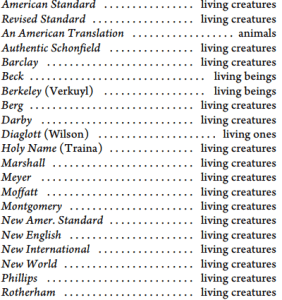
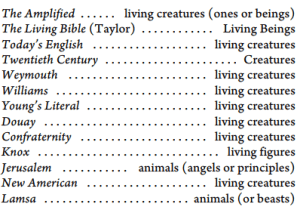
There is a similar reference to “living ones,” i.e., living creatures, in Ezek. 1:5, but in Ezek. 10:15, 20, these are referred to the “cherubim.”
4:7 – “And the first beast [living one] was like a lion, and the second beast [living one] like a calf, and the third beast [living one] had a face as a man, and the fourth beast [living one] was like a flying eagle.”
It is important that we note, John did not say, that the “living ones” were a lion, a calf, a man, and an eagle, respectively; but rather that they were “like” unto these. The significance of this seems to be that some particular characteristic of each of these creatures, or the manner or purpose in which it was used, is to be considered, or regarded as a symbolism for the four cardinal attributes of God, viz., POWER; JUSTICE; LOVE and WISDOM.
The first of the “living ones,” John says, was “like a lion.” An outstanding characteristic of the lion is its phenomenal strength! (Encyclopedia Britannica; Article: Lion) Thus we have here the symbolism that stands for God’s POWER, everywhere manifest throughout this wonderful universe. (Gen. 1:1; Psa. 8:3, 4; 19:1; 89:9; 102:25; Isa. 48:13)
“… the Lion (the strong one) …” (B85)
The second “living one” was “like a calf.” The animal referred to here, is the same as that of Lev. 16:3. The calf (young bullock) in this latter text is designated a “sin-offering,” and was brought to be sacrificed to “satisfy” a violated justice! Thus we have here the symbolism which is to stand for God’s JUSTICE. (Psa. 89:14)
The third “living one,” had, as it were, “a face as a man.” As already suggested, in Old Testament times, animals were frequently brought to be sacrificed to satisfy justice. While God had so ordained it for the purpose of establishing the type, these sacrifices never did “satisfy” justice, nor could they take away sin. (Heb. 10:1-4) Thus was it impossible for man in his fallen estate to redeem himself; and there was none righteous, no, not one (Rom. 3:10); nor was it possible for any man to redeem his brother. (Psa. 49:7) A perfect man had sinned and was justly condemned to death; and since God’s justice demanded “an eye for an eye, a tooth for a tooth,” (Exod. 21:24; Deut. 19:21), only a perfect man could be the Redeemer. It was not incumbent upon God to furnish such a redeemer; but he did; and thereby showed his own great Love; as the Apostle declares, “But God commendeth his love toward us, in that, while we were yet sinners, Christ died for us.” (Rom. 5:8) And so God’s LOVE was reflected in the face of him who left the glory he had with the Father before the world was (John 17:5; 2 Cor. 8:9), and became tThe man Christ Jesus. And he (Jesus) in giving himself the ransom for all (Matt. 20:28; 1 Tim. 2:6) tasted death – the penalty for violated justice – for every man. (Heb. 2:9) Thus have we here, in the “face as a man” the symbolism of God’s LOVE.
¹ It is possible that the thought here (in 1883) was based on Bro. Russell’s thought as expressed (in 1881) on T123-125!
The fourth “living one” was said to be “like a flying eagle.” An eagle, especially a flying one, because of his proverbial sharpness of vision, is able to see, and therefore to know, what is going on in the earth beneath him. He is, therefore, a very wise bird, and thus we have here a most apt symbolism of the WISDOM of God. (Psa. 56:2; 102:19; Deut. 32:11, 12)
John has already told us that these “living ones” were “full of eyes before and behind.” (Rev. 4:6) The “eyes before” seem to bespeak God’s ability to exercise himself in his POWER, JUSTICE, LOVE, and WISDOM, according to his foreknowledge of all things; “and (eyes) behind” would signify his ability to “see” what is already past, as if it were still present, or, to “see” things to come, as if they were already in the past. (Isa. 46:10)
Jehovah-God – His Wisdom
“He is never confused, bewildered, perplexed, anxious or careworn, nor in the least fearful that his plans will miscarry or his purposes fail; because all power and wisdom inhere in him. The scope of his mighty intellect reaches to the utmost bounds of possibility, comprehends all causes and discerns with precision all effects; consequently he knows the end from the beginning, and that, not only upon philo- sophical principles, but also by intuition.” (R1832:6)
The “faces” or the “likeness of four living creatures” of Ezek. 1:5: “…the face of a man … and the face of a lion …the face of an ox … the face of an eagle.” (Ezek. 1:10)
(See “Special Treasures” Book – The Four Cherubim) 4:8 – “And the four beasts had each of them six wings about him; and they were full of eyes within: and they rest not day and night, saying, Holy, holy, holy, Lord God Almighty, which was, and is, and is to come.”
The “Six Wings” of the “Four Beasts”
Six (6) is the number that identifies good men, who in evil times were used of God. Peter speaks of these when declaring “the prophecy came not in old times by the will of man: but holy men of God spake as they were moved by the holy Spirit.” (2 Pet. 1:21) Bro. Russell applied it to the saints of the Gospel age. (R3164:1)
In Rev. 4:4, reference is made to the “24 elders,” which, of course, represent the personification of the testimonies of these men who in evil times were used by Jehovah-God to proclaim the good tidings regarding the Millennial Kingdom. (R529:3, 4, W. I. Mann)
In Rev. 4:6, we have brought to our attention the “four beasts” (living ones) that were “full of eyes,” to represent the four cardinal attributes of God – Justice, Wisdom, Love and Power, and his all-seeing omniscience. (R5210:4)
However, in Rev. 4:8, we are told that each of the “four beasts” had “six wings,” which means that for the four there were (4 x 6 =) 24 “wings” in all, and that is the exact number of the “elders.” This, seemingly suggests that the testimonies of these “24 elders” concerning the Millennial Kingdom, were also to reflect the Justice, Wisdom, Love and Power, of Jehovah-God, even as the fullness of these was subsequent to their day, to dwell bodily in Christ Jesus. (Col. 2:9)
Both the Father and the Son were seated upon this throne, and we understand that the glory and honor being rendered by the “24 elders” must have been unto both. It was the Father that had honored the Son (Phil. 2:9), so how could any one honor the Father without honoring the Son? If they were already one in spirit, while the Son was still here, how much is it even more so now! (John 10:30; 14:11; 17:22; Phil. 2:11)
Wings!
It will have been observed that Bro. Mann, in dealing with the matter of the “four beasts” (living ones – Emphatic Diaglott) used the term “cherubim” (R530:1, 2)! Perhaps this was because the “four living creatures” of Ezek. 1:5, are in Ezek. 10:15, 20 identified with the cherubim. However, those cherubim had each of them but “four wings” (Ezek. 1:6); whereas those in Rev. 4:6-8 had “six wings”!
Only in Isa. 6:2 do we read of another “six winged” creature, but he belonged to the order of the seraphim!
There seems to have been beside the “four winged” cherub, one also having but two wings, such as those that were represented on the top of the Ark of the Covenant’s Mercy Seat, which was made by Bezaleel according to the pattern shown Moses in the mount. (Exod. 37:1-9; 25:9, 40) Of course, nothing is said in the Exodus accounts about these two cherubim having but two wings, yet it is very clearly stated in 1 Kings 8:7, of the time when the Ark of the Covenant was transferred to the Temple.
4:9-11– “And when those beasts give glory and honor and thanks to him that sat on the throne, who liveth forever and ever, The four and twenty elders fall down before him that sat on the throne, and worship him that liveth for ever and ever, and cast their crowns before the throne, saying, Thou art worthy, O Lord, to receive glory and honor and power: for thou hast created all things, and for thy pleasure they are and were created.”
Perhaps we ought to recognize that there are two who sit on this throne (Rev. 3:21; 5:6): the Father, “who liveth for ever and ever” – who had no beginning, but is “from everlasting to everlasting,” (Rev. 4:9; Psa. 90:2); and This exalted Son, who had a beginning (Rev. 3:14; Col. 1:15), “which was, and is, and is to come,” – the “Almighty.” (Rev. 1:8; 4:8) Note, not only does Jesus already share the throne with the Father, but he also promises the “overcomers” that they too, are to share it with him. (Rev. 22:1; 3:21)
The Throne of our Lord!
Heb. 1:3, 8, 13 – “Who being the brightness of his glory, and the express image of his person, and upholding all things by the word of his power, when he had by himself purged our sins, sat down on the right hand of the Majesty on high.… Thy throne, O God, is for ever and ever: a scepter of righteousness is the scepter of thy kingdom.… But to which of the angels said he, Sit on my right hand, until I make thine enemies thy footstool?”
The Throne – Authority and Rulership
“The throne of God … is not a material one, but refers to his supreme authority and rulership; and the Lord Jesus has been exalted to a share in that rulership. Paul declares, ‘God hath highly exalted him (Jesus) and given him a name above every name.’ He hath given him authority above every other, next to the Father.” (A92)
Psa. 110:1 – “Sit thou on my right hand, until I make thine enemies thy footstool.”
“The vague, indefinite idea regarding this text seems to be that Christ sits on a material throne somewhere in the heavens until the work of subduing all things is accomplished for him through the Church, and then he comes to reign. This is a misconception. The throne of God referred to is not a material one, but refers to This supreme authority and rulership; and the Lord Jesus has been exalted to share in that rulership. Paul declares, ‘God hath highly exalted him (Jesus) and given him a name above every name.’ He hath given him authority above every other, next to the Father?” (A92)
In harmony with the Father’s will, the “four living ones” cease not to honor and glorify the Son for his faithfulness to the heavenly Father’s will. Their wings and eyes bespeak the omniscience of God in every place. And such as these, finding the Wisdom, Love, Justice and Power of God fully exemplified in him – “which was, and is, and is to come” – Christ Jesus, they proclaimed him by these divine standards to be, “Holy, holy, holy, Lord God Almighty.” (Rev. 4:8; See also Col. 2:9; T125)
But not only did these “living ones” thus glorify the Son, but also the Father, who has always been “from everlasting to everlasting” (Psa. 90:2) – the One who “liveth for ever and ever,” the chief exponent of these attributes.
Immediately upon this glorification of the Father by these four “living ones,” the twenty-four elders (the personification of the testimonies pertaining to the kingdom), cast their crowns before the throne, (Rev. 4:10), as if in recognition of the fact that it was all the heavenly Father’s plan, and that it was from him that they had received their divine inspiration, to foretell the glories and beauties of that Plan. Thus did they feel it their duty as well as their privilege to declare the Father’s worthiness to receive glory and honor and power; for in His pleasure did He create all things for the blessing and favor unto others. (Rev. 4:11)
“In Rev. 4:9-11, John hears the cherubim ‘give glory and honor and thanks to him that sitteth on the throne,’ and immediately the twenty-four elders fall down before him, saying, ‘Worthy art thou, our Lord and our God, to receive the glory and honor and the power: for thou didst create all things, and because of thy will they are and were created.’
“When we can hear the power, wisdom, justice, and love, of God proclaiming in perfect harmony the glory and honor of our Father, then indeed his twenty-four witnesses ring out his praise as never before, and we realize that he created all things, both good and evil, and they exist by his permission and shall ultimately work out his pleasure.” (R530:5, W. I. Mann)
“Worthy, O Lord”
“The Scriptures declare that all things were created for the Lord’s pleasure (Rev. 4:11) – without doubt, for the pleasure of dispensing his blessings, and of exercising the attributes of his glorious being. And though, in the working out of his benevolent designs, he permits evil and evil-doers for a time to play an active part, yet it is not for evil’s sake, nor because he is in league with sin; for he declares that he is ‘not a God that hath pleasure in wickedness.’ (Psa. 5:4) Though opposed to evil in every sense, God permits (i.e., does not hinder) it for a time, because his wisdom sees a way in which it may be made a lasting and valuable lesson to his creatures.” (A 118)