
Journeying to the Promised Land
“Now all these things happened unto them for ensamples. The Diaglott says, “typically.” And they are written for our admonition, upon whom the ends of the ages have come. Wherefore let him that thinketh he standeth take heed lest he fall.” 1 Corinthians 10:11,12
WE ARE those “upon whom the ends of the ages are come.” So today we are going to consider some of the highlights of the history of Israel up to the time of their entering the promised land to see what admonitions there are for us to keep us from falling.
After many difficulties Joseph became ruler of Egypt. At the invitation of a benevolent pharaoh he brought his brethren and their families, as well as his father Jacob, into Egypt and settled them on the broad and grassy plains of Goshen. It was an ideal land for their flocks and herds. Now we read from Exodus 1:6,7:
“And Joseph died, and all his brethren, and all that generation. And the children of Israel were fruitful and increased abundantly, and multiplied, and waxed exceeding mighty; and the land was filled with them.”
This covers a period of about 215 years. Notice how the phenomenal growth of the children of Israel is stressed. In this one verse there are five different expressions of their increase: they were “fruitful,” they “increased abundantly,” they “multiplied,” they “waxed exceeding mighty,” and “the land was filled with them.” Thus began the fulfillment of God’s promise to Abraham:
“In multiplying I will multiply thy seed, as the stars of the heaven, and as the sand which is upon the sea shore.” Genesis 22:17
We determine from Exodus 12:37 that at that time there were over 600,000 adult males in Israel, beside women and children. If we calculate five to a family, which is not unreasonable for so prolific a people, this would indicate a population of over three million. That was a real population explosion!
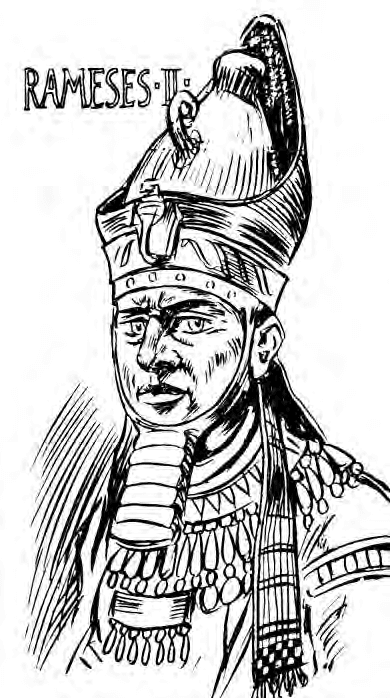
We continue with Exodus 1:8: “Now there arose up a new king over Egypt, which knew not Joseph.” This was the infamous Rameses the second who oppressed the children of Israel and with whom Moses dealt. His mummy has been found and is preserved to this day. One day he may return and see his own mummy.
The phenomenal increase of the children of Israel disturbed this Pharaoh. He considered it a threat to the security of Egypt. We read of this in the first chapter of Exodus. He enslaved and oppressed the Hebrews with hard labor. He gave orders that all their male babies should be killed at birth which may be the first attempt at genocide in human history. But the midwives would not cooperate. We read in Exodus 1:20 that in spite of Pharaoh’s order, “The people multiplied and waxed very mighty.” When this scheme failed,
Pharaoh issued a vicious and heartless order which clearly indicated his depravity. It is recorded in Exodus 1:22. Any Egyptian was required to take any Hebrew boy he could find and throw him into the Nile river and drown him! Is it any wonder that the Hebrews cried to the God of their fathers? They probably met together in family units secretly at night and raised their combined voices to their God. What a great cry it was that went up! So we read in Exodus 3:7,8:
“And the Lord said [to Moses] I have surely seen the affliction of my people which are in Egypt; and have heard their cry by reason of their taskmasters; for I know their sorrows. And I am come down to deliver them out of the hand of the Egyptians and to bring them up out of that land unto a good land, and a large, unto a land flowing with milk and honey; unto the place of the Canaanites and the Hittites and the Amorites, and the Perizzites, and the Hivites, and the Jebusites.”
This was the great promise upon the basis of which Canaan came to be called “The Promised Land.”
Then followed the confrontation of Pharaoh by Moses demanding that he let the children of Israel go. Pharaoh stubbornly refused, and the Lord brought ten devastating plagues upon Egypt culminating in the death of the firstborn. On this occasion the Passover ritual was instituted whereby the firstborn of Israel were saved. This last plague, which killed all the firstborn in Egypt, finally broke Pharaoh’s determination. His own beloved firstborn son, his pride and joy, the Crown Prince and heir to the throne of Egypt, had died with the others. He now urged the children of Israel to leave and leave quickly. They were ready. They had just eaten of the Passover lamb with their loins girded, their shoes on their feet, and their staffs in their hands. They had eaten it in haste, expecting to leave hurriedly. (Exodus 12:11) Now, under the leadership of Moses they rose up and started out as one man. We read, in Exodus 12:37,38:
“And the children of Israel journeyed from Rameses to Succoth, about six hundred thousand on foot, that were men, beside children. And a mixed multitude went up also with them. And flocks and herds, even very much cattle.”
What a spectacle that must have been: an entire nation on the move! Three million men, women, and children, beside a mixed multitude, marching in a great column. On either side of this vast river of humanity there were shepherds leading enormous flocks of sheep and herdsmen driving tens of thousands of cattle. There was a tenseness in the air, a feeling of suppressed excitement. Not many spoke but their combined footsteps must have been like the rolling of distant thunder.
Then with the Red Sea safely passed and the pursuing armies of Pharaoh destroyed, the children of Israel set their faces toward Canaan, the Promised Land. Their course led through what is called a “great and terrible wilderness” (Deuteronomy 1:19) and a “waste howling wilderness” (Deuteronomy 32:10). They spent nearly a year in the vicinity of Mount Sinai. It was about a year and fifty days after their departure from Egypt that they broke camp to journey toward Canaan. During this time many stops were made, the tabernacle services instituted, many laws and statutes given and many lessons learned. When they finally arrived at Kadesh-Barnea on the border of the Promised Land, they had achieved at least some semblance of an organized and orderly nation.
This was a dramatic moment for the children of Israel. The culmination of their hopes was within view. Those lovely green hills on the horizon were of the land which their father Abraham’s eyes had beheld when the Lord told him:
“Lift up now thine eyes, and look from the place where thou art, northward, and southward, and eastward, and westward. For all the land which thou seest, to thee will I give it, and to thy seed for ever. And I will make thy seed as the dust of the earth so that if a man number the dust of the earth, then shall thy seed also be numbered. Arise, walk through the land, in the length of it and in the breadth of it; for I will give it unto thee.” Genesis 13:14-17