Victories Over Modern Giants – R. 5662
THE first giants mentioned in the Bible were those who had human mothers, but whose fathers were materialized fallen angels, as recorded in Genesis 6. These, however, all perished in the Deluge of Noah’s day. From time to time since then, there have been human giants found in Asia. Og, king of Bashan, had an iron bedstead thirteen feet long. In their report on Canaan, the spies told of seeing giants there – the sons of Anak. Goliath, the giant of Gath, whom David slew, was probably a descendant of this family.
We have had giants in recent times, also; Byrne, an Irishman, eight feet four inches; Middleton, an Englishman, nine feet three inches; Lushkin, the Russian, eight feet five inches; Chang, the Chinese, seven feet eight inches. Pliny declared that Gabbaras was nine feet nine inches tall. There is, therefore, no room for discrediting the story of David and Goliath.
David, a youth of probably twenty years, visited the army of Israel, in which three of his brothers were soldiers, taking food and delicacies for their refreshment. To his amazement he found the army of Israel facing the army of the Philistines, who had invaded from the west. They were not fighting, each apparently fearing the other. A champion from the Philistines came forth every morning, a giant in size and strength, wearing a bronze armor weighing two hundred and twenty pounds, and brandishing his spear, the head of which weighed twenty-five pounds, and the shaft of which was nearly three inches thick. He defied the Israelites, declaring that a battle between individuals would settle the war. He defied not only the nation of Israel, but its God.
Young David was amazed that this had progressed so long, and that nobody accepted the challenge. A believer in the true God, he realized the Covenant between God and his nation. His faith in the Almighty was such that he accepted the Divine promises implicitly. He wondered at the lack of faith manifested by his brothers and his countrymen. He intimated that, backed by God’s promises, he himself dared to meet that Goliath.
King Saul of Israel had let it be known that great honor would come to the one who would meet the challenge of the foe. Young David was brought before him; but, anxious as he was for a champion, the king realized that the sinewy youth before him would be no match for the giant strength of Goliath, one blow from whose spear would destroy him. Then the stripling pleaded his cause. He declared that, as keeper of his father’s sheep, he had time and again delivered them from the mouth and the paw of the lion and the bear. He had the courage, and above all he had the faith in God. As God had blessed him in his daily duties of the past, He would give him strength for victory in the duty of the hour, the meeting of the defiance of the giant and his insult to Jehovah.
The king was impressed. He would lend David his armor – the best in Israel. But after trying it, young David declined it with thanks. He was not accustomed to such armor and could be himself better without it. He took with him merely his shepherd’s staff, to which he was accustomed, and his sling. Passing over toward the side of the Philistines for the combat, he chose five smooth pebbles from the brook. This slight armament, with God’s blessing, was more than sufficient; for he needed to use only one of the pebbles.
The giant was indignant, saying, “Am I a dog, that this boy should come out to meet me with a stick?” According to tradition, as the lad approached the giant laughed, throwing his head backward. His helmet fell off; and he was exposed to the sure marksmanship of his despised opponent. There were no newspapers in those days, nor public libraries; and he knew not of how mighty a place sling-stones occupied in warfare even then, and that often, in skilled hands, they were almost as effective as are the rifles of today. The giant stunned, his armor-bearer fled; and young David quickly dispatched him and took his armor as a trophy. The Philistines surprised, dismayed, fled, Israel pursuing them to their own fortified city.
How to Meet Modern Giants
Following Jesus’ death, a new Divine order of things was ushered in. Those who have faith in God still have battles to be won, but not with carnal weapons. Their victories, nevertheless, are based upon the same principle which operated favorably with David. Faith in God is lying at the basis – the realization that the cause in which they fight is one approved of God. A courage proper to their faith – a faith gradually developed in previous victories over lesser foes, as in David’s case – helps to give courage and strength for battling with the most terrifying giants we may encounter.
Remembering this, each Christian should be daily on the alert to overcome the little weaknesses, the little frailties – to become conquerors in the little battles with selfishness, anger, malice, envy, evil-speaking. Victories over these, and experiences gained with God’s help in overcoming these, give preparation step by step for the greatest trials and the grandest victories.
When we learn of the Divine promise, “To him that overcometh will I grant to sit with Me in My Throne,” it gives us the thought that a great victory must be won to prove ourselves worthy of the great honor to which God has called His Church. And this victory, as we are happy to learn, is not always to the strong, but to those whom God will bless. And the conflict which God approves and will reward is not strife with friends or neighbors, however unreasonable they may be, but strife against unrighteousness, against sin, against everything which the Divine Law opposes. This strife and victory belong, first of all, in our own hearts and minds and, secondarily, will extend, as the Lord’s providence may indicate, in battling against public evils and in support of public and civic righteousness.
We are not, however, to forget that the great giant of sin and iniquity, which has dared the people of God for centuries, will be smitten down only at God’s appointed time, and by the antitype of David. The name David signifies Beloved. The antitypical Beloved is The Christ – Jesus the Head, the Church His Body. Shortly, a sling-stone of Truth is to smite down the great opponent; and the antitypical David will begin the Millennial Reign which is to lift up the world and bless it. As members of this David class, we must have the overcoming spirit, and its supporting faith and trust in God’s promise and power.
David and Goliath – R. 1902
1 Samuel 17:38-51
“The battle is the Lord’s.” – 1 Samuel 17:47
THE lesson to the Christian to be gathered from this narrative is briefly embodied in the golden text – “The battle is the Lord’s.” Let him ever bear this in mind, and daily go forth to battle with the great powers of darkness, strong in the strength which God supplies, with the faith, courage and heroism that distinguished David, and no foe can stand before him. The one great essential to victory is faith. “This is the victory that overcometh the world, even our faith.” “Without faith it is impossible to please God” or to secure his interposition on our behalf.
Having faith, we need no carnal weapons, and no armor of human invention is of any service to us; but trained and practical faith can work wonders as great as did David’s sling and stone. The sling and stone were not an untried weapon with David. He was in constant practice with them, and thus he had gained skill and confidence in their use. So the Christian must practice dependence upon God continually in all the small affairs of life, and then when the giant trials come his practised faith will be abundantly able to meet and overcome them. And the more severe the trial, the more glorious the victory of faith and the greater the strength of character derived from its exercise. Doubtless it was the previous struggle with the lion and the bear, and the victory God gave him then, that gave David such boldness in defying the power of Goliath. So every battle we fight and every victory we win through faith in God develops strength for future conflicts and makes the more sure our final overcoming.
Our Sufficiency is of God – R. 3230 1 Samuel 17:38-49
If God be for us who can be against us?” – Romans 8:31
THE Philistines occupied a considerable portion of the seacoast fronting the land of Canaan at the time the Israelites took possession, and their rights seem to have been respected by the Israelites, for even when the land was divided by lot, before it was subdued, the portion occupied by the Philistines was not included in that recognized as given by God to the Israelites. Indeed we remember that the Lord used this powerful nation as his rod in chastening the chosen people when the unfaithfulness of the latter required it on more than one occasion. Thus in the time of Samson the Philistines were the masters of Israel, Samson being used of the Lord as one of his agents in the removal of their yoke – although the work begun by Samson was not completed until the days of Samuel, the prophet. – 1 Sam. 14.
Our lesson shows us another invasion of Israel’s borders by the Philistines, Saul at this time being king, though David had already been privately anointed but not publicly proclaimed as his successor. The Philistine hosts had advanced a considerable distance into the territory of the Israelites, and had reached the more mountainous country, where Saul gathered the army of Israel to meet them. A valley lay between the two hosts, and in the center of this valley there was a ditch about ten feet deep, cut through the rock by a mountain stream. The place was favorable for a battle of the kind usually fought at that day. Neither army seemed to be anxious to attempt to cross the steep banks of the brook in the face of its opponent, for under such conditions the attacking party would be considerably disadvantaged. Besides, the Philistines – knowing that Israel’s king stood head and shoulders above his fellow-Israelites – had pitted against him a giant Philistine, Goliath, still taller, about ten feet high and probably stout in proportion, as indicated by the weight of his armor, spear and sword. The challenge set forth that the disputes between the two nations, of many years’ standing, should be settled, not by a general battle, but by a duel between the Philistine giant and the most competent Israelite who could be found to come against him – who undoubtedly would have been Saul, the king.
For forty days this challenge was made every morning, and the king of Israel and his chief mighty men practically confessed that they feared the giant and would not respond to his challenge. It was at this juncture that David, a young man of about twenty-one, was sent by his father to his brethren in the army of Israel to see how they fared, to take them some delicacies from home, and to bring back word respecting the prosperity of the Lord’s hosts. The infidel is prone to twit the Lord’s people upon the statement of Scripture that David was a man after God’s own heart – referring to some of his weaknesses and shortcomings; but in this lesson we see clearly the feature of David’s character which God so highly esteemed, and which he has always esteemed in everyone to the extent that he possesses and manifests it. This quality which God esteemed in David was his faith – the same quality that he esteemed in Abraham and in all the faithful of the past. Of all who had “this testimony that they pleased God,” it is written that by faith they did thus and so, “and it was counted unto them for righteousness.” – Gal. 3:6.
David’s faith in the Lord being great, he was surprised to learn when he came to the army that the Philistine had been boasting himself for forty days against Israel and Israel’s God, and that no one of his nation had possessed sufficient faith in God to accept the challenge. He at once proposed that he would accept it himself and asked to be taken to the king that he might be thus commissioned. Those who mentioned him to the king spoke of him as a “mighty, valiant man,” yet when Saul looked upon him he perceived that he was but a youth and was physically no match for the giant. However, he was the only champion who had arisen, and he was full of confidence in his own success as an instrument in the Lord’s hands for delivering Israel from the boastful heathen. Saul finally consented, and proposed to loan Israel’s champion his own armor; but, unused to such accoutrements, David found when he had donned them that he could not feel properly at home in them. It would require considerable time to learn how to use such armor and implements advantageously and without discomfort, and he decided to go in his usual garb as a shepherd, armed only with his shepherd’s club and sling and the scrip or leather bag in which to carry the stones which he selected from the bed of the brook as he passed.
Goliath could scarcely believe his own eyes when he saw that the ruddy youth who approached him had come out to do him battle with a club, for he probably did not notice the sling. He felt indignant and inquired whether he – the great, the mighty, the strong, the well-armed – was regarded as a dog to be attacked by a club; and, cursing David by his gods, he declared that he would make short work of him, and that the fowls should have his flesh.
David’s retort shows clearly that he appreciated the situation in all its bearings. He was aware that his opponent was armed with sword and spear and javelin, but, as he states the matter, he was approaching the conflict strong in the strength that God supplies – strong in his faith in the Lord as the decider of battles, as the one who would be able to give him the victory and deliver his people from all their enemies. David noted, and counted well upon the fact, that the issue was not between the two armies, not between two men, but between the God of Israel and the false gods of the Philistines. Faith in God had doubtless been increasing amongst all the Israelites within the twenty years preceding this event. They were gradually coming to learn that, having been punished for their sins and idolatries and having returned unto the Lord, his favor was now with them because of his people, but David seems to have had confidence in God in more than an ordinary degree. Doubtless his own anointing to be Saul’s successor in the kingdom gave him assurance that it was God’s will that the kingdom of Israel was to be continued, and that God’s favor was to be with them still as a nation, notwithstanding the transgressions of the divine commandment by Saul, noted in a previous lesson.
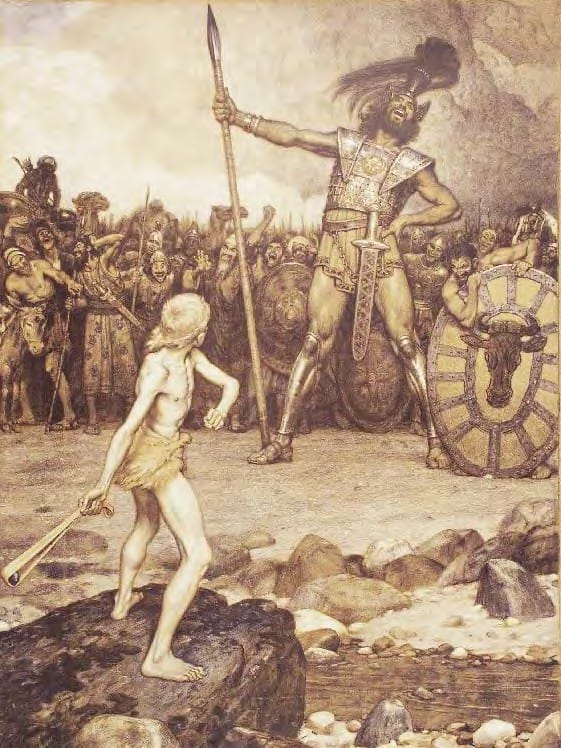
David und Goliath by Osmar Schindler
The Jews have a tradition that it was while Goliath threw back his head in laughter at his stripling opponent that David’s sling-stone struck him in the temple. The helmets of that time were not nearly so complete as those used extensively in the middle ages, and apparently the neck and a portion of the head were generally exposed, so that David’s stone might have struck the vital spot of the forehead even though Goliath’s head had not been thrown back in laughter. Neither was David’s marksmanship so extraordinary as to be considered wholly miraculous. We have the Scriptural record that many in the tribe of David could throw such sling-stones to a hair’s breadth. (Judges 20:16) Xenophon mentions the expertness of certain Persian slingers, and Livy speaks of slingers so expert that they could send a stone from a distance through an ordinary wreath or chaplet, and could not only strike their enemies in the face, but in whatever part of the face they chose.
We cannot call this little incident a type, but we may properly see in it a figure and a lesson respecting spiritual things applicable to all who belong to the antitypical David – Beloved – the Christ. Goliath fitly pictures the great Adversary, Satan, and all who are on his side of any controversy, seeking to bring the Lord’s consecrated people into bondage either to errors or sins. Satan, as the prince of this world, found no one either willing or able to dispute his supremacy of power until our Lord Jesus, the antitypical David (Beloved), became the champion of God and the truth and such as love righteousness. As David risked his life for the deliverance of his people Israel, so our Lord Jesus not only risked, but sacrificed, his life for the deliverance of antitypical Israel; as David, after being anointed, encountered the lion, so Jesus, after he had been anointed by the holy Spirit at Jordan, was led of the Spirit into the wilderness and endured a great fight with the Adversary. He conquered him with the Word of God, answering each of Satan’s propositions for his overthrow with the words, “It is written.” The Apostle explains, – For this purpose Christ was manifested, that he might destroy the bondage of death and “him that hath the power of death, that is the devil” – eventually delivering all the people of God. – Heb. 2:14.
David’s conquest in some respects illustrates battles which all of the Lord’s people must engage in. Goliath and the hosts supporting him may well illustrate to our minds various foes of God and truth and righteousness which challenge us and all of the Lord’s people.
(1) The hosts of doubt and scepticism are today led about by the great giant of unbelief, whose size, armor, sword and spear are over all the hosts of nominal Christendom – all except the David class – the body of Christ. This giant is the evolution theory, and his armor-bearer is higher criticism. The records and promises of Israel’s God are disdained, and the David class who stand forth in their defense are treated with contempt and their pebbles from the brook of truth disregarded. But science, falsely so called, though it boasts itself today and creates so great an impression that few would think of opposing it, will, nevertheless, meet its Waterloo. It shall fall before the Lord’s anointed – David, “Beloved” – and its own sword of truth shall eventually complete its destruction in the morning of the new dispensation: at the same time all the hosts of error shall flee, and many of the people of God, aside from the elect body of Christ, shall be blessed by these deliverances.
(2) Goliath may properly represent pride, backed by a host of worldliness. One of the severe ordeals of the New Creature is the conquering of the love of the spirit of worldliness under the leadership of pride. Worldly pride challenges faith in God and obedience to him, and only those who are of good courage and full of confidence in the Lord can overcome this giant. It is necessary, too, that the victory should be made complete – that pride should be thoroughly humiliated, killed, so that it can never rise up again to destroy us. It is an individual battle, and the only proper armament against this giant is a stone from the brook, the message of the Lord, showing us what is pleasing and acceptable in his sight, and assuring us that he that humbleth himself shall be exalted and he that exalteth himself shall be abased. As the poet has expressed it:–
“Where boasting ends, true dignity begins.”
(3) Another giant which will sometimes challenge the people of God is fear, distrust. Mighty, imposing and terrifying indeed is the influence of fear, except upon those who have learned to know the Lord through previous experiences, and to trust him even where they cannot trace him. The giant of fear and despair must be met with the pebble from the brook, “It is written.” The sling of faith must propel the word of promise with such force as to slay the adversary and to deliver us from his domination.
(4) Another giant which assaults the Lord’s people, but which in the present time can be overcome only by the David class, the body of Christ, is the giant of sectarian influence. How strong, how majestic, how well-armed, how influential is this great giant, whose powers are exercised in a large measure in intimidating the Lord’s true children, so that all their lifetime they are subject to bondage and fail to attain the liberty with which Christ makes free indeed! To meet this giant and to resist him successfully and to gain the victory over him, thoroughly armed as he is with the haughty voice, and large and strongly organized and equipped with worldly power and influences and boycotting opportunities, requires great grace, such grace as is to be found only in the little flock, the overcomers, the body of Christ – the David class, the “Beloved.” Thus armed only with the Word of God, and trusting in his rod and staff, we may well be courageous and answer imposing sectarianism as David answered the Philistine, “Thou comest to me with a sword and with a spear and a javelin: but I come to thee in the name of the Lord of hosts, the God of the armies of Israel, which thou hast defied.“
Let us all remember the meekness and humility of David, note that his conduct was utterly devoid of boastfulness, and that we are to copy this. Like him our confidence is to be in the Lord, and not in ourselves.
By whom was David taught to aim the dreadful blow,
When he Goliath fought, and laid the Gittite low?
No sword or spear the stripling took,
But chose a pebble from the brook.
‘Twas Israel’s God and King who sent him to the fight,
Who gave him strength to sling, and skill to aim aright.
Ye feeble saints, your strength endures
Because young David’s God is yours. – Cowper
Victory Not to the Strong – R. 4216
1 Samuel 17:38-49
“In the Lord put I my trust.” – Psalm 11:1
NOT long after David’s anointing he became the hero of a most remarkable battle. The Philistines, residing on the seashore of Palestine, were the enemies of the Israelites from earliest times, and, as we have already seen, they held mastery over them at the time of Saul’s coronation. Subsequently the victory gained over them by Saul was not complete, and they still occupied the city of Gath and considerable territory in the land given to Israel. In Gath dwelt Goliath, a descendant of the giants or Anakim, whose sight terrified the spies of Israel when they first essayed to enter the promised land. Goliath was a Philistine therefore, not by birth but by naturalization, as people of various nationalities become Americans. Goliath was in the prime of his manhood, proud of his size and strength. The Philistines, too, were vigilant and thought that with this champion and leader they might gain another victory over the Israelites. As a result they organized an army and marched northwesterly toward Jerusalem. King Saul, apprised of the fact, recruited an army to oppose them. The two armies faced each other on opposite slopes of the valley Elah. Evidently the opposing forces were fairly well matched and neither cared to make the attack. The Philistines, resorting to a method already known in history, proposed that a war be averted and that the issues between the two armies be decided by a personal battle. They sent forth Goliath as their champion and dared the Israelites to meet him. Similarly the Romans and the Albans, B.C. 667, settled the war by having three Roman Horatii and three Alban Curatii engage in mortal combat. The victory came to the Romans, inasmuch as one of their number survived. Similarly later, Sir Henry d’Bonham fought with Robert Bruce between the two contending armies in Scotland. Goliath was a giant indeed. His six cubits and a span, if estimated on the 16-inch cubit, would represent 8 ft. 8 in., or counted by the 18-inch cubit would represent 9 ft. 9 in. A cubit is the length of the human arm from the elbow to the tip of the little finger; a span is half a cubit. Encyclopedia Brittanica refers to several giants: one a Scotchman, whose height was 8 ft. 3 in.; another an Arabian of 9 ft.; Charles Birne, an Irishman, measured 8 ft. 4 in.; Patrick Cotter, 8 ft. 7 1/2 in.; a Russian giant, 9 ft. 8 in. There is nothing, therefore, impossible or improbable in the story of Goliath. The giant was elaborately armored and practically invulnerable.
Israel and Israel’s God Defied
At that time each nation apparently stood for a religious system and their prosperity and influence were largely credited to the favor of their god or gods. For forty days Goliath, clothed in his resplendent, gleaming armor, with a loud voice had shouted defiance to the men of Israel and incidentally to the God they worshiped, thus endeavoring to shame them and drive them to an unequal contest, of which he felt sure he would be the victor. We cannot wonder that no Israelite was found foolhardy enough to undertake a battle with the giant on the terms and conditions then prevalent – a battle with sword and spear and javelin; ordinarily anyone would have been but a child at the mercy of the foe.
Jesse at Bethlehem was only about twenty miles distant from the camp of the army, and on the fortieth day he sent David with greetings and delicacies for three of his elder sons who were in Saul’s army and to bring back word of the progress of events. The ruddy youth, the shepherd boy David, with little knowledge of warfare, was surprised to see the challenger and that the God of Israel was thus defied by the heathen. By nature and by experience in the keeping of his sheep and the defending of them from wild animals David was courageous, fearless. Besides, he evidently was well born as respects reverence for God and faith in him. It was Goliath’s defiance of the God of Israel that seemed to strike him most forcibly. He made inquiries as to why none of the Israelites in the name of the Lord had undertaken the battle, implying his own willingness to do so. Many of those with whom he communed on the subject were evidently impressed with his faith and ardor. But his own brethren were less appreciative, and sneered. However, the matter spread from mouth to mouth until it reached the ear of King Saul, who sent for David.
Although the king for some years had been out of favor with the Lord, he nevertheless had good reason for believing in divine power, as it had already been manifested in his own experiences. He evidently queried if this proposition of David, his only hope, might not be of the Lord. David explained briefly his own prowess in connection with the slaying of a lion and at another time a bear in defense of his flocks. The king admired the youth, his courage and his faith, and consented that he should undertake the battle with the giant, hoping doubtless that God would favor his people with a victory even against such odds of physical strength. King Saul had the best armor, of course, amongst all the Israelites, and he proposed that David use it. But when the latter tried it on he felt himself constrained and declared that he would have less confidence in it than out of it. He went forth to meet Goliath in his own way, armed merely with a shepherd’s oak stick and with a sling and a shepherd’s bag. Selecting five smooth stones for use in his sling he approached the giant as the latter came forth as usual to dare the Israelites.
The story of the conflict is quickly told. The Philistine was indignant that he should be asked to fight with a boy unarmored, and he cursed David in the name of his gods, saying, “Come to me, and I will give thy flesh unto the fowls of the air and unto the beasts of the field.” David’s reply was characteristic – full of that faith in God which marks his entire history from first to last, and on account of which the Lord speaks of him as a man after his own heart. He said to Goliath, “Thou comest to me with sword and spear and with javelin; but I come to thee in the name of the Lord of hosts, the God of the armies of Israel, whom thou hast defied. This day will the Lord deliver thee into mine hand; and I will smite thee and take thy head from thee; and I will give the carcasses of the hosts of the Philistines this day to the fowls of the air and to the wild beasts of the earth; that all the earth may know that there is a God in Israel. And all this assembly shall know that the Lord saveth not with sword and spear: for the battle is the Lord’s and he will give you into our hands.” Thus the issue was seen by both Philistines and Israelites to be as between the Lord, his people and their enemies. Hastening forward David threw his first stone, which struck the giant in the forehead and caused him to fall senseless. Directly David finished the conflict with Goliath’s own sword, beheading him while the Israelites, their faith reviving, attacked the Philistines, whose courage fled.
It is supposed that Goliath wore a helmet with moveable front common in those days, and that he laughed at the youth who was coming against him, and in so doing threw back his head, allowing the vizor of his helmet to open, exposing his forehead. Others suppose that he reached for his javelin, which he carried in a sheath between his shoulders, and in reaching back for the javelin the helmet opened at the opportune moment and admitted David’s stone. However the matter happened we cannot doubt that David was quite correct in his understanding of the matter; that divine providence supervised the entire transaction and brought the victory. Nor was such marksmanship with the sling an unusual thing in those times, for we read how on another occasion 700 men of the tribe of Benjamin threw stones “to a hair’s breadth.” – Judges 20:16.
The Christian’s Adversary and Conflict
What lesson can the “New Creation” of the present time draw from this story of olden time? David, whose name signifies beloved, in many respects typified the Christ, Head and Body. His experiences with Goliath illustrate well first of all our Lord’s conflict with the Adversary during the forty-days’ temptation in the wilderness. Our Lord’s victory over Satan on that occasion, his loyalty to the Father and the work entrusted to him, his own self-sacrifice, meant the victory for all the world of mankind desirous of being in harmony with God and his arrangement. Did he not declare to us, “Fear not, I have overcome the world”? In overcoming Satan, the prince of this world, he was gaining at the same time a victory over all the hosts of evil and servants of sin. He stood faithful to God and to his covenant relationship and responsibility and hurled at the Adversary the pebble of truth – “It is written.” As Goliath fell before David, so Satan was vanquished by our Lord, who declares, “I beheld Satan fall from heaven,” and declared also as a result of his victory, “All power is given me in heaven and in earth,” and sent forth his disciples in his name to similarly battle in his strength and to come off conqueror and to ultimately share with him in his Kingdom, which is to “bless all the families of the earth.”
It is written of the Lord’s faithful disciples, who shall constitute the Church of glory, that they must walk in his steps as he set the example. This means to them as to him a warfare against sin, its great representative and leader Satan, and all the hosts of deceived humanity who are on his side. Does not the Apostle intimate this when he says, We wrestle not with flesh and blood, but with wicked spirits in influential positions? (Eph. 6:12) Our enemy is a giant in whose presence we are feeble indeed. The Apostle calls him a wily foe and our Lord taught us to pray the Father, “Abandon us not in temptation, but deliver us from the evil one.” Very evidently, then, we need divine assistance in our unequal contest, as did David in his.
“Not by Might, Nor by Power, But by my Spirit”
All those whom the Lord accepts to probationary membership in the Body of Christ, have been previously anointed and come under the divine power and guidance. They have had their experiences, too, in struggling against evil in general, even as David had his experience with the lion and the bear, and those experiences in the Lord’s providence were merely preparations for the great testing, the great conflict with the Adversary and his various devices for our injury. The natural thought in connection with such a contest is to put on armor similar to that of our opponent, as Saul offered his armor to David. It is for each of the Lord’s people, however, to learn that victory cannot be won along worldly lines. We cannot fight evil with evil, wrong with wrong, boasting with boasting and slander with slander, hatred with hatred, etc. If we undertake so to do we shall surely lose in the battle. Our course, like that of David, must be full reliance upon the Lord and the use of the sling and pebble of truth. If we cannot conquer along these lines we cannot conquer at all. Who is sufficient for these things? – for such an unequal contest with the prince of darkness and all the hosts of sin? Surely the one who would have confidence in himself would be unwise; hence, as the Apostle says, we place our confidence in God; if we are loyal to him victory will be ours, if we are careless or unfaithful we shall not be of the David class – not be members of the glorious Body of Christ, in which event we shall never reign with him, even as David, who received the anointing, would never have reached the throne, if he had fought the giant with Saul’s armor.
“Works of The Flesh and of The Devil”
The imperfections of the flesh with which we all must contend are indeed part of the works of the devil, for did he not in Eden accomplish the fall of our first parents, and thus the fall of our entire race into the sin and death condition against which we struggle in vain, except as we are rescued by him who loved us and bought us with his precious blood? But in addition to these inherited weaknesses of the flesh we must contend against the active works of the Adversary – not only his temptations to ourselves but his intrigues through mankind in general, for he is indeed the “one who now worketh in the hearts of the children of disobedience,” and they are much more numerous than the children of obedience. Hence our assailants are manifold, and in many of their assaults upon us they have at least the sympathy of our fallen flesh, however antagonistic our hearts, our minds as New Creatures in Christ.
The Apostle helps us to get a view of the great enemy and the influences he is bringing to bear against us on every hand and every day. He sums them up as follows: “Now the works of the flesh are manifest which are these, – adultery, fornication, uncleanness, lasciviousness, idolatry, witchcraft, hatred, variance, emulations, wrath, strife, seditions, heresies, envyings, murders [he that hateth his brother is a murderer], drunkenness [intoxication literally or symbolically with the spirit of the world, Babylon], revelings, and such like; of the which I tell you before, as I have also told you in times past, that they which do such things shall not inherit the Kingdom of God.” – Gal. 5:19-21.
“We Wrestle Not With Flesh and Blood”
Behold in this list the Goliath with whom we must contend! The special weakness of one may not be the special weakness of another, but the list which the Apostle has here provided is sure to include the weak points of the flesh of every one of the Lord’s consecrated people, every one who is a member of the David class, of the Beloved One, of the Christ. All who are anointed for the coming glory as kings and priests, as New Creatures, have a Goliath in their own flesh to be fought, and fought to a finish! Either the old nature must die or the new one must die. Exhorting along this line the Apostle says, Mortify, therefore, your members that are upon the earth – the downward tendency of your flesh. It must be killed, it must be beheaded, as was Goliath; but there can be no complete putting away of the earthly mind, the fleshly mind and its influence until first we in the name of the Lord have conquered by smiting it with the pebble of truth.
As we look over the above list of the works of the flesh and the devil, we find that they are all rooted in selfishness; and as we look to the Lord as our pattern as New Creatures we find that all the fruits and graces of the Spirit are reversely centered in love. In proportion, therefore, as the New Creature lives, grows and thrives in love, the old creature, the works of the flesh, will perish with its selfishness.
We might be inclined to reason amiss on the subject and to say with the Apostle, Having begun in the spirit, are you seeking to be perfect in the flesh? We might say, Surely all who have been begotten of the holy Spirit and who have reckoned themselves dead indeed to the flesh and its inclinations and desires – none of these, surely, could ever be influenced again to come under the Adversary’s power and become a partaker of his spirit and participate in his works!
This is a wrong thought! It is possible for some of the Lord’s true children to be thus overcome. True, if thoroughly overcome by the spirit of selfishness it would mean the death of the New Creature, and this would mean the Second Death. The path from the new nature into the Second Death is not necessarily a very long one, but we have no reason to believe that it could be taken at merely one step. We remember that the new nature up to the present time, up to the time of our resurrection change, is but the new mind, the new will, the new disposition in harmony with the Lord, his righteousness, his love. We are to remember, as the Apostle suggests, that we have this new nature in an earthen vessel and that the earthen vessel has practically all of its original blemishes and fallen tendencies still as powerful as ever except as the new mind has these under its mastery and control; but if that mastery or control should be released even for a moment the result would be the awakening, the reviving of the old nature. And we may be sure that our Adversary is alert and fully realizes the situation and will do all in his power to put us off guard, even to the extent of endeavoring to make white appear black and black appear white before our judgment. The Lord very graciously shields us from temptations more than we are able to bear. Hence it is possible for us at all times to be overcome, not only in the infancy of our new nature, but also in its further development; but the testings permitted grow more severe, more crucial, as we near our spiritual graduation time. Nor can we object to this; it is exactly what we should expect.
The Apostle, following this line of thought, declares, “I keep my body under;” and again he says, “Mortify, therefore, your members which are upon the earth” – your earthly ambitions, will, etc., everything in yourself that would tend toward envy, hatred, anger and strife – put these to death. Allow the new nature to have full sway and control in every thought, in every word, in every deed. And watch to this end; watch your thoughts, watch your words, watch your conduct. Many can watch their conduct who find it difficult to scrutinize and properly weigh their thoughts and their words. Truly the Apostle intimates that out of the heart proceeds envy, bitterness, evil speaking, backbiting and strife; unless they are in the heart the mouth cannot utter them, for it is out of the abundance of the heart that the mouth speaketh.
”The Tongue is a Fire and a World of Iniquity”
Alas, yes! our words do judge us; as the Master declared, “By thy words thou shalt be justified, and by thy words thou shalt be condemned.” No wonder the prophet said, “I will set a guard upon my lips lest I sin with my mouth.” The setting of a guard evidently means that we will practice great deliberation, great care in respect to everything that we say; that we should speak evil against none. Our evil speaking is not at all necessary to the Lord and to his cause; he is perfectly able to accomplish all of his purposes without our violating a single one of his wise arrangements on our behalf. If he is not wise enough to bring order out of confusion, surely we are not sufficiently wise, and it would be very presumptuous on our part to interfere with the Lord and his affairs, except strictly along the lines of the instruction of his Word. Let this be our authority; when he instructs us to speak let us speak, when he instructs us to be silent let us be silent. No other course is a safe one.
The Apostle declares the “tongue setteth on fire the course of nature, and is set on fire of Gehenna.” (James 3:6) In other words, that which fires the tongue to evil is a spark which belongs to the Second Death, for all anger, malice, envy, hatred, strife, evil speaking, backbiting, are all works of the flesh and of the devil, which are tending toward the Second Death. As the Apostle says in enumerating these, “They that do such things shall not inherit the Kingdom of God.” (Gal. 5:21) They that do such things, if they continue in that evil course, will not only fail to get a share in the Kingdom, but fail to get a share in the Great Company, and will receive their portion in Gehenna – the Second Death. This is no exaggerated teaching on our part; it is the clear testimony of St. Peter and St. James. And not only is this the rule of this Gospel Age and the Church which is now on special trial, but the same will be the rule during the Millennium; those who will not come into harmony with the law of love, which is the opposite of all these works of the devil, will be counted as servants of sin and of Satan and will have their portion in the lake of fire, which is the Second Death. – Rev. 20:14.
When the Apostle speaks of the tongue as setting on fire the course of nature, we believe that he is expressing a truth in full harmony with that set forth by the Apostle Peter, when he tells us that the symbolic heavens and the symbolic earth shall surely be on fire. The tongue, that little member, will thus set on fire the course of nature and eventually bring in the great period of awful anarchy with which present institutions will go down, preparing the way for the Kingdom of the Lord under the whole heavens. Whoever has an ear to hear can already perceive that bitter tongues are moving rapidly in the direction of the igniting of the great fire which the Apostle delineates. Passions are being aroused in Church, State, financial and political circles. Selfishness is more and more getting into command until by and by, as the Scriptures declare, there will be no peace to him that goes out or comes in, but every man’s hand will be against his neighbor.
If thus the tongue is to set on fire the course of nature in the nominal Church and in the social world, shall we suppose that the Church of the Living God, whose names are written in heaven, will be exempted from such trials, and shall we suppose that the tests will be less crucial with them than with the world? No, verily! We must expect that judgment will begin at the house of God and extend to the nominal house and to the world. It behooves each one to be awake on this subject of the unruly member, to bring ours into absolute submission to the will of the Lord; that we shall speak only those things which are edifying; that we shall speak evil of no man; that our tongues wherewith we bless and praise God shall be used only in blessing and assisting and uplifting and strengthening the Lord’s cause.
But since it is out of the abundance of the heart that the mouth speaketh we must keep our hearts with all diligence, we must remember their natural deceitfulness; we must be on guard lest they should deceive us now into thinking that evil is good, and that in promoting evil in speaking and slandering one another we are promoting good. This is a part of the artifice of the Adversary, and, as the Apostle says, “We are not ignorant of his devices.” Let us, then, be more than ever on guard to scrutinize our motives, and not only so, but after finding good motives, let us scrutinize our methods and square them all with the Word of the Lord, especially remembering his instructions that we shall love one another as he has loved us – to the extent of laying down our lives for each other – and that we shall be obedient to him to the extent that we shall give heed to his Word, not forgetting his methods of procedure, as outlined to us in his own words. – Matthew 18:15-17.