
Great Opportunities Misused– R. 3240
1 Samuel 31:1-13
“There is a way that seemeth right unto a man; but the end thereof are the ways of death.” Proverbs 14:12
King Saul’s life as a whole was a blunder and a failure. It opened with grand possibilities and opportunities under divine favor and the love and adoration of his countrymen. Not only his personal qualities were in many respects estimable, but even his physical proportions – head and shoulders above his fellows, goodly to look upon, and attractive to his people – had added to his influence. Yet he failed. A valuable lesson may be drawn by each of us from the causes of his failure. A contemporary sums up his case thus:
“Saul had many noble and lovable qualities, such as bravery, promptitude – in his earlier days modesty and generosity. All these he had by nature, but there is no sign that he ever sought to cultivate his moral character or to win any grace that did not come naturally to him; nor is there any reason to suppose that religion had ever had any strong hold upon him. From the baleful influence of his selfishness, as before some hot poison wind, all the flowers of good dispositions were burned up, and the bad stimulated to growth. His earlier virtues disappeared and passed into their opposites. Modesty became arrogance, and a long course of indulgence in self-will developed cruelty, gloomy suspicion and passionate anger, and left him the victim and slave of his own causeless hate. He who rebels against God mars his own character. The miserable last years of Saul, haunted and hunted as by a demon by his own indulged and swollen rebellion and unsleeping suspicion, are an example of the sorrows that ever dog sin; and, as he fell by his own sword in his final battle at Gilboa, the terrible saying recurs to our memory: ‘He that being often reproved hardeneth his neck, will suddenly be destroyed, and that without remedy.’ ”
Saul’s difficulty, which led to all this disaster, was his selfishness – and he was not unusually selfish either. The great majority of mankind are equally selfish – self-willed; and the great majority, like him, make a failure of whatever possibilities were before them at the first. As David’s career illustrates the wisdom and advantage of an early consecration to the will of the Lord, and the blessing which must surely attend such a course – even though those blessings be accompanied with trials and difficulties – so Saul’s course in a general way illustrates the error of those who measurably ignore the Lord and attempt to direct their own paths. Such will surely find themselves misled by their selfish ambitions as Saul was by his. Saul’s two special transgressions were: (1) his offering of sacrifice, which, according to divine arrangement, he had no right to offer (1 Sam. 13:1-14); (2) his disobedience of another direct command of the Lord, as recorded in 1 Sam. 15:1-13. It may be argued that King David also erred and did contrary to the Lord’s will on several occasions, but we are to notice the wide difference between these two characters, in that David’s heart was apparently always loyal to the Lord, and that when overtaken in a fault his sorrow therefor was sincere and led to greater carefulness in the future. With Saul, on the contrary, the difficulty seems to have been with the heart – that at heart he was not submissive to the Lord’s will but was guided by his own will, and merely repented and apologized through fear of consequences and not from sorrow at having deviated from the Lord’s way.
Herein we may note a great difference between people nominally the Lord’s today: The truly consecrated may stumble, may err, but at heart they are ever loyal to the Lord and wish to serve and please him. These are spiritual Israelites indeed, and the blessing of the Lord is upon them. The other class professes to be the Lord’s people, but at heart are far from him, and merely draw nigh with their lips and outward ceremonies. They have neither part nor lot with the others, and will surely reap the results of their own self-will so far as any opportunities under the present call are concerned. Another writer has well said:
“When Saul forsook God there necessarily was a separation between him and God; and an evil spirit took possession of his heart. We see no sign of God’s doing anything direct to hasten Saul’s doom. He was left to work out the natural results of an evil heart, and a life guided by passion and selfishness, without the help and direction of God. He spent his time in hunting David instead of overcoming his enemies. His kingdom was thus neglected, his people discontented, many of his best men abandoned him and went over to David, and together were driven into the enemies’ country. His army lost courage, and in the last great battle he was weakened and worn by spending the night in consulting a witch instead of preparing for his work. So that he perished miserably by suicide at last. ‘He ate of the fruit of his own way, and was filled with his own devices.’ ” – Prov. 1:3.
Our lesson concerns the closing days of Saul’s experiences. The Philistines with an army had penetrated the kingdom of Israel, and Saul, with an opposing army, went forth to engage them in battle. The two armies encamped not far from Nazareth. We can easily imagine the dejection of mind which led King Saul on the night before the battle to consult the witch at Endor. In his self-will he neglected the Lord’s will in general and was filled with hatred for David, because he realized that it was the Lord’s will to ultimately bring the latter to the throne of Israel. He realized, therefore, that in opposing David, who did him no harm, but was really one of his most loyal subjects, he was in fact fighting against God. And now, on the eve of battle, it is no wonder that he felt downcast and dejected, because when he sought to inquire of the Lord he got no response. He bethought him of the witch of Endor and concluded to inquire of her respecting the outcome of the battle on the morrow. Here again he knew that his course was in opposition to the divine will; for he himself had given instructions for the execution of the Lord’s command of Deut. 18:10,12; Exod. 22:18. His course in this matter illustrated the quality of his disposition which the Lord disapproved. Knowing that communication with the evil spirits through mediums was disapproved of God, he nevertheless pursued the wrong course. Similarly some of God’s people today, notwithstanding the instruction of the Scriptures that they should not seek those having familiar spirits, etc., have attended Spiritualistic seances “just to see how it is done.” Such a disposition to be careless of the Lord’s instruction, self-willed, was the one which got Saul into trouble and surely will make trouble for those who have it today. God is not pleased with those who are careless of his commands: he lets them take their own way as he permitted Saul to take his own way; but, however wise such a self-willed way may appear at the time, the end is sure to be disastrous so far as peace and fellowship with the Lord are concerned. Only those who are fully committed to the Lord and who love the Lord’s will better than their own can expect to have fulfilled toward them the promise, “All things shall work together for good to them that love God.”
The narrative of the lesson is very simple and requires very little comment. Saul and three of his sons and his entire bodyguard perished in the battle, in which the Philistines seemed to have specially pursued the royal party. Saul committed suicide, lest falling alive into the hands of his enemies they would have tortured him, as was not infrequently the custom in that day. The Philistines, of course, rejoiced in his discomfiture, and as an evidence of their victory his head was sent as a trophy to one and another of their cities. They were worshipers of the goddess Ashtaroth, and as a memorial of their victory Saul’s armor was hung in one of her temples. The bodies of Saul and his sons were fastened to the outside wall of the city of Bethshan as a mark of special indignity, but they were soon recovered by men from the tribe of Manasseh, who, probably to prevent further desecration to the bodies, burned them, and subsequently buried the ashes, unconsumed bones, etc.
The Golden Text is worthy of being committed to memory by all. Its lesson is that we are not competent to guide and direct our own affairs; that we need divine counsel. Human judgment would be unreliable even if supported by absolute knowledge; but in view of our deficiency in knowledge as well as in judgment, very evidently to man many ways seem right and wise and advantageous and desirable which, pursued, lead to disappointment and chagrin and ultimately would lead to death – second death. The wise, proper course for all, therefore, is to realize and acknowledge our own insufficiency, unwisdom, and to look to our great Creator for guidance. Happy are those who heed the Scriptural injunction, “Remember now thy Creator in the days of thy youth.” The earlier this right course is begun the better will be the results every way, the easier will it be for us to bend our wills to the will of the Lord; and the lessons and satisfaction and peace coming to us through the Lord’s guidance will be the more precious. A full consecration of the heart and life and all our interests to the Lord, that his will may be done in us in all things, is the consecration necessary to the bringing of every justified believer into fellowship in the body of Christ, which is the Church.
King Saul’s Ignominious End – R. 4234
1 Samuel 31
“Prepare to meet thy God.” – Amos 4:12
Saul’s career began under most favorable conditions and terminated most ignominiously in suicide. A man of manifest ability, as a general and a ruler he lacked in one thing, which made his career as a whole a failure. As we have seen, he was not irreverent, nor profane and vicious in the ordinary sense of those terms. In many respects he showed a deep reverence for the Almighty and a considerable desire to do his will. His failure, on the whole, was the result of a double mind. The Apostle remarks that “A double-minded man is unstable in all his ways.” Our Lord states that we “cannot serve God and Mammon.” King Saul was desirous of serving God, but was also desirous of serving self and Mammon. His proper course would have been full consecration, full submission of his will to the divine will. This is the principal difference between his course and that of his successor, David. Outwardly, perhaps, Saul was as noble in character as his successor; but the latter, putting God first and submitting his own will to the divine will, had the advantage, so that whatever natural blunders he made, whatever natural defects he shared in common with the remainder of the human family, these were offset by that heart loyalty to God which never permitted him to stray far, and which, after every transgression caused him to weep bitterly and to seek divine forgiveness and therefore a closer walk with God. Thus David was a man after God’s own heart, not because of his perfection of the flesh, but because of his perfection of intention and heart desire. Saul’s character is represented today in many worldly people, who by a full submission of their wills to the Lord, a full consecration, might become saints, but who, in endeavoring to maintain their own wills, make a failure of life and accomplish little that is praiseworthy.
Made Mad by Jealousy
Saul lamented his loss of divine favor, declared by the Prophet Samuel; but apparently the matter did not strike him so seriously until he began to notice that the divine blessing was with the youthful David. Jealousy, one of the most intense foes of human happiness, entered his mind and almost bereft him of reason. The more faithfully David served him, and the better the results obtained, the more did Saul recognize that this marked David as his successor in the Kingdom under the Lord’s providence. This, as we have seen, led to the hate which sought to assassinate him and which later on led to Saul’s hunting him as a brigand, with his troops. Various matters associated with the narrative clearly imply that the evil spirit which entered into Saul in connection with his envy of David was a spirit of an unsound mind, an evil or injurious spirit or disposition. There is a great lesson in this matter, not only for the worldly class represented by Saul, but a lesson also for ourselves of the New Creation. In our journey through life, almost daily we come to places and circumstances which, wrongly received, may change our entire course from fellowship and relationship to God to sin and opposition to him. What Christian has not realized certain crises in his life in which two voices seemed to speak to him; the one favoring humility and obedience to God at any cost; the other urging self-will backed by pride? If we are advanced Christians, who through numerous victories have gained a position where such besetments are rare, we still need to be on guard and to remember that we have a very wily Adversary, that we have the treasure of the new mind in an earthen vessel, and that in our flesh dwelleth no perfection. These recollections should make us very humble, and lead us to cling closely to the Lord, and to fear and abhor any attitude of conduct and even of thought that would in any measure seem to antagonize the divine will. Even if the Lord’s favor seemed to be passing from us to another in certain respects, we should follow the course of Jonathan and know for a certainty that it would be folly to battle with God, for no blessing could possibly lie in that direction.
The Philistine Invasion
It would not be correct for us to suppose that Saul’s persecution of David occupied all of his time and attention. Undoubtedly as a man of ability he exercised quite an influence throughout his Kingdom. This is evident from the fact that for seven years after Saul’s death the ten tribes of Israel clung to his successor and declined to recognize David. On the other hand Saul’s insane jealousy undoubtedly weakened him personally and also the resources of the people, so that the Philistines considered it an opportune time for an invasion of the land of Israel. The battle was not fought on the borders, and the invaders were not met promptly, but obtained a considerable foothold before the battle began. Meantime the attitude of King Saul’s mind may be well judged from the incidents of his visit to the witch of Endor. Poor man! He had sufficient knowledge of God to have faith in him, but equally well for years he knew that he had been cut off from special divine favor, and that he had been vainly striving against God in his opposition to David. But with all this, in his vexation of heart he desired some superhuman counsel. Not only had he been seeking to take David’s life, but he had slain the priest for giving David the shewbread, and in general had done everything he could to cut himself off from God’s favor, even though he realized his need of it.
Visiting the Witch of Endor
The fallen angels, demons, even back in Saul’s time, sought to personate the dead, to hold communion with the living by representing themselves as their deceased friends. The Lord distinctly forbade such communications with demons; and the command throughout Saul’s dominion had been that witches and those having familiar spirits, mediumship, should be put to death, with a view to driving them out of the land of Israel and thus to put away temptation from the Israelites. But now in his extremity doubtless, King Saul, disguising himself, sought the witch, that through her he might have communion with Samuel, the prophet. Evidently he had come under the delusion which was very rapidly making headway throughout the world, namely, that the dead are not dead, but merely disembodied. On this supposition he placated the witch and made his request for an interview with the Prophet Samuel.
The manifestation that took place may be accounted for in two ways:
(1) An evil spirit may have personated Samuel and foretold the results of the battle on the morrow. Doubtless it would have been easy for any one of mental acumen to forecast the predicted results. Besides we know not what facilities for information on such matters the demons may possess. Many of the things which today they tell through mediums are remarkable for their accuracy.
(2) It is not said that Saul saw anything nor that he heard anything. His communications were through the witch; she saw, she heard, she told. Saul perceived from what the witch said that it was Samuel, recognizing the prophet from the description of his mantle, etc., which she gave him. But his boldness in still attempting to ascertain his future is remarkable. One would think that, with his knowledge of God and with his realization that already he was under divine disfavor, he should have feared God’s further displeasure in doing that which was forbidden. There is a lesson, too, for the Lord’s people here. What the Lord is not pleased to give us through proper channels we should realize we would be better without. It is in vain that any might endeavor to circumvent the Lord, to get ahead of him in any manner. Our Lord’s words, “Agree with thine Adversary quickly while thou art in the way with him,” would certainly apply in such a case as Saul’s, when God had become his adversary. His proper course would have been to throw himself completely upon the Lord’s mercy, assured that he is able to make all things work together for good. This should be our course. Faithfulness to the divine will is the only secure and happy course for us.
Saul and Jonathan Slain
The next day the battle raged, and the army of the Israelites was worsted, and Saul and his three sons were slain, besides many of his troops. Our lesson tells of the suicide of Saul.
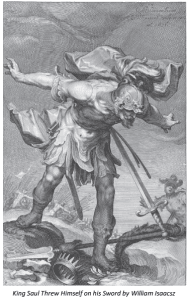
He preferred to die by his own hand rather than to come under the control of his enemies alive. Poor man! The poet describes the anguish of his last hour, saying,
“And the falchion at thy sids
To thy heart thy hand did guide;
Crownless, horseless, headless, fall
Son and Sire, the house of Saul!”
The closing verses of the lesson tell us that the Philistines sent Saul’s armor piecemeal to their various cities with reports of their victory, and that they fastened his dead body to the wall of Beth-shan. It will be remembered that at the very beginning of Saul’s reign, forty years before this, the Ammonites, having made an attack upon the city of Jabesh, overpowered it and demanded the surrender, and would give no better terms than that the right eye of each Jabeshite should be destroyed; and that then King Saul went promptly to their deliverance and rescued them. It is worthy of note that the men of Jabesh, forty years after, had not forgotten Saul’s energy on their behalf; so that when they heard that his body and those of his sons were ignominiously fastened to the outer wall of the city to putrefy and to be devoured by vultures, they went quite a distance and took down the bodies and burned them, so that no such indignity could further be expressed, and carefully buried the charred remains. Thus they attested their recognition of the king’s kindness to them. Kind words and kind deeds can never die, and we are often surprised at what a power they exercise even over those who are not in any special degree the Lord’s people. Such evidence of a spirit of appreciation, of kindness, illustrates the fact that, although our race is sadly fallen and bruised by the fall, nevertheless elements of the original image of God in the flesh are still traceable in the words and deeds of natural men. Without this, it might be said there would be nothing to work upon. How glad we may be to suppose that when the new dispensation shall have been ushered in, and when by reason of the binding of Satan and the restraint of evil it will be more easy to do right than to do wrong, then many will fall in line with righteousness and eventually learn to love righteousness and to hate iniquity!
Our Golden Text, “Prepare to meet thy God,” is appropriate to everybody in every time. But the right way to prepare to meet God and to hear his decision respecting the character is not, as usually supposed, to begin to get pious when we feel the approach of sickness or death or in the presence of calamity. From the moment we become believers in Christ and turn from sin and seek forgiveness and thus become eligible to God’s favor, we are urged to present our bodies living sacrifices to him and thus to receive of him an adoption of his spirit to fellowship. This in turn proves to be but the entrance way to the school of Christ, where they are to be taught as sons of God, to be prepared for the glorious work in association with their Redeemer in his glorious Kingdom. As they grow in grace and knowledge, they grow in appreciation of divine favor. As the poet has said,
“Oh, let no earth-born cloud arise
To hide thee from thy servant’s eyes.”
Such as are in this attitude of heart are prepared to meet their God at any time. Indeed their meeting with him has already begun, and anything that will serve in any degree to hinder its pleasurable continuance will be a disaster indeed.
The Battle of Armageddon – Volume 4, page i (excerpt)
Armageddon is a Hebrew word signifying the Hill of Megiddo, or the Mount of Destruction. Megiddo occupied a very marked position on the southern edge of the Plain of Esdraelon, and commanded an important pass into the hill country. This locality was the great battleground of Palestine, on which were fought many of the famous battles of Old Testament history. There Gideon and his little band alarmed and discomfited the Midianites, who destroyed one another in their flight. (Judges 7:19-23) There King Saul was defeated by the Philistines. (1 Sam. 31:1-6) There King Josiah was slain by Pharaoh-Necho in one of the most disastrous conflicts in the history of Israel. (2 Chron. 35:22-25) There also King Ahab and his wife Jezebel lived, in the city of Jezreel, where Jezebel afterwards met a horrible death. 2 Kings 9:30-37
These battles were in a sense typical. The defeat of the Midianites released the people of Israel from bondage to Midian. Thus Gideon and his band typified our Lord and the Church, who are to release mankind from their bondage to sin and death. The death of King Saul and the overthrow of his kingdom by the Philistines opened the way for the reign of David, who typified Messiah. King Ahab typified the civil government, symbolically called the “Dragon” in the Revelation. Queen Jezebel symbolically foreshadowed the great harlot, Babylon, and as such she is mentioned by name. “Thou sufferest that woman Jezebel, which calleth herself a prophetess, to teach and seduce My servants.” Rev. 2:20 In the Scriptures the Lord has evidently seen fit to associate the name of this famous battlefield, Armageddon, with the great controversy between Truth and Error, right and wrong, God and Mammon, with which the Gospel Age will close and the Messianic Age be ushered in. He has purposely used highly symbolic language in the last book of the Bible, evidently with a view to hiding certain important truths until the due time for their revealment. But even in the due time, “None of the wicked shall understand; but the wise shall understand.” (Dan. 12:10) None who are out of heart harmony with God shall know; but only the wise among His people – the wise virgin class of the Master’s parable. Matt. 25:1-13