
A Friend in need a Friend Indeed – R.4223
1 Samuel 18
“A friend loveth at all times, and a brother is born for adversity.” – Proverbs 17:17
History does not record a more touching story of love than that which existed between Jonathan and David. Both were noble characters, capable of loving deeply, intensely, although in many respects they were men of entirely different stamp. David was the more versatile, His is the broadest character on record; says Charles Reade: –
“In holy writ Moses, Elijah and Paul; in profane history Solon, Alexander, Caesar, Charlemagne, Napoleon and others excelled David in one quality or another. But David presents a greater number of distinct and striking features than any one of those great men; and that is why I style him the widest character on record – a shepherd, a soldier, a courtier, a famous friend, a fugitive, a captor, a marauder, a general, a king, a statesman, an exile, a priest, a prophet, a saint, a criminal, a penitent, and nothing by halves. His character was a harp of many strings.”
Jonathan, the son of King Saul and heir apparent to the throne of Israel, had also noble qualities. He was a faithful son, who alone could comfort his father in his times of disappointment. He showed himself an able warrior and displayed great faith in God; and his religious nature was apparently as fully developed as was that of David. Evidently these elements of honesty and devotion and reverence for God which these two men perceived in each other, constituted the basis of the great friendship which so spontaneously knit their hearts together in a wonderful bond of friendship – love. Indeed, according to the entire account, Jonathan would seem to have been the larger of these two great souls and his love the greater. From this standpoint alone, since love is the principal thing in the world, Jonathan may be considered to be one of the grandest characters in the world; for he loved much and against his own interests.
Deep Friendship For His Rival
At times friendships spring up based upon mutual admiration, and often with a measure of selfishness in cooperation. But in the instance under consideration selfishness would have operated against the friendship; it is, therefore, a sample of disinterested love. Every success and honor that came to David raised him as a popular idol to the place which Jonathan to a considerable extent had held. Every advancement of David meant the preparation of the people to receive him instead of Jonathan as Saul’s successor. The king saw this, so did Jonathan; but they were reversely affected by it. The king was made jealous, angry; Jonathan, reversely, loved his rival, and that from the time of their first meeting, on which occasion he gave to David his armor and court robes. (1 Sam. 18:4) We read, “The soul of Jonathan was knit unto the soul of David”; their natures interwove, intermixed – a beautiful description of the purest and truest of love. Alexander White says:
“Had I read, ‘Jonathan loved David as his own soul,’ for once only I should have passed it by as hyperbole,… but as I read again the rest of the story, I found myself saying to the sacred writer, ‘Lo, in all this speakest thou plainly, and speakest no hyperbole.’ ”
The Basis Of Loving Friendship
Friendship love is not a miracle, but results from certain combinations. The one we love need not of necessity be just like ourselves, but rather would appeal to us more as a counterpart possessing qualities which we admire, but do not so strongly possess. Darkness, however, never loved the light; the light never loves darkness. Hence for friendship-love on a noble plane both friends must have high ideals, noble aspirations, even though they may have these in different measure. Each should see in the other something to esteem and to look up to; although in the case of the Almighty this cannot be true; his love for us must be chiefly along the lines of sympathy for us and appreciation of our endeavors to attain to his character standards. We may be sure, too, that in Jonathan’s case reverence for the Lord had much to do with estopping any feeling of rivalry and with encouraging his admiration for his rival. Who will not admit that such an appreciation of the divine will and providences would be a help to all friendship, a hindrance to all spirit of rivalry and in general a most valuable uplift in every Christian character? How much it means to us in the way of contentment to know that our heavenly Father is at the helm as respects all the affairs of his people! How much rest it permits in our own hearts! How much meekness, gentleness, kindness and love it prompts toward others, both to realize that they as well as ourselves are subjects of divine care, and to have a heart so fully submitted to the Lord as to desire that his will shall be done irrespective of our own temporal interests or those of others.
Undoubtedly this was the good basis of Jonathan’s love; and undoubtedly it is the fruitful soil out of which all proper love amongst the Lord’s people will be developed. We must love the Lord with all our heart, mind, soul and strength before we shall be prepared to love our neighbor as ourselves, and to wish for him the same riches of grace that we desire for ourselves under the Lord’s providences. Still more is it necessary to have this supreme love for God before we could in any measure approximate the degree of love which the Lord set before his followers as a new commandment, saying, “A new commandment I give unto you, that ye love one another as I have loved you.” Jonathan’s love approximated this Christian love, this self-sacrificing love which so loved his neighbor as to delight to see that neighbor have the Lord’s blessing upon him, even while this meant his own loss of honor, prestige and kingly power. Oh, that such love as this might more and more prevail in the hearts of the New Creation! It is to such that the Apostle says, “Let the brother of high degree rejoice in that he is abased, and the brother of low degree rejoice in that he is exalted” – under the Lord’s providences.
A David And Jonathan Bond
It is not necessary for us to form a society for the propagation of the Jonathan and David bond of love amongst us as the Lord’s people. We have this organization which inculcates a love that is even greater. The head, the chief, the center of this organization is our Lord Jesus Christ, who not only exhorted us to the highest conceptions and practices of love, but exemplified this in himself when he laid down his life, not only for his friends, but also for his enemies. “Greater love hath no man than this.” This greatest of all lovers, our Lord Jesus Christ, has organized an association of lovers, and has made membership therein dependent upon the willingness of his followers to take up the cross and follow him, to lay down their lives for the brethren. Only those who have made such a consecration of faithfulness to the Captain, faithfulness to the spirit of love, faithfulness to one another as members of the Body of the Anointed – only these are admitted to membership in this exclusive society, “The Church Of The Living God, whose names are written in heaven.” And more than this, the founder of our society has told us that he is the Vine and we are the branches; and that every branch in him that beareth not this fruit of love will be taken away, cut off from the Vine, disassociated from membership in this blessed Church. He assures us further, that our faithfulness to our covenant with this true Vine will bring upon us purgings, prunings from the great Husbandman, that he may develop in us more and more the fruits of the Spirit, the fruit of the Vine – meekness, gentleness, brotherly kindness, love; that these graces may be in us and abound; that thereby the Father may be glorified and blessed, and that we may be made ready, “meet for the inheritance of the saints in light.”
So then we see that we need no special organization, but are already members of such a company, if so be that we are disciples of Christ and united to him as members of the New Creation. (Article continues on page 44)
Strong Characters In Contrast – R.3231
1 Samuel 18:5-16
“God is our refuge and strength, a very present help in trouble.” – Psalm 46:1
Saul and David were both men of strong character, but the former neglected the divine word and counsel and undertook the management of his own affairs, while the latter accepted the Lord and his leadings and by faith sought to follow him. The results showed in both cases: Saul came to an ignominious end. David was prospered and exhibited a wisdom and strength of character quite beyond his times. We are not to forget in this connection that David’s discreetness and obedience to the Lord kept him from the throne of Israel for years – years of trouble, privation and wandering, whereas the following of worldly methods might have led to much greater prosperity so far as outward appearances would be concerned. Nevertheless, we are to remember also that the nation of Israel had been adopted by the Lord as his chosen peculiar people, with whom he would deal, whose course he would supervise, and in respect to whose rulers he would decide. Neither are we to forget the great difference between the Jewish age, with the divine arrangements and regulations of the same, and this Christian or Gospel age, with its different regulations and its law of love, patient endurance and spiritual instead of carnal warfare. Those who consider the course of David and other faithful ones of the Jewish epoch to be patterns for the Church, the body of Christ, show thereby that they have a total misunderstanding of the divine Word on this matter. To their mind David’s battles and victories and slaughters are figures illustrative of spiritual battles and victories on the part of the antitypical David, the Beloved, – head and body – the Christ.
Although Saul had already been notified by the Lord through the prophet Samuel that the kingdom should be taken from his family and given to a neighbor more worthy of the trust than he, more faithful to the Lord, nevertheless he had been given to understand that the kingdom might endure in his hands for a considerable time. We may assume, therefore, that Saul was on the lookout for one to rise to prominence who should ultimately become his successor, – although we have no reason to think that he understood that David had already been anointed to this position, for David’s anointing was kept secret.
Saul, although appreciative of David’s prowess, was, nevertheless, jealous of him because of the prominence to which his noble course brought him in the eyes of the people. This jealousy was accentuated as he heard the praises of David sung in grander terms than his own were lauded. Jealousy is always an evil quality – no part of the Lord’s Spirit, the holy Spirit, but a strong ingredient in the spirit of evil. Hatred, envy, malice, strife, works of the flesh and devil, are all closely related to jealousy, and often spring from it. Saul should have resisted the envious suggestions which came to his mind: he should have allowed his mind to rise above all personalities and to rejoice most sincerely, most heartily, in the praises of his young general. Doubtless it was in part his remembrances of the Lord’s declaration that he should be bereft of the kingdom that made him look with jealous eyes upon David from thenceforth.
Jealousy is one of the great foes that confront every Christian. It should be slain on sight as an enemy of God and man and of every good principle; and to the extent that its presence had defiled the heart even for a moment, a cleansing of the spirit of holiness and love should be invoked. Jealousy is not only a cruel monster of itself, but its poisonous fangs are almost certain to inflict pain and trouble upon others, as well as to bring general woe and, ultimately, destruction upon those who harbor it. Jealousy is sin in thought, wickedness in thought, and is very apt to lead speedily to sin and wickedness in action, the probable result being the defilement of men. The mind, if once poisoned with jealousy, can with great difficulty ever be cleansed from it entirely, so rapidly does it bring everything within its environment to its own color and character. This sin, when it is finished, if it is allowed to grow, if it is not routed, if it is not overcome, bringeth forth death. All of the Lord’s followers should be on guard against this sin, and none need it more than those whom God has greatly honored as his mouthpieces or servants in any capacity. Had David and Saul not been in such high positions, jealousy and rivalry and enmity would have been comparatively impossible.
Under the circumstances we are not surprised to read (v. 10) that jealous Saul was troubled with an evil spirit – an evil disposition. Perhaps the language should be understood as meaning that an evil spirit – in the sense of a fallen spirit, a demon – troubled him. We certainly know that as love, patience, joy and peace are elements of the holy Spirit – God’s disposition – so a spirit of hatred and jealousy is an evil spirit or disposition “from God,” – that is, away from God, to the contrary of God. We may recognize the fact, too, that such an evil spirit as here took possession of Saul was not only a spirit far from God, or anything that he could approve, but we may even assume that, since Saul was God’s anointed representative in the throne of Israel, the evil spirit could not have gained control over him without at least divine permission. As holy men of old were moved by the holy Spirit to speak and write matters of divine indictment, so men have been moved and are sometimes moved today by evil spirits to speak and to write perverse things. This is the thought contained in the word “prophesied” in this verse. Saul spoke unwise things, improper things, spoke foolishly while he had his javelin in his hand. The spirit of evil was upon him, leading him to make a motion with his javelin as though he would do violence to his faithful and humble young general who, as a friend and companion, played for him upon the harp with a view to dispelling his melancholy. The word “cast” (v. 11) is a stronger one than is borne out by the original, which seems simply to signify a motion – although subsequently he did actually hurl the weapon. – 1 Sam. 19:10.
David seems to have been quite intrepid, fearless, 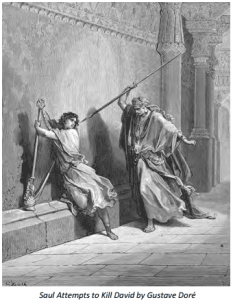 and again and again exposed himself to Saul’s power when the latter was under the influence of his melancholia. There is no mention of David’s fear, for although he felt it to be propriety and duty to escape as he did, he seems to have had continually the memory of God’s power for his preservation, and the fact that God had already anointed him to be the king in due time. Such faith and courage points a good lesson to all the members of the antitypical David. Nothing shall by any means hurt us. Things may interfere with our fleshly interests or comfort or course of affairs; but when we remember that we are not in the flesh but in the Spirit, that it is as New Creatures that the Lord has promised us the Kingdom in his due time, we can realize that no outside influence can interfere with our real interests, our spiritual interests, nor hinder our attaining to the glories of the Kingdom which the Lord has promised to his faithful ones. Only our loss of confidence in the Lord and our unfaithfulness to him could separate us from his love and his promises.
Saul’s jealousy of David was supported by his fear of him. Doubtless he wondered often that the fearless youth who attacked the lion should spare himself – even when he, Saul, had manifested openly his hatred and opposition toward him. He perceived that the Lord was with David and not with himself. David’s presence became distasteful in the palace, and, as he could not be ignored, he was put into the army and various commissions given him in connection with the interests of the kingdom, Saul evidently hoping that through some indiscretion David would give an excuse for a turning of popular sentiment against him – perhaps hoping also that in some of the forays he would be wounded or killed. But the Spirit of the Lord, as the Apostle explains, is the “spirit of a sound mind,” and in proportion as David trusted the Lord and was guided by that trust he was enabled to do his part with wisdom, winning the approval of the people and all the more the fear and awe of Saul.
This lesson to some extent illustrates the relationship between the Lord’s consecrated people and the world at the present time. The worldly are in power, in influence, and yet they are conscious of the fact that divine favor is no longer with them; that a change of dispensation is about to be determined in the divine program; that the Laodicean stage of the church is to cease to be the Lord’s mouthpiece, and to be spewed out; that the faithful little flock – of whom not many are wise or great or noble according to the course of this world – are to inherit the Kingdom with much power and glory. They do not indeed realize that the anointed class is in their midst and mingling with them day by day;
nevertheless they feel a jealousy in respect to those who have more of the Lord’s Spirit than themselves, and hate that which is purer and higher and better than they themselves possess. At times their jealousy would almost lead to murder; but they fear and hate the David class because of their closer relationship to the Lord, and because of his blessing manifested in their hearts and lives. Our Lord referred to such a condition of things in the end of the Jewish age, which was certainly a type of the end of this age. He said of the religious people of that time: “The darkness hateth the light, neither cometh to the light, lest its deeds be reproved; but he that doeth truth cometh to the light, that his deeds may be made manifest that they are wrought in God.” Thus, as a separation was made between Saul and David, and between those who loved the darkness and those who loved the light at the Lord’s first advent, so a separation is rapidly going on today between those who love the light, the truth, and who are guided by the holy Spirit, and those who are of a different mind or disposition.
Our Golden Text should be borne in mind as a comforting and sustaining power to the Lord’s faithful. It is in full harmony with the words of the Apostle in the New Testament, who declares that “all things are working together for good to them who love God, who are the called according to his purpose.”
THE SPIRIT OF ENVY AND MURDER – R.4218
1 Samuel 18:6-16
“The Lord God is a sun and shield.” – Psalm 84:11
This lesson affords us a contrast between a spirit or disposition in harmony with the Lord and a spirit or disposition out of harmony with him and his arrangements. The first is exhibited in David, the shepherd boy, secretly anointed to the office of king and later brought into prominence through his victory over Goliath, recounted in our last lesson. So far as Saul is concerned the record is that an evil or malevolent spirit possessed him. On the contrary the Spirit of the Lord is said to have been with David from the time of his anointing. We are not to confuse in our minds those blessings of the Lord’s Spirit in ancient times with the still more blessed experiences of God’s people throughout the Gospel Age under the anointing of the holy Spirit, the begetting of the holy Spirit, the sealing of the holy Spirit as sons. Doubtless there would be much in common in the experiences of those who received the Lord’s Spirit at that time and those who receive it now; but most certainly that which we now enjoy as the “house of sons” is far beyond anything that was possible for the “house of servants” to experience; because the holy Spirit as a comforter and guide into the truth and a seal of the new nature was not then given, because Jesus was not then glorified. Hence the blessing of the Spirit given at Pentecost and enjoyed by the Church since is peculiarly the Lord’s blessing for the Bride class and has been possible only since their Advocate appeared in the presence of God for them in the merit of his own sacrifice.
To whatever extent the holy Spirit was bestowed upon the “house of servants” it would necessarily be a spirit of moderation, of fellowship with God, of desire to do his will and of peace with him; and to this extent it would be the spirit of a sound mind, relieving its possessor of much of the nervous fret and strain, excitability and languor which might be his own naturally under trials and disappointments. Of Saul, it is said that an evil spirit entered into him, but this does not necessarily mean that he became obsessed of a demon, but rather that an evil mind, a perverse mind or disposition, an unhappy or melancholy mind took the place of the restful and peaceful and trustful mind which he previously had enjoyed.
An evil spirit from the Lord
But we read that an evil spirit from God came upon Saul and he prophesied in the midst of the house. This would seem more like an obsession, or, as Dr. Merrine suggests in Bibliotheca Sacra, Saul had psychic epilepsy; he says, “Epilepsy may coexist with a healthy growth and development of the intellectual faculties, and a very high degree of intelligence and even genius may be associated with it. Julius Caesar, Augustus Caesar, Napoleon, Petrarch, Mohammed, Moliere, Handel and many other great men were epileptics. Certain peculiarities are common to the whole class of epileptics, and dominate their character, such as an explosive irritability of temper; in some instances a display of highest excitement, and again a gloomy stupor. Numerous criminal acts have been committed while in this state.”
We do not get the thought that this evil spirit was from the Lord in the sense that the Lord exercised this evil influence upon Saul, but we understand the word from in an entirely different sense, and signifying not of, contrary to: “An evil spirit [apart] from the Lord was upon Saul.” The Apostle tells us that anger, malice, hatred, envy and strife are works of the flesh and of the devil, and hence to whatever extent Saul or anybody else came into sympathy with these works of the Adversary to that extent he would have, would be controlled by an evil spirit, an evil disposition, the Adversary’s spirit; and, as a matter of fact, those who come consciously into accord with the Adversary in spirit become thereby exposed to obsession, to the intrusion of the evil spirits themselves.
It is undoubtedly true that persons whose minds are in sympathetic accord with righteousness and truth, are proportionately surrounded by a protective influence which shields them from the intrusion of the evil spirits. This is the intimation of the Scriptures, which declare that the holy angels are ministering spirits for those who shall be heirs of salvation, and “The angel of the Lord encampeth round about them that fear him and delivereth them.” (Heb. 1:14; Psa. 34:7) But with any departure from the reverence of the Lord, with any departure from loyalty to righteousness and truth would come a corresponding separation from this holy protecting influence of the angels of the Lord and a consequent exposure of heart, of mind, to the malevolent influences of the fallen angels, who are ever ready to enter into such, and more seriously than ever defile them. This lesson seems to be enforced by our Lord’s parable of the man out of whom a devil had been cast and his heart swept and garnished; not, however, receiving into it the good Shepherd of his soul, but, standing for righteousness merely in his own strength, he was assaulted by seven demons more wicked than the first and was overcome, and the last end of that man was worse than the beginning. – Luke 11:24-26.
Thus it was with Saul; as a natural man he evidently had some noble characteristics, because of which Samuel loved him; but failing to make a full consecration of himself to the Lord he was continually beset by his own will, a spirit of selfishness, which hindered him from being a satisfactory servant of the Lord. As a result of this, the Lord’s special protection and assistance were not afforded him, and correspondingly the spirit of selfishness grew. In our lesson we saw that so far from desiring that the will of the Lord should be done in him and in all of his affairs the very reverse spirit of selfishness, of self will, grew rankly in his heart. These heart conditions merely needed an opportunity to manifest themselves, and this opportunity came in connection with David. After the exploit with Goliath the fame of David greatly spread abroad throughout the cities of Israel. As the story was told subsequently that he with the army gave battle with the Philistines and victory resulted, his praises were sung after the custom of the time by women and children, who at the gates of the various cities saluted the returning victorious warriors. A song gradually spread, the chorus of which was, “Saul hath slain his thousands, but David his tens of thousands.”
It would have required a man of very large calibre in Saul’s place not to be offended at this, not to feel jealous of such honors given to the young hero of the hour, implying that he had entirely eclipsed the king. But whatever might have been the natural sentiment of King Saul or others there can be no doubt as to what would have been the proper one. The king should have rejoiced and taken pleasure in honoring the young patriot, whose chivalry had been so blessed to the whole nation. To have done this would have been to evince the spirit of a sound mind, and it would have redounded to the honor of Saul himself. But it does not surprise us that it had an opposite effect upon him, knowing as we do the general spirit of the world in respect to such matters – the spirit of selfishness and pride. Saul was filled with anger and envy and eyed David jealously henceforth. He recognized in him a rival; he also perceived that David was a true servant of the Lord, and that the Lord’s blessing was upon him. Jonathan, on the contrary, of a different cast of mind, loved David more and more, because of the very qualities which led his father to hate David.
Lessons for spiritual Israelites
Keeping in mind that the anointed David represents the Church, the Lord’s anointed, who by and by with Jesus their Head shall occupy the throne of the world’s dominion for the blessing and uplifting of mankind, and for the deliverance of all from the yoke of Satan, sin and death, we may properly enough apply the essence of this lesson to this class. Their victories over the evil one, over the power of sin in their own bodies, and their general fighting of the good fight of faith bring the approval of some of the Jonathan class, as well as the comfort of the “exceeding great and precious promises” of the Lord’s Word. (2 Pet. 1:4) But these victories over sin will not bring to this class the love of the world, the love of those who have not the Lord’s Spirit, but a selfish spirit, the spirit of those represented by Saul. Of this condition of things the Lord forewarned us saying, “Marvel not if the world hate you; ye know that it hated me before it hated you.” He tells us that we are the children of the light, and should let our lights shine, and that in proportion as we are faithful in so doing it will bring upon us the opposition of the children of darkness, who love the darkness rather than the light, who love sin rather than righteousness, selfishness rather than love.
Perhaps, too, Saul represented those of the present time who in the nominal Church system, the nominal kingdom of God, affect to be reigning now. As they perceive the Lord’s blessing on those who have no titles amongst men and whose anointing is not of man, neither recognized by man, they feel jealous of their success, they seem to realize that the prosperity of Present Truth in the world makes steadily against the institutions of Babylon. Every victory for truth, every evidence of the Lord’s favor towards it seems to beget an evil spirit of indignation, of opposition, hatred, envy, strife – “works of the flesh and of the devil.”
Saul’s coming under an evil influence, by which he prophesied, seems to correspond thoroughly with the power of evil spirits exercised at various times in the past. And speaking of the power that Babylon will exhibit in the near future, the Lord tells us that the image of the beast will become so alive shortly that it will call down fire from heaven upon all opposed; that is to say, it will, apparently in the name and power of the Lord, express imprecations and fiery vengeance from the Almighty upon all who are not in full sympathy and accord with it. It may even seek to destroy us with the javelin of bitter words, misrepresentation and slander, as Saul threw his javelin twice at David. But as the latter was not smitten with the javelin, so we shall not be injured as New Creatures, no matter what the Lord may permit to come against us according to the flesh. “All things work together for good to them that love God, to the called ones according to his purpose” – to his anointed. His Word is, “Touch not mine anointed, and do my prophets [ministers] no harm.” (Psalm 105:15) And again, “Nothing shall by any means hurt you,” injure your real, highest interests.
”Jealousy is cruel as the grave”
These words of the wise man have been amply demonstrated as truthful through many centuries of the world’s experience. Some one has said, “Jealousy is said to be the offspring of love. Yet, unless the parent makes haste to strangle the child, the child will not rest until it has poisoned the parent.”
The lesson to the New Creation is that we should be specially on guard against jealousy, envy, hatred and strife. We cannot doubt that much of the final testing of the “very Elect” will be along these lines. “Who shall be able to stand?” is a question, therefore, that appeals to all those who have taken their stand for the Lord, for righteousness, for truth – their stand for love of God and of the brethren. If, indeed, we have consecrated our lives, to lay down our lives in the service of the Lord and his truth and in the service of the brethren, what should it not mean to us as respects the manifestation of that love and faithfulness! Any root of bitterness, any word of bitterness, any thought of jealousy entering into our hearts might mean the defilement of not only the brother or sister against whom these are directed, but would surely mean the poisoning of our own hearts, the destruction therein of the spirit of love, the Spirit of the Lord; and possibly this evil spirit, far from the Lord, proceeding from us, might contaminate many members of the Body of Christ for their defilement. How much on guard, therefore, each of us ought to be; how we should analyze our thoughts, our motives, our intentions to see that they all square perfectly with the law of love to the extent that our Lord indicated, saying, “A new commandment I give unto you, that ye love one another as I have loved you;” to the extent of being willing to die for each other’s interests and welfare and honor!
On the contrary the Spirit of the Lord in David kept him sweet, kind, generous toward his enemies. He indeed fled from the king’s presence when in a fit of anger Saul threw the javelin, and we may be sure that it was nothing less than faith in the Lord and in his divine providence that enabled David to continue to serve the king as his musician, and by the sweet music of his heart and of his voice, to cheer Saul and drive away his melancholy. Such should be our attitude toward those who oppose us. The natural disposition of an evil course toward us would be to arouse an antagonistic spirit in return, render evil for evil, railing for railing, accusation for accusation. The result of such a course would be our own injury as well as the possibility of further injuring our opponents. David’s course was the proper one; he waited upon the Lord, he was submissive to what the Lord’s providence permitted. In his estimation and ours nothing could befall him that would be outside the divine knowledge and the divine power to prevent. Hence these trying experiences meant for David a great development of character, a strengthening of his heart in harmony with the divine will. Providential changes accepted
In various ways did Saul seek to arouse in David a spirit of antagonism; not only did he make an attempt to assassinate him twice, but he kept back from him a part of the promise he had publicly made, that the one who would gain the victory over Goliath should become his son-in-law. How foolishly shortsighted was Saul’s course even up to this time! He might have fallen into line with the Lord’s providences and have fulfilled his obligations to David, and by having David as a son-in-law, his own family would have been closely knit to that of David when the latter would ultimately come in possession of the kingly authority, as the Lord had ordained. But jealousy and hatred are usually blind to their own best interests. So Saul kept back his daughter from being the wife of David, and his next step was to send David to the army as the commander of a regiment, with the hope and the expectation that his boldness in war would mean his death. But the Lord was with David and blessed him, and the record is that “he behaved himself wisely in all his ways.”
So with all those who now have the Lord’s Spirit in still greater measure and power for the illumination of their minds, their hearts and their guidance in the right way. All these, under this heavenly influence and as sons of the Most High, should behave themselves wisely, prudently, in a manner to glorify their Father in heaven, to honor the Lord Jesus, to make themselves helpful to all the household of faith, and to let their lights so shine before men that the latter may take knowledge of the fact that they have been with Jesus and learned of him.
But the more wisely David conducted himself, the more envious did King Saul become. The more the Lord blessed and prospered David in his humility of life and wisdom, of course the more opposition did he have from the king. And so it will surely be with us. In proportion as we have the spirit of a sound mind and are zealous for the Lord and for the brethren, laying down our lives in the service of the truth, the more hatred and fear we may engender in the hearts of those who are out of heart-harmony with the Lord. But as we read of David that all Israel and Judah loved him, so we may be sure as respects the true people of God; for they are more and more loved and respected – those who have the Lord’s Spirit, those who are of the David class. By and by when Satan shall have been bound, and when the Lord shall have established his Kingdom under the whole heaven, when all the blind eyes shall be opened and all the deaf ears unstopped, then all the people, all who are in accord with the Lord, shall recognize the faithfulness of the David class, the Christ, and shall glorify God on their behalf.
”The Lord God is a sun and shield”
Our Golden Text is a great encouragement to the David class, the beloved class, the anointed ones, the members of Christ. To these the Lord God is both a sun and shield; he not only enlightens these but he will not suffer them to be injured by the blessings which he bestows upon them. He will shield them from all enemies and everything that would tend to injure them in any manner; all things shall work together for good to those that love him, to the called ones according to his purpose. (Rom. 8:28) With such blessed assurances, then, we may look forward into the future with rejoicing and with confidence, trusting to have a share in the glorious rewards God has promised to the faithful.
As it would not have done for David merely to have thought about his anointing to be king and the blessing that would then come to him, so it would not do for us merely to think about the Kingdom honors that God has promised to the faithful, for in so doing we might be puffed up and thereby made unfit for a share in those coming blessings. Rather our attention, like that of David, must be directed to the things of the present, without, of course, forgetting the blessed influence of the coming prospects. It is ours to do with our might what our hands find to do at the present time, remembering that only thus can we make our calling and election sure.
As each step of opposition on the part of Saul worked out a blessing for David, giving him wider experiences and fitting and preparing him for his future usefulness as the king, so all of the trials and difficulties and the disappointments that the Lord will now permit to come upon us from the world, the flesh and the Adversary – all of these will prove but preparations for his glorious Kingdom privileges, if faithfully used.