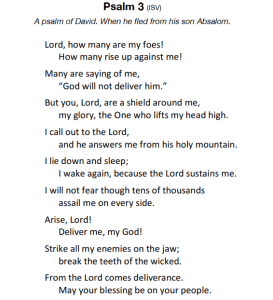
Absalom’s Rebellion – R. 2024
2 Samuel 15:1-12
“Honor thy father and thy mother, that thy days may be long upon the land which the Lord thy God giveth thee.” – Exod. 20:12
In this account of Absalom’s rebellion there are several important lessons to thoughtful minds. (1) First of all we notice in Absalom the sin of disrespect to parents. The experience and wisdom of riper years are, when heeded, the safeguards of youth, and specially in the case of parental experience and wisdom, which parental love is ever desirous of utilizing for the benefit of sons and daughters, to protect them from the ills of life of which they have learned either by experience or observation. Youth, alas! too often disregards this divinely provided safeguard until by and by it learns its folly by bitter experience. The hopefulness of youth naturally gilds the future with glory; and, with ardent spirits, undisciplined, unrestrained and self-conscious, it plunges into new schemes, sanguine of the success of its theories until, by and by, its bright visions fade before the stern realities of life.
So it was with Absalom; and so it is with every youth who disregards the commandment of the Lord, “Honor thy father and thy mother;” and again, as expressed by the Apostle, “Children obey your parents.” The duty to “honor” parents, however, extends far beyond the obligation to obey them, which specially applies to childhood, and not to mature years. The duty of honoring parents extends from the cradle to the grave, and when the last honors are paid to the lifeless forms of parents they should still hold an honored place in the archives of memory. Nothing is more beautiful in youth than preferment and deference to riper years, and specially to old age. “Thou shalt rise up before the hoary head, and honor the face of the old man.” – Lev. 19:32.
(2) We notice in Absalom the sin of disrespect to the God of his father, which was but the natural result of his lack of love and confidence in his father. He entirely ignored the facts that the kingdom was the Lord’s, and that the Lord placed whom he would upon the throne, so that his youthful ambition plotted not only against his father, David, but also against God, who had anointed David to be king, and who also promised to establish his throne and to indicate his successor, and to subdue all his enemies. In his rebellion Absalom vainly thought not only thus to outwit his father, David, but also the Almighty Jehovah. How vain and foolish! What reckless folly! And yet, how many have repeated this folly, and few of the sons of men have paused to consider how puny is the arm of flesh when lifted in defiance of the Almighty!
(3) We see how political intrigue stole the hearts of the people and made the cause of Absalom temporarily very prosperous, so that “the conspiracy was strong and increased continually with Absalom.” But every successful step of the plot was only bringing the young man nearer to the height from which he must eventually fall. So it is in the temporary success of every evil device: the much sought elevation only adds force to the final disaster. In this view it is manifest that the truest friendship to the wayward is resolute, wise and well-planned opposition, which no flattery or political craft can overcome. Such friendship is seldom appreciated except by Him who reads the heart, though it does sometimes turn the sinner from the error of his way and save a soul from death. For such service how necessary is great sobriety, patience, faith, hope and love! Especially in any efforts to assist fellow members of the prospective body of Christ, who are now on trial for eternal life and in the race for the prize of our high calling, lest any, becoming wayward, should fail of the grace of God.
(4) We observe the progressive course of evil – how the sin of ingratitude and dishonor to a father brought on ambition and defiance of God; how this led to unscrupulous political intrigue, flattery and lying; and finally to a bold and wicked plot which was treason alike to the king and to God. In all this Absalom was cultivating that haughty spirit which goes before a fall.
While thus noting the course of Absalom and its lessons to the young, there is also a hint of wisdom for parents which they would do well to heed. The example of David to his children was not a faultless one: the sins of his youth and of his later years yielded a most undesirable harvest. Not only had he violated the law of God in multiplying wives to himself (Deut. 17:14-17), but he had further transgressed by taking some heathen wives, the mother of Absalom being the daughter of the heathen king Talmai, king of Geshur in Syria; and the children of a polygamous household, living apart from their father with their several mothers, were necessarily almost without a father’s influence and care, so that Absalom was brought up under the influence of a heathen mother and apparently with little reverence or respect for the true God.
The sin of Amnon for which Absalom slew his brother was one deserving of punishment, and yet in view of his own sin with the wife of Uriah how could David become the avenger? The crime doubtless caused him sorrow and tears and bitter reflections upon the past, all of which he recognized as part of his own penalty but, remembering his own folly, he could not punish the offender.
In the slaying of Amnon, whatever purposes of selfish ambition or personal hatred may have mingled with his indignation, Absalom was avenging the crime against his sister with only a lawful vengeance, the prescribed penalty being death. To David, who loved all his children, this was a terrible blow, and Absalom, fearing his indignation, fled to his maternal grandfather where for three years, unrecalled by his father, he remained, under the influence of that heathen land, no doubt restive under unfavorable conditions, with no indication of any favorable turn of affairs and chafing under a sense of injustice, since in avenging his sister he had merely executed the sentence of the law (Deut. 27:22; Lev. 20:17); and, brooding over his misfortunes and magnifying all the faults and weaknesses of his father, it is no matter of surprise that the spirit of rebellion strengthened; for in the absence of any expression of his father’s interest in him, how could he know of his heart yearnings? And when after three years he was permitted to return to the land, still he was not permitted to see his father’s face, nor to know of his continued love for two more years.
It is not, therefore, surprising that the experience of these five years fastened upon the mind of Absalom the conviction that his father no longer loved him or considered his interests; and this feeling rankling in his heart, he prepared to set at defiance his kingly authority, and in the fire of his youth, the self-consciousness of early manhood and his now dominant ambition, he also recklessly ignored the divine authority.
This attitude of David toward his son was a great mistake on the part of David, the realization of which when it was too late to rectify it doubtless greatly deepened the grief which was subsequently expressed in the bitter and tearful lament, “O my son Absalom! My son, my son Absalom! Would God I had died for thee. O Absalom, my son, my son!” For five years David had allowed the hard side of his nature to thoroughly conceal his tender emotions; and not only so, but in all that time he had been neglecting his opportunities for exerting a godly influence upon his son, and that at a time when he most needed such influence, and instead of which he was surrounded with the influences of a heathen land. It was a dear price for David to pay for his resentment, and in the light of his son’s highest interests it was certainly very poor policy. Yet how often is the mistake of David repeated by fathers! Many seem to forget the temptations, trials and inexperience of youth, and so fail to be gracious, considerate, forbearing and studious of their highest interests. Kind, generous, self-forgetful interest will follow the son long after childhood has matured into manhood, and will make parental counsel very potent long after parental authority has ceased.
There is probably no time in life more fraught with danger than when the young birds leave the home nest and launch out to try their own wings and to carve out their own fortunes. And if they can go with a father’s and a mother’s blessing; if every rebuff and misfortune they meet from a hard, cold world elicits home sympathy and prayers and loving encouragement; if father’s house is felt to be the place of refuge in case of a sudden disaster; if they feel that loving forbearance there offsets the hard knocks of experience outside, what a power is there for good! It certainly is not a wise father that will long permit any pride of dignity or stiff reserve to forego the privileges of his position for the blessing of his offspring.
Parents should heed well this lesson, that the bitter lament of David over a son whom kindness, forbearance and loving counsel and sympathy might have saved, may not be theirs; and in every relation of life let us all see to it that love not only exists, but also that it is made very manifest.
In verse 7 the word “forty” evidently should be “four.” It is believed to be a transcriber’s error.
Absalom’s Shameful Disloyalty – R. 3261
2 Samuel 15:1-12
“Honor thy father and thy mother: that thy days may be long upon the land which the Lord thy God giveth thee.” – Ex. 20:12
The closing years of King David’s life included a series of very trying experiences, which, however, under the Lord’s providential care, apparently worked out for him a ripeness of heart and character exhibited to us in the Psalms of his later writing. These disastrous experiences date from the time of his sin, and to a considerable extent they were used of the Lord as punishments for that sin. Although in the case of Absalom’s rebellion we may trace the evil which there culminated to circumstances which occurred long previous to David’s sin, we are also to remember that it was quite in the Lord’s power to have shielded the King so as to have prevented the success of Absalom’s deceitful machinations. Amongst these earlier influences may be mentioned David’s marriage to Absalom’s mother, who was not a Jewess but a foreigner, the daughter of a heathen king. The counsel of the Lord is to the effect that his people should not be unequally yoked together with unbelievers, and this counsel applied to the typical Israelite as it still applies to spiritual Israel. This disregard of the divine wisdom was sure to produce unfavorable results in some manner at some time. Children born to such a mismated marriage are sure to inherit certain elements of character and disposition from the unbelieving parent which will eventually show themselves. In the story of Absalom we see an illustration of this. His vanity, insubordination, disloyalty, went hand in hand with an ambition which seemed to hesitate at nothing. It killed a half-brother who stood between himself and the throne, and later on stimulated a usurpation of his father’s throne, and the seeking of his father’s life.
Absalom is a distinguished example of dishonor to a father, and the resultant cutting off in the prime of life. The story of his unfilial conduct is told in this lesson. For the murder of his half-brother under provocation he fled from his father’s dominions, and was three years an exile in the king’s (his grandfather’s) country. Then in intrigues in official circles his father’s love for him was prevailed upon to such an extent as permitted his return to his homeland, and eventually to all the privileges of the heir apparent to the throne. It is at this time that our lesson opens. The young man, remarkable for his handsome appearance, introduced a custom from his grandfather’s court, a custom which still prevails in Egypt, namely, that a prince should have a special chariot and a bodyguard of fifty trained men. King David seems to have had so much love for his son that he practically let him have his own way in these matters. The people were pleased with the display, etc., of royalty in the person of their prince, and for several years a great and sobering change had come over the King, who was also advancing in years and who no longer showed himself amongst his people as much as formerly.
The vain young prince was quick to see that his spectacular course pleased the people, and quite probably he heard that his young brother Solomon was David’s choice for his successor in the kingdom, and he concluded to make a bid for the royal honors of his father. His method was a crafty one: he would steal the hearts of the people from his father to himself. He had no filial affection; only selfish ambition is manifested in his course. He would use his father’s indulgence, which had shielded him from the penalty of his crime, to undermine his father’s influence. Surely, if it is wrong to render evil for evil, it is a despicable crime to render evil for good – to a father or a friend or to anyone.
The King in these days acted as a superior court, so that cases not satisfactorily adjudicated before the regular judges were appealed to him. As the nation grew these cases of appeal became more and more numerous, and doubtless the King’s advancing age and his greater attention to religious things, writing of Psalms, etc., interfered to some extent with his conduct of this court business. Absalom perceived all this and turned it to his own account. Meeting those persons who had appeals and who were delayed, he expressed sympathy for them, assuring them that if he were a judge in their case justice would be speedily meted out – of course implying that his hearer had justice on his side and would therefore be pleased with the results. As a prince it was the order of that day that he should receive homage from the people of the realm, and feigning a love and humility which he evidently did not really feel, he lifted up and kissed these people. A royal kiss would be a matter to be boasted of. To have the fellowship, nay the affection, of a prince would mean to many a complete perversion of their judgment and a binding of them to him as his obedient servants.
Not only was this conduct unfilial, dishonoring to his parent, but it would have been disloyal to any ruler, ignoble toward any benefactor. Indeed the word “stole” is none too strong. In stealing the hearts of the people the theft was not less, but even greater, than if he had stolen money or merchandise. There is a point of morality here which is but faintly discerned by many in our day. We regret to be forced to believe that quite a good many are very willing to steal the affections of another and to misrepresent another to their own advantage. The Lord’s people of the New Creation need continually to be on their guard against any such tendency in their flesh, which might disguise itself so that its real character would not be discerned readily by the new mind. The Golden Rule should be applied by the saints to all the affairs of life every day. It is a safe rule, and those who use it freely and are obedient to it will assuredly grow in the fruits of the Spirit, all of which are branches of the one great spirit of love.
This conspiracy against his father may be considered as having begun immediately on Absalom’s return from exile, or as dating from his full acceptance back to fellowship with his father and a princely position. In the latter case it was four years in progress, in the former case six years. When he considered that matters were properly ripe for action, in order not to excite the suspicion of the King or others he asked of the King permission to go to Hebron, there to offer a great sacrifice unto the Lord in harmony with a vow made years before, and the occasion was thus made so important that the taking with him of many of the chief men of the army and of the city would not be considered remarkable, but rather an honor to the King through his son.
Meantime spies had been sent throughout the twelve tribes, and trumpeters were posted in various quarters, so that when the appropriate time would come and Absalom should proclaim himself king at Hebron, these trumpeters, being heard by others, the whole line of trumpeters throughout the twelve tribes would sound almost simultaneously, and the spies in Absalom’s secret service as well as the trumpeters would explain the meaning of this to be that Absalom was now king. The people, who had learned to love Absalom because of his mock meekness, would thus gain the impression that the revolution of the kingdom was complete; that King David was certainly thoroughly vanquished, and that their personal prosperity with the new king would depend upon the prompt manifestation of their loyalty to his cause. The matter worked remarkably well, and as a result practically the entire nation was turned to Absalom in a day.
Some of those who went from Jerusalem to Hebron were totally ignorant of the use that was being made of them, yet their influential names being associated with Absalom would affect the populace; and they in turn, being with him and favored by him as his friends, and their future being dependent upon his grace, had everything to gain by adherence to his cause and everything to lose by its repudiation.
The conspiracy was successful to a degree that could scarcely have been anticipated. Practically the whole nation gave allegiance to Absalom, and that in so outward and marked a manner that it was necessary for them subsequently, after his defeat and death, to publicly request the King to return to the head of the government of all the tribes. If we wonder that a nation should so quickly forget the valuable services of so eminent a ruler, to whom it owed so much of its prosperity, let us remember that the King’s confession would not be viewed by the populace as it is now viewed by God’s holy ones. Doubtless some appreciated him in a measure, but more would disesteem him for “showing the white feather,” and many would be inclined to consider him an “old hypocrite.” His seclusion during those eleven years and his accumulation of treasure for the building of the Temple – perhaps involving taxes upon the people – could all have been viewed from an evil standpoint and have assisted in his unpopularity. It is the fortune of all of the Lord’s people to be misunderstood by the worldly, even when conduct and words and intentions are the very best. How careful, then, we all should be to walk circumspectly, and to avoid every appearance of evil!
Here, too, we may have an illustration of how God is able to overrule the affairs of the world in such a manner as to execute his designs without interfering with the free agency of any. Had it not been for David’s sin and the penalty prescribed for it, Absalom might have had the same evil designs upon the kingdom, – might have made the same effort to accomplish his designs; but the Lord would not have permitted the matter to reach so successful a climax. An example of this is found in the subsequent attempt by a younger brother of Absalom to take the throne. He proceeded in many respects as Absalom did and under more favorable conditions, in that at that time the King had grown quite feeble with age and was unable to administer the interests of the kingdom personally or to take the field in battle. However, in due time the Lord brought the matter to the attention of David, so that the revolt was nipped in the bud before it had time to take effect, and Solomon instead of Adonijah was anointed king.
Just so it is with the Lord’s people today. Conspiracies may arise to threaten the interests of the Truth, but the Lord is at the helm, and will permit these to go no further than in his judgment is wise – only so far as they will work for the Lord’s glory and the accomplishment of his plans, for the instruction and disciplining of his people, and for the sifting out of those who at heart are enemies of the cause. The general lesson for us is confidence in the great King of kings and Lord of lords; implicit obedience to him and loyalty to the principles of his government; the law of love in our dealings with all the true Israel of God and with mankind in general. The Lord is able and willing to make the things which would seem to harm us work out for our everlasting good and work disastrously to those who essay the injury of his people and his cause. The Golden Text is well illustrated in our lesson. Absalom, the disrespectful, ungrateful, disobedient son, selfish, avaricious and grasping, came to a disgraceful end in the prime of life, and marks a lesson to his kind. On the other hand Solomon, the peaceful, the good, the wise son, attained to the kingdom, and attained to it, too, with his father’s blessing and the divine favor.
Pride, Ingratitude, Hypocrisy, Rebellion – R. 4275
2 Samuel 15:1-12
“Honor thy Father and thy Mother, that thy days may be long in the land which the Lord thy God giveth thee.” – Exod. 20:12
LESSONS may be drawn from the lives of the ignoble, as well as from those of the noble. As the poet says: –
“Lives of great men all remind us,
We should make our lives sublime,
And, departing, leave behind us
Footprints on the sands of time.”
This being so, then surely it is true also that the footprints of the evil-doers on life’s pathway have lessons for us also, indicating to us which paths should be shunned, which elements of character should be restrained, which ambitions should be curbed. Following this course of instruction the divine Word holds up before the Spiritual Israelites not only noble precepts and counsels and examples of heroic devotion to truth and righteousness, but illustrations also of the course of evil-doers. Our lesson today belongs to this latter class. It considers Absalom, the son of King David, who at the time of this lesson was presumably nearly thirty years of age. His father, the Lord’s anointed king over Israel, his mother, the daughter of a king of a neighboring realm, Absalom inherited princely qualities and manners and, being very beautiful, became a center of Israelitish pride. “In all Israel there was none to be so much praised for his beauty. From the sole of his foot, even to the crown of his head, there was no blemish in him”; and the hair of his head is a proverb to this day. It is worthy of note that those who are highly favored by nature, richly endowed in appearance or mental ability, are subject to temptations to a far greater degree than their fellows who are less talented, less handsome. Their besetting weakness is apt to be pride, self-esteem, to which ambition is apt to lend a helping hand. Thinking of Absalom and his beauty and his high position in the kingdom reminds us of Lucifer and the glorious description given of him in the Scriptures – his high position and honor and his pride and ambition and the downfall to which they led. The very suggestion of these two characters, from this standpoint, should bring a thrill of fear to the hearts of all who realize that we today of Spiritual Israel are princes, highly favored of our Father, the Great King, and greatly blessed with the beauty and perfection which come to us through our justification and greatly honored of our Father in the gracious hopes set before us in the Gospel of glory, honor and immortality, and greatly blessed also in the light of divine revelation granted to us, which gives us a wisdom superior to that of the world. What if these blessings and mercies and favors should have their wrong effect upon us and bring us eventually to disaster, as was the case with Absalom and with Lucifer? The thought is sufficiently appalling to remind us of the Apostle’s words, “Let us fear, lest a promise being left us of entering into his rest [of becoming joint-heirs with our Redeemer], any of us should seem to come short of it” – through a lack of loyalty, a lack of allegiance, a lack of faith, a lack of humility.
A Murderer of the Brethren
It will be remembered that David’s eldest son was Amnon, and that he had defiled his half-sister Tamar, the full sister of Absalom. King David, sorely vexed at the matter, appears to have been at a loss as to what manner of punishment he should properly meet out for the offense, so that two years passed without any being inflicted. Then Absalom took upon himself to be his sister’s avenger. He made a feast, to which were invited all the King’s children by his several wives. In the height of the feast, in disregard of the rules of etiquette and the claims of natural affection, Absalom slew his brother and then fled, from fear of justice, which, under their code, centered in his father, the King. What lesson is there in this experience for us? What should we copy? What avoid? In Spiritual Israel we are all princes, sons of the Great King, who is also the Judge. The lesson to us would properly be that the authority and responsibility for meeting out justice is not in our ambitions, but with the Father.
As the Scriptures declare, “Vengeance is mine; I will repay, saith the Lord.” We are not to wait what seems to us a proper length of time, and then, if we see no divine punishment for what we consider to be no longer tolerable, to take the matter in our own hands – to murder one another. Nay, the command of our Great Teacher is, “A new commandment I give unto you, that ye love one another, even as I have loved you.” The lesson for us to learn is expressed in the Master’s words, see to the beam in thine own eye, rather than put thyself to too much inconvenience examining the mote that is in thy brother’s eye. To his own Master he standeth or falleth.
The parallel would not imply that literal murder would here be accomplished amongst the Lord’s children. No, thank God! The world is too far advanced in civilization to make such a course practicable; but where the Absalom spirit is – the spirit of hatred, anger, envy, bitterness-strife – it is also. There is a modern method of assassination by the use of slanderous words, by insinuations, by the shrugging of the shoulders, etc. And this modern kind of murder is often committed in the presence of the members of the royal family, the heavenly brotherhood. How terrible! do we say? Let us take heed that such blood-guiltiness, such “works of the flesh and the devil,” be not upon us, else we shall never inherit the Kingdom.
The Ungrateful Son – Traitorous
Absalom remained for three years at the court of his grandfather, Talmai, king of Geshur in Syria. By the murder of his elder brother he had put himself next to the throne of Israel, heir-apparent, and this, possibly, was considerably his inspiring motive in the crime, although he affected that the crime was committed in defense of justice and principle. Alas! how treacherous is the human heart! How frequently do we find double motives operating therein! We see the advantage of those who, as children of God, follow implicitly the Father’s Word and leave all the results to him. They thus show their faith in God’s power, as well as in God’s justice, and thus, as the Apostle intimates, they show that they have become partakers of a holy spirit of wisdom – “wisdom from above; first pure, then peaceable, easy of entreatment, full of mercy and good fruits,” a spirit of wisdom which leaves in the Lord’s hands his own matters and trusts fully to his care. This is indeed “the spirit of a sound mind.” Let us, dear brethren of the Royal Spiritual Family, apply this principle in all of our dealings and thus receive thereby increasing blessings.
But Absalom realized that as an exiled prince his chances for acceptance as king of Israel would be comparatively small, in the event of his father’s death. He therefore instituted an ingenious scheme by which his case was brought to his father’s notice under most favorable conditions, and finally a respite or forgiveness or an invitation to return to his homeland was sent to him. As a continued showing of disfavor, his father, loving him the while, refused for two years to invite his wayward son to a personal visit and fellowship. Meantime the ambitious murderer skillfully managed his affairs so that, as the Scriptures declare, he “stole” the hearts of the men of Israel. He did not openly plot mischief against his father, the king, nor speak vilely respecting him, nor manifest any antagonism; he was too deep, too adroit, too wise with earthly wisdom for such a course. He stole the hearts of the people away from the king to himself by feigning extreme humility and extreme zeal for justice, and by careful attention to his personal appearance and by attention to those in influential positions. He got up early, contrary to the usage of princes, and went forth to the King’s gate, where he could see the people who, some justly and some unjustly no doubt, were awaiting the king, hoping for contracts and decisions in their favor, etc. These, beholding the handsome and elegantly dressed prince, bowed themselves to the ground after the manner of the East, only to be lifted up by the hands and kissed and told with affected modesty and love that they should not do that; that it was a king’s business to serve his people and that the prince was merely sorry, so sorry, that it was not in his power to do for them all and more than they asked.
Thus for two years Absalom, the hypocrite and sycophant, endeavored (and was considerably successful in so doing) to draw to himself the love, the loyalty of the nation, which had belonged to his father David as the Lord’s anointed. Evidently the young man was leaning to his own understanding and forgetting, if he ever knew, that the Lord God was the Ruler of that nation, and he alone had the power to designate who should be and who should not be his representative upon the throne.
Absalom’s Open Rebellion
Our text says, “After forty years,” but scholars are agreed that this is a copyist’s blunder and that it should read “four years.” Some ancient authorities read this “four years”; so does Josephus. Feeling sure that his mock humility, combined with his handsome appearance, gentle manners, and affected love for the people and for justice, worked successfully on the minds of the people, Absalom was ready for his next step – open rebellion against his father, the king of the nation and the appointee of divine providence. Surely he did not realize his situation in the odds of divine power against him. Continuing his practice of hypocrisy, he requested of his father the privilege of visiting the neighboring city of Hebron, which had been the capital before Jerusalem was taken.
He said he desired to do sacrifice there in fulfillment of a vow. He affected to be very humble and very religious, while his heart certainly was far from the Lord. “Do men gather grapes of thorns or figs of thistles?” The king granted the request, which included the privilege of taking a certain number of companions and chief people from Jerusalem, without anything amiss being thought of it. What worldly wisdom this young man had! And how ignominiously his mock humility stands out to his discredit! And how his ingratitude to his father, and his lack of every element of principle and righteousness, are conspicuous! For us, dear friends, to see in ourselves anything in any degree or measure apparently approaching such a picture, or in our course anything in any degree corresponding to this, should be to horrify us, to rebuke us, to quench the kindling fire.
Into the conspiracy was drawn King David’s most valued counselor, Ahithophel, whose presence with the prince as one of his friends on the occasion would mean a tower of strength to his position and the attainment of his ambition. Many of the people, deceived for years, were drawn into this conspiracy. Besides, Absalom had carefully appointed men throughout the various tribes and parts of the land district, who were posted for his designs and in full sympathy with them, and whose business it was to create a stampede in his favor, and to help by expressing evil insinuations against the king and expressing hopes of wonderful things if Absalom took the kingship. These were to congratulate the tribes that they now had a most worthy king in Absalom, and to explain to them that when the trumpets were heard blowing this meant not that Absalom aspired to the kingship, but that he already was king.
Alas, that history shows so many perfidious characters like Absalom! And alas, dear friends, let us remember that while we have become New Creatures in Christ, we still have to contend with the mean, perfidious dispositions that were ours according to the flesh! Let us remember, too, that “we wrestle not with flesh and blood” merely, but additionally “with principalities and powers and wicked spirits in high positions.” Let us, on the contrary, remember the Apostle’s words, “Humble yourselves, therefore, brethren, under the mighty hand of God, that he may exalt you in due time.” – 1 Pet. 5:6.
“My soul, be on thy guard,
Ten thousand foes arise;
The hosts of sin are pressing hard
To draw thee from the prize.
“O watch and fight and pray,
The battle ne’er give o’er;
Renew the conflict every day,
And help divine implore.”
To those about to enter, or who have entered the narrow way, as well as to those who have already been on it for a time, there comes a suggestion that we must “mark well the pathway and make straight paths for our feet, lest that which is lame be turned out of the way.” We are all lame according to the flesh; some more, some less, but all need to observe the heavenly course and to walk circumspectly, seeing that pride and ambition are the greatest of foes to humanity and faith. We are reminded here of one feature in the story of Pilgrim’s Progress: When Christian and Hopeful had escaped from the dungeon of Giant Despair and returned to the highway leading to the Celestial City, they erected a monument near the entrance to Bypath Meadow, which had led them astray. On the monument they put the following words: “Over this stile is the way to Doubting Castle, which is kept by Giant Despair. He despises the King of the Celestial Country and seeks to destroy his holy pilgrims.”
Satan is the great giant who, through these many centuries, seeks to draw us away from the narrow path, away from full confidence in God, and away from reliance on God’s power, his wisdom, and his Truth, by which alone we can ever become heirs of the Kingdom.
Our Golden Text
While fully commending the propriety of honor to earthly parents, and appreciating the Lord’s promise of blessing to such as obey it, we have in mind that the Great King Eternal, the Creator, has adopted us into his family and given us the spirit of sonship whereby we cry, “Abba, Father.” He has given us “exceeding great and precious promises, that by these we might become partakers of the divine nature” and sharers with our heavenly brother Jesus in his Messianic Kingdom. How we should honor him! How it should be the chief endeavor of life to glorify our Father in heaven! How we should hearken to his words and keep them before us – “If ye love me, keep my commandments!” How we should realize that the end of his commandment is love – out of a pure heart, fervently! How we should realize that hereby we know that we love God, if we keep his commandments – and his commandments are not grievous unto us, if we delight to do his will! Of this character are the sons who, as copies of the Redeemer, will be the heirs of God, joint-heirs with Jesus Christ our Lord in his Kingdom. Let us make no mistake, but remember that the “Well-done” blessing will be given only to those who attain such a character development.
Thankless, Rebellious Absalom – R. 5700
2 Samuel 15 & 18
“Children, obey your parents in the Lord; for this is right.” – Ephesians 6:1
“How sharper than a serpent’s tooth it is To have a thankless child!”
Our study of today discusses the death of Absalom. It is sufficiently explicit without comment. It will be of value to us, however, to look backward along the life of this young prince and to note some of his failures. In the first place, he was not well-born. His mother, King David’s wife, was the daughter of a heathen king nearby. His mother may have been beautiful, probably was; for the Scriptures indicate that Absalom was a beautiful boy, a beautiful young man, having a fine, courteous manner and being a popular idol. He had the disadvantage of being a member of the royal family and not being required to labor with sweat of face.
Absalom is first brought prominently to our attention by his murder of his half-brother Amnon, to avenge his sister’s honor. For this he fled to the protection of his grandfather. He was thus still further removed from any good influences associated with his father and with the true religion. After several years’ absence, his father, who had never ceased to love him and mourn him, was induced to invite Absalom back to Jerusalem – where for two years more, he declined to receive his son into his presence. All of these influences were unfavorable to the young man, but none of them can excuse his treachery to his father, Israel’s king.
Absalom’s Conspiracy
There were judges throughout the land of Israel for the deciding of the ordinary causes of discontent; but when their decisions were unsatisfactory, appeal was made to the king as to a superior court. King David was busily engaged in preparing the materials for the Temple, which was not to be built until after his death. This may to some extent have hindered him from his work for the people as a superior judge, so that some of their cases, as in every superior court, were delayed of a hearing – tediously, it seemed to those impatient for desired results.
We are not sure, however, that there was anything lacking on King David’s part as respects the administration of justice. We merely know that his crafty son, Absalom, made himself very popular. He was very gracious to the people, very familiar with them, always ready to hear their complaints; and he answered them very cunningly, expressing sorrow for their delay, and saying, Would that I were king! It would be different! Thus by deception, by intrigue, by falsehood, we read, he “stole the hearts of the people” from his father. The people really began to think that if they had such a man for a king, they would be immensely better off. They seemed to have overlooked entirely the fact that God was the King of Israel; and that, as the Bible says, King David merely sat upon the throne of the Lord. – 1 Chron. 29:23.
Absalom was spectacular, a beautiful prince, with long, wavy hair. He rode in his chariot; and before him were fifty swift runners, his heralds. The thoughtless people admired this; and, apparently, at least one wise man was drawn away by the infectious infatuation of this glitter.
Absalom knew of his father’s religious sentiments, which apparently he did not at all share. He realized that he would not probably be his father’s choice for a successor; and that the time for a new king was not so very far off, as King David was becoming aged. Following Satan’s course of ambition and disloyalty to God, Absalom became disloyal to his father. He recruited an army, proclaimed himself king, and did the matter so quickly and so thoroughly, with the sympathy of so many people whose hearts he had stolen, that King David and his regular army and the loyal ones of his court were obliged to flee for their lives. Our lesson recounts the battle which was fought between the superior forces of Absalom and the smaller forces of King David, who, however, were better trained soldiers. The victory came to King David. Absalom was slain, notwithstanding David’s urgent request of his soldiers that they should not kill the young man, his son.
What a contrast we have here between the man after God’s own heart and the man whom the people admired – the flashy, the showy, the ambitious, the deceitful, the intriguing, the rebellious, who sought his father’s life! The man of God, notwithstanding his weaknesses, which were acknowledged and repented of, had a heart of loyalty to God, true as the needle to the pole; and he had a sympathetic love for his son which found expression in that notable dirge, “O Absalom, my son, my son, would God I had died for thee!”
A Very Important Principle
The human will is wonderful, so that we might almost say that each boy is responsible for his own career. Our expression, a self-made man, is therefore not far wrong.
This, however, does not excuse the parent whose duty it is to see that a proper child is born into the world, reasonably gifted – not merely outwardly beautiful, but conscientious, just, loyal to God and to the principles of righteousness. Nor does it excuse the parent from giving the child proper conceptions of life, proper instruction; for the Scriptures say, “Train up a child in the way he should go; and when he is old, he will not depart from it.” – Proverbs 22:6. It seems pitiful indeed that, with all the preaching and teaching of centuries, so few parents realize their obligations toward the children they bring into the world. So few fathers realize that they are the protectors and caretakers of their wives and of their offspring; and that not only is it their duty and privilege to select a noble, conscientious wife to be the mother of the family, but it is also their duty to place her under favorable conditions during the period of gestation, and generally to assist her to keep her mind and her heart pure, loving, noble, loyal to God and to righteous principles, to the intent that their child may be well birthmarked, of noble character – less seriously marked and blemished with sin than would otherwise be the case.
Well do the Scriptures declare that the people perish for lack of knowledge. – Hosea 4:6.
True, we have eugenics thrust upon our attention everywhere; but to what purpose? Important as this teaching is in respect to health and proper choice of a life-companion, it sinks into insignificance in comparison to the principle we are noting; namely, that the mind of the mother during the period of gestation is stamping and impressing, favorably or unfavorably, the character of her child. It of course would not be possible for a mother to produce a perfect child; but with her own ideals high and true and unwavering, fixed upon things pure, noble and good, we know beyond question that her child would thus be greatly benefited both physically and intellectually, and also morally. On the other hand, as we have pointed out in the Photodrama of Creation, the perfect mother, Eve, could and did mark her son Cain with a jealous, unhappy disposition, which eventuated in his murdering his brother.