
The Chart of the Ages
In order to rightly understand the Bible it is necessary to have some knowledge of the subject of this chapter, to which end we give the chart on the following page, which is intended to illustrate how the Bible divides time. First, into “worlds,” as shown by Whereby the world that then was, being overflowed with water, perished: (2 Pet. 3:6.)
Who gave himself for our sins, that he might deliver us from this present evil world, according to the will of God and our Father: (Gal. 1:4.)
For unto the angels hath he not put in subjection the world to come, whereof we speak. (Heb. 2:5.)
where it speaks of the world that was, the present world and the world to come. These worlds are again divided into Ages. The “Patriarchal Age,” the time when God dealt only with individuals, shown by And the LORD appeared unto Abram, and said, Unto thy seed will I give this land: and there builded he an altar unto the LORD, who appeared unto him. (Gen. 12:7.)
And Isaac departed thence, and pitched his tent in the valley of Gerar, and dwelt there. … And he went up from thence to Beer-sheba. And the LORD appeared unto him the same night, and said, I am the God of Abraham thy father: fear not, for I am with thee, and will bless thee, and multiply thy seed for my servant Abraham’s sake. (Gen. 26:17,23,24.)
And God appeared unto Jacob again, when he came out of Padanaram, and blessed him. And God said unto him, Thy name is Jacob: thy name shall not be called any more Jacob, but Israel shall be thy name: and he called his name Israel. (Gen. 35:9,10.) and other texts.
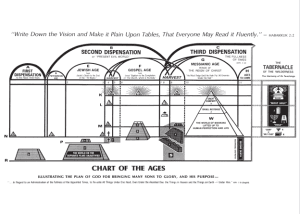
The Jewish Age, the time when God dealt with the Jewish people, and with them only, shown by And I will take you to me for a people, and I will be to you a God: and ye shall know that I am the LORD your God, which bringeth you out from under the burdens of the Egyptians. (Ex. 6:7.)
You only have I known of all the families of the earth: therefore I will punish you for all your iniquities. (Amos 3:2.) and other Scriptures.
The Gospel Age, the time in which we live, shown by And Jesus went about all Galilee, teaching in their synagogues, and preaching the gospel of the kingdom, and healing all manner of sickness and all manner of disease among the people. (Matt. 4:23.)
And he said unto them, Go ye into all the world, and preach the gospel to every creature. (Mark 16:15.) And this gospel of the kingdom shall be preached in all the world for a witness unto all nations; and then shall the end come. (Matt. 24:14.) and other texts.
The Millennial Age, shown by And I saw an angel come down from heaven, having the key of the bottomless pit and a great chain in his hand. And he laid hold on the dragon, that old serpent, which is the Devil, and Satan, and bound him a thousand years, And cast him into the bottomless pit, and shut him up, and set a seal upon him, that he should deceive the nations no more, till the thousand years should be fulfilled: and after that he must be loosed a little season.
And I saw thrones, and they sat upon them, and judgment was given unto them: and I saw the souls of them that were beheaded for the witness of Jesus, and for the word of God, and which had not worshipped the beast, neither his image, neither had received his mark upon their foreheads, or in their hands; and they lived and reigned with Christ a thousand years. (Rev. 20:1-4.) and many other texts.
The “ages to come,” after the Millennial, shown by That in the ages to come he might shew the exceeding riches of his grace in his kindness toward us through Christ Jesus. (Eph. 2:7.)
Time is again divided by two Harvest periods, one closing the Jewish Age and opening the Gospel Age, and shown by Then saith he unto his disciples, The harvest truly is plenteous, but the labourers are few; Pray ye therefore the Lord of the harvest, that he will send forth labourers into his harvest. (Matt. 9:37,38.)
Say not ye, There are yet four months, and then cometh harvest? behold, I say unto you, Lift up your eyes, and look on the fields; for they are white already to harvest. (John 4:35.) and other texts.
The other closing the Gospel Age and opening the Millennial Age, and shown by Let both grow together until the harvest: and in the time of harvest I will say to the reapers, Gather ye together first the tares, and bind them in bundles to burn them: but gather the wheat into my barn. … The enemy that sowed them is the devil; the harvest is the end of the world; and the reapers are the angels. (Matt. 13:30,39.) and other texts.
The varied work of these several divisions is also clearly marked in the Scriptures. The selecting, in the Patriarchal Age, of one man (Abraham), through whom to bless all the nations of the earth, is shown by And the LORD said, Shall I hide from Abraham that thing which I do; Seeing that Abraham shall surely become a great and mighty nation, and all the nations of the earth shall be blessed in him? (Gen. 18:17,18.) and other Scriptures.
The twofold work of the Jewish Age, first the picturing in types and symbols, for our instruction, the entire plan of salvation, is shown by Now all these things happened unto them for ensamples: and they are written for our admonition, upon whom the ends of the world are come. (1 Cor. 10:11.) and second, the trial and development of a “House of Servants,” shown by And Moses verily was faithful in all his house, as a servant, for a testimony of those things which were to be spoken after; (Heb. 3:5.) and by the entire eleventh chapter of Hebrews.
The work of the Gospel Age, namely, the development of a House of Sons, the taking out a people for His name, the perfecting of the saints, the body of Christ, and the preaching of the Gospel for a witness, is shown by But Christ as a son over his own house; whose house are we, if we hold fast the confidence and the rejoicing of the hope firm unto the end. (Heb. 3:6.)
Simeon hath declared how God at the first did visit the Gentiles, to take out of them a people for his name. (Acts 15:14.)
And he gave some, apostles; and some, prophets; and some, evangelists; and some, pastors and teachers; For the perfecting of the saints, for the work of the ministry, for the edifying of the body of Christ: (Eph. 4:11,12.)
And this gospel of the kingdom shall be preached in all the world for a witness unto all nations; and then shall the end come. (Matt. 24:14.) and other texts.
The work of the Jewish Harvest, gathering the true-hearted Israelites into the Garner of the Gospel Church, and burning the chaff of merely nominal Israel in the fire of affliction, is shown by Whose fan is in his hand, and he will thoroughly purge his floor, and will gather the wheat into his garner; but the chaff he will burn with fire unquenchable. (Luke 3:17.) and other texts.
The work of the Gospel Harvest, the separation of God’s true Church from merely nominal Christians, is shown by Let both grow together until the harvest: and in the time of harvest I will say to the reapers, Gather ye together first the tares, and bind them in bundles to burn them: but gather the wheat into my barn. (Matt. 13:30.) and other texts.
While the work of the Millennial Age is shown by After this I will return, and will build again the tabernacle of David, which is fallen down; and I will build again the ruins thereof, and I will set it up: That the residue of men might seek after the Lord, and all the Gentiles, upon whom my name is called, saith the Lord, who doeth all these things. (Acts 15:16,17.)
For it is written, As I live, saith the Lord, every knee shall bow to me, and every tongue shall confess to God. (Rom. 14:11.)
For the earth shall be filled with the knowledge of the glory of the LORD, as the waters cover the sea. (Hab. 2:14.)
And they shall not teach every man his neighbour, and every man his brother, saying, Know the Lord: for all shall know me, from the least to the greatest. (Heb. 8:11; see also, Jer. 31:33,34.)
For full and detailed explanation of the work of the different periods see A, B and C.*
* These features of the chart, together with its remaining features, the several horizontal lines, the perfect and imperfect large and small pyramids, and the outline of the tabernacle, will be found fully explained in A, pp. 219-244.