
Its Importance as a Chronological Feature.
“Then shalt thou cause the trumpet of the jubilee to sound on the tenth day of the seventh month, in the day of atonement shall ye make the trumpet sound throughout all your land” (Leviticus 25:9).
Amongst the features of Israel’s history that have specially interested God’s people is that of the Sabbath and Jubilee system which provided special days and years of rest; and from this arrangement there has been deduced quite an important line of reasoning that has been woven into our chronological system, the results of which have greatly strengthened the conclusions of Bible students during the past 50 years, that the times of restitution were already chronologically due to begin. Referring briefly to the system as it was given to Israel, we observe that the year of Jubilee was a sabbath of rest and refreshing, both to the people and to the land which God gave them. It was the chief of a series of sabbaths or rests.
Reckoned According to Sabbatic System of Sevens
The sabbath year occurred every seventh year. In it the land was allowed to rest and no crops were to be planted. Seven of the sabbath years, embracing a period of seven times seven years, or forty-nine (7 x 7 = 49), constituted a cycle of sabbath years.
Those familiar with the presentations on the subject of the Jubilee in “The Time is at Hand,” will readily recall the method of reckoning by which the conclusion is reached, that 1874 marks the beginning of the great Jubilee, or Times of Restitution.
It has been a very general understanding of Bible students based upon this interpretation of Israel’s Jubilee system, that seventy Jubilees with 49 years between, was the full number divinely intended to be celebrated; that with the expiration of these seventy cycles, provided they had been faithfully kept by the nation of Israel, the great antitypical Jubilee, the Times of Restitution, would begin to be ushered in. It is stated in Leviticus 25:10,11, that these Jubilees were to be celebrated at the end of cycles of 49 years each, the Jubilee being called the fiftieth year.
The conclusion that seventy Jubilees constituted the entire number is based wholly on the “sabbaths” referred to in the words of 2 Chronicles 36:21, which read: “To fulfil the word of the Lord by the mouth of Jeremiah, until the land had enjoyed her sabbaths; for as long as she lay desolate she kept sabbath, to fulfil threescore and ten years”; the supposition being that Jubilee sabbaths were referred to. It is not our purpose to question the claim that this Scripture proves conclusively that seventy Jubilees was the divinely intended number to be celebrated, but rather to consider how the change of nineteen years in the chronology of Gentile rule affects the ending of the Jubilee cycles. We take for granted that the seventy years during which the land was to enjoy her sabbaths, refers to the divinely intended number of Jubilee-year sabbaths to be kept by the nation of Israel.
A Year of Liberty and Rest
As to the significance of the Jubilee, Brother Russell set forth the matter, which all have generally understood:
“While in the typical Jubilee year many restored liberties and blessings were at once entered upon, yet probably most of the year was required to straighten out affairs and get each one fully installed again in all his former liberties, rights and possessions. So, too, with the antitype, the Millennial Age of Restitution. It will open with sweeping reforms, with the recognition of rights, liberties, and possessions long lost sight of; but the work of completely restoring (to the obedient) all that was originally lost will require all of that Age of Restitution. The first work in the typical Jubilee year would naturally be a searching out of former rights and possessions and the ascertaining of present lacks. Tracing the parallel of this, we should expect in the antitype just what we now see going on all about us.”
Now let us again bring before our minds the Divine instruction to Israel as to how they should count to reach the typical Jubilee year. We read: “And thou shalt number seven sabbaths of years unto thee, seven times seven years; and the space of the seven sabbaths of years shall be unto thee forty and nine years” (Leviticus 25:8). Concerning the year of Jubilee itself, we read: “And ye shall hallow the fiftieth year, and proclaim liberty throughout all the land unto all the inhabitants thereof; it shall be a Jubilee unto you” (Leviticus 25:10). In some sense therefore the fiftieth year was to be the Jubilee year, and was to begin in connection with the close of the forty- ninth year. The time of year for the Jubilee to begin to be celebrated was in the autumn (October), as we read:
“And thou shalt number seven sabbaths of years unto thee, seven times seven years; and the space of the seven sabbaths of years shall be unto thee forty and nine years. Then shalt thou cause the trumpet of Jubilee to sound on the tenth day of the seventh month, in the day of atonement shall ye make the trumpet sound throughout all your land. And ye shall hallow the fiftieth year. … A Jubilee shall that fiftieth year be unto you” (Leviticus 25:8-11).
Two Methods of Reckoning
We call attention to two different methods of counting to reach the Jubilee.
One of these that many of us have observed in the past was as follows: Basing our calculation of course upon the seven-year cycles, 7 x 7, each seventh year being a sabbatic year, the conclusion is reached, namely 49 years, the forty- ninth being a sabbatic, or rest year, the following or fiftieth was calculated as the Jubilee year. Thus this method of reaching the next fiftieth or Jubilee year proceeds as follows: Commencing the first year of the next seven-year cycle after the Jubilee and permitting a break or a skipping of one year in following out the seven-year cycle system, thus, 7 x 7, again brings us to another Jubilee at the end of 49 years and constitutes each Jubilee cycle 50 years, running thus, 50+50+50. We believe that this method was not the one followed by the Jews and that it does not meet the requirement specified in the Law; one point of error being in permitting the break to occur in the sabbatic system or the seven- year cycle every 50 years — the passing over of one year, that of the Jubilee. There was no intimation in the Law to Israel that this break should be permitted to occur. The sabbath system of seven was intended to count without cessation or break, for any reason, either on account of the Jubilee or any other. A careful review of various facts bearing upon this subject reveals, we believe, that the Jews observed a different method from the foregoing.
First it is important to remember that the system of year-sabbaths being identified with their land, Canaan, and their inheritance in it, the first cycle of forty-nine years, leading to the first Jubilee, should begin to count from the time they entered Canaan. This reasonable inference is made positive by the Lord’s words — “When ye come into the land which I give you, then shall the land keep a sabbath [observe the sabbath system] unto the Lord. Six years thou shalt sow thy field, and six years thou shalt prune thy vineyard, and gather in the fruit thereof; but in the seventh year [from entering the land] shall be a sabbath of rest unto the land” (Leviticus 25:2-4). So then, the cycle of seven times seven, or forty-nine years (7 x 7 = 49), began to count at once on entering the land of Canaan.
Jubilee Typified Forty-Ninth Thousand Years Not Fiftieth
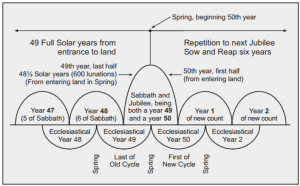
In this method which we now submit it is seen that the septenary count or count by sevens is not disturbed or interrupted by Israel’s Jubilee celebration; there is no extra year, no year skipped every 49 years. In other words it will be seen that the Jubilee year, which is designated the fiftieth, extended from the day of atonement in the forty-ninth year (reckoning from the spring, when they entered the land), to the same date in the fiftieth year, and was thus an overlap- ping of the forty-ninth and fiftieth years, the course of Jubilees being 49+49+49 years, etc.
Israel’s Jubilee year is very generally understood to be a type of the “Times of Restitution.” Accepting this as a true interpretation, we ask, If it occurred on a year following a seventh or a forty-ninth year, as it would if reckoned from the fall after the entrance into the land, which of course would be an eighth and a fiftieth, how could it possibly typify a seventh or a forty- ninth thousand years? If it was celebrated on an eighth or a fiftieth year, would not the “Times of Restitution” be due to begin on the eighth and fiftieth thousand years, thus making the antitypical Jubilee due to begin a thousand years hence? The Scriptures indicate that there would be six toiling days of one thousand years each, and the seventh thousand years (not the eighth) would be the Millennial Times of Restitution; and what seems to us another type teaches that there would be seven great epochal days of seven thousand years each in length, and the forty- ninth thousand years (not the fiftieth) would be the “Times of Restitution.” The question is, How shall we harmonize these apparent contradictions and inconsistencies?
The answer we believe is found in being able to show that the count by sevens is not interrupted, and that Israel’s Jubilee year — beginning as it did in the seventh month of their forty-ninth year, reckoning from the time they crossed the Jordan and entered Canaan — was made up of the last half of the forty-ninth year and the first half of their fiftieth year. There are two ways of demonstrating this. We will consider first the one that may be to some the more easily comprehended.
Count Commenced in Spring of Year
Again we emphasize the point that the time to begin the count of the 7 x 7, or 49 years, was not in Israel’s seventh month, but rather on the tenth day of their first month when they crossed Jordan. The time Israel’s year began is divinely stated: “This month shall be unto you the beginning of months: it shall be the first month of the year to you” (Exodus 12:2). This was in what we call the spring. It was on the tenth day of this month, the month Nisan, that the passover lamb was set apart (Exodus 12:3). It was on the tenth day of this month that Israel crossed Jordan and entered Canaan. (Josh. 4:19). It was on this very day — “When ye come into the land” — that they were to begin the count to reach the Jubilee year (Leviticus 25:2). The Jews had two commencements of the year, and because of this it is commonly but inaccurately said that they had two years, the sacred and the civil. It is more correct to say, the sacred and civil reckonings. The sacred reckoning was that instituted at the Exodus, in what we would call the spring. By the civil reckoning the first month was the seventh, which began in what we call the autumn. However, we know of no Scripture referring to the Levitical economy in which the seventh month was called the first. What are commonly called the civil and the sacred years were both lunar years, of 354 days. It was when the epacts of about 11 days grew by repetition to complete lunations (months) that the years were made to agree with solar years. This was done by intercalation, and recurred seven times in 19 years.
Jubilee a Forty-Ninth and Fiftieth Year
Following the Divine instructions, the fiftieth year would begin at Nisan, in what we term the spring, after the lapse of forty-nine full solar years. However, it is divinely stated that their Jubilee year was to begin in their seventh month, Tishri, in what we term the autumn (Leviticus 25:9). This being a fact that is indisputable, the question most naturally arises, Did the Jubilee year begin in the autumn following the spring when forty-nine full solar years had elapsed, or in the autumn preceding? If it began in the autumn following the end of the forty-nine full solar years, it is evident that the last half of it would extend through the first half of the fifty-first year. If it began, as we have Scriptural reason to believe it did, in the autumn preceding the end of the forty-nine full solar years from the entrance into the land, it would include the last half of the forty-ninth solar year and the first half of the fiftieth. The Jubilee year, according to this method, would be an overlapping of Israel’s forty-ninth and fiftieth years, reckoning, as we are divinely instructed to do, from the entrance into the land on the tenth day of the first month of their first year.
This is a simple way of stating it, and perfectly accords with its typical char- acter, being both a seventh and a forty-ninth year, which is required in order for it to foreshadow the “Times of Restitution.” It also preserves the septenary count, and is in a sense a fiftieth year, as the Scripture requires it to be; and, as we shall endeavor to show, it meets the requirements that are set forth in Leviticus 25:20-22.
Forty-Nine Years Form a Soli-Lunar Circle
However, before considering these verses, we call attention to a still more convincing method of proving the correctness of the above conclusions. This is the more important one — the one that will require deeper research and study. This method requires that we understand that the Jewish month was strictly lunar; that is, it was a lunar month, comprehending the period elapsing between one new moon and another new moon. This period was practically 291 days. A Jewish year comprised twelve lunar months or 354 days. However, the count of 7 x 7 or 49 years was full solar time; lunar time being made to agree with solar by frequent intercalation. The Jewish sacred feasts, however, were regulated by lunar or moon time and not by solar. And while the adjustment of solar to lunar years was effected by the intercalation of months, as the epact grew by repetition to complete lunations, there was no break whatever in the lunar or moon months, regulating their sacred feasts, each month beginning with the new moon and ending with the next new moon. This succession in reckoning in regulating their sacred feasts continued right on without a break throughout the whole period of the forty-nine solar years — indeed, throughout the whole of Jewish history.
It will have been noticed by all who have given any attention to the matter that the Jewish new year does not start each year on a date to correspond with our solar year dates. The reason for this is, of course, that they begin their new year with the appearance of the new moon nearest the vernal equinox. This causes the beginning of their year to vary from our solar dates, sometimes nearly a whole month. We note this peculiarity every year in our observance of the yearly Memorial of the antitypical Passover, our Lord’s death, which occurred on the fourteenth day of the Jewish new or sacred year. The day of atonement, which was celebrated on the tenth day of the seventh month, was located, not by counting six solar months from the tenth day of their first month, but rather by reckoning six complete moons, or lunar months, which would make it occur about 51 days sooner than our solar calendar would register. This is because there is a difference of about 11 days between a solar and a lunar year.
Now, note carefully the effect this has upon the matter of locating the beginning of the Jubilee year. The fact that the Jewish feasts were regulated by lunar time, lunar months, would make it necessary that at the time the Jubilee would be celebrated, the year and months or solar and lunar dates would have to perfectly agree. As bearing on this we notice first that forty-nine full solar years are equal to 606 lunar months. Forty-nine years, then, form what is called a soli-lunar cycle. A soli-lunar cycle is a period of time in which, after a certain number of years, the sun and moon occupy in the heavens the same relative position to each other that they did when the cycle began, which of course would mean that if our solar calendars were absolutely correct, the solar (sun) and lunar (moon) calendars would agree or register the same day of the month as they did when the cycle began.
Furthermore, as bearing on the matter that the Jubilee year began immediately the day after the tenth day of the seventh month, in the autumn preceding the end of forty-nine full solar years, it would be necessary that an exact number of months would terminate on the tenth day of the seventh month, the day of atonement, of that particular year. This was the case. The interval from the tenth day of the first month of the first year (beginning in the spring), to the tenth day of the seventh month in the forty-ninth year was exactly 600 lunations. Forty-eight solar years, and six months, are substantially the measures of 600 lunations.
Regulated by Revolutions of Both Sun and Moon
We cannot do better in this connection than to quote the words of Mr. Guin- ness, whose exhaustive research and study, both as an astronomer of rare ability and as a Bible expositor, offers much assistance in the investigation of this subject
“The divinely ordained Levitical chronology was soli-lunar, i.e., it was regulated by the revolutions of both sun and moon. Its years were solar, for they followed the seasons, as in the various ordinances connected with the ingathering of the fruits of the earth; while its months were strictly lunar — not artificial months, but lunations — certain ordinances being connected with the recurrence of every new moon. The adjustment of solar to lunar years was effected by the intercalation of months, as the epact grew by repetition to complete lunations.
“The feasts of the Lord, representing the history of redemption, were connected with certain days of lunations and phases of lunar fulness; as the passover with the tenth and fourteenth day of the first month; the feast of unleavened bread with the fifteenth; the feast of trumpets, the day of atonement, and the feast of tabernacles, with the first, tenth, and fifteenth day of the seventh month, etc. Lunar revolutions were the chronometric wheels measuring the intervals of the Levitical calendar.
“There is a close adaptation in lunar phases to the septiform arrangements of the calendar The nature and closeness of this adjustment was very remarkable in the case of the Jubilee. The Jubilee reckoning, regulating important civil arrangements in the land of Canaan, began with the day on which Israel crossed Jordan and entered Palestine. Like the sabbatic law, of which it was an expansion, its point of commencement is thus defined, ‘when ye be come into the land,’ etc. (Leviticus 25). Now, as the Jubilee was regulated by years, for it recurred every forty-ninth year at the time of the autumnal harvest, and was also regulated by months, for it was reckoned from the tenth day of the first month when Israel crossed Jordan, and the Jubilee day was the tenth day of the seventh month (that of atonement), it was important that the year and months should closely agree. It is most interesting to observe that such is their natural adjustment that, in the first place, forty-nine years form a soli- lunar cycle; and in the second place, the interval from the tenth day of the first month of the first year, to the tenth of the seventh month of the forty-ninth, is exactly 600 lunations forty-eight solar years, six lunar months, nine days, and fourteen hours, of a tenth day, or 17,718 days, 8 hours, are the measures of 600 lunations. It should be observed that the day of atonement was reckoned from the evening of the ninth day to the evening of the tenth, ‘in the ninth day of the month at even, from even unto even shall ye rest’ (marginal reading).
“It will be seen from this, that the Jubilee redemption rest followed immediately on the expiration of the complete period of 600 months. As 600 months are exactly fifty lunar years, the fiftieth lunar year terminated on the day of atonement, on which day the Jubilee year commenced. The Jubilee year, which is called the fiftieth, extended from the day of atonement in the forty- ninth year to the same date in the fiftieth year, and was thus an overlapping year, the course of Jubilees being 49+49+49 years, etc.”
The accompanying diagram (next page) illustrates various features explained foregoing.
Sun and Moon Rule Night and Day
It seems most evident that Bible students have for some cause not given sufficient attention to the Scripture teaching concerning solar and lunar influence and dominion, and the relation that both sustain to the times and seasons of God’s dealings with man. We have failed to realize the wonderful significance of the words of Genesis:
“And God made two great lights; the greater light to rule the day, and the lesser light to rule the night. And God set them in the firmament of the heaven to give light upon the earth, and to rule over the day and over the night, and to divide the light from the darkness.” “And God said … let them be for signs, and for seasons, and for days, and years.”
The three great tasks assigned to the sun and moon by the Creator are, to rule, to give light, and to divide — to mark out the boundaries that separate day from night, month from month, year from year, “appointed time” from “appointed time.” Let it be noted that the inspired narrative says, let them be for signs and seasons, etc.; that is, let them in their conjoint revolutions be such. “So obvious and influential are the main revolutions of these ‘great lights’ that in all ages men have as a matter of fact divided time by their means. The movements of the sun and moon are such that naturally in most lands and ages, those of both, and not those of either alone, have been employed as measures of time.” The more these facts concerning the times and seasons are studied in their relation to these divinely ordained typical feasts of redemption, the more will we realize their Divine authorship. There is much, very much yet to be learned about them. This is evidently one of the ways God has hidden, until a due time, the prophetic periods of the “time, times, and a half,” the “seven times,” etc.
Again as illustrating the fact that there was a close adaptation in lunar phases to the septiform arrangement of the calendar, we cite the prophecy regarding the “seventy weeks,” appointed to extend from the going forth of the commandment to restore and to build Jerusalem unto Messiah the Prince, as an illustration of an enlarged Jubilee cycle, the former being 49 and the latter 490 years (Daniel 9:24-27). Thus the period to the end of the Jewish favor was not ten times fifty, but ten times forty-nine, or 490 years
Were There Two Consecutive Rest Years?
We notice next that while the foregoing is sufficient of itself to establish the fact that Israel’s Jubilee year was an overlapping of the forty-ninth and fiftieth solar years, reckoning from the tenth day of the first month of the first year when they entered Canaan (and thus the septenary count is not disturbed), this conclusion, as we would expect, also meets all the requirements set forth in Leviticus 25, where the Jubilee subject is specially treated. These requirements are stated in verses 20-22, and read:
“And if ye shall say, What shall we eat the seventh year? behold, we shall not sow, nor gather in our increase: Then I will command My blessing upon you in the sixth year, and it shall bring forth fruit for three years. And ye shall sow the eighth year, and eat yet of old fruit until the ninth year until her fruits come in ye shall eat of the old store.”
That these words apply to the Jubilee arrangement seems very evident, because the Jubilee is the matter specially considered in the preceding verses. Of course, with our understanding that the Jubilee and sabbatic years were celebrated the same year, the words apply to both. If it be said that they apply to the sabbatic year only, which we would be obliged to say if the Jubilee year followed the seventh or sabbatic year, then we have recorded no promise on the part of Jehovah concerning a special provision made by Him for that, the Jubilee year. Furthermore, it will be readily seen that if there were to be two rest years in succession, the important matter of most special solicitude on the part of the Israelites would be concerning an additional year — the year following the sabbath, which would of course be both a fiftieth and an eighth.
Considering the matter from the standpoint that the sabbatic year or seventh year was in point of time identical with the Jubilee year, we meet with no diffi- culty in explaining these words.
The first proof we present to support this, is the statement “If ye shall say, what shall we eat the seventh year?” — not the eighth year. Certainly this is in perfect harmony with what we have already noted is taught in the foregoing, namely that the Jubilee year was from the last sabbatic year, a seventh year, and must begin immediately following the occurrence of 600 lunations. It must commence after the tenth day of the seventh month, the day of atonement; this, as we have seen, would then be in the middle of the 49th solar year from the entrance into the land. In other words, forty-eight and a half solar years having elapsed from the spring when they entered the land, to the fall or middle of the 49th year, when the Jubilee began.
Sowing the Eighth Year
The next matter bearing on this that is mentioned in the text is equally conclusive evidence that the Jubilee year was identical with the sabbatic year in point of time. In other words, the Jubilee year was both a seventh and a forty- ninth year. The words are: “And ye shall sow the eighth year.” Is it not apparent that if the Jubilee year were an eighth year, as it would have to be if it began immediately after the lapse of forty-nine full solar years, this would conflict with the command that there should be no sowing or reaping in that year? That the seventh or sabbatic year on the occurrence of the 49th year is the Jubilee will be seen from the fact that when the Lord said, “What shall we eat the seventh year,” He is referring to both the Jubilee and sabbath year; for both are clearly referred to in the context. See verses 4, 8, and 10.
We consider next the words: “Then I will command My blessing upon you in the sixth year, and it shall bring forth fruit for three years.” This statement would seem at first as though provision were made for two rest years, but not so. Let us note carefully the accompanying diagram:
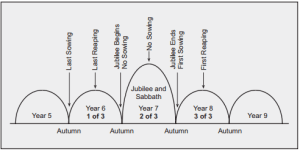
By a careful study of this view it will be seen that God’s blessing upon the sowing and reaping of the sixth year was to be such as to supply the people with food for the sixth, seventh, and eighth years, until the ninth year opened, in harmony with the word of the Lord quoted above “until her [the eighth year] fruit come in.” Thus we see that instead of the Jews having only five years in which to work the land, they had in every case six years, as the diagram shows, and at the same time, in harmony with the command, it was necessary for them in the sixth year preceding the Jubilee to reap sufficient to provide them for the sixth, seventh, and eighth years, as they would not sow again until after the Jubilee would end, which would be in the fall, and would need to continue to eat the fruit of the sixth year until the fruit of the eighth year come; this would be close unto the ninth year, as stated in the Divine instruction.
An Illustration Indicating Error
We submit still another diagram [next page] which is designed to show that the method of making the Jubilee year follow a seventh or sabbatic year, does not meet the requirements of Leviticus 25:20-22. (Read Scripture carefully.)
From this view it will be seen that as there could be no reaping when the sabbatic year opened, the last sowing (the crop of which would have to last through both the sabbatic year and the Jubilee year), would have to be in the autumn, when the sixth year had begun. In other words, as according to this view there could be neither sowing nor reaping, on either the sabbatic or Jubilee years, the sowing at the beginning of the sixth year would have to last four years instead of three. Hence, this diagram and explanation fails to meet the Scriptural requirements.
In consideration of the testimony and evidence herein offered we conclude that the celebration of both the Jubilee and sabbatic years began at one and the same time, in the fall (Deuteronomy 31:10, Leviticus 25:9), and that only by arranging that the Jubilee and 49th or sabbatic year should be one, could there be avoided the break in the septenary or count of sevens; and that this was done by having the count to reach the Jubilee year begin in the spring, when the Israelites entered the land. In this method of counting, 49 full solar years thus elapsed from the spring of the first year to the spring of the 50th year. The sabbatic year, which would be a 49th, began the autumn before this, and to make the Jubilee and 49th or sabbatic year begin at the same time, the Jubilee year also began the fall before and not after the spring when the 50th year from the entrance to the land began. This would constitute the Jubilee both a 49th and a 50th year, through an overlapping process.
Remarkable Harmonious Adjustments
Commentators in general who have written on the subject have adopted this method of counting the fiftieth year as inside of the 49-year cycle and not as an extra year. It will be seen then by those who carefully observe this difference in counting, that the course of 70 Jubilees in the old method would be 50 + 50 + 50, etc., making in all 3500 years, while in the other, which we regard as the correct method, the course of 70 Jubilees would be 49 + 49 + 49, etc., making 3430 years.
We must look to discover what difference is made in the ultimate results counting the 70 Jubilee- year cycles with 49 years each. First we recall the 19 years’ shortage in connection with the starting of the times of the Gentiles, in 606 BC, and Zedekiah’s overthrow in 588 BC. A moment’s thought will cause one to see that while the period from Zedekiah’s overthrow has been affected to the extent of lengthening out the period of Gentile rule by nineteen years, the period from the entrance of Israel into the land of Canaan, up to Zedekiah’s day is not affected. This period is 969 years, and is found as follows:
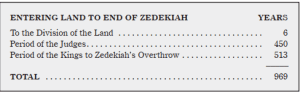
Regarding the former reckoning of the Jubilee cycles as 50 years each, it is remembered that the method pursued to discover when the last typical Jubilee was due to be celebrated before the Babylonian servitude began, was to divide these 969 years by 50. By thus doing, it was found that 19 Jubilees had been celebrated, with 19 years remainder. It will be seen then, according to that reckoning, that 19 years had elapsed at Zedekiah’s overthrow, since the last one was celebrated. This is easily seen because 969 years had elapsed since the entrance of Israel into the land, and if 50+50+50, etc., was the course of Jubilees, then dividing 969 by 50 would give the number celebrated. And if 606 BC marked Zedekiah’s overthrow, as was our thought, then 19 years before this date would reach the year the last one was celebrated, which was 625 BC.
Now mark the result of following the other method, that of making the course of Jubilees to be 49+49+49, etc. Understanding that Zedekiah’s overthrow occurred 588 BC, when, of course, the same number of years had elapsed, namely 969, we divide this number by 49 instead of 50, and find the result to be in the number of Jubilees celebrated exactly the same — 19; but the remainder we find to be 38 years instead of 19. Adding the 38 years, instead of 19, to 587 BC, instead of to 606 BC, we discover that we reach the same date, 625 BC, as the time the last typical Jubilee was due to be celebrated. 969 / 49 = 19 and 38 remainder: 587 + 38 = 625 BC.
Former Conclusions Regarding 1874 Sustained
In other words, allowing but 49 years to each Jubilee cycle instead of 50, we gain 19 years over the other method, from the time of Israel’s entering the land to Zedekiah’s overthrow, and this 19 years exactly offsets the other 19 years we lose in computing the times of the Gentiles from Nebuchadnezzar’s first year.
It is then seen that if 19 Jubilees had been observed up to 625 BC, there would remain 51 Jubilees still unobserved of the original 70 contemplated. Thus 51 x 49 = 2499, as the number of years to be measured from 625 BC to reach the end of the 70 sabbatic Jubilee cycles: 2499 – 625 = 1874 AD, the end of the 70 Jubilee cycles.
Stating the matter in another form: It has been quite generally understood among Bible students for some years past that as the Jubilees were a part of the Law Covenant, and like all the other features of the Law, were very imperfectly kept or celebrated, and sometimes, perhaps the Jubilees were not celebrated at all, hence the proper way to discover when the great antitypical Jubilee would be reached would be by counting the full number of years which would elapse to make seventy Jubilees. This would be done by adding 49+49+49, etc., until 70 had been counted; or by multiplying 49 years by 70, which equals 3,430 years. This will be found to reach the same time — 1875. Thus:
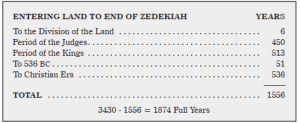
Does this not appear to be indeed an illustration of a Divine overruling — calculating incorrectly the two matters, as we have been accustomed to doing in the past, that of Gentile dominion and of the Jubilees — our mistake in the one instance perfectly counterbalancing the mistake made in the other?
Other Evidence in Support
It occurs to us in this connection that we may well supplement the evidence that we have already given as to the unbroken septenary count — the counting of the 7-year cycles without any break — by referring to certain historical matters in connection with Zedekiah’s overthrow. By a careful comparison of Jeremiah 37:1-11, 34:21,22, with Jeremiah 39:1,2, it will be seen that in connection with the last siege, which resulted in the destruction of Jerusalem, Nebuchadnezzar’s army came twice into the land before Zedekiah was overthrown. The first time he was obliged to withdraw his army on account of being menaced by the King of Egypt. Just previous to this first invasion, about three years before Jerusalem was destroyed, indeed, on account of the threatening invasion, Zedekiah and his nobles, through fear, and by an endeavor to gain Jehovah’s favor, to the end that the judgment might be stayed, started to observe a sabbatic year by letting their servants go free. When Nebuchadnezzar’s armies withdrew, on account of being menaced by the King of Egypt, Zedekiah and his associates apparently repudiated their observance of the sabbatic year and began to take their slaves back again. Jeremiah the Prophet then told the king, Zedekiah, that Nebuchadnezzar would come back (Jeremiah 34:8 — 22), and in harmony with this prediction Nebuchadnezzar did return, in Zedekiah’s ninth year and tenth month (Jeremiah 39:1), and the city of Jerusalem was besieged by Nebuchadnezzar at this time until its fall in Zedekiah’s eleventh year and fourth month.
Now the conclusion to this matter is this: According to the foregoing method of reckoning the sabbatic years, the count of sevens, a sabbatic year was due to be observed in Zedekiah’s eighth year, which, according to the chronology, would be the 966th year from the entrance of the Israelites into the land.
That this sabbatic year occurred in the 966th year from the entrance into the land will be seen when we bear in mind that the date 625 BC, which corresponded with the 931st year from entering the land, was the year when a sabbatic Jubilee was due. This, as we have shown, was 37-38 years before the overthrow of Zedekiah, which overthrow was in 588 BC. By a division of 38 by 7 we have 5 sabbatic years and 3 years remainder up to the destruction of Jerusalem, which, as we have claimed, was in 588 BC; and as 588 BC corresponds with 969 years from the entrance into the land, three years back of that would bring us to the 966th year or 591-590 BC, when a regular sabbath was due, as was proved by the fact that Zedekiah and his nobles, that year undertook to observe the sabbath by conforming to the requirements given in the Law.
On the contrary, if we calculate the sabbath and Jubilee years according to the old method and allow that a year was passed over in every 50 and a break occurred in the sabbatic system, then there would not have been any sabbath year due to be kept at the time when Zedekiah and his nobles began to observe it, 591-590 BC, for it would have come two years earlier, or in 593-592 BC; for about 606 would have been the last Jubilee, instead of 625, leaving 19 years remainder, which, divided by 7, would make 2 sabbath years, the last one of which would be due to be observed 592 BC; and 5 years remainder to 587 BC; whereas the Scripture records we have cited above show a sabbath year observed by Zedekiah about 591-590 BC, which is entirely harmonious with our method of reckoning.
The Year 1925 Not Indicated in the Jubilee System
As we have been preparing the foregoing explanation, the objection is raised that the deductions herein presented would seriously interfere with the realization of certain hopes and expectations that many have entertained with regard to the overthrow of the present order of things and the establishment of the Kingdom in 1925; and we are asked to remember that the 51 Jubilee years that have not been kept since the last one observed before Israel went into servitude, added to 1874, brings us to 1925, when, as some have thought, the Great Jubilee was to commence in full.
Our reply to this is that we quite fully agree that in following that which we find to be the Scriptural method of reckoning the Jubilees, the results in some respects are quite different from those of the old method. In calclating the Jubilee cycles, allowing 49 years to each, and counting the Jubilee year as one of the 49 years and as one of the cycles of seven, we discover of course that there are no grounds for the accumulation of 51 extra years since the last one was observed in the days of ancient Israel, but at the end of the 70 cycles of 49 years each, which is reached about the year 1875, the entire matter ends and there is no extension of it beyond that point. Since about the year 1875, it would therefore seem that we have been realizing in some important measure the fulfilment of the antitype, the blowing of the Jubilee trumpet — the general awakening of the world as to its rights and liberties, and a general preparation looking toward the introduction of the great thousand-year Jubilee period in full, in due time.
We must conclude, therefore, that there is no foundation whatever, for believing that anything of an unusual character was to take place in the year 1925; no reason for expecting that this order of things was to pass away, nor that the Kingdom was to be established then.
Again we urge upon the brethren everywhere great conservatism and modesty in this time, when so many seem to be giving loose reign to wild fancy and foolish speculation with regard to fixing of dates for this, that or the other thing to happen. Let us require a “thus saith the Lord” for all that we receive as truth on the subject of time features, as well as upon every other line that has to do with our system of faith. Let us cultivate more and more the disposition to wait upon the Lord for His due time, and so far as our own departure or deliverance is concerned, to strive to be ready at all times; and while we are waiting, to give heed to our Master’s solemn warning to “watch” and keep our lamps trimmed and burning.