
It is good that a man should both hope and quietly wait for the salvation of the LORD. –Lam. 3:26.
THE Plan of Salvation shall run its appointed course according to times and seasons, which can neither be altered nor hastened. The whole creation awaits God’s good pleasure; but those who have an understanding of the Plan of the Ages do not wait in ignorance. The children of God wait because they believe that the Lord’s times are best; the children of the world wait because they must.–Rom. 8:19-23
Rewards for Faithful Waiting
We recall to mind how the Lord specially rewarded some of the Ancient Worthies who, in the midst of trials and testings, faithfully waited for the fulfilment of His promises.
Noah, after building the Ark, waited seven days for the flood. (Gen. 7:10) This final period, though short, must have been a time of great trial. Noah endured, and his faithful waiting on God was vindicated when the waters bore up the ark, and he with his household were alone saved.
Abraham, after a long 25 years of waiting, had the joy of begetting a “son indeed,” in whom centred all the promises. For the fulfilment of these promises he still waits, as do also Isaac and Jacob, his heirs. But so real did the promises appear, that these three patriarchs “died in faith” having “seen them afar off, and were persuaded of them, and embraced them.” (Heb. 11:13) What grand men they were! There is nothing more wonderful in all the earth than a man who lives in quiet faith in God.
Moses waited for forty years in the wilderness for God to appoint him the saviour of his brethren. He believed the Lord’s promise that His people would be delivered from Egyptian bondage in the fourth generation (Gen. 15:13-16); and when forty years old he sought to be the champion of the oppressed. But at that time Moses went in his own strength, and thus failed. (Ex. 2:11-15) His experiences during the succeeding forty years of waiting taught him his own nothingness; and when at last the Lord honoured him, he was the meekest man in all the earth. (Num. 12:3) His long wait was not in vain–he became a mighty deliverer.
David would not kill Saul, although himself anointed king of Israel. In spite of many opportunities he would not slay the Lord’s anointed, but waited God’s time to ascend the throne. (1 Sam. 26:23) He recovered the sacred Ark lost many years before at the overthrow of Shiloh. David was a man after God’s own heart.
Surely with these and many other examples we should willingly wait for the sure fulfilment of the promises the Lord has so graciously made to us. Nor do we forget the dire calamities that befell such as refused to wait upon God and His arrangements, when they knew they ought to have waited.
Punishments for not Waiting
The Jewish nation refused to wait for the return of the Law-giver from the mount. “As for this Moses,” they said, “the man that brought us up out of the land of Egypt, we wot not what is become of him.” (Ex. 32:1) And they made the golden calf in their impatience, and forsook the Lord. Because of this God threatened to blot them out; only two of all those above 20 years of age at the time of the exodus from Egypt, were permitted 40 years later to cross the Jordan into the promised land.–Num. 14:26-38
King Saul refused to wait for the return of Samuel, and contrary to the Lord’s appointment forced himself to offer a sacrifice. In consequence of this his house was not permitted to continue the rule in the kingdom of Israel.–1 Sam. 13:8-14
The Nominal Church of the Gospel Age refused to wait for Christ’s return, and set up a counterfeit Christendom. The result was the formation of the “abomination that maketh desolate” during that dreadful period universally known as the Dark Ages.
The Lord stigmatised the original Apostate Church as a “harlot”; and the later Protestant denominations are spoken of as her “daughters.” In the symbolical language of Cant. 2:7, the true “virgin” Church of Christ counsels the nominal churches (daughters of Jerusalem) not to stir up nor awaken love–that is, not to attempt to do the loving works of the Millennial reign of Christ; but to wait “till He please.” And they are counseled in the name of the roes and hinds of the field–two swift animals which need not to be urged to fly like the wind when occasion is necessary. So love, backed by power, represented by the cherubim with outstretched wings on the mercy-seat, will not require urging to fly to man’s rescue, whenever the atoning blood is sprinkled upon the mercy-seat the second time.
And in this we see the supreme examples of waiting; for God Himself waits to be gracious; He is not slack concerning His promise as some men count slackness, but is longsuffering, not willing that any should perish, but that all should come to repentance. (Isa. 30:18; 2 Pet. 3:9) And our Lord Jesus has patiently waited, sitting on the right hand of the Majesty on high, until God makes His enemies His footstool. Known unto God are all His works from the beginning of the world; and He will not alter any part of His plan, for He is a God of judgment. Blessed are all they who wait on Him.
Everything Awaits God’s Good Pleasure
Even material things wait to give their harmonious testimony to the truth of the Lord’s Word. The Great Pyramid in Egypt has waited for over 4,000 years to give its wonderful corroborative evidence. During all of this long period its purpose has been misunderstood. It has been set aside as merely an old tomb; whereas it is really God’s “Pillar of Witness” referred to by the Prophet Isaiah.–19:19, 20
The Written Word has had to wait till the “Living Word” should come to serve up its wonderful truths to His faithful people. Daniel was told to “shut up the words, and seal the book” of his prophecies till the “time of the end,” for none would understand their import till knowledge had increased, and many should run to and fro. (Dan. 12:4, 9) Thus Daniel’s writings had to wait for nearly 2,500 years before they could give their testimony. And even the entire Old and New Testaments, the “two Witnesses,” had to wait “clothed in sackcloth,” or dead languages, till the completion of the 1260 symbolical days (years), which is the beginning of the period spoken of in Daniel as the “time of the end.” (Rev. 11:3) They then came to “life,” and were exalted to Heaven. The Bible Societies, which came into existence immediately after 1799, multiplied the Scriptures a million-fold, and gave new life to the witnesses of God.
Archaeological remains of ancient days have waited in the dust of the earth (in Babylonia, Egypt, etc.) until their comparatively recent discovery, to add their harmonious testimony to the truth of the Bible. Before the unearthing of these material evidences, many historical narratives in God’s Word had been doubted by scholars. The child of God takes the Lord at His word, and is thus guarded against the errors arising from doubt. These archeological witnesses vindicate the faith of God’s children.
Jacob’s Waiting for Salvation Connected with his Son Dan
The founder of the Jewish nation, Jacob, declared that he waited for the salvation of God; and he strangely connected this hope with a prophetic utterance regarding one of his sons, Dan. We know that many of the patriarchs were prophets (Gen. 49:1); and their prophecies have had to wait for further elucidation by God, before their deep meanings could be searched out. This is specially true of the prophecy concerning Dan.
In Gen. 49:16-18, we read: “Dan shall judge his people, as one of the tribes of Israel. Dan shall be a serpent by the way, an adder in the path, that biteth the horse heels, so that his rider shall fall backward. I have waited for thy salvation, O Lord.”
The Tribe of Dan was Idolatrous
To understand this dark saying, we must trace the history of Dan; and we also require to take a broad survey of God’s Plan of Salvation. In Judges, chapter 18, we learn that the tribe of Dan apostatised from the worship of Jehovah, and practiced open idolatry. It is for this reason, undoubtedly, that Dan is omitted when honourable mention is made of the 144,000 of all the tribes of Israel who were sealed in their foreheads with the seal of the living God. (Rev. 7:1-8–Manasseh, Joseph’s first-born, is there substituted for Dan.) The whole manner of this tribe’s apostacy evidences an unfaithful character from the first. Its people did not conquer their inheritance in the promised land, owing to lack of faith in God; for not in their own strength, but in God’s strength, they could have overcome their enemies and possessed their portion of country. Their enemies proved too strong for them, and compelled them to keep to the hills; and latterly they forsook their inheritance and migrated north, to a country where the people feared no ill, and were not learned in the art of war. These the Danites were able to overpower; they burned Laish, and established their own city instead, which they named Dan. Thus the city of Dan became the most northern of all the cities; and as Beer-sheba lies in the south, the saying, “From Dan to Beersheba” became the picturesque way of denoting the entire length of Palestine.–Judges 20:1, etc.
Besides failing to conquer their own rightful inheritance in the land, and instead searching out an inheritance for themselves and conquering a people who hardly knew their right hand from their left, the Danites on their journey northward forcibly possessed themselves of a man’s private priest and images, and established an idolatrous worship in their city of Dan. The Scriptures say that this state of affairs continued until the captivity. (Judges 18:29-31) When on the death of Solomon the tribes of Israel divided into two kingdoms, we read that Jeroboam, the king of the ten tribes, in order to prevent his people from going up to Jerusalem to worship the Lord, made two golden calves, one of which he set up in Bethel (a little north of Jerusalem), and the other in Dan. Jeroboam then cried to his subjects; “It is too much for you to go up to Jerusalem; behold thy gods, O Israel, which brought thee up out of the land of Egypt”–after the example of his unfaithful ancestors in the wilderness at the time of the exodus from Egypt. “And this thing became a sin; for the people went to worship before the one, even unto Dan.” (See 1 Kings 12:26-30.) Jeroboam evidently found Dan to be a very suitable place to set up his idol.
Thus the city which the idolatrous tribe of Dan set up became the recognised centre of heathen worship. The stolen images placed there by the Danites at the first, represented the gods of the heathen (Baalim); and the golden calf erected there by Jeroboam centuries later, stood for Osiris, the god of the Egyptians. And the Greeks later on worshipped their god Pan in the same place. Hence the name given to the city of Dan in later times by the Greeks–Paneas (pronounced by the Arabs Banias). The Romans called it Caesarea Philippi (after Philip, the tetrarch of the region). It lies at the source of the Jordan, as can be seen by consulting any Bible map.* When we recognise the fact that Pan and Osiris, and all the other heathen gods, had their origin in the apostate Nimrod, the founder of idolatrous worship, and that these gods were each claimed to be the saviour of the dying world (a counter- feit Messiah), we can appreciate the full and significant force of Jesus Christ’s question to his disciples at this famous seat of the false Messiah. They were in Caesarea Philippi, the ancient city of Dan, and Paneas, when Jesus put the question: “Whom do men say that I the Son of man am?” And then addressing His disciples directly: “But whom say ye that I am?” What joy Jesus had when he heard Peter reply: “Thou art the Messiah, the Son of the Living God”! Jesus knew that none could perceive His identity except by inspiration. (Matt. 16:13-17) Here, right in the very stronghold of the false Messiah, Jesus tested the faith and spiritual perception of His followers, to see if they could recognise Him as the true Saviour of the death-doomed world! And the answer came spontaneously “Yes.” Truly, flesh and blood could not have revealed this great truth, but the heavenly Father alone. Great was the rejoicing of Jesus. Six days later he took his more intimate disciples up the loftiest mountain in the land, Mount Hermon, and was transfigured before them to foreshow in vision his future glory in the Kingdom of Restitution. Matt. 17:1-9; 2 Pet. 1:16-18
Bethel, where the other idol was set up, was in Ephraim’s division of the land. From one standpoint it is correct to say that the city of Dan was also in Ephraim, for this tribe was the largest of all, and frequently the entire ten tribes are collectively named Ephraim. And as the particular division of land belonging to the tribe Ephraim is also called Samaria (1 Kings 13:22), then this name Samaria as well as Ephraim, and also Israel, are used inter- changeably as the name of the ten tribes. (Hosea 7:1) Ephraim or Samaria are often taken to typify the apostate church of the Gospel Age.–Hosea 4:17; 8:5, 6
* On some maps the name Dan is shown at a place called Tell-el-Kadi; but there is no doubt that this is a mistake. In spite of the fact that the name Kadi means the same as Dan, namely, “Judge,” all the evidences prove that the successive cities of Laish or Leshem, Dan, Paneas or Banias, and Caesarea Philippi, all stood on the same site, two or three miles to the east of Tell-el-Kadi, and this site is at the source of the Jordan, where its waters break forth from the earth a full-born river, being supplied by subterranean streams.
Dan–Judas–Satan
So much, then, for the apostate character of the tribe of Dan. Now, we know that the Lord overruled all things connected with His typical people of Israel, in order that they might foreshadow the antitypical realities of the Gospel and Millennial Ages. The Apostate Danites prefigured a similar unfaithful and treacherous class in the Gospel Age, who, forsaking the Lord, set up idols in their hearts. Of this class Judas Iscariot was the forerunner. Judas, however, was but a tool in the hands of Satan, who is the great adversary and betrayer of the Lord, the real Danite and “serpent by the way.” (See John 13:26, 27.) And just as the tribe of Dan forsook their first inheritance and seized an inheritance in the north, so Satan had said in his heart that he would ascend and sit in the “sides of the north,” and that he would be “like the Most High.”–Isa. 14:13, 14
In the symbols of the Scriptures, the four cardinal points of the compass are associated with certain definite conditions. Thus we read Psa. 75:6, 7. “For promotion cometh neither from the east, nor from the west, nor from the south. But God is the judge; He putteth down one and setteth up another.” By inference, God and the place of power are understood to reside in the north. Hence Satan’s ambition to sit in the sides of the north and be like the Most High, that he might wield the sceptre of power. It is remarkable, too, that during the time of the building of the Great Pyramid (which edifice corroborates the Plan of the Ages), the north star was Alpha Draconis, the principal star in the “Dragon” constellation, a mythological representation of Satan. And this star at that time shone right down the Descending Passage of the Pyramid. When we recall that this downward passage symbolically represents the “Present Evil World,” and that Satan is Scripturally called the “god of this world,” we can see an appropriate significance in this arrangement. We do not suppose that such coincidences are haphazard; we believe them expressly supervised by God to strengthen the faith of His people. Satan, that “Dragon” and “old Serpent” (Rev. 20:1), is the god of a dying world; and this fact is portrayed in the Lord’s “Stone Witness” by the Dragon Star shining into the Entrance Passage, which descends at a steep angle down to the subterranean chamber or pit, symbolical of destruction.
Jehovah’s Great “Horse” and its “Rider”
A “horse,” when spoken of in a symbolical sense, represents an orderly plan or arrangement, progressing along an appointed path. Thus, the Lord’s “horse,” of which Jesus was the “Rider,” is the Plan of Salvation–see Isa. 31:3, where we read: “Now, the Egyptians are men, and not God; and their horses flesh, and not spirit”–in other words, the plans, doctrines, and schemes of the world are not of the spirit of God; and woe to them who rely upon such “horses.”
When Satan, the great Judas and Danite, waylaid and treacherously bit the heel of the Lord’s “horse” so that the rider Jesus fell backward and was killed, he evidently thought he had upset the Plan of God, and had forever slain the Prince of Life. But Jacob declared prophetically in the name of all Israelites indeed: “I have waited for thy salvation, O Lord.” (Gen. 49:18) That which Satan considered to be a masterstroke, when he entered into the receptive heart of Judas and caused him to betray the Lord, was in reality his own undoing; for we read that Jesus became flesh for the suffering of death, that “through death He might destroy him that had the power of death–that is, the devil.” (Heb. 2:9, 14) Thus, the death of Jesus means the salvation of the world, and the destruction of Satan.
Further Light on the Tribe of Dan
Just as the founder of the tribes of Israel, Jacob, foretold what would befall them in the last days, so the lawgiver of the nation, Moses, uttered additional prophecies in connection with each tribe. The prophecy of Moses regarding Dan gives us further elucidation as to the typical part played by this tribe in the Lord’s Plan.
In Deut. 33:22 we read: “And of Dan he said, Dan is a lion’s whelp; he shall leap from Bashan.” On glancing at a map of Palestine, it will be seen that Bashan is a mountainous district in the north, on the east side of Jordan; and the city of Dan was situated on the northwestern edge of this district. Bashan is thus identified with the idolatrous tribe of Dan.
Not only has the Lord caused the nation of Israel, and all the nations round about, to typify and illustrate various features of His glorious Plan of Salvation, but even every mountain and valley in and around the land of Palestine, every sea and river, the plains, deserts, cities, animals, trees, herbs, etc., are used by Him to symbolise or represent some detail in that wonderful Plan. Thus we find that the mountain of Bashan represents the kingdom of Antichrist, the stronghold of the Danite or Judas class. This thought is borne out in Psa. 68:15, 16. In the Authorised Version this passage reads: “The hill of God is as the hill of Bashan; an high hill as the hill of Bashan. Why leap ye, ye high hills? this is the hill which God desireth to dwell in; yea, the Lord will dwell in it forever.”
The Hill of Bashan versus the Hill of Zion
Every Bible student knows that the hill in which the Lord, figuratively, desires to dwell, is the hill of Zion. (See Psa. 132:13, 14.) The Psalmist is therefore contrasting Bashan with Zion. This thought is more evident in Leeser’s translation, or, better still, in the Variorum Bible. We could render the passage thus: “The hill of God [is it] the hill of Bashan? [No.] A hill of many peaks is the hill of Bashan. Why are ye so envious, ye hill of many peaks? This [small, unpretentious hill of Zion] is the hill which God desireth to dwell in; yea, the Lord will dwell in it forever.”
During the Gospel Age the great Antichrist system would fain have called itself the Kingdom of God; and even as the imposing and many-peaked hill of Bashan looked askance at little Mount Zion, and envied its position of favour with the Lord, so the proud Antichrist with which all the high ones (many “peaks”) of earth identify themselves, has envied, while despising and persecuting, the little Zion class, the little flock, to whom it is the heavenly Father’s good pleasure to give the Kingdom.
Our Lord Jesus, when encouraging His followers not to fear, for it pleased the Father that the Kingdom should be theirs, counseled them to be “like unto men that wait for their Lord, when He will return.” (Luke 12:32, 36) The Apostate church refused to wait, and it claims to have already set up Christ’s Kingdom, calling the kingdoms of this world “Christendom.”
Did Dan “leap from Bashan”? Yes, in the person of Judas, he leaped upon our Lord Jesus as a hungry lion upon its prey; for even at that early time Antichrist had its small beginning. (1 John 4:3) Our Lord called Judas the “son of perdition,” which is also the name applied by the Apostle Paul to the “man of sin”–i.e., the Antichrist. (John 17:12; 2 Thess. 2:3, 7) During the whole of the Gospel Age the Danite or Judas class have been “leaping” from the Bashan system upon the body-members of Christ.
The Bulls of Bashan
David, prophetically in the name of Jesus, as well as in the name of Jesus’ foot-step followers (in a secondary sense), speaks of this persecuting class as “Bulls of Bashan.” See Psa. 22:12, 13 (margin): “Many bulls have compassed me; strong bulls of Bashan have beset me round. They opened their mouths against me as a ravening and a roaring lion.” (Notice the first verse of this Psalm.) The mountainous country of Bashan was famous for its breed of cattle (Deut. 32:14); and its bulls are taken as types throughout the Old Testament of cruel and loud-mouthed oppressors (see Amos 4:1). During the height of its power in the Papal Millennium, the heads of the counterfeit kingdom of Christ oppressed the “little flock” with his “bulls of excommunication.” Why did the Papacy call these notices of ostracism “bulls”? Is it not because such decrees were backed up with so much fierce and irresistible power (even kings tremble at them), that they could be truly likened to the great strength of a bull’s head set with terrible horns? We believe that this may be the explanation, for Papacy makes much use of graphic language.
While Patiently Waiting, we Earnestly Long for the Kingdom
But “Bashan” is rejected; and “Zion” is still waiting for the Kingdom. Doubtless our dear heavenly Father desires to develop in us during this final period, an earnest longing to see Him and His beloved Son. Such longing may be accentuated by trials. Psa. 42:1-3 bears out this thought: “As the hart panteth after the water-brooks, so panteth my soul after Thee, O God. My soul thirsteth for God, for the living God; when shall I come and appear before God? My tears have been my meat day and night, while they continually say unto me, Where is thy God?”
The full force of this similitude is rather obscured in the Authorised Version. To appreciate the Psalmist’s thought, we must remember that for a continuous six or seven months of the year rain never falls in Palestine. With very few exceptions the rivers and streams dry up, and then the only water supplies are the springs and wells, and cisterns hewn in the rock.–Jer. 2:13
Wherever a good and constant spring exists, a village is generally to be found. Sometimes the water must be conducted from the spring’s source to the houses, and in such cases a covered-in aqueduct may be used. Holes are pierced at interval through the cover of the aqueduct, to prevent bursting from the accumulation of air. There appears good reason to believe that it was an aqueduct like this to which the Psalmist referred, and that the text should read: “As the hart panteth over the aqueduct,” etc. The hart knows that the water is there, for it can both hear and smell it through the air-holes in the cover. The animal pants after the life-giving water, but is unable to quench its thirst. We can well imagine the distress of the poor hunted creature as it stands over the closed-in waterway in the midst of that dry and thirsty land!
In a similar manner, we who are in this earthly tabernacle do groan, earnestly desiring to be clothed upon with our house which is from heaven; for we know that when we are like Christ, we shall appear before Him and see Him as He is. Flesh and blood cannot inherit the Kingdom of heaven. We have heard of the patience of Job; it was not for his sake so much as ours that Job declared: “All the days of my appointed time will I wait till my change come.” –Job 14:14
We have need of patience, that after having done the will of God, we should receive the promise. Soon our waiting will be over; and then what joy it will be to hear the poor groaning world shout: “Lo, this is our God; we have waited for him, and he will save us; this is the Lord; we have waited for him, and we will be glad and rejoice in his salvation.”–Isa. 25:8, 9
Revelation IV
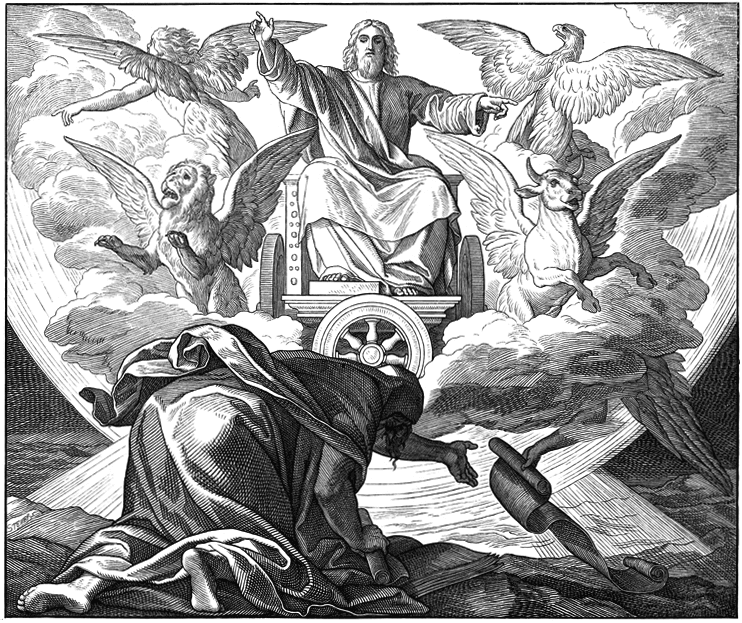
After this I looked, and, behold, a door was opened in heaven. And behold the first voice which I heard was as it were of a trumpet talking with me; which said, Come up hither, and I will show thee things which must be hereafter. Immediately I was in the spirit: and, behold, a throne was set in heaven, and one sat on the throne. And he that sat was to look upon like a jasper and a sardine stone: and there was a rainbow round about the throne, in sight like unto an emerald. And round about the throne saw I four and twenty seats, and elders sitting, clothed in white raiment; and on their heads crowns of gold. And out of the throne proceeded lightnings and voices and thunderings: and there were seven lamps of fire burning before the throne, which are the seven Spirits of God. And before the throne there was as a sea of glass like unto crystal: and in the midst of the throne, and round about the throne, were four beasts [living creatures] full of eyes before and behind. And the first beast was like a lion, and the second beast like a calf, and the third beast had a face like as a man, and the fourth beast was like a flying eagle. And the four beasts had each of them six wings about him; and they were full of eyes within: and they have no rest day and night, saying Holy, holy, holy, holy, holy, holy, holy, holy, Lord God Almighty, which was, and is, and is to come. And when those beasts give glory and honour and thanks to him that sat on the throne, who liveth for ever and ever, amen, the four and twenty elders fall down before him that sat on the throne, and worship him that liveth for ever and ever amen, and cast their crowns before the throne, saying, “Thou art worthy, O Lord, our Lord and God, to receive glory and honour and power: for thou hast created all things, and for thy pleasure they were created. (Sinaitic Manuscript.)
Summary of Chapter IV of Revelation *
This chapter is a pen-picture, in symbolical language, of the great Jehovah in his identification with his glorious Plan of the Ages. It reveals him as being the Author of that wonderful Plan. These symbols, also, have the virtue of hiding the truth from the natural man, because the natural man has not that Spiritual discernment which enables the Spiritual man to perceive the true meaning behind the symbol. Jesus therefore spake in parables and dark sayings, in symbols, for the double purpose of hiding his meaning from the natural, worldly mind, and of making the truth exceptionally clear and reasonable to the humble, honest, and teachable mind. Unto this latter class it is given to comprehend the secrets of the Kingdom of Heaven. Another virtue of the symbol is, that it conveys to the instructed mind in one word truths which would take many words in the ordinary way to explain. A symbol may also teach the spiritually minded deep and vital truths which ordinary words could never fully reveal. After instruction the spiritual mind does not think of the symbol, but reaches out to the true meaning behind it. In this connection see John 6:53-63. Symbolical language is the language of the Spirit; for the symbols used convey to the mind the deep spiritual truths which God desires to impress there.
John the Revelator was given his visions of the things pertaining to the Plan of the Ages in order that they might instruct the spirit begotten Church of the Gospel Dispensation, especially during the very end, or “harvest” of the Age. The members of the Church may be called the “John” class, because they “see” the visions that John saw, not in symbols, but in their realities.
The “John” class are permitted to see these heavenly things from God’s standpoint; for God has revealed them unto us by his Spirit, for the Spirit searches all things, yea, even the deep things of God.
The Plan of the Ages is the work of God himself. He sits in his throne in heaven wielding authority and directing all things according to his own good will and pleasure, and none can say him, Nay. In character he is like the jasper and the sardine stones; for these two stones have special features which well represent the characteristics of Jehovah. Like the jasper, or diamond, he is perfect and glorious; and even as the crystal of the diamond has eight triangular faces (like two solid pyramids set base to base), and thus 24 angle-points (8 by 3 equal 24), so God is perfect in himself (a Pyramid being the symbol of perfection), and has 24 view-points, all expressed by himself through the mouths of his holy prophets, 24 in number. Like the sardine stone he retains a clear impression of all his creation. The sardius is the engravers’ stone, taking on a high polish and permanent engraving, perpetuating the work of the world’s best artists. So the Lord never forgets the work of his hands. His tender mercies are over all his works. He has engraved us upon the palms of his hands. (Isa. 49:15, 16) Earth’s millions who have entered the tomb are remembered by him, and will be raised from the dead, each with individual identity. The dead are not preserved anywhere except in the remembrance of God. Thus He is like a jasper and a sardine stone.
* References to “The Finished Mystery” have been omitted at the discretion of the Publishers.
The authority of Jehovah is established in absolute justice, and therefore absolute peace is assured for ever. Without justice there can be no peace. This fact is recognised by men, and they accordingly appoint special representatives of the crown (of the king on his throne) whom they name “Justice of the Peace.” By dispensing justice, they preserve peace. The green rainbow round the throne of Jehovah is the symbolical picture of this fact; the rainbow being the express symbol of perfect peace, and the green (emerald) colour representing everlastingness.
Jehovah requires 24 different styles of utterances to fully declare his character and Plan. The utterances of the 24 prophets of ancient days are represented by the 24 “Elders” who sit on thrones around His own throne. Beginning with Enoch and ending with John the Baptist, God’s inspired prophets declare the glorious character of Him that sits on the throne, and by their utterances foretell the loving design of His mighty plan of salvation. The white raiment and gold crowns show the spotless and wholly clean annunciations of God’s mouthpieces (even though the men themselves were not perfect); and the crowns represent their glory and honour, conferred upon them because of their willing and loving obedience to their God. Their glory was really His glory; and those who speak of God’s loving character and glorious plan of Restitution, are holy in His sight. None others are holy.
During the long and gloomy night of earth’s history, lightning-flashes of truth and righteousness have been sent by God, that His people might see their path through the darkness. Errors have also been shown up clearly to those who were expectant. The result has been much wordy conflict. Many ideas as to the right road to pursue have resulted from the momentary dispellings of the enveloping darkness. But those who saw clearly the errors were alone able to avoid them and walk the right way. They also could pronounce judgment upon those who upheld the errors. The lightnings, voices, and thunderings which proceeded from the throne represent all this. God through it all has perfect command of the situation. His knowledge is all comprehensive, as shown by the symbol of the seven “lamps of fire” which are the seven “spirits of God,” and the “seven eyes.” The troubled condition of mankind, which is like the raging of the sea, is thus clear and calm in God’s sight, and also in the sight of God’s consecrated people, who view matters from His standpoint. The ever-changing conditions and opinions and doings of men, like the tossing sea, is confusing and terrifying when viewed from the earthly standpoint; but from the heavenly standpoint, represented by God’s throne, this raging “sea” is but a reflection of God’s own orderly plan, clear as crystal to all who are rightly informed. They recognise that God rules in the kingdom of men, and that He moves always in strict harmony with the four attributes of His character, perfect justice, power, love, and wisdom, doing violence to none of them. The four “living creatures,” which represent these four attributes, are said to be in and around the throne, being woven into its very fabric, showing that God’s sovereign rule is perfect in every moral respect, even though during the out-working of his plan he might be misjudged by those not understanding his purpose. Indeed, none could fully understand his purpose until the end of the six thousand years of earth’s history. Each of the symbolical creatures had six wings, operating in pairs. The wings represent the six thousand years, through which the four attributes of God “flew,” gradually revealing themselves and thus making manifest God’s graciously benevolent character.
The order of the four “living creatures,” as stated, represent the successive order in which God revealed his four perfect attributes. Justice (the “lion”) was revealed first in the condemnation of the human race because of disobedience. Power (the “calf”) was revealed second in the destruction of the “Old World of the Ungodly” in the overpowering flood. Love (the man-faced creature) was revealed third in God sending His beloved and only begotten Son to die as a ransom-sacrifice, in order to redeem the death-doomed world. Wisdom (the “flying eagle”) was revealed fourth at the full end of the six thousand years, when the beauty and wisdom of God’s Plan is now clearly seen by the Lord’s people, the six thousand years, represented by the six wings of the living creatures, having carried the Plan toward completion. Those who are privileged to look on these things at this time perceive that each one of Jehovah’s attributes takes full cognisance of the others, doing no violence either before or after to the work which each has to perform. Indeed, none of these attributes can operate without the cooperation of the other three, for all work together, even though the effects of the work of one may at times be more manifest than of the others. The complete cooperation of all four attributes in every phase of God’s Plan is well symbolised by the four living creatures as presented in the prophecy of Ezekiel. In Ezekiel, chapter one, each of these four creatures had the four faces which represent justice, power, love, and wisdom. Each of the symbolical creatures see in the future what will require to be done in the outworking of the Plan of the Ages, and they each look at the past to the work which has been accomplished, and keep in strict harmony therewith. We, therefore, can well understand why the four “living creatures” are said to have been “full of eyes before and behind,” and also “full of eyes within”; for nothing has transpired, or ever will transpire, without God’s knowledge. In the past six thousand years, whether hidden or partially revealed, God’s justice, power, love and wisdom, have been evident in all the affairs of His plan of salvation. They have never “rested,” but have always “worked” together toward the grand consummation. Blessed are those who can call themselves co-workers with God. They will rest from their labours, but their works will follow with them in the glorious Ages to follow the completion of the six thousand years.
In the seventh thousand-year period the work of Restitution will be gradually carried out; and in the eighth thousand-year period full circumcision of the hearts of mankind will have been attained. In this mighty work the overcomers of the past six thousand years, both spiritual and earthly, will be joyfully engaged. While the revealment of the four attributes of God was complete at the end of the six thousand years, the six “wings” having carried them, as it were, till God’s secret was due to be finished, yet the work of these four attributes will continue in the hands of the Christ, head and body, for two thousand years more, until God’s loving and perfect character is fully revealed to all in heaven and on earth. The holiness of the Heavenly Father’s character, the absolute harmony of his four attributes, has been clearly revealed to his special covenant peoples. In the Age of Restitution, and in the Age of “holy convocation” to follow (i.e., the seventh and eighth thousand-year periods*), the Lord’s beauty of holiness will be apparent to every being, whether in earth or in heaven. Thus the four “living creatures” are represented as crying “Holy” eight times; for every 1,000-year “day” has been holy to the Lord God Almighty, as all will fully realise when the “days” are finished. All will realise that the great Jehovah, who has been from everlasting, and will be to everlasting, has carried toward its glorious completion all his foreordained Plan of the Ages. His four attributes, which will then be evident to all, will forever continue to glorify Him. By these he will have gained honour and power, for their fulfilment in every particular will demonstrate that He is the God of truth, and therefore worthy of everlasting honour and obedience. The recognition of his loving provision for the lasting joy and peace of all his creatures as foretold by his servants the prophets, 24 in number, will call forth the unfeigned love and adoration of every being in heaven and earth. Worthy indeed is He to receive glory and honour and power from that creation which he formed for his own pleasure. With infinite patience he has waited for it, and when it is fully established there will be pleasures forevermore and peace everlasting. Amen.
* According to the Bible chronology, the eighth thousand-year period of the history of man on earth is also the fiftieth from the time when God began to form the earth. (See the chronological chart, diagram No. VIII, which demonstrates this interesting fact.) In this sense, therefore, the great thousand-year period which follows the Millennial reign of Christ may be called a grand Jubilee, when everything will have reached full restoration and perfection, all evil and evil-doers having been cut off by that time. The eighth thousand-year period really represents eternity.
NOTE–Regarding the symbolical significance of the four “living creatures,” we are glad that Vol. VII “Studies” presents the correct understanding of this matter. All Bible students who know the Lord’s Plan of the Ages are agreed that they represent the four perfect attributes of God. The opinion has been expressed that, instead of the lion representing justice, it better represents power; for, said the Philistines in answering Samson’s riddle, what is stronger than the lion? Also, instead of the calf representing power, it better represents justice, because bulls and calves were sacrificed to satisfy justice. This claim–namely, that the lion symbolises power, and the calf justice–seems reasonable at the first glance. Yet the Scriptures rather prove the other view, the calf being undoubtedly a figure of power, and the lion of justice. Apart from the order in which the four living creatures are stated in the 4th chapter of Revelation, which agrees well with the manifestations of God’s four attributes throughout the six thousand years of earth’s history, we find certain declarations elsewhere in the Bible which decide the matter for us in favour of the interpretation given in Vol. VII “Studies.” The word “calf” and the word “bull” or “bullock” are used synonimously. But there is another word used in the Scriptures for the same species of animal, and which is sometimes mentioned along with the bull and bullock. We refer to the “unicorn.” (See Isa. 34:7, where the three words occur together: “And the unicorns shall come down with them, and the bullocks with the bulls.” Also in Deut. 33:17, we read “His [Joseph’s] glory is like the firstling of his bullock, and his horns are like the horns of unicorns: with them he shall push the people together to the ends of the earth.”) This word “unicorn” is really a misnomer; for, as the word itself signifies, a unicorn is an animal with only one horn, whereas the particular animal referred to in the Scriptures had two horns, like an ox or bull. This fact is demonstrated in the marginal reading of Deut. 33:17, where it speaks of the “horns of an unicorn.” The Hebrew word is “Reem,” a well-known animal of the olden days, which became extinct about the middle ages. The discovered remains of the ancient Reem (in the Lebanon mountains of Palestine) show that it was an animal of the ox variety (not a rhinoceros, as suggested in the marginal reading of Isa. 34:7; or the buffalo). Wherever the word “unicorn” occurs it should be translated “wild ox,” as in the Revised Version. The Reem was noted for its untameableness. (Job 39:9, 10) It was very fleet and active. (Psa. 29:6) It was noted for its horn, of which it had more than one, as we have mentioned. (Psa. 92:10) In Deut. 33:17, and in Psa. 22:21, the Authorised Version has the phrase: “horns of the unicorns.” Now the translators of the Authorised Version knew that a unicorn has but one horn; and as the word “horn” occurs in the plural in the original Hebrew Scriptures, and is thus rightly rendered “horns,” they thought that more than one unicorn must be meant, and put the word “unicorn” also in the plural to agree with “horns.” This is a mistake, for the Hebrew while in the plural for “horn,” is in the singular for “unicorn.” The passage should have been translated: “horns of an unicorn (as given in the marginal reading of Deut. 33:17); or, rather, “horns of a Reem,” or wild ox. This wild ox, a specially strong, nimble, and fierce species of the bull, is used by the Lord to symbolise His mighty power. In this connection see Numbers 23:22; 24:8–“God brought them out of Egypt; he hath as it were the strength of the wild ox”–the Reem, mistranslated “unicorn.” Thus we perceive that Jehovah’s strength is compared to the ox, and the strongest species of this animal. Then we know, of course, that the horns of the ox were used specially to symbolise power; the passages cited above prove this.
Justice is represented by the lion. The voice of authority is always represented by its loud voice; and true authority–that is, the authority that will be respected and obeyed, is strictly just. The roar of the lion would thus in itself very well represent the loud authoritative voice of Justice. “The Lord also shall roar out of Zion,”–His judgments against the evil nations shall be loudly proclaimed from Zion, the Spiritual Kingdom. (Joel 3:16) If we compare this passage in Joel 3:16 with the similar passage in Isa. 2:3, we perceive that the “roar” of the Lord (like the roar of a great lion), is identified with the “law” (justice) of the Lord. In Joel 3:16 we read: “The Lord also shall ‘roar’ out of Zion, and utter his voice from Jerusalem;” and in Isa. 2:3 we read: “out of Zion shall go forth the law, and the word of the Lord from Jerusalem.” In both passages the context shows that judgments and justice are to be meted out among the nations during the time of the spiritual and earthly phases of the Kingdom of Righteousness, which phases are represented by Zion and Jerusalem. In Num. 24:9, after comparing the Lord’s mighty strength to the wild ox (in verse 8), the writer compares His justice to a lion. Jehovah is represented as a great lion “crouching,” meaning that, so far, God’s justice is largely held in abeyance during the period of the permission of evil. While the “wrath” of God is revealed from heaven against all unrighteousness, His justice is not yet fully vindicated (except to the eye of faith–the children of God are the only ones who realise His absolute justice, and this only as they exercise their faith in the great Plan of the Ages–God, of course, is never at any time unjust). Justice has not yet been meted out to wrong-doers, for we read that God knows how to reserve the unjust unto the day of judgment to be punished; nor have the Lord’s faithful people received their just rewards for well-doing. But when, in the Millennial Age, the “great lion” is at last “roused up,” then “blessed” will be he who blesses God, and “cursed” will be he who curses God! Justice will then be laid to the line, and righteousness to the plummet. In this connection see also Gen. 49:9, 10, where Judah is compared to an old lion (“who shall rouse him up?”), out of whom the “lawgiver” is to come–i.e., the one who dispenses justice. Satan, the god of this world, is said to go about as a “roaring lion,” seeking whom of the Lord’s little ones he may devour. (1 Pet. 5:8) All persecutions of God’s people have their origin in Satan, who accuses them before God day and night. Now, persecutions are generally instigated in the name of justice, but they are really perversions of justice. Satan is not the true lion; it is the “lion of the tribe of Judah,” the Lord Jesus, who satisfied justice, and prevailed to open the secrets of God. (See Rev. 5) One of these profound secrets (represented by the “seals”) is the reason for the permission of gross injustice by Him whose throne is founded on justice.–See Rev. 6.
It is to be noted that in Solomon’s throne, which was typical of the Throne of God, lions constituted a very prominent part of the ornamentation.–1 Kings 10:18-20
Love is represented by the man-faced creature, for man, in his perfection like Adam before his fall, and the man Jesus Christ, is the most loving of all God’s earthly creatures. None of the creatures of earth could represent love more perfectly than the perfect man, in whose heart the law of his God is written, the sum of which is love for God and neighbour.
Wisdom is symbolised by the flying eagle. The wonderfully keen vision of this bird represents well the clear-sightedness of wisdom. The care of the eagle over its young, when instructing them in the use of their wings, shows great wisdom. It wisely puts its little ones into such a position that, while guarding them from injury, their flying powers are developed.–See Deut. 32:11. í
From Darkness to Light
Long in bondage we have waited
For the dawning of the light;
Error’s chains we’ve felt and hated
Through the long and weary night.
Now the blessed light appearing
Fills our hearts with joy and peace,
Doubt and fear for aye dispelling;
O! what rest in this release!
Lord, we recognize its fountain,
In thy long looked for return,
In thy glory crowned mountain,
How our hearts within us burn!
Lo, in all the clear fulfilling
Of old prophecy and type,
Now we see thy kingdom coming;
For the time is fully ripe.
O! we long to see thy glory
Streaming wide o’er all the earth;
Ev’ry error, old and hoary,
Flee to realms that gave them birth.
For this glorious culmination,
Not for long shall Zion wait:
Soon will come her coronation;
Lo, her King is at the gate.
Bride and Bridegroom,
then appearing,
Shall illuminate earth’s gloom;
And the nations will be shouting,
Lo! our King! make room, make room.
O! the times of glad refreshing
Soon shall bring a sweet release,
Through the glorious reign of blessing,
Through the mighty Prince of Peace.
— Hymns of Dawn 156