Christ Our Passover
“Christ, our Passover, is sacrificed for us; therefore, let us keep the feast.” 1 Cor. 5:7
The passover was one of the most important of the types given to the Children of Israel, and was ever observed by them as one of their most solemn feasts. They kept it in remembrance of the passing over of their first-born when the tenth plague was visited upon the first-born of Egypt. They commemorated it every year on the anniversary of the event, slaying a lamb each year on the fourteenth day of the first month. They saw only the type: We, instructed by the Holy Spirit through the apostles, are able to recognize the antitype as “Christ our Passover Lamb slain for us”—“the Lamb of God.” Death would pass upon us, were it not that our Lamb’s blood is sprinkled upon us, but in Him we have life.
As the typical lamb was put to death on the fourteenth of the first month, so our Passover Lamb was put to death on the same day. No other day would fulfill the type, and so it was, as we read, Luke 22:7. As they feasted on the typical lamb, we feast on our Lamb. It was on this same day that Jesus gave to the apostles the symbols of His broken body and shed blood, saying: “THIS do in remembrance of me;” i.e., keep this feast hereafter, thinking of me as your Lamb.
It has for several years been the custom of many of us here in Pittsburgh to do this; i.e., remember the Passover, and eat the emblems of our Lord’s body and blood, and it has ever been an occasion of solemn pleasure and communion, and was particularly so this year. We met on the night of March 24th, as usual, at the house of Brother and Sister Conley (it being the most commodious); and ate together the unleavened bread—eating, meantime “the truth” which it symbolized, viz. that Jesus was unleavened (without sin), holy, harmless, undefiled, and therefore food “of which, if a man eat, he shall never die.” We said, with Paul, “Christ, our Passover is slain; therefore, let us keep the feast.” We saw clearly that because we had Christ within, therefore (soon, we believe), all the church of the first-born will be passed over, and spared, as it is written: “I will spare them, as a man spareth his only son that serveth him,” and we said one to another, “Watch that ye may be accounted worthy to escape all these things coming upon the world, and stand before the Son of Man.”
We read, also, how that if we are Christ’s, we are part of the same loaf; to be broken as He was; to die, as He did to the flesh—crucifying the flesh. “The loaf, which we break, is it not the communion of the body of Christ? For we, being many, are one loaf and one body.” (1 Cor. 10:17) We saw, also, that if we would count ourselves parts of that loaf, and be broken, we must first “purge out therefrom the old leaven” of sin, that we may be like our Master, “who knew no sin.”
After supper, we took the cup—the wine. As we took it, we remembered that it was not represented by the type, the passover supper, but that it was the symbol of joy and life. After supper, He took the cup … saying, “Drink ye all of it,” and we realized that, when the present night of eating the Lamb with bitter herbs (afflictions) has passed, our Lord will give us the new life and new joys, saying, “Enter thou into the joys of thy Lord.” And we realized, even now and here, a foretaste of those joys of Paradise. Thus, the wine of our feast was but typical of the joys of the kingdom, when we shall drink it new with Him, in our Father’s kingdom—“after supper.”
The Lord’s Supper
“Christ our Passover is sacrificed for us, therefore let us keep the feast.” 1 Cor. 5:7
The Passover was a Jewish feast kept annually (and is still observed by them) as a commemoration of their remarkable deliverance under the tenth plague upon Egypt—the Passing-over or sparing from death of their first-born.
The circumstances as narrated in Exod. 12—the slaying of the Lamb, the roasting of the flesh with fire, and the eating of it with bitter herbs and unleavened bread while the eaters stood, girded and shod, and with staff in hand ready to depart out of Egypt for the Land of Promise—Canaan —are doubtless familiar to most of our readers. Also, the meaning of these things which were but types: How that Jesus came—“The Lamb of God which taketh away the sin of the world,” and “Christ our Passover was sacrificed for us”—how the door posts and lintels of the household of faith are sprinkled (typically) with the blood of our Lamb which speaketh better things, and saves in a higher sense all that are in that house—how that we are to be pilgrims and strangers, not making Egypt (the world) our home nor resting there, but with staff in hand—how that the “bitter herbs” represent the bitter experiences and trials of this life, which are needful to us and tend to sharpen our appetite for the unleavened bread, (truth in its purity; leaven being a type of corruption or error,) and for the eating of our Lamb, who said unless you eat my flesh … you have no life in you: Thus we partake of our Lamb and have Christ formed within, the hope of Glory. Thus during this night of more than 1800 years, since our Lamb was slain, the one true household has been eating—waiting for the morning of deliverance—the early dawn of which we believe has already come.
When Jesus died on the very same day, and in fulfillment of that part of the type— the Lamb—how fitting it seems that all Christians should commemorate the day on which our Lamb died. We certainly have much more interest in the day than has “Israel after the flesh,” who recognize only the type. Then, while we keep the feast daily—partaking of Christ and His word of truth, would it not be a great pleasure and a beautiful way, to commemorate our Lord’s death on its anniversary?
We understand that it was our Lord’s wish that this day be observed annually as a remembrance of Him, and that he instituted what is termed, The Lord’s Supper, of bread and wine—emblems of His body and blood, our Passover supper—as a substitute for the Jewish observance of the type.
Everything connected with it seems to show that this was His intention. He kept the Passover regularly every year, and at the last one, the night in which he was betrayed, he said: “With desire I have desired to eat this Passover with you before I suffer.” What Jesus commemorated was the killing of the Passover (Lamb;) and not the “Feast of Passover,” which followed it for seven days. The Jews at that time kept both, but particularly the latter, (the feast). They do not now, and have not for a long time commemorated the killing of the Passover, but the feast only. Jesus commemorated (the last time) the killing only and then gave Himself as the real sacrifice. When he had instituted the new supper—remembrancers, (the bread and wine) instead of the old type (the lamb) he gave to his disciples and said: “This do in remembrance of me.” (Keep no longer the type or shadow but use these new emblems to commemorate me—the anti-type.) “As often as ye eat this bread and drink this cup, ye do show the Lord’s death, (not the typical lamb’s) till He come,” the kingdom be established and the type completed by the passing over, or sparing of the first-born (overcomers) and the ultimate deliverance of the entire “household of faith.”
The Passover killing—Christ’s death, can be remembered at no time so appropriately as on the regular anniversary, the fourteenth day of the first month. Jewish time which this year falls on April 14th (commencing at 6 o’clock P.M.) The feast of seven days eating unleavened bread, which followed representing in type the continuous, perfect and everlasting feast which we enjoy after and because of our ransom; (seven being typical of perfection).
We are aware that some Christians observe the Lord’s supper every Sunday, and claim that their custom is based upon the oft repeated mention in Acts of the “breaking of bread,” and “upon the first day of the week when the disciples were come together to break bread.” (Acts 20:7) etc. They evidently overlook the fact that bread-breaking, was of necessity a frequent occurrence but that there is no mention of wine in any of these instances which constitute as important a feature in the ordinance as the bread, nor are any of these meetings on the first day of the week ever called the “Lord’s Supper” or by any name that should lead us to such a conclusion. There are several reasons why “The Lord’s Day” would not be at all appropriate for the commemoration of His death, the principal one being, that “the first day,” or “Lord’s day” was instituted and used to commemorate an event the very opposite in its character, viz: The resurrection of our Lord. The one was in the “night” and called a supper, the other was observed in the day. The one was a night of weeping and sorrow, the other a morning of joy and rejoicing, saying—“The Lord is risen indeed.” The one was a type of the present night of suffering—the Gospel Age—the other a type of our gathering together and communion in the bright Millennial day—after the resurrection of the body “very early in the morning.”
When Jesus had risen from death He appeared to the disciples frequently, if not invariably on the “first day” of the week, and on several occasions made himself known to them in the breaking of bread at their ordinary meal. Upon the organization of the church what would be more reasonable, than to suppose that they would set apart that first day, as especially a day for meeting with each other and with Him, and that coming from distances as well as because He thus revealed Himself first, they would arrange for the having of their food in common on that day? But this was always a day of joy as the other was properly a night of sympathizing grief.
The proper observance of this ordinance like that of baptism, seems to have been lost sight of during Papacy’s reign: This one doubtless, was made void, to allow for the deathbed administration of the “Sacrament” to keep the dying from purgatory, etc. Protestants have not generally given the subject much attention, using the words “As often as ye do this” as authority for any convenient time, and not seeing that “this” referred to the Passover, as oft as ye do commemorate this event do it in remembrance—not of the type but of the anti-type—Me.
We do not say that a sin is committed by an untimely observance, nor that the non-observance, is sinful; but we do say that the observance of it as instituted is much more suggestive, appropriate and commemorative than any other.
Christ Our Passover
“For even Christ our Passover is sacrificed for us: therefore let us keep the feast.” 1 Cor. 5:7, 8
The Passover feast lasts seven days with the Jews, commencing this year March 31 and ending April 7, and typifies perfect and everlasting purity and joy to all who partake of the Lamb slain. Paul teaches that as Christ our passover [lamb] is slain, so many of us as have by faith partaken of his imputed merit should henceforth continually rejoice before God and feast upon the truth, putting away completely all leaven of sin; malice, hypocrisy, etc.
The death and eating of the Passover lamb was with Israel the cause or basis for the “Passover Feast” which lasts a week. The lamb was slain the day preceding the feast week, and was the type of Jesus’ death. Hence the anniversary of the crucifixion this year [Jewish time] will be March 30, between noon and 3 o’clock P.M.; and the evening before, viz., the Sunday evening March 29 (the same day by Jewish time, their day beginning at 6 o’clock in the evening) between 6 o’clock and 10 o’clock, was the time spent in killing, preparing and eating the Passover supper, and after it the supper of bread and wine, representing our Lord’s body and blood broken and shed for us, which he here introduced to his disciples as thereafter taking the place of the literal lamb; these emblems being representative of himself the antitype— “The Lamb of God which taketh away the sin of the world.”
When the Lord, after giving the disciples the bread and wine as emblems of his body and blood, and telling them to partake of them, said, “This do in remembrance of me,” (Luke 22:19) we understood him to teach that henceforth the Passover anniversary should be commemorated not by eating the typical lamb, but by partaking of these emblems of the anti-typical lamb. Not in remembrance of the deliverance from Egyptian bondage, but in remembrance of our deliverance from the bondage of sin and death. The anti-type should be recognized as begun in every sense.
And when the Apostle says, “As often as ye do this ye do show the Lord’s death till he come,” we understand him to teach, that as often as this anniversary is observed [at its yearly recurrence] we should thus show the Lord’s death as the basis of all our joy, purity and hope. Nor do we understand the words “till he come” to limit us and make its present observance improper, since the evident meaning is—until the Lord’s kingdom shall have come, and he shall have called you to share with him the new wine (the joys, rights and privileges of the divine nature), in that kingdom. See Mark 14:25, Luke 22:16.
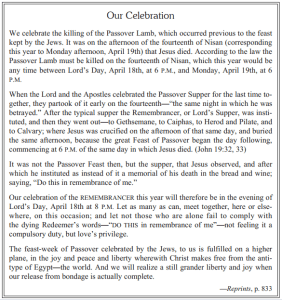
For the sake of our many new readers, we mention that it has for some years been our custom to “do this” “as often” as its anniversary recurs; preserving so far as possible the simplicity of the early church and of the first occasion as instituted by our Lord. The Church in this city will meet at our usual place, the “Upper Room” of No. 101 Federal Street, Allegheny City. We shall, as heretofore, welcome all who are the Lord’s disciples—all who appreciate the broken body and shed blood, to meet with us, that we may together commemorate our ransom.
We cannot all meet here, but we can all meet with our Lord, and in the communion of heart we shall have fellowship one with another and with our Head and with our Father, while realizing that the blood of Jesus Christ cleanseth us from all sin. Where two or three are met in Jesus’ name, the Head will be present and a blessing ensue. As we break the bread which represents our Lord’s body, let us not forget that by his appointment we are now members of His body, and as such are to be broken also. As we drink of the emblem of his sacrificed life by which we are justified, let us not forget that we are called to share the cup with him, thus partaking in symbol of his death. By his grace we shall indeed drink of his cup and then share his glory. (Matt. 20:22, 23)
It is to this, the Apostle refers in 1 Cor. 10:16-18. Those priests who ate of the sacrifice, were the ones which did the sacrificing and whom the sacrifices represented. “The cup of blessing which we bless is it not the communion [sharing] of the blood of Christ? The bread which we break, is it not the communion [sharing] of the body of Christ? For we being many, are one bread [loaf] and one body: for we are all partakers of that one bread [loaf].” Let none partake thoughtlessly of the emblems but with attentive, earnest hearts let each endeavor to realize not only his share in the benefits resulting from Jesus sacrifice, but also as a result, his share afterward with Jesus in sacrifice.
The Passover Instituted
EXODUS 12:1-14
Golden Text: “Christ our Passover is sacrificed for us.” 1 Cor. 5:7
The term Passover signifies to pass by or spare from an affliction. When the last plague was visited upon Egypt, the houses of the Israelites were all marked with the blood of a slain lamb, that the destroying angel might not cut off the first born of Israel with the first born of Egypt. These first born ones were afterward represented in the priestly tribe of Levi, to which Moses belonged (Exod. 13:2; Num. 3:11-13), and through this priesthood all Israel was brought into covenant relationship with God. The Gospel Church, is the antitype. These alone of all people are now in danger of everlasting death—the second death— because these only have the knowledge sufficient—if rejected or abused—to bring condemnation to the second death.
The first born of Israel represented those who now by faith abide in Christ, under “the blood of sprinkling”—the precious blood of Christ, our passover lamb, slain for us. And these shall be delivered, spared, passed over, being counted worthy of life through the merit of the precious blood of Christ. But if any abide not under this covering, he must surely perish, as any of the first born of Israel would have perished had they ventured out, beyond the protection of the blood of the typical lamb. How forcibly does the type thus illustrate the value of the precious blood of Christ, our Passover Lamb!
The typical feast, commemorative of the typical Passover, was celebrated ever after by Israel. Our Lord and his disciples observed it, as all Jews were required to do, yearly on the fourteenth of Nisan. The Lord’s Supper was instituted just after this Passover supper, and to take its place, on the last night of our Lord’s earthly life—the same night in which he was betrayed, the same day on which he was crucified, the Jewish day beginning the evening preceding at sunset. This annual remembrancer was to be to Christ’s followers what the Passover had been to the Jews. They were to see Christ Jesus as their lamb, and rejoice in their justification through his precious blood. And they were to celebrate it yearly—as the Israelites had done—but now in remembrance of the reality and not of the type. “Christ, our passover, is sacrificed for us; therefore, let us keep the feast”—as often as the season returns, until fully delivered from death to life in his likeness.
Passage of The Red Sea
EXODUS 14:19-29
Golden Text: “By faith they passed through the Red Sea.” Heb. 11:29
This chapter in the history of God’s ancient people is an illustration of the power and wisdom and love of God. And it is a warning to all who are disposed to heed it, to beware of undertaking to contend with the Almighty. No matter how weak or insignificant or poor or despised among men may be the subjects of his care, the hand that is lifted against them defies the power of Jehovah, and shall surely come to grief.
This deliverance of typical Israel from Egypt illustrates the deliverance from sin and its bondage of all who desire to be God’s servants and to have the promised blessing as it shall be fulfilled after the plagues (Rev. 16), in the utter destruction of all the systems born of sin and selfishness which would hinder human prosperity and advancement toward God. The overthrow of Pharaoh’s army by the sea, corresponds to the fact that many of the present enslaving agencies will be overthrown by anarchy in the great “time of trouble,” now so near at hand. Already the storm is approaching which will eventually overthrow all evil-doers; but a way of escape is provided for all who seek God and put their trust in him, following the course which his wisdom has marked out.
It is important to note in this connection that the terms “borrowed” and “lent” in Exod. 11:2; 12:35, 36 are improper and misleading translations of the Hebrew word shaal, giving the impression of a command to dishonesty on the part of God and a dishonest transaction on the part of the Israelites. The Israelites did not borrow, but asked for (as in R.V.) jewels of silver and jewels of gold and garments. And the Egyptians did not lend, but allowed their request. Thus the Israelites had some reward for their long service, though it was only granted by their oppressors under fear to refuse them.
The Lord’s Supper
MARK 14:12-26—MATT. 26:17-30; LUKE 22:7-30; 1 COR. 11:23-25
Golden Text: “This do in remembrance of me.”
Verses 12-16. The first day of unleavened bread when they killed the Passover lamb, was the 14th of Nisan (See R1786). The Feast of Passover began on the 15th and lasted for seven days; the day beginning at sunset—6 P.M., of the preceding day. (Exod. 12:18-20) The prohibition of the use of leaven during this time was a reminder (1) of the haste with which they fled from Egypt, not having time to wait for bread to rise (Exod. 12:34, 39); and (2) of their sufferings in Egypt, on account of which it was called the bread of affliction. (Deut. 16:3) But (3) its chief significance was the putting away of sin, leaven being incipient putrefaction and hence a symbol of impurity. (1 Cor. 5:6-8; Matt. 16:6) Considering Israel in its typical character and their deliverance from Egyptian bondage as a type of the deliverance of the world from the bondage of sin and death, this feast is seen to be a type of the world’s proper condition in the Millennial age. Having, through Christ, experienced the great deliverance from the present bondage of sin and death and the great time of trouble, it will be required of all that they put away from them the leaven of sin and, in grateful remembrance of their deliverance, keep the feast (rejoicing in and partaking of the good things of God), not with the leaven of selfishness, neither with the leaven of malice and wickedness, but with the unleavened bread of sincerity and truth.
The killing of the passover lamb, which prefigured the sacrifice of Christ, was always done on the 14th of Nisan (Exod. 12:6); so also the sacrifice of Christ was accomplished on this same day, thus fulfilling the prediction of the type. The sacrifice of the lamb prefigured the sacrifice of Christ for the salvation of “the Church of the first-born,” and the subsequent deliverance of the whole groaning creation of which the nation of Israel was a type.
During the passover week hospitality was recognized as a duty in Jerusalem: hence the readiness with which the Lord’s request for a room was granted. Probably the man was a believer, as verse 14 would seem to indicate; or there may have been some previous arrangement with him, as verse 15 seems to show.
Verses 17-21. The strife to be greatest, mentioned only by Luke (22:24), probably began when they were taking their places at the table, each desiring to be nearest to the Lord and so manifesting somewhat of a selfish spirit. This was made the occasion of a very touching illustration of humility on the Lord’s part, and the enforcement of the truth upon the minds of the disciples that without this very necessary qualification they could not enter the Kingdom of heaven. (John 13:5)
The attitude of the disciples upon the Lord’s announcement that one of them should betray him showed at once the effect of this lesson on humility. They were not overconfident, but each seeming to fear his own stability, inquiringly turned to the Lord saying, not, Lord, is it this one or that one? but, Lord, is it I? They had the spirit of self-examination.
The hardness of Judas’ heart and the depth of hypocrisy manifested in the coolness with which he heard the Lord’s warning (verse 21) and in the deliberate plotting and wicked perseverance in evil are in marked contrast with the humble, loving spirit of the eleven. It is an illustration of the hopelessness of a soul willingly submitted to the power of Satan. Verse 21 leaves no ray of hope for his restoration. See also John 17:12. The goodness of God only hardened his heart and therefore there was no remedy.
Verses 22–24 point out the very obvious import of the emblems, bread and wine. The broken bread represented the sacrifice of Christ’s humanity for our redemption, the benefits of which sacrifice we must individually appropriate by faith, such appropriation being symbolized by the eating of it. The cup, the wine, which symbolized his shed blood, the blood of the New Covenant shed for many for the remission of sins, had the same significance as the broken bread, our partaking of it also meaning our appropriation of the benefits of his sacrifice, thus securing our justification. So the Lord declares, saying, “Except ye [thus by faith] eat my flesh and drink my blood, ye have no life in you.” (John 6:53) And to this significance the Apostle Paul (1 Cor. 10:16, 17) shows another; viz., our participation with him, as members of his body, in the sacrifice—“The cup of blessing for which we bless God, is it not a participation of the blood of the Anointed one? The loaf which we break, is it not a participation of the body of the Anointed one? Because there is one loaf, we, the many, are one body; for we all partake of the one loaf.” After the Supper followed all those words of instruction, consolation, comfort and hope, and the touching prayer reported by John (13:33–38; Chapters 14–17). It was a season never to be forgotten by the disciples, one whose influence was very manifest in their subsequent course.
Verse 25 foretells the final triumph of Christ and the Church when the sufferings of the present time are all ended. Then their feasting together will have a new and blessed significance, being commemorative of the heroism of their faith and their fidelity to the divine purpose under the most crucial tests, and a rejoicing together in the victory that faith and fidelity.
Verse 26. “And when they had sung a hymn they went out into the Mount of Olives.” Instead of dispersing they went out together. Observing the Lord’s sadness and forebodings, the eleven sought to comfort and help him with their love and sympathy, while Judas went on his diabolical errand.
Hezekiah’s Great Passover
2 CHRONICLES 30:1-13
“Yield yourselves unto the Lord, and enter into his sanctuary.”
Our last lesson respecting Isaiah’s vision and his commission, to announce the fall of Israel, was “in the year that King Uzziah died.” (Isa. 6:1) The wicked king, Ahaz, succeeded Uzziah in the throne of Judah, and reigned wickedly, in neglect of God and his law, for sixteen years. It would appear, however, that he had an excellent wife, Abijah, under whose careful training their son, Hezekiah, was prepared for the kingdom, and became in many respects a model ruler, and a faithful servant of God. It is even supposed that the Prophet Isaiah, who was related to the royal family, was Hezekiah’s tutor, and helped to guide him into right ways of thinking and doing. The fact that so good a son could come of so evil a father is an evidence to us that under divine providence it is not necessary that we should inherit all the evil traits of our ancestors. Although we cannot overcome them completely, so that none of the fallen race of Adam can ever hope to regain perfection as a result of personal effort and of training, nevertheless, we see that favorable conditions, religious training, etc., lead to a vast improvement in those who are rightly exercised thereby.
And here we get a suggestive hint of the methods which the Lord will employ in the world’s blessing and uplifting during the Millennium. The human family is unable to lift itself out of the degraded condition in which it is, because of shortness of life, and because of the general prevalence of evil; hence, the power that will lift mankind must be a power from the outside, uncontaminated by the fall. Moreover, under the terms of the divine sentence, the penalty of man’s sin must be cancelled, his penalty must be paid for him, before he can be fully released from its condemnation and weaknesses. It is this redemption or purchase which has already been accomplished for mankind: the deliverance out of sin and its consequences, mental, moral and physical depravity, is a future work, made possible by Christ’s great sacrifice. And, gracious thought, it is he who redeemed mankind, and who has been highly exalted to power and great glory, who is shortly to use this power on man’s behalf, in uplifting to righteousness and perfection whosoever will accept his grace, of all the families of the earth. The uplifting, nevertheless, will be along lines of instruction, chastisement and correction in righteousness, in which the individual will be obliged to cooperate in order to the attainment of full “restitution of all things, which God hath spoken by the mouth of all the holy prophets since the world began.” (Acts 3:19–21)
That Hezekiah was already well instructed, and thoroughly consecrated to the Lord, at the time of his father’s death and his own entrance to kingship, is evidenced by the fact that he immediately began, in the first month of his reign, to inaugurate reforms of the character noted in our lesson—the restoration of the worship of Jehovah, as divinely appointed. Had he not been consecrated to the Lord, and thus in the proper attitude of heart, his accession to power would have had an influence the very opposite of this: it would have led to self-gratification and personal vanity.
His first public work was to open and prepare the Temple of the Lord, which had been closed and out of repair for years, and in which had been permitted to accumulate a vast amount of rubbish, etc. The king called to his aid the proper assistants for this work—the divinely appointed tribe of Levi. The cleansing of the Temple proceeded according to the law of Moses, and when completed the first thing in order was a great sin-offering. King Hezekiah was broadminded, and gave special instructions that the offering was to be, not only on behalf of the people of Judah, the two tribes, but on behalf also of their separated brethren—“for all Israel.”
He recognized properly that the nation was still in some respects one, in the sense that the divine promises were made to all the seed of Abraham: whoever, therefore, of all the tribes would recognize the Lord God and seek his face was properly to be esteemed a brother-Israelite.
It was the time for the Passover Feast, in commemoration of the Lord’s deliverance of Israel from Egypt; typical of the deliverance of Spiritual Israel from the bondage of sin and Satan; and typical also of the ultimate deliverance of those who love righteousness, and desire to serve the Lord, from Satan’s bondage, by his complete overthrow during the Millennium. It was determined that this Passover Feast should be properly observed that year, for, although, from the account, it had evidently been kept by a few Israelites, yet the general religious disorder was such, that apparently it was not observed by the nation, nor with all its appointed particularity by any. This time the king determined that its proper observance should be re-inaugurated, preceded by all the proper arrangements of the law respecting the cleansing of the people (Exod. 12:15–20) and the putting away from their houses of leaven, a symbol of sin: thus, in figure at least, typically, the people were sanctified, in order that they might properly keep the feast. But all this required time—to issue the decrees, to succeed in stimulating the zeal of the people, and on their part to perform these works, symbolizing holiness to the Lord and separation from sin. The nation being thus defiled, the time was too short to be ready to observe the Passover on its appointed day, the 14th day of the first month, and hence the 14th day of the second month was observed instead—as the Lord had given permission. (Num. 9:10, 11)
The same breadth of mind and heart which characterized Hezekiah’s instructions that the sin-offering should be on behalf of all Israel, still controlled him, and led him to desire not only a reformation of “Judah,” but also amongst their separated brethren, known as “Israel.”
Accordingly, special messengers were sent, from Beer-Sheba, the most southern town of the land of Israel, to publicly invite all Israelites of every tribe to return to the worship of Jehovah, and to specially come up on the occasion of this feast. The postal system of the present day was not in vogue, and hence a special postal arrangement was made for the carrying of these letters.
The time for such an invitation was most favorable, for the prophecy of Isaiah respecting the carrying away of Israel into captivity was already in progress: the ten tribes were at this date paying tribute to Assyria, and the carrying away of many of the people had already actually begun. Thus, the Lord’s arrangement served to draw attention of any who might be “Israelites indeed” to the fact that their captivity was a punishment for their rejection of the Lord, and thus to incite those who had any faith and zeal to return to the Lord’s worship. King Hezekiah’s letters, briefly summed up, were an exhortation to remember the past and to return to Jehovah: “Be not ye like your fathers and like your brethren, which trespass against the Lord God of your fathers, who therefore gave them up to desolation, as ye see. … Yield yourselves unto the Lord, and enter into his sanctuary … that the fierceness of his wrath may turn away from you.”
The exhortation held out the suggestion, not only of present deliverance, but also of the return of their brethren already deported. But the postmen who bore these messages were laughed at in the northern kingdom. In proportion as the people were far from the Lord they were proud and vain, as is always the case; and it was in large measure, no doubt, their pride that was leading them on to destruction as a nation. All who are in harmony with the Lord are humble minded, and only such receive the Lord’s gracious messages with appreciation or love and well entreat the servants who bear the messages. We may note also that their obedience under such circumstances would imply considerable faith and devotion to Jehovah, for they would be the subjects of the scoffs and scorns from the unbelieving masses, as well as the messengers who invited them. Some, but not many, we are told, yet in all a fair number, humbled themselves and came, from the tribes of Asher, Manasseh and Zebulon, and of course got the blessing which God always grants to those who humble themselves and are obedient. In addition to this mention in verse 11, we find another, that “many” came also from the tribes of Ephraim and Manasseh, Issachar and Zebulon. (Verse 18) Thus, at least five of the ten tribes were represented more or less numerously, and of the remainder two were already in captivity—Reuben and Gad. We are to remember, furthermore, that some from the ten tribes had already allied themselves with the kingdom of Judah, because of the idolatry prevalent in their own land and of the better religious opportunities in Judah. (2 Chron. 15:9)
Throughout Judah the invitation to the Feast of the Passover seems to have been well received: “The hand of God was to give them one heart to do the commandment of the king and of the princes by the Word of the Lord.”
In consequence there was an unusually large assemblage of the people at Jerusalem that year. The record is, that no such Passover had been observed since the days of Solomon—over two hundred and fifty years. The Feast was observed with great joy and gladness, singing and praising God; and so imbued did the people become with religious fervor, that it was by their own proposition that the Passover week of praise and sanctity to holy things was prolonged for an additional week. (Verses 21–26)
We break from our topic here, to call attention to the fact that the true faithful Israelites were gathered out of the ten tribe kingdom into the two tribe kingdom at that early day. After the later captivity of Judah the division of Israel was lost sight of. The decree of Cyrus permitting return from captivity ignored any division and was to all Israel: and the faithful of all the tribes who returned were unitedly recognized as Israel, and are subsequently so referred to in the Bible. Use a concordance and note the New Testament references to Israel. It was the remnant of Israel and not merely of Judah that was gathered into the Gospel age, while the remainder were “blinded” and broken off from the covenant promises, until after the Gospel age shall have selected the “elect,” Spiritual Israel.—See Rom. 11:7, 25–32
Nor did the revival of true religion inaugurated by Hezekiah stop with that Passover. While it filled the people with zeal for the true worship of the Lord, to give liberally for the support of the priests and Levites, the maintenance of the sacrifices, etc., it led also to a strong movement against every form of idolatry throughout Judah, extending even throughout the land of the ten tribes: as a consequence, there was a general destruction of idols out of the land, a cutting down of the obscene high places, devoted to the licentious worship of Baal, etc. The result of this proper turning of the people to the Lord brought to them and to their king great earthly blessings, in harmony with God’s covenant made with that nation. The king became very rich, and the people also, so that their tithes and offerings to the Lord were not only sufficient for the supply of the priests and Levites, but far in excess of this, so that storehouses had to be built to receive them.
Looking for analogies in Spiritual Israel, we find several. (1) All true religion is identical with order and cleanliness, as the Apostle intimates, saying, If any man defile the Temple of God, him God will destroy, and correspondingly we may say that whoever attempts to cleanse the Temple of God, and to bring it into accord with the divine arrangement will be blessed now, as were Hezekiah and his kingdom, only we should remember that the rewards promised to Spiritual Israel are spiritual and not temporal blessings. As heretofore noticed, the congregation of the Lord in the present time may be considered nominally his Temple, though the real Temple is the Church triumphant, not yet completed. Nevertheless, it is proper also to apply this lesson to our own individual hearts; for, as the Apostle also points out, each Christian is a temple of the holy spirit, and the Church in general, therefore, may be properly considered, even in its present imperfect condition, a temple of the holy spirit, devoted, consecrated, to the Lord. So then, each individual Christian, justified and sanctified by the great atonement of our High Priest, should seek to keep himself (and, so far as possible, all others associated with him, and imbued by the same spirit) free from all worldly contamination, if they would have the Lord’s blessing in spiritual things. All of the Lord’s people need to remember the necessity for cleansing from worldly defilements, not only those of the past, but also those which are ever present in the world. We remember the Apostle’s words, “Let us cleanse ourselves from all filthiness of the flesh and spirit, perfecting holiness in the fear of God.” (2 Cor. 7:1)
Not only should the cleansing be done, but it should be done according to the divine arrangement. As Hezekiah and the priests and Levites cleansed and sanctified “according to the law of Moses,” the mediator of Israel’s covenant, so we, who belong to the house of sons, are to seek cleansing and sanctification in strict accordance with the law of Christ, the Mediator of the New Covenant, under which “we are accepted in the beloved.” As there was a formal ritual to be observed under the law, so there is a form of faith, of sound words and of obedience, to be observed under the Gospel. Our cleansing is not with the blood of bulls and goats, but through the merit of the more precious blood of Christ, which does not call for vengeance upon us because of his death, but on the contrary calls for mercy, pardon, grace, to all those who come unto the Father by him.
(2) There is a lesson for us also in Hezekiah’s broad conception that all Israelites who were willing to join in the worship of the Lord were to be esteemed as brethren, and to be invited so to do. Nor would it have been sufficient that he should have broad and liberal and Scriptural ideas on this subject: it was his duty, as well as his privilege, to make sure that there were no fences of separation between any of the Lord’s people, and the arrangement for the Lord’s worship in the Lord’s house, the Temple. So with Spiritual Israelites, there should be a realization that all “Israelites indeed” are one in Christ Jesus, and all are to be esteemed and treated as Israelites indeed who trust in the precious blood of Christ, as the great sin-offering of atonement, and are consecrated to the service of the Lord. Such a general recognition of Christian character is, we are glad to believe, greatly on the increase during the last half century. But more is still to be done along proper lines: sectarian fences should all be pulled down and sectarian names and creeds all be abolished, and true Christians (all who trust in the precious blood, and are fully consecrated to the Lord, to obey the instructions of his Word as best they can understand them) should mingle together, and be one people, without other distinctions than that some may have attained to greater knowledge and sanctification than others—all, however, seeking to “come to the full stature of manhood in Christ Jesus.”
(3) There is a lesson for us also in the fact that such a message of true fellowship to the true Israel, and in the promises of God, made alike to all, and ignoring all creeds and parties, would not be popular today, as it was not popular with many at that time. Now, as then, the majority are disposed to “laugh with scorn,” and to mark as visionary enthusiasts those who advocate the simplicity which is in Christ Jesus, as taught in the Scriptures, and practiced in the early Church. Nevertheless, now as then, some are attracted by what they realize to be the proper message, the truth. Many will hear the message, no doubt, who will not have sufficient courage to act upon it, as no doubt there were some in Israel. A few, nevertheless, from almost all sects and parties and creeds will be attracted; and they will be found to be the meek, those ready and willing to humble themselves. The proud will stand up for sectarianism and for the honors and dignities which go therewith, and will fail to get the divine blessing, “Blessed are the meek.”
(4) A true revival of religious sentiment toward God, and his worship in the beauty of holiness and in accordance with the directions of his Word, will imply now, as well as in Hezekiah’s day, a general breaking up of idols. And Oh! how many idols there are which the Lord’s people should be zealous in overthrowing. They are many in form and feature, but one in general character. One of these idols, before which thousands upon thousands prostrate themselves in the dust, is Sectarianism; another is Money; another is Lust; another, Selfish Ambition; another, Pride; another, Ease; and on the whole, they are legion, with the one family name, Selfishness. Whoever has come into a condition of full consecration to the Lord through the redemption that is in Christ Jesus, whoever has come to worship the Lord in the beauty of holiness, will readily realize the abominable character of these idols which the great Adversary has induced him, through sin, to bow down to and worship. And in proportion to our zeal for the Lord, in proportion to the measure of his spirit in our hearts, will we be zealous in putting down all these idols, and bringing not only the words of our mouths and the acts of life, but also our very thoughts, into subjection to the will of God in Christ. (2 Cor. 10:5)
“Christ Our Passover Was Sacrificed For Us”
EXODUS 12:1-17
Pharaoh’s heart seemed to grow harder and harder under divine mercies, as one plague after another was stayed at his request, through Moses. The goodness of God, instead of leading him to repentance, would seem to have made him only the more determined, as God had foreseen and foretold. God, however, informed Moses that the tenth and final plague would be sufficient to break down the opposition of this hard man, and compel his acquiescence with the requirement that Israel should go free. Before the infliction of this plague Moses enquired whether or not Pharaoh were willing to let Israel go, and upon receiving the negative response he warned Pharaoh that in consequence a dire calamity would befall the Egyptians. Apparently he immediately departed for the land of Goshen, there to put the people in readiness for the exodus. Their Egyptian neighbors gave them liberally jewels of gold and of silver and various articles of value, evidently anxious to have them go, and regretful that their ruler was so stubborn. They realized also, no doubt, that in some sense God was with the Israelites, and against the Egyptians, a matter which it seemed difficult for Pharaoh, their king, to discern.
How much time they may have consumed in preparation for the journey we know not, but we may well suppose that this was a time of suspense upon Pharaoh and all who knew of the last threat presented to him by Moses and Aaron. We are certain that the preparations required several days, if not weeks, because amongst other instructions each family was to select for itself a representative male lamb of the first year, unblemished, as the foundation for the religious ceremony, known as the Passover, ever since observed by that nation. The lamb was to be selected, accepted, separated from others, and cared for specially from the tenth day of that month, Abib (later known as Nisan), and on the fourteenth day of the month it was to be killed between evenings (between six o’clock the one evening and six o’clock the next evening—the usual Jewish day). Its flesh was to be roasted for eating the following evening, and its blood was to be preserved for sprinkling upon the lintels and doorposts—the door frame, above and at either side. It was in the night following the fourteenth day that the roast lamb was to be eaten, with bitter herbs, the eaters being gathered in family groups, and all in expectation for the journey, sandals on their feet, and staff in hand, etc., ready to depart out of Egypt early in the morning of the fifteenth.
The story, as recorded in Exodus, is an interesting one, and has ever been one precious to the Hebrews, the law concerning it serving as one of the most prominent landmarks in the history of that nation. But to the Christian the meaning of this incident is of still greater importance. To him, as the antitypical Israelite, the whole transaction speaks of the antitypical deliverance at the hands of the antitypical Moses at the close of the antitypical night, and at the opening of the antitypical Passover day. Our Golden Text, “Christ, our Passover, is slain for us” (1 Cor. 5:7), identifies the Lord Jesus as the antitypical Lamb, and identifies the sacrifices which he gave with the deliverance which we are now hoping for, as near, even at the door. This fact is recognized by Christians of all denominations, and our Lord’s Supper is recognized as the commemoration of the antitype of the Passover supper, especially by the Catholic Churches and the older denominations of Protestants. As the Hebrews celebrate the Passover annually, so these churches celebrate annually “Good Friday,” by an emblematic supper known as the Eucharist or Lord’s Supper, commemorative of the death of “the Lamb of God” and the divine mercy consequently extended to “the Church of the first born.”
Let us go backward, and look at some of the minutia, and the meaning of these to us, the spiritual antitypical Israelites. The taking up of the lamb on the tenth day of the month found its correspondency at the first advent of our Lord Jesus, when he presented himself to Israel at the close of his ministry, as their King, riding upon the ass, exactly on the 10th of Nisan. It was then that that nation should have accepted him, should have received him; but instead “they hid, as it were, their faces from him,” and saw not in him the beauty for which they were seeking, as a nation. It was on the fourteenth day of Nisan that our Lord partook of the Passover with his disciples, early in the evening. Later on in the same night he was betrayed. The next morning of the same day he was condemned and crucified. Later in the same day he was buried. All this was on the fourteenth day between evenings, between six p.m., where the day began, and the next six p.m., where it ended, and it was on the next day, the 15th, in the evening, that the Passover feast of the Jews was celebrated. We celebrate that feast antitypically, continuously feasting and rejoicing in the grace of God toward us. But the Lord’s Supper belongs to the 14th of Nisan and commemorates the killing of the Lamb of God. That night in which the Passover feast was eaten represents this Gospel age—a dark time, in which sin and evil still triumph, and darkness is abroad, and in which the Lord’s people feed upon the merit of Christ, our Passover Lamb, slain for us, and realize that his “flesh is meat indeed.”
Along with the Lamb the Jew partook of unleavened bread, pure, unadulterated, figuratively separate from sin; it symbolized the precious promises which come to us from the Heavenly Father through our Lord Jesus Christ. “This is the bread that came down from heaven, whereof if a man eat he shall never die.” (John 6:50) And, as the Hebrews ate their bread and lamb, so the antitypical spiritual Israelite partakes of Christ’s merits and graces freely, but with them receives also the bitterness of persecution, trials, difficulties, misrepresentation and suffering symbolized by the “bitter herbs.” As the Hebrews ate shod and ready for their journey in the morning, so the true Israelites of this Gospel age partake of these spiritual favors, feeling the while that we are still in Egypt, and longing for the promised land; and they indicate by the conduct of life that they are pilgrims and strangers in this country, the world, and that they are seeking the heavenly country. But the deliverance did not come in the night in which the Passover was eaten, but in the morning which followed it. And so the deliverance of the spiritual Israelite does not come during the night of sin and trouble in which the god of this world reigns. It comes in the Millennial morning, for which we wait and hope and pray, “Thy Kingdom come.” “God shall help her, early in the morning.” (Psa. 46:5)
It is the mistake of some to suppose that the Passover refers, either directly or indirectly, to the passing of the children of Israel across the Red Sea. Nothing of the kind. The name was given with reference to the passing over or sparing of the first-born of Israel during that night in which the lamb was being eaten, and during which the blood was on the doorpost without. The death-messenger was abroad throughout the land of Egypt, and the first-born of all Egypt were smitten, and the first-born of Israel were saved only upon condition that the blood should be sprinkled upon the doorposts and lintels of the houses in which they were. Any Israelite who did not respect the divine command, and place the blood-marks upon the front of his door, as directed of the Lord through Moses, would suffer, just in the same manner and just as surely as the Egyptians—the blood was the mark of distinction between those who were the Lord’s people and those who were not his people.
What does this signify now, to the spiritual Israelites? We answer that the sprinkling of the blood symbolizes an acknowledgment of faith in the redemptive merit of our Lord Jesus’ sacrifice, as our Passover Lamb. Whoever recognizes the Lord’s word in respect to this matter realizes that without the shedding of blood there is no remission of sins, and he who thus realizes the importance of the death of our Savior is expected to confess it, as symbolized by the sprinkling of the blood upon the outside of the dwelling. And its being upon the door signifies that all who were within that door were trusting in the blood, were under its efficacious merit. It is remarkable that while this doctrine of the redemption through the blood of Christ has been held with more or less clearness for centuries, it is now, in the close of this age, being called in question by some who are still naming the name of Christ, and by some who profess to be advanced teachers, and higher critics. All such are, from the Lord’s standpoint, Egyptians, not Israelites. All whom he will recognize as his people, Israelites indeed, will be such as will recognize him, his Word, and the work which he has accomplished for them through the shedding of the precious blood of our Passover Lamb, Christ Jesus.
The doctrine of substitution is made most emphatic in this type. As the blood represents life while in the veins, so it represents death when shed; and so, as the sentence of death was against our race, it was needful that Christ should die for our sins. Hence also the Lord has made it incumbent throughout this age that each one whom he would recognize must be one who would trust in and confess the atonement, the redemption which is in Christ Jesus. The blood was to be for a token, for a witness, for a sign, as evidence of the faith of those who were in the house on which it was sprinkled. It was not God’s token, but man’s token. God would do the sparing, but every Israelite who would be spared must see to it that his part of the program was carried out.
Let it not be overlooked that not all of the Israelites were in danger of death, but only the first-born; for this is a striking and prominent feature of the type. It teaches that while the deliverance that is to be accomplished in the morning will be deliverance for all who love the Lord and love righteousness, the first-born as well as all the rest, yet a special trial or testing comes during the night—before the Millennial morning—and this special testing or trial will affect only the first-born ones. Who are these first-born ones? We answer, they typified “the Church of the First-born, whose names are written in heaven,” the “little flock,” begotten to a newness of nature, and to joint-heirship with our Lord Jesus in the coming Kingdom. Others will be delivered from the power of Satan and the oppression of sin, as represented in the deliverance of all Israel from Pharaoh and his power and bondage, but the only ones who will be in danger during this night, the only ones who will be passed over or spared, during this Gospel age, will be the little flock, the Church of the First-born. This is distinctly the language of the type, nor can it be otherwise accounted for. It will be remembered that after the Passover, in the new order of things, the first-born ones spared in this Passover became representatively the Levites, amongst whom, in turn, were the priests, a little flock; and even so the Apostle declares of the Church of the First-born, “Ye are a Royal Priesthood.” (1 Pet. 2:5, 9)
As already remarked, this Passover lamb found its antitype in Christ, our Passover Lamb, who was slain for us, and of whom we partake. Our Lord instituted for us, the spiritual Israel, a commemorative service to take the place of the type observed by fleshly Israel. It was instituted on the same night in which he was betrayed, the same night in which he ate the Passover supper, as a Jew, and after the eating of the Passover supper. He took bread and wine to represent himself, as the true, antitypical Lamb of God, who taketh away the sin of the world, and he enjoined upon all who were truly his followers that they henceforth, instead of any longer, as the Jews, celebrating the typical Passover, should henceforth celebrate the antitypical Passover. “As often as ye do this [celebrate the Passover] do it in remembrance of me [and not any longer in remembrance of the typical deliverance].” And from year to year this celebration has been handed down to the present time, and is still commemorated.
Some of God’s people, however, having become confused upon the subject, and having lost sight of the fact that it is a commemoration of the antitype of the Jewish Passover, feel quite at liberty to set for its observance times and seasons of their own, without any authority from the Lord. They are excusable to a considerable extent, because, during the eighteen centuries since the institution of the ordinance the great Adversary introduced many doctrines and false practices amongst the followers of Jesus—amongst others, the doctrine of the Mass, which purports to be a repetition of Christ’s sacrifice, performed by the priests, recreating Christ in the flesh, they claim, and sacrificing him afresh in the Mass, for the sins of those for whom it is performed. Protestants, coming out from Papacy, have rejected the doctrine of the Mass, but because the Mass had come to be frequently performed they imagined that the Lord’s Supper, as they celebrate it, is also without any limitation as to time and season. Moreover, even those old churches which still observe the Passover date for the Lord’s Supper have adopted a new method of reckoning it, contrary to the method in use by the Jews—one in which the memorial day always falls upon the Friday which is nearest to the true date, so that the Sunday following, Easter, will symbolize our Lord’s resurrection on the first day of the week.
The next proper anniversary of the celebration of the Passover, according to the Jewish reckoning of time, as used by our Lord and the apostles, and by some of the Lord’s people since and today, will be after sundown, April 20th, 1902.
The Memorial Celebration
The annual celebration of our Lord’s death, rather than a more frequent one, commends itself to the Lord’s people more generally every year. At Allegheny the number participating this year was much larger than ever before. Anticipating this, Carnegie Hall was secured for the afternoon discourse on Baptism, as well as for the Memorial Service of the evening of April 16th. The death-baptism was symbolized in water at Bible House baptistry by 10 brethren and 31 sisters, after their public confession of faith in the redemption accomplished by the precious sacrifice of Christ, of their renunciation of sin, and of their full consecration to walk in Jesus’ footsteps in self-sacrifice, even unto death.
The Event And The Day
At the Memorial service explanation was made of why we celebrate the greatest event of history annually—not weekly, monthly, quarterly, etc. Not that the very day or hour or moment is of special consequence, but that it was meant to be a yearly celebration, and that so observed it is more than proportionately impressive. In fact, as all are aware, it could not be celebrated throughout the world at the same moment or hour or even on the same day, so great is the difference of time. For instance, the brethren in London had celebrated, and it was past midnight and they were asleep while we at Allegheny were celebrating. And for us to have partaken at the same hour with them would have been a day too early. A similar difficulty is met with by the Jews in their celebration of the Passover. History tells us that the early Church met with the same difficulty and that it was partly to correct this that it was decided to always commemorate our Lord’s death on the day of the week nearest to the Passover date—“Good Friday.” This arrangement has three advantages:
(1) It groups the events of that momentous week more accurately before the mind’s eye: Palm Sunday, when our Lord rode on the ass as King of the Jews; Monday, Tuesday and Wednesday at the Temple teaching; Thursday preparing for the Passover Supper eaten that night and followed by the institution of our Memorial Supper, the lessons and prayer of John 14–17, the experiences of Gethsemane, of Caiaphas’ court, and on Friday morning before the Sanhedrin, and at Pilate’s and Herod’s palaces. Then the scenes of Calvary and Joseph’s new tomb. Saturday our Lord lay dead, hope being buried with him. Sunday, the resurrection day, with its new hopes, then comes in most appropriately—an Easter-day of new hopes and impulses.
(2) It would bring us into closer fellowship and sympathy with those who celebrate Good Friday and Easter Sunday, and our celebration of the Memorial on Thursday night would suggest the appropriateness of that date and cause them the more to question the authority for and the wisdom of more frequent celebrations.
(3) In civilized lands Good Friday is quite generally a legal holiday, and all the associations and precious memories of our Lord’s death-day would find the better opportunity for exercising our minds.
Since it is impossible for all to celebrate on the same night and hour anyway, the congregation was asked to consider these arguments for hereafter having the celebration on the Thursday night before Easter Sunday. And now the same thought is offered to all the dear friends scattered abroad.
This Do, Remembering Me
The occasion was, as usual, a very solemn one as we communed respecting our Lord, the “Bread from heaven” broken for us. Nevertheless we rejoiced as we recognized in it a token of the “Love divine all love excelling.” We rejoiced afresh as we assured our hearts that if God so loved us while we were yet sinners, much more does he love us now as he sees us daily striving to walk in the footsteps of Jesus—“not after the flesh but after the spirit.”
The bread spoke to us of the human rights of Jesus sacrificed for us and of which we who believe may eat—appropriate by faith to ourselves, reckoning ourselves justified to all the rights originally possessed by Adam. Then we took the further lesson suggested by the Apostle’s words—“The loaf which we break, does it not signify the communion [fellowship] of the body of Christ? For we being many are one body: for we are all partakers of that one loaf.” (1 Cor. 10:17)
The “cup” we recognized as symbolic of our Lord’s blood—his life poured out during the three and a half years of his ministry and the dregs at Calvary. It was shed for us, yes, “shed for many for the remission of sins.” Not the blood which flowed from our Redeemer’s side when pierced by the soldier’s spear. No, he was already dead then. Blood is used symbolically to represent life, and our Lord’s life or being or soul was poured out unto death before the spear was thrust. We saw the necessity for this under God’s law, that “without the shedding of blood there is no remission of sins.” While we sorrowed we again rejoiced, singing in our hearts unto the Lord—
“His blood can make the foulest clean. His blood availed for me.”
Then we got the still deeper meaning of the “cup” from the Spirit’s teaching through the Apostle’s words—“The cup of blessing for which we bless God, is it not a participating [sharing] of the blood of the Anointed One?” (1 Cor. 10:16) Viewing it thus our Lord’s words would have a deep meaning to our hearts, “Drink ye all of it;” —partake of my shame and death, walk in my steps; so shall ye be my disciples indeed and where I am there shall my disciples be.
We thanked God then for the privilege of being broken with him as part of the great loaf; and for the privilege of drinking of his cup and so filling up that which is behind of the afflictions of Christ; assured that “if we suffer with him we shall reign with him.”
About 550 were present and probably 525 partook of the emblems of the broken body and shed blood. Then we sang a hymn and went out to remember the scenes of the night of the betrayal, and of the day of suffering which followed it.
Passover And Atonement Day Sacrifices
Our recent celebration of the Passover has raised the question, Did the sacrifice of the Passover lamb on the 14th day of the first month represent the same thought as the sacrifice of the Atonement Day on the 10th day of the seventh month?
We answer, No, not exactly. These two types were put at opposite ends of the year; the one at the beginning of the religious year and the other at the beginning of the secular year. The secular year began in the fall and the religious year in the spring. The Passover sacrifice in the beginning of the religious year represented particularly the sacrifice of our Lord Jesus on behalf of the Church only, while the Atonement Day sacrifice in the beginning of the secular year illustrated the sacrifice of Christ and also the sacrifice of the Church, the “royal priesthood,” and the broader work thereby accomplished “for all the people.”
The Passover lamb did not represent Jesus the Head and the Church his Body. It represented specifically our Lord Jesus, “The Lamb of God.” It was prophesied of our Lord that not a bone of him should be broken. And the same was commanded respecting the Passover lamb. It was to be roasted whole, and not a bone of it was to be broken in the eating. Furthermore, the Passover lamb and its blood affected, preserved, “passed over,” the first-born ones only, representatives of the Church of the First-borns only. The deliverance of the others is no part of the Passover picture.
In the Atonement Day sacrifice, there is a distinct difference. Two sacrifices were offered—one for the high priest’s body and his family and the other sacrifice “for all the people.” The first, as we have already seen (in Tabernacle Shadows, published twenty-nine years ago), represents our Lord’s death on behalf of the Church and the entire “household of faith.” The second sacrifice on the Day of Atonement represents the death of the Church as the antitype of the Lord’s goat “for the sins of all the people.” The same high priest offered both, and typified our Lord Jesus and his work of first performing his own sacrifice; and secondly offering us, whom he accepts as his members.
In the account of the consecration of the priests a bullock only is shown as the sin-offering (no goat, because it was not “for the people”). Then a burnt-offering is shown, which represents both the Lord and the Church in their united and yet divided position and relationship. A ram was killed and divided into pieces and washed, and then the pieces were laid in order, in relationship to the head, upon the Lord’s altar; and the entire lamb was the burnt-offering. This represents the relationship of the Church, the members of the Body with the Lord, the Head of the Body. (Exod. 29:10-18)
“Burned Outside The Camp”
Another item connected with the sin-offering of the Atonement Day sacrifice is well worthy of notice as totally different from that of the Passover; namely, that they alone were to be burned outside the camp. The bullock was burned first and secondly the goat. (Lev. 16:27; Exod. 29:14) The burning represented the gradual destruction of the flesh. Outside the camp signified ostracism, rejection of men, dishonor. The Apostle says that our Lord thus suffered outside the camp and that we should arm ourselves with the same mind, with the full intention of suffering with him as his members. St. Paul emphasizes this fact saying, “For the bodies of those beasts, whose blood is brought into the sanctuary by the high priest for sin (offering), are burned outside the camp. Wherefore Jesus also, that he might sanctify the people with his own blood, suffered outside the gate. Let us go forth therefore [as the Lord’s goat] unto him outside the camp, bearing his reproach.” (Heb. 13:11-13)
Passover And Atonement Day Sacrifices
Notice that here the Apostle is pointing back to the typical sacrifices and comparing them with the better sacrifices of Christ and the Church; and that he exhorts us to share in Christ’s sacrifice—to recognize ourselves as members of the Lord’s goat class who go through experiences outside the camp similar to those which our Lord endured—he typified by the bullock, we by the goat.
Some who were once of us, but who have gone out from us, are doing all in their power to shake the faith of any with whom they have influence. Although they have professed for years to see eye to eye with us (the fulfillment of this type and the fellowship of the Church with her Lord in these very sufferings of the present time), they now seem to have gone blind as respects these things and to be anxious to blind and confuse as many others as possible. What we have presented above is what we have been presenting for the past twenty-nine years to the best of our ability—showing, proving the Mystery of this Gospel Age to be that the elect Church is privileged to suffer with Christ as his members, and, by and by, to be glorified with him as members of the one Body, of which he is the Head.
Nothing in this, nor in anything we have ever written, controverts the idea that our Lord Jesus gave his own blood as our sacrifice and that he finished the sacrifice for us at Calvary in his own Body on the cross. Then it was, according to the Apostle, that the time came for his exaltation to be the spiritual Head over the spiritual Body. He was not that spiritual Head in the flesh. It was after his resurrection that he became the Head of the Church, his Body. And the Church become his members only as spirit-begotten New Creatures, when their mortal bodies have been presented in sacrifice and accepted. In accepting us as New Creatures the High Priest accepts our sacrificed wills and then tests us respecting the accomplishment of it, counting the blood of our sacrifice as his own, because it was his that justified ours and made ours possible.
Here we perceive the advantage of those who have wisely improved their time in the study of these truths which God caused to be prepared for their nourishment. Those who have been faithful in the study, and who lived according to it, are now strong. Others are now weak and liable to be carried about with every wind of doctrine. We cannot too strongly urge, dear friends, the necessity for spiritual nourishments—through meetings and particularly through reading. No amount of hearing can take the place of reading. Moreover, we advise connected, consecutive reading—especially the six volumes. We remind you afresh that many are now following the suggestions of a mother and her daughter who some time ago wrote a letter to the Tower telling that they had found that they could read the entire six volumes within a year by reading twelve pages per day. They had followed this course for one year and had begun it for the next. The suggestion has been taken up by several with excellent results and we commend it to you all. Our minds are leaky vessels and many who have read the volumes several times find that their later readings reveal to them matters which they did not see earlier.
“This Do In Remembrance Of Me”
MATTHEW 26:17-30
These studies are selected for us in advance. Otherwise our preference would have been to consider the incident connected with our Lord’s closing of earthly life in the Spring of the year about the season at which that occurred. But Truth is always precious to us and has always profitable lessons.
Jesus was a Jew and was, therefore, obligated to every feature of the Mosaic Law. He came not to destroy the Law, but to fulfill it. Today’s study points us to the fulfillment of one feature of the Law—the Passover; not that it is already entirely fulfilled, but that the type has for more than eighteen centuries been in process of fulfillment and the complete fulfillment, sure to come, is, we believe, near at hand. To appreciate this study we must have clearly in mind the type:
Approximately 3,500 years ago God delivered the people of Israel from the despotic power of Pharaoh, King of Egypt. Time after time Pharaoh had refused to let the people go, preferring to hold them as chattels, slaves. Time after time God had sent plagues upon Egypt as chastisements. Under the influence of each plague Pharaoh repented and through Moses entreated God for mercy upon himself, and for the people relief from the plague. Nevertheless, every manifestation of Divine mercy tended only to harden his heart until finally the tenth plague, the severest of all, was necessary. That plague consisted in the execution of the death sentence against all the first-born of Egypt. But the Israelites in Egypt were exempt from its provisions under certain conditions. Each family was required to have its own lamb, not a bone of which was to be broken. Its blood was sprinkled upon the door-posts of the house and the family, assembled within, partook of its flesh with unleavened bread and bitter herbs, pilgrim-like, with staff in hand, ready for departure out of Egypt in the morning.
Israel’s First-Borns Passed Over
When that night the Divine sentence slew all of Egypt’s first-borns, the first- borns of Israel were passed over or spared; hence the name—Passover. And this ceremony, as a reminder of the great blessing of the Lord upon Israel, was commanded to be observed yearly as a memorial of God’s goodness and because it typed, or illustrated, a still greater mercy and blessing yet to come.
A little later on those spared first-borns were exchanged for one of the tribes— Levi. Thereafter the Levites were the passed-over first-borns and were specially devoted to God and his service.
The Antitypical Fulfillment
Those experiences of the Israelites and their first-born ones were very real and properly very interesting to them; but they are still more interesting to Christians, who themselves are antitypes now being passed over. By Christians we do not mean all who merely make profession, nor all who attend Church, however regularly. We mean merely the saintly few who are now being called and being tested as to faithfulness to the Lord and by faith being passed over—from death unto life. These are Scripturally styled, “The Church of the first-borns, whose names are written in heaven.” (Heb. 12:23) As the deliverance of the nation of Israel from Egypt took place after the sparing or passing over of the first-born, so, correspondingly, the Divine blessing will come upon the world of man-kind directly after the completion of “the Church of the first-born”—directly after their passing from death into life, by the power of the First Resurrection. If there is a first-born class it implies that there will be an after-born class. Thus the Scriptures everywhere distinctly teach that the present call, trial, testing, proving and final rewarding of the Church will not be the end of Divine mercy toward humanity, but, on the contrary, will be only its beginning; for since the saintly are spoken of as the “Church of the first-born,” or as the Apostle declares, “the first-fruits unto God of his creatures,” we are assured thereby that after-fruits are equally part of the Divine Program.
Amongst the Levites were several divisions representing different ranks and grades of the Church of Christ. But the principal division or section of the Levites was the priestly family of Aaron, just as there is a special class amongst the anti- typical Levites, the faithful few, known in the Scriptures as the Royal Priesthood.
The Antitypical Lamb And His Blood
In Jesus’ day the time had come for the fulfillment of the antitype of the Passover. Jesus himself was to be the Passover Lamb. By faith the merit of his sacrifice, his blood, was to be sprinkled upon the door-posts of his people’s hearts, and his flesh, the merit of his earthly perfection, was to be eaten or appropriated by them in their minds. With it they were to eat the unleavened bread of the Divine promises and the bitter herbs of trials and adversities, and withal they were to drink wine, the blood of the grape, symbolically implying their participation with the Lamb in his ignominy and sufferings.
The Lamb of God, Jesus, the antitypical Passover Lamb, was slain nearly nineteen centuries ago on the exact anniversary of the killing of the typical lambs. The sacrifice of Jesus needs not to be repeated, for by faith we all sprinkle this same blood today, and in our hearts feed upon the merit of the same earthly sacrifice, and have plenty of bitter herbs of persecution and drink of the blood—share the Master’s spirit and its reward of suffering for righteousness’ sake.
Not many have appreciated these privileges during all these nineteen centuries—in all but a “little flock.” Nor are there many who envy them their present experiences; nor are there many who appreciate how great will be their reward and blessings in the life to come. Then, instead of suffering with Christ, they shall reign with him in glory, honor and immortality.
“This Do In Remembrance Of Me”
Jesus, about to begin the fulfillment of this type by dying as the antitypical Passover Lamb (Christ our Passover is slain for us—1 Cor. 5:7), instituted for his followers an annual remembrancer which, in their minds, would take the place of the type and continually remind them of the great Antitype. Instead of the literal flesh of the lamb, the Master used bread, and instead of the blood, the fruit of the vine, and in- stead of a further commemoration of the type, he directed that this be done in remembrance of the antitype—“the Lamb of God which taketh away the sins of the world,” and the passover coming to the Church of the first-born, as precedent to the great blessings to result for Israel and all the families of the earth.
Our Lord as a Jew was obligated to keep the typical passover, eating of the literal lamb, etc., first; but subsequently, after that passover supper, he instituted with the bread and the fruit of the vine his substitutionary memorial of himself, saying, “Take, eat; this is my body. And he took the cup; and when he had given thanks, he gave it to them; and they all drank of it. And he said … Verily I say unto you, I will drink no more of the fruit of the vine, until that day when I drink it new in the Kingdom of God”—until his second coming in power and great glory to receive the Church as his elect Bride and Joint-Heir in his Kingdom and to shower blessings richly upon Israel and through Israel upon the whole world of mankind.
Judas, The Selfish Betrayer
The hour for the betrayal was drawing near. The Master knew by some power unknown to us who would betray him, etc. Breaking the matter to the twelve, he said, “One of you will betray me.” Each asked, “Is it I?” Even Judas brazenly challenged the Master’s knowledge of his deceitful course and said, “Is it I?” The answer was, It is as you have said—you are the betrayer. The Divine program was carried out by the traitor, and the Scriptures were fulfilled which declare that he should be sold for thirty pieces of silver; but the coincidence marks the Divine foreknowledge without implying that God in any manner instigated the traitorous conduct, hence the statement, “Woe unto that man by whom the Son of Man is betrayed!” From this standpoint we are to understand that there is no hope for Judas in a future life. His sorrow and anguish before his death were such as found no compensation in any happiness he had enjoyed in previous days.
In My Father’s Kingdom
In giving the disciples the bread, which represented his flesh, and the cup, which represented his blood, the Master pictorially offered them justification and sanctification, and, as St. Paul explained, he did more than this—he offered them a participation with himself in the sufferings of the present and in the glories of the future. (1 Cor. 10:16, 17; Matt. 26:29) The antitype of the cup in its higher sense will be the new joys of the Kingdom which all the faithful in Christ will share with the great King of glory, when he shall take unto himself his great power and reign.
Israel Spared, Or Passed Over
EXODUS 12:21-31
“The Son of Man came not to be ministered unto, but to minister, and to give His life a Ransom for many.” Matthew 20:28
Christian people speak of the Jewish Passover as an institution, as a relic of the past, in which they have no special interest. This is because the meaning of the Passover is not generally grasped. Really the Christian is more deeply interested in the Passover than is the Jew. But there is one sense in which the entire world is interested in it, as we shall see in today’s Study.
The tenth plague, sent upon the Egyptians as a chastisement for their persistent injustice toward the Hebrews, was the death of their first-borns. In every home of Egypt there was death, and that of the flower of their families, the first-born—son or daughter. The terror of such a night can better be imagined than expressed.
Death is always represented in the Scriptures as being the enemy of man—the penalty of sin. The death sentence came upon our first parents because of sin; and through them by the laws of heredity it has passed to all their children—the human family. We are all dying; and the Bible tells that the only hope of a recovery from death lies in the fact that God wills it, and that He has made preparation for the satisfaction of His Justice through the death of Jesus, “the Just for the unjust.” It tells also that the great remedy for both sin and death is to be applied to mankind shortly. During Messiah’s Reign, the death sentence shall be abolished, the curse shall be removed, there shall be no more sighing, crying or dying.
On the contrary, the rolling away of the curse, death, will mean the bringing in of the blessing of life through the glorified Redeemer. Then He will become the Life-giver to all of those who, when fully enlightened, will accept the Divine favor at His hands. The resurrection process will begin for the full recovery of all the willing and obedient of humanity to the glorious perfection of Father Adam and to the privilege of life everlasting.
What God brought upon the Egyptians in that night was, therefore, merely the same penalty that has been against all mankind for six thousand years. The penalty was not so much in the death as in the suddenness of it. The first-borns, retiring in good health, were corpses before morning, the death sentence coming upon them more suddenly than it otherwise would have done. They fell asleep.
This plague did not touch the homes of the Israelites. Their first-borns were passed over, spared, protected, by the Almighty; hence the name Passover. By Divine command the Israelites made the anniversary of this event historical. Every Israelite shows his faith in God and his confidence in this record of the Divine deliverance of his forefathers, when he celebrates the Passover—or else he commits a fraud; for it has no other significance.
The Passover’s Real Meaning
“Israel My First-Born”
Since any blessing, any deliverance from the power of Sin and Death, was of God’s grace, and not an obligation of Justice, He had a perfect right to determine long in advance that the blessings He intended to send should reach mankind through Abraham’s Seed, or children. This He plainly declared, but in an indirect way. Unnoticed by the Jews, the Lord indicated that Abraham would have two different seeds, the one a Heavenly, the other an earthly. Thus He said: “Thy seed shall be
(1) as the stars of heaven, and (2) as the sand of the seashore.”
God did not explain this to Abraham, but now we see the meaning of this feature of the Promise. The stars represent the Heavenly Seed of Abraham—Messiah and His Church, symbolically called His Bride. The sand of the seashore—multitudinous—represents the vast multitude who ultimately will be saved from sin and death and recovered to Divine favor and everlasting life, in the Messianic Kingdom of the Spiritual Seed, the “Church of the First-borns.” Nor did God forget or turn aside from His favor to the natural seed of Abraham in the selection of the Spiritual Seed, for to them came the first privilege, or opportunity, and from them were gathered the first members of this Spiritual Israel—the Spiritual Seed of Abraham. Of them St. Paul says: “If ye be Christ’s, then are ye Abraham’s Seed, and heirs according to the Promise”—the Promise made to Abraham that in this, his Spiritual Seed, all mankind would receive the Divine blessing—the rolling away of the curse of sin and death. (Gal. 3:29; Rev. 21:4, 5; 22:3)
Moreover, the Scriptures indicate that after the Spiritual Israel will have been completed by the change from earthly nature to Heavenly nature, God’s blessings will begin to come once more to the natural seed of Abraham. Thus God’s providences were to the Jew first in respect to the spiritual privileges, and will be to the Jew first as respects the earthly privileges—Restitution to human perfection. (Rom. 11:25-33; Acts 3:19-21)
First-Borns Blood-Protected
Let us not fail to note that the Divine favor toward the first-born of Israel was not without blood. Indeed, as St. Paul points out, the whole lesson of the Old Testament Scriptures is that “Without the shedding of blood there can be no remission of sins.” By Divine command, the Israelites indicated their faith in the Lord by taking a lamb of the first year without spot, killing it and sprinkling the blood upon the door posts and lintels of their houses and eating the flesh within.
As the Passover was typical, so also were the lamb and the sprinkled blood. The lamb represented Jesus, the Lamb of God—spotless, pure, holy, harmless, undefiled. His death was not for His own sins, but for the sins of humanity. It is equally important to notice that Christ died not merely for the Church, but, as the Scriptures declare, for the sins of the whole world. The Church constituted only a small portion of the world; namely, the First-born portion. As St. James declares (1:18), we are a kind of first-fruits unto God of His creatures. The Church is passed over in the night, especially saved in advance of others; but none are spared except through the merit of the Blood. That the Blood covers more than the First-borns is shown by the fact that in the type it was sprinkled not merely upon the first-borns, but upon the house, as indicating the Household of Faith.
The Passover of the First-Borns
A memorial of first rank with the Israelites is the Passover. It celebrates one of the most momentous chapters in their history. It stands at the beginning of their ecclesiastical year, as the Day of Atonement stands near the beginning of their civil year. It is associated with their national birth. The Scriptures declare that God at that particular time had brought to the throne of Egypt a Pharaoh of indomitable will. The Scriptures declare that whereas other persons might have been in line for the throne, God specially favored this man’s attaining it in order that through his natural stiffnecked-ness and obstinacy Divine power might be manifested in one after another of the plagues which his course would make necessary and proper. We read, “For this very purpose have I raised thee up, that I might show forth my power in thee.” (Exod. 9:16) The ten plagues sent upon the Egyptians were manifestations of Divine Justice in opposition to their unjust treatment of God’s Chosen People. The last of the ten stands related to our subject, The Passover.
The edict sent forth was that all of the firstborn of the Egyptians should die, and that the first-born of the Israelites should not die. And the Chosen People residing in Egypt were directed to take special steps whereby to mark themselves as separate and distinct from the Egyptians. They were to take for each family a lamb without blemish and bring it into the house on the tenth day of the first month. They were to cherish it and care for it until the fourteenth day, and then to slay it. Its blood was to be sprinkled on the outside doorpost and lintels while its flesh was to be roasted in the fire without a bone of it being broken. It was to be eaten in the night of the fourteenth with bitter herbs and with unleavened bread. On the morrow, in the strength of this food, they were to march forth out of Egypt to go to the Land of Promise for an inheritance under the Covenant made with Abraham.
The Destroying Angel Passed Over
The Passover at Jerusalem
On the eve of the Passover, every Jewish family was in preparation for it. As the tenth day of the first month of the Jewish calendar had passed before our arrival, we did not witness the selection of the lambs for the families. The lambs had already been taken into the homes. We were in time, however, to note the various preparations for the feast. Each householder cleaned house for the occasion and searched every nook and corner for old bones or anything decaying and malodorous, and everything of food containing any corruption; and all such refuse was burned. Not only so, but after the actual cleansing had taken place a ritualistic or formal procedure was practiced. The head of the family, with a lighted candle, followed by the members of the household, made an inspection of the entire house.
The killing and roasting of the lamb was quite a procedure. A stick was run through the entire length of the animal and also another stick crosswise, was used by some, thus unintentionally giving the suggestion of a cross, for nothing is at present further from the minds of the Chosen People than that their lamb represents Jesus, the Crucified One.
The family gathered around the common dish, and while many now use knives and forks and spoons, others of the people seem to preserve the custom of early times and use their fingers to a considerable extent. Some had the modern matzos, but very many appeared to use the old style of unleavened bread, which more resembles thick pancakes. These are rather tough and pliable. One of them bent in the fingers serves fairly well as a spoon, which is consumed in the usage, sometimes being saturated in the juices for a specially tasty bite. The eating is supposed to be done in the manner to remind one of the original occasion, when the Israelites ate with their outer garments on, ready for immediate departure for the Land of Promise. In every family the householder, as directed by Moses, explained to the family the meaning of the feast—its origin as connected with the beginning of the Jewish national life. This eating of the lamb, according to the Law belonged to the fourteenth day of the first month. Following it on the fifteenth day began the festival of rejoicing celebrating the grand deliverance from the power of Pharaoh and the Red Sea. It was not our privilege to continue in Jerusalem for the eight days. But the first great day of the feast certainly saw the Holy City at the time of its greatest exhilaration.
Not only was the occasion one of special interest to the Jews who constituted a majority of the population, but likewise it was a time of general prayer and holiday with the Greek and Armenian Christians and the Mohammedans who together constitute a considerable proportion of the population. The old Christian communions still celebrate the date of our Lord’s death and resurrection, after the manner of the early church, according to the Jewish style of calculation, from which the Roman Catholic and daughter systems slightly departed long centuries ago. This accounts for the fact that this year the Roman Catholics,
Episcopalians and Lutheran Churches celebrated Good Friday and Easter Sunday—March 25-27—while the celebration which we witnessed was a month later, April 22-24. We therefore had the pleasure of noting the Greek and Armenian celebration of Good Friday and Easter Sunday.
The Meaning and Interpretation
For thirty-five centuries God’s Chosen People, obedient to the Divine Direction, have celebrated the memorial “Passover,” seeing merely its outward signification and not for a moment realizing the true significance of the grand fact which they celebrate—that it typified a grand feature of the Divine Program of great value to them and to all mankind. The lamb they slew typified “the Lamb of God,” Jesus, whose death constitutes the Ransom Price for the sins of the whole world. His death was necessary before the promise to Abraham and through him to the Chosen People could possibly have fulfillment. A redemption from sin, to be everlastingly efficacious, must be based upon a better sacrifice than the literal lamb repeated annually. It was not only necessary that Jesus become a man in order to give his life a sacrifice for mankind (Adam and his race), but it was necessary, additionally, that having finished the sacrificing work he should ascend up on High to Jehovah’s right hand, to be the Spiritual Messiah, who in due time will accomplish for the Chosen people all the gracious promises made to them in the Covenant with Abraham, in which they trust, and in harmony with which they will be used of the Lord in conveying His blessings to all nations, peoples and tongues. A sin-condemnation was on the world—“The wages of sin is death.” Man’s penalty must be met before this condemnation of death could be fully and forever set aside—before man could be entirely and forever lifted out of death conditions back to eternal life and into harmony with his Creator.
In harmony with the Divine arrangement, Jesus first offered himself to Israel as their King. But Israel saw not how he could be their Messiah, because he had neither wealth nor armies nor influential friends: they disdained him as a deceiver. When he declared himself the Son of God and their Deliverer, they thought him an impostor and blasphemer, and worthy of death. After sentencing him in their own Sanhedrin Court, not having the authority to execute him themselves, they charged him with the only crime which the Roman Governor would hear—treason to the Roman Emperor. By threatening Pilate that they would associate him with Jesus in treason, they finally effected the crucifixion of the Antitypical Passover Lamb. He was stretched upon the cross much after the manner in which they impaled their Passover lamb for its roasting.
“On the Tenth of the First Month”
Additionally, let us note the fact that just at the appropriate time, namely, the tenth day of the first month, when the Chosen People were taking up their lambs for the Passover, Jesus presented himself as the Lamb of God, and was rejected. His presentation was on the exact day and in exactly the manner prescribed by the Prophet Zechariah, “Behold thy King cometh unto thee; he is just, and having salvation; lowly, and riding upon an ass. … the river even unto the ends of the earth.” (Zech. 9:9, 10) This was fulfilled to the very letter, as we have already seen. It was fulfilled as the Prophet foretold, on the very day that Israel’s “double” of experiences began. The Chosen People were blinded with self-satisfaction and repudiated the lowly King and refused to accept him as their Lamb and to receive him into their hearts and homes. Nevertheless, he proceeded to fulfill this wonderful type. As the antitypical Passover Lamb, he died on the fourteenth day, exactly in accord with the type.
Forthwith, some of the Chosen People received a great blessing through him—the Apostles of Jesus and others of the people whose hearts were in a humble, obedient and faithful condition. These fed upon the Lamb and the unleavened bread of God’s Grace through him. These recognized the blood of Jesus as sprinkled upon the doorposts and the lintels of the hearts of the “household of faith.” These, very shortly afterward, were enabled to celebrate, and they still commemorate, the death of the Lamb of God as being the foundation for all their hopes and joys and blessings. These have therefore a continual season of refreshing in the favor of the Lord, whether they be poor or rich, whether their honors be many or few as respects earthly things. These were recognized by the Father on the fiftieth day after Jesus became by resurrection “the Sheaf of the first fruits”—on the Day of Pentecost. He received them to a higher plane, begetting them of the Holy Spirit and engaging with them that if faithful in following in the footsteps of Jesus, they may be sharers with the Lamb of God in his great triumph and Spiritual Kingdom, through which the earthly blessings will very shortly begin to come to God’s Chosen People—Israel.
Not only will Messiah be King of the Jews, but, as the prophecy of Zechariah declares, “His Kingdom shall be from sea to sea” (worldwide.) All nations shall recognize his power and glory, and unto him every knee shall bow and every tongue confess, to the glory of Jehovah. Israel will receive the glorious Messiah promised to them, when in power and great glory he shall be revealed in the end of this age. They, meantime, will have missed (except the remnant of Isa. 10:21-23) the honor offered to them first of constituting his Spiritual Bride. (Psa. 45:9-14) But, then, God foreknew and through the Prophets foretold this. (Isa. 10:22; 1:9) And, anyway, Jehovah kept hidden the fact that Messiah’s Kingdom would be a spiritual one. Not one promise of a Spiritual Messiah was given either in the Law or the Prophets. Every promise from Genesis to Malachi is earthly. Even to Abraham the promise reads, “All the land which thou seest, to thee will I give it and to thy seed after thee.” Israel has not lost this promise. Not only are the Chosen People represented in the Spiritual Seed of Abraham most prominently, but now shortly Abraham and all their faithful prophets are to be made “Princes (rulers) in all the earth.” (Psa. 45:16)—then the seed of Abraham will be uplifted and made the channel of Divine blessings to all peoples. “God has not cast away his people whom he foreknew.” He is about to fulfill to them every good promise under his New Covenant of Jer. 31:31—under its greater Mediator and grander antitypical priesthood symbolized by Melchizedek (Psa. 110:4) and foretold by Malachi (3:1-3).
Like Unto Moses, but Greater
According to Jehovah’s Plan, the Messianic King will stand as Mediator between God and Israel—as the antitype of Moses—the antitypical Priest, King, Messiah, long-promised. The fact that he will not be in the flesh, but a spiritual Messiah, instead of decreasing his glory and power, will augment them. Earthly glory the Israelites will have—earthly blessings beyond their fondest dreams, from the hand of him whom Jehovah has highly exalted as “the Son of David the King of Israel.” Thus from Israel, under the New Covenant through Israel’s Mediator, a way of approach to God will be opened up for all the Gentiles. Thus it is written, “Many people shall go and say, Come ye, and let us go up to the Mountain (Kingdom) of the Lord, to the house of the God of Jacob, and he will teach us of his ways, and we will walk in his paths; for out of Zion (the Spiritual Kingdom) shall go forth the Law, and the Word of the Lord from Jerusalem” (the earthly Kingdom of Israel restored.) (Isa. 2:3) And it shall come to pass that the nation that will not thus recognize Jerusalem as the Government of God then and there established—upon that same nation there shall be no rain (no special blessing). (Isa. 2:3)
Notice how this item respecting the blessing of the Gentiles is mentioned by the Prophet Zechariah. We read: “Messiah shall speak peace to the Gentiles.” But this blessing of peace will come primarily to God’s Chosen People and proceed through them to the Gentiles. Not only so, but the same holds good in respect to the selection of Spiritual Israelites. We have already noticed how some of the Chosen People, a “remnant,” as the Prophet declares, were ready for Messiah and did receive Jesus and received the Pentecostal blessing.
These, as we have noted, were the Apostles of the Christian Church and the earliest representatives of the same; but after giving the first opportunity for the spiritual blessings to the Chosen People, Messiah favored and spoke peace also to the Gentiles in respect to the Spiritual Seed of Abraham. And so the Gospel of Grace, or invitation to become members or associates with Messiah on the spirit plane, has been, in God’s Providence, extended to the Gentiles throughout this Gospel Age—to whomsoever of them has had the hearing ear and the understanding and obedient heart. Thus of both Jews and Gentiles Jehovah has been selecting worthy individuals for association with his Son, the Redeemer. These are but a “little flock” out of nominal millions. To this “little flock” the Redeemer said, “Fear not, little flock; it is your Father’s good pleasure to give you the Kingdom”—the Kingdom that is to bless Israel, and, through Israel, to speak peace to all Gentiles, to every member of Adam’s race—to afford all a full opportunity of return from sin and death conditions to harmony with God and everlasting life.
Ah, yes, there are precious lessons and blessings in the Passover type, and in its antitype, for God’s Chosen People, when God’s due time shall come. He declares that the condition of blindness and being outcast from his favor which has prevailed with the Chosen People for more than eighteen centuries is not to prevail forever, but merely until he shall have gathered, first from Israel, and subsequently from the Gentiles, his “elect” associates on the spirit plane. Then all Israel shall be recovered from this blindness, and blessings shall come to them in abundant measure. Their casting off and blinding as a nation are intended of God to work out for them a national blessing. Under adverse conditions they have been held together as a people condemned as a whole, that they might receive mercy as a whole. (Rom. 11:25, 30-32)
“The Church of the First-Born”
Be it remembered that not all of the Israelites were in danger that night in which the Passover lamb was eaten—only the first-born of the Chosen People were passed over. A little later, God exchanged the first-born of every family for an entire tribe—the tribe of Levi. Hence that one tribe thereafter represented those saved by the passing over of the destroying angel—saved by the blood of the lamb and the eating of its flesh with bitter herbs and unleavened bread.
Two types blend in this:
(1) The spiritual Israelites to whom we have already referred constitute the primary type: Of these the glorified Messiah is the great High Priest—the antitype of Aaron who sacrificed, and of Melchizedek, who sat a priest upon his throne. Aaron’s sons typified the saintly few who, through evil report and good report, have followed their Master in sacrifice faithfully unto death. As we have seen, the first of these were called out from God’s Chosen People. When not a sufficient number of these were ready, the remainder were accepted from among the Gentiles, because these were actuated by the faith and obedience of Abraham.
(2) Additionally, there is a class of faithful but less zealous followers of Jesus who have done noble work of service, but have failed to some extent of the proper sacrificing spirit. These, who correspond to the Levites, are similarly called from both Jews and Gentiles.
Unitedly these two classes, typed in the Priests and Levites, constitute “the church of the first-borns whose names are written in heaven.” They are “a kind of first-fruits unto God of his creatures.” (James 1:18) These, together, selected primarily from God’s Chosen People and secondly from the Gentiles, were typified in the first-born of Israel who were passed over in that night, when the first-born of Egypt were slain. Thus we see that this Gospel Age, from the time of the first Advent of Jesus to the time of the setting up of the Messianic Kingdom, is the night-time when darkness covers the earth (the civilized earth) and gross darkness the heathen. The blood of Jesus, the Passover Lamb (1 Cor. 5:7), is sprinkled upon the doorpost by the house- hold of faith and they are under its protection and may share in the unleavened bread of Truth, and in the strength and blessing freely provided by the Sacrifice and accepted and incorporated by the believer.
After-Borns as Well as First-Borns
A great mistake has been made by many of us in the past in supposing that only the firstborn passed over by God’s Providence—passed from death unto life—during this Gospel night, are to be saved. A glance at the picture or type given to us through God’s Chosen People in their Passover shows us clearly to the contrary. Instead of the firstborn of Israel being the only saved ones, the narrative shows that following the dark night came a morning of blessing and joy and going forth from bondage—not merely for the firstborn, but for all Israel. As in the type the firstborn became the Priests and Levites, the religious leaders of the people out of darkness and slavery into emancipation and light, so the Church of Messiah, elected during this Gospel Age from Jews and Gentiles, will lead forth Israel—all the tribes of God’s Chosen People, from the power of Sin and Death, in due time—in the morning of the New Dispensation, the Messianic Kingdom. Moses, who led forth God’s Chosen People in type represented this great Messiah on the spirit plane, who will shortly lead forth his people Israel and grant to them all the blessings and privileges and favors included in the Abrahamic promise—and more, doubtless, than we have yet appreciated.
The fact that only God’s Chosen People were delivered from Egyptian bondage— that only they crossed the Red Sea dry shod—that only they had the special Divine providences of the Wilderness, should not be understood to signify that the Messiah will bless the natural seed of Abraham only. The blessing will come first to God’s Chosen People, who for the fathers’ sakes are beloved still and who are to be brought into Covenant relationship with God. Other nations are not included in the type because in order to come into fellowship and relationship with God through the great Mediator, the Messiah, they will needs become citizens of Zion, members of God’s Chosen People.
This may astonish some noble Christian people, some well-versed Bible students, because many of these have evidently overlooked certain features of the Divine Promise respecting the New Covenant. That Covenant, we are distinctly told, is to be made between God and His Chosen People, and not with any other nation. And thus it will be that according to God’s Covenant and oath to Abraham, “All the families of earth shall be blessed” through Israel. The making of the New Law Covenant with Israel will bless the other nations because the opportunity will be granted to every nation and people to come under the terms of that New (Law) Covenant mediated by the Greater than Moses. To come under that Covenant will mean a full subordination to the Divine Law as expressed in the Law of Moses and the high interpretation of the same—Love the fulfilling of the Law.
The Great Messiah, who will thus bless God’s Chosen People first, will be pleased to serve all nations and peoples as they shall prove willing to accept his favors and to conform to the Divine Laws. Thus all nations will gradually become of the seed of Abraham during Messiah’s reign. And thus in the end of Messiah’s reign, the promise of God to Abraham will have fulfillment. “Thy seed shall be as the stars of heaven and as the sand of the sea for multitude.” Here the two seeds are clearly set forth—(1) The Spiritual or Messianic Seed, the Antitypical Priests and Levites on the spirit plane, symbolized by the stars. (2) Israel absorbing the obedience of all the nations of earth through Messiah’s mediation of the New Covenant will swell the seed of Abraham until, at the close of Messiah’s Kingdom, all mankind will be in and of God’s Chosen People; because all who will refuse to hear, to obey that Prophet, Priest and King, Greater than Moses, will be cut off from life in the Second Death—everlasting destruction.
The Church and the Passover
Our critic is in error in supposing that we claim that the Church is any part of the “Passover” sacrifice. We hold, on the contrary, that the Passover Lamb found its antitype in our Lord alone. This is in harmony with the words, “Christ our Passover is sacrificed for us; therefore let us keep the feast.” (1 Cor. 5:7, 8.) The Passover Lamb was prepared whole, not a bone being broken. It thus represented our Lord alone, and not his “members,” the Church. On the contrary, in one of the atonement day sacrifices, the ram of the burnt-offering was cut into pieces, and the parts washed, and then laid with the head on the altar, thus representing Christ and his members separately, yet unitedly, offered up to God—the members under the merit of the Head.
The Passover was not for all the people, but only for the firstborn. This symbolized, therefore, the work of Christ for the Church of this Gospel Age, which is elsewhere designated the “Church of the First-Born.” Evidently the Church has no share in her own deliverance, which is entirely a work of grace and love Divine. As the passing over of the firstborn of Israel led to the making of the Law Covenant with Israel at Mt. Sinai, so the passing over of the Church of the First-Born during this Gospel Age leads to the inauguration of the New Covenant for the blessing of natural Israel and the world. Moses, representing The Christ, Head and Body (which God is selecting from amongst mankind during this Gospel Age) became the Mediator of the Law Covenant. And he took the blood of a bullock and a goat and sprinkled the book of the Law, representing God or Divine Justice, and subsequently sprinkled the people, thus binding God and the people by that Covenant. The blood of the antitypical bullock (Jesus) and of the antitypical goat, the Church, will both together seal the New (Law) Covenant. The antitype will soon be here. The raising up of the antitypical Moses, the antitypical Mediator, will soon be accomplished.
The Passover Instituted
Time and again Moses and Aaron went to Pharaoh with God’s message, “Let My people go!” Time and again plagues were given as a punishment for refusing to let them go. Time and again Pharaoh declared that if the plagues were stopped he would let them go, and time and again he broke his word. The Scriptures say, “And for this very purpose God raised Pharaoh up, that He might show forth His Power through him.” This is interpreted to mean that God could have brought another prince to the throne of Egypt. He favored this particular Pharaoh because of his wicked self-will, obstinacy and selfishness.
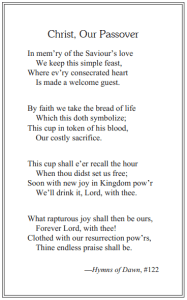
The Scriptures declare that the Lord hardened Pharaoh’s heart. The explanation is that it was the goodness of God that hardened Pharaoh’s heart. Divine goodness and generosity were shown in the removal of the various plagues as soon as Pharaoh promised to do right. This, instead of inciting him to love and obedience, led him to a greater obstinacy. He determined, as he had passed through one plague after an- other, that others could not be much worse. He paid dearly for his defiance. (Exod. 4:21; 7:3; 14:4)
The tenth plague was the crisis. All the first-borns of Egypt died, but the first-borns of Israel under the sprinkled blood were safe. Thus God pictured the “Church of the First- borns,” now being “called” out from the world. After glorification by the First Resurrection they will be the “Royal Priesthood,” Spiritual Levites, for the blessing of all Israel, and through Israel, all the families of the Earth.
Bible students hold the Passover night to have typified this Gospel Age of nearly nineteen centuries, during which the spirit begotten ones, the church of the First-borns, are to be passed over, or specially saved, and made partakers of the Divine nature and associates in the Messianic Kingdom for the blessing of the later born, during Messiah’s Reign. The blood sprinkled on the door-posts typed faith in the blood of Christ.
PASSOVER—How Often Repeated?
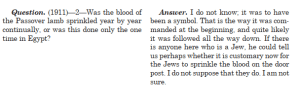
PASSOVER—Who Typified by First-born?
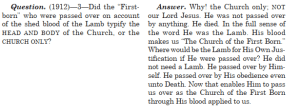
PASSOVER—Passover as Related to Atonement Day.
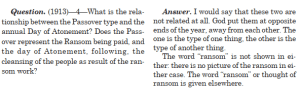
Passover In Type And In Antitype
“Christ our Passover is sacrificed for us; therefore let us keep the feast, not with old leaven, neither with the leaven of malice and wickedness, but with the unleavened bread of sincerity and truth.” 1 Cor. 5:7, 8
The Passover ceremonies, the first institution of Divine favor with the nation of Israel, prefigured the first institution of Divine favor inaugurated by our Lord Jesus Christ in the Eucharist, or Holy Communion. As the Apostle indicated in our text, the Jewish Passover was a foreshadowing, or typifying, of the better things—the real Passover—with which we Christians have to do. We are not wholly dependent upon the Jewish type for our information, however; for we have clear, Divine statements by our Lord and His Apostles respecting the relationship between Christ and His Church and respecting the special salvation of the Elect. Nevertheless, we find in the Passover type many details which assist us greatly in understanding the Antitype.
First of all, we should notice that the Passover directly affected only the firstborn of Israel, although it indirectly affected all the remainder of Israel. That is to say, the last plague upon Egypt was the death of all their firstborn; and the Passover celebrates the fact that the firstborn of Israel were spared, or “passed over,” by the destroying angel in that night. As the younger children of the Egyptians were not endangered, neither were the younger children of the Israelites. Hence the latter were not passed over. Yet they were certainly interested in the passing over—or sparing—of the firstborn, not merely because of their relationship, but because in the Lord’s providence those firstborn became leaders and deliverers of the people on the next day as they went forth from Egypt. (Num. 8:17, 18)
Furthermore, those firstborn of Israel, exchanged by Divine direction for the entire tribe of Levi, were thereafter represented in them; and they, as the sacrificing priests and the teaching Levites, became the ministers of the Law Covenant for that nation. The antitype of this was distinctly pointed out by the Apostle Paul; namely, that the elect Church of this Gospel Age is “the Church of the Firstborn, which are written in Heaven.” These are to be the “able ministers of the New [Law] Covenant.” (Heb. 12:23; 2 Cor. 3:6)
These firstborn alone are being dealt with during this Gospel Age, or “night.” These alone are in danger of a death penalty. As the Apostle declares, if we sin willfully after we have received the knowledge of the Truth, there remaineth no more sacrifice for our sins, but a certain fearful looking for of judgment and fiery indignation, which shall devour us as the adversaries of God and of righteousness. (Heb. 10:26, 27)
Nevertheless, the whole world of mankind is certainly interested in this Church of the Firstborn in its successful passing over—its attainment of everlasting life; for these are the Royal Priesthood and the instructors of the New Covenant, which is shortly to be sealed, and by the terms of which all the families of the earth are to be blessed. All mankind will receive the blessing of reconciliation to God through the knowledge of the Truth and through the blessings of the Millennial Kingdom associated with the New Covenant. (Jer. 31:31-34)
Jesus The Passover Lamb
Having noted the firstborn class, we should also clearly discern the Passover lamb, through the merit of whose blood the passing over of the firstborn was effected. The lamb is a peculiarly innocent animal, wholly unprepared for defense or resistance, and thus a suitable picture—or type—of our Lord, who was nonresistant and who fully and freely surrendered His rights and His earthly interests on our behalf—on behalf of the Firstborn. True, others besides the Firstborn will ultimately profit by His sacrifice, but these especially and peculiarly so. Thus far, God’s dealings during this Gospel Age are solely with this class. These alone have an Advocate with the Father—Jesus Christ the Righteous. (1 John 2:1, 2) These alone, thus far, are reconciled to God.
All of God’s blessings to the unbelievers must come in the future, under the New Covenant; for only believers can be justified by faith and receive the blessings of the Faith Covenant—the Abrahamic Covenant. “The Lamb of God, which taketh away the sin of the world,” first saves, or passes over, the Church of the Firstborn, and later in the Millennium will bless all who become Abraham’s seed.
There are pictures of the Church which represent her as participating with the Lord in His sacrifice; but this Passover type is not one of these. The Passover lamb represented our Lord Jesus Christ as “the Lamb of God, which taketh away the sin of the world.” (John 1:29) But the sin of the world has not yet been taken away. Our Lord has not yet applied His merit for the world, but only and expressly for the Household of Faith. In another sacrifice, which represents our Lord and the Church conjointly sacrificing as Head and members, the body of the animal was cut into various pieces and laid with the Head upon the altar, thus typifying Christ Jesus as the Head and the Church as His members. (Exod. 29:15–18) But provision was made that the Passover sacrifice was not to be divided. It was to be eaten whole—not a bone was to be broken. It represented not Christ and the Church, but Christ alone in His sacrifice. (Exod. 12:46; John 19:36)
“In That Night”
Be it remembered that the passing over took place in the night, not in the daylight. When the morning arrived, the Israelites went forth out of the land of Egypt to liberty, to freedom from bondage. But during the night they were still in bondage, waiting for the deliverance which could come only after the passing over of the firstborn. That night of the type represented this Gospel Age.
This same thought is given by our Lord when He says, “Let your light so shine before men”; again, “Neither do men light a candle and put it under a bushel, but on a candlestick; and it giveth light unto all that are in the house.” (Matt. 5:15, 16) The Apostle Peter expresses the same thought, saying, “We have also a more sure word of prophecy, whereunto ye do well that ye take heed, as unto a light that shineth in a dark place, until the Day dawn, and the day star arise in your hearts.” (2 Pet. 1:19) Again, the Prophet, speaking of the Church, says, “Thy Word is a lamp unto my feet, and a light unto my path.” (Psa. 119:105)
Numerous other Scriptures refer to the new Millennial Dispensation as the Morning in which the Sun of Righteousness shall arise with healing in His beams, and in which the shadows of superstition and works of darkness shall all be driven away. The appropriateness of this figure must be evident to every reasonable mind. God’s people are children of the Day in the sense that their hopes and sentiments belong not to the darkness of sin—not to the nighttime—but to the Day, to the Reign of Righteousness, for which they are praying, “Thy Kingdom come; Thy will be done on earth, even as it is done in Heaven.”
Eighteen centuries ago our Lord said that He had come as a Light into the world, but that men loved darkness rather than light. (John 8:12; 3:19–21) Only a few yet recognize Him as “the true Light.” But eventually He will “light every man that cometh into the world.” (John 1:9) Indeed, His Church are invited to become associated with Him as lamp-bearers; and if faithful in permitting their light to shine now, they will by and by be parts of that great Sun of Righteousness which shall heal the world with its beams. Our Lord pointed this out in the parable of the Wheat and the Tares. He declared that in the end of this Age He would gather the wheat into the barn; and that then “the righteous [shall] shine forth as the sun in the Kingdom of their Father.” (Matt. 13:43) Alas, that so few have “an ear to hear” and accept the wonderful teachings of the Divine Plan!
Blood On The Doorposts All Night
The Israelites were instructed that the blood of the lamb must be sprinkled on the doorposts and the lintels of their houses that night. This indicated that all who would belong to the Household of Faith must believe in the precious blood of Christ, and thus be “justified by faith,” irrespective of denomination. To believe thus would make us members of the Household of Faith; but it would not determine whether or not we would be of the Firstborns. The Very Elect, the Saints, the Royal Priesthood, have this place of seniority in the Household of Faith—not by reason of natural years, but by reason of spiritual development. They are priests, elders, in the sense of their primacy of development in the character-likeness of their Redeemer, which also indicates their faith and obedience.
We cannot emphasize too strongly the fact that this is the Scriptural teaching. We are not merely to believe that Jesus lived, that Jesus died. We are especially to believe that He died sacrificially, “the Just for the unjust,” and are to accept our share of the redemption which He secured by His precious blood. The sprinkling of the blood upon the doorposts in the type implied public confession of the precious blood of the Lamb of God, in His death and in its efficacy for us, which is thus signified.
It will be remembered that the Israelites were enjoined against going out of the house during the night; for when the Lord would pass through to smite the Egyptians, He would see the blood upon lintels and doorposts, and would not suffer the destroying angel to come into their houses. (Exod. 12:1–13) The injunction that those under the door sprinkled with blood should not go out from under it during that night had special application and force with respect to the firstborns. Antitypically it signifies that if any of us who are of the Firstborns should go out from under the blood, in the sense of denying the merit, the efficacy, of the blood of Jesus, the penalty of such a course would be death—the Second Death—hopeless extinction. (Heb. 6:4–6; 10:26–31)
Eating The Lamb
As the blood of the lamb marked the household of faith, not merely the first-borns of that household, so the eating of the lamb was not merely for the first-borns, but for all the household. So our Lord said, “My flesh is meat indeed”; and again, “This is the Bread which came down from Heaven; he that eateth of this Bread shall live forever.” (John 6:55, 58) In other words, not only was it necessary that Jesus should die, a meritorious Sacrifice, but it is also necessary that all who would have profit through His Sacrifice must feed upon Him—must appropriate the merit of His Sacrifice.
The eating of the lamb pictured, or typified, the appropriation, by the Household of Faith, of those earthly rights and interests which were forfeited by Adam’s dis- obedience and redeemed by Jesus’ death. In other words, it signifies our appropriating justification from sin. We eat by faith, and therefore are said to be “Justified by faith.” By faith we are permitted to count ourselves as fully reinstated in God’s favor through the merit of Christ’s Sacrifice, even as we were debarred from Divine favor through the demerit of Adam’s sin. The eating of the lamb signifies the appreciation of these things and the appropriation of them to ourselves. The more we eat, the greater is our feeling of satisfaction in respect to our freedom from condemnation and our reinstatement in Divine favor through the merit of our Passover Lamb.
The Blood Of The New Covenant
Year by year for more than sixteen centuries the Jews kept the Passover by Divine decree—not merely the sacrifice of the lamb and the eating of it on the same night, after the doorposts had been sprinkled with blood, but additionally a feast of seven days following. That Passover feast represented the joys and rejoicings, the blessings and favors of relationship to God, based upon the merit of the Passover lamb—its sacrifice and the eating thereof. Yet the Jews understood not the meaning of what they did. It was not necessary that they should understand. When God’s due time came, the explanation would be granted.
That due time came on the night in which our Lord was betrayed—the night of the fourteenth day of the first month, the very night of the typical killing of the Passover lamb. The Master gathered about Him His twelve Apostles. They had their usual Passover supper of roast lamb; and afterwards our Lord introduced what we familiarly term “The Lord’s Supper” a new symbolization of the antitypical Passover. What our Lord introduced was to take the place of the Jewish ceremony with His followers, to carry out the same thought, but on a higher plane, as representing a clearer, better understanding of the matter. Instead of the lamb would be the unleavened bread, representing our Lord’s flesh. This He distributed to His Apostles, saying, “This is My body, which is given for you; this do in remembrance of Me.” (Luke 22:19) The eating of that unleavened bread represented their appropriating to themselves of the merit of Christ’s sacrifice—their justification by faith.
Then our Lord added a new feature, “the cup.” For while all believers might partake of the bread, might realize justification through the merit of His sacrifice, yet only a certain class of believers were invited to partake of the blood. The cup represented death. Ordinarily, under the Jewish Law, the partaking of blood would represent blood-guiltiness, or responsibility for the death. (Lev. 17:10-14) But our Lord gave His disciples fruit of the vine as symbolic of His blood; and He urged upon them its appropriation, saying, “This cup is the New Testament in My blood, which is shed for you,” and “for many.” “Drink ye all of it.” (Luke 22:20; Matt. 26:27, 28)
This invitation to drink of His blood signifies a participation with Christ as His members in a sacrifice of earthly life, earthly interests, hopes, aims, ambitions—everything. All who accept this invitation to drink of His blood thereby pledge their lives in the same service for which He gave His life. This thought is entirely additional to anything in the Jewish Passover type. There is no intimation that any of the household were to partake of the blood of the slain lamb. Nevertheless we who now accept our Lord’s proposition to share in His blood and lay down our lives with Him in defense of the Truth, thereby mark ourselves as elder brothers in the Household of Faith, members of the Firstborns with our Lord, our Redeemer, and as prospectively the Royal Priesthood.
As Ye Are Unleavened
The apostle Paul points out these items to which we have called attention. He says that the Lord’s consecrated followers are counted as members of the Body of Christ, the Church, under Jesus the Head. He indicates that the broken loaf represents primarily our Lord Jesus, who was broken for us, and that secondarily it represents the Church of Christ, those who willingly and joyfully yield themselves for the sake of the Lord’s cause. He also points out that the cup of Christ’s blood, of which we are invited to partake, signifies to us a common union in the sufferings and afflictions of Christ. (St. Paul Enterprise, April 18, 1916—See Harvest Gleanings 3, page 814) Therefore, whoever intelligently partakes of the Memorial Supper thereby indicates two things: (1) His faith in Jesus as the Passover Lamb, and his appreciation and participation in the merit of Jesus—his justification by faith; and (2) his membership in the Body of Christ, all the members of which agree to be broken—membership in that “little flock” whose faithfulness is manifested by drinking of the Master’s cup—sharing with Him in His sacrifice, suffering with Him in order to reign with Him. (1 Cor. 10:16, 17; 2 Tim. 2:11, 12)