Our Passover
Our celebration of the death of “Christ our Passover” on its anniversary, the 14th of April, announced in last paper, was, as the occasion has always been, a “blessed season:” a time for remembering our Lord’s agony for our sins, and also of our “redemption through His blood.” As we looked at the acceptableness of our ransom we realized the completeness of our forgiveness, and said with Paul: If God be for us who can be against us? He that spared not his own Son but delivered him up for us all, how shall he not with him also freely give us all things? Who shall lay anything to the charge of God’s elect? It is God that justifieth. [God by his own arrangement has purged us of sin—who shall say it was not fully and properly done?] Who is he that condemneth? It is Christ that died. [Who says we are yet sinners? Let him remember who it was that paid our debt—it was Christ, and surely his was an acceptable sacrifice.] (Rom. 8:31-34)
Seeing our justification, we reflected on what Paul said to all justified persons: “I beseech you brethren by the mercies of God [His daily mercies and especially his mercy in providing Jesus as your ransom and thus justifying you] that ye present your bodies a living sacrifice, holy, acceptable to God, your reasonable service.” We looked at the significance of the memorials of his death which Jesus had provided—the bread and the wine—and found that they taught the same lesson—consecration and sacrifice. First the body was broken and the blood shed for our sin—to justify us—then the bread (truth—“I am the truth”) is offered us to give strength for the sacrifice which we are asked to make. God first gives the exceeding great and precious promises of becoming joint heirs with Jesus Christ our Lord to the “Divine nature” and kingdom, and then tells us how we may claim and attain those promises, viz. “If so be that we suffer with him, that we may be also glorified together.” (Rom. 8:17) This is all expressed in the symbol, as Jesus first handed the “bread,” and after supper the “cup” (wine), so during this age to all that come to him as disciples he offers first the nourishment and preparation of truth, and when they have eaten it and discerned the prize of their high calling, he offers them the cup of—death. Wine is a symbol of two things—first, in appearance it is like blood, and is called “the blood of grapes,” in this way it symbolizes death; second, it symbolizes the spirit, the effect being to cheer, refresh and enliven.
When we have been enlightened and strengthened by the heavenly food, Jesus passes us each the cup, saying, “Drink ye all of it”—drink unto my death—take up your cross and follow me, and at the same time you will be drinking unto my spirit and have a joy and refreshing which the world can neither give nor take away—and finally with me, inherit all things.
We remembered that we had been thus fed and strengthened by God’s promises, and had already covenanted to drink of his cup and become dead with him if we might “reign in life” with him.
We remembered the two disciples who had asked Jesus about their positions in his throne, to whom he answered, “Ye know not what ye ask. Are you able to drink of the cup that I shall drink of, [death—“Father, if it be possible let this cup pass from me.”] and to be baptized with the baptism that I shall be baptized with”—death? [“I have a baptism to be baptized with”—water was its symbol—“and how am I straightened until it be accomplished.”] The disciples answered him, “We are able,” and he said “Ye shall indeed.” So we have been begotten to the hope of sitting with him in his throne, and how his words apply to us: “Are you able to drink of my cup?” We asked ourselves, are we willing to share the sufferings as well as the glory? Then we said—Lord by thy word we know that we may have “Grace to help in time of need;” and that “Thy grace is sufficient for us.” We have given our all to Thee—“Work in us both to will and to do of thy good pleasure.” Thus having his strength made perfect in our weakness—we are able. Amen.
A number of letters received seem to indicate that the occasion was very generally celebrated among the scattered “twos and threes” “of this way.” We presume that it was celebrated in about twenty places. All who wrote expressed the feeling of solemnity and appropriateness, attaching to the celebration on the anniversary, rather than at any other time.
One or two brethren questioned the date announced—suggesting that by the almanac it would fall on the 12th instead of the 14th of April. To these we reply that the calendars in most almanacs are arranged upon astronomical calculations and are seldom exactly in harmony with the Jewish methods, which seem to be based on the eyesight. Some almanacs publish the Jewish calendar, and we used it in ascertaining when the “14th day of the first month,” Jewish time, would come.
The moon is used to symbolize The Law or Jewish nation, which reached its full at the time of Jesus’ presence, but began to wane when he gave them up and died. The moon was at its full on the 14th of April and began to wane; this seems to agree with the Jewish calendars and therefore we observed that time.
One sister wrote expressing disapproval, and asks, Why not go back to the Law in everything as well as in keeping the Passover? Our sister is in haste; we did not suggest the observance of the Passover as instituted by The Law, but the observance of “The Lord’s Supper” instead of it. Nor did we suggest this as a law, believing that “Christ is the end of the Law for righteousness to every one that believeth.” (Rom. 10:4, and 7:6) But who will say that we may not celebrate the death of our Lamb on the anniversary, for, “as often as ye do this, ye do show forth the Lord’s death.”
The Passover
“Christ our Passover is sacrificed for us, therefore, let us keep the feast.” 1 Cor. 5:7
From the account of the instituting of the Lord’s supper, furnished in Matt. 26:26, 28, and Luke 22:7-20, and 1 Cor. 11:23-26; we incline to the view that it was designed to be a yearly remembrancer of our Lord’s death, and that it is properly observed on its anniversary. Apparently it was instituted by Christ Jesus “our Passover,” “The lamb of God which taketh away the sins of world,” (John 1:29) as a substitute for the Jewish Passover.
For this reason we meet each year for its commemoration on the anniversary of our Lord’s death. (The 14th day of the first month—Jewish time.)
We do not quarrel with any who prefer to commemorate more frequently, neither do we regard it as a binding or compulsory observance. We observe it because we re- joice thus to remember our ransom price— “the propitiation (satisfaction) for our sins, and not for ours only, but also for the sins of the whole world.”
The time for the observance of the Lord’s death this year will be after 6 P.M. of April 2d, which we believe to be the date corresponding to the time at which Jesus and his disciples ate of it; 3 o’clock P.M., the day following corresponding to the hour of Jesus death. (Matt. 27:46-50)
Accordingly, there will be a meeting at the residence of J. L. Russell, No. 80 Cedar Avenue, Allegheny City, at 7:45 P.M. of Sunday April 2nd, for commemorating the breaking of the body and the shedding of the blood of Christ. Thus, “as oft as we do this, (on its anniversary) we do show the Lord’s death till he come”—till the last member of his body being dead with him, shall be like him, glorified and perfected as a new creature. For “the cup of blessing which we bless is it not the communion [sharing by us] of the blood [death] of Christ? The bread which we break is it not the communion of the body of Christ [in his death]? For we being many are one bread [loaf] and one body.” (1 Cor. 10:16) Hence, when we eat and drink, we show not only our interest in his sacrifice, but also ex- press our own covenant to be dead with him, and to drink of his cup. (See, Matt. 20:22, 23)
These are always precious seasons here; and letters received from various groups of twos, threes, twenties and fifties last year, indicated that they enjoyed a similar blessing. “Christ our Passover is sacrificed for us, therefore, let us keep the feast”— putting away all leaven of malice, envy- ings, etc., let us be of the unleavened loaf— the body of Christ—each member, not puffed up, but easily broken.
We generally use unleavened cakes (which may be purchased of any Hebrew family) and raisin juice.
Till He Come
Because Paul, referring to the Lord’s Supper, says that we do thus “show forth the Lord’s death till he come,” some regard that as a limitation. Consider, however, that in the Jewish age the typical lamb was slain and eaten every year, until our Lord, the true or antitypical lamb, came. But when John the Baptist introduced our Lord as present, and said “Behold the Lamb of God,” the killing and eating of the typical lamb did not at once cease to be proper; for our Lord himself observed it up to the same night in which he was betrayed. The commemoration of the typical lamb only ceased to be proper, when the antitypical lamb was slain on Calvary.
So now, our Lord, the true Lamb of God, gave us the bread and wine as emblems of his flesh and blood, given for us— for our passing over or sparing. And we are to commemorate his death with these emblems until he comes, and until the last member of his body shall have been passed over—into the fullness of salvation, with him and like him. Then the symbol shall cease, the antitype having fully come in our being thus passed over. Until this grand consummation of our hopes, it is proper for us to show it forth by commemorating his broken body and shed blood by which it shall be secured.
The Memorial Supper
We believe and teach that the most proper occasion for the celebration of our Lord’s death is its anniversary. This was the custom of the early Church, and it is still observed in a fashion by some denominations on Good Friday—although, in order to have the observance come upon the same day of the week, the exactness of the date is disregarded. We, like the early Church, prefer to observe the memorial up- on its exact anniversary—which we reckon as they and the Jews reckoned it—by lunar time—the day before the beginning of the Jewish Passover.
Furthermore, we believe and teach that the only proper manner for the celebration of this memorial is that which our Lord introduced and which the early Church followed, and not as Good Friday is now celebrated by some.
On the same night in which he was be- trayed—after 6 o’clock P.M. of what we now would call the 13th day of the Hebrew month Nisan, but which the Jews called the beginning of the 14th day of the month (their 24-hour day beginning with the evening); and therefore, in Jewish reckoning, in the same day in which he was crucified (the day before their Passover week began)
—our Lord celebrated the Passover supper with his disciples. (The lamb supper, which always preceded the feast-week of Pass- over, was not, and is not now, termed the Feast of Passover by the Jews.) And after having thus complied with the Law (which was still in force over every Jew until our Lord’s death on the cross), Jesus instituted a memorial of his own death, bread and “the fruit of the vine” being used as emblems of his flesh and blood.
He instructed his followers that thus they should commemorate his sacrifice for sins, saying,
“This Do In Remembrance Of Me”
And to us it appears that the time is no less a part of the institution than the bread and the juice of the grape. We should as soon think of substituting another time than that of the institution—especially in view of the particularity of our Lord in the matter; for although he declared, “With desire have I desired to eat this passover with you before I suffer,” yet, according to the Law, it could not be eaten until the anniversary of the killing of the typical lamb preceding the passing over of Israel’s first-born in Egypt; which was to be the anniversary also of the killing of the true “Lamb of God which taketh away the sins of the world” and by whom the Church of the first-born is first to be spared or delivered. Our Lord waited, therefore, and “when the hour was come [the earliest hour possible according to the Law] he sat down.” (Luke 22:14-20)
The words of the Apostle “As oft as ye do this, ye do show forth the Lord’s death until he come” (1 Cor. 11:26—particularly explained in Reprint 1289), are understood by many to give license to the observing of any hour, any day and any month; but not so to those who read critically; for the words “do this” have special weight. It would not be this if done at another time: just as if a command were given to celebrate the Independence of the United States on the fourth day of July, it would not be a fulfillment of this command, nor a celebration of this event, but something else, if another day were celebrated.
But let no one suppose that we teach that God’s people are under the Law on this or on any other subject. The only law of our new covenant is the law of love. We love our Master, we love to celebrate his great sacrifice for our sins, and we love to do it as he was pleased to show us, as nearly as we can.
Some of the Lord’s people celebrate his death every first day of the week, supposing that in so doing they have the sanction of the custom of the apostles and the early Church, as recorded in Acts 2:46; 20:7. We hold, however, that they err in this application of the words “breaking of bread,” and that it was not the Memorial Supper, but an ordinary meal customary in the early Church for two reasons, (1) being few and scattered, when they gathered for a meeting they brought a luncheon; and (2) probably for the same reason that they met on the first day of the week, they ate a meal together, viz.: because it was on the first day of the week that our Lord arose from the dead, and because on that day he expounded unto them the fulfillment of the
Scriptures applicable to himself and was known to them in the breaking of bread, i.e., in the eating of supper. No wonder that afterward they loved to celebrate both the day and the meal which brought them so much joy and blessing. (Luke 24:25-32) Those who have confounded these luncheons, celebrating the resurrection on the first day of the week, with the Memorial of our Lord’s death have erred greatly if not seriously. They should notice, too, that the fruit of the vine is not mentioned in connection with these luncheons, while it is never omitted when the Memorial Supper is referred to, being no less important than the bread. The same expression, “breaking of bread,” from the same Greek words, is used in Acts 27:35 where there can be no doubt that it refers to an ordinary repast for the satisfying of hunger and not as a memorial or symbol.
We treat this subject but briefly here. As to who should celebrate the Memorial, and how, and many other interesting points, our regular readers are referred to Reprint 1289.
Let us urge upon all who recognize that value of Christ’s death as their ransom-sacrifice, to surely “do this,” as the Master enjoined, in remembrance of that great event which is the basis of our present joy in the Lord as well as of those which we shall enter upon as the fulfillment of this Memorial—when we shall partake of the joys of our Lord in glory, in the Kingdom. But those who trust to forgiveness aside from this sacrifice for sins, or who are trusting that they can crucify their own sins, and thus render themselves acceptable to God (as some claim), should not celebrate this Memorial; for in so doing they would be eating and drinking condemnation to themselves—not discerning the value of the Lord’s broken body and shed blood as the one and only sin-offering which can take away sin and make the believer acceptable before God.
The Annual Memorial Supper
This year, Thursday, April 19th, after six o’clock P.M., will mark the anniversary of our Lord’s “Last Supper,” which he gave as the memorial of his death on our behalf, saying, “This do in remembrance of me.” (Luke 22:19)
In previous issues of this magazine, we have given the evidence that the Last Supper was given us to take the place of the Jewish Paschal Supper, and to be celebrated at the corresponding time, yearly. As the Paschal lamb typified Christ, the Lamb of God, so its death was typical of his death, and therefore his death was upon the same day. We have shown, also, that the Jewish method of reckoning time, as beginning the day at six P.M., was so arranged that our Lord could institute the Last Sup- per upon the same night in which he was betrayed (1 Cor. 11:23)—the same day in which he died.
As a Jew, under the Law Covenant, not yet supplanted by the New Covenant, it was the duty of our Lord to eat first of the typical lamb; and it was after that supper that he took bread and wine, as the symbols of his own flesh and blood, and instituted the Memorial Feast which we and all of his people since delight to celebrate.
Taking the place of the typical lamb, our Lord could be crucified only upon the fourteenth day of the month Nisan; and the commemoration of his death, and the passing over thereby effected, taking the place of the commemoration of the Passover lamb and that typical passing over, it follows that the commemoration of the anti-type should be an annual observance, as was the commemoration of the type.
This we have seen was the custom of the early Church, which adopted for centuries the Jewish method of reckoning which we follow; viz., the evening, following the thirteenth of Nisan, which was the beginning of the fourteenth. This method of reckoning was afterward changed by the Church of Rome, although the thought and custom of a yearly commemoration of our Lord’s death is still observed on “Good Friday” by the Church of Rome, the Greek Church, the Syrian Church and the English Church.
Protestant Churches got the Romish doctrine of the Mass confounded with the Lord’s Supper, whereas they have no correspondence (See Mass in Vol. 3, pp. 98-101); and as a result they adopted various times and seasons, morning, noon and night, and monthly, bimonthly and quarterly, seeing no reason for any particular date, and supposing that the Apostle’s words, “as oft as ye do it,” etc., give full license to celebrate it at any time. On the contrary, we understand the Apostle to mean, Every time (yearly) that ye do this.
The Celebration
The Allegheny Memorial Service
The service here will be held, as usual, in Bible House chapel, No. 58 Arch St., at 7.30 o’clock P.M. All who trust in our Lord Jesus’ death as their ransom, and who are fully consecrated to him, will be made very welcome. But we extend no special invitation to visitors from a distance this year; nor are there any arrangements for other than our usual Sunday services, except as above mentioned. If there be any solitary ones in nearby towns, we shall be glad to have them attend with us; but where there are even two or three who can unite in this memorial, our suggestion is that they had best meet together at home.
On previous occasions of conventions here, we have always been rather pain- fully aware of the fact that the various local gatherings of believers were interfered with and impaired by the absence of those who were most needed. This year we would like to see this matter quite reversed; and therefore advise that, wherever even two or three can meet together, they do so; and that even the solitary ones, if within reach of a larger and a smaller circle of believers, prefer to give their presence to the smaller rather than the larger gathering, and thus encourage and help those who need their presence most. Those who thus strive to do good to others will be the more blest themselves.
The Prophet Like Unto Moses
As “our Passover,” Christ is the Prophet like unto Moses. When the Passover was instituted, “the Lord spake unto Moses and Aaron in the land of Egypt, saying, ‘This month shall be to you the beginning of months; it shall be the first month of the year to you.’ ” There is an adequate reason for this. The life which man derives through the first Adam is condemned; and God has never entered into covenant with man on the basis of condemnation. In the institution and observance of the Passover, the people were typically passed over from death unto life. Their physical lives were preserved when others were destroyed; and that preservation is a type of a more widely extended and enduring one. In the treatment of the Passover lamb, there are at least two points which ought to be specially noted. First, as to the blood: “They shall take of the blood and strike it on the two side posts and on the upper doorpost of the houses wherein they shall eat it . . . and the blood shall be for a token upon the houses where ye are; and when I see the blood I will pass over you and the plague shall not be upon you to destroy you when I smite the land of Egypt.” (Exod. 12:1-28) Very early the eating of blood was prohibited: “Flesh with the life thereof, which is the blood thereof, shall ye not eat.” (Gen. 9:4) This prohibition was frequently repeated, and a specific reason assigned for it: “For the life of the flesh is in the blood; and I have given it to you upon the altar to make an atonement for your souls; for it is the blood that maketh an atonement for the soul.” (Lev. 17:11) The shedding and sprinkling of the Passover blood is a striking “figure” of giving “life for life”— the requirement of divine justice before the condemned could be justified. It was only a “figure,” however—the reality came afterwards: “Forasmuch as ye know that ye were not redeemed with corruptible things, as silver and gold . . . but with the precious blood of Christ, as of a lamb without blemish and without spot.” (1 Pet. 1:18-19) The other point is as to the flesh: “They shall eat the flesh in that night, roast with fire, and unleavened bread, and with bitter herbs they shall eat it . . . with your loins girded, your shoes on your feet, and your staff in your hand; and ye shall eat it in haste; it is the Lord’s Pass- over.” Through the blood-shedding, the life of the Israelites was preserved; but the wilderness journey was before them, and they had to eat of the flesh as well. This feature, too, is a striking “figure” of the Lamb of God—“our Passover.” Through the shedding of his precious blood we have life. But that is not all. The journey of life has to be pursued, the enemies of life have to be overcome, the work of life has to be accomplished, and the discipline of life has to be perfected. In all this there is wear and tear—weariness and exhaustion; but our strength is renewed by heavenly food: “My Father giveth you the true bread from heaven: for the bread of God is he that cometh down from heaven and giveth life unto the world. He that cometh to me shall never hunger, and he that believeth in me shall never thirst.” (John 6:27-58)
The Memorial Supper
With Christians generally it is customary to celebrate Good Friday as a memorial of our Lord’s death, and Easter Sunday as a remembrancer of his resurrection. But with the early Church every Sunday was a remembrancer of our Lord’s resurrection, while his death, symbolized in the Last Supper eaten the evening before the crucifixion, but “in the same day,” was celebrated annually, as the antitype of the killing of the Jewish Passover lamb—on the fourteenth day of the first month, lunar time, as reckoned by the Hebrews. Desiring to return to the “old paths,” many WATCH TOWER readers, in every quarter of the world, adopt and practice this custom of the Primitive Church. Its appropriateness is beyond question even by those who for one reason or another have seen fit to adopt more modern customs and to celebrate it quarterly or monthly or weekly or daily— according to human judgment, caprice or theory.
Only two of these theories claim Scriptural authority, and they alone, therefore, require answer.
(1) Those who hold that the Lord’s death should be commemorated daily have no other argument than that the Apostle declared, “As often as ye do this ye do show forth the Lord’s death until he come.” They forget that three or four times a day or even hourly would be more “often,” and therefore more proper, according to their definition of this word “often.” The fact is that the stress lay upon the words “do this,” as our Lord said—“This do ye, as oft as ye drink it [annually], in remembrance of me.” (1 Cor. 11:25) The Lord’s disciples as Jews were accustomed to the killing and eating of the Paschal lamb, at a specified time annually, and our Lord wished that henceforth they should recognize him as the antitype of that lamb—his death as the antitype of its death and the passing over, or justification from death to life, of the Church of the Firstborn (Heb. 12:23) as the antitype of the sparing of the firstborn of Egypt.
To “do this”—i.e., to celebrate the Pass- over—was the command of the Law to the Jew; but our Lord in setting his followers free from the Law Covenant and accepting them under the New Covenant did not command them to “do this,” nor to do anything but “love”—which he declared to be the fulfilling of his law of the New Covenant. But he did say, “As oft as ye do this [yearly— never oftener, and never less often did the Jews celebrate their Passover], do it [henceforth, not in remembrance of the typical Passover and the typical lamb slain and eaten, but] in remembrance of me”— “the Lamb of God which taketh away the sin of the world,” by whose death and blood of sprinkling you are passed over, from death unto life, and by the eating of whose flesh (figuratively speaking) ye shall obtain strength for the journey out of the Kingdom of darkness, sin and oppression, the dominion of Satan (typified by Pharaoh) to the heavenly Canaan under the lead of the Lord’s Anointed, whom Moses and Joshua typified.
(2) Those who celebrate the Lord’s death every Sunday well know that more appropriately that day commemorates the re- verse idea—the resurrection of our Lord from death; but they think that they find justification of their course in the “breaking of bread” every first day of the week, practiced by the early Church. But they hastily draw a wrong inference: those “breakings of bread” were only ordinary lunches or “love-feasts” eaten for a double purpose— to satisfy hunger, but apparently, specially, because they met on that day to celebrate the Lord’s resurrection—because it was in the “breaking of bread” that he had twice made himself known to them on that notable day when his communion and expounding of the Scriptures had driven away their fears and enkindled hope and caused their hearts to burn within them with the hope that maketh not ashamed. (Luke 24:32; Rom. 5:5) It was in connection with the eating of natural food that twice again before his ascension, our Lord made himself known to the disciples and instructed and refreshed them, and probably both were on the first day of the week. (John 20:26; 21:13)
Is it any wonder, then, that the early Church formed the habit of gathering every first day of the week to commune with the Lord in spirit; and is it any wonder that they repeated the “breaking of bread” and any other features that would keep vividly before their minds the scenes and thoughts of their first experience and heart-burning? It is not surprising. But that had nothing whatever to do with the annual Pass- over, which to the early Christians took on a fresh importance, because “Christ our Passover” had been slain. (1 Cor. 5:7, 8) Christ our Passover represented his sacrifice by both bread and wine, as symbols of his flesh and his blood; but the accounts of the love-feast or “breaking of bread” make no mention of the wine—and not the slightest hint that these were meant to commemorate the sufferings and death of our Lord, the Head, and the Church, which is his body.
But we, as Christians, do not celebrate the Jewish Passover and its deliverance from Egypt, nor do we kill and eat the typical lamb. With the Jews the lamb, its selection on the 10th day of the month and its killing on the 14th day were separate from the Passover festival, which began on the 15th and lasted for a week. The Jews celebrate specially the festival: we memorialize the death of the great Lamb of God, and understand the Jewish seven days festival to be only typical of the complete and ever- lasting joy resulting from our present eating of our Lamb with the bitter herbs of persecution during this Gospel night, waiting for deliverance early in the Millennial morning. Surely when the blindness of fleshly Israel begins to turn away, nothing will appeal to them more forcibly than that Christ is the antitype of the Passover lamb, and that the blessings flowing from his death are the antitypes of the Passover blessings.
We follow the Jewish method of reckoning the date—the same that our Lord and the Primitive Church followed—and it is very simple. The Jewish (ecclesiastical) year begins in the Spring—with the first appearance of the new moon after the Spring equinox. There they begin to count their month. This year the new moon of Spring will appear on the 26th of March, and consequently the fourteenth day of the first month will be April 8th. But as in the Hebrew reckoning the day begins at six o’clock of the preceding day, it follows that the fourteenth of Nisan will begin at six P.M., Sunday, April 7th. About 8 o’clock on that evening, therefore, would be the anniversary of the Lord’s Supper.
At this hour, in accordance with our usual custom, the Church at Allegheny will celebrate the memorial of the greatest transaction upon the pages of history—the transaction which means so much to all who trust in the ransom given once for all, but which has so little meaning to others. No arrangement is made for a convention or general gathering at the time; but friends passing through the city are al- ways welcome. The same course is recommended to the scattered ones of like mind everywhere: that they meet with brethren residing near them, and celebrate with as nearly as possible the simplicity of the model given us by our Lord over eighteen centuries ago.
Let us each call to mind that the bread and wine not only symbolize our Lord’s sacrifice on our behalf, but also that as his Body or Church we are members of the one loaf now being broken for others—that thus we are to share with our Lord in sacrifice, and by and by share also his glory—“If so be that we suffer with him, that we may also be glorified together.” (Rom. 8:17)
As To Serving The Memorial Emblems
A brother writes, inquiring for an appropriate order of service in connection with the celebration of the Memorial Supper, and, as the subject may be of interest to many, we publish a portion of our reply, as follows:
After opening the meeting, let as competent a one as is present give a little talk upon the import of the ordinance and then on the emblems, beginning with the bread and what it symbolizes—informally, and just as lengthily or briefly as circum- stances indicate, endeavoring to set forth the real meaning of what is done. Follow with the remark that the Lord, in instituting the Memorial, first gave thanks; then either return thanks yourself or ask some one else present to do so. Then follow with some such expression as the following—After having eaten the Passover Supper, the typical lamb, our Lord “took bread, and blessed it, and break it, and gave to the disciples, and said, Take, eat; this is my body.” Suiting the action to the word, break a piece of the bread (preferably “unleavened bread” purchased from Hebrews, or else soda-biscuits, which are unleavened), and hand it to those who will serve it, or serve it yourself, according to the size of the company.
It is generally well, we think, to have a little interim of silence for meditation—a few moments. Then let some one give thanks for that which the cup emblemizes. Then say, “And he took the cup, and gave thanks, and gave it to them, saying, Drink ye all of it; for this is the blood of the New Covenant, which is shed for many for the remission of sins.” (We advise, as preferable, either grape juice or a mixture of the latter with a very little wine and sugar—so little that the flavor of the alcohol cannot be detected— as a safeguard for any who may have had in the past a craving for liquors.) After passing this emblem, again leave a little space for silent reflection, and then say: It is writ- ten, “And when they had sung an hymn, they went out.” Let us do likewise—in thought following the course of the Lord during that eventful night in the Garden of Gethsemane, the prayer with the disciples and admonishing them to watch and pray, the betrayal, arrest, trial, crucifixion, etc.
Sometimes it may be found profitable, instead of speaking, to read from Reprints 1289 and 1786.
The Memorial Of Our Lord’s Death
Few and simple are the memorials of the true Church in contrast with those of heathendom and formalistic nominal Christendom. Instead of the numerous fast and feast days and weeks, we have only three memorials:
(1) Baptism, the symbol of the death and burial of the already justified human will into the will of God in Christ.
(2) The Memorial Supper, emblemizing the literal breaking of our Lord’s body and shedding of his blood (his death as “the man Christ Jesus” at Calvary)—and reviving our covenant to “be dead with him” that we may also live with him,” to “suffer with him” that we may also be glorified together.”
(1) The memorial of our Lord’s resurrection on the First-day of the week, now commonly called Sunday.
Our Lord instituted all three beautiful, yet simple, memorials. His baptism was different from the baptism of John, preached to Jews only, a “baptism unto repentance;” for he had no sins to repent of. His was the first baptism of the new order, symbolizing the death of the will of a justified human being, already acceptable to the Father, and full submission to God’s will, a full sur- render, complete consecration.1 It took the place of “John’s baptism.” (Acts 19:3-5)
Our Lord instituted the observance of the first day of the week, in the same manner that he instituted the Memorial Supper and Baptism; namely, not by command, but by example. He met with the disciples on the first day of the week, immediately after his resurrection; with Mary near the Sepulchre, with Simon Peter, with the two who went to Emmaus, and with the ten disciples in the upper room. (John 20:1, 14, 19; Luke 24:13-31, 34, 36) Then he waited another week, and again appeared to them on the eighth day, probably meaning the day after the seventh, the first day of the week. (John 20:26) The disciples seem to have expected something of the kind and had come together, and thereafter remembering the opening of their eyes of understanding to know him, that it was in connection with the “breaking of bread,” they afterward not only met regularly on the first day, but regularly had a simple meal together, called “breaking of bread.” This some in our day have mistaken for a commemoration of the Last Supper. The two, however, were to- tally different—the one commemorating the death, and the other celebrating with joy the resurrection. The first day of the week was not only honored as the memorial of our Lord’s resurrection and manifestation and communion, but was again marked by divine favor at Pentecost, and became the memorial of the outpouring of the holy Spirit. (Acts 2:1; 20:7; 1 Cor. 16:2)
Our Lord instituted the Memorial Supper after, and to take the place of, the Jewish Passover supper. The killing of the Passover lamb was to be done on the fourteenth day of the first month of each Jewish year, in commemoration of the deliverance of Israel’s firstborn from the last plague of Egypt, and subsequently the deliverance of the entire nation from slavery. Our Lord was himself the antitype of the Lamb. His Church is the antitype of the spared first- born of Israel; and the near approaching “restitution,” in which all who love God will be delivered from the slavery of Sin and Death under Satan, will be the antitype of the deliverance of the nation.
The Memorial Supper, with its unleavened bread and wine, representing the flesh and blood of the Lamb of God, whose sacrifice takes away the sin of the world, making reconciliation for iniquity, was intended to keep fresh before the memory of the Church of the firstborn the remembrance of her purchase price, and to pledge her to fellowship in the sufferings of Christ. (1 Cor. 10:16, 17; 11:26) It was instituted, therefore, in the same night in which our Lord was betrayed, in the same day in which he was crucified (the Hebrew day counting from six p.m. until six p.m.).
1. See Reprint 1539, “Baptism and Its Import.”
It was not the intention of our Lord to commemorate the feast of Passover, which began on the 15th of Nisan and lasted for an entire week, but merely to give us a memorial of his death on the 14th of Nisan. So far from being a feast of rejoicing, it was an occasion of sorrow and perplexity to the early Church. Jesus himself was “exceeding sorrowful.”
Seeing that this Memorial celebrates the antitype of the killing of the Passover lamb, we can see that it is properly celebrated on its anniversary—not monthly, quarterly, weekly nor daily, but yearly—and properly at the same time of the year at which our Lord died, and at which he instituted the memorial. This was the custom of the early Church, which reckoned its date according to the Jewish method of reckoning time. The first deviation from this was by the churches represented by the Bishop of Rome, which substituted, appointed and observed the nearest Friday, when the 14th of Nisan fell on some other day, as it most frequently did. This was the origin of “Good Friday,” and the third day following was known as Passover Sunday, and later as “Easter Sunday.” Later, by the decree of the Council of Nice (A.D. 325), and still later under the revision of the calendar by Pope Gregory XIII., the so-called Catholic churches have been brought into practical agreement, and annually fix dates for “Good Friday” and “Easter Sunday.”
For the past twenty years we who are seeking the “old paths” (Jer. 6:16) have celebrated the Memorial Supper upon its anniversary, as reckoned according to the He- brew usage, which was recognized by our Lord and the Apostles. Theirs is an easy and simple method. They begin their year (Nisan being their first month) with the new moon at the Spring Equinox and on the night of the 14th, at six p.m., commences the 15th, which is the first day of their Passover feast. (Exod. 12:2)
This year the Equinoxial moon, or month Nisan, begins March 15th; hence its 15th day or the beginning of the Hebrew Pass- over week will be on the 29th. The 14th of Nisan, on which they killed the Paschal lamb, the anniversary of the death of our Lord, “the Lamb of God,” will be March 28th, beginning, according to Hebrew reckoning, on the 27th at sundown. Since our Lord instituted the Memorial on the evening preceding, we celebrate it correspondingly.
Following this honored custom, therefore, the Church at Allegheny will meet on the evening of March 27th, at 8.00 o’clock, to commemorate the greatest transaction known to mankind. As heretofore our services will be very simple, consisting of praise, prayer, a review of the significance of the emblems and the realities celebrated, partaking of the emblems, “Passover-bread” (i.e., unleavened bread), and “fruit of the vine.” (For “fruit of the vine” we prefer unfermented grape juice or raisin juice rather than wine, because if the liquor habit has a hold upon any one we would avoid the temptation to such—adding a spoonful of wine for the sake of those who consider that nothing but wine would fill the prescription, “fruit of the vine.” As for the unleavened bread, what is needed can readily be purchased from almost any Hebrew family; if not, “soda crackers” or “water crackers” are an unleavened bread, and will serve every purpose.)
The special feature of the occasion is the heart communion with the Lord, facilitated by the appreciation of the significance of the emblems revealed in the Word. They are to be appreciated, not only as representing our Redeemer’s sacrifice, but also as representing our privilege of fellowship with him in suffering for righteousness’ sake, as members of his body, the Church—our individual share in it. “The cup of blessing for which we bless God—is it not a participation of the blood of Christ? The loaf which we break—is it not a participation of the body of Christ?” (1 Cor. 10:16, 17) Concluding with an appropriate hymn of praise we seek to avoid conversation, and to perpetuate the “communion” by thoughts respecting the great event just commemorated, and to follow our Lord reflectively to Gethsemane, and the day following to Calvary, thinking meanwhile of how little we are able to do to show our love for him, and resolving to be more jealously careful in the use of every hour and every mite of influence in his service.
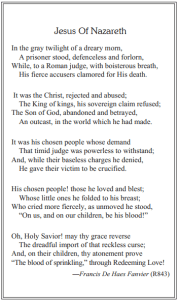
Any friends who trust in the “precious blood” will be cordially welcome to meet with us. We advise, however, that brethren and sisters, so far as possible, should not desert little groups at home to enjoy the privileges of meeting with a larger company. Where two or three meet in the Lord’s name he blesses them. Let each one be thoroughly willing to sacrifice his own preferences in the interest of the fellow-members of the body of Christ. This is being broken for others, as set forth in the preceding quotation, and the results are always blessed.
Remember all the dear flock of the Lord, not forgetting us, here, at Allegheny, in your prayers, and we will remember you all. Watch and pray lest ye enter into temptation. Let each one be on guard against the wiles of the devil. Remember that we near the anniversary not only of our Lord’s sufferings, but also of Judas’ treachery and false kiss, and question “Is it I?” Let each one examine his heart and see that it is in such an attitude of love and devotion to the Lord, and to every member of “his body,” that he can have communion with the Lord and all who are truly his. In any other attitude there is danger that Satan “enter in.” (Luke 22:3) “The last state of that man is worse than the first.” (Matt. 12:45; Luke 11:26)
The Memorial Supper
As instituted by our Lord, and perpetuated by the apostles and the early Church, the Memorial Supper took the place of the Passover Supper—on the fourteenth day of the Jewish first month Nisan. This custom of the early Church is still preserved in the English, Roman, Greek, Armenian and other so-called “Catholic” churches and by Lutherans. But soon after the death of the apostles, ceremonialism gradually crept in and very greatly altered the original simple Memorial services. Then, too, the idea of the Mass was evolved—a fresh sacrifice of Christ as the basis for forgiveness of special sins. Masses are not figurative sacrifices, remembrancers of the great sacrifice at Calvary, but meant as new and real sacrifices. The priest is specially commissioned to turn plain ingredients of bread and wine into the actual body and blood of Christ in order that the priest may make a fresh sacrifice of Christ, with fresh efficacy for the forgiveness of the special sins for which the Mass (sacrifice) is performed. These Masses appear in many respects to merely elaborate the Lord’s blessing and breaking of the bread and wine at the institution of the Memorial Supper, only that they may be and are celebrated at any hour of any day or night.
It is not surprising that after a thousand years of false teaching and false practice along these lines, Protestants, when awaking and seeking to find the old paths, failed to discern all of the Papal error on this and other subjects. Accordingly, while discarding the Papal Mass (called in Scripture “the abomination that maketh desolate”) as additional sacrifices for sins, and properly holding and teaching that “by one offering he [Christ] hath perfected for ever them that are sanctified” (Heb. 10:14), they overlooked the fact that the added times for what they term “Communion” were added for Masses, and that the anniversary of our Lord’s death is the only appropriate and the only appointed time for its commemoration.
Accordingly, some celebrate three times a year, some four and some weekly. If the contention, “the oftener the better,” be correct, why should they not celebrate it every day? While we cannot say that done in sincerity it is at any time a sinful abomination like the Mass, we may be sure that men of today are not wiser than our Lord and the inspired teachers of the Church—the Apostles—and that any change from the original institution must result unfavorably. The occasion loses its weight and impressiveness by repetitions disconnected with the fact memorialized. How national memorials would lose their intended significance if repeated three to fifty times a year! The fourth of July, for instance, celebrates a great event, the institution of the United States Government, and it is generally celebrated. But suppose instead it were celebrated weekly or quarterly—would not this deprive the celebration of weight and influence? Assuredly; and so with the Memorial of our Lord’s death—its anniversary is its only proper or designated occasion for celebration. But once the origin was lost sight of, general carelessness and indifference prevailed, so that although always mentioned in the Scriptures as a “Supper,” it is now generally observed at dinner time; and rarely or never as a supper or evening meal, like its pattern.
The expression, “As oft as ye do this, ye do show forth the Lord’s death, till he come,” has been misinterpreted by many to mean—Do this as often as ye choose. But the emphasis should be put upon this—As oft as ye celebrate this annual Memorial, instituted by our Lord, ye are showing forth his death, and are to so do until his second coming—until the establishment of his Kingdom and your glorification therein will fulfill or complete all that is symbolized in the Memorial.
As the people of God “seek for the old paths” (Jer. 16:6), the light of present truth spreads and the number who celebrate the central fact of redemption (the great Sin-offering) on its anniversary increases; and this year probably more than ever before, since the fifth century, will “Do this” in remembrance of their Redeemer, on the anniversary of his death.
The “Catholic” churches slightly changed the method of reckoning the anniversary so that they always celebrate a Friday for our Lord’s death (Good Friday) and, on the Sunday following, his resurrection (Easter Sunday). The early Church, however, followed the Jewish custom of counting, regardless of the days of the week, and so we do. In fact, it is claimed by some that, as the Jews had an abrupt beginning of months every Spring, with the appearance of the new moon at or after the vernal equinox, so they had an abrupt beginning of weeks with the beginning of Passover, which was always counted a Sabbath and the new start of the cycle. However this may be, their Passover week always began with the fifteenth day of Nisan by divine direction. (Exod. 12; Num. 28:16, 17)
We Christians, however, do not celebrate the Passover week. That will find its anti-type by and by, when the glory of the Kingdom shall be enjoyed. We celebrate the fourteenth; a day of which the Jew takes little or no account. It would appear that the fourteenth of Nisan should have been generally observed, but that the Jews seemed to begrudge the time, and generally crowded the supper over onto the fifteenth day, to gain one more day for business. Certain it is that it was proper to both kill and eat the Passover lamb on the fourteenth, for our Lord and the twelve apostles so did, and our Lord was crucified on the same day; this being provided for in the Jewish arrangement of time, which began each day at six P.M. (Lev. 23:5, 6)
Reckoning according to the Jewish rule, the fourteenth of Nisan will this year commence Thursday, April 15, at six P.M. At 8 P.M. a few earnest Christians all over the world, including a little company in Allegheny, will break the memorial bread and taste the memorial fruit of the vine, in grateful remembrance of him who loved us and gave himself for us; and in pledge of our fellowship with him and all who are his, in the sufferings and trials of this present time; and in testimony of our hopes of fellowship by and by in his glory. Reader, will you not join with us at that hour? Whether alone, or as little groups, hundreds of miles asunder, we will surely have a special blessing; and, if we seek it, no doubt we will be welcomed specially near to our Heavenly Bridegroom, and be specially strengthened to share his cross, and to withstand the wiles of the devil.
We do not invite a general convocation to Allegheny as formerly, for two special reasons: (1) we are so situated as to be unable to entertain as formerly; and (2) we believe that the cause in general is benefited by having all of each little group meet together on this occasion. Every family together, was the law for the Jews; and it seems appropriate and profitable for us.
As we have heretofore pointed out, anyone of the Lord’s people, the choice of the company, may serve the emblems of our Master’s broken body and shed blood. The distinctions of “clergy” and “laity” are not of God, but of mistaken men. All who are true “disciples” are invited to take, eat, drink and distribute the emblems. It would surely require a great amount of authority and ordaining to qualify any man to “create God” out of bread and wine, as it is claimed the Catholic priests do; but it requires only a fully consecrated, humble believer to do any and every thing commanded by our Lord in respect to this beautiful Memorial. Let us, therefore—all who are his and who see the beauty of his arrangement—obey, and “do this” in remembrance of him. Unleavened bread is best to use, as an emblem of our Lord’s purity, his freedom from sin, which leaven symbolizes. Fruit of the vine may be wine or (preferably, we think) unfermented grape-juice, or the juice from stewed raisins—“fruit of the vine” is quite a broad term.
Make Due Preparation
In the type only the circumcised were allowed to eat of the Passover supper. Circumcision of the heart is the antitype, as the Apostle explains, and signifies a full consecration to the Lord and a separation from the filth of the flesh and sin in general. Let us note, also, that none but those consecrated to be broken with him, and to share his cup of suffering and self-denial, are truly “disciples,” and invited to “do this.”—See Matt. 20:22, 23
Note, also, that even the “circumcised” were to cleanse their dwellings and put away sin, symbolized by leaven. And faith in the blood must be publicly confessed as symbolized by its being sprinkled on the front of their houses. All these things represented Christian life during this Gospel age. The eaters are to be Pilgrims who seek a heavenly country; our “bitter herbs” are the trials and persecutions and revilings and disappointments, incident to our faithfulness to the Lord—they will only sharpen our appetites for more of our Lamb—Christ our Passover (lamb) slain for us. (Exod. 12:8, 11, 12; 1 Cor. 5:7) And, inasmuch as the law provided that none of the lamb must remain over to be eaten on the morrow, it seems to signify, typically, that the privilege of participation in the Lord’s sacrifice is meant by the eating; and that this fellowship or communion in sufferings is confined to this Gospel age. This is intimated also by the Apostle. (1 Cor. 10:16, 17)
Let all of the Lord’s people examine themselves to see that their hearts are circumcised, separated from the will of the flesh and fully subjected to the will of God in Christ. Let us see to it that we purge out any of the old leaven of malice, envy and strife (1 Cor. 5:8), that the thoughts and intents of our hearts are pure and sweet and clean, and that unavoidable weaknesses are under cover of the precious blood. Although the Lord and the Apostles gave no command to fast forty days, as is the custom of the “lenten season” with many, and although we deprecate such formal commands of men, nevertheless, we believe that those who as a preparation voluntarily do some fasting, as well as praying, will be blest according to their faith and love and devotion.
The Celebration Of The Memorial
The recent celebration of the Memorial Supper at Allegheny was amongst the most solemn and impressive that we have ever enjoyed. The attendance was good, perhaps the largest we have had since the abandonment of the general convention at this date, in 1892. About two hundred were present, and that notwithstanding the fact that none were invited to come on this occasion except believers in the ransom who professed full consecration to the Lord. Quite a number of brethren, too, were hindered from attendance, by reason of many of the works in this vicinity running extra time, and the inability of those desirous of attending to get substitutes for the time. Our meeting convened at 7:30, but we delayed the general service to accommodate some who were unable to arrive until nearly eight o’clock. Meantime the entire congregation took part in worshiping the Lord in psalms and hymns and spiritual songs, singing and making melody in our hearts also, to him who loved us and bought us with his own precious blood. We sang,
“Ask ye what great thing I know,
What delights and stirs me so?
What the high reward I win?
Whose the name I glory in?
Jesus Christ, the Crucified.”
Hymns of Dawn, No. 15
Then we joined in prayer for the divine blessing upon our gathering and upon all of the Lord’s people everywhere gathered for similar purpose, not forgetting also the solitary ones; entreating the divine blessing and wisdom, and grace to appreciate the realities symbolized by the “Supper” before us. Then our hearts and voices united in the grand old hymn—
“There is a fountain filled with blood,
Drawn from Immanuel’s veins;
And sinners plunged beneath that flood
Lose all their guilty stains.”
Hymns of Dawn, No. 290 Following this came—
“In the cross of Christ I glory,
Tow’ring o’er the wrecks of time;
All the light of sacred story
Gathers ’round its head sublime.”
Hymns of Dawn, No. 123
This was followed by the old, familiar, solemn and heart-cheering hymn—
“Sweet the moments, rich in blessing,
Which before the cross I spend;
Life and health and peace possessing,
From the sinners’ dying Friend.”
Hymns of Dawn, No. 276
At eight o’clock we took up our Lord’s words in which he describes himself as the living bread, reading from John 6:48-58—
“I am the bread of life. Your fathers did eat manna in the wilderness and are dead. This is the bread which cometh down from heaven, that a man may eat thereof and not die. I am the living bread which came down from heaven: if any man eat [feed upon] this bread, he shall live forever: and the bread that I will give is my flesh, which I will give for the life of the world. Except ye eat the flesh of the Son of Man, and drink his blood, ye have no life in you. Whoso eateth my flesh, and drinketh my blood, hath eternal life; and I will raise him up at the last day. For my flesh is meat indeed, and my blood is drink indeed. He that eateth [continuously] my flesh and drinketh [continuously] my blood, dwelleth in me, and I in him. This is that bread which came down from heaven: not as your fathers did eat manna and are dead: he that eateth [continuously] of this bread shall live forever.”
Examining the subject we saw that the manna of the wilderness was at very most only a type to illustrate our Lord Jesus who is the true manna for our souls: feeding upon which we are to have eternal life. We sympathized with the Jews and realized how, in their fleshly condition, unenlightened by the holy spirit which was not yet given, it was impossible for them to comprehend the significance of the deep things of God contained in our Master’s words.
Indeed, we see that the majority of Christians but faintly comprehend their meaning today. We discussed the subject of how our Lord’s flesh is the bread of life to those who eat it. We noted that “Bread is the staff of life” amongst all mankind, the main dependence for this present life, and hence the appropriateness of the figure of speech which likens our Lord and the graces and virtues which are in him to the bread which imparts sustenance to the new life.
We noted the importance of our Lord’s flesh and that it was uncontaminated, free from sin—“holy, harmless, separate from sinners.”
We noted that this is necessary because our father Adam, having been created in a similar condition of sinless flesh, had, by transgression of the divine law, become a sinner: his flesh came under divine sentence of death and became corrupt both morally and physically. We noted the necessity for the man Christ Jesus, whose sinless flesh could be accepted as the ransom price, the offset, the full equivalent, instead of Adam and his flesh which had become defiled through sin. We noted the Scriptural explanation that it was for this purpose that our Lord Jesus left the glories and honors of the higher nature and condition and “was made flesh … that he by the grace of God should taste death for every man.”
We noted our Redeemer’s own words: “My flesh I will give for the life of the world.” (John 6:51) We saw that thus the giving of our Lord’s unblemished flesh as a corresponding price for father Adam’s condemned flesh, constituted the purchase price by which not only father Adam was redeemed, but also all his race which was in his loins at the time of his transgression. We praised God for the undefiled flesh of our Redeemer and took note of the fact that, while it had been broken for all, it is required of each that he shall for himself accept of his own share in the great work of atonement accomplished by that broken body and shed blood. We noted that none can have eternal life except by partaking of this broken body. This meant to us an out and out contradiction of all the various claims to the effect that a knowledge of the historic Christ and of his sacrifice for sins is unnecessary to salvation: it meant to us what it says, that only by eating of the Lord’s flesh and partaking of his blood can any ever obtain life eternal.
We considered what is signified by the eating of the flesh: we saw that as the eating of natural bread includes the thought of its assimilation and absorption into the system through the blood, so our eating of the flesh of Christ signifies (1) our appreciation of the fact that he was sinless, and a suitable sacrifice on our behalf. (2) Our faith in the fact that he did offer himself a ransom for all. (3) Our conviction that this sacrifice was acceptable to the Heavenly Father, as evidenced by our Lord’s resurrection from the dead, and also by the Father’s acceptance of believers through him, and his impartation to them of the holy spirit of adoption, which began at Pentecost and has continued since. (4) It signifies our desire for the life eternal and also for the purity which was in Christ, and implies our separation from sin—the renouncement of our relationship to the first Adam, and our acceptance of the hoped-for life through the second Adam, based upon his sacrifice—his flesh given for the life of the world.
We then turned to and considered 1 Cor. 11:23-26, and noted the fact that the Lord’s Memorial Supper followed the Paschal Supper and was a separate institution and designed to take its place. Looking back to the deliverance of fleshly Israel from Egyptian bondage and the passing over or sparing of their first-born on the night before they left Egypt, we noted the antitypes of these things: that Egypt was a type of the world; its king, Pharaoh, a type of the prince of this world; its bondage a type of the bondage of sin; the deliverance from all these under the leadership of Moses, a type of the ultimate deliverance in the next age of all who love God and who desire to do sacrifice to him, under the leadership of the antitypical Moses (Christ), and that the final overthrow of Satan and his servants was prefigured in the destruction of Pharaoh and his hosts.
In harmony with these thoughts and as a part of them, we saw that the passing over or deliverance of Israel’s first-born from death, in the night before all the people went forth from the bondage, was a type of how God passes over, spares, gives life to, a certain class now (in the “night” before the full introduction of the Millennial age and his Kingdom for the deliverance of all who love and seek righteousness). The class that will be delivered, spared, passed over, during this night, while God’s people are in the world and under the evil influence of the prince of this world, is merely and only the first-born—the Church—“the Church of the first-born [ones] whose names are written in heaven.” (Heb. 12:23)
But we noted that in the type, in order that the first-born ones might be passed over, it was necessary that a lamb without blemish should be killed, its blood sprinkled upon the door-posts of their houses, and its flesh eaten within with bitter herbs. We saw that this Passover lamb was a type of “the Lamb of God which taketh away the sin of the world,” and that the antitypical first-born, the elect Church, must eat of the flesh of our Lamb, as the literal first-born of Israel ate of the flesh of the typical lamb. We saw that our hearts also must be sprinkled with the precious blood from all consciousness of evil, from all wrong association in sin, and that the “bitter herbs” signify the trials, oppositions, persecutions, difficulties and crosses of the human will, necessary to our feeding upon our Lord’s flesh which was given for the life of the world.
We saw that in giving the symbols of the bread and the fruit of the vine to represent his own flesh and blood, our Lord wished us to recognize two things. (1) That he is the antitypical Lamb, and that the passing over or sparing of the Gospel Church and the deliverance of her from death to newness of life in Christ and to a share with him in the first resurrection, is the antitypical Passover. (2) That the unleavened bread and the fruit of the vine were to emblemize the body and blood of the true Lamb, and to take the place of the typical Paschal lamb. Not that the bread and the fruit of the vine are the antitypes of the lamb, but that they are the symbols, figures or representations of the antitypical Lamb. We saw, consequently, that the partaking of the unleavened bread and the fruit of the vine are matters of small importance as compared with our partaking of and feeding by faith upon our Lord, which this symbolizes; and that many have partaken of the emblems who have never “tasted that the Lord is gracious:” while others may have tasted of the Lord’s grace who may never have seen their privilege and had opportunity of partaking of the emblems of his broken body and shed blood. We rejoiced in our privilege to have both—the real feast in our hearts and the symbols which our Lord himself had provided and instructed us to use.
We considered the bread that it was unleavened—leaven, in the type, signifying sin. We noted the Apostle’s explanation that the bread not only represented our Lord’s flesh upon which we feed by faith, but that, having fed upon it and received of his spirit, we, as his Church of the first-born, are reckoned as being members together in one loaf or cake of unleavened bread. Thus he exhorts us to remember that, as a little leaven leaveneth an entire batch of dough, so a little sin might accomplish a great fermentation in our midst. Hence he exhorts, “Purge out therefore the old leaven, that ye may be a new lump, as ye are unleavened. For even Christ our Passover is sacrificed for us: therefore let us keep the feast, not with old leaven [rank wickedness], neither with the [less rank but more insidious] leaven of malice and wickedness, but with the unleavened bread of sincerity and truth.” (1 Cor. 5:6-8)
Following up this same thought, and comparing advanced Christians (who have purged their hearts of sin and consecrated themselves fully to the Lord) to a baked loaf of unleavened bread, the Apostle declares that all such are (with Christ) members or parts of one loaf—all pledged to be broken, that they may be of life-giving power and influence to others. He says, “The bread [lit., loaf] which we break, is it not the communion of [our participation as] the body of Christ? For we being many are one loaf and one body: for we are all sharers in that one loaf. The cup of blessing for which we give thanks, is it not our participation in the blood of Christ?” (1 Cor. 10:16) Thus we see the double figure. (1) Christ our Passover slain for us, on account of which we keep the feast, seeking to abstain from sin and feeding upon the merit of our Redeemer. (2) Our union with him and consecration to participation in the sufferings of this present time, that by and by we may participate also in the glory that shall follow. Thus we see that all who reach this stage of development in the body of Christ have pledged themselves to be broken with him for the good of others.
All such are inspired with their Master’s spirit—a spirit of love to the Father, and to those who have the Father’s likeness, and to all. It is to these that the Apostle says, “Hereby perceive we the love, because he laid down his life for us: and we ought to lay down our lives for the brethren.” (1 John 3:16) This willingness and desire to be broken for the good of others is the result of our first feeding upon our Lord’s broken body and receiving of his spirit, mind, disposition, love. And such have the promises. “If we suffer with him we shall also reign with him.” “If we be dead with him we believe that we shall also live with him.”
Having thus considered the significance of the bread and having fed upon it in our hearts, and having pledged ourselves afresh to be broken with the Lord for the feeding and blessing of others, we followed the Scriptural example and gave thanks to God for the bread of eternal life. Following this was a period of silence, during which the bread was carried to the communicants.
Next we considered the fruit of the vine, and saw that it symbolized death, and not only death, but the more or less of suffering associated therewith. We saw that the grapes must be crushed, trodden, sorely pressed, ere the fruit of the vine could be drawn. And as we considered the juice of the grape as a symbol for the blood of Christ, his consecrated life, and then as a symbol of the consecrated lives of all those who become joint-sacrificers with him, we saw that it was a most beautiful and fitting symbol. Our Lord likened himself to the vine and his followers to the branches, and declared that it was his desire that we should bring forth much fruit: and the grape juice which we used seemed a fitting symbol of the fruitage of the Vine, Christ, and the sufferings of all who would be faithful as members of his body and who would seek to walk in his footsteps, to spend themselves and be spent in glorifying God in their bodies and their spirits which are his.
We remembered, also, the words of two of the disciples of old, who requested that they might sit with the Lord in his throne, and our Lord’s response to the effect that they did not comprehend fully what their request implied of self-denial, saying, “Are ye able to drink of my cup [of ignominy and suffering] and be baptized with the baptism [death] that I am baptized with?” (Matt. 20:22) We noted that, although the apostles could not comprehend this subject fully, yet our Lord was evidently gratified with their promptness to make the consecration, declaring themselves willing to endure the cross to win the crown, and he in turn pledged them that, since this was the desire of their hearts, they should indeed be able to carry it out—since they had (and so long as they would continue to have) the will to suffer with Christ, they would have the opportunity; and with that opportunity and faithfulness to it they would have a share in his Kingdom; although he could not designate for them the particular place, that being in the Father’s hands. This gave us the encouraging thought that, however insignificant and weak we are, the Lord by his grace is both able and willing to carry us through—that if we abide faithful to him and his spirit of sacrifice, he will bring us off conquerors, and more than conquerors.
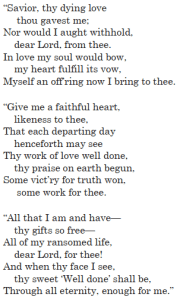
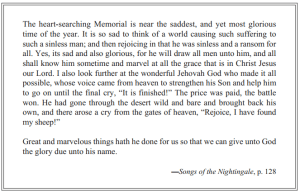
Then thanks were rendered to the Lord for the cup—for the sufferings of Christ on our behalf for our redemption, and for our privilege of being partakers of his cup—his sufferings, his ignominy: and that the reproaches of them that reproached him may be shared by us, and that we can rejoice in the divine promise that if all manner of evil be said against us falsely for his sake, and if we take it patiently, we may rejoice therein; knowing that it will work out for us a far more exceeding and eternal weight of glory. Then the cup was passed, remembering our Lord’s words, “Drink ye all of it”—have fellowship in my sufferings. We concluded the service, using as a united prayer, and as a fresh pledge of consecration to the Lord, the following precious hymn—
The Date For The Memorial Supper
In our last issue we noted that the Hebrew Calendar seemed this year to disagree with the original methods of reckoning (and we have experienced similar difficulties in the past). Since then we have interviewed Rabbi Mayer on this subject. His explanation is that the Jews had great difficulty in securing uniformity of date for the Passover, because, after the watchers had noted the new moon, the fact required to be signaled by fires from hill tops, and by messengers sent to various communities, etc. Consequently, about fifteen hundred years ago, in the fourth century, Hillel’s Calendar was adopted, and it has been followed since.
We are to bear in mind two important matters relating to the date of the Passover. (1) It was to be after the Spring Equinox (yet not too long after), so that the 16th of Nisan, the date of our Lord’s resurrection, could be provided with a sheaf of the first-fruits of the harvest—a type of “Christ, the first-fruits” born from the dead. (2) The lamb was to be killed at the full of the moon, as representing the fulness of God’s favor under the Law Covenant, to the Jews, which culminated there, and which was followed by the rejection of that nation and their waning in accordance with their prayer, “His blood be upon us and upon our children.”
The decision regarding the month to be esteemed the first month was seemingly left to the Elders of Israel, subject to the limitations foregoing; and it appears that they did not always wait until the Spring Equinox, and then after that wait for the following new moon, to begin counting Nisan. (To have done so this year would have been to begin Nisan as late as April 11th.) On the contrary, knowing when to expect the equinox, they accepted as the beginning of this first month, the beginning of their year, the appearance of the new moon whose full would be about the harvest time, and after the equinox. And this evidently is the rule which we should follow.
Following this rule, we find that the full moon after the equinox this year will be on March 27th, which therefore should be recognized as the 14th of Nisan, the anniversary of our Lord’s death: and according to Jewish reckoning the 14th would begin on Sunday, March 26th, at six o’clock, P.M., the anniversary of the Last Supper. From this it will be observed that the date given in our last issue was in error, as well as the Jewish date, and we are glad to have opportunity of correcting the matter thus early.
Some will doubtless notice that almanacs give the date of the new moon as March 11th, but if the fourteen days were counted from that date it would not bring us to the full of the moon. We assume, therefore, that the Jews, instead of accepting the dark moon for the new moon, waited until a sufficiency of the moon would be visible to the eye, and counted from that date. So counting now, the new moon would be expected to be visible on the night of the 13th and morning of the 14th of March, which would be Nisan 1st.
The Memorial Supper
Our usual custom of celebrating our dear Redeemer’s death on its anniversary will be followed this year by a larger number, we believe, than ever before.
Our Lord, as the antitype of the Passover lamb (1 Cor. 5:7), was crucified the day before the “Feast of Passover” began; and “on the same night in which he was betrayed” he took bread, representing his flesh, and “fruit of the vine,” representing his blood, and with these instituted a new memorial by which the spiritual Israelites were to celebrate their greater antitypical Passover, secured by his “blood of sprinkling” applied by faith, and his flesh, eaten by faith, “meat indeed.” (John 6:55)
Our celebration has nothing in common with that of the Jews: indeed what they celebrate is the “Feast” week; while we celebrate on the day preceding their Feast the death of the Lamb of God which taketh away the sin of the world. The day we celebrate represents the entire Gospel age, in which the entire Church—the body of Christ Jesus, the Head—must suffer with him as voluntary sacrificers. The Feast week to us typifies the glory and joy soon to be introduced—in the Millennium.
Our Lord’s words respecting this Memorial are, “This do ye in remembrance of me.” And the Apostle adds, “As oft as ye do this ye do show forth the Lord’s death till he come”—till he in his Kingdom shall have come in power and shall have gathered you unto himself. Many Christian people have assumed the liberty to celebrate this Memorial at various times—weekly, monthly, quarterly, etc.; but in harmony with the early Church we understand our Lord to mean that we should celebrate this as we celebrate any other event—on its anniversary: just as we now might say, As oft as the Fourth of July is celebrated it shows forth the independence of this nation.
Those who celebrate our Lord’s death in the “Last Supper” at noon every Sunday, mistake it for the weekly “Love Feast” or “Breaking of Bread” practiced every Lord’s Day by the early Church in memory of our Lord’s resurrection and his opening of the eyes of their understanding in the breaking of bread. Rightly understood, nothing in these weekly feasts of joy resembled the annual commemoration of our Master’s sorrow and death—nor is the “cup” ever mentioned in connection with them.
The Church at Allegheny will celebrate the Memorial Supper commemorative of our Redeemer’s death for us, and of our Passover from death unto life through the merit of his sacrifice, and of our consecration to “be dead with him”—to drink his “cup”—at Bible House chapel, Allegheny, Pa. Friends of the Truth who can make it convenient to meet with us will be welcomed cordially: but we advise that wherever there are home-meetings or wherever such gatherings seem possible they be not deserted. No other season seems so favorable for the drawing of the hearts of the Lord’s people closely together—even as it seems also to be specially an hour of temptation to all professing to be the Lord’s followers, who like Peter of old seem to be specially sifted at this season of the year.
The advice of our Lord to the early disciples, at this time of the year, seems still specially appropriate, “Watch and pray lest ye enter into temptation!” And recognizing this the older systems, Roman Catholic and Episcopalian, still precede the Memorial with a fast or Lenten season—which entered into not formally but in the spirit we believe is a very helpful custom to many—not only physically but spiritually.
“Good Friday” was substituted for the Memorial Supper as originally observed by the Lord’s people—the system of counting being slightly changed. The more frequent celebrations of the Lord’s Supper by Protestants are based upon Papacy’s celebration of the “Mass” an institution which both in fact and theory is an abomination to our Lord—denying as it does the fullness of the
efficacy of the original sacrifice at Calvary. We trust that the Lord’s people everywhere will “do this” in remembrance of the great sin-sacrifice—not merely as an outward memorial but also and specially at the same time feeding on the Lord by faith in their hearts, and afresh pledging their consecration unto death with him while partaking of the “cup.” For further particulars see Reprint 5191.
We will be glad to have prompt postal card reports from the appointed secretary or scribe of each little group—wherever “two or three” meet in his dear name to do this. Make all your arrangements beforehand that the precious season of heart “communion” be not disturbed by business affairs. Let us not only all unite in prayer and communion, but also so far as practicable in our songs of praise—using numbers 23, 122 and 1 of Hymns of Dawn.
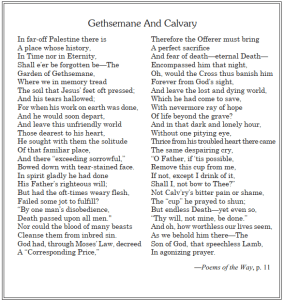
The Memorial Supper
Each year seems to add to the interest of the Lord’s people in the celebration of the great event which lies at the foundation of all our Christian hopes—the celebration of the death of “Christ, our Passover.” Each year the matter seems to be more clearly grasped by a larger number, and correspondingly the solemnity and holy joy proper to the occasion seems to be the more intense, and the overflowing blessing to be more pronounced.
Many of the little companies of the Lord’s people who celebrated on the evening of April 12th have responded to our request for information respecting the numbers participating, and the measure of the Lord’s Spirit and blessing prevailing. From these reports we judge that the number participating this year was considerably more than last year. Though we have not heard from nearly so many, the totals are larger. We believe, too, from the letters that the meaning of the institution was very deeply appreciated, not only as marking the great sacrifice of our Lord Jesus, but also as marking the consecration of his people to be one with him in his sacrifice.
The Allegheny Church had a most blessed season, about 290 participating. We first reviewed the general meaning of the Passover, as it was instituted with the Jews, tracing the relationship between the typical Passover Lamb and Christ the Lamb of God, our Passover, and saw in the first-born of Israel passed over in that night a type of the Church of the First-born, which God is passing over during this Gospel night. We saw that subsequently these first-born ones became the leaders of Israel as a whole, and their deliverers from Egyptian bondage, and we saw that the antitype of that deliverance will be the ultimate deliverance of all who love God and who desire to serve him, from the bondage of the world and of sin and of Satan, the antitype of Pharaoh, and that this ultimate deliverance would be during the Millennial age, when “the Church of the First-born” ones will be associated with Christ in the Millennial Kingdom.
Next we saw how that the Jews had celebrated the type for over sixteen centuries, with no knowledge of the antitype, and yet that in God’s due time Christ, the antitypical Lamb, was slain on the very same day of the month that the typical Lamb was slain; and that on the very same day in which he and his disciples met as Jews to celebrate the typical Lamb and the typical passing over, our Lord instituted a new memorial, which should not look back to the type, but to himself, as the antitype. We noted also the appropriateness of the emblems which Jesus chose to represent his flesh and his blood; we saw that unleavened bread most beautifully illustrated the purity, the sinlessness, of our dear Redeemer, and that the cup, the fruit of the vine, represented his sufferings—not sufferings that were grievous, but joyous, endured willingly, gladly, on our behalf, and we rejoiced in these things.
We considered how we were to feed upon the Lord in our hearts while using the bread emblematically—that we could feed upon his flesh in the sense of calling to mind the fact that only through his sacrifice could we have life, only by his becoming our substitute in death could we, as a race, be set free from the condemnation that was upon us through Father Adam’s transgression. We considered the fruit of the vine, the symbol of our Lord’s blood, as the sealing of the New Covenant under which God, through Christ, could be merciful toward our imperfections, accepting our intentions, even though the weaknesses of the flesh might sometimes hinder us from attaining all the desired results.
Then we viewed the matter from the other standpoint—the secondary one mentioned by the Apostle in 1 Cor. 10:16, 17, viz., that the entire Church is one loaf, and that it is the duty and the privilege of all who have become members of the one loaf, the one body of Christ, to be broken in the service of the Head and in the service of each other, that thus we might have fellowship with Christ in his sufferings and ultimately be sharers in his glory. We saw that the cup of blessing with which we bless is indeed our communion or fellowship in the blood [sufferings] of Christ, our mingling of our lives with his life, our joining with him in “filling up that which is behind of the afflictions of Christ.” We sought to enter into the very deep meaning of the beautiful symbol, and to have it in our hearts a power of God, leading us to keener appreciation of our dear Saviour, and to a keener devotion as his disciples, to walk in his footsteps.
Then, after a prayer of thanksgiving to God for the living Bread that came down from heaven—for Jesus, who was not a condemned member of the human family, but a specially provided one, suitable to be our Saviour, our Bread, our Life-giver, and for all the blessing which we have through his great sacrifice, we partook of the bread. After this we gave thanks for the cup, acknowledging that we have no righteousness of our own, even though all the past were forgiven, and that we could not hope to stand before God acceptably or to have any dealings with him except under the gracious provisions of the New Covenant, sealed with the precious blood of Christ. We gave thanks also that by God’s grace we have been called to fellowship with Jesus, and told the Lord of our hopes that by his grace we might run our course with faithfulness and eventually be received to joint-heirship with our Master in his glory when we are partakers with him of the joys of the Kingdom.
The simple but impressive memorial being ended, it was requested that in order that the solemnity of the hour might abide with us, to our mutual comfort and joy, we should part on that evening without entering into any conversation likely to attract our minds from the precious things which filled them, but rather might, for the hours following, remember the severe trials of the disciples, and the dear Master’s trials, and seek to enter into close sympathy with his faithfulness, and to be all the more on guard against the wiles of the Adversary, which seem to be so potent at this season of the year. Then singing the first hymn we were dismissed.
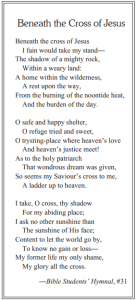
Who May Properly Memorialize?
Question. Is it correct to say that the “sacrament,” the Memorial Supper, symbolizes the appropriation of Christ’s righteousness by faith in his sacrifice? If so, has not a person who is justified by faith, but who has not yet made a consecration, a perfect right to partake of the emblems?
Answer. The only object of justification in this present age is to fit or enable the justified one to make his consecration and whoever does not so use his justification as to obtain thereby consecration and begettal to the new nature is to that extent receiving the grace of God in vain—failing to make use of it. Just as though a wealthy friend should give a poorer one an order on his store for goods, saying: “Upon the presentation of this order by John Blank or Mary Blank at my store at any time during the year 1905, he shall be privileged to purchase such goods as he may desire at one-tenth of their actual price, ninety per cent of all their purchases being charged to me.” If John Blank or Mary Blank failed to present this order during the year, and thus failed to buy any goods during the specified period, the order would be practically valueless to them, because they did not take advantage of its favorable terms. Just so now, any who are justified by faith have the privilege of consecrating themselves and being accepted in the Beloved, and thereby the privilege of obtaining the exceeding great and precious promises at the small cost of sacrificing present privileges; and whoever does not so use his justification during this age to obtain the high calling may be said to have profited nothing by it, for it lapses with the end of this life, and must be renewed, if at all, in the next life, upon the same conditions and terms as to all the remainder of humanity.
Applying this to the Memorial Supper: the Memorial Supper not only represents the eating of the bread, the symbol of our justification, but it also represents the partaking of the cup, fellowship in the sufferings of Christ. These two thoughts are linked together in the symbol, and may not be sundered in our application of it. It would not, therefore, be proper for any to participate in the Memorial Supper except such as have not only been justified by partaking of Christ’s righteousness, but who additionally have become joint-heirs in sacrifice with him, drinking of his cup.
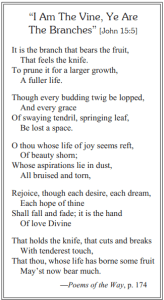
The Passover Memorial, April 8, 1906
For the benefit of our readers in foreign lands we make early announcement of the date for the celebration of the death of our Passover Lamb. Again we have the choice of two dates. All almanacs to which we have access show the date for the new moon after the spring equinox to be March 24th. If we calculate from that date, the Memorial night of the 13th of Nisan would fall on April 6th. On the other hand all the almanacs, so far as we are aware, show that the moon will not reach its full until April 9th. As we have already pointed out, the moon in the Scriptures is the symbol of the Jewish nation, and the intention evidently was to represent that the full measure of Israel’s opportunity and test was reached at the time of our Lord’s crucifixion, and that from that time the light of that nation began to wane.
Unable to account for the discrepancy, or to see how it would require sixteen days for a new moon to reach its full, we made inquiry of the Allegheny Observatory astronomers, who seemed unable to account for the matter and merely confirmed the facts as given in the almanacs. They in turn referred us to the United States Naval Observatory at Washington, D.C., from whom also we received confirmation of the almanac dates, but they could give no explanation of the peculiarity of the discrepancy— why on this occasion it requires sixteen days for the moon to reach its full, while ordinarily it requires fourteen days.
U.S. Naval Observatory,
Washington, D.C.
MR. C. T. RUSSELL,
SIR, I am in receipt of your communication of the 31st ult. in which you state that you find in some 1906 almanacs the statement made that a new moon appears March 24, 6:52 p.m., and that it fulls April 9, 1:12 a.m., and also that it occurs to you that there must be some discrepancy in this, as the time would amount to 15 days and six hours.
In reply I beg to advise you that the data given above are correct, the time being given in eastern standard time. By reason of the great eccentricity of the moon’s orbit it not infrequently occurs that the time be- tween the two above-mentioned lunations exceeds 15 days.
Very respectfully,
WALTER S. HARSHMAN,
Professor of Mathematics,
U.S.N., Director Nautical Almanac.
Although we went to so much particularity to ascertain exactly the proper date for the celebration of the Memorial we do not wish to give the impression that the exact date is of importance. We are not under the Law, but under grace. Our observation of the Memorial Supper is a privilege and opportunity rather than an obligatory command. The principal thing would seem to be that we have a uniform time for its celebration and that we celebrate it with the right thought in mind, viz., as a memorial of the fulfillment of the type of the Passover lamb with the death of Jesus, the Lamb of God, the ransom price for the world. Christ our Passover is slain for us, therefore let us keep the feast. This and not something else we do in remembrance of him, and in confirmation of our covenant to be broken with him and to give our lives with his in the sacrificial services open to us as members of his body in the present time. We conclude that the most appropriate time for the celebration of the Memorial will be Sunday night, April 8th. The Jews adopt this same reckoning, celebrating Tuesday, April 10th, as the beginning of the Passover feast or fifteenth of Nisan. On this same reckoning the fourteenth of Nisan would be Monday, April 9th, and according to Jewish reckoning that day begins the previous evening, namely, Sunday evening, April 8th. On this date, therefore, let us unitedly celebrate the Memorial Supper.
The Passover In The First Month
Considerable difficulty is experienced by many in harmonizing our solar calendar with that of the Jews, which is built upon an association of lunar and solar time. We tender assistance to such by quoting an extract from Smith’s Bible Dictionary on the subject—followed by an extract from the Hebrew chronologist Lindo on the same subject.
Smith’s Bible Dictionary says:
“The characteristics of the year instituted at the Exodus can be clearly determined, though we cannot absolutely fix those of any certain year. There can be no doubt that it was essentially tropical, since certain observances connected with the produce of the land were fixed to particular days. It is equally clear that the months were lunar, each commencing with a new moon. It would appear, therefore, that there must have been some mode of adjustment. To decide what this was, it was necessary first to ascertain when the year commenced. On the 16th of Abib ripe ears of corn were to be offered as first-fruits of the harvest. (Lev. 2:14; 23:10, 11) The reaping of the barley commenced the harvest (2 Sam. 21:9), the wheat following. (Ruth 2:23) It is therefore necessary to find when the barley becomes ripe in Palestine. According to the observation of travelers, the barley is ripe, in the warmest parts of the country, in the first days of April. The barley harvest, then, commences about half a month after the vernal equinox, so that the year would begin at about that tropical point, were it not divided into lunar months. We may conclude that the nearest new moon about or after the equinox, but not much before, was chosen as the commencement of the year. The method of intercalation can only have been that which obtained after the Captivity—the addition of a thirteenth month whenever the twelfth ended too long before the equinox for the first-fruits of the harvest to be offered in the middle of the month following, and the similar offerings at the times appointed.”
Extracts from Lindo:
“The Jewish year is luni-solar, for although the months are lunar, our calculations being founded on the lunar cycle, every 19th year we come to the same date in the solar year. The cycle contains 235 lunations, which we divide into twelve years of 12 months, and seven (termed Embolismic) of 13 months.
“The celebrated mathematician Meton of Athens, who flourished B.C. 432, which was in the reign of Zedekiah, A.M. 3328, made the same division of time, but by making every third year embolismic, the 18th and 19th were both of 13 months; by our arrangement the solar and lunar years are better equalized.
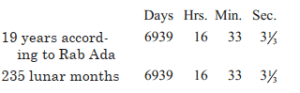
“The year is of three kinds, perfect, common and imperfect. The perfect has 355 days, and is when the months of Hesvan and Kislev have each 30 days. The common, 354 days, when Hesvan has 29 and Kislev 30. The imperfect, 353 days, when both have only 29. The embolismic year is formed by the introduction of an intercalary month, immediately after Adar, which is called Veadar, or Second Adar. The year then consists of 385, 384, or 383 days, according to the rule above. The reason of the introduction at that period is that the Passover may be kept in its proper season, which is the full moon of the vernal equinox, or after the sun has entered Aries; it is indifferent at what period of it the full moon happens, but it must be kept while the sun is in that sign. That a time was fixed for its observance is shown in Numbers 9:2, ‘Let the children of Israel also keep the Passover at its appointed season.’
“That our months have always been lunar is shown by 1 Kings 6:38, ‘And the eleventh year in the month Bul, which is the eighth month,’ etc. By a reference to the Hebrew text it will be seen that the two words translated month are different, the first being derived from the word ‘moon,’ the latter from ‘innovation.’ Our months are the following:
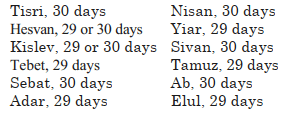
“In the embolismic years, Adar has 30, and the intercalary month Veadar 29.
“As a lunation from one conjunction to another, termed a synodical month, has 29:12:44:313 , being 291 2 days and about 3 4 hour, it could not be better arranged than by making one month 29 and the following 30 days. When a month has 30 days, the last day of the month and the following day are both kept as New Moon, on the principle that a holiday cannot be kept part of a day. The 30th day being half in the preceding month and half in the new moon, the whole day is made a holiday, and the following as a matter of course, from its being the first whole day of the new moon. That this rule was followed in ancient times, is to be seen in 1 Sam. 20:5, 27.
“It will have been seen that by this arrangement there is yet a deficiency every month of 44 min., 313 sec., making nearly 9 hours in years of 12 months. To make up this deficiency one day is added to Hesvan every second or third year, by which that month then consists of 30 days. When Hesvan has 30 days, Kislev invariably has the same. Without Hesvan having 30 days, Kislev is sometimes made 30, which is done to prevent Passover happening on Monday, Wednesday or Friday, for as that festival regulates all the other holidays, it is arranged that none may fall on days on which they could not be properly observed. On the same day of the week as the…
1st day of Passover are the fasts of Tamuz and Ab
2nd day of Passover is the first day of Sebuot and Hosana Raba
3rd day of Passover is the first day of New Year and Tabernacle
4th day of Passover is the Rejoicing of the Law
5th day of Passover is the Kippur, the day of Atonement
“Consequently, were the first day on Monday, Purim would be on Saturday and Kippur on Friday, days on which neither could be observed. If it were on Wednesday, Kippur would be on Sunday, on which it could not be kept; the reason is that as Kippur has the same strict ordinances as Sabbath, it cannot precede or follow the Sabbath. If it were on Friday, Hosana Raba would be on Saturday, a day on which the ceremonies of it could not be observed. By the above regulation, it will be seen that Rosh Ashana can never fall on Sunday, Wednesday or Friday.
“This holiday is to be observed on the day of the conjunction, with the following exceptions:
“1. If the conjunction takes place on Sunday, Wednesday or Friday, the holiday is to be kept on the following day, as in 5604.
“2. If the conjunction should happen after noon, the following day is to be observed, and if that should happen to be Sunday, Wednesday or Friday, the next is to be kept, as in 5601.
“3. If the conjunction takes place in an ordinary year on Tuesday, on or after 9h., 11m., 20s. A.M., it is not to be observed thereon, and as it may not be kept on Wednesday, it will be observed on Thursday, as in 5616. An objection may be made to this, as New Year should be observed on the day of conjunction, but were it to be so kept, the preceding month of Elul would only be of 27 or 28 days, and a month can never be less than 29.
“4. The conjunction being on Monday, on or after 3:30:52 P.M., in a year immediately following an embolismic, the holiday is to be kept on Tuesday, as in 5617. This occurs but seldom.
“Our embolismic years are Nos. 3, 6, 8, 11, 14, 17, 19 of each cycle.
“Although the Gregorian calculations have been made with great nicety they are still imperfect, and other alterations must take place in future ages. As a proof the Council of Nice ordered that Easter should not be kept on the same day as the first day of Passover, in order that there might be no appearance of Judaism in it; ‘Ne videantur Judaizare,’ to prevent which they ordered its observance on the Sunday after the full moon, Passover being always kept on the day of the full moon; and yet in 1825 both were kept on the same day.”
* * *
From the foregoing it will be seen that, with every endeavor to reach exactly the date specified in their Law for the Passover, the Jews have difficulty, and often there is of necessity a choice between two days equally appropriate. However, they follow the guidance of their leaders in this matter and have a uniformity of celebration, in- stead of each one trying to fix the date and celebrating according to his personal knowledge, convenience or preference. And this measure of subserviency to leaders was endorsed by our Lord, who said, “The Scribes and Pharisees sit in Moses’ seat; whatsoever therefore they bid you observe, that observe and do.” (Matt. 23:3) The Apostle indicated the same course to the Gospel Church. (Heb. 13:17) Two essential features of the celebration of the Passover were: (1) uniformity, and (2) that it begin as exactly as possible at the full of the moon— which symbolized the fullness of favor to Israel.
The Memorial Supper, 1908
Following the custom of the early Church, we celebrate the “Last Supper,” not weekly, nor monthly, nor quarterly, as do our fellow Christians, but annually. Nor do we celebrate it in the forenoon, but as a supper. To our understanding we thus better preserve the letter and spirit of our Master’s request—“Do this in remembrance of me.”
There still persists amongst Christians in general a hallowed respect for our Lord’s death-day, celebrated as “Good Friday,” but the precious Memorial Supper of the preceding evening they overlook. The reason for this is evident. Catholicism, which long held almost universal sway, introduced the “Sacrifice of the Mass” as a substitute for the Memorial Supper; and when the Reformers rejected the Mass as a sacrifice for sins and resumed a more proper celebration they styled it “the Holy Communion.” They failed, however, to note that the original Supper was given to celebrate the antitypical fulfillment of the eating of the Passover Lamb—and that its force and beauty would be dimmed by observing it oftener than on its anniversary.
The writer and many others would incline to celebrate the Memorial Supper annually on the Thursday night most closely corresponding to the original celebration, for several reasons. (1) That would bring the celebration into its proper relationship to Sunday, which is the remembrancer of our Lord’s resurrection. (2) At that season Easter Sunday is quite generally celebrated as a special memorial of our Lord’s resurrection. (3) The celebration of the Memorial Supper on the evening of what is by many styled “Holy Thursday” would of itself be a powerful lesson to many of our dear Christian friends who now think us “odd,” or “followers of a Jewish custom,” because, without study, which they will not give, they cannot understand our position. (4) Instead of copying anything “Babylonish,” we would be calling attention to something long lost to Babylon. The finding of this sometimes means an investigation and appreciation of other truths lost or buried under human traditions.
But we pass by all these advantages, fearing that some could not appreciate them, and that therefore a schism might ensue. We prefer to remember the Apostle’s words that there be no schism; that we seek to “preserve the unity of the Body in the bonds of peace.” Hence we do not announce as the Memorial date the Thursday night nearest to the first full moon following the spring equinox. We again announce, as heretofore, the Memorial date as the evening of (preceding) Nisan 14—the day before the commencement of the Jewish Passover Feast week; viz., April 14, 1908, after 6 P.M. The Jewish Passover begins Thursday, April 16 (Nisan 15); but in Jewish reckoning it begins after sundown of April 15. Consequently Wednesday, April 15, is Nisan 14, beginning at sundown of Tuesday, April 14.
Following the custom of the early Church, we celebrate the “Last Supper,” not weekly, nor monthly, nor quarterly, as do our fellow Christians, but annually. Nor do we celebrate it in the forenoon, but as a supper. To our understanding we thus better preserve the letter and spirit of our Master’s request—“Do this in remembrance of me.”
There still persists amongst Christians in general a hallowed respect for our Lord’s death-day, celebrated as “Good Friday,” but the precious Memorial Supper of the preceding evening they overlook. The reason for this is evident. Catholicism, which long held almost universal sway, introduced the “Sacrifice of the Mass” as a substitute for the Memorial Supper; and when the Reformers rejected the Mass as a sacrifice for sins and resumed a more proper celebration they styled it “the Holy Communion.” They failed, however, to note that the original Supper was given to celebrate the antitypical fulfillment of the eating of the Passover Lamb—and that its force and beauty would be dimmed by observing it oftener than on its anniversary.
The writer and many others would incline to celebrate the Memorial Supper annually on the Thursday night most closely corresponding to the original celebration, for several reasons. (1) That would bring the celebration into its proper relationship to Sunday, which is the remembrancer of our Lord’s resurrection. (2) At that season Easter Sunday is quite generally celebrated as a special memorial of our Lord’s resurrection. (3) The celebration of the Memorial Supper on the evening of what is by many styled “Holy Thursday” would of itself be a powerful lesson to many of our dear Christian friends who now think us “odd,” or “followers of a Jewish custom,” because, without study, which they will not give, they cannot understand our position. (4) Instead of copying anything “Babylonish,” we would be calling attention to something long lost to Babylon. The finding of this sometimes means an investigation and appreciation of other truths lost or buried under human traditions.
But we pass by all these advantages, fearing that some could not appreciate them, and that therefore a schism might ensue. We prefer to remember the Apostle’s words that there be no schism; that we seek to “preserve the unity of the Body in the bonds of peace.” Hence we do not announce as the Memorial date the Thursday night nearest to the first full moon following the spring equinox. We again announce, as heretofore, the Memorial date as the evening of (preceding) Nisan 14—the day before the commencement of the Jewish Passover Feast week; viz., April 14, 1908, after 6 P.M. The Jewish Passover begins Thursday, April 16 (Nisan 15); but in Jewish reckoning it begins after sundown of April 15. Consequently Wednesday, April 15, is Nisan 14, beginning at sundown of Tuesday, April 14.
“Christ Our Passover Is Sacrificed For Us, Therefore Let Us Keep The Feast”—1 Cor. 5:7
What a meaning is in these words when seen in connection with the Memorial Supper as the remembrancer of the Jewish Passover! How the light of the type illuminates the antitype. As the first-born of Israel were exposed to death, so “the Church of the First-born whose names are written in heaven” (Heb. 12:23) are now on trial for life or death everlasting. As then all the typical first-born were safe so long as they remained in the house and ate of the lamb whose blood was sprinkled upon the doorposts and lintel, so we who abide in the household of faith under the better “blood of sprinkling” and who eat of our Passover Lamb, Jesus, are safe from death—sure of life everlasting under God’s providence.
We do not now recognize the typical lamb, but instead Jesus, “the Lamb of God, which taketh away the sin of the world.” On him we feed; not eating his flesh literally, but by faith partaking of the merit of his sacrifice and appropriating it to ourselves. All through this night of the Gospel Age do we thus feast on our Lamb—until the morning of the Millennium, when we shall be delivered. The annual Memorial Supper is not our feast, but an illustration or archetype of it—a remembrancer—most beautiful, most solemn, helpful. Let us keep the feast of faith and also the Memorial Supper. “As oft as ye do this [annually] ye do show forth the Lord’s death—till he come again.” (1 Cor. 11:26)
In accord with our usual custom let us, then, on Tuesday night, April 14th, at 7.30 P.M., assemble ourselves and memorialize the great Redeemer’s death and our release from condemnation to destruction. Yea, more, as we break the loaf of unleavened bread, let us remember the later suggestion of the Apostle that all the consecrated followers of Jesus are so counted in with him by the Father that we are “all one loaf” (1 Cor. 10:17) and all have participation not only in our Lord’s sacrifice or breaking on our behalf, but are to be broken with him as “members of his Body,” the Church of the First-born. And as we partake of “the cup” of “the fruit of the vine” let us recognize it as not only representing our Lord’s blood, his life sacrificed for us, but also as the cup in which we join—our communion or fellowship in the sufferings of Christ, as the Apostle explains. (1 Cor. 10:16) And let us remember further the Apostle’s words that “we fill up that which is behind of the afflictions of Christ for his Body’s sake [service], the Church.” Thus “we ought to lay down our lives for the brethren”—our moments and hours and talents and strength and convenience. (Col. 1:24; 1 John 3:16)
We recommend that unleavened bread be used. Jewish Passover bread (crackers) may be obtained in many cities, but otherwise “Uneeda” biscuit or soda biscuit would serve every requirement. As for the cup, “the fruit of the vine,” we advise that grape juice or raisin juice be used, if agreeable to all, but if any require regular wine we advise that such be accommodated also.
We advise that the celebration be in classes or congregations as they usually meet for worship every Sunday: that friends do not desert the little gatherings on this occasion in order to celebrate with larger groups—unless all can thus unite, which is improbable. Do not forget the Lord’s words, “Where two or three of you are met in my name there am I in your midst.” And if there be sick or solitary brethren or sisters who cannot possibly meet with even one other, let them celebrate alone with the Lord. All such who have no means of preparing the Memorial emblems, if they apply to us by April 1, will be supplied freely.
For those who think of no better method, we advise the reading of selections on the subject from Vol. 6, with prayer and praise. As for the ministers or servants for the occasion: they should be those ordained or set apart by the congregation by vote, “by the stretching forth of the hand”—the Elders. If the class is small and no Elder has been chosen, a servant for the occasion should be first chosen by consent of the majority of the consecrated believers participating. It is requested that some one be appointed to communicate to us on a post-card a brief report of each celebration, giving the number of participants. We urge that all of the consecrated shall thus renew before the Lord their vow of loyalty and devotion to him and his brethren and his cause. There is a blessing in so doing which each one needs. Such participator will be strengthened and blessed, as the Lord and the Apostle indicate. Address all of these cards (even from foreign lands) to the Society at Allegheny, Pa., U.S.A.
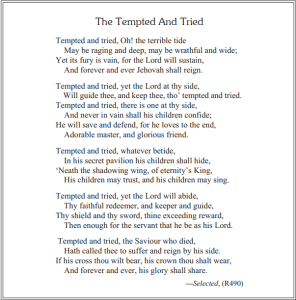
The Memorial Celebration
On Sunday evening, April 4th, approximately 450 celebrated our dear Redeemer’s Memorial Supper in Brooklyn Tabernacle. We were much pleased to have so considerable a number of communicants present. Of course, these were not all of Brooklyn proper. In fact, the regular congregation comes largely from the region round about. The occasion was a very solemn and impressive one. Our afternoon discourse on the Passover, typical and antitypical, led our minds in the proper direction for the appreciation of the solemn memorial and our comments in the evening related chiefly to the significance of the bread and the cup. We showed that the eating of the bread pictured the appropriation of our Lord’s human rights, by which we were justified and by which our justification of righteousness in God’s sight is maintained, notwithstanding the imperfections which are ours through heredity. We showed that the blood represented primarily our Lord’s earthly life rights appropriated to us, justifying us to life.
Then we took the second and larger view of the matter and saw in the light of the Apostle’s words that all of the faithful, all of the Royal Priesthood, all of the members of the one Body of Christ, join with their Lord in becoming the One Loaf and join with Him also in the breaking of that loaf, that it may be the Bread of Restitution to the world of mankind. We saw in the light of the Apostle’s words, too, that in becoming members of the Body of Christ we become sharers with our Lord in his cup of suffering, in his sacrifice of earthly life. We saw further how in the Divine purpose this earthly life, which we surrender forever, goes under the New Covenant to Israel, Judah and all the families of the earth, while we are granted spiritual life and rights.
“The cup of blessing which we bless, is it not the communion (fellowship-sharing) of the blood of Christ? The bread which we break, is it not the communion (in his sufferings) of the body of Christ? For we being many are one bread and one Body; for we are all partakers (sharers) of that one Bread.” (1 Cor. 10:16, 17)
As we thus took a fresh glimpse at the significance of the “deep things of God,” our hearts were stirred to their depths with the realization. How wonderful it seems that we should be called to such an intimate association with our Lord and Redeemer, both in the sufferings of this present time and in the glories that shall follow! We called to mind the fact that the Lord could not reasonably require less of us; that this is but a reasonable service, privilege and honor. We realized afresh how great would be our loss if we should fail to make our calling and election sure by unfaithfulness to the vows taken when we were accepted as his “members.” We pointed out that even those who would constitute the “great company” must attain that standing through great tribulation, and that none could be acceptable to the Lord for life eternal except the pure in heart, filled with his spirit; and that, as the Apostle says, the matter with us is one of life or death eternal. We sought afresh to build one another up in the most holy faith and love and devotion and zeal, that the victory might be won—eternal life. We exhorted that it is really easier in some respects to gain that eternal life on the highest plane, the Divine nature and Royal Priesthood, than on the lower plane of spirit being, typified by the Levites.
Almost all who were present partook of the memorial emblems and we closed the service with prayer, followed by a hymn, after which we went out quietly, without our usual greetings, striving to carry with us, so far as possible, the precious thoughts of the occasion.
Reports thus far received are that the celebration has been very general and that in a majority of cases the numbers participating show an increase over last year. In a few cases the increase is small or none, because whereas friends from several districts had previously met together, they have now grown large enough to meet separately. The report from Pittsburgh is an excellent one—just about as we expected; the Bible House Chapel was more than filled, so that extra chairs were needed and brought in. Notwithstanding this the showing is not as large as on some previous occasions, because usually these services have been held in Carnegie Hall or some other larger auditorium, and have been attended by friends from nearby places—notwithstanding our frequent reminders that it is desirable that the friends of each locality meet by themselves, after the manner of a family, in harmony with the original instructions of the type.
Altogether the general interests of the harvest work seem to be deepening and broadening. Yet, we must expect continued and increasing testings of faith and love, even to the end of the Harvest time; for in no other manner does it seem possible for the Church to be tested. Thus St. Paul, while admonishing us to mark those who cause divisions (Rom. 16:17), and exhorting again that there be no divisions among you (1 Cor. 1:10), declares, “I hear that there be divisions (schisms) among you, and I partly believe it; for there must be heresies among you that they which are approved may be made manifest among you.” (1 Cor. 11:18, 19) Again, St. John says, “They went out from us. They were not of us, for if they had been of us, they would, no doubt, have continued with us; they went out that they might be made manifest that they were not all of us.” (1 John 2:19, 20)
The substance of this teaching is that while it is true that the Body of Christ is one and should be bound together mutually by the bonds of love and sinews of Truth, nevertheless if, after we have done all in our power to hold a fellow-member with our love and with the truth he departs, we are to take the matter with equanimity, remembering that the Lord knows the heart and that having done all in our power the remainder is for the Lord to attend to and that he will attend to disciplining and bringing back into fellowship with the Body all that are truly his. “The Lord knoweth them that are his.” We do not. We do well to remember this and to exercise full confidence and faith in the Lord and his wisdom and love and power in dealing with every disobedient member. It is ours to be kind and gentle toward all, while reminding ourselves and others of the Lord’s own statement, “Vengeance is mine, I will repay, saith the Lord.”
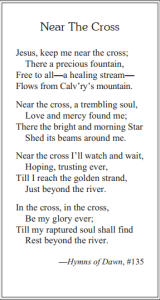
1911—The Memorial Supper—1911
Again we are approaching the anniversary of our dear Redeemer’s crucifixion; once more we remind our readers of the les- son which years have taught many of us, namely, that for some unexplainable rea- son the Lord’s consecrated people experience special trials and testings at this particular season—corresponding to our Lord’s time of heaviness and sorrow, and the time of special testing amongst the early disciples. It was shortly before he went up to Jerusalem, foreknowing the crucifixion, that he explained it to the Apostles. It was then that he declared that only those who eat his flesh and drink his blood have life in them. Many of his close followers said, “This is a hard saying; who can receive it?” and walked no more with him. (John 6:60)
Shortly after, when telling the twelve of his approaching crucifixion, St. Peter brought upon himself a rebuke by saying, Far be it from thee, Lord. This thing shall not happen unto thee. But Jesus answered him, saying, Get thee behind me, Adversary, for thou savorest not of the things of God, but of the things of men. (Matt. 16:22, 23) Your suggestions and advice are con- trary to the Divine Program; it is necessary that the Son of man suffer sacrificially, that he might enter into his glory and accom- plish his appointed work as the Savior of the Church and of the world—whosoever wills.
Later on, near the climax, we remember the special trial upon Judas, and how his love of money led him to oppose the anoint- ing of the Master for his burial, and later on led him to sell that Master for thirty pieces of silver, and, later on, to betray him with a kiss. Still later we remember how all the disciples were disconcerted by the arrest of their Master and by his evident willingness to be arrested, so that they “all forsook him and fled.” (Mark 14:50) We remember how, still later, the noble St. Peter was overtaken in a serious fault and denied his Lord and Master, even with cursing.
Perhaps we partly imagine a parallel of testing on the Lord’s people at this season of the year. And perhaps it is real and appropriate that the members of the Body of Christ should, in this particular at this season, have special trials, peculiar difficulties, testings of faith, obedience and loyalty.
The Lenten Or Fasting Season
It would appear that thoughts along the line above suggested came to others long ago and led to the appointment of the Lenten Season as a time of special fasting and prayer amongst the consecrated ones of the Lord’s family. Certain it is that for long centuries this fasting has been in observance in the Roman Church, in the English Church, in the German Church, and, to some extent, in others.
Although with the majority fasting has become a mere outward form and ceremony, without heart appreciation, and, therefore, not pleasing to the Lord, nevertheless we believe that some fasted from the best of motives in olden times, and that some still so fast. It is not for us to judge and individually condemn anybody, yet many, we are sure, will confess to just what we have charged in an indefinite way. It is impossible, of course, for any laws or regulations to be made which will govern the heart—they can scarcely govern the flesh, even in the most casual manner.
We do not approve of set rules and laws governing such matters. The suggestions should be quite sufficient for all those who heartily desire to practice abstemiousness in respect to diet. We have the Master’s suggestion that after his departure his followers would fast. Several instances of such fastings are recorded in the Scriptures, and these may be considered proper examples for the Lord’s followers, none of whom are under law, under command, in respect to meats or drinks or other earthly ordinances.
A measure of self-restraint in fasting is valuable to us physically, as well as spiritually—and particularly in the Spring of the year. The stronger foods necessary for the cold weather of winter are less necessary, as the weather becomes milder. Much of the Spring sickness is undoubtedly due to over-eating and may be considerably corrected by the observance of a measurable fast—restraint from the eating of dainties and rich food. And when the system is clogged with over-supply of nourishment, the brain becomes more stupid, impairing the higher mental powers, and particularly including those which connect us appreciatively with heavenly and spiritual things.
We throw out these suggestions without any desire to put a yoke or a law upon anybody, but wishing each to fast and pray according to the dictates of his own conscience and to receive spiritual blessings according to the degree of his fellowship with the Lord in this and in every matter.
The Date Of The Memorial Supper
As we have previously remarked, our Lord gave no intimation such as many dear Christian people have imagined— namely, that the Memorial Supper should be celebrated weekly, monthly, bimonthly, trimonthly. Most evidently the Supper was instituted by all of the Jewish arrangements as an annual observance—to take the place of the Passover Type. There was a definiteness about the date of the type which would not necessarily attach to our celebration of the antitype. The type was intended to specifically mark the exact date on which our Lord would be crucified. Hence great particularity on the part of the Jews was appropriate. Now that the great fact of Jesus’ death is a thing of the past, there seems not to be as great necessity for particularity as to the exactness of a day and an hour.
Hence we see no objection to the custom followed by Episcopalians, Catholics and Lutherans of celebrating the Friday and the Sunday nearest to the anniversary of our Lord’s death and resurrection, as Good Friday and Easter Sunday. Indeed, something may be said in favor of their custom, as it permits the anniversary to harmonize with the days of the week. However, for over thirty years we have been accustomed to observe this Memorial—the nearest that we know to its exact anniversary, according to the Jewish reckoning of time— on the preceding evening of the 14th day of the Jewish Month Nisan. In view of this long custom, and the fact that some might not see clearly any advantage of a change; in view of the fact also that some might become confused and think that they were following an error, it is our preference. We advise, therefore, that the exact date, according to the Jewish calendar, be followed.
This year the new moon of the Spring Equinox appears March 30th, thus constituting it the First day of the First Month, Jewish time. Our Lord was crucified on the 14th day of the First Month, which this year will be April 12th. But the Memorial Supper, commemorative of his death, was celebrated on the evening preceding and therefore we, according to our previous custom, recommend that all, with one heart and one mind, unite in celebrating the great Redeemer’s death on Tuesday night, April 11th, after six o’clock. Even then, of course, we will not all be able to celebrate at the same hour, because of differences of time; but the celebration will be very nearly at the same hour all over the world. The thought of this general fellowship will add to the joy and solemnity of the occasion. We recommend that all who love the Lord and are fully consecrated to do his will, even unto death, join in this celebration, which means so much to all of us. It first of all reminds us of our dear Redeemer’s sacrifice on behalf of his Church and on behalf of all the families of the earth. It reminds us, secondly, that we have vowed unto the Lord to walk in his steps, to suffer with him, to drink of his cup, to be baptized with his baptism of death. Of course, the breaking of the bread and the sipping of the cup, memorially, is far less important than our participation in the realities, of which they are merely a figure. We must in our minds and hearts feed upon the broken body of Jesus and realize by faith that we partake first of all, imputedly, of justification of our flesh through him and that, through him, comes all our hopes of a future life.
Secondly, as represented by his cup, we must share his sorrows, be partakers of the sufferings of Christ, fill up that which is behind of his afflictions, in walking faithfully in his footsteps—even unto death. The cup which the Father poured for the Master he drank. And by the grace of God we are privileged to share in his cup; for if we suffer with him, we shall also reign with him. And if we escape the sufferings of Christ and fail to become living sacrifices with him, we will thereby also be escaping the glorious privileges of his Kingdom.
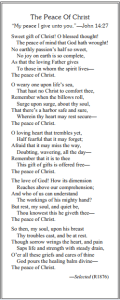
The Memorial Supper April Tenth
We trust that all of the Lord’s consecrated people everywhere will avail themselves of their privilege of memorializing the death of the Redeemer for our sins and—as the Apostle points out—our participation with the Redeemer in His sufferings and death to human conditions. As our Lord and the Apostles met and symbolized His death in advance of the event, so it is appropriate for us to meet on the anniversary to celebrate His sacrifice.
The doing of this annually, in harmony with the evident purpose of the Lord in establishing this Memorial instead of the Jewish Passover, makes the occasion a very impressive one, much more so than any celebration which ignores the anniversary feature and celebrates occasionally—monthly, weekly, quarterly, etc. Let us not find fault with others who do differently; but, as opportunity offers, let us inform them of our reasons for observing this great event on its anniversary.
As often as we do this (yearly) we do show forth the Lord’s death until He come. While we believe that our Lord has been present for a number of years—during the Harvest—this does not hinder us from continuing the blessed Memorial of His death. Our thought is that our Lord meant that we were to continue celebrating His death until, at His Second Coming, the full Harvest work of the Age shall be completed, and the entire Body of Christ, the Church, shall be received into glory. Then, as He declared, we shall drink of the New Cup with Him.
Whereas now we drink of His Cup of suffering, shame, ignominy, reproach, the world’s derision and opposition, His New Cup will be a Cup of joy, blessing, glory, honor, immortality—the Divine nature. The Father, who poured for our Lord the Cup of suffering, has already poured for Him the Cup of blessing and glory. As we are privileged to share with Him in this Cup of suffering, so with our resurrection “change” we shall be privileged to share with Him the Cup of glory and blessing.
Yea, ours is a mingled Cup now, a bittersweet; for by faith we already enjoy many of the things which He has in reservation for them that love Him.
In the Lord’s arrangement the moon symbolized the Jewish prospects, while the sun symbolized the prospects of the Gospel Age. The Law Dispensation was a shadow, or reflection, of the things future, as the moon’s light is the reflection of the rays of the sun. We are near the time of the rising of the Sun of Righteousness with healing in His beams, to flood the world with the light of the knowledge of God. Seeing this, we lift up our heads and rejoice, as the Master directed. Since all the overcoming members of the Church are included in that Sun of Righteousness, according to our Lord’s parable (Matt. 13:43), it follows that the Elect Church must all be gathered, and her glorification must be completed before the full light of the Millennial glory will shine forth upon the world.
In partaking of the Memorial we may look forward with the eye of faith to the rising of the Sun of Righteousness, in contrast with the conditions which prevailed at the time when the first Memorial was observed. Then, the Moon (the Law Covenant) was at its full; and immediately after the rejection of Jesus and His crucifixion the Jewish polity began to wane. It is worthy of note that the very day on which Jesus was crucified the moon was at its full, and the waning began at once. So this year, on April 11, the moon will be at its very full, and will then begin its wane. The 11th, therefore, corresponds to the day on which our Lord was crucified; and the evening of the 10th corresponds to the night of the first Memorial Supper.
Eating And Drinking It Worthily
As from the intelligent appreciation of the fact symbolized by the Memorial Supper a great blessing comes, and a joy proportionate to the participator’s faith and obedience, so also a condemnation attaches to an unworthy, improper participation in the Memorial. None are to participate except those who have come into relationship with the Lord by consecration of their hearts—their all—to Him and His service. None can come into this consecrated condition except as they have recognized themselves as sinners and the Savior as the Redeemer from sin, whose merit is sufficient to compensate for the defects of all those who would come unto the Father through Him. All such should partake with a great deal of joy. Remembering the sufferings of the Master, they are to rejoice in those sufferings and in the blessings that these have brought to their hearts and lives. None are to drink of the fruit of the vine on such occasions except those who have appropriated the merit of the sacrifice of Christ and who fully realize that all their blessings are through Him. None are to drink of the Cup except those who have given up their all to the Lord, for this is what the Cup signifies—it is the Cup of suffering, the Cup of death—a full submission to the will of God. “Thy will, O God, not Mine, be done,” was the prayer of the Master, and is to be the sentiment and petition of those who partake of the Memorial Supper.
For others to participate in this Memorial Supper would be a farce, would be wrong, and would bring more or less of condemnation, disapproval, from God and from their own consciences—and that in proportion as they realized the impropriety of their course.
But let none think that they should remain away from the Memorial because of imperfections of the flesh. This is a great stumbling-block to many. So long as we are in the flesh, imperfection of word, deed and thought are possible—yea, unavoidable. St. Paul says that we cannot do the things that we would. It is because we need Divine grace to forgive our daily, unintentional, unwilling trespasses that all whose sins have been forgiven and who have been accepted into fellowship with Christ are encouraged to come to the Throne of Heavenly
Grace in prayer. The Apostle says, “Let us come with courage to the Throne of Grace, that we may obtain mercy and find grace to help in time of need.” (Heb. 4:16) It was because of our needs that God opened up the way and made this arrangement for us.
By God’s provision for the forgiveness of our sins, of which we have repented, and for which we have asked forgiveness in Jesus’ name, we may realize ourselves as no longer sinners under condemnation, but as clothed with the robe of Christ’s righteousness. This is the thought behind St. Paul’s expression, which applies to every day: “I beseech you, brethren, by the mercies of God, that ye present your bodies a living sacrifice, holy, acceptable to God, which is your reasonable service.” (Rom. 12:1)
All Christians should keep their accounts squared with the Lord. If they come short, they should lose no time in getting the account squared, in obtaining forgiveness through the merit of the Savior’s sacrifice. Such accounts with the Lord should be settled promptly at the time of their occurrence, or not later than the day of their occurrence. They should not be allowed to accumulate; for they will rise as a wall between the soul and the Heavenly Father. But whatever has been the condition in the past, the Memorial season, above all others, is the time for making sure that no cloud remains between the Lord and us, to hide us from His eyes.
Thus forgiven, thus cleansed of any defiling spot on our robe of Christ’s righteousness, let us keep the feast—the Memorial of our Lord’s death. In it let us afresh acknowledge and impress upon our minds the importance of the merit of His sacrifice and death, and how it represents the grace of God to us, as it will by and by represent the same grace extending through the Millennial Kingdom to the whole world. Let us remember also our devotion of ourselves, our consecration to be dead with our Lord, to be broken as members of His Body, parts of the One Loaf, and to participate in the drinking of His
Cup of suffering and shame and death. “For if we suffer [with Him], we shall also reign with Him.” (2 Tim. 2:12)
We trust that the celebration of the Memorial this year may be a very deeply impressive one, an occasion of rich blessing to all of the Lord’s consecrated people everywhere. “For even Christ our Passover is sacrificed for us; therefore let us keep the feast.” (1 Cor. 5:7, 8)
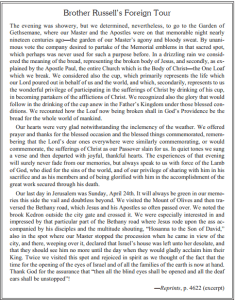
The Memorial Supper
Five days after Jesus rode on the ass, offering Himself as Israel’s King, came the Passover, typical of the passing over of the Church of the First-borns. Jesus was the Lamb of God to take away the sin of the world. In order to do this, He must be the Passover Lamb. St. Paul says, “Christ our Passover is slain, therefore let us keep the feast.” Jesus ate the typical Passover lamb with His disciples. Then He took unleavened bread, and fruit of the vine, as representing His own flesh and His own blood, and instituted an antitypical Passover Supper.
Jesus’ followers were to do this in remembrance of His death as the antitypical Lamb. He said, “Except ye eat the flesh and drink the blood of The Son of Man, ye have no life in you.” Of course, the outward performance would be nothing except as it would symbolize heart experiences. In their hearts, Jesus’ followers must realize that His death is the Ransom-price for the sins of the whole world; that without it there would be no everlasting life. Such believers constitute the Church of the First- borns, who pass into life in advance of the world—in the First Resurrection. (Rev. 20:6)
St. Paul shows a still deeper meaning to the Memorial Supper. All the followers of Jesus are represented in the One Loaf that is being broken, and as sharing in the One Cup of suffering, shame, ignominy and death. (1 Cor. 10:16, 17) Only such will be members of His glorious “Body,” the world’s “Prophet like unto Moses.” (Acts 3:19-23)
The disciples neglected to wash each other’s feet or even the Master’s. Jesus performed the service as a lesson in humility— not as a ceremonial. The spirit of the lesson is that we render each other any service possible, as “members” of Christ. (Acts 9:5; 1 Cor. 12:27)
After the Supper, Jesus with the Eleven went to Gethsemane, where Judas be-trayed Him to the officials with a kiss. Then followed the memorable closing scenes of our Lord’s life.
MEMORIAL SUPPER—Why We Partake.
Question. (1911)–1–Why do you Partake of the Lord’s supper?
Answer. Because it is a memorial of our Lord’s death. And when the Apostle says, “This do until he come,” we understand that the Lord’s people are properly to remember the Lord’s death as the very foundation of all their faith and obedience until the time when they shall be changed and shall participate with him in the better things beyond the vail, sharing with him in the first resurrection. We do it for another purpose. To our understanding, the Lord’s supper not only symbolizes our dear Redeemer’s body and blood, but it also symbolizes our participation; for the Apostle says, “The loaf we break, is it not a participation with the body of Christ? And the cup which we drink, is it not a communion in the blood of Christ?” In other words, the Apostle suggests that those who partake of the communion are showing that they are sharers with Jesus in his sufferings and in his death. We belong to the same body. So it is part of our present obligation, that we suffer with him now, in order that we may also reign with him.
MEMORIAL SUPPER—Use of Wine at.
Question. (1911–2–Where can the word “wine” be found in connection with the Lord’s Supper in the New Testament?
Answer. I do not know that the word wine is used. The fruit of the vine is used, and if anybody prefers to think of the fruit of the vine as being grape juice, I have not a particle of objection; I think it will do for just the same purpose, and perhaps better than wine.
PASSOVER AND ATONEMENT—When And Why Observed.
Question. (1916)–1–Why was the Passover celebrated, on the evening of the 14th day of the first month, and the annual Atonement Day on the 10th day of the seventh month?
Answer. Because God wanted them to be different. The two things have no direct relationship the one to the other. The one is a picture of the passing over of the Church of the First Born, whereas the other is a picture of the suffering of Christ and the Church during the gospel age as a basis and preparation for their dispensing of blessings to all the families of the earth during the Millennial Age. The passover Lamb merely represented the death of Jesus and the passing over of His people during this age and consequently another and different picture is given to represent the death of Jesus and the Church and the consequent blessing of the world in the age to come. He did not want them to run into each other. The one referred to the death of Jesus and the other was given to make a different picture.