
A Friend in Need – A Friend Indeed – R. 5664
1 Samuel 20
“A friend loveth at all times.” – Proverbs 17:17
History records noble examples of friendship; but supreme amongst these is the story of our lesson – the friendship, the love, of Jonathan, son of Saul and prospective heir of the throne of Israel, for David, his rival in the hearts of the people and in the Divine Program. The purity and unselfishness of his friendship demonstrates to us a nobility possessed by some in those days, which we might not have suspected and which is quite in conflict with the Evolution theory.
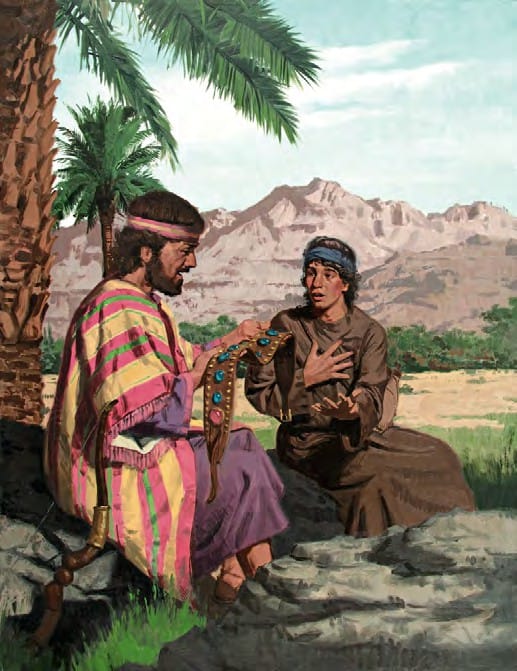
The loving spirit of Jonathan stands out all the more in contrast with the jealous spirit of his father, King Saul. Apparently his first meeting with David was after the latter’s victory over Goliath. Instead of thinking of David as a rival, who should be crushed, the noble Jonathan took off his own princely robe and gave it to him, together with his sword and his famous bow.
Rev. Alex. Whyte remarks, “Jonathan was the eldest son of Saul; and he was thus the heir-apparent to the throne of Israel. Handsome and high-mettled, full of nerve and full of heart, Jonathan was the pride of the army and the darling of the common people. His comrades, for his beauty of person and swiftness of foot, were wont to call him The Gazelle. But for his father’s great and disastrous transgressions, Jonathan might soon have been the second king of Israel, second in succession to Saul, but second to no king that ever sat on a throne in those great qualities of mind, heart and character that give stability to a throne and add lustre to a crown.” Well was it written by one of the ancients, “Life hath no blessing like an earnest friend”; and a poet has written:
“Life offers no joy like a friend;
Fulfilment and prophecy blend
In the throb of a heart with our own –
A heart where we know and are known.”
“A Friend in Need, a Friend Indeed”
Jonathan’s friendship, love, was not of the effervescent kind. It was the genuine article. He did not love merely in word, but in deed and in truth – not merely when his father favored his friend and when the public acclaimed him and when he would thus have favor with others; but he loved him just the same when the king became the enemy of his friend and sought his life. Indeed, it may be said that no friendship could be surely counted upon until after it has been tried. The friendship which will not endure trial, testing, the friendship which will make no sacrifices is not the kind to be modeled after.
Jonathan had love of the kind the Lord admonishes His followers to have – the love which in honor prefers one another. While other loves have been great, this one doubtless stands preeminent above earthly love, especially because it was founded on a religious basis. It was because David loved the Lord, and sought to be guided by His will as that will was manifest at that time, that he would wait – that he conducted himself with wisdom, as the record declares. And it was because Jonathan discerned this spirit of wisdom, because he realized David was guided by the spirit of righteousness, that he loved David.
Indeed, we may be sure that in proportion as we understand the Bible and receive the spirit of the Truth, in that same proportion we shall be able to appreciate and to copy and to exemplify the best there is of principle – whether of friendship, or of duty to a monarch, of duty to our family relationship, or of duty toward our God. There are many influences operating toward a spirit of selfishness, avarice, jealousy, while the influences making for true friendship, true love, all the best qualities of heart and head, are from the Lord.
We have already noted in a previous lesson how Jonathan acted as peacemaker between his father the king, and David. Today’s lesson brings to our attention another occasion on which Jonathan acted the part of a true friend. David realized that his life was in danger and mentioned his fears to Jonathan. The latter was at a loss to believe that his father would break his word, yet was impressed by David’s attitude. The feast of the new moon was at hand; and David was expected to sit at the royal table, King Saul at the head, Prince Jonathan at the right hand, the captain of the host at the left, and David occupying the fourth place, opposite the king. In harmony with an arrangement made between the friends, Jonathan was to ascertain his father’s intentions definitely and to communicate these to David.
On the first day of the feast the king said nothing, although Jonathan, to attract attention to the matter and thus to draw out his father, chose a convenient time for taking David’s seat. Finally the king asked for the “son of Jesse,” as though he hated the very name “David.” Jonathan replied that David had gone to keep the feast at Bethlehem by his permission.
The king had apparently been foiled in his intention to kill David at this time and vented his wrath upon his son, whom really he greatly loved. He addressed him as an unruly son, unworthy of his mother, thus implying that he ignored him as his own son. In his anger he threw a javelin at his son, probably not with the intention of striking him, but merely of venting his ferocious jealousy. Jonathan’s speech in return shows that he was thinking less of what he himself was risking for his friend and more in respect to the injustice being done that friend. “So Jonathan arose from the table in fierce anger, and did eat no meat the second day of the month; for he was grieved for David, because Saul had done him shame.”
It is a beautiful friendship which in stress forgets self and thinks only of the interests of the friend. As though in contrast with all the human loves and friendships, we read of Jesus, “Greater love hath no man than this, that a man lay down his life for his friends.” Nevertheless, in the case of Jesus, it meant more than any earthly love or friendship; for “while we were yet sinners, Christ died for us.” The Apostle declares that the Lord thus set an example to all Christians, that they should “lay down their lives for the brethren,” be ready to die the one for the other. This is the Heavenly love, the Divine friendship, of which the love of Jonathan may be taken as a sample, next to the example of our Lord and the Apostles.
“Is It Not Beyond Thee?”
The next morning David, having returned from his home, was to get Jonathan’s judgment respecting the king’s sentiments. The agreed-upon signal was that Jonathan with his bow and arrows should go into the field near to a great rock; and in connection with his archery would call out, “Is it not beyond thee? Make haste!” if the message was that David should flee. And so it was done. But the two friends could not think of parting, perhaps forever, without having personal contact. Jonathan went over to the rock behind which David hid. The two embraced, after the manner of the East, kissing each other Goodbye – true lovers, with a manly, noble love. Here it was that Jonathan indicated his faith in God’s providence in respect to David, and asked him to make a covenant with him that whatever should occur he would deal graciously with him and his family, saying, “Go in peace, forasmuch as we have sworn both of us in the name of the Lord, saying, The Lord be between me and thee, and between my seed and thy seed, forever. And he arose and departed; and Jonathan returned to the city.”
Bible history shows us that David never forgot the obligation he thus undertook to be a friend to the family of Saul. The custom of the East at that time was that a new dynasty coming into power should utterly destroy all the males of the dynasty which was being overturned. But this was not so in David’s case.
It was on the occasion of Jonathan’s death with his father on the field of battle shortly after, in conflict with the Philistines, that David expressed the beautiful words:
“O Jonathan, on thy high places thou wast slain!
I am distressed for thee, my Jonathan, my brother!
Pleasant hast thou been to me exceedingly!
Wonderful was thy love to me, passing the love of women!”
We trust that none can read this story without being influenced favorably toward friendship, to be a truer, a nobler, a more faithful friend than otherwise; but especially should Christians get a blessing from this story of love, leading on as it does to the love of Christ and to the injunction that they should be copies of God’s dear Son; and that their friendship should be loyal, true, enduring, Jonathan’s especially one for the other, as the Apostle exhorts, “Doing good unto all men as we have opportunity, especially unto the Household of Faith.”
David and Jonathan – R. 1907
1 Samuel 20:32-42
“There is a friend that sticketh closer than a brother.” – Proverbs 18:24
True friendship is a rare flower on our sin-cursed earth, and when it is found and proved it should be greatly prized. It is an element of the original likeness of God. True friendship can never exist in a heart where selfishness reigns; for the moment self-interest is crossed, the false and fickle friendship begins to decline or proves treacherous.
The friendship of David and Jonathan was evidently of the true kind; for it was proved on the part of both in the furnace of trial, and it held fast through years under circumstances of temptation which meaner souls could never have withstood. It was founded, not upon a mere fanciful whim on the part of either, but upon real moral worth in each; and those points of moral worth were the attractions and bonds of their friendship. Both were devout men of God, men of faith and of godly courage and heroism, and lovers of truth and righteousness; and it was the discovery of these elements of character in each other that knit their souls as one.
Jonathan, the eldest son of King Saul, was the natural heir to his throne, and doubtless would have succeeded his father had Saul not incurred the divine displeasure and so forfeited that privilege for his posterity and cut short his own career. (1 Sam. 13:13) Jonathan was a devoted son to his father and a devoted and energetic servant to God and to his people. The deep attachment of father and son is manifest from several facts: Jonathan could undertake his dangerous expedition against the Philistines only by keeping his project a secret from his father. (1 Sam. 14:1) The effect of Saul’s strange vow was emphasized by his affection for his son. (1 Sam. 14:39-44) That dearest object he declared he would sacrifice, if need be, in fulfilment of his vow. But the people rescued him, declaring the Lord to be on the side of Jonathan.
There was very marked and intimate confidence between the father and son. (1 Sam. 20:2) “Behold my father will do nothing, either great or small, but that he will show it me.” And Jonathan had great influence with his father (1 Sam. 19:6), and was very active in cooperation with him in the defence of the Lord’s people against their foes and oppressors.
Jonathan loved the Lord and his people, and had strong faith in the power of God on their behalf. Like David before Goliath, with faith in God he with his armour bearer approached the garrison of the Philistines, saying, “It may be that the Lord will work for us; for there is no restraint to the Lord to save by many or by few.” – 1 Sam. 14:6.
In that beautiful friendship there was no spirit of rivalry, no jealousy, no vain glory, although Jonathan was the natural heir to the throne of Israel, and David had been anointed to take his place; though Jonathan was of the royal family and a man of some thirty odd years, while David was but a shepherd youth, probably about twenty-three years of age. Each in simplicity of heart accepted the Lord’s appointments as wisest and best, and determined nobly to do his part toward the Lord and toward his people and toward each other. And so Jonathan, cooperating with his father in the duties of his office to Israel so long as the Lord sustained him in power, nobly used the privileges of his position for the protection and preservation of the one whom he knew to be appointed to reign in his stead.
And while Saul, filled with envy, malice, hatred and revenge against this one whom he regarded as his rival and the rival of his house, determined, and continually sought, to slay him, Jonathan, by every means in his power, protected and defended him, even at the risk of his own life. – 1 Sam. 20:32,33.
When David first came to the house of Saul to minister to him, and Jonathan’s soul was knit to that of David, “Then Jonathan and David made a covenant because he loved him as his own soul; and [in recognition of the fact that he was the Lord’s anointed – the Lord’s choice for the kingdom by and by] Jonathan stripped himself of the robe that was upon him, and gave it to David, and his garments, even to his sword and to his bow and to his girdle.” Thus they covenanted faithful friendship to each other, being subject in all things to the will of God.
And when David was taking leave of Jonathan to fly for his life from the face of Saul, again they covenanted perpetual friendship. “And David arose out of his place…and [approaching Jonathan] fell on his face to the ground, and bowed himself three times [in token of great respect for both the person and office of his friend]; and they kissed one another, and wept one with another until David exceeded.” And Jonathan said, “Go in peace, and the Lord be with thee, as he hath been with my father. And [when thou comest into the kingdom] thou shalt not only while I live show me the kindness of the Lord, that I die not; but also thou shalt not cut off thy kindness from my house forever [as he foresaw David might be tempted to do when later the descendants of Jonathan might urge their claims to the throne]; no, not when the Lord hath cut off the enemies of David every one from the face of the earth….And Jonathan caused David to swear again, because he loved him; for he loved him as his own soul.” – 1 Sam. 20:13-17.
Only once again they met, a year or two later. It was under very similar circumstances, in the wilderness of Ziph. Saul was still hunting for his rival to slay him, and again Jonathan, learning of his situation, sought him out. “And Jonathan went to David into the wood, and strengthened his hand in God. And he said unto him, Fear not; for the hand of Saul, my father, shall not find thee; and thou shalt be king over Israel, and I shall be next unto thee; and that also my father knoweth. And [again] they two made a covenant before the Lord.” – 1 Sam. 23:16,17.
In this touching narrative there are valuable lessons which we cannot afford to overlook.
(1) It shows that true and enduring friendship is possible, though it be of rare occurrence.
(2) It suggests that true and lasting friendship can exist only between noble and unselfish souls, whose wills are fully submitted to the will of God, and who are actuated by the fixed principles of truth and righteousness.
(3) It suggests that if such friendship existed under the dim light of the Jewish law, it ought to be of much more frequent occurrence under the light of the gospel. True, there may not always be just such circumstances to make it manifest, but there are many similar circumstances. There are always temptations to rivalry, to the ignoring of the will and appointments of God and the substituting of one’s own will and way.
When tempted thus, let us call to mind the noble examples of Jonathan and Samuel – Jonathan strengthened the hand of David in God, and saying, “Fear not, …thou shalt be king over Israel, and I shall be next unto thee;” and Samuel saying of Saul, his rival, “See ye him whom the Lord hath chosen, that there is none like him among all the people!” So let us “in honor prefer one another,” and ever rejoice to see the Lord’s will and the Lord’s way prosper.
The friendship of David and Jonathan seems also to be suggestive of that beautiful accord which shall exist between the glorified Church and the earthly princes who shall be next to them in the Kingdom of God. There will not be a note of discord or rivalry or jealousy between them; for each will be delighted to fill his honored place in the wonderful plan of God, and will love the other as his own soul. Though the Gospel Church will receive the first place of favor offered in the Abrahamic covenant, and the ancient worthies will find themselves next in honor, they will rejoice to have it so, because divine wisdom and love have so planned it.
And as David remembered his covenant with Jonathan not to cut off his kindness from the house of Jonathan (2 Sam. 9:1-13), so the glorified Church will remember its covenant to bless the ancient worthies first, and then all the families of the earth who will then be under their jurisdiction. Their loving ministry through the law and prophecies and their noble examples of godly life and character, which have been so helpful to us, while Satan was hotly pursuing us (“as a roaring lion,” 1 Pet. 5:8), as Saul pursued David, shall be held in “everlasting remembrance.”
The Passover in the First Month – R.4127 (excerpt)
Considerable difficulty is experienced by many in harmonizing our solar calendar with that of the Jews, which is built upon an association of lunar and solar time. We tender assistance to such by quoting an extract from Smith’s Bible Dictionary on the subject – followed by an extract from the Hebrew chronologist Lindo on the same subject.
Smith’s Bible Dictionary says: – “As a lunation from one conjunction to another, termed a synodical month, has 29:12:44:3!, being 29″ days and about! hour, it could not be better arranged than by making one month 29 and the following 30 days. When a month has 30 days, the last day of the month and the following day are both kept as New Moon, on the principle that a holiday cannot be kept part of a day. The 30th day being half in the preceding month and half in the new moon, the whole day is made a holiday, and the following as a matter of course, from its being the first whole day of the new moon. That this rule was followed in ancient times, is to be seen in 1 Sam. 20:5,27.
A Remarkable Friendship – R.3232
1 Samuel 20:12-23
“There is a friend that sticketh closer than a brother.” – Proverbs 18:24
History relates many instances of intense friendships between great men in ancient times, but it tells us of none surpassing the friendship between Jonathan and David, referred to in this lesson. Jonathan’s love for David, evidently thoroughly reciprocated by the latter, shines out not only as a friendship that was unselfish, but as one that was apparently injurious to Jonathan’s interests – though not really so.
As the son of King Saul, Jonathan was the recognized heir to the throne of Israel, and was at this time about thirty-five years of age. David, the country youth of about twenty-one years of age, had suddenly sprung into prominence before the nation, had been appointed a captain of a thousand men, and was just recently married to Saul’s daughter. Saul himself viewed David as a rival in the affections of the people, and everything foreboded that some day he would be Saul’s successor. From the standpoint of fallen manhood, therefore, Jonathan had every reason to consider David an opponent and rival, and the envy and jealousy of the fallen nature might be expected to breed in Jonathan’s heart hatred and enmity instead of friendship and love. These circumstances constitute the remarkable friendship between these two young men one of the most wonderful on the pages of history.
We read of how Jonathan’s soul was knit unto the soul of David – their affections, confidences and loves were interwoven. Jonathan giving to David certain parts of his own apparel when the latter came to live at the court of Saul, was merely an outward manifestation of the other precious sentiments which prompted this and other manifestations of affection – all of which, dignifying David and promoting his honor, were derogatory to the natural interests of Jonathan, who, as the heir apparent, might not improperly have aspired to the maintenance of his own place of honor at the court. Small minds are apt to make the mistake of supposing that the crushing down of others is essential to their own honor and exaltation; but it was because Jonathan was not thus small-minded, but noble-hearted, that his character has been beloved by all who have known it from then until now.
There is a reason for everything, and there must have been a reason for this love between these two noble souls. We are to love and esteem whatsoever things are just, true, pure, noble, honorable, says the Apostle, which implies that the love of the reverse of these would be improper. True, there is a difference between loving principles of righteousness and goodness and loving individuals, but what we wish to notice is that the love for individuals should be based upon their possession of noble and loveworthy characters. Neither of these men could have loved the other had he been bad, ignoble; for only the mean can love the mean, and only the perverse can love the perverse.
What was there in David’s character that attracted Jonathan’s love? Undoubtedly it was his nobility, his courage, his honesty, his faithfulness to the king and to the nation, and, above all, his trust in God, his reliance on him. What was there in Jonathan which drew forth the responsive love of David? There were many of the same qualities: Jonathan was also courageous and had already demonstrated this; he was sincere, honest, humble-minded, generous, faithful to a friend, and above all faithful to his God. – 1 Sam. 14:1-15,27-30,43; 23:16-18.
While these two men had certain natural qualities of heart which commended each to the other’s love, the great bond of union was the faith and devotion of each to God. Some one has said that those who would be the best friends need a third object in which both are interested, and that then, like the radii of a circle, the nearer they come to this center the nearer they approach to one another. So with these men: their loyalty to God and to the principles of truth and righteousness exemplified in God, was the strong bond of their friendship which hindered the diversity of their earthly interests from alienating their affections.
This same principle is exemplified in all true, unselfish love: there must be something mutually attractive to draw and to hold the interest and love of each to the other. The breaking of vows of love and friendship or the breaking of marriage vows implies that one or other had a selfish love and not a pure love, which the Lord’s Word inculcates and which is so nobly illustrated in this lesson. Selfish love may indeed admire that which is brilliant, that which is good, that which is noble, that which is generous; but not being equally noble and generous, it will be sure at some time to be assaulted with the temptation to abandon the friendship where it believes it could better serve its own interests. Jonathan’s love was not of this selfish kind, consequently it was unchangeable – indeed, grew the firmer and the stronger in proportion as it triumphed over the propositions of any selfish suggestions. In this respect it well represents the love of our Lord Jesus for his people. As Jonathan loved David at the cost of his own position, our Lord Jesus left the glory which he had with the Father that he might become the Redeemer of his people, to whom he declares, “Ye are my friends if ye do whatsoever I command you.”
“One there is above all others Well deserves the name of friend; His is love beyond a brother’s, Costly, free, and knows no end.”
Our lesson introduces these two friends at a time when the life of David was in danger. Our preceding lesson showed that Saul was disposed to do violence to David. The threatening action mentioned in that lesson was repeated several times, and finally the javelin was thrown at his musician David, but the latter escaped it. It was in view of this hostile feeling that these friends decided that it would be unwise for David to again appear at court unless King Saul manifested some change of mind toward him. The coming feast would be an important one; Jonathan and others of the household would be present, but it was not considered prudent that David should hazard his life by attending, and it was arranged that Jonathan should make his excuses to the king and should subsequently let David know the king’s attitude of mind, so that if necessary he should flee out of the country. Jonathan found Saul full of bitterness of heart toward David, so much so that he was angered at his son for making excuses for him and threw his javelin at him as an evidence of his displeasure, though probably not with the intention of killing him. Jonathan resented the indignities and wrong of his father, and at once communicated the matter to David by the prearranged signal related in this lesson. However, the two friends could not part without a personal interview, in which they kissed each other, and wept, and bound each other in promises, and called upon God to witness the sincerity of their devotion to each other. Jonathan was evidently fully convinced that David was the Lord’s choice for a king to succeed Saul, and, being full of faith and devotion to God, he had not the slightest thought of opposing the divine arrangement. Quite probably, too, in their confidences, David had already told Jonathan of his anointing, assuring him, however, that he would not consider this anointing a proper excuse or ground for any interference with King Saul; that on the contrary, as the Lord had sought him and anointed him, the Lord himself was able in his own due time and in his own way to install him in authority and power without his stretching forth his hand to do injury to one who already had been anointed of the Lord to this office of king.
We have already noticed that friendship implies like qualities of mind and of heart. The generous love the generous, the noble love the noble, the honest love the honest, the meek love the meek, etc.; but now we call attention to the fact that amongst the Lord’s people are not many great, wise or noble – naturally speaking – and that God loves and accepts as his covenant people, friends, children, chiefly those who are not noble by nature. We notice also a love and friendship amongst the Lord’s consecrated people stronger and deeper than any earthly tie or relationship – notwithstanding the fact that amongst the Lord’s people are “not many great or noble,” but chiefly the poor of this world, rich in faith. How comes this seeming contradiction of a general rule of friendship? We reply that God’s love toward us as sinners was not that of friendship but of compassion, and similarly the love of his people for sinners is not that of friendship but of compassion, sympathy, the desire to help them out of their degradation. Not until after we had ceased to be sinners, through acceptance of Christ, were we privileged to become the friends of God and to realize him as our friend. Not until we had ceased to be sinners, and had been accepted in the Beloved, would we become the friends of others similarly transformed, and begin to grow in this quality of friendship – love for one another as brethren, partakers of the holy Spirit.
In a word there are two planes of friendship – a natural plane, on which men of like natural qualities would be drawn together; and a spiritual plane, on which those unlike in natural qualities, but alike in spiritual hopes, aims and ambitions, are drawn still more closely together by the new tie, the new love, which binds not their flesh but their hearts in Christian love and unity.
These New Creatures in Christ Jesus know each other not according to the flesh but according to the Spirit. In each other’s spirits or new minds there are the noblest sentiments, the highest aspirations, that which is good, true, noble, pure – whatever may be their weaknesses according to the flesh. They love each other from the new standpoint of intention, will, harmony with God, and their friendship for one another grows increasingly as they perceive each other’s energy in fighting the good fight of faith against the evil influences of the world, the flesh and the Adversary. Nor tongue nor pen can properly express the love, the friendship, which subsists between these New Creatures in Christ Jesus, to whom old things have passed away and all things have become new.
This does not signify, however, that a parent must have exactly the same love for other children as for his own; – he has a greater responsibility for his own, and should realize it. Nor does it imply that even the saints will all be loved to the same degree. Our Lord, we are told, specially loved some of his disciples. By and by, when perfection shall have replaced imperfection, all “brethren” will be perfect and all neighbors will be brethren beloved. Until then, however, we must love all, but “making a difference” – according to natural obligations and spiritual development. – Jude 22.
As there are nominal Christians and real Christians, so there is a nominal love as well as a real love amongst those who profess the name of Christ, and it should be more and more the aim of the Lord’s true people to cultivate his spirit, his character, his disposition, his love, his friendship; and that they may be able to cultivate these he has caused the Apostle to present to our attention a most graphic description of the love which is from above. This description is given in 1 Cor. 13. It must be enjoyed to some extent by all who are New Creatures, for if any man have not the Spirit of Christ he is none of his; but it will be increasingly enjoyed and appreciatingly understood in proportion as the Lord’s people each become stronger in the Lord – copies of God’s dear Son – like him who is the friend above all others.
One writer says, “The glory of life is to love, not to be loved; to give, not to get; to serve, not to be served….The self-centered cannot keep friends even when he makes them.”
Another remarks, “Behold, what gross errors and extreme absurdities many do commit for want of a friend to tell him of them.”
“True criticism does not consist, as so many critics seem to think, in depreciating but in appreciation. More lives are spoiled by undue harshness than by undue gentleness.”
“The centered love of any one person tends toward universal good-will, the love of all. The candle not only shines on him who lights it, but on all within reach of its rays.”
“Every power for good in true friendship is a power for evil in the false.
“‘Was it friend or foe that spread these lies! Nay, who but infants question in such wise? ‘Twas one of my most intimate enemies.”
A friend in need a friend indeed – R.4223
1 Samuel 20:30-42
(Continuation of article on page 26)
 David, A Friend − Lifeway Collection
David, the younger man of the two, as we have seen, possessed by nature a deep, generous character, capable of intense love, but apparently time was required for its development. And as we perceive Jonathan’s love for him, the brighter and more intense at first, we find that David’s love was drawn forth, that he loved in return, just as God’s love was first toward us and subsequently our love drew out toward him increasingly. Our lesson tells us how Jonathan endeavored to preserve peace between the king and David, but finding his father intent upon killing his friend, he took occasion to forewarn David that he must flee, as matters had come to that pass where his life would be unsafe anywhere near the king. This warning was given by a previous arrangement in a field at a distance from the palace. David was hidden behind a great rock. As an excuse, Jonathan went forth to practice archery, with a lad accompanying him to bring back the arrows. His real mission, however, was to advise David whether or not he must flee that vicinity. His words to the lad, “Make speed, haste, stay not,” while appropriate to the arrows, were really intended for David, that he might know the urgency of the situation.
Then, sending the boy with the weapons to the palace, Jonathan concluded that he must risk a few moments with his friend. By this time David was realizing the depth of Jonathan’s love, which had been proved in so many ways and now finally in his willingness to protect David’s life, when it would have been to his own interest to permit his father to wreak vengeance upon David. Such a love is rarely known, except amongst the saints; and alas, we fear not too much experienced even amongst these. When, however, we do find a friend who sticketh closer than a brother, we properly appreciate him all the more because of the rarity of his kind.
At this meeting David bowed himself three times to the earth, an eastern custom expressive of humility and appreciation. The friends kissed each other and wept one with another, David ultimately appearing to be the more heartbroken of the two. Although confident in the Lord, he was leaving his home to be an outcast – an outlaw. He not only was losing the companionship of his dear friend Jonathan, but he would be considered by many of the people of his own nation as a traitor, because of the king’s opposition and the necessity it would put upon him for becoming a kind of brigand. Then it was that Jonathan said to him, “Go in peace; forasmuch as we have sworn both of us in the name of the Lord, saying, The Lord shall be between thee and me and between thy seed and my seed forever.” They parted, according to the record, and never met again except once, a year or two later, when David was pursued by Saul. Then Jonathan went again to his friend to comfort him and “strengthened his hand in God.” – 1 Sam. 23:16. A glimpse of David’s estimation of Jonathan and his love is given in what is termed “The Song of the Bow,” David’s touching lament at the death of his friend Jonathan. He exclaims, “I am distressed for thee, my brother Jonathan. Very pleasant hast thou been unto me; thy love to me was wonderful, passing the love of women.” (2 Sam. 1:26) But we, dear friends, know of a still more wonderful love than this, of which we sometimes sing,
“Love of Jesus, all divine,
Fill this longing heart of mine.”
Love begets love; and so the Scriptures tell us that it was not that we first loved God, but that he first loved us and manifested his love for us in the gift of his Son. So it was the love of Jesus that attracted us and drew forth our love in response. And day by day, as we come to appreciate more and more the heights and depths and lengths and breadths of the love of God and of Christ, which passes all human understanding, the more our love toward them will increase and abound. And as it increases we ourselves become more Godlike and correspondingly also from us proceeds a love for others who love us not; and our love for them will excite the love of some in return, and lead them to a greater appreciation of this principle which stands in opposition to the spirit of the world, the love of the world, the selfishness of the world. Let us then seek to cultivate this godlike quality. Let us notice not only that the Scriptures declare love to be the principal thing in the world, but that it is the very essence of the divine character, the very essence of the divine law which is fulfilled in this one word, Love. Let us remember then that in the exercise of this quality we are preparing ourselves for the glorious possibilities to which we have been invited, and which by our Lord’s grace we are seeking to obtain by making our calling and election sure.
In the Scriptures sharp contrasts are drawn; and while this love of Jonathan, and the love of the Father and of the Son are set forth as worthy of emulation, another kind of character is also pictured, as when our Lord is represented in the Psalms as saying respecting Judas, “Yea, mine own familiar friend, in whom I trusted, which did eat of my bread, hath lifted up his heel against me.” (Psa. 41:9) Let us see to it that this spirit of love, our spirit of friendship, proceeds, from the fountain of love itself; for God is love. Let us also have in mind the Apostle’s declaration that there are only two great sources: a sweet fountain cannot send forth bitter waters, nor a bitter fountain send forth sweet waters. (James 3:11) Let us, therefore, settle it in our hearts that any spirit of treachery toward a friend, toward a brother, is not in any sense of the word connected with the spirit of love, but in opposition to it. Let us remember that a sweet fountain, a pure fountain, a love-fountain, cannot send forth bitter waters of hate, of malice, of envy, of strife. We must recognize such a stream of evil as coming from a different quarter, a different fountain, from the enemy of God and man. These qualities are therefore set forth in the Scriptures as works of the flesh and of the devil. Let us remember, too, that a radical change from an attitude of love and friendship to an attitude of bitterness and enmity is not an instantaneous but a gradual work. In the case of Judas we see a gradual deflection, which at first merely murmured because others had honors bestowed from the Lord; yet that spirit of murmuring increased, until within a week it took delight in betraying the Friend of all friends, who was even then laying down life on his behalf. Let us remember that by nature we have seeds of evil, of selfishness, received from the Adversary through heredity, through the fall; and that we need continually to be on guard to uproot all such roots of evil, and need continually to be cultivating the tender plant of love, that its fragrance may fill our entire lives and prepare us for association with him who is love and with him who is the friend above all others.
Our Golden Text
Well has the wise man said that a friend loveth at all times. He who merely loves at a time when he thinks it will be to his own advantage to love knows not love. He who loves, and is a brother in prosperity merely, and whose love and friendship wither under the heat of persecution and adversity, has never known love in its true sense, but merely a certain brand of selfishness – the love of the world.
As God commended his love toward us and showed us that not through selfishness, but generosity, at a great cost to himself, he provided us release from our prison, and gave us privileges of sonship, so true love will be willing to sacrifice. Let us judge then of our love for others, for the Lord, for the brethren, for our families, for our neighbors, for our enemies even, by our willingness to sacrifice in their interest and for their highest welfare. If we find ourselves sacrificing nothing in the interest of the Lord’s cause, let us not delude ourselves by saying that we love the Lord. If we find ourselves unwilling to endure, to sacrifice in the interests of the brethren and others dear to us, let us not mistake the matter and call it love. If we find ourselves unwilling to do kindness even to our enemies when they are in need, let us make no mistake; for the Lord hath declared that a course of goodness and mercy and self-denial is the only index of a loving heart. If once we can see that such a love of heart is essential to a place in the Kingdom it will make us doubly earnest in the attainment of such a character. If still farther than this, we see that none will ever gain eternal life in this age or that which is to come, except as he or she shall possess a heart of love, it will help to awaken us to realize that love indeed is the principal thing, the most important thing to be attained and cultivated by ourselves, yea, by all.
Note Canon Farrar’s earnest words: “My brethren, the love that sees goodness and beauty in all human nature, helps to make goodness and to make beauty in human nature. To those who love, even a common person is a human soul, who walks in the transfiguring glory of their affection. You think a person dull. Why? That is because you are dull. An angel has been with you and you have known it not; and I imagine that to a spirit full of malice and self-conceit an angel would be very dull. Each human soul is like a cavern full of gems. The casual observer glances into it through some cranny, and all looks dark, sullen and forgotten. But let light enter into it; lift a torch up to the walls; let God’s sunlight fall into it and flood its open recesses; and lo, it will flash with crystals and with amethysts, and each separate crystal will quiver under the touch of brightness with a transporting discovery of its own nature. If souls do not shine before you it is because you are bringing them no light to make them shine. Throw away your miserable, smouldering, fuming torch of conceit and hatred; lift up to them the light of love, and lo! they will arise and shine; yea, flame and burn with an undreamt glory.”
“Was it friend or foe who spread these lies? Nay, who but infants question in such wise? ‘Twas one of my most intimate enemies.”