
“Do Good To Them That Hate You” – R. 4225
1 Samuel 22
“Love your enemies; do good to them that hate you.” – Luke 6:27
For seven years David was forced to be an exile from his home and nominally to fill the role of an outlaw. King Saul, troubled with evil spirits, was at times practically insane, and no doubt pursued David from place to place during those seven years as a relaxation, as some men take pleasure in hunting wild game. It is in this light that David himself in the Psalm presents the matter of his escape. A large band of discontented people gathered to David as their leader, mostly victims of Saul’s persecution. These numbered 400 at least (1 Sam. 22:2) and later on 600. (1 Sam. 25:13,27) David’s own parents and brothers were amongst those persecuted, probably on David’s account; also the prophet Gad, and the high-priest Abiathar, a son of the high-priest Abimelech (1 Sam. 22:22,23), also his nephew Abishai, subsequently a great general. (1 Sam. 26:6) It is also noted that in the company were eleven mighty men of valor of the tribe of Gad (1 Chron. 12:8-14), and twenty-three Benjamite warriors who could shoot their arrows with both hands equally well. – 1 Chron. 12:1-7.
Professor Wright suggests that under the circumstances then prevailing, to be an outlaw was creditable. He says: “To be an outlaw at such a time was not to be on the side of disorder; it was the beginning of a justifiable revolution. The dissatisfied men who gathered around David in the cave of Adullam were the true patriots of the time. This is evident from his message to Nabal, in which he claims that he had performed all the duties of a government in protecting Nabal from the incursions of the bordering tribes; so that the tribute he asked was not more than just taxation of established authority.”
There are many caves in that limestone region. The one credited as the Cave of Adullam has several apartments and space for a small army; it is located not far from the place where David encountered Goliath. Associated with its name are three items of considerable interest. One of these, told in 1 Chronicles 11:15-19, gives us a little picture of the fidelity of David’s followers and of David’s own unselfishness, which lay no doubt at the foundation of the love which his followers bore him. It was at a time when the Philistines were making an invasion and when David and his followers could not be on Saul’s side, yet would not be against him. The Philistine camp lay between the cave and the spring of fine water at Bethlehem, David’s hometown. Thirsty, David had remarked longingly on the fineness of the Bethlehem spring. With devotion to their leader three of David’s chief men ventured through the lines of the Philistine camp and brought him some of the coveted water. On receiving it David’s heart was full of gratitude to God for such appreciation and love from his followers; yet considering the price it had cost them and the dangers they had risked, he felt himself unworthy, and tendered the water as a thank-offering to the Lord and as an expression to his followers of his highest appreciation of their kindness. Of this the poet says, –
“And all the host looked and wondered,
And those noble three,
The mightiest of the thirty, felt their souls
Knit closer to King David and to God.”
The second item of interest referred to was the taking of David’s aged parents from Adullam on a long journey over the rocky hills and around the furthest end of the Dead Sea and up the mountains of Moab to a place of safety with the king of Moab. – 1 Sam. 22:3,4.
The third item of interest referred to was the sparing of the life of King Saul at this cave. – 1 Sam. 24. (article continues on page 52)
Overcoming Evil With Good – R.3238
1 Samuel 22
“Love your enemies, do good to them that hate you.” – Luke 6:27
This lesson concerns the seven years of David’s experiences as a fugitive from the envy and hatred of King Saul. The latter, though still the nominal representative of the Lord upon the throne of Israel, had lost the divine blessing and power which, in considerable measure, had been transferred to David after his anointing to be Saul’s successor. The lesson brings before our minds in sharp contrast the king, whose better judgment was overcome by evil impulses, and David, the “man after God’s own heart,” who, although far from perfect, strove successfully for mastery over himself, and overcame promptings of evil under the guidance of principles of righteousness. We are not to think of David as perfect. Neither are we to be blind to his faults and sins, nor to excuse them nor to copy them. David was not one of the “saints” in the New Testament sense. He lived at too early a date to share in the high calling, nor could he follow in the footsteps of Jesus, since the Captain of our salvation and our forerunner in the narrow way had not yet come. David was a man after God’s own heart, in the sense that he was full of faith in God and aimed aright. At heart he desired to do the Lord’s will, and wherever he failed of this it caused him grief and led him to repentance. He lived before the time of God’s revelation of his own character and plan and perfect will concerning his people. All things considered, David’s attainments in faith and obedience were quite remarkable, so that although as a whole he was not to be considered as a model or pattern by the Church of the Gospel age, nevertheless many beautiful illustrations of proper faith and obedience may be drawn from his career, and some of them are noted in the lesson before us.
The seven years from the time David fled from the wrath of Saul until Saul died must have seemed to David a peculiarly long period of trial of faith and patience. His own course had been a noble and true one. He had served his king and his nation most loyally, yet he suffered as a reward. He was for a time an exile in a foreign land, and his father’s family was obliged to remove to Moab for protection. It must have seemed peculiar to David that the Lord should permit him, anointed to succeed King Saul, to be thus delayed from coming into his kingdom, and instead to be hunted and persecuted as an outlaw. This, however, was a valuable test of his faith, and doubtless helped to strengthen its roots, and thus to make his character stronger and his trust in the Lord firmer. But besides this, we may readily see that those seven years were valuable to David as a preparation for his kingly office. They made him intimately acquainted with the people and their usual manner of life and general sentiments – acquainted also with the neighboring peoples. Above all, he became intimately acquainted with the Lord, and, we may be sure, learned to trust his providences even where he could not trace them. Several of the Psalms were either written during this period and describe David’s experiences on the spot, or written subsequently describing the lessons learned from those experiences. Amongst these Psalms may be mentioned numbers 34, 52, 56, 57, 63.
Spiritual Israelites who have already received the adoption and anointing of the Lord to future service as kings and priests, who shall reign on the earth with our blessed Lord and Head, to bless all the families of the earth, can easily trace valuable lessons in the trying experiences of David at the time of this lesson. The Prince of this world is our enemy, not because we have done evil, but because he realizes that he has but a short time, and because he has a spirit that is opposed to the Lord’s Spirit in us. We too, at times, may wonder why the Lord – having anointed us and assured us of the glory, honor and immortality in the Kingdom – permits us to have such trying experiences and such severe conflicts with the world, the flesh and the devil. The reason becomes evident as we learn the way of the Lord more particularly – as we learn that the present “afflictions which are but for a moment [comparatively] are working out for us [fitting us for] a far more exceeding and eternal weight of glory.” We have need of patience, and that can only be gained by trials. We have need of faith, and that can only be developed by necessities. We have need of experience for our future work, which can be gained only by such experiences, which permit us to be touched with a feeling of the infirmities and difficulties and trials of those about us, to whom we shall be ministers and representatives when we reach the throne. For us, then, as for David, the lesson of present experiences is to resist evil, – and not with evil but with good.
In considering the story of David and other Bible heroes we are impressed with the candor of the narratives – that the evil things of their conduct are told with the same frankness as their good deeds. This is one of the peculiarities of the Bible and one of the internal evidences of its truthfulness. How easy it would have been to have glossed the history of David so as to have avoided everything that would be to his discredit; and how surely this would have been done, especially in the case of a king, had the preparation of the Bible not been under divine supervision. Some, we are sure, incline to the thought that the Bible would have been much better reading had some of the faults of its prominent persons been omitted; we, however, are not sure of this. The story of the trials and failures and repentances of some of these noble characters have been no less blessings than the records of their noble deeds and sentiments. As some of the Lord’s people have realized their own weaknesses in the flesh, having at times come short of their ideals in the battle against sin, they have found encouragement in the experiences of others related in the Scriptures – not to delve further into sin but to realize that “there is forgiveness with the Lord that he might be feared.” As such have noted the failures of David on various occasions and his repentance, contrition and restoration to the Lord’s favor, it has given them courage to similarly repent and to similarly trust in God’s mercy and in their own forgiveness, and similarly to be encouraged to arise from their dejection and sin and start afresh in the battle for righteousness, truth, purity, etc. (article continues on page 50)
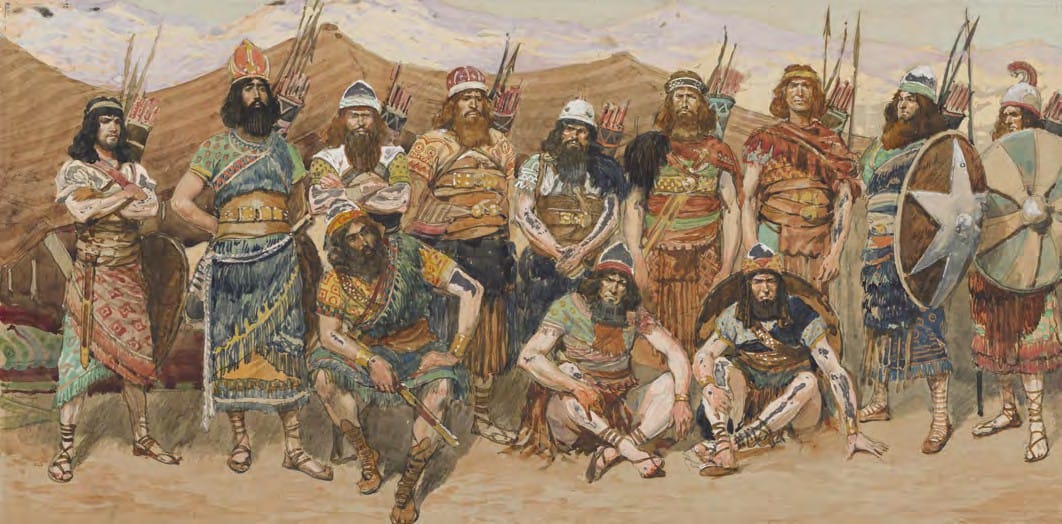 David’s Valiant Men by James Tissot