King Saul’s Last Battle – R. 5673
1 Samuel 28
“Jehovah is my strength and my shield; my heart hath trusted in Him, and I am helped.” Psalm 28:7
Today’s study covers an interesting period in the history of Israel and in the experiences of David, the beloved of God. Persecuted and hunted by King Saul, no place was safe for David. The Philistines, desiring him for a friend rather than a foe, gave to David and his followers the city of Ziklag. While residing there, David’s conquests were over the Amalekites, and never against the Israelites. He could not willingly battle against the Lord’s people, though he felt free to fight against those whom the Lord declared were to be destroyed because their wickedness was come to the full, to the limit of Divine permission.
Meantime, the end of Saul’s reign was nearing. A fresh invasion of the Philistines required all the army he could muster, and then he felt very dubious respecting the results. Although as king, in harmony with the Divine regulation, he had ordered all witches, wizards, and all who claimed to communicate with the dead to leave the land of Israel, nevertheless there were some here and there remaining. In his extremity, seeing the Lord would not answer him, King Saul visited the Witch of Endor – said by some to have been the mother of the king’s chief general, Abner.
The witch, after being assured that it would not work ill for her, got into communication with the fallen angels, who she supposed, as spiritualists still suppose, were the spirits of the dead. Doubtless she was honest, and thought it was Samuel that was called. But the Bible assures us that “the dead know not anything.” Samuel was sleeping with his fathers, waiting for the resurrection morning, and could give no counsel, could know nothing about matters going on.
The evil spirits, however, in that time as well as now through mediums, personated the dead and, using their superior knowledge, answered as instead of the dead. The questions having been propounded in this case, the answer was that the king would lose the battle the next day, and that himself and his sons would be slain.
We do not know how the fallen angels know so much about the matters of our race, but we do know that it is unwise for any to have any dealings with them; for the Lord has forbidden it. Their sole object is to deceive the people; and, according to St. Paul, through dreams and revelations they have brought into the Church various doctrines of devils (1 Timothy 4:1), which, becoming incorporated in our creeds, like the fly in the ointment, have made them to stink. – Eccl. 10:1.
Happy would it be for people if they realized what the Bible so clearly teaches; namely, that the dead are dead and can give no information of any kind, that they have neither joy nor suffering, but are simply in a state of suspended animation, awaiting the dawn of the better day in which Immanuel, Messiah, will bring the knowledge of the glory of God to all as the result of His ransom-sacrifice at Calvary. The teaching that the dead are more alive than they were when they were alive is not only senseless, but contradictory to the Lord’s Word, and has become the foundation of all the various grievous errors which have distressed the reasoning faculties of Christian people. None would pray for the dead, or say masses for them for their release from Purgatory, if they knew that their dead friends were merely sleeping until the resurrection morning.
But, worst of all, this theory that the dead are alive has become the foundation of serious blasphemies against God, in which all denominations are more or less joined as represented by their creeds. These blasphemies consist in declarations respecting God’s character and plan which would be a disgrace to any devil, and are far from the character and attributes of the God of all grace, the Father of all mercies, from whom cometh down every good and every perfect gift. – James 1:17.
(article continues on page 78)
Spiritism Examined – R. 754
“Regard not them that have familiar spirits …to be defiled by them.” – Leviticus 19:31
“There shall not be found among you…a consulter of familiar spirits, or a wizard or a necromancer…because of these abominations the Lord thy God doth drive out (the nations) from before thee.” – Deuteronomy 18:10-12
The belief that the dead are alive in another sphere or condition of being is not new. It was part of the religion of the ancients, and was the very root of all mythology. This naturally made it appear then as it now does, at least reasonable that these dead persons under such circumstances should be capable of, and did hold intercourse with the living.
This very plausible reasoning, based on a misunderstanding (the facts being made known in the Scriptures only) has given cover and force to the deceptions practised by “demons” under the guise of disembodied spirits of men. They have eagerly availed themselves of this mode of concealing their identity, and have thus perpetuated their sway over the minds and lives of many.
God regards this intimacy or familiarity with spirits as a vile abomination, and threatened those who would engage in it (mediums) and those who would inquire of them with death.
This consulting of spirits was evidently extensively practised by the heathen nations that had inhabited the land of Canaan. Against spiritism, “orthodoxy,” so called, makes a feeble show of opposition, but it is really powerless to cope with it, because the orthodox theories give it encouragement and strength. This is shown by a sermon preached by Rev. W. J. Robinson, of Allegheny, which we quote below from the Pittsburgh Dispatch, of November 3d, 1884:
Modern Spiritualism
“An unusually large audience assembled last evening in the First United Presbyterian Church, of Allegheny, to hear an interesting and instructive sermon on “Modern Spiritualism,” as delivered by the pastor of that congregation, Rev. W. J. Robinson, D.D. He had chosen for his text the words: “They have Moses and the Prophets. If they hear not them neither will they believe, though one rose from the dead.” In his introductory remarks he said he did not see the necessity of any soul returning from the spirit land, as they could tell no more about it than had already been revealed by the word of God as set forth in the Scriptures. He cited the declaration of King David in regard to Absalom’s spirit returning. David said, “I will go to my son; he shall not return,” and again, Job had emphatically declared, “the dead shall not come until the heavens are no more.” There are but three instances of the return of souls from spirit-land in all the records contained in the Bible. When Jesus took three of his disciples into the mount, they fell asleep, and, upon awakening, saw Moses and Elijah was one of these; Samuel’s apparition to King Saul forewarning him of his death on the morrow, and the coming reign of David was another, and the returning of Dives, the rich man who persecuted Lazarus and turned a deaf ear to his requests for the necessities of life, was the remaining one.
As to Samuel’s coming, there was no need of it, as Saul knew what was inevitably to happen to him for his wilfulness and disobedience of the commands of God; but it is evident that Samuel came to convince men of the uselessness of such visitations, as he could tell only what was already known. Moses had been dead several hundred years. Elijah had departed for the other world 150 years previous. Dives’ message was concerning that hell of torment of which all had heard. He told them that repentance on earth alone would save a soul, and that such a thing was impossible in hell. And that was also familiar to every one who had heard the Scriptures read or explained. All these came with messages and only reported facts which God is constantly keeping before the eyes and in the minds of men. But how different were these Bible revelations to those spoken of today. Only one in all the ages appeared in response to a call. And then the manner of their coming. Those of the olden times were voices which spoke messages of truth, while those of today, so called, are rappings, which would indicate anything else as well as a return from spirit land. The Bible-told messages were the truth, while those of modern times speak a mummery that whatever else the spirits had learned they had lost their former senses. They speak drivelling nonsense. The difference lies between truth and falsehood and light and darkness. The Bible contains all men need to know; there is found the testimony of the dead. “And now, while the dead did not come back to us, we are rapidly going to them. Study this world and your Bibles, and prepare for the world to come,” were the concluding words of his sermon.
This may be regarded as the expression of “Orthodoxy” as to the condition and abode of the dead.
“Only one (says Dr. Robinson) in all the ages responded to a call,” but if one why not more? And this one was God’s faithful servant Samuel. If this were true, then God’s righteous servant was under the dominion of a wicked medium, and all God’s servants would undoubtedly be subject to the same kind of power, and if the great God was powerless to protect Samuel from this abomination which was so abhorrent to his will, how could any of his children expect protection from the powers of darkness? We cannot find words to express our indignation and abhorrence of such blind and misguided views of God and his word. Is it any wonder that spiritism is spreading, when teachers in high places misquote and flatly contradict the word of God? God’s word declares, “The dead know not anything;…there is no work, nor device, nor knowledge, nor wisdom, in the grave whither thou goest” (Eccl. 9:5,10). “In death there is no remembrance of thee; in the grave who shall give thee thanks” (Psa. 6:5). Either so-called orthodoxy and Romanism and spiritualism are right, and that the characteristics and sensibilities of life are possessed by the dead, and God’s word is a lie, or else God’s word is true, “the dead know not anything,” and these man-made systems teach falsely. There can be no middle course. We must reject one or the other.
If Dr. Robinson had quoted Job correctly he would have demolished his own argument. Job says (Chap. 14:10-12), “Man dieth, and wasteth away: yea, man giveth up the ghost (“gasps out – expires” – Young), and where is he?… as the waters fail from the sea, and the flood decayeth and drieth up, so man lieth down, and riseth not: till the heavens be no more, they shall not awake, nor be raised out of their sleep.”
Could anything be stated more plainly than this? It shows the absence of everything that characterizes life – wisdom, knowledge, work, device, remembrance, or thanksgiving. And none are exempt from its penalty. “In Adam all die.” No man can deliver his soul (being) from its power. He is cut off from the “land of the living” – all life, for the time being, shown by the words “man dieth…and where is he?” implying that he no longer exists – except as he has a place in God’s purpose to be realized through a resurrection.
The penalty or wages of sin is death – extinction of life. There is no escaping it, nor is there any possibility of rising out of it: this is proven beyond a peradventure by these Scriptures, and is made very emphatic by the words – “riseth not,” and “shall not awake,” but that there will be an awakening or resurrection of the dead at an appointed time is apparent from the completion of the sentence – till the heavens be no more; i.e., till the new dispensation is introduced; the present referred to by Jesus (Matt. 24:29), and by Paul, (Heb. 12:26,27), being shaken and removed. As no exception to these statements of God’s word is possible, it should be evident that the possibility of communication with dead men is a delusion. The deception practiced in spiritism is the more gross, because, not men but demons are communicated with. There is abundant proof of this furnished by God’s word. Nevertheless “orthodoxy” is powerless to cope with this abomination because of her adherence to false theories as to death and her wilful ignorance of the testimony of God’s word to the contrary.
What Say the Scriptures About Spiritism? – R. 2171 (Excerpt)
Who Are These Spirits Which Personate the Dead?
We have in the Scriptures most abundant and most positive testimony that no communication could come from the dead until after the resurrection. Furthermore, we have positive Scripture testimony that not only some, but all, of these spirits are “evil spirits,” “lying spirits,” “seducing spirits.” The Scriptures forbid that humanity should seek to these for information, and clearly inform us that these demons or “devils” are “those angels which kept not their first estate,” – some of the angels to whom was committed the supervision of mankind in the period before the flood, for the purpose of permitting them to endeavor to lift mankind out of sin; that by their failure all might learn that there is but one effectual remedy for sin; viz., that provided in Christ. These angels, instead of uplifting humanity, were themselves enticed into sin, and misused the power granted them, of materializing in human form, to start another race. (Gen. 6:1-6) Their illicit progeny, was blotted out with the flood, and themselves were thereafter restrained from the liberty of assuming physical bodies, as well as isolated from the holy angels who had kept their angelic estate inviolate.
The Apostle Peter (2 Pet. 2:4) mentions these, saying, “God spared not the angels that sinned, but cast them down to hell [Tartarus] and delivered them into chains of darkness, to be reserved unto judgment.” Jude (6) also mentions this class, saying, “The angels which kept not their first estate, but left their own habitation [proper condition] he hath reserved in everlasting chains – under darkness unto the judgment of the great day.” Notice three points with reference to these evil angels.
(1) They are imprisoned in Tartarus, restrained, but not destroyed. Tartarus is nowhere else rendered “hell,” but in this one passage. It does not signify the grave, neither does it signify the Second Death, symbolized by the “lake of fire and brimstone;” but it does signify the air or atmosphere of earth.
(2) They have some liberties in this imprisoned condition, yet they are chained, or restrained, in one respect – they are not permitted to exercise their powers in the light being “under chains of darkness.”
(3) This restriction was to continue until “the judgment of the great day,” the great Millennial Day – in all a period of over 4000 years. As we are now in the dawning of the Millennial Day – “the great day” – it is possible that this should be understood to mean that some of these limitations as to “darkness” may ere long be removed, gradually. If so, if the “chains of darkness” should be released, it would permit these evil spirits to work deceptions or “lying wonders” in the daylight (as they are now attempting to do) to the delusion of mankind more than ever has been known since the flood. These fallen angels, or demons, are not to be confounded with Satan the prince of demons, or devils, whose evil career began long before – who was the first, and for a long time the only, enemy of the divine government; who, having been created an angel of a superior order, sought to establish himself as a rival to the Almighty, and to deceive and ensnare Adam and his race to be his servants; and to a large extent, for a time at least, he has succeeded, as all know. As “the prince of this world,” who “now worketh in the hearts of the children of disobedience,” he has indeed a very multitudinous host of deceived and enslaved followers. Naturally he would appreciate the deflection of the “angels who kept not their first estate,” and who were restrained at the time of the flood; and hence he is spoken of as their chief, “the prince of devils;” and no doubt as a superior order of being he exercises some degree of control over the others.
These fallen angels, “demons,” have probably very little to interest them amongst themselves; – evil beings apparently always prefer to make game of the purer, and apparently take pleasure in corrupting and degrading them. The history of these demons, as given in the Scriptures, would seem to show that the evil concupiscence which led to their fall, before the flood, still continues with them. They still have their principal pleasure in that which is lascivious and degrading; and the general tendency of their influence upon mankind is toward working mischief against the well-disposed, and the debauchery of those over whom they gain absolute control.
We are well aware that many Christian people have reached the conclusion that the Lord and the apostles were deceived, when they attributed to the works of demons conduct that is now considered human propensity and mental unbalance and fits. But all should admit that if our Lord was in error on this subject, his teachings would be an unsafe guide upon any subject.
Notice the personality and intelligence attributed to these demons in the following Scriptures – “Thou believest that there is one God; thou doest well; devils also believe and tremble.” (Jas. 2:19) Do human propensities “believe and tremble?” The demons said to our Lord, “Thou art Christ, the Son of God! And he, rebuking them, suffered them not to speak [further], for they knew that he was Christ.” (Luke 4:41) Another said, “Jesus I know and Paul I know, but who are ye?” (Acts 19:15) The young woman from whom Paul cast out the spirit of soothsaying and divination (Acts 16:16-19) is a good illustration. Can it be claimed by any that the Apostle deprived the woman of any proper talent or power? Must it not be confessed to have been a spirit which possessed and used her body? – an evil spirit unfit to be tolerated there?
Many of those who claim that the demons of the Scriptures were the spirits of wicked men and women who died, and that these are the “lying spirits” acknowledged by Spiritists, have still another difficulty; – for generally they claim that the spirits of wicked dead go to hell-torments, as they wrongly interpret sheol and hades to mean. If so, how could they be so much at liberty?
“Witchcraft,” “Necromancy,” the “Black art,” “Sorcery,” etc., are supposed by many to be wholly delusions. But when we find that they had a firm hold upon the Egyptians, and that God made special provision against them with Israel, we are satisfied that he made no such restrictions either against that which is good, or against that which had no existence whatever. The instruction to Israel was very explicit: they should not have any communion nor make any inquiries through necromancers (those who claimed to speak for the dead; i.e., spirit-mediums); nor with any wizard or witch; nor with any who had occult powers, charms; nor with those who work miracles by means of sorcery and incantation. – Read carefully all of the following Scriptures, – Exod. 22:18; Deut. 18:9-12; Lev. 19:31; 20:6, 27; 2 Kings 21:2, 6, 9, 11; 1 Chron. 10:13,14; Acts 16:16-18; Gal. 5:19-21; Rev. 21:8; Isa. 8:19, 20; 19:3.
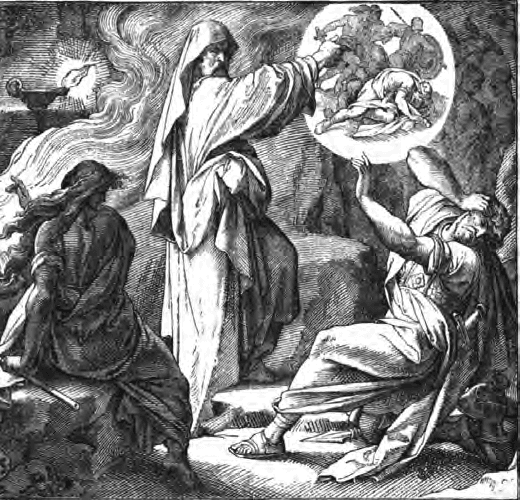
The Bible story of King Saul’s “seance” with the witch of Endor, a necromancer or spirit-medium, as related in 1 Sam. 28:7-20, is an illustration of what is claimed to be performed today. Altho the law with reference to these mediums was very strict and the punishment death, there were some who were willing to risk their lives because of the gains which could thus be obtained from people who believed that they were obtaining supernatural information from their dead friends – just as with spirit-mediums today. King Saul was well aware that there were numerous of these mediums residing in Israel contrary to the divine injunction and his own law, and his servants apparently had no difficulty in finding the one at Endor. Saul disguised himself for the interview, but no doubt the crafty woman knew well the stately form of Saul – head and shoulders taller than any other man in Israel. (1 Sam. 9:2) Hence her particularity to secure a promise and oath from his own lips that no harm should befall her for the service.
The methods used by the evil spirits through the medium at Endor were similar to those in use today. They caused to pass before the medium’s mental vision the familiar likeness of the aged prophet, Samuel, wearing as was his custom, a long mantle. When she described the mental (or “astral?”) picture, Saul recognized it at once as a description of Samuel; but Saul himself saw nothing – he “perceived,” from the description, that it was Samuel. Easily convinced, as people under such circumstances usually are, Saul did not stop to question how it could be that Samuel looked as old and as stooped as he looked in the present life, if he was now a spirit being and far better off; nor did he inquire why he wore the same old mantle in the spirit world that he had worn when he knew him as an earthly being. Saul had been forsaken by the Lord and was now easily deceived by these “lying spirits,” who personated the prophet and spoke to Saul in his name, through their “medium,” the witch, necromancer, Spiritist.
The fallen spirits are not only well-informed in respect to all the affairs of earth, but they are adepts in deceit. In answering Saul, the manner and style, and as nearly as could be judged the sentiments of the dead prophet were assumed – the better to deceive. (Thus these “lying spirits” always seek to counterfeit the face manner and disposition of the dead) The response was, “Why hast thou disquieted me to bring me up?” This answer corresponds to the Jewish belief – that when a person died he became unconscious in “sheol,” the grave, waiting for a resurrection. (Job 14:12-15,21; Psa. 90:3; Eccl. 9:5,6) Hence the representation is that Samuel was brought up from the grave, and not down from heaven; and that his rest or peaceful “sleep” was disturbed or “disquieted.” – Psa. 13:3; Job 14:12; Psa. 90:5; John 11:11,14.
Saul was easily deceived into thinking that the Prophet Samuel who had refused to visit him to have any further converse with him while alive, had been forced to commune with him, by the wonderful powers of the witch. (See 1 Sam. 15:26,35) Saul’s own testimony was, “God is departed from me and answereth me no more, neither by prophets, nor by dreams.” – 1 Sam. 28:6,15.
Any rightly informed person will readily see the absurdity of supposing that Samuel would hold any conference whatever with Saul under the circumstance. (1) Samuel (when living) was aware that God had forsaken Saul, and hence Samuel had no right to speak to him and no right to give him any information which the Lord was unwilling to give him. And Samuel would not do so. (2) It is thoroughly absurd to suppose that a spirit-medium under condemnation of the Lord and prohibited of the right of residence in the land of Israel could have the power at the instance of a wicked king, whom God had deserted, to “disquiet” Samuel and to bring him “up” out of sheol. Was Samuel down in the earth, or was he afar off in heaven? And had the witch the power in either case to command him to present himself before King Saul to answer his question? Or is it reasonable to suppose that any spirit-mediums have the power to “disquiet” and “bring up” or in any other manner cause the dead to appear to answer the speculative questions of the living?
The “familiar spirit” of the witch, personating Samuel, foretold nothing which Saul himself did not anticipate. Saul knew that God’s word had been passed that the kingdom should be taken from him and his family, and he had sought the witch because of his fear of the Philistine hosts in battle array for the morrow. He expected no mercy for himself and his family, God having told him that David would be his successor. He even anticipated, therefore, the statement which was the only feature connected with this story that indicates in any degree a supernatural knowledge; viz., “Tomorrow shalt thou and thy sons be with me: the Lord also shall deliver the host of Israel into the hands of the Philistines.” The well-informed demons knew full better than did Saul the strength of the Philistines’ position and army, and the weakness of Saul’s position and army, and that he himself was already panic stricken and making this inquiry of the witch-medium because he was distracted at the situation. Any one familiar with the warfare of that time would know (1) that one day’s battle would probably settle the question; and (2) that the death of the king and his household would be the only logical result. Nevertheless, the “familiar spirit” erred, for two of Saul’s sons escaped and lived for years. It is even denied by scholars that the battle and the death of Saul occurred for several days after the visit to the witch.
It is not surprising that Satan and the fallen angels, his consorts in evil, should know considerably more than do men, concerning many of life’s affairs. We must remember that by nature they are a higher, more intelligent order than men; for man was made “a little lower than the angels” (Psa. 8:5): besides, let us remember their thousands of years of experience, unimpaired by decay and death, as compared with man’s “few years and full of trouble,” soon cut off in death. Can we wonder that mankind cannot cope with the cunning of these “wicked spirits,” and that our only safety lies in the divine provision that each one who so wills may refuse to have any communication with these demons? The Word of the Lord is, “Resist the devil, and he will flee from you.” (Jas. 4:7) “Be sober, be vigilant; because your adversary the devil, as a roaring [angry] lion, walketh about, seeking whom he may devour: whom resist, steadfast in the faith.” – 1 Pet. 5:8,9.
 Saul and the Witch of Endor
Of this passage Charles Wesley wrote –
“What do these solemn words portend?
A gleam of hope when life shall end? –
Thou and thy sons shall surely be
To-morrow in repose with me: –
Not in a state of hellish pain,
If Saul with Samuel remain;
Not in a state of damned despair,
If loving Jonathan be there.
One remarkable thing in connection with the manifestations of these fallen angels, or “demons,” is that people of ordinary common sense are so easily deceived by them and accept such flimsy proofs respecting the dead, which they would not accept respecting the living. The inquirer will accept through the medium a description which fits to the individual and his manner, clothing and appearance years before, and will hold sacred a message purporting to come from him, whereas the same individual would be more on guard against deception by a living impostor, and his message through a servant.
The mention in the Scriptures of these necromancers, witches and mediums, leads us to infer that through mediums they were for centuries seeking fellowship with the Israelites. But it is apparently the custom to change the manner of manifestation from time to time: just as witchcraft flourished for a time in New England and Ohio, and throughout Europe, and then died out and has been succeeded by Spiritism, whose tipping and rapping manifestations are gradually giving way to others, clairaudience and materialization being now the chief endeavors, the latter, being very difficult and the conditions often unfavorable, are often accompanied by mediumistic assistance and fraud.
Spiritualism – R. 196 (excerpt)
Take a concordance and see how much God says against wizards, witches, and “they that have familiar spirits” – mediums of the devil for communicating with mankind. It was the claim of these mediums of “familiar spirits” that they held communication with the dead and received their information from them. In this claim they contradicted the plain statements of God’s word, which assure us that the dead could not furnish any information. (See Job 14:10-21; Eccl. 9:10)
But this was merely another way in which Satan sought to continue the lie imposed upon Eve in Eden. [“He is a liar from the beginning” said Jesus.] God had said that if disobedient they should die; Satan contradicted this statement; claimed that man had naturally, immortality and could not die, and that God was a liar. Ever since, he seeks to uphold the statement, “Ye shall not surely die.” Full well does he know that if people realized that it was the “spirits of demons” who spoke to them through the mediums they would shun them; hence, the claim that it is dead people (not dead, but more alive than ever) who communicate the information.
An illustration of this sort, is given in 1 Sam. 28. Saul, King of Israel, had become wicked, and God would no longer communicate with him through the Prophets. He was engaged in a war with the Philistines, and a great battle was about to be fought. He wanted council and desired to know what would be the outcome. Since the Lord would not answer him, he sought out one of the condemned and forbidden class, a medium, a woman who had a familiar spirit – the witch at Endor.
All are familiar with the story: (1 Sam. 28:3-20) how that the medium pretends ignorance as to her visitor, knows what Saul desires, gives a description of Samuel, etc. Then follows an account of the coming defeat of Saul’s army and the death of himself and his sons. The fact that these things occurred just as foretold by the medium, has been thought by some, to be a proof that Samuel really furnished the information. But, Satan could foretell those things as well as Samuel could were he alive. Not that Satan is a prophet, nor that God reveals coming things to him, but he is a student of God’s word and a believer of it. “Devils also believe and tremble.” (Jas. 2:19) The defeat of Saul and accession of David to the throne had been foretold by the Prophet and both Saul and Satan knew it, and Satan had learned that every word of God’s is sure.
Besides we should not forget the words of the apostle that “He that hath the power of death is the devil.” (Heb. 2:14) Since he is the executor of the death penalty, and must have the permission to execute from God, (Job 1:12) is it strange that he knew that he was to have power over the lives of Saul, his sons and many others on the next day? No, it is the reasonable inference. Certainly we should not for a moment suppose that God (or Samuel if he could) would recognize, or use any means of communication which He had prohibited on pain of death and condemned as wicked. Read 1 Chron. 10:13.