
The Ark Brought To Jerusalem – R. 2002
2 Samuel 6:1-12
“O Lord of hosts, blessed is the man that trusteth in thee.” – Psa. 84:12
The special teaching of the incident of this lesson is the reverence of the Lord. “Holy and reverend is his name;” and “the Lord will not hold him guiltless that taketh his name in vain.” “God is greatly to be feared in the assembly of the saints, and to be had in reverence of all them that are about him.” When God appeared unto Moses in the burning bush to speak with him, he commanded him, saying, “Put off thy shoes from off thy feet; for the place whereon thou standest is holy ground.” So also when he appeared on Mount Sinai in the sight of all the people of Israel, enveloped in a thick cloud, there were great demonstrations of awe-inspiring solemnity, and special restrictions to guard against any irreverent familiarity. Israel was also specially commanded to reverence his law and his sanctuary. – Psa. 111:9; Exod. 20:7; Psa. 89:7; Exod. 3:5; 19:11-13; Lev. 19:30.
Reverence is defined as a feeling of profound respect, often mingled with awe and affection; a feeling of worshipful regard when directed to the divine or sacred: also conduct inspired by, or conformed to, such feeling. “The fear [reverence] of the Lord is the beginning of wisdom.” (Psa. 111:10) This is the only proper attitude of the creature toward the Creator, the Author of our being, and the Creator, Preserver and Lord of the whole universe. When he speaks, therefore, our ears should be reverently attentive to his voice, and every power alert to do his bidding. Our safety, our happiness, and that nobility of character which prompts to love and gratitude, and which promptly and wisely heeds instruction and advances in knowledge and wisdom, all depend primarily upon our supreme reverence for the Lord. And therefore the Lord would foster and cultivate in us that becoming, filial reverence that is due to his name.
The ark of God was the symbol of the divine presence in Israel, and as such it was the most sacred thing about the typical tabernacle. It was made by divine direction, as was everything belonging to the tabernacle; and its place was in the holy of holies, where only the high priest (who represented Jesus, the great high priest) was permitted to enter; and that only once a year, on the day of atonement. As the symbol of the divine presence, like the divine presence itself, it was guarded from irreverent handling, and also from the common view. Only the priests, who typically represented the body of Christ, the saints of this age, were permitted to see or to touch it. The Levites, who represented all justified believers of this age, were appointed solemnly and reverently to bear the ark when the Tabernacle was removed from place to place, but it must be first carefully covered by the priests; for even the Levites might not look upon it nor touch it. – Num. 4:15-20.
Previous to the event of this lesson religion was at a very low ebb in Israel, and for many years the ark of the covenant had been separated from its place in the tabernacle. As the visible symbol of the divine presence, wherever the ark went the power and favor of God went with it; as, for instance, when Israel crossed over Jordan on dry land, the waters parting before them as soon as its bearers reached the brink of the river; and again when the walls of Jericho fell before it and Israel had a great victory. But when Israel sinned against God, no such power accompanied the symbol. It was even permitted to fall into the hands of their enemies, and the Philistines were allowed to capture it while Israel suffered a great defeat. But though Israel was thus punished God did not long permit the sacred emblem of his presence to remain in Gentile hands, and the Philistines were punished for retaining it until they were glad to restore it again to Israel. In returning it there were no anointed priests among the heathen to cover it, nor Levites to bear it; so the Philistines placed it upon a new cart, and left the oxen without a driver to take their own course, and God guided them back to the land of Israel, to Bethshemesh. Thus was the ark restored to his people. But the people of Bethshemesh, ignoring the restrictions of the divine law with reference to the ark, presumed to look into it, and God punished them with a great slaughter in which fifty thousand and seventy men perished. Thus they were taught to fear the Lord and to reverence his commandments; and they said, “Who is able to stand before this holy Lord God, and to whom shall he [this symbol of his presence] go up from us? And they sent messengers to Kirjathjearim….And the men of Kirjathjearim came and fetched up the ark and brought it into the house of Abinadab…and sanctified Eleazer his son to keep the ark of the Lord.” There it remained for twenty years. (1 Sam. 6:1-21; 7:1,2) The Lord’s dealings with Israel were on the lines of the Law Covenant made with them at Mount Horeb. The lesson to us of the New Covenant is that those favored by one part of God’s covenants are held accountable proportionately. We are not, however, to think of those fifty thousand men as destroyed in the Second Death; for the trial of Israel under its Law Covenant was only typical, and did not decide the final destiny of all under it.
But when David was finally established upon the throne of all Israel he purposed to bring the ark up to Jerusalem, and to lead the people as a nation back to the hearty and reverent worship of God, the restoration of the sacred ark of the covenant being necessarily the first step to that end. He gathered together thirty thousand representative men of the nation thus to make the restoration a national act, and in so doing to call the whole people to a revival in the worship of God.
The method chosen for the conveyance of the ark to Jerusalem was not, however, according to the law which prescribed that it should be reverently borne by the Levites, but patterning after the example of the Philistines in returning it to Kirjathjearim they set it upon a new cart drawn (probably) by oxen. While God tolerated the ignorance and inability of the Philistines, who were not his people, to comply with the requirements of his law in this matter he did not so regard the forgetfulness or carelessness of Israel, but gave them a severe reminder of his displeasure. In the midst of the general joy and rejoicing with music of many voices and all kinds of instruments the sudden jostling of the cart seemed to endanger the position of the ark so that Uzzah put forth his hand to steady it, when instantly he was stricken down dead.
This was a severe and a most necessary rebuke. It halted the procession, and was understood by the king and all the people as a rebuke to the whole nation in that they had ignored the commandment of the Lord and had failed to properly reverence the symbol of his presence. And the fear of the Lord fell upon the king and all the people; the music and the festivities were hushed; the multitudes dispersed and thoughtfully returned to their homes: and the king, fearing to continue his purpose of taking the ark to Jerusalem, turned aside and bore it to the house of Obededom, a Levite, who doubtless reverently received it; for we read that in consequence “the Lord blessed the house of Obededom and all that he had.” – 1 Chron. 13:13,14.
There the ark remained for three months, while King David, still zealous for the Lord and anxious to lead the people to a closer observance of his worship was quietly studying the lesson of this strange providence. And it was told David, “The Lord hath blessed the house of Obededom, and all that pertaineth unto him, because of the ark of God.” Then David read the lesson clearly, and he determined to act upon it at once – to carry out his original purpose of bringing up the ark to the chief, the capital city, to give it the chief place of honor in the whole nation, as he had before intended, and again to call the representatives of all the people together that the restoration might be a national act and lead to a great national revival of religion. But this time he would see to it that the symbol of the divine presence should be reverently borne according to the divine directions.
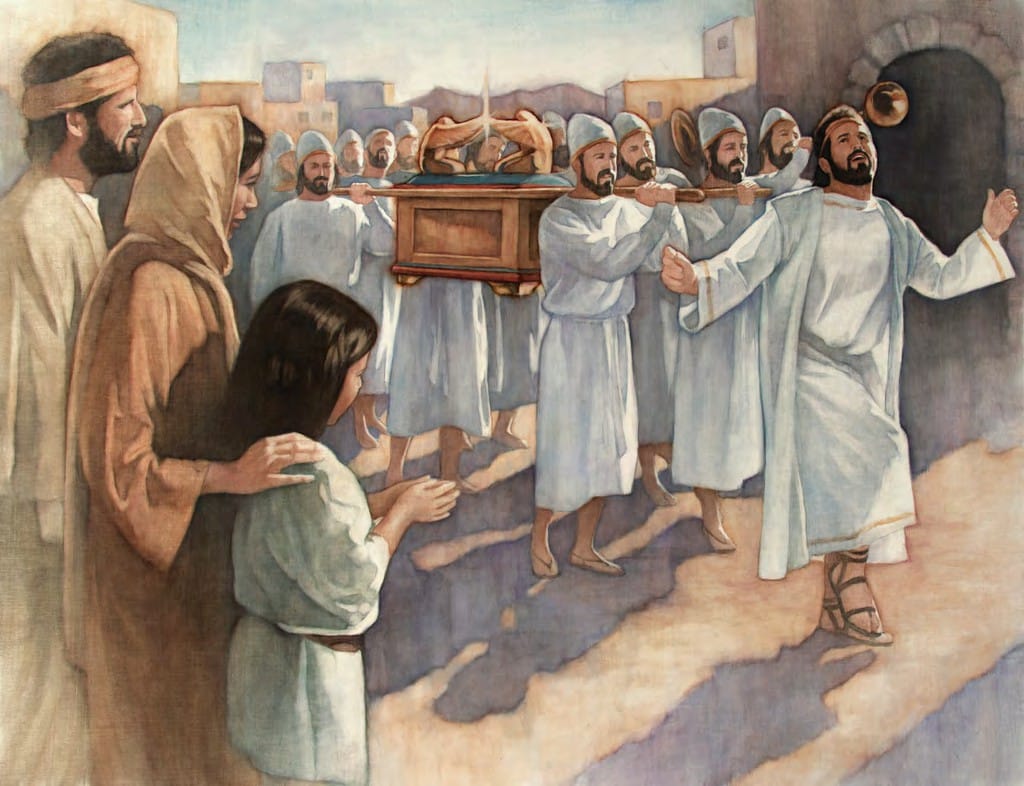
“And David made him houses in the city of David, and prepared a place for the ark of God, and pitched for it a tent. Then David said, None ought to carry the ark of God but the Levites: for them hath the Lord chosen to carry the ark of God, and to minister unto him forever… For because ye did it not at first, the Lord our God made a breach upon us, for that we sought him not after the due order. So the priests and the Levites sanctified themselves to bring up the ark of the Lord God of Israel. And the children of the Levites bare the ark of God upon their shoulders, with the staves thereon, as Moses commanded, according to the word of the Lord. Thus all Israel brought up the ark of the covenant of the Lord with shouting, and with sound of the cornet, and with trumpets and with cymbals, making a noise with psalteries and harps.” – 1 Chron. 15:1,2,13-15,28.
“And it was so that when they that bare the ark had gone six paces he [David] sacrificed oxen and fatlings, and David danced before the Lord with all his might [another expressive symbol of joy], and David was girded with a linen ephod. So David and all the house of Israel brought up the ark of the Lord with shouting and with the sound of the trumpet.” – 2 Sam. 6:13-15.
While Israel was thus taught the reverence of the Lord, the lesson applies with equal force to the Church of the Gospel age. It is not our part to change one iota of the ordinances of God. We may not turn the ordinance of the baptism of believers into the sprinkling of infants, nor change the simplicity of the Lord’s supper, or the time of its observance as indicated by its superseding the celebration of the typical passover. Nor have we a right to abate the just requirements of his holy law, nor to render null and void the authority of his precepts and instructions in order to please the worldly-minded. The law and the testimonies of God must be received into good and honest hearts without regard to human philosophies and idle speculations. The reverence of the Lord is the beginning of wisdom and blessed is the man that trusteth in him, and to whom a “Thus saith the Lord” is the end of all controversy on every subject.
“If our lives were but more simple, We should take him at his word; And our lives would be all sunshine, In the sweetness of our Lord.”
A Proper Seeking of Divine Favor – R. 3252
2 Samuel 6:1-12
“Blessed are they that dwell in thy house.” – Psa. 84:4
After David had been voluntarily chosen king of all the tribes of Israel, not as a result of his conquest, but as a result of his patient waiting for the Lord’s time to put him into the position of king, he took possession of Jerusalem and made it the capital city of the kingdom. Then followed wars with the Philistines, who again sought to invade the land of Israel. In these wars, under the Lord’s blessing, the Israelites were successful. It was after seven years had passed under such conditions – after the kingdom of Israel had become quite settled, and was not likely to be molested by enemies – that the scene of this lesson opens. King David, at this time about forty-four years of age, recognized the fact that religious matters had been at a low ebb in the nation for many years, and that the Lord having now blessed them by reuniting them and giving them peace, an appropriate time had come to do what he could in the way of reviving the religious sentiments of the people. His own heart ever loyal to the Lord, he desired that others should more fully appreciate the Lord as their light and their salvation. So it is with all who truly reverence the Lord and trust in him; they are desirous of telling their joys abroad, and helping others into the same condition of peace and rest in the Lord.
The Ark of the Covenant, it will be remembered, was the chief article of furniture in the Tabernacle service which the Lord instituted at the hand of Moses in the wilderness. We have no certain knowledge of the regularity of the Tabernacle worship during the period from Joshua to date. Quite probably the services were maintained with more or less regularity. It is possible that since the Ark was the chief center of interest in connection with that service, its movements, etc., may have included the movement of the other articles of furniture of the Tabernacle, its boards, curtains, lamp, table, altars, etc.
Shortly after Israel entered Palestine Joshua located the Ark at Shiloh, twenty miles north of Jerusalem. (Josh. 18:1) That it was still there at the close of the period of the Judges, and while Samuel lived with Eli, is shown by 1 Sam. 1:3.
The sons of Eli took the Ark with them into battle against the Philistines, thus evidencing their faith in the divine institutions, although their lives were corrupt; but as a result of this misuse of the Ark, the Lord permitted it to be captured by the Philistines. However, while they possessed it a curse seemed to accompany it. In the temple of their god, Dagon, his image fell down before the Ark, and the people of the cities in which it was located were afflicted with plagues. The Philistines were glad to get rid of the Ark, and loading it upon a cart started the oxen in the direction of the Israelites. From the time of its return the Ark was in the custody of Abinadab, the priest, and his sons, one of whom was Uzzah. The Ark had thus been with the house of Abinadab in the hill Gibeah and Kirjath-jearim, otherwise called Baale, seventy years.
Any religious movement amongst the Jews must necessarily center in and about the Ark of the Covenant, for it was the symbol of the Lord’s presence and of his mercy and grace toward them as a people. We remember that when in its place in the Most Holy of the Tabernacle a bright light, called the Shekinah glory, represented the Lord’s presence between the two Cherubim of its golden lid, which lid was called the Mercy Seat, because upon it the blood of atonement was sprinkled each year, which covered the sins of that people for a year, and was repeated year by year continually, as a foreshadowing type of the blood of Christ, by which the real atonement is made. In the box under this lid or Mercy Seat was the golden pot of manna, Aaron’s rod that budded and the two Tables of the Law, symbolizing the gracious arrangements and promises of the Almighty to his people. Spiritual Israel, thank God, has inherited the realities which were thus typified. Christ is the Ark of the Covenant. In him the Law has full satisfaction. In him is vested the priestly office, represented by Aaron’s rod, and in him is provided the heavenly manna. All these things are made ours by the Mercy Seat, and we have access to and are accepted before the Mercy Seat as members of the High Priest’s body, by virtue of the blood of atonement shed by our Redeemer as a propitiation for our sins, and not for ours only, but also for the sins of the whole world.
King David realized that the Ark of the Lord, representing his presence, should be in the capital city of the nation, making it the city of the great King, and directing the minds of Israel, not only to their earthly king and his laws and regulations, but through him to the heavenly King whom he represented. To have this event notable – to arouse the religious sentiments of the whole people – the king realized that they must all to some extent participate in the movement, and hence he gathered from all quarters thirty thousand of the chief men of the nation – not only its military representatives, but the heads of the tribes. There is a good lesson here for all spiritual Israelites who have any prominence in the carrying forward of religious work. It is not sufficient that a leader, a representative, shall attempt some prominent service for the Lord and for the Truth. It is wiser, better every way, that all of the Lord’s people be invited to join directly or representatively in any prominent matter connected with the Lord’s service. Even in the affairs of a small congregation it will be found disadvantageous to have one person do all the speaking, all the leading, all the serving. Far better, far wiser is it, far more in harmony with the Scriptural direction, that each should endeavor to take a part in the service, and be encouraged so to do along the lines of his natural talents and in proportion as he shall be found humble, faithful and helpful.
The holy joy and rejoicing of the journey with the Ark from Kirjath-jearim toward Jerusalem was suddenly interrupted by the jolting of the cart, which Uzzah, who had it in charge, feared would overthrow it. When he put forth his hand to steady the Ark he was smitten dead for his error. Consternation took the place of rejoicing. The thirty thousand who had come together specially to honor the Lord, and David himself also, were alarmed. Fear fell upon all, and David at once determined that this was either a mark of divine disfavor concerning the bringing of the Ark to Jerusalem, or that increasingly disastrous experiences might come to him and to the city by reason of the presence of the Ark. All were in fear, and the question now was, what to do with the holy oracle. A courageous man of the tribe of Levi, Obed-edom, was willing to receive the emblem of the Lord Jehovah’s presence into his premises – probably the Ark was set up with the Tabernacle, etc., in his yard or court or appropriate place.
“David was displeased because the Lord had made a breach upon Uzzah” – not displeased with the Lord, we may be sure, from what we know of the man, for David’s reverence for the Lord and his confidence in his righteous dealings are clearly manifest in all of his writings. We may properly understand this to mean, then, that David was displeased with his former determination – to take the Ark to Jerusalem; displeased that his good intentions respecting the revival of religion and the honoring of the Lord had thus gone astray through a lack of particularity on his own part and on the part of the priests who had charge of the movement, in that they did not obey the direct and explicit instructions of the Lord concerning the manner in which this sacred emblem of his presence should be moved. See Num. 4:15; 7:9, where it is specified that the Ark was to be carried upon the shoulders of the Levites by poles running through certain rings arranged for the purpose. That this was David’s attitude of mind is evident upon the reading of the ninth verse: “David was afraid of the Lord that day, and said, How shall the Ark of the Lord come to me?” We can imagine the disappointment and chagrin, not only of David, but also of the thirty thousand representative Israelites, when they scattered to their homes, disappointed respecting their good intentions, which apparently had not been fully approved by the Lord.
The statement that “the anger of the Lord was kindled against Uzzah” is not to be understood to signify violent passion on the Lord’s part, but evidently is an accommodated expression to bring down to human comprehension the fact that the Lord was displeased with the action of Uzzah, and thought proper to punish him for his neglect. Quite possibly long association with the Ark had bred in Uzzah a familiarity and loss of respect for it as representative of God; and his open violation of the divine regulation on the highway, and in the sight of the representatives of all Israel, would have brought the divine commands and threatening’s respecting the Ark and the various holy things of the Tabernacle into disrespect. The Lord resented this in the interest of his people, and incidentally took the opportunity to teach all Israel, through their representatives there assembled, a great lesson on the propriety of reverence for the Lord and for the particularities of his commands.
The reverence of the Lord is the beginning of wisdom. Whoever has not learned this primary lesson in reverence has not made a proper start in his worship and service. Unless he learns this lesson he is not likely to accomplish anything that will be pleasing to the Lord – he is apt to be a stumbling-block, rather than an assistance in the Lord’s service. Indeed, those who are the Lord’s consecrated people, and who have been privileged to handle holy things, and to enter into the Most Holy by the blood of Jesus, approaching the throne of the heavenly grace in prayer, have continual need to remember the appropriateness of reverence as they approach the Lord or engage in any service for him. All such should learn from this lesson how they touch holy things, and to do so according to the divine direction and not otherwise. The poet has noticed this tendency of some to “rush in where angels fear to tread.” Such irreverence sometimes manifests itself conspicuously in prayer, where the one who should be a worshiper, overflowing with thanksgiving for mercies received, undertakes to give direction to the great King of kings concerning the management of his work far and near and in all particulars. The Lord does not smite down such today, and make public examples of them for their irreverence, but we may be sure that, as the Apostle says, such petitions will receive no consideration of the Lord. (James 1:7) A lesson in this matter to us is that obedience is better than sacrifice. The carrying of the Ark upon the shoulders of the four Levites might not have been as majestic a procedure as the one attempted with the cart; it would nevertheless have been more pleasing to the Lord, because it was according to his directions. Let us apply this lesson carefully, and see to it that we not only desire to do the Lord’s will, but that we so desire to do it in his way that we will give close attention thereto, hearkening to the statements of his Word, or, as the prophet expresses it, let us be amongst those who tremble at his Word – who are extremely careful to note and particularly follow the Word of the Lord in every matter. “They shall be mine, saith the Lord, in that day when I come to make up my jewels.”
To those who discern the Scriptural teaching that death is the cessation of life, and not an entrance into life more abundant, there will be no need to explain that Uzzah’s conduct not only justified the Lord in making him an example before the nation, instructing the whole people in reverence, but also that no injury was done to Uzzah’s eternal future. He lived before the redemption price had been paid, and before any door to eternal life had been opened. He was one member of the human family for which Christ Jesus our Lord gave his life a ransom. As a consequence, he will be one member of the human family who shall ultimately hear the voice of the Son of Man and come forth from the sleep of death – to have it testified to him, in that his “due time,” that God has been gracious to our entire race, and has redeemed us with the precious blood. (1 Tim. 2:4-6) It is to those who have gotten the mistaken idea which ignores the resurrection and claims that there are no dead to be resurrected, but that the dead are more alive than they ever were before, and who, therefore, think of Uzzah as being dropped immediately into the hands of devils for eternal torture – it is to these that this narrative seems perplexing and unjustly severe. Thank God for the clearer light now shining upon his character and plan!
During the three months that the Ark was at the home of Obed-edom the Lord’s blessing was specially with the family, to such a degree that their neighbors took knowledge of it, and the matter eventually reached the attention of the king. We think it not unreasonable to assume that there was something in the character of Obed-edom, and the conduct of his home, in his reverence of the Lord and his confidence in him, that had to do with the blessing accompanying the possession of the Ark; because we have no record of any special blessing coming to the house of Abinadab during the seventy years that the Ark remained there. We might draw a lesson from this applicable to spiritual Israel. The Bible in some respects represents the Lord to us, as the Ark represented him to natural Israel. To it we go for the settlement of our questions. From it we hear the message of the Lord speaking peace to our souls, the forgiveness of sins, etc. The Bible has been in many homes in Christendom for more than seventy years without bringing any special blessing to those homes; yet to some, even in a few months, it has brought inestimable favors. What is the difference? We reply that very much depends upon the genuineness of the Israelite and the degree of reverence he has for the Lord and his Word, and his carefulness to consult that Word in respect to all his affairs, and the affairs of his home. Those who have the blessing of the Lord’s Word, and especially those who have any light upon its pages in this dawning of the Millennial morning, if they are not receiving great blessing from it in their own hearts, peace, joy, comfort, courage, strength, and finding such blessings also upon the members of their households, have reason to inquire to what extent they are responsible for their failure to profit thus.
Hearing of the blessing of the Lord upon the home of Obed-edom, King David took fresh courage, and realized that these different experiences of Uzzah and Obed-edom taught the lesson that those who reverently and carefully sought to know and to do the will of the Lord would have a blessing in proportion to their nearness to him, while the careless and the irreverent only need be in fear. Again the king assembled the representatives of the nation from all quarters, the chief men of the tribe and the chief representatives of the army, etc., and apparently this day of the bringing of the Ark to Jerusalem was the most joyful and the most notable day in David’s entire experience. See an account of this in 1 Chron. 15, 16. On this occasion care was taken to follow the divine direction, and the Ark was borne on the shoulders of the Levites, frequent stoppages being made, during which sacrifices were offered to the Lord.
On the whole we discern that the Lord’s dealing in this matter taught David and all Israel a great lesson, and was very advantageous to the nation as a whole. Thus it is with all the corrections in righteousness which the Lord may at any time give to those who are truly his; rightly received they will bring forth peaceable fruits of righteousness, reverence and obedience.
Homing the Ark at Jerusalem – R. 4258
2 Samuel 6:1-12
“Enter into his gates with thanksgiving, and into his courts with praise.” – Psa. 100:4
The Ark of the Covenant, wherein was deposited the tables of the Law, the basis of God’s covenant with Israel, and Aaron’s rod that budded, and the golden pot of manna, was the most sacred article of typical Israel’s religious emblems. Its lid, consisting of a golden plate surmounted with two cherubs, constituted the Mercy-Seat – the meeting place between God and the officiating priest, who acted as mediator between God and the nation of Israel. When in the Tabernacle, the divine presence was manifested upon the Mercy-Seat between the cherubim by a miraculous light called the Shekinah glory. For seventy years prior to our lesson the Ark had been neglected and in considerable degree the religion of the nation had likewise been neglected, though it is presumed that their devotions as individuals were not entirely forgotten, even as in David’s case, we note his continued reliance upon the Lord and appeals to him.
It will be remembered that the Ark was in the Tabernacle of the Lord at Shiloh when Samuel was a boy and Eli was high priest, and that later, when the latter was aged and Samuel was grown, in a battle with the Philistines the sons of Eli, who were disreputable, self-seeking, grasping characters, took the Ark into battle as a talisman or mascot, believing that the Lord would protect the Ark and that thus the army of Israel with it would have success. But the iniquity of Eli’s sons had reached its full and God willed that they should fall in the battle and that the Ark should be captured by the Philistines and that Eli himself should die of heart failure upon hearing the news of the disaster, and that Samuel should occupy the place of judge, prophet and priest to the Lord.
It will also be remembered that while the Ark was with the Philistines it brought them no blessing, but on the contrary sickness, trouble, etc., or “bad luck,” as some would say. It was thus sent from one Philistine city to another, each being glad to get rid of it until finally they put it upon a cart and started it eastward to the land of Israel. There it was received by the priest Abinadab and lodged in his own house. There it had remained for several years up to the time of this lesson, when David had become King of Israel.
++ Please see January 1909 Issue where the author says the word “advocate” should have been used instead of “mediator.” – site Editor
Fervent in Spirit
As we have already seen, King David possessed a very deep religious nature, whose center or will had been early turned in full consecration to the Lord. Realizing that God was the real King of Israel and that he himself was merely God’s vice-gerent or representative, David sought to fulfill the divine will and arrangement by inaugurating the Tabernacle and its religious services, as God had appointed through Moses. Accordingly, a royal decree went forth summoning the priests, Levites, and tribal princes and religious people of the various parts of the dominion for the reinauguration of the public worship of Jehovah God. The scope of the decree may be judged from the assembled multitude – 30,000. It matters not to us that some are inclined to impugn the motives of the king and to claim that this was merely a policy stroke of the king for the binding of the people to himself through his religious instincts and a revival of ancient customs. If it were merely policy on David’s part, it was good policy, wise policy, helpful policy as respects the people, as well as in respect to unifying and solidifying his kingdom. To be religious did not necessitate the avoidance of such things as would be good for the people, even though some might impugn the motive. But the love which thinketh no evil should be experienced and the king should be given credit for the best of motives in calling for the fulfillment of divine commands given through Moses.
Indeed, those who have learned to look for the Lord’s leading, amongst the Lord’s people, in all the affairs of life should be convinced that God did not leave the affairs of his people Israel in the hands of David – that the Lord himself was King and Director of all of the interests of that chosen and covenanted people. In our estimate, therefore, it matters not what motive David may have had in calling this convocation, because God was behind it and David, wittingly or unwittingly, was being used as the divine agent in accomplishing the divine purposes. And it will surely do us good to call to mind that similarly the Lord has a special interest in all the matters which pertain to Spiritual Israel and that no great or important matters that pertain to Spiritual Zion take place without his notice, without his permission. Only those who thus recognize the divine supervision of the Church’s interest can rest their hearts in faith and confidence or feel assured that God is working all things according to the counsel of his own will.
We feel specially impressed with the special evidences which show that God’s supervision was particularly with Israel in their harvest time, at the end of the age, in all of the affairs pertaining to our Lord’s first advent: his birth in the “fulness of time,” his death “in due time,” the number of his disciples, the one that should betray him, his crucifixion as a malefactor, the rejection of Israel because of the rejection of Messiah, the anointing of the “most holy” at Pentecost, the final overthrow of the nation, A.D. 70. And if we note such particular care by the Lord over natural Israel, may we not experience as much faith in his care for Spiritual Israel in the present harvest time? Surely the lessons we have learned in the Scriptures respecting the harmonious parallels between the Jewish Age and the Gospel Age, between the harvest of that age and the harvest of this age, justify fully our expectation that the Lord will be equally careful in overruling even the smallest affairs in the harvest of this age.
Whoever can by faith reach and maintain this position will surely have a confidence in the Lord which will be very helpful to him. The trials and difficulties of the Jewish harvest seemed like calamities at the moment of their permission, and it is only by hindsight directed by the Holy Spirit and prophetic Word that we are able to discern God’s providences there. Similarly, calamities, adversities, peculiar conditions, etc., are to be expected in this harvest, which at the time of occurrence will not be understood by any except those of large faith and intimate acquaintance with the prophecies, and even they will be obliged to walk by faith and not by sight. It will be afterward that the divine supervision in every detail will be discernible. Meantime, the Lord wills evidently that the Spiritual Israelite, instructed in the school of Christ, shall have learned the lessons of faith and obedience from the harvest time of typical Israel.
“Obedience Better Than Sacrifice”
The occasion of bringing the Ark of God to the capital city of the nation was to be a gala day of rejoicing, long to be remembered from one end of Israel’s land to the other. King David rejoiced at the unanimity of religious sentiment everywhere prevalent with the people who accepted his instructions. The players of musical instruments of every kind had been engaged so as to accompany the procession. An ox-cart, specially prepared, was provided, and the Ark was put upon the cart and the two sons of the high-priest accompanied it, the one preceding and the other driving. The good intentions of all concerned are not to be misjudged, but a serious error was made in that the divine order in connection with the matter was neglected.
(1) God had made no such arrangement of transferring the Ark on a cart, however honorable that may have seemed to David and to the priests.
(2) It was not the business of the priests at all to transfer the Ark, for, although they ranked high in the Lord’s services, it was the Levites who were commissioned to bear the Ark by its staves on their shoulders. In neglecting these divine provisions an opening was made for all kinds of irregularity in connection with the services of the Tabernacle, which the Lord designed should not be reinaugurated. It was proper that the king, the priests, the nobles of all the tribes, and the religious people of the nation should have a lesson that would not soon be forgotten respecting the importance of carrying out every detail of the divine law in respect to the worship and services of the Tabernacle. The lesson which the Lord gave on this occasion not only was profitable to the king and the nation, but has been profitable in a large degree to Spiritual Israel during this Gospel Age.
When the time came for the manifestation of the Lord’s disapproval of the neglect of the Law on the part of those who desired to honor him, the oxen stumbled and, to steady the Ark, Uzzah, an under-priest, put forth his hand, when immediately God’s displeasure was manifested in his falling down dead. The gala day was suddenly spoiled. The joy of the king and of the people vanished. Instead came distress and fear – if, because of some blunder, even one of the priests should be thus smitten down of the Lord, what would be the dangers as respects others! King David promptly concluded that he dare not have the Ark with him and near his own house at Jerusalem, as previously intended. The procession stopped and, turning aside, the Ark was deposited in the home of Obed-edom.
“The Fear of the Lord Is the Beginning of Wisdom”
One of the first lessons necessary for every Israelite, natural and spiritual, is reverence. Without this quality we shall be sure to err. There is an old and true adage, “Familiarity breeds contempt,” and this applies to religious things and to God, as well as to earthly things and to men. The worship of God, which King David was to inaugurate in the typical temple built by Solomon, must be founded upon a proper base of respect and reverence. It must be recognized as fundamental, that obedience is a pre-requisite to the offering of acceptable sacrifices to the Lord.
The fact that this lesson was taught at the expense of human life has seemed to us terrible, because of our delusion in respect to eternal torment, which led us to suppose that poor Uzzah not only ceased from human activities and pleasures but that he was immediately dropped into a seething abyss of hell-flames and torture. Now, by the grace of God, we see that this is not the teaching of the Scriptures, and this relieves the narrative of its distressing features. We perceive that Uzzah lost his life a year or so earlier, as the case might have been, than he otherwise would have lost it, and that it was for the Lord’s glory and for the good of the people that he died as he did and not by disease or accident. We are to remember that he was already, like the rest of the race, under condemnation of death and that God had a perfect right to require his life at any moment. We are to remember that all that he lost was of God’s purpose and in God’s time will be made good to him, in his awakening in the resurrection of judgment, when he shall come forth from the tomb to more favorable conditions than those under which he was living – to the antitypical jubilee of restitution to all who will receive it.
Spiritual Israelites must learn this lesson – that in handling the holy things of the divine Word, the divine plan, the services of the Truth, the ministry of the Church of Christ, they are not at liberty to do as they please, merely assuring themselves that their motives are good. It is their duty to note carefully the divine will and to follow out the program in the order of the directions of the divine Word. Furthermore, it is for us to learn, too, that God designs that not all the services are to be performed by one or two persons, but that there is a part in the service of God for all of the consecrated and that each is to be granted the opportunity for such service, as the Lord has planned. Some may occupy the priestly service, which others may not enjoy, and some may occupy the Levites’ service, and their opportunities are not to be taken from them. Again, another important lesson to be learned by Spiritual Israelites is that God is guiding his own affairs; that he is as much interested in them as we are and more, too, and that he is fully capable of their management. Some of the Lord’s people carry great burdens which do not belong to them and which hinder them from the rest and joy which otherwise might be theirs. Others are so active, so zealous, that they fancy that the work of God would not be accomplished at all unless they did it. The Lord wishes us to learn the important lesson, “In all thy ways acknowledge him,” “and he shall give thee the desires of thy heart.” Only by recognizing the Lord as first in every feature of his work and by recognizing ourselves as honored by him in every opportunity of service shall we be able to bring blessing to ourselves and to others.
Profiting by Experience
If we think of David’s course in refusing to bring the Ark to Jerusalem, as at first intended, as a mark of petulance and anger against the Lord for spoiling the gala day, we shall make a great mistake. David’s character was too reverential for anything of this kind. He was the man who could fight Goliath, but not the man who could fight against God. Every act of his life was marked by reverence and humility and a recognition of God’s justice and power and love and of David’s own humility in the Lord’s sight. Meantime the Lord was teaching a great lesson to the whole nation, which heard of the sad disappointment of the people with reference to the great gala day and that God’s displeasure was shown in such a striking way that even a priest was stricken down for neglect of the divine supervision, and that the Ark was now in the house of Obed-edom.
King David was watching and noted these results, and again his heart went out longingly with the wish that the chief emblem of divine worship should rest under the shadow of the Lord, near to the Lord and to the shekinah glory. Evidently he made investigation as to the handling of the Ark and concluded that the mistake was that of himself and of the priests and that God’s blessing and not a curse would go with the Ark. So at the end of three months he made arrangements afresh for the bringing of it to his capital. Again the visitors came, the bands of music in order, and the procession accompanied the Ark again towards Jerusalem. We read that David brought the Ark from the house of Obed-edom unto the City of David with gladness and with joy.
A description of the festival procession may be found in I Chron. 15 and 16. It was decidedly the greatest day in David’s career. But this time, in harmony with the lesson taught, there were no innovations, no cart driven by priests after the manner of the heathen, but instead a strict adherence to the divine direction. The Ark was borne on the shoulders of the Levites. The lesson was learned that obedience to the letter is better than sacrifice. In the joyous procession, the king apparently led, playing upon the harp, while with him the singers and the musicians were divided into several companies which sang parts in alternation. See Psalms 105, 96, and 106. The 24th Psalm is supposed to have been sung as a marching accompaniment as the procession was entering Jerusalem, where a tent or tabernacle had already been placed for the reception of the Ark. Seven choirs formed part of the procession, according to Josephus.
Other Lessons for Spiritual Israel
Members of antitypical David – the Christ – are to learn lessons from all the experiences of life; that with them it may be as it was with David in this case, when the proposed gala day was turned into a day of mourning and fear. Similarly, our mistakes are to be received rightly and the reasons for them rightly appreciated so that, instead of stumbling-stones, they may be stepping-stones which shall draw us “Nearer, my God, to thee.” Another lesson is that we should desire to be nearer to the Lord.
The Ark in the Tabernacle near to David’s home represented not its glorious resting place, but its present dwelling. The condition of the Church in glory is represented by the Temple of Solomon. We, of course, long to be there and to enter into all those glorious things of the future, but that is impossible until the Lord’s time, even as David was not permitted to build the Temple. Thus his life shows a picture not of the Beloved in glory, but of the flesh in the trial state below. As David desired to be near to the Tabernacle, close to the Lord, so we, members of the Beloved, should find ourselves longing for a closer walk with God, a nearness to his arrangement of the mercy-seat – Christ Jesus. This will signify a desire to be near to the members of his Body, the Church, to have fellowship with them,
because the condition of things is represented as being the “holy” of the Tabernacle, with only a veil between this and that glorious condition beyond the veil. And is it not so that whoever desires to be near to the Lord and to those in fellowship with him, along the lines of the new nature, will give heed to the privileges of showing forth his praise by manifesting their love for the brethren and their confidence and faith in the Lord and in his light and wisdom and love?
“Enter into His Gates with Thanksgiving”
In some respects the City of God is the Church – not the nominal system, but the true Church, whose “names are written in heaven.” According to the Apostle, the justified believers can enter into this City only by consecration. The Apostle exhorts, “I beseech you, brethren, present your bodies a living sacrifice.” There are some who seem to enter this gateway of sacrifice in sorrow and with a measure of regret – with a feeling that they are sacrificing too much. They either overestimate the things sacrificed or they underestimate the things which they are securing. It would have been better for such if they had sat down and counted the cost before taking the step of consecration. The proper attitude of all is to take a right view of that which now is and that which is to come and what we have contracted to do as priests, doing it, then, joyfully. And thus this lesson is learned, that we “Enter into his gates with thanksgiving, and into his courts with praise.” The appreciative child of God will be able to “count it all joy” when he falls into various difficulties, because it will be a trial of his faith that “Tribulation worketh patience; and patience, experience; and experience, hope,” which maketh not ashamed and is a preparation for the glories of the Kingdom.
City of David – City of God – R. 5679
2 Samuel 6:1-19; Psalm 24
“I was glad when they said unto me, Let us go into the House of Jehovah.” – Psalm 122:1
Guided by Divine providence, King David sought a new capital after he had been anointed king over all Israel. The city of Jerusalem had for centuries been an impregnable fortress, held by the Jebusites. They claimed that even the blind and the cripples could defend it against any foe, so advantageously was it situated. But when the time came, it was delivered into the hands of King David and became the capital of Israel. One of the first acts of the new king was to provide himself a palace fitting to the dignity of the nation and the court. To this end he obtained from King Hiram of Tyre not only material, but also skilled craftsmen.
Soon King David’s spiritual nature, so marked and represented in his Psalms, began to assert itself in respect to the government of Israel. It was not sufficient that idolatry should not be tolerated amongst God’s Covenant people. The symbols of God’s presence should be honored once more. The Tabernacle at Nob had fallen into disuse when King Saul destroyed the priests because they gave comfort to David; and King Saul had had the Tabernacle removed to Gibeon; but the Ark was not in the Tabernacle, and had not been for a long time.
We recall that the wicked sons of Eli had taken the Ark with them into the battle with the Philistines; that in the defeat it was captured by the Philistines; that in its presence, Dagon, the Philistine idol, fell down broken; and that in whatever city the Ark rested, there were chastisements from the Lord until the Philistines returned it to Kirjath-Jearim. There it had remained for seventy years, until the events now noticed. King David made the transfer of the Ark to its new Tent, or Tabernacle, a very important affair, sending word to various parts of the nation, assembling some thirty thousand warriors and multitudes of people of deep religious inclination who desired to be witnesses to this great new religious movement, which all hoped would mean the bringing of God’s blessing back to the nation, as of old.
A Great Lesson in Reverence
King David, intent upon honoring God, had nevertheless neglected to look particularly into the Divine Law regulating the Ark and its movement – who should touch it, etc. Divine providence now gave him a great lesson in respect to reverence for the Almighty and carefulness in respect to the Laws. He had esteemed the Ark, but not highly enough. Really, it was the most important of all the various furniture of the Tabernacle.
The Brazen Altar and the Laver were in the Court; the Table of Shew-bread, which was overlaid with gold, the Golden Candlestick, and the Golden Altar of Incense were in the Holy. But in the Most Holy the only article of furniture was the Ark. In shape it was like a box – about four feet long, two feet high, and two feet wide. It had a pole at each side, by which the Levites were to bear it on their shoulders. It was overlaid with gold; and inside the box were the Tables of the Law, a Golden Pot of Manna, preserved from the Wilderness times, and Aaron’s rod, by which miracles had been wrought. The top of the Ark was its most particular feature. It was a solid plate of gold, wrought out above in the shape of two cherubim, whose faces looked inward and whose wings stretched forward.
The Divine direction was that the priests should cover the Ark in a particular manner, symbolical of certain things; and that then only the Levites should have the care of it, to bear it upon their shoulders. Neglecting these matters, the king had a new cart made and oxen to draw the cart, as though this would be a more dignified way to bring it than any other thought of. But it was not God’s way; and a lesson of reverence for God and for the Ark, which symbolized His character and His Mercy-Seat, must be given.
The appropriate time came when the oxen, drawing the cart over a smooth, sloping, stone surface, allowed it to tilt a little. Then it was that Uzzah stretched forth his hand to steady the Ark, and was immediately smitten dead with a bolt of lightning. This evidence of Divine displeasure with the procedure brought all the festivities to a sudden termination; and King David feared to bring it too near to him, lest it should do other injury. The procession stopped; turning aside, the Ark was delivered to the home of Obed-edom the Levite, possibly a priest.
The whole people thus learned the lesson of reverence – a lesson, by the way, which seems to be as much needed today as at any time. Irreverence is frequently manifested by the world; but this does not astound us as much as when we find irreverence manifested by those who profess to be the Lord’s consecrated people, His Royal Priesthood. It is sometimes irreverence of manner, sometimes irreverence of language, sometimes the making of jokes on religious things or on passages of Scripture. Everything of the kind is surely injurious to the individual, as well as to his influence with others.
We are not to forget that Uzzah was not sent to eternal torment; but that he merely fell asleep in death, and that his mistake, which taught a good lesson in his time, will not inure to his disadvantage in the future. Meantime, another lesson was taught; for the Ark at the home of Obed-edom began to bring blessings, of just what character we are not informed, but blessings of such a nature that they attracted the attention of many. Among them King David noticed. Again his heart turned to the original thought that Jerusalem should be not only the City of David, but the City of God, God’s dwelling-place, as represented by the presence of the Ark and the Shekinah Glory-light which shone between the two cherubim, as indicating the presence of God with His people, Israel.
God’s Own Holy Nation
We are not situated in the same way as were David and the Israelites. There is no nation in the world today that is God’s Kingdom. When He took away the crown from Zedekiah, 606 B.C., He declared through the Prophet, “I will overturn, overturn, overturn it; and it shall be no more until He comes whose right it is; and I will give it unto Him.” (Ezekiel 21:25-27) We believe that the time for the giving of the Kingdom to Messiah and the fulfilment of our prayers, “Thy Kingdom come,” is near at hand. But, in the meantime, no earthly kingdom is God’s Kingdom except in the sense that St. Peter declares the Church to be the holy nation, a peculiar people of God. (1 Peter 2:9) But even then, it is not a sectarian system that is referred to – not the Baptist Church, nor the Methodist, nor the Presbyterian, nor the Lutheran, the Anglican or the Roman. The true Church of Christ is the unlimited Church, to which properly belongs the name Catholic in the sense that it is general; for that word means general, or universal.
The Church of Christ is the one Church throughout the whole world; and its members are those who are united to Christ by consecration and by Divine acceptance through the begetting of the Holy Spirit. Some of its members may be found in the Roman Church, some in the Anglican, some in the Presbyterian, some in the Baptist, some in the Lutheran, some in the Methodist and others, and some outside of all these. But this is the only holy nation that God recognizes; and it will not be organized as a new nation fully until the resurrection change shall glorify the Lord’s people with Himself beyond the Veil; as it is written, we shall be like Him, shall see Him as He is and shall share His glory.
We can no more expect the world to appreciate the Truth of God and the presence of God than the Israelites could have expected that the Philistines, on the one hand, and the Moabites, on the other hand, would accept the Lord. Only God’s Covenant people can appreciate Him and His arrangements. He is in their midst only.
 People Sang at Church − Lifeway Collection
Nor can we even claim that it is a family matter; rather, as the Scriptures show, it is an individual matter. Here one, there another, the Church of Christ is scattered throughout the world. Only the consecrated belong to it or have its privileges and the fellowship with the Father and with the Son which the Ark of the Covenant would imply. One exception to this rule might be noted; namely, the one mentioned by St. Paul – the children of believing parents, who are counted in with their parents as participators in God’s favors, blessings and care until such time as they reach a development of mind that would enable them to decide for themselves, either to make a full consecration to the Lord and be individually accepted by Him through the begetting of the Holy Spirit, or to turn aside and be part of the world.
When King David was ready for the bringing up of the Ark the second time, some three months after the first attempt, which failed, he had studied the matter more carefully; and this time there was no new cart, but the Divinely directed method – the Levites, bearing the Ark upon their shoulders. It is not for us to be ingenious and inventive in respect to Divine methods and services, but rather to be students of the Divine will, searching the Scriptures that we may know the will of God and do it. The lesson which King David learned is one which all of God’s people may well take to heart.
Dancing Before the Lord
The record tells that, besides the thousands of warriors who acted as a guard and gave dignity to the procession, and the multitudes of people who met the Ark at various villages on the way, there were trumpeters, rattlers, and players on stringed instruments, who made joyful manifestations of appreciation of the great event of God’s return to the nation as represented in the Ark’s return. Another arrangement was that of having the Levites chant, one to the other, the different portions of a certain Psalm which King David had composed for this very occasion. It is made a part of this lesson. – Psalm 24.
King David joined with the others in his manifestation of delight, and danced before the Lord. It would appear that this custom of a dignified rhythmic moving of the feet in harmony with music is a common form even today in far Eastern countries. Mr. Clark tells us how there was such a dance at a gathering of the Christian Endeavorers at one of their meetings in India, and how dignified and beautiful it appeared.
As the grand procession neared the city of Jerusalem, it was met by the women of the city with rejoicing. At the head of these should have been Michal, King David’s wife, the daughter of King Saul. But not so. She was in a cynical, proud mood. Was she not the daughter of King Saul? Had not her husband David been a poor shepherd boy, and then an outlaw for a time? On his coming home she criticized him for his manifestations of joy in connection with the bringing in of the Ark. She said that it was undignified and reproved him. King David reminded her that the Lord had taken the kingdom from her father and given it to him, and that he thus had the Lord’s favor and thus relied on Him. And the proud woman was apparently thereafter left to herself, the bare mention being made that she was thenceforth childless.
The Psalm Was Prophetic
As the Ark represented Christ, in whom are hidden all the wisdom and power of God and in whom center all of God’s blessings for men, so the bringing of the Ark into the city corresponded in a measure to our receiving of Christ. All such realize that “the earth is the Lord’s, and the fulness thereof” – that every good and perfect gift cometh down from the Father and through the Son. The world and all that dwell therein are subjects of these blessings.
God is founding His new order of things in the midst of the seas of discontent – amongst those who are not established and in harmony with God – the restless masses. He invites us to ascend into His Holy Hill, His Holy Kingdom, and to be established in His Holy Place, in the spiritual Divine nature. He stipulates that none can be of this class except upon certain conditions; namely, a pure heart, an honest heart, and clean hands, righteous living to the best of his ability. These are all expected to swear allegiance to God. This is styled their covenant with Him.
Jesus was the first of these Covenanters; and all of the Church must walk in His steps, if they would be with Him in His Holy Kingdom. These must not lift up their soul to falsehood nor swear deceitfully. God will require of them all that they have covenanted with Him. Only such will receive the blessing of the Lord, and only to such will His righteousness be imputed through Christ.
Never more than today has this lesson seemed to need to be impressed. How many today confess that although they have made a covenant of sacrifice and vowed to the Lord, they are not considering this nor keeping their vows! How many indeed confess that they are speaking falsely in respect to their creeds, denying privately what they publicly have declared to be their faith! Surely such a course must be reprehensible in God’s sight and such cannot hope to be of the Kingdom.
Then follows in the Psalm a declaration that the children of Israel are those who seek the Lord, and who request that the King of Glory come in, even the Lord, mighty, powerful, able to deliver from sin and from the power of sin – death. We are still waiting for the entrance of this King of Glory in the full sense of the word. He declares that He will be revealed in flaming fire, so far as the world is concerned – a great “time of trouble such as never was since there was a nation.” (Daniel 12:1) Many Bible students see this trouble already beginning in the awful war now spreading, and are expecting the fiery anarchy of it to result in the near future. Then quickly will come the still small voice, the Divine influence, the mighty power of the Savior, which will deliver from sin, from death, and from Satan, who shall be bound for a thousand years.