
SOLOMON, KING OF ISRAEL – R. 5701
1 Kings 1:1—2:12
“Know thou the God of thy father, and serve Him with a perfect heart and with a willing mind.” – 1 Chronicles 28:9
KING DAVID was seventy years of age; Absalom, his eldest son, had died in rebellion not long before the present lesson opens. David’s next oldest son was Adonijah, whom the death of Absalom had made the heir-apparent to the throne, and who is supposed to have been between thirty and forty years of age at this time. Joab, for a long time the head of David’s army, must have been well-advanced in years too, and probably was on the retired list, not merely on account of age, but because he had deeply wounded King David’s feelings in disregarding his instructions that Absalom’s life should not be taken.
Adonijah thought the time ripe for him to proclaim himself king, and especially as he had succeeded in gaining the friendship of Joab, the long-time military leader, and the friendship, too, of one of the prominent priests. He made a feast, to which were invited, apparently, all of King David’s sons except Solomon, who was ostensibly known to be more or less a favorite with his father. The feast was held not far from Jerusalem, and the arrangement was made that in the midst of the feast one of the company should salute Adonijah as king. The others of his company were expected to echo the sentiment; and thus the movement would seemingly be a popular one and not a rebellion. It carried out much as planned thus far.
However, in God’s providence, the matter was brought to the notice of King David, who promptly made the arrangement with the new general, Benaiah, with Nathan the Prophet, and with Zadok the priest, to have Solomon immediately placed upon the king’s white mule, as a sign that the king had approved him as his successor. Then he was anointed in the name of the Lord; and forthwith the military salute was given, and the people of the whole city of Jerusalem shouted their joy, “Long live King Solomon.” Next in turn, by King David’s direction, King Solomon was brought to the throne and publicly crowned.
Adonijah, whose plans seemed to be working thoroughly, was astounded, and so were those with him, when they heard the clamor of the people, blowing of horns, etc., and later learned that it meant that Solomon had been crowned and enthroned. Adonijah feared for his life and fled; and his adherents melted away. Later, however, Solomon sent word to his brother Adonijah, assuring him of peace.
Thus beautifully King David’s public career ended, not in an eclipse, but at his zenith, in his full maturity of old age, and in his perpetuation upon the throne in the person of his chosen son. To him may well be applied the poet’s words:
“He sets as sets the morning star,
Which goes not down behind the darkened west,
Nor hides obscured amid the tempests of the sky,
But melts away into the light of heaven.”
SOLOMON, SON OF PEACE
Solomon’s name has come to signify wisdom; but originally, primarily, it meant Peaceful. It surely was a prophecy of his wonderful life, in which was no war.
Solomon was the son of Bathsheba, after she had legally become David’s wife. Somehow, not explained, the Lord had revealed to David that Solomon was to be his successor; and David had promised Bathsheba to this effect. Solomon was born at a period when King David’s activities as a warrior had very nearly closed and when the great double sin of King David’s life and his repentance from it had, we believe, wonderfully moderated and chastened him. His loyalty to God in this serious matter, his earnest prayer for forgiveness and his realization of peace from God, apparently had made a new man of King David. Even though before this he had been loyal to God, he apparently was now still more devoted. The peace which he craved, and which was a mark of Divine forgiveness, may have had something to do with the gentle and thoughtful character of King Solomon, and something also perhaps to do with his name. It may have been given him as signifying that his birth marked peace with God on the part of his parents. In any event, in Solomon we perceive a different character from that manifested by any of his brethren whose histories are recorded. He partook of his father David’s religious disposition more than the others. He was thus highly favored, and really probably more gifted. Truly it is time for us to estimate to what extent others and ourselves are handicapped or blessed by dispositions and character-traits which we inherit.
Another thing favorable to Solomon would appear to have been the fact that his mother was not of a heathen family, but an Israelite, and therefore more in sympathy with the Divine arrangement, Law, worship, etc., than others of David’s wives.
Additionally, the Record seems to show that King David, having in mind a successor to his throne, and perhaps by that time having realized that he had not done his full duty by his other children in allowing them to grow up under the adverse influences of the court, rectified the matter in the case of Solomon while he was still young, leaving him partly in his mother’s care, and appointing him as the ward and pupil of the Prophet Nathan. This excellent start in life doubtless had much to do with Solomon’s career, which we shall examine in our next Study.
THE KING OF PEACE INAUGURATED – R. 4286
I Kings 1:32-40,50-53
“Know thou the God of thy father, and serve him with a perfect heart, and with a willing mind.” – 1 Chronicles 28:9
SOLOMON’S name signifies peaceful. Nathan, the Prophet, who was his tutor, called him Jedidiah, which signifies, “beloved of Jehovah.” Apparently he inherited certain natural traits which were much to his advantage, and under special divine blessing gave him properly the title, “the wise man.” A writer says of him: –
“His parental inheritance was remarkably strong in several directions. His father David was in the maturity of his age; his mother was the grand-daughter of the Prince Ahithophel, whose advice ‘was as if a man had inquired at the oracle of God.’ He thus inherited from his mother sagacity, quickness of judgment, judicial insight and perhaps some sensual weakness; from his father, thoughtfulness, literary taste, the skill of ruling and an interest in religion. His bodily form and countenance must have borne the graceful characteristics of all David’s children; and, if we may follow the description given in the Canticles, he was fair, with bushy locks, dark as the raven’s wing, yet not without a golden glow, tall and imposing.”
He was about twenty years of age when his reign began. His father, King David, was about seventy years old and quite feeble, and it was manifest to all that a successor to the throne must soon be found. David’s eldest son, Amnon, was murdered by Absalom, who was next in years, and the latter was slain in the battle of his rebellion. The next in age, “the heir apparent,” was Adonijah, who evidently understood that his father, the king, premeditated that Solomon should be his successor, and this purpose he sought to thwart by himself seizing the kingdom on the pretext that his father was now too old to administer its affairs.
When Adonijah thought his project ready, he invited his adherents with all of the king’s sons – except Solomon, who seemed to have shared his jealousy – to a great banquet in the “royal garden.” Here, amid the mirth of the festival, a preconcerted cry was raised, “Long live King Adonijah”! Joab, King David’s able general, now advanced in years, and Abiathar, the High Priest, were among his abetters. Thus the second conspiracy was hatched in David’s family.
”THE KINGDOM OF THE LORD”
“God is not in all their thoughts,” writes the Prophet. This was true of Absalom’s conspiracy, and again of Adonijah’s. They did not consider that the kingdom of Israel was the special institution of the Lord, different from other kingdoms, so that, as the Scriptures declare, it was God’s Kingdom. Thus we read, “Solomon sat upon the throne of the kingdom of the Lord in the room of his father David.” Had the conspirators realized that they were really attempting an interference with the Divine arrangements, surely neither attempt would have been made. God’s people of today should be on the alert to discern in all of life’s affairs, the will of the Lord. We surely should know that the Lord’s wisdom and power are with the interests of Spiritual Israel in all of their affairs, in such a manner and to such a degree that human conspiracies and oppositions can work only harm to those who foment them. Though the Lord may permit these to go to great lengths and to have apparent success, as in the case of the conspiracy of the high priests and Scribes and Judas against our Lord, or in the case of Absalom and his coadjutors against King David; but the assurance given to all who have the faith to receive it is that “all things must work together for good to them who love God, who are the called ones according to his purpose,” and that it must always be true in the case of all the Lord’s people; as Jesus said to Pilate, “Thou couldst have no power at all except it were permitted thee of my Father.” The Father will permit nothing which would interfere with his glorious plans. He assures us of this, saying, “The word that goeth forth out of my mouth shall not return unto me void; it shall prosper in the thing whereto I sent it, and accomplish that which I please.”
SOLOMON CHOSEN, ANOINTED, PROCLAIMED
In due time, Divine providence drew the attention of King David to Adonijah’s conspiracy – in proper time for him to take the necessary steps to accomplish the Divine will. Our lesson tells of how David called another priest, Nathan the Prophet, and Benaiah, another general, and sent them with his son Solomon to the valley just outside the city gate and near the very place where Jesus later rode on the ass. Solomon was directed to ride on King David’s own white mule, an act which would of itself proclaim him David’s appointed successor. With this special envoy went the two companies of the king’s special body-guard, the Cherethites and the Pelethites. Presently, the anointing performed, the trumpet was blown announcing Solomon king, and the people unanimously confirmed this with great shouts and rejoicing. Thus was Solomon brought in state to the palace, where he reigned jointly with his father David for some six months until the death of the latter.
SOLOMON’S WISDOM AND MODERATION
The king was a very young man for the heavy responsibilities devolving upon him, and the moderation displayed shows him to have been not merely well-balanced but well-trained. Solomon was born when his father was in his 53rd year, and at a time, doubtless, when he had learned from experience that he had been too indulgent to the remainder of his family. David had not brought them up with sufficient strictness. He had not realized sufficiently the need of training them in the nurture and admonition of the Lord. Great affairs of state had claimed his attention and the children had been left too much to the care of others not so reverential as the king. Himself religious from his youth, he seems to have supposed that his children would possess similar qualities of heart and mind. Evidently he had not sufficiently realized the demoralizing influence of wealth and earthly honors; that these do not make for godliness but, to the contrary, cultivate pride, worldliness, godlessness.
It was doubtless due to David’s increasing reverence for the Lord, and his realization of the mistakes made in the training of his other children, and his desire that his successor to the throne should honor the Lord and carry forward the interests of religion – these things doubtless led the king to put his son Solomon under the special care of the Prophet Nathan, with the view to his preparation to serve the Lord and his kingdom righteously, and to build the temple of the Lord which David had purposed to build but was not allowed. The Prophet Nathan knew of the temple project and of God’s promise that it should be built by David’s heir, and that Solomon was the chosen of the Lord and of the king. We can imagine the Prophet’s faithfulness in the training of Prince Solomon for the duties of the position he was intended to fill.
Respecting Adonijah it is written, “His father had not displeased him at any time.” (I Kings 1:6) Evidently he was a spoiled child, and one that probably felt glad that his father had never put him under the tutelage of so religious an instructor as the Prophet Nathan. He no doubt considered that Solomon was specially hampered and hindered from certain pleasures and “sowing of wild oats” and in general had too much restriction. Solomon, however, seems to have been greatly pleased by this experience, which illustrates well the fact that the twig that needs to be bent should be dealt with early. Fain would we impress this lesson upon all parents and guardians – that their wards need supervision and loving religious control, and that it is a mistake to allow the early years of life to be wasted through inattention and lack of training and then expect good results.
WE ARE IN TRAINING FOR A THRONE
Our Father is the Great King and he has promised that the Christ shall sit upon his throne, and we have been invited to become parts of the Christ, the Anointed, the Messiah. Shall we wonder that we need training for this important position; shall we be surprised if disciplines are imposed and requirements made of us more than are imposed upon those not intended for this high position! Surely the arrangements of our Father, the Great King, are wise and righteous altogether. Therefore, those who are in full sympathy and accord with him will be anxious to learn the lessons and to make the preparations necessary for the Kingdom honors. These must not wonder if they are excluded from the companionship and feastings of the Absalom and Adonijah types. They may be disesteemed by their ambitious brethren and may be evil spoken of, from the Head down to the last member of the Body, but if they have the Divine favor, theirs shall be not only the anointing but also the acceptance to the throne. “Have patience, brethren, the hour of your deliverance draweth nigh”; “Humble yourselves, therefore, under the mighty hand of God, that he may exalt you in due time.”
OUR GOLDEN TEXT
“Know thou the God of thy father, and serve him with a perfect heart and a willing mind.” There is a golden sentiment expressed in these words. Outward service is not sufficient in our dealing with the Lord. “He seeketh such to worship, as worship him in spirit and in truth.” Solomon’s excellent start in his high office and the favor of God which then came upon him had been preceded by years of study. Under the Prophet’s direction and under his father’s suggestions he was enabled to enter into the spirit of his father’s plan respecting the erection of the great temple at Jerusalem which would put religion, the true religion and worship of God, in the most prominent position before the nation of Israel. He got, sympathetically, the spirit of his father which discerned that the whole nation of Israel would be specially blessed in putting God and his worship in advance of every other thing and interest. He was informed respecting the stores of material and wealth gathered by his father for the temple purposes and consecrated to that service. In these things Solomon found abundant opportunity for the exercise of his intelligence and his ambitions along proper and helpful lines, which drew him nearer to the Lord and taught him how better to serve the Lord and his people Israel as his father’s successor.
So we see, as we seek the Lord with all our hearts as “dear children,” and with willing minds, that he makes known to us his great plans and purposes respecting the future. He makes known to us his purpose to have a temple, and preparations already made therefor, and how and when it will be built and its object: the blessing of all the families of the earth. At each step of the way, as we the more fully enter into sympathy with God’s great plan of the ages, it serves to develop us the more and to prepare us for the share in that Temple and Kingdom.
SOLOMON’S WISE MODERATION
Our lesson closes with the account of Solomon’s magnanimity toward his brother Adonijah. It seems to have been the custom of that day amongst other kingdoms that as soon as the king was installed in office, others who might become his rivals and opponents were put to death. Adonijah, probably judged Solomon by himself, and concluded that his life would be in danger, and laid hold upon the altar in the tabernacle court as a place of safety until he would get a message from the king assuring him that he would suffer no harm for the rebellion he had almost inaugurated. Solomon’s words to him, as well as his conduct, were wise and kind – “If he will show himself a worthy man, there shall not a hair of him fall to the earth, but if wickedness be found in him, he shall die”; and when he presented himself before Solomon the latter said to him, “Go to thine house.” In other words, no punishment of any kind was to be inflicted for the past, and as for the future, he was on his good behavior. Generosity is always a good sign wherever it is displayed, and in the children of the heavenly Kingdom it is an indispensable quality; as our Master said, “Be ye like unto your Father in heaven, for he is kind to the unthankful and causes his sun to shine upon the just and unjust, and sendeth rain upon the good and upon the evil.”
God purposes that ultimately all the wicked will he destroy, and he extends his present kindness and mercy to his enemies and the enemies of righteousness by reason of the fact that ignorance and weakness have such a hold upon the human family that they are not so responsible as they would be under full light and ability. It is only when we get this broad view which God’s Word emphasizes that we can exercise loving benevolence toward all men, yea, against our enemies also, realizing that they like ourselves are encompassed with weakness, frailties and ignorance, by which their responsibility every way is largely controlled and which God has arranged to cover and ultimately remove through the merit of our Redeemer. As he generously overlooks these inherited blemishes, so we shall – all who have his spirit and are guided by his Word.
SOLOMON ANOINTED KING – R. 2045
1 Kings 1:28-39
THAT Solomon was the Lord’s choice among David’s sons to succeed him upon the throne of Israel is clear from 1 Chron. 22:8,9. – “The word of the Lord came to me, saying, …Behold, a son shall be born to thee who shall be a man of rest: and I will give him rest from all his enemies round about; for his name shall be Solomon, and I will give peace and quietness unto Israel in his days.” (2 Sam. 12:24, 25; 1 Chron. 17:11-15; 2 Sam. 7:12-17) And it was in view of the fact that Solomon was the Lord’s choice, that David assured Bath-sheba, Solomon’s mother, that her son should surely inherit the Kingdom. – 1 Kings 1:13,30.
Solomon was the second son of David by Bath-sheba. His name signifies “the peaceful,” thus commemorating the promise of God concerning him. The additional name Jedediah (the beloved of Jehovah) seems to have been given by Nathan the prophet as a sign of David’s forgiveness and restoration to the divine favor (2 Sam. 12:25), as the special love thus expressed before the child could know or choose good or evil could not have been for his own merit, and therefore must have been for his father David’s sake, whom God had loved and chosen, and of whose posterity was to come the long promised Messiah – King of the antitypical Kingdom of God. Hence the names, Solomon (the peaceful) and Jedediah (the beloved of the Lord) indicated that David was still the beloved, that he was fully restored to the divine favor, and that the promises of God made to him and his posterity still held good.
Solomon came to the throne at an early age, probably at about nineteen or twenty. Of his personal qualifications at this time we know but little except from 1 Kings 3:3, – “And Solomon loved the Lord, walking in the statutes of David his father: only he sacrificed [unto the Lord] and burnt incense in high places.” This was prohibited by the Mosaic law (Deut. 12:13,14), but was accepted of God until the Temple was built. – See 1 Sam. 9:12; 1 Kings 3:2.
It was not long, however, until the seductive influences of position, power, wealth and general prosperity bore down with telling effect upon the character of this favored young man whose future was all aglow with promise. His character had never been developed in the school of experience, for he was reared in luxury from his youth up; nor were his principles put to the test. His principles were not fixed and firm. Though he loved God because of what he had seen and heard of his goodness to his people and to David his father, and because God loved him and had chosen him to be king, yet his heart was not anchored in God. He had not learned to love God for his inherent goodness – because he is the embodiment and glorious exemplification of righteousness and truth. And it is only those who love righteousness, and who therefore love God, because he is righteous, who are truly anchored in God, and who, consequently, have any stability of character. That Solomon was sadly lacking in such love to God and the consequent stability of character, his subsequent course soon began to show.
Yet, though God knew the end and all the intervening steps of his career from the beginning, though he foresaw his moral decline and its baneful influence upon the nation, still in his own wise purpose he chose Solomon to be king over Israel; and the purpose of God in choosing him was admirably accomplished, notwithstanding his own degeneracy and the sins into which he led the nation. That purpose and its accomplishment will be more clearly understood from our consideration of the succeeding lesson. But let us observe here that God did not propose always to provide for Israel a king whose reign would afford them the largest measure of temporal prosperity. Indeed, when they demanded a king and he granted them their desire, he faithfully forewarned them of the infringements of kingly power upon the rights and liberties of the people. (Read 1 Sam. 8:9-18) All of this the nation experienced in the subsequent years of their history.
This was not the Lord’s idea of government, but it was his foretelling of what he foresaw that the imperfect and selfish heart of man would do when exalted to power; for he knoweth what is in man. So it was in Israel, and so it has been in all the world: selfishness exalted to power has always used that power, largely at least, for self-aggrandizement.
The Lord’s instructions to the kings of Israel were, however, to the opposite of all this; viz., that the king should study the law of the Lord, and put its principles in practice – “that his heart be not lifted up above his brethren, and that he turn not aside from the commandment to the right hand or to the left.” (Deut. 17:18-20) But no king, either of Israel or of any other nation, however wise or good, ever did that. All have been more or less inflated with the pride of power, and their hearts have been lifted up above their brethren. Even David, the beloved of the Lord, succumbed to this baneful influence until, being greatly intoxicated with it, he fell into gross sin. The temptations of power to our impaired humanity in any position are always to the gratification of pride, ambition and self-aggrandizement. The only ruler of the world who will fully meet the requirements of the divine law, turning not aside to the right hand nor to the left, will be Jehovah’s Anointed Son, our blessed Lord Jesus, who so loved his (future) subjects that he gave his life for them. His heart is never lifted up by pride, though God hath highly exalted him and given him a name which is above every name, that at the name of Jesus every knee should bow, both of things in heaven and things in earth. – Phil. 2:9-11.
In him there is no scheming for self-aggrandizement, no ambition except lovingly and willingly to serve and bless his subjects, and that not only in theory, but in a blessed reality fully attested by his great sacrifice on their behalf. Though he was rich, for their sakes he became poor; though he had everlasting life, yet for their sakes he freely gave his life a ransom for theirs. Of him it is written, “Behold, a king shall reign in righteousness;” and he is called “the Prince of peace.” Until his righteous reign is established in the earth the whole creation groans and travails in pain, and neither Israel nor the world could enjoy the blessings of that peace and prosperity which God designs to give through Christ. The reign of Solomon only prefigured this; and, as we shall see, the typical peace and prosperity of his reign were very hollow and unsatisfactory, yet the brilliant bubble was a speaking type of the future glorious reality; and when it had accomplished this mission of shadowing forth the glory to be revealed in Christ, the bubble burst and the groaning creation continued to groan under the heel of the oppressor, and will until he whose right it is shall take the kingdom and possess it.
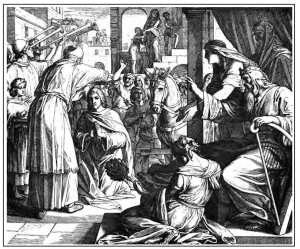 Solomon is Anointed King by Julius Schnorr von Carolsfeld
“Now as for you, my son Solomon, get to know the God of your father.
Serve him with a sound heart and a devoted soul,
because the Lord is searching every heart, every plan and thought.
He will be found by you, assuming you are seeking him,
but if you abandon him, he will abandon you forever.
David continued with these words for his son Solomon:
“Be strong and courageous, and get to work.
Never be afraid or discouraged, for the Lord God, my God, is with you.
He will not fail you nor will he abandon you right up to your completion
of the work for the service of the Temple of the Lord.
1 Chronicles 28:9, 20 ISV