
Over 3,500 years ago, Rome, founded by descendants of Japheth, was no more than a soggy marsh, and the Acropolis of Greece, also founded by Japhethites, was just an empty rock. But Egypt, founded by Mizraim, the second son of so-called cursed Ham, was on the brink of becoming one of the greatest empires in history. Another proof the “curse of Ham” is untrue!
Mizraim, Ham’s second son, according to God’s genetic code was light skinned unlike Ham’s grandson Nimrod, who many feel was Black. The Ancient Egyptian Empire began in approximately 3,000 BC and lasted until 300 BC. Then it gradually became dominated by Arabs. When Egypt became a unified country under the Pharaoh Menes, it was just a small civilization in the Nile River Valley. Eventually, though, as the kingdom grew and new pharaohs came into power, Egypt conquered many other nations. Much wealth was gained from temporarily conquering Nubia. Egypt then stretched the entire length of the Nile River and continued to expand by conquering what is modern day Lebanon, Syria, Jordan, Iraq and Iran. At one point Egypt’s boundaries even extended into Asia. However, Egypt did not hold control of these faraway lands for long. It was just too much for the pharaoh to control.
Behind the power of the Egyptian empire lay a vast wealth of natural resources. Chief among these was the River Nile, the freeway of the ancient world. Egypt became a very strong Empire with a vast army. The Egyptians were the first ones to tame wild horses, breeding and bringing forth the finest horses and chariots on earth. We read in 2 Chronicles 1:16-17 how Solomon and the kings of the Hittites and Syria eagerly purchased horses and chariots from the Egyptians.
Egypt attained a high culture that marked it superior to all its neighboring nations. One historian’s descriptive portrayal was:
“Five thousand years ago, nearly two millennia before the Romans [Japhethites] built their first mud huts, ancient Egyptians [Hamites] began creating edifices so vast and architecturally sophisticated they remain to this day among the most impressive structures ever built. For thousands of years, without the benefit of computers, cranes, trucks or power tools, the Hamite Pharaohs’ engineers oversaw the construction of monumental masterpieces whose scale, beauty and craftsmanship still boggle the mind. Egypt’s massive pyramids, lavish burial temples, impenetrable fortresses and towering obelisks were the result of unparalleled architectural genius, unrivaled technology and millions of man-hours of backbreaking labor. As Egypt’s succession of Pharaohs alternately conquered and ceded vast expanses of what is today the Middle East, their dedicated royal architects stretched the boundaries of imagination and human potential, essentially inventing the science of structural engineering as they went along.”
Yes, the world’s oldest stone super structures are found in ancient Egypt. The Great Pyramid, which constitutes one of the Seven Wonders of the World, was built with perfect symmetry. The Great Sphinx was the marvel of the world. The Temple of Amun stands 338 feet wide and 1,200 feet long, the largest ever of its kind built by human hands. The Egyptians not only mastered architecture, but it is claimed they gave the world what has become modern calculus.
The descendants of Mizraim, Ham’s son, founded Egypt the first superpower in history, proving again the “curse of Ham” is false. It is universally recognized that the descendants of so-called cursed Ham pioneered in developing civilizations while the descendants of Shem and Japheth followed their example.
Modern Women
Egyptian religion gave women a central role and they were seen as central to their husband’s success. Although there were few women in power like Nefertiti and Tiy, all women were treated with respect and enjoyed legal rights that other women would still be waiting for thousands of years later.
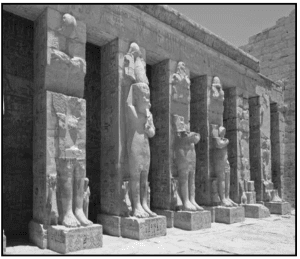
Temple of Amun
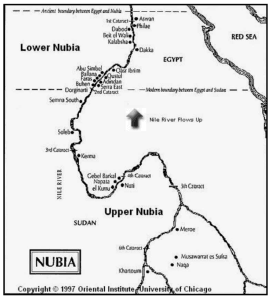
Map of the Nubian Empire