
The Faith Of One Persecuted – R.5662
1 Samuel 19
“Whoso putteth his trust in the Lord shall be safe.” – Proverbs 29:25
Wars with the Philistines continuing, David was made a regular soldier, with a command over a regiment and closely in touch with King Saul himself. Victory after victory came wherever David was engaged, and King Saul saw the admiration of the people turned from himself to David. The sentiment reached a climax when, returning from one of the victories, the women and girls of a village came forth singing:
“Saul hath slain his thousands,
But David his tens of thousands!”
The flame of jealousy took full possession of the king, and thenceforth his one purpose seems to have been to destroy David. It was a secret withheld from him that David was already anointed by Samuel to be his successor. He merely knew that Samuel the Prophet had told him that, as a consequence of his failure to carry out the Divine instructions regarding the Amalekites, the kingdom would be taken from him and his family and given to another. He possibly hoped that this might never come true – that his son Jonathan might be his successor.
Jealousy is the bitter fruit of selfishness gone to seed. It unbalances reason, extinguishes happiness. It subjects its possessor to horrible melancholy, so that when it is in control he is really crazy. Not only is this illustrated in King Saul’s case, but it is more or less illustrated in the experiences of every human being. Who does not by experience know what jealousy is? and the more he knows of it the worse. It has made murderers of children, as well as of grown-ups. It has wrecked homes, as well as business enterprises. It is the most terrible, and at the same time the most foolish, manifestation of selfishness. Every one recognizing it in himself should be alarmed – should throttle it promptly, seeking victory through vigilance, and if a Christian, through prayer.
Saul’s Jealousy Was Crafty
When under control of these fits of jealousy, King Saul is described as having had an evil spirit from the Lord, but more properly, we shall say, an evil spirit opposite from the Lord’s – the reverse of the Lord’s Spirit of kindness, justice, love. When the king was laboring under these fits of melancholy which followed the cessation of the Philistine wars, young David could sometimes soothe him by skilful playing on a harp; yet he knew the king’s treacherous mood and, keen eyed, on two occasions caught the king with his eye in time to hinder Saul from throwing at him a javelin-scepter which he usually carried.
Intent upon drawing David into a quarrel which might be construed as traitorous and justifying his death, the king promised him his elder daughter to wife, and then gave her to another. David, however, was discreet, and merely commented that he was not of a sufficiently noble family to expect such honors; neither was he able financially to give a sufficient dowry for a king’s daughter. Another trap was to betroth to him the king’s younger daughter, Michal. Young David again told of his unworthiness of the daughter and his lack of wealth for dowry, whereupon Saul stipulated that the dowry should be the evidence of the killing of a hundred Philistines. No doubt he hoped confidently that in the attempt to meet this requirement David would lose his own life; but instead, young David killed twice the number and received Michal, Saul’s daughter.
The king, getting more insanely jealous, told his son Jonathan and his courtiers in general that David must be destroyed. The sentiment of Jonathan was as loving and brotherly as his father’s was cruel, jealous, selfish. It was Jonathan who would lose by David’s attainment of the honor of the kingdom. Hence the love of Jonathan has become a proverb. Additionally, he had the true spirit of manhood and brotherhood, the spirit of a peacemaker. He interceded with his father for David. His language is a beautiful model of filial respect as well as of devotion to his friend David. He said, “Let not the king sin against his servant, against David; because he hath not sinned against thee, and because his works have been to theeward very good: For he did put his life in his hand, and slew the Philistine, and the Lord wrought a great salvation for all Israel; thou sawest it, and didst rejoice; wherefore then wilt thou sin against innocent blood to slay David without a cause?” – Verses 4,5.
The plea of the peacemaker was successful. The king relented. David was brought back and became again a member of the household. But it was only for a time. The king was not without some noble sentiments, but they were not deep enough. They did not control his life. On the contrary he was under the control of the evil mind, the selfish mind, the jealous mind, which is far from, and opposite to, the mind, the Spirit, of God.
Ere long, in a jealous fit again, the king not only made the motion to throw the javelin, but threw it with deadly aim and smote into the wall just behind where David sat; for David was quick and dodged it. David went to his room; but a guard had been stationed there, instructed that upon his coming forth he was to be killed. His wife informed him and assisted him to safety by letting him down out of a window. Possibly the house was built upon the wall, as in the case of St. Paul’s similar deliverance.
Two Hundred Murders For A Wife
Scoffers seize upon one feature of this lesson to condemn the Bible as encouraging murder and with being, therefore, in conflict with righteousness and in conflict with a God of righteousness. They say, “Here we find David, a Prophet, described as being very discreet and as having the Spirit of the Lord, the spirit of a sound mind; and yet we see him taking the lives of two hundred human beings as the price of a wife, and not a word in the Scriptures in condemnation.”
Such charges and arguments should be met in a reasonable way – they should not be passed over with the remark, “No use reasoning with you; you are an infidel.” He that doeth righteousness is righteous; he that doeth unrighteousness is unrighteous. This Bible proposition applies to God and to David, as well as to others. But, when inquiring respecting it, we should approach our subject with unprejudiced minds. Instead of condemning from the standpoint of prejudice, we should rather inquire how this course can be made to square with the principles of justice, which the Bible everywhere maintains.
In the first place, we must have in mind the difference between being a Jew under the Law Covenant and being a Christian under the headship of Christ. Second, we should remember that the Bible does not teach that those who die still live and pass immediately into everlasting torture. It teaches that the dead are really dead, and that the hope which God holds out for them is a resurrection from the death state in the future under more favorable conditions, under the blessed influences of Messiah’s Kingdom. The Bible informs us that the penalty of sin is death – not torment after death. It informs us that this penalty was justly inflicted upon Father Adam because of his intelligent and wilful sin. It tells us that the human family are dying because, by laws of heredity, the seeds of sickness, imperfection, death, are in us, from the hour of our birth.
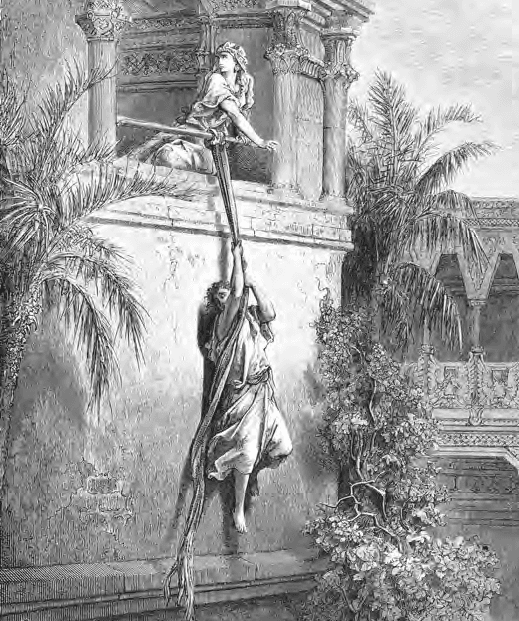 David Escapes through a Window by Gustave Doré