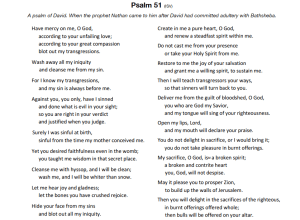
King David’s Repentance – R. 3253
Psalm 51:1-17
“Create in me a clean heart, O God.”
Prosperity did not work to King David’s personal advantage. After years of phenomenal success under the Lord’s blessing, when his kingdom was mighty and his name honorable, and the necessity for his personal participation in wars was passed, and his heart had begun to gravitate towards earthly pleasures and was less zealous for the Lord and the Law than at first, the king fell into very grievous sins, which appear all the more black in contrast with the high moral character shown by him in his earlier life, when he was the man after God’s own heart. The story of his sins, how he became enamored of Bathsheba and committed adultery with her, and subsequently, to shield himself, caused her husband Uriah to be placed in the forefront of the battle that he might be killed by the enemy, involving the loss of several other lives as well, is told in the Scriptures in a most straightforward manner, without the slightest effort to condone the king’s wrongdoing. No excuses are offered in connection with the account; the full weight of these awful crimes is laid directly on the king’s head. Whatever excuses may be offered on his behalf must come from the reader of the account. We may suggest some thoughts along this line: In that day the kings of the world exercised a despotic authority, and it was a theory among the people that the king could do no wrong – that whatever he pleased to do was proper to him because of his high position as the head and ruler of the nation. We could in no sense of the word agree with such a thought. Nevertheless we can reasonably suppose that a sentiment so general would have more or less influence upon the mind of the king. He who respected Saul’s life, because he was the Lord’s anointed, may have to some extent fallen into the misconception that his own anointing by the Lord relieved him in some degree from the responsibilities resting upon others of his nation. For about two years after these crimes were committed the king sought to stifle his conscience, and to consider that he was only using kingly liberties in what he had done. Nevertheless his conscience smote him, and he felt an alienation from God and a condemnation under his law such as he would not have felt had he been of a different stamp of character. God was not hasty in reproving him, either. He allowed him to have a full taste of heart bitterness – allowed him to feel the darkness of soul, absence of joy, resulting from the cloud which had come between him and the Lord. It was at the appropriate time, after David had passed through secret mournings and travailings of the soul, that the Lord sent him a reproof through Nathan the prophet to bring the whole matter clearly before his mind. Nathan, under the figure of a parable, excited the king’s sympathies and declaration of a very severe judgment – a death sentence – against the person offending, and then the Prophet brought home to him the lesson saying, “Thou art the man!”
King David, we are to remember, did not belong to the spiritual house of sons, and hence had a far less clear view of such matters than that which would properly belong to every member of the house of sons, begotten of the Spirit and “taught of God.” We are not, therefore, to expect to draw a lesson to ourselves along similar lines. Rather we of the spiritual house, under the clearer conceptions of the divine will, are to remember the higher interpretation of adultery and murder set forth in the New Testament: that whoever desires adultery, and is merely restrained from it by outward circumstances or fears, is really an adulterer in his heart (Matt. 5:28); that he that is angry with his brother, he who hates his brother, is a murderer – because the spirit of anger is that which, unrestrained, would lead to murder (Matt. 5:22); and that the person who covets the things of another and is merely restrained from taking them for lack of opportunity or fear of consequence, is at heart a thief. If these principles be applied by the New Creation in the examination of their hearts, it is entirely probable that some of the “house of sons” today may find themselves very near the plane of King David as respects sin, and so viewing matters they will exercise proportionately greater compassion in their judgment of the royal transgressor. Such, too, will find great consolation in the Lord’s compassion, provided they are exercised in respect to their offences as David was concerning his. “There is compassion with thee that thou mightest be feared,” is the prophet’s expression. If God were wanting in compassion, as are many of our fellow creatures, there would be nothing to hope for under such circumstances. It is when we realize that there is forgiveness with the Lord for all who are penitent at heart, and who, therefore, give evidence that their sins are not wilful, but rather of the weakness of heredity and under the pressure of blinding temptations, that we are moved to repentance by a hope for better things.
The 51st Psalm is generally recognized as being the one in which the Psalmist expresses to God his contrition for his sins, and the fact that it is dedicated to the Chief Musician implies that it was the king’s intention that it, in common with other of the Psalms, should be chanted in the Tabernacle services, for which he had set apart a large number of singers. We thus perceive that if the sin was flagrant and gross, the atonement which the king endeavored to make was a most public one. Probably many of the nation had felt more or less of the king’s condemnation, and its influence must have been very injurious; and now in his public view of it as sin, and his prayer for divine forgiveness, the king would undo so far as possible not only the injury which he had inflicted upon his own conscience, and which as a cloud hung between the Lord and him, but he would undo also the evil influences as respects the conscience of the nation – on the subjects of adultery and murder.
Here again we see why David was described as a man after God’s own heart. His sins were not pleasing to God – quite the reverse; but the after appreciation of the enormity of the sins and the hearty repentance therefor to the Lord, and the desire to be cleansed from every evil way, were pleasing to the Lord. Here we have an illustration of how all things may work together for good to those who love God. By reason of his heart-loyalty to the Lord, and the principles of righteousness, even these terrible sins resulted in bringing a great blessing to David’s own heart – humbling him – giving him an appreciation of his weakness and littleness, and of his need to abide close to the Lord, if he would have the Lord’s fellowship and compassion and be safe from the temptations of his own fallen flesh. So, too, with the New Creation. How many of them have realized profitable lessons and blessings out of some of their stumblings – not that the stumblings were good nor of the Lord, but that the Lord was able to overrule such circumstances for good to those who are of the proper mind – rightly exercised by them to repentance and reformation.
The first three verses of the Psalm express David’s appreciation of his sin and his trust in the Lord, without any attempt to apologize for his shortcomings. He trusted to the Lord to make whatever allowances could be made and merely appealed to his great “loving-kindness.” In calling to mind the multitude of God’s tender mercies in the past, he expressed faith and trust that in some way the Lord could blot out these grievous transgressions and forgive them. The Lord had not yet clearly defined the way in which he could be just and yet be the justifier of sinners. Only vaguely through the shadows of the Day of Atonement sacrifices had he intimated that he had some way of his own by which in due time the guilty but repentant ones might be cleansed. David grasped the thought of mercy as understood in the types and shadows of the Law, and much more may we of the house of sons grasp the thought of our Father’s forgiveness when we see that it is exercised towards us by the Lord Jesus Christ, who already has given himself a ransom for all, to be testified in due time, and whose sacrifice has been accepted of the Father, – as manifested by our Lord’s resurrection from the dead, and by the descent of the Holy Spirit at Pentecost. If, therefore, David could trust the Lord for loving-kindness and tender mercies and forgiveness of sins, the members of the house of sons should be able to exercise full faith in the divine character and plan of salvation from sin.
The fourth verse would seem to ignore the fact that wrongdoing had been done to fellow creatures, but we may preferably understand it to mean that while this wrong to fellow creatures was recognized by the king, he recognized a still higher responsibility to God, whose laws he had broken and whose kingly office, typifying that of the Christ, he had dishonored. Hence, in contrast between what man might think of his crime as against man and his own still higher consciousness of his sin as against the Lord, the latter seemed so much greater as to practically obscure the former. The greater sin as against the Almighty quite overshadows the wrongs to humanity. David declares his recognition of the fact that God is the great Judge, and that whatever his judgment would be he knew in advance that it would be right.
In the fifth verse he introduces an extenuating thought, as though reminding the Lord that he was born in sin and therefore that perfection was not possible for him. But he does not use this fact as a screen behind which to hide his own responsibilities. Free to will, though a sinner by nature, he was necessarily responsible for yielding as he did to temptation, but he was confident that the Lord would give him the benefit of every mitigating circumstance.
It will be noted that David expected punishment from the Lord for his sins, and was here expressing his confidence that the Lord would send no punishment which would not be reasonable and within the limits of justice. What he was praying for in this Psalm was not a remission of proper punishment, but rather for the cleansing of his heart in the sight of the Lord and for his restoration to the divine favor. As a matter of fact we find that the Lord did send a severe punishment upon the king, and that he restored the sinner to his favor, granting him to experience again the joys of his salvation. According to the sentiments of other kings of his time, evidently acquiesced in by the people of Israel, the king had taken an extremely moderate course in sin, in that he had not directly taken the life of Uriah but merely connived at his death in battle; but the king appreciated the fact that God was looking deeper than this and desired truth – righteousness in the inward parts – in the heart. Outward crime and a crime allowed in the mind are alike heinous in God’s sight: his experience had taught the king wisdom. Now he wished to be thoroughly cleansed, and poetically says, “Purge me with hyssop and I shall be clean. Wash me and I shall be whiter than snow.” Hyssop was used in the sprinkling of the unclean under the Law. David, grasping to some extent the significance of the symbol, desired the antitypical cleansing of his heart. His appreciation of the Lord’s thoroughness in dealing with sin and of his compassion in forgiveness are good lessons for some of the still more favored members of the “house of sons.” Many of the latter, although having seen with “the eye of faith” the great Atonement for sins made by our Lord Jesus, are still unable to appreciate the fact that the application of the merit of his sacrifice is quite sufficient to cleanse us from all sin and perfect us, that we may be recognized as absolutely pure in the Father’s sight and dealt with accordingly – not as sinners, but as sons.
From the statement of verse 8 we may reasonably infer that during the year that preceded this repentance King David was in so miserable a state of mind that even the music of the singers and of those who played skilfully upon the harp and all the joyous songs of Nature were sore to his heart – had no gladness in them to comfort his heart when it was barred from the Lord’s presence and fellowship. This is the thought of our hymn, which says of the soul which enjoys the light of the Lord’s favor: –
“Sweet prospects, sweet birds and sweet flowers
Have all gained new sweetness to me;…
His presence disperses all gloom,
And makes all within me rejoice;…
While I am so happy in him,
December’s as pleasant as May.”
King David was longing for the joy and gladness which he had experienced in times past, and figuratively he likens himself to one whose bones had been broken. He knew that his joy and comfort would return if he could but have back again the Lord’s favor. He knew, too, that the Lord could not look upon sin with any allowance, hence his prayer: “Hide thy face from my sins and blot out mine iniquities [unrighteousness]. Create in me a clean heart, O God, and renew a right spirit within me. Cast me not away from thy presence and take not thy Holy Spirit from me. Restore unto me the joy of thy salvation: and uphold me with thy free Spirit.”
No true Christian can read these words without feeling a deep sympathy with the different expressions; and even though as New Creatures in Christ Jesus we have had no experience with such terrible sins as those which weighed upon the heart of David, nevertheless our higher responsibilities and higher conceptions of sin under the “new commandment” and under the instructions of the Holy Spirit, as sons of God, cause us to feel with proportionate weight transgressions which in the sight of the world would appear nothing – such, for instance, as we have just mentioned: covetousness, hatred, slander, which are thefts and murders from the higher standpoint of the divine view appropriate to the New Creation.
In verse 13 the prophet proposes to the Lord that his discomfiture in divine disfavor was used for the instruction of others, – to show transgressors the Lord’s ways and to turn sinners from the evil of their course. How appropriate this thought to us! Not until we know experimentally through faith in the blood of Christ that our sins have been put out of the Father’s sight, not until we have experienced the joys of his salvation and forgiveness, are we in any condition to be servants to the truth or illustrations to others. Hence we see that it is only those who have been begotten of the Holy Spirit who are anointed to preach the gospel. To others the Lord says, “What hast thou to do to take my word into thy mouth, seeing thou hatest instruction and castest my words behind thee?” – refusing to submit to the divine requirements.
The 14th verse repeats the same thought in a different form. If the Lord will deliver him from his guilt in connection with his sin, his tongue shall thereafter sing loudly the Lord’s righteousness – not David’s righteousness. This is the song that all the blood-washed may sing, “True and righteous are all thy ways, Lord God Almighty. Thou hast redeemed us from amongst men.” None of us have any right to sing our own righteousness, for as the Apostle declares, “There is none righteous, no, not one.” The mission of the cleansed ones is to accept and use the Lord’s mercy towards them, to extol his righteousness, to acknowledge their unworthiness and to call upon others to recognize this fountain of righteousness and forgiveness.
“O Lord, open thou my lips: and my mouth shall show forth thy praise.” This expression implies that none need expect to have a proper opening of their mouths to show forth the Lord’s praises, and give the call from darkness into his marvelous light, unless the Lord shall first have opened their lips with his mercy and truth; for otherwise how could any expect to tell the glad tidings of great joy which shall be unto all people? This equally implies that all who have had forgiveness of sins should be in a condition of spirit to make a full consecration of their all to the Lord, and then all such should expect an unsealing of their lips, that the message of God’s truth and grace may flow out from them for the instruction and blessing of others – as it is written, “Grace is poured upon thy lips.” “Thou hast put a new song in my mouth, even the loving-kindness of our God.” While these are appropriate specially to our dear Redeemer, they are appropriate also to every member of “the Church which is his body,” and all claiming to be of “the body,” who have never had their lips unsealed to confess the Lord to the extent of their opportunity, have reason to question everything pertaining to their relationship to the Lord.
In verses 16 and 17 the king shows that he had acquired a deep insight into the meaning of some of the typical sacrifices; – though probably, by inspiration, he wrote more wisely than he understood. As we have seen in our study of Tabernacle Shadows of Better Sacrifices, only the Day of Atonement sacrifices were sin offerings, the burnt offerings and peace offerings of the remainder of the year representing the consecration to the Lord and his service. Grasping this thought prophetically, to whatever extent he also grasped it intellectually, King David expressed his realization that the Lord is pleased rather with a broken and contrite condition of heart than with burnt offerings, which were but types. So, too, we learn that nothing that we can give the Lord, even after our acceptance in Christ, has any value in his sight until first of all we have given him ourselves, – our hearts, our wills.
Let us ever keep in memory that a broken and contrite heart the Lord never despises, will never spurn. Therefore into whatever difficulty any of the Lord’s people of the New Creation may stumble, if they find themselves hungering for the Lord’s fellowship and forgiveness, if they find their hearts contrite and broken, let them not despair, but remember that God has made a provision through the merit of Christ which enables him to accept and justify freely from all sin all that come unto him through Jesus – through faith in his blood. There is a sin unto death – a sin unto the Second Death – from which there will be no recovery, no resurrection; but those who have broken and contrite hearts on account of their sins may know that they have not committed “the sin unto death,” for their condition of heart proves this, as the Apostle declares: “It is impossible to renew again unto repentance” any who have committed the sin unto death – wilful sinners against full light and knowledge. Let all, therefore, rejoice in the grace of our God, who is able through Christ, his accepted way, to save unto the uttermost all who come to him, laying aside sin and its desires.
“Now, if any man [of the Church stumble into] sin [through weakness and temptation – not intentionally] we have an advocate with the Father, Jesus Christ the righteous.” (1 John 2:1)
Such, therefore, may come with faith to the throne of the heavenly grace that they may obtain mercy and find grace to help in every (future) time of need. (Heb. 4:16) But, like David, their prayers and hopes should be for a restoration of divine favor and not for escape from chastisements needful to their correction. God forgave David, but also chastened him. – 2 Sam. 12:11-14.
Surely King David must have learned a great lesson in mercy from this sad experience. How many times must he have called to mind his response to Nathan’s parable, “The man that hath done this thing is worthy of death: and he shall restore the lamb fourfold, because he did this thing and because he had no pity!” Alas, poor David! These words showed that he had a mind, a heart, that was no stranger to justice and pity in other men’s affairs, and hence that he was the more guilty in his much more serious violations of justice and compassion. “Blessed is he that is not condemned in that which he alloweth,” – who is not condemned by his own declarations in respect to the affairs of others. Oh, how merciful to the failings of others it should make us when we remember our dear Redeemer’s words, “If ye forgive not men their trespasses, neither will your heavenly Father forgive your trespasses”; and when again we remember that we may not even pray for forgiveness of our sins unless we from the heart forgive those who have injured us and again desire our fellowship.
The joys of God’s forgiving love – R. 3260
Psalm 32
“Blessed is he whose transgression is forgiven, whose sin is covered.”
This Psalm will be quickly recognized as King David’s exultant acknowledgment of God’s forgiveness of his sins against Uriah. The first verse is the keynote of the entire Psalm. Verses 3-5 record the King’s mental distress during the period in which his sins had come as a cloud between him and the sunshine of divine favor which he previously had enjoyed. His distress of mind naturally affected his physical health to such an extent that all of life’s duties became burdensome and practically all of its pleasures died. In this fact we perceive that the King was far from the condition of a hardened criminal. His heart had been set for right and for the Lord, and was still set in that direction, even though under temptation he had grossly violated the simplest laws of justice and friendship. The fact that he had gnawings of conscience, that his soul was not at ease under the burden of divine disapproval, were the hopeful signs in the case.
Since David was not a wilful sinner – since he did not at heart approve and rejoice in sin, but despised it, mourned for it – the Lord very graciously guided his affairs so that the lesson became more and more severe to him, until finally he could not bear it longer. Then, when the boil of contrition was fully ripe, the Lord sent his message through Nathan the Prophet to lance it, and his sharp reproof and severe sentence marked the culmination of the King’s terrible mental distress and brought him to the point of confession to God and before the nation – to the point of prayer for divine forgiveness and restoration of divine favor, without which he realized that his agony of mind would continue.
The King’s prayers were heard – God was gracious to him, his transgression was forgiven, his sin was covered, his iniquity was no longer imputed to him, because his heart was repentant – in it there was no guile. His repentance was sincere, full, thorough. The Psalmist exultingly sings of his own restoration to divine favor, and, doubtless under divine guidance, represented his as being a sample or illustration of what God is willing to do for all who similarly have sincere sorrow for sin, true repentance, who confess their faults and make fresh acknowledgment of their faith. It is safe to say that in thousands of God’s people, not only in David’s own nation but in every nation, kindred, people and tongue familiar with God’s Word, the King’s experiences and the lessons of this Psalm, showing his reconciliation with God and the exercise of divine favor toward him, have inspired faith and brought peace and rest to those cast down through weaknesses of the flesh – some of them as grievous or more so, if possible, than David’s, and some of them for sins less great in the sight of men but realized as being great in the sight of God – sufficient to separate the sinner and his Lord.
As a picture or illustration this does not specially relate to the sinner coming from the alien world and seeking entrance into God’s family: it rather represents one who had already enjoyed divine favor and lost it – one who had gotten from the light into darkness. The Scriptures clearly point out to us that even after we have become children of God it is possible to “fall away.” They show us two classes of those who fall. One class is described in Heb. 6:4-7; 10:26-31: these we may have no hope for, because at heart they have become sympathetic with sin; they are wilful sinners, as the Apostle here describes. It would not be appropriate that God should exercise his mercy toward those who, after having come to a clear knowledge of the Truth, wilfully, preferably, approvingly delight in sin. The only thing remaining for these, as the Apostle declares, is judgment which will devour them as adversaries of God and adversaries of righteousness. Of this class the Apostle declares, “There is a sin unto death: I do not say that he shall pray for it.” – 1 John 5:16.
It is of the second class that the Apostle says there is a sin not unto death – one which may be repented of, which may be forgiven, and out of which the transgressor may come with valuable lessons which may ultimately result in blessings of knowledge and experience which will be helpful to him in future conflicts and triumphs. David’s sin was of this latter class – not wilful, not approved by him, but of the class of sins referred to by the Apostle when he says, “If any man sin, we have an advocate with the Father, Jesus Christ the righteous.” (1 John 2:1) Of the same class of sins the Apostle says, “He is just to forgive us our sins and to cleanse us from all unrighteousness,” and again, “Though he fall yet shall he not be utterly cast down.” The fact is that transgression that is wilful and approved by the heart means an utter fall from divine favor in every sense of the word, while stumbling into sin contrary to the will, through weakness of the flesh and temptation, is to be considered a stumbling from which there is every hope of recovery.
Some one will perhaps argue that practically every transgression is a wilful one, because the Lord’s people, however weak in body, have still the power to will aright if they would. Such are inclined at times to accuse themselves of wilful sin, and to fear that they are under the ban of the second death. We point, however, to David’s case as an illustration of what is not esteemed of the Lord to be a wilful sin. King David deliberately planned for days and weeks and months in connection with his transgression. It cannot be denied that there was a measure of wilfulness in it, but there was a measure of something else also: namely, of weakness of the flesh, inherited as a member of the race from father Adam. Only divine judgment could clearly, distinctly discern how much of David’s sin should properly be accredited to wilfulness and how much to weakness. That it was not wholly weakness or ignorance is evident, and that it was not wholly wilfulness is equally evident. It was therefore what we might term a mixed sin. The proof that it was not wholly wilful is found in the fact that David’s conscience afterward, before being reproved by the Lord through the Prophet, recognized his sin and realized the barrier which it had raised between the Lord and his soul. Had the sin been wilful, instead of feeling sorrow and contrition the King would have felt disposed to go on in the course of sin still farther, and would have had no longings for divine forgiveness and reconciliation. His desires for these prove to us that, although he had deviated so grievously from the proper paths, his heart, his will, was still on the side of the Lord and of righteousness. Let this serve as a lesson and illustration for all who have fallen into sin and who long for divine forgiveness and reconciliation. Let such accept the mercy of the Lord by faith and rejoice therein as did King David. Let them remember that those who have sinned the sin unto death it is impossible to renew again unto repentance – impossible to bring them back to a condition where they would be truly contrite and repentant for their evil course.
True repentance implies a rectification of the wrong to the extent of one’s ability. David’s sin being a public one, known to the nation, it was appropriate that the repentance should be as public as was the sin, and we have reason to believe that David would not have received restoration to divine favor had he not been thoroughgoing in his confession and his endeavors to make good the wrong he had done. His course had led some to blaspheme God’s name (2 Sam. 12:14), and it was appropriate that his repentance should, so far as possible, offset this. And so the story of David’s repentance has come down the ages with the story of his crime; and while the one has given occasion to blasphemers, the other has given hope and encouragement to many overtaken in faults, who, like David, at heart were loyal to the Lord.
We are to distinguish sharply between forgiveness of sin and remission of penalties. In this case we see that David’s sin was forgiven, yet the punishment which the Prophet had foretold came upon him in due time. Thus we see that forgiveness here stands not for judicial forgiveness, which would have exonerated the forgiven one from all punishment, but it stands merely for the removal of divine disfavor which had come upon the King as one of the results of his transgression. We are to notice also that the King had not in his mind the thought of escaping the punishment which God had foretold and described; his joy was in respect to the restoration of communion between himself and the Lord – the removal of the sin-born cloud which had hidden from him for a time the light of the divine countenance, the smile of heaven, the fellowship of God. And so it will be today with all who, falling into sin wilfully, repent thereof and seek a renewal of the fellowship of the Father and of the Son from the right standpoint. Their moving desire will not be simply escape from punishment, but specially a renewal of communion of soul broken by transgression. It is in full accord with this that the New Creation at the present time rejoices in forgiveness of sins and reconciliation with the Father through the Son, yet live under practically the same conditions as the world, subject to the aches, pains, trials, difficulties and disappointments which belong in general to the fallen race because of original sin. The blessings of our new relationship to God consist not in our release from the burdens and difficulties of the groaning creation, but in the realization that we are no longer under divine condemnation, no longer children of wrath even as others, but brought nigh unto God in fellowship and communion through the blood of Christ. Our hope of deliverance from the burdens which afflict the whole groaning creation are centered in the promised Kingdom blessings at the second advent of our Lord. Inspired by these hopes and promises we sorrow not as do others, but are enabled to rejoice in tribulation and to wait patiently for the Lord’s time and for the Lord’s way – the First Resurrection.
This thought, namely, that in the present time our sins are merely covered from divine notice through the merit of our Lord, – that they are merely forgiven or given over or set aside, are hidden and not actually blotted out – is very clearly stated by the Apostle Peter (Acts 3:19-21) when, preaching under the influence of the holy Spirit, he declared that his hearers should repent and be converted to the Lord, so that their sins might be blotted out when the times of refreshing should come – the times of restitution – the Millennial age and Kingdom.
In that glorious Millennial day the Church, now reconciled, will first pass inspection, and those counted worthy will share in the first resurrection, and the bodies they will then receive will be perfect, without blemish and without flaw – very different from the mortal bodies of the present time, all of which are more or less marred by sin, mentally and physically. The receiving of the new bodies perfected will mean that all the blemishes, all the marks of sin for this class, were blotted out in the tomb, in the flesh, their spiritual bodies being perfect, even as it is written of this first resurrection class: “It is sown in corruption, it is raised in incorruption; it is sown in weakness, it is raised in power; it is sown in dishonor, it is raised in glory; it is sown an animal body, it is raised a spiritual body.”
The world not having received reconciliation, not having received forgiveness of sins, will not receive the blotting out of sins in the Millennial morning. The great blessing that will come to the world of mankind as distinguished from the Church, the body of Christ, the little flock, the elect of the present time, will be the blessing of forgiveness – full, free. The great atonement day (the Gospel age) will then have closed, its better sacrifices will all then be in the past, its blood of atonement will then have been presented before the Father and will have been accepted on behalf of the whole world. As a result of this acceptance, the divine forgiveness will reach the whole world through Christ – a remission of the sentence pronounced upon the world in the person of Adam. This is specifically stated by the Apostle, saying, “As by the offence of one judgment [sentence] came upon all men to condemnation; even so by the righteousness of one the free gift [will come] upon all men unto justification of life.” (Rom. 5:18) But as forgiveness to David did not mean a repudiation of such penalties as were due him because of the measure of wilfulness contained in his sins, and as forgiveness in this Gospel age to the Church does not mean an immediate release from the penalties that are upon the race, so likewise the forgiveness of the world’s sins at the dawn of the Millennium and the beginning of Messiah’s reign will not mean the removal of all the marks of sin, the disabilities, death conditions, which come upon all men partly through their own wrongdoing. As with the Church now, forgiveness of sins means a covering of those sins, that we may be treated as though we were not sinners: so with the world in the next age – the forgiveness of the world’s sins will mean that thenceforth Christ stands for the whole world before God as the covering of their sins, and that on account of the sacrifice paid by Christ on behalf of the world the sentence of everlasting death upon them is annulled. The work of Christ and of the Millennial Kingdom will be to lift up all who will of the world of mankind to the full perfection of their human nature, so that at the close of that age they may be perfect and entire as human beings. The work of the Millennial age will therefore be a work of blotting out sins – blotting out the evidences and traces of sin in body and mind. The weaknesses and impairments which sin has brought upon humanity will be thus overcome, and it is for this reason that that age is called the times of restitution, the times in which gradually the original likeness of God will be brought back to all those who will accept the divine favor through the great redemption.
In verse six King David suggests that his own experience should be helpful to others who at heart were godly – desiring God’s way of righteousness, but who had stumbled in the way. He advises that they pray to the Lord promptly – that they should seek him while he may be found. David’s own experiences seemed to teach him that every day removed him farther and farther from fellowship with the Lord. His exhortation is that in order that the floods of great waters of trouble should not reach such an one, he would be spared much by going promptly to the throne of heavenly grace to make confession and to obtain mercy and grace to help in future times of need.
In verse seven the King reverts to his own experiences and how he had found peace in the Lord – a hiding-place in which he could have rest; and although he knew to look forward to the prescribed punishments, his heart now being in fellowship with the Lord he could realize that the Lord’s presence would be with him in those punishments and preserve him in that trouble, and that he would be, so to speak, enabled to hear the heavenly messengers singing songs of his deliverance even whilst in his affliction.
The concluding verses of the Psalm represent the Lord as the speaker, instructing David and all of his people who, like David, desire the Lord’s guidance and feel wretched and troubled when any earth-born cloud intervenes between the Lord and their souls. The Lord engages to be the teacher, the instructor of all such; he will overrule their affairs, he will make all things to work together for good. Even their stumblings shall not prove disastrous; but because they maintain the spirit of devotion to the Lord and to the principles of righteousness, he will make even their missteps to become valuable lessons, that they may be henceforth less liable to stumble, and learn to look unto the Lord and to be guided in their goings by his eye.
Those whom the Lord instructs, and who will receive his instruction, will not be like the horse or mule that must be turned and guided by force. Their hearts will be so in sympathy with the Lord that he can deal with them otherwise, to their blessing and joy. The wicked shall have their sorrows, but the Lord’s people will not be counted in among these; for his mercy shall be with them, restoring their souls. Therefore this class, through the Lord’s mercy, will be counted righteous – not that they were righteous of themselves, but counted righteous through the divine provision in Christ. These may be glad in the Lord, though they could not be glad in themselves. These, because upright in heart even though prone to sin and full of weaknesses according to the flesh, may be brought off conquerors through him who loved us and bought us with his precious blood – may shout for joy as they realize the abundance of the divine provision “for the propitiation of our sins; and not for ours only, but also for the sins of the whole world.” – 1 John 2:2.
The Prayer of the Penitent – R. 1397
Psalm 51:1-13
“Create in me a new heart, O God, and renew a right spirit within me.”
This draws our attention to the darkest stain upon the history of the Prophet David – the matter of the murder of Uriah and the taking of his wife. Skeptics are wont to point to that great, double sin and to sneer: “And that was the ‘man after God’s own heart,’ according to the Bible’s grand standard of morality.” But the fact is that it was when David was a young shepherd just coming to manhood that he was after God’s own heart. And yet in connection with this very matter of this, David’s greatest sin, there is something which shows forth his better character which was “after God’s heart:” and this is brought before us by this lesson. The commendable features are: (1) He did not attempt to justify his course by saying that all the kings around about did such things and worse, and that it was generally conceded by their subjects that a king had a right to do as he pleased; (2) he not only did not deny the wrong, but he did not even try to see what he could say in self-defense; he did not plead his peculiar temptation nor that it was above that of others, from the power he exercised as king; but he confessed fully and heartily in such a manner as convinces all that his heart was really better than his evil conduct had seemed to indicate. We have no right to condone David’s crimes, but we have the privilege of noting those other qualities in him which to some extent were an offset to his weaknesses.
And it is well, too, that the Bible attests its own truthfulness in thus faithfully preserving the record of the sins of its great characters alongside the records of their faith and service. Of no other book which stands as the foundation of a religion is this true. Others tell only the good and leave the evil untold; but the Bible tells of the weaknesses of its greatest heroes except our Lord Jesus: of Paul’s persecutions; of Peter’s denial and blasphemy; of David’s sins; of Abraham’s errors, etc.
Yet this, which worldly wisdom would consider a serious drawback, God saw to be the proper thing; and many of God’s people have been greatly blessed by these very records of human weakness and sin. They but corroborate God’s testimony that all have sinned; that there is none righteous; that all need the grace of God to forgive the past and to lift them out of the miry pit of sin and its consequences. And many a sinner has thus been taught to have hope toward God for forgiveness and to realize that God who offers him his grace has had compassion upon others who were out of the way when they turned to him with true repentance.
Verses 1-3. “Have mercy upon me, O God, according to thy loving kindness: according unto the multitude of thy tender mercies blot out my transgressions. Wash me thoroughly from mine iniquity and cleanse me from my sin. For I acknowledge my transgressions, and my sin is continually before me.”
David thus plead for mercy; and although he realized finally that God’s favor was restored to him, he knew nothing of the real philosophy of the matter – how God could be just and yet be the justifier of those whose sins merited wrath. Ah, yes! The standpoint of the sons of God, during this Gospel age, is much more blessed. Our Father in heaven not only tells us of our forgiveness and reconciliation to his favor, but he gives us the particulars so that we may see how he has done it without sanctioning our sins or excusing them and without violating his own just law on the subject. He shows us that Christ our Lord was the Lamb of God whose death as our substitute and sin offering taketh away the sins of the world; that by his stripes pardon and healing may be granted to whosoever accepts the grace offered through him. Indeed, David’s sins were not blotted out nor forgiven; for although the Lord restored to him divine favor and communion, he punished him severely for his sin, as he had foretold by Nathan the Prophet (2 Sam. 12:11,12), Absolom’s rebellion being the means employed.
True, the penalty exacted was not the full penalty of sin, for that would have been lasting death. God showed mercy on David (as to all Jews under the Law Covenant established upon the basis of the typical sacrifices) in that he made allowance for his fallen condition and hence punished his sin, not with everlasting death, but with trouble, etc., in connection with Absolom’s rebellion, as above stated.
And as with David and others under the typical Law Covenant, so, too, it is with God’s children under the New Covenant in Christ. The death of Christ as our ransom-price cancels the original sin of Adam, and also such portion or degree of our sins and shortcomings as are involuntary and contrary to our real sentiments. But whatever proportion of a sin is wilful, designed and agreed to by us, has a penalty attached to be inflicted in either the present or the future life. And in the case of all who shall be members in the Anointed body, God declares that such sins shall be punished in the present life – saying through the Apostle “Some men’s sins go before to judgment [during the present life], others they follow after” into the next life, when some shall be beaten with many and some with a few stripes. And again it is specified that in the cases of all accounted worthy to be of the glorified Church, they are chastened now in order that they may not have part with the world in the condemnation (trial) of the world in the next age. – 1 Tim. 5:24; Luke 12:48; 1 Cor. 11:32.
Verses 4 and 5. David’s confession here is to God – the wronged Uriah was dead. Anyway, in that day it was esteemed a king’s privilege to have the bodies and lives of his people subject to his will; and doubtless other kings habitually did as bad. But David had been enlightened and knew better, and although his offenses would have been lightly passed over by others, David realized his guilt before God and besought his mercy. He confessed his sin that others might know, when the chastisements of the Lord should come, that God’s judgments and the king’s troubles were just punishments and not violations of God’s covenant promises.
Verses 5-12. After confessing in verse 5 his original sin – his impairment through the fall – he shows in verse 6 his clear appreciation of the divine plan. Although fallen and weak in the flesh, and therefore unable to do perfectly, God looks for and demands purity of heart (purity of motive or intention) and this David realized he had not manifested. Hence his prayer in succeeding verses is not that the Lord shall excuse him in sin, but that his heart may be cleansed and brought into harmony with God’s character and plan. Alas! How strange that some living under the still clearer light of the Gospel dispensation fail to see what David so clearly expresses, and instead some even charge God with inspiring and causing all sin and crime and wickedness. But David was right, and these would-be wise ones have become darkened and foolish in their vain imaginations.
Verse 13. What a grand principle is here set forth. It is eminently proper that those who would be used of the Lord as teachers to instruct transgressors, whether in this or the coming age, should be fully consecrated to God – clean – pure in heart. And the only way to get to this condition is to lay hold by faith upon the merits of the Lamb of God which taketh away the sin of the world, and to have our sins blotted out by him, and then, too, to be renewed in spirit, sanctified through the truth.