
And he said unto him, I am the LORD that brought thee out of Ur of the Chaldees, to give thee this land to inherit it. –– Genesis 15:7
It would be some four hundred years later and four generations after beginning their sojourn in Egypt (Genesis 15:13,16, covering the generations of Levi, Kohath, Amram, and Moses) before the promise of inheriting the land would be fulfilled.
God’s promises come with a cost. He would give them the land, but they would have to fight to conquer it. He would not fight for them; he would fight with them. This divine aid would, however, only be available if they obeyed him as their Commander-in-Chief (Exodus 23:20-23).
It took a little more than a year after Israel left Egypt before they reached the southern borders of the promised land at Kadesh Barnea (Numbers 13:26). From there the spies were sent forth and, when they returned, convinced their fellow countrymen that the inhabitants of the land were too strong to be dispossessed.
Chastised by the message of Moses, they changed their minds and decided to begin their conquest. However, because the spies had brought back a message of fear, God did not go up with them; they were routed by the Amalekites and the Canaanites (Numbers 14:42-45).
It would be some forty years later after this unbelieving generation had all died, that the final conquest of Canaan would begin.
The Inhabitants of the Land
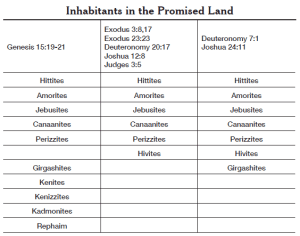
There are several listings of the inhabitants of the promised land to be dispossessed by the Israelites. There are some interesting variations in these lists as shown in the table below.
The discrepancies may be accounted for within the context. The Kenites, Kenizzites, Kadmonites, and Rephaim in the Genesis list all resided on the east bank of Jordan and had been defeated before the main conquest of Jordan began. The Hivites, omitted in Genesis, were a small sub-tribe living on the northern outskirts of the promised land, close to Mt. Hermon (Judges 3:3). The Girgashites, omitted in the majority of the lists, while living east of the Jordan, were not conquered until the Israelite invasion of the west bank had commenced.
The Borders of the Promised Land
While many texts give a general description of the promised borders, the most complete description of the land which Abram’s seed was to inherit is found in Deuteronomy: “Turn you, and take your journey, and go to the mount of the Amorites [the Nebo ridge on the east bank of the Jordan], and unto all the places nigh thereunto [the Jordan Valley, east of the river itself], in the plain [in Hebrew, Arabah, the Great Rift of the Jordan Valley south of the Dead Sea], and in the hills [the Judean hills], and in the vale [in Hebrew, Shephelah, lying between the coastal plain and the Judean hills], and in the south [the Negev], and by the seaside [the Mediterranean coastal plain], to the land of the Canaanites [particularly the Plain of Sharon and the Jezreel Valley], and unto Lebanon [in the north, but how far north?], unto the Great River, the River Euphrates. Behold, I have set the land before you: go in and possess the land 1 which the Lord sware unto your fathers, Abraham, Isaac, and Jacob, to give unto them and to their seed after them” (Deuteronomy 1:7,8).
Three Staged Invasion
The conquest of the promised land took some six years and was accomplished in three stages:
1) the territory east of the Jordan river
2) the southern flank
3) the land in the north of Canaan
After being rebuffed by the Amalekites in their abortive attack near Kadesh Barnea in the Negev, the wandering tribes were directed thirty-eight years later up the Great Rift Valley northward along the Dead Sea. Here, at the time of the fall harvest, they crossed the river Arnon to do battle with Sihon, King of Heshbon. “And the LORD said unto me, Behold, I have begun to give Sihon and his land before thee: begin to possess, that thou mayest inherit his land” (Deuteronomy 2:31).
Within six months the twelve tribes had taken possession of the trans- Jordan, except for the lands inhabited by Edom, Moab, and Ammon (as well as the isolated sub-tribe of the Girgashites). It was here that Moses died after viewing the promised land from Mt. Nebo, and it was here that Balak, king of Moab, sought to enlist the aid of the prophet Balaam to curse the Israelites. It was shortly after his failure that the tribes of Israel, now under the command of Joshua, amassed themselves at the banks of the Jordan in preparation to pass over.
It was in the spring of the year, just before the Jewish feast of Passover, and the river Jordan was in flood stage (Joshua 3:15). These raging flood waters probably gave those dwelling west of Jordan a feeling of security. A landslide upriver at the town of Adam, however, dried up the torrent so that the Israelites could pass over dry shod. Crossing the river, they set up camp in a box canyon by the name of Gilgal.
The crossing of Jordan is seen by many Christians as the passing over of the death sentence when Christ and his Church raise the billions of humanity back to life once again. This erasure of the original curse will also be traced as far back as the first man named Adam.
Gilgal provided an ideal staging ground for the next step of the invasion. Here the nation’s dependency on heaven-sent manna ceased (Joshua 5:12), for here there was ample pasturage for their flocks in the fertile Jordan Valley, an abundant source of clean water from the river, as well as the protective mountain cul-de-sac for protection from enemies. It was here that they awaited instructions from God as to how to claim their promised heritage.
Jericho
An angel from the Lord instructed Joshua to begin the conquest at Jericho, a prosperous Canaanite city located not far from the Jordan, between the river and the cliffs of Quarantania. It was built on a foundation set in alluvial soil which would have become greatly moistened by the overflowing floods of spring. This geological sub-strata is similar to that of Santa Rosa, California, the city that suffered the greatest damage in the San Francisco earthquake of 1906 (International Standard Bible Encyclopedia).
The tribes of Israel were instructed to march around the city for seven days with the priests blowing a loud blast on seven ram’s horn trumpets (Hebrew, yobel, from which we derive the word jubilee). This was to be followed on the seventh day by seven encirclements and seven blasts of the seven trumpets. The city had been living in fear of an attack (Joshua 6:1) and it is likely that the unusual events, particularly of the seventh day, would have brought crowds to the city wall to see what was happening. The synchronic noise, the accumulated weight on the walls, and the unstable dampened alluvial foundation may have all contributed to the miracle power of God in bringing down the thick stone walls.
The trumpet soundings of six days followed by seven blasts on the seventh day are suggestive of the picture given in the book of Revelation where seven trumpets appear in parallel with the seven churches and seven seals, followed on the seventh day by the seven plagues which topple the antitypical Jericho, the great Babylon. The further connection with the trumpets being ram’s horns, or “jubilee” trumpets, blown by the priests may be of further significance since the great seventh thousand-year day of humanity is known as “the year of jubilee.”
Ai
The thrill of victory was soon met with the bitterness of defeat. The sin of covetousness by a single Israelite resulted in a stunning defeat to Joshua’s army by the army of the city of Ai. God had commanded that nothing be taken from the spoils of Jericho, but Achan, a man of Judah, took a Babylonish garment, two hundred shekels of silver, and a fifty-shekel wedge of gold. The three items may hold a symbolic meaning relative to the remnant of fallen desires from which mankind needs to rid itself in the kingdom age.
1) A Babylonian garment illustrating the ritual ways of attaining justification practiced in antitypical Babylon. The Vulgate translates it as a purple garment while the Septuagint calls it “a garment of different ” Some suggest that it was the royal robe of the king of Jericho, while others speculate it was a robe kept in the temple for the king of Babylon when he would come on royal visits to this important trade center.
2) Two hundred shekels of silver illustrate the greed of Achan and the temptation of Its placement under the other items (Joshua 7:21) suggests that it is greed and selfishness that lie at the foundation of all the other faults.
3) A wedge of gold. The Hebrew expression is “a tongue of gold” and probably refers to a golden phallic image or idol, representing the difficulty that many will have in the kingdom giving up the many cherished idols of their former
God’s Secret Weapon
Ambush was a standard tactic in Old Testament warfare. It was one ambush, strategically placed between the cities of Ai and Bethel that resulted in the fall of both these hilltop strongholds. Their defeat gave Joshua’s forces a foothold in the southern highlands of Samaria. From there a prolonged campaign in the north conquered the territory as far north as Tyre and Sidon on the coasts of present-day Lebanon.
Ambush, however, was also a tactic used by the entrenched cities of the land. The lush croplands of the Jezreel and Sharon valleys provided ample hiding places for the armies arrayed against Israel. It was for just such contingencies that God provided Israel with a secret weapon — swarms of hornets: “And I will send hornets before thee, which shall drive out the Hivite, the Canaanite, and the Hittite, from before thee” (Exodus 23:28). More than just a nuisance, these stinging insects would evoke cries of pain from the hidden enemy forces, revealing their location.
So, it will be in Christ’s kingdom when man does battle against his seven spiritual foes (Proverbs 6:16-18). God will reveal the secret sins in man’s heart, but it will be up to him to achieve victory over them (Psalm 19:12).
A Gradual Conquest
God did not promise swift victory. The land was to be claimed piecemeal. “I will not drive them out from before thee in one year; lest the land become desolate, and the beast of the field multiply against thee. By little and little I will drive them out from before thee, until thou be increased, and inherit the land” (Exodus 23:29,30).
Nature abhors a vacuum. If Israel’s foes had fallen before the invaders were ready to use the land for farming or grazing, the ground would soon be overspread with weeds and inhabited by wild beasts. This further illustrates the methods God uses in helping mankind overcome their fallen propensities. Jesus used a parable to demonstrate this principle; “When the unclean spirit is gone out of a man, he walketh through dry places, seeking rest; and finding none, he saith, I will return unto my house whence I came out. And when he cometh, he findeth it swept and garnished. Then goeth he, and taketh to him seven other spirits more wicked than himself; and they enter in, and dwell there, and the last state of that man is worse than the first” (Luke 11:24-26).
It is not enough that man rid himself of sinful and impure thoughts, but he must replace these with the principles of righteousness and the desire to implement these.
Caleb and the Conquest of the South
When the spies entered the land at Kadesh Barnea, they penetrated as far as the cities of Hebron, a confederacy of four sheikdoms ruled by Anak and his three sons, Ahiman, Sheshai, and Talmai, all men of gigantic stature (Numbers 13:22). Hebron (whose name means “confederacy”) was then named Kirjath-arba, or Cities of the Four, named for these four rulers.
Now at age 86, Caleb requests permission from Joshua to conquer the city whose inhabitants had earlier struck terror into the hearts of the spies (Joshua 14:13,14). Seeking to inspire others with similar zeal, he offered the hand of his daughter Achsah in marriage to any warrior who would take on the neighboring city of Debir, also known as Kirjath-sepher, or City of the Book for its being the center of learning for the Canaanitish culture. Caleb’s younger brother, Othniel, accepted the challenge. Because Debir was in the desert of the Negev, he also requested water and was given “the upper and nether springs” (Joshua 15:19). After the death of Joshua, Othniel became the first judge of Israel.
Conquest of the entire south progressed at a rapid pace and soon Israel was master of the entire area, though the failure to drive out pockets of resistance, particularly in the Philistine-controlled Gaza strip, became the source for not only continual conflict but a temptation for assimilation and the practice of idolatry.
When Joshua neared the time of his death, the Lord listed the lands yet to be conquered (Joshua 13:1-6), but he was given the task of dividing the land among the nine and a half tribes who were to reside west of the Jordan as though it were all subdued. The actual job of distributing the inheritance was left to Joshua, the leader, and to Eleazar, representing the priesthood (Joshua 14:1).
Two tribes were not given a territorial inheritance: Levi (Joshua 13:14) and Simeon, who was to dwell in the tribal lands of Judah (Joshua 19:1). These two sons of Jacob had been the ringleaders in the slaughter of the Shechemites after the rape of Dinah and were condemned for this act by Jacob on his death bed; “Simeon and Levi are brethren; instruments of cruelty are in their habitations. O my soul, come not thou into their secret; unto their assembly, mine honour, be not thou united: for in their anger they slew a man, and in their self-will they digged down a wall. Cursed be their anger, for it was fierce; and their wrath, for it was cruel: I will divide them in Jacob and scatter them in Israel” (Genesis 49:5-7).
The tribe of Levi redeemed itself by standing with Moses after Israel’s sin with the golden calf. They received a special inheritance of service to God and were given 42 cities with surrounding pasturage within the tribes of their siblings plus six cities that were to serve as “cities of refuge” for those fleeing punishment in cases of manslaughter.
Simeon, on the other hand, was given no special honor and produced none of the heroes of faith, save perhaps Judith in the Apocryphal account of deliverance from the Assyrian general Holofernes.
The completion of the six years of conquest started Israel in her experiences as an independent nation with her own homeland, an existence that was to continue for nearly a thousand years, first under judges and then under kings, until its termination in the invasions of Nebuchadnezzar, king of Babylon.
In this warfare of conquest, we find a rich treasure trove of lessons applying to mankind’s conquest of individual sin and the claiming of their rich and eternal resurrection inheritance — their “promised land.”
––The Herald of Christ’s Kingdom
2002/5
1 For a complete discussion of these boundaries, see the booklet This Land Is Mine, published by the Chicago Bible Students and distributed by the Pastoral Bible Institute.