
And saviors shall come up on mount Zion to judge the mount of Esau; and the kingdom shall be the LORD’s. –– Obadiah 1:21
Jesus of Nazareth is the central figure in the Bible’s plan for man’s salvation. Closely associated with him in the work of uplifting the human race is his bride, the Church. There are many roles which they, as supporting actors, carry out together with him. There are certain roles in this drama that he and he alone can play.
Redeemer
The word “Redeemer” is only found eighteen times in the King James Bible, all in the Old Testament. While usually referring to Jehovah as the author of redemption, there is at least one exception in Isaiah 59:20, “And the Redeemer shall come to Zion, and unto them that turn from transgression in Jacob, saith the LORD.”
The Hebrew word gaal from which it is translated is rendered with eight different English words and is frequently referred to in Messianic prophecies. Specifically, the term refers to the right of purchase of a family inheritance by the next of kin.
In the New Testament, the words “redeem,” and “redemption” are used many times and taken from a variety of Greek words including lutrosis, apolutrosis, and exagarazo. All relate to a purchase being made for a price.
Thus, the concept of redemption or redeeming is a legal and economic one. It refers to a specific price being paid for a person or object. In the Greek, it is closely related to the nouns lutron and antilutron, signifying a corresponding price, an exact equivalent. The only use of antilutron, translated “ransom,” is found in 1 Timothy 2:5,6: “For there is one God, and one mediator between God and men, the man Christ Jesus; Who gave himself a ransom for all, to be testified in due time.”
The price of redemption or ransom, as a corresponding price, is supported in 1 Corinthians 15:21: “For since by man came death, by man came also the resurrection of the dead.” This principle is based on the Mosaic law of strict justice which required “life for life, eye for eye, tooth for tooth, hand for hand, foot for foot, burning for burning, wound for wound, stripe for stripe” (Exodus 21:23-25).
Paul’s equation in the text above is simple: one perfect life, Jesus, for one perfect life, Adam. This transaction is legal and just. It requires no addition. It is paid by Christ and Christ alone. As the hymn well phrases it:
Jesus paid it all,
All the debt I owe.
Saviors
Savior means deliverer or liberator. The prophet seemingly applies this title to Jehovah alone in Isaiah 43:11: “I, even I, am the LORD; and beside me there is no savior.” Yet, in a prophecy of Jesus’ triumphal ride into Jerusalem, we read in Zechariah 9:9: “Rejoice greatly, O daughter of Zion; shout, O daughter of Jerusalem: behold, thy King cometh unto thee: he is just, and having salvation; lowly, and riding upon an ass, and upon a colt the foal of an ass.” Even the very name Jesus comes from the Hebrew yasha, or Joshua, meaning “Savior.” When he was thus named, the angel said the reason for the name was that “he will save his people from their sins” (Matthew 1:21). The word is yet broader. Moses was the prototypical deliverer, saving Israel from their Egyptian bondage (Acts 7:35). In this act of deliverance, he was a fit picture of Jesus (Acts 3:22,23).
The beginning text from Obadiah is still broader. It mentions “saviors,” plural, on Mount Zion judging the mount of Esau. There is a parallel text in Revelation 14:1: “And I looked, and, lo, a Lamb stood on the mount Sion, and with him an hundred forty and four thousand, having his Father’s name written in their foreheads.”
The Revelator leaves no doubt as to who these are. In Revelation 14:4 we read of them: “These are they which were not defiled with women; for they are virgins. These are they which follow the Lamb whithersoever he goeth. These were redeemed from among men, being the firstfruits unto God and to the Lamb.”
This group has five characteristics which identify them as the Church, the Bride of Christ:
1) They have the Father’s name written in their foreheads. (More reliable manuscripts add the phrase “his [Jesus’] name” as well as the Father’s name.
2) They are “virgins,” pure ones
3) They are footstep followers of the Lamb
4) They are redeemed from among
5) They are the firstfruits of redemption
These, then, are the “saviors” of Obadiah’s prophecy. What is their role as saviors? Obadiah defines it as “judging the Mount of Esau.”
Judges
The Apostle Paul concurs with the use of this title for the Church in 1 Corinthians 6:2: “Do ye not know that the saints shall judge the world?” The prophet Daniel, in his vision of world empires as four beasts, makes a similar statement: “Until the Ancient of days came, and judgment was given to the saints of the most High; and the time came that the saints possessed the kingdom” (Daniel 7:22).
A still more thorough description of this work is given in Malachi. After describing how the Lord gathers those who fear him as a man gathers precious jewels, he concludes: “Then shall ye return, and discern between the righteous and the wicked, between him that serveth God and him that serveth him not” (Malachi 3:18).
This text assures us that wicked men as well as righteous ones will be in God’s Kingdom. Jesus said as much: “Do not marvel at this; for an hour is coming, in which all who are in the tombs shall hear His voice, and shall come forth; those who did the good [deeds] to a resurrection of life, those who committed the evil [deeds] to a resurrection of judgment” (John 5:28,29, NAS).
The Greek word here translated as judgment is krisis and has the same meaning as our medical term “crisis,” namely, that point in a disease where the outcome can go either favorably or unfavorably. Putting these texts together, we see that all the good and the bad will come forth from the tomb and that there will be a judgment, eventually rendering a decision, on those who have had an evil record. This work will be shared by the Church with Christ.
In contrast with even the best of judgments today under imperfect men dealing with incomplete evidence, we are assured that the judgments of that day will be completely just. “And he shall judge the world in righteousness, he shall minister judgment to the people in uprightness” (Psalm 9:8). “Because he hath appointed a day, in the which he will judge the world in righteousness by that man whom he hath ordained; whereof he hath given assurance unto all men, in that he hath raised him from the dead” (Acts 17:31).
Today an accused may plead insanity or ignorance of the law. The judgments of that day will be preceded by an educational program in which none will be able to make such pleas. “When thy judgments are in the earth, the inhabitants of the world will learn righteousness” (Isaiah 26:9).
Priests
The educational training of that kingdom will be done with the utmost of compassion as is shown in, yet another title shared by Christ and his Church: Priests. Many biblical verses speak of this role. “And from Jesus Christ, who is the faithful witness, and the first begotten of the dead, and the prince of the kings of the earth. Unto him that loved us, and washed us from our sins in his own blood, and hath made us kings and priests unto God and his Father; to him be glory and dominion for ever and ever” (Revelation 1:5,6). “Thou hast made them [to be] a kingdom and priests to our God; and they will reign upon the earth” (Revelation 5:10, NAS); “Blessed and holy is he that hath part in the first resurrection: on such the second death hath no power, but they shall be priests of God and of Christ, and shall reign with him a thousand years” (Revelation 20:6).
Jesus is the great High Priest over this order of priests. “Wherefore, holy brethren, partakers of the heavenly calling, consider the Apostle and High Priest of our profession, Christ Jesus” (Hebrews 3:1). His distinguishing feature in that role is compassion learned through sufferings common to others. “Wherefore in all things it behooved him to be made like unto his brethren, that he might be a merciful and faithful high priest in things pertaining to God, to make reconciliation for the sins of the people. For in that he himself hath suffered being tempted, he is able to succor them that are tempted” (Hebrews 2:17,18). “For we have not an high priest which cannot be touched with the feeling of our infirmities; but was in all points tempted like as we are, yet without sin. Let us therefore come boldly unto the throne of grace, that we may obtain mercy, and find grace to help in time of need” (Hebrews 4:15,16).
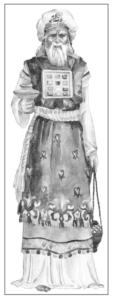
The same compassionate understanding must be learned by the Church. The experiences of the present life are to fit and train them to identify with the sins that fallen men experience and the consequences of those sins. The Apostle Paul says of their experiences: “Every test that you have experienced is the kind that normally comes to people. But God keeps his promise, and he will not allow you to be tested beyond your power to remain firm; at the time you are put to the test, he will give you the strength to endure it, and so provide you with a way out” (1 Corinthians 10:13, TEV).
Another function of the ancient priests of Israel, specifically the high priest, was to be an intermediary between the people and God. This was done through the use of the “Urim and Thummim” (see Exodus 28:30; Numbers 27:21; 1 Samuel 28:6; Nehemiah 7:65). The priesthood was the link between God and man in a theocratic society.
A similar function is ascribed to the Church as part of the “new heavens” in earth’s future society. The prophet Hosea describes this role, picturing God as not speaking to the earth, but dealing with them through the new heavens. “And it shall come to pass in that day, I will hear, saith the LORD, I will hear the heavens, and they shall hear the earth” (Hosea 2:21). The same thought is expressed by David in Psalms 50:4-6: “He shall call to the heavens from above, and to the earth, that he may judge his people.
Gather my saints together unto me; those that have made a covenant with me by sacrifice. And the heavens shall declare his righteousness: for God is judge himself.”
Kings
Another role shared by Christ and his Church is that of kings. “It is a faithful saying: For if we be dead with him, we shall also live with him: If we suffer, we shall also reign with him: if we deny him, he also will deny us” (2 Timothy 2:11,12).
In Israel, the role of a king combined the legislative and executive roles of government. Kingship was a position open to temptations of corruption. Unfortunately, the majority of Judah’s kings and all of those of Israel fell to the corruption of absolute power. On the other hand, a king truly interested in his people could produce powerful benefits. This was illustrated in the reigns of such righteous kings as Asa and Josiah.
Earth’s new dominion will be of the most righteous sort. It will combine the strictness of rigid enforcement of kingdom rules with the compassionate understanding of man’s inherent weaknesses. It is for this reason that the training of these future kings is, as Paul phrased it to Timothy, by being “dead with him,” by a course of sacrificial suffering.
Summary
Each of these roles –– saviors, judges, priests, kings — is a part of God’s redemptive plan for man’s salvation. As saviors, we see the militaristic function of deliverance. As judges, the emphasis is on the judicial aspects and the righteous adjudication of mankind’s problems with sin. Priests serve in the intermediary capacity of connecting earthly man with his heavenly Creator. Kings assist in the execution of the laws that will govern man for all eternity.
Each of these roles is a part of God’s great sin-eradication project. Each helps to bring mankind back from its present sinful state to absolute righteousness. Each is a stepping stone on the “highway of holiness” (Isaiah 35:8-10). The present sacrificial offerings of the Church prepare them for these glorious future activities. It is for this reason that many Bible Students see these experiences as “an offering for sin,” while distinguishing them from the legal aspects of redemption which reside in Jesus alone in his unique position as the world’s Redeemer.
–– The Herald of Christ’s Kingdom
1999/6