
The Earth Yields Her Secrets
[God] hast set signs and wonders in the land of Egypt, even unto this day, and in Israel, and among other men; and hast made thee a name, as at this day. –– Jeremiah 32:20
Archaeology, like forensics, is an interpretative science. Evidence is gathered, collected, analyzed, and tentative conclusions are drawn. Because the conclusions are tentative, archaeology cannot be used to prove the Bible, although it does furnish evidence to corroborate the accuracy of biblical persons, places, and cultural backgrounds. Ephraim Speiser of the University of Pennsylvania phrased it thus: “We can tell that the Assyrians conquered Israel, but we have no way of knowing if it was God who sent them.”
Archaeological discoveries can be divided into three categories:
1) permanent fixtures, such as towns, houses, public buildings and roadways;
2) artifacts, including pottery, coins, and skeletons; and
3) written records, such as parchments, papyri, and Biblical archaeology, a specialized field beginning with the discovery of the Rosetta Stone during Napoleon’s Egyptian campaign in 1799, uses all three of these kinds of evidence.
Biblical Cities
The Holy Land has proved to be a rich trove for the searchers of the past. Sifting through the silent dust of centuries, the spades of archaeologists have turned up scores of ancient cities. Sites for prospective ruins have been relatively easy; the lumpier the landscape, the larger the potential city. Urban areas were usually located on higher plots of ground, so approaching enemies could be easily spotted. The height advantage enabled the city defenders to shoot their arrows from the strategic high ground. A convenient water supply was essential. Plotting caravan routes was yet another means of finding the best places to dig. But the most productive tool in locating promising areas for excavation has been the Bible itself. Geographic clues from the Scriptures have often pointed to productive locations.
The period of the Old Testament times was one wrought with warfare as various tribes fought for ethnic superiority, to loot, or to bring other groups into a tributary relationship where they could reap a percentage of the crops or of the flocks and herds. Since ideal town locations were rather few, the attackers would merely level the area and build a new city upon the one they had just destroyed. Sometimes as many as twenty or more levels of habitation have been located, one on top of the other. These large mounds are known as “tells” and are easily spotted by the trained archaeological eye in search of an area to investigate.
Once located, the archaeological team lays out a “grid,” marking the area to be researched. A different team is assigned to each area of the grid and the painstaking work of excavating begins, peeling off one layer of earth at a time, seeking for evidence of past habitation. Each shard of pottery, each uncovered stele, idol, or other artifact, is carefully preserved, its location noted within the grid, and by the depth of the find. Then it is dated and preserved.
The interpreted results give a general background to the culture and lifestyle of the period. In addition to giving credence to the existence of specific cities named in the biblical narrative, they often hint at some of the specifics mentioned in the Bible’s account. This article will cover only a few of such cities.
Arad: When the Israelites left Egypt for the Promised Land, they enlisted the aid of Hobab, the Kenite, to guide them, and they promised him a portion of their inheritance (Numbers 10:29-32). The fulfillment of this promise is recorded in Judges 1:16 where the Kenites were allowed to dwell in Arad. Excavations there in the latter part of the twentieth century have unearthed a sizeable settlement at Tel Arad, just west of the current city bearing the same name. Among the findings were the remains of a temple structure bearing a marked similarity to Solomon’s Temple in Jerusalem. Such structures were forbidden by God for he had placed his name in Jerusalem and desired his worship to be centered there (1 Kings 9:3; 11:36; 2 Kings 21:4-7). When God promised Abraham the land of Canaan, he instructed him to drive the Kenites from the land (Genesis 15:18-21). Instead, Israel gave them a portion of the inheritance and thus introduced a competing religion. Perhaps this is why Heber, the faithful Kenite whose wife Jael slew the enemy general Sisera, “severed himself from the Kenites” (Judges 4:11).
Caesarea: The mighty seaport of Caesarea was one of the building projects of Herod the Great. Both Cornelius and Phillip the evangelist lived there. The city was not only a thriving maritime and commercial center, it also served as the administrative headquarters for the Roman occupation of Judea. Explorations of this location were conducted by the Israeli Department of Antiquities; and their findings included a Crusader castle, the theater, the amphitheater, the hippodrome, and the pavement of a Jewish synagogue — possibly the very one visited by Phillip, Peter, and Paul. Also discovered was the base of a column bearing the inscription of Pilate, the Roman procurator of Judea.
Capernaum: Situated on the north shore of the Sea of Galilee, Capernaum (Kfar Naum, or the city of Nahum) was the main commercial and social center of life in Galilee during the days of Jesus. (The present larger city of Tiberias, on the southwest coast of the sea, was only a small garrison for Roman soldiers at that time.) Extensive excavations have been centered on the large synagogue, a two-story, gable-roof structure measuring 60 by 80 feet. Built of white limestone, the interior columns and porticoed porch made balconies for women worshipers possible on the second floor. Although there is debate as to whether the building dated to New Testament times or shortly thereafter, an Aramaic inscription on one of the columns gives weight to the earlier dating. This inscription reads: “HLPW, the son of Zebidah, the son of Johanan, made this column. May blessing be his.” The archaeologist Dr. Nelson Glueck notes that “these names correspond roughly to the New Testament Alphaeus, Zebedee, and John, mentioned … in the list of Jesus’ disciples and their families” (Mark 3:17,18). Among the elaborate ornamentation unearthed were such typical Jewish symbols as the seven-branched candlestick, the six-pointed Star of David, and the Ark of the Covenant. While there is some evidence that another structure may be the house of Peter’s mother-in-law, often visited by Jesus, the evidence for this is more conjectural.
Ezion-geber: This naval port of King Solomon was located near the north end of the Gulf of Aqaba, an arm of the Red Sea. These ships were manned by experienced Phoenician sailors of Hiram, king of Tyre (1 Kings 9:26,27). The cargo shipped from this port was largely metals — both precious metals, such as gold from Ophir, and copper, a popular metal for both ornamental and utilitarian uses. Excavations by Nelson Glueck in 1938 found not only vast slag heaps of iron and copper ore but blast furnaces so aligned as to gain the maximum wind to fan the flames to produce the necessary heat for refining the metal. Dr. Glueck wrote of the site: “The whole town of Ezion-Geber, taking into consideration place and time, was a phenomenal industrial site, without anything to compare with it in the entire history of the ancient Orient. Ezion-Geber was the Pittsburgh of Old Palestine and at the same time its most important seaport.”
Gezer: A city on the Shephelah plateau overlooking the Mediterranean plains, Gezer was originally designated to be a Levitical city (Joshua 21:21), but the Canaanites who dwelt there proved to be too entrenched to be dislodged (Judges 1:29). Years later the city was burned to the ground by the Egyptians and then rebuilt and given by the Pharoah to his daughter, a wife of Solomon, who, in turn, fortified it as one of his garrison cities (1 Kings 9:15-17). Two series of excavations were carried out at Gezer. The first was by R.A.S. Macalister in 1902-5 and then by A. Rowe in 1934. They found that the earliest inhabitants of the city were non-Semitics whose cave dwellings showed their way of life as farming people. From about 2500 BC (a date estimated by pottery shards) a Canaanite tribe lived there until about 1000 BC. One of their “high places” to Baal and Astarte revealed a row of chiseled stone pillars nearly eleven feet high and some polished stones worn smooth by the kisses of devotees. Plaques with rude exaggerations of sexual organs evidenced the sensual nature of their worship. At a higher level of the tell, a Hebrew altar was uncovered with the name “Jehovah” in its inscriptions. A rare insight into the agricultural cycle of Old Testament life was found on a schoolboy’s plaque in classical Hebrew, outlining the calendar of agricultural operations. It read:
His two months are olive harvest;
His two months are grain planting;
His two months are late planting;
His month is hoeing up flax;
His month is barley harvest;
His month is harvest in festivity;
His two months are wine-tending;
His month is summer fruit.
Jericho: Jericho is perhaps the most excavated city in the holy land. Four major expeditions have probed its remains: those of Charles Warren (1868), Ernst Sellin (1907-11), John Garstang (1929-36), and Kathleen Kenyon (1952-58). The last two hold the most interest to Bible students. It was Garstang’s expedition that located the fallen walls with pottery shards dating it to the time of Joshua. He also found at the same level, charred remains that still give their testimony to the accuracy of Joshua 6:24, “And they burnt the city with fire, and all that was therein: only the silver, and the gold, and the vessels of brass and of iron, they put into the treasury of the house of the LORD.” Scarabs at the same level contained the names of such Egyptian rulers as Thutmose III, Amenhotep II, and Queen Hat- shep-sut, further confirming a date in the fifteenth century BC. Miss Kenyon’s excavations were for the purpose of proving Garstang wrong, but she was finally driven to admit: “All the canons of historical criticism demand that we accept the main facts of the story as authentic …. As concerns the date of the destruction of Jericho by the Israelites, all that can be said is that the latest Bronze Age occupation should, in my view, be dated to the third quarter of the fourteenth century BC. Ultimately archaeology will be the decisive criterion, but only when the archaeological timescale has been firmly fixed, which is not yet the case.”
Sodom: The Australian archaeologist, Dr. Alexander Beasley, in his Amazing Destruction of Sodom and Gomorrah, demonstrated the unique geological strata of oil, bitumen, salt, and sulfur, which make the biblical account of the destruction of these cities credible (Genesis 19:15-28). The further tracing of two parallel fault lines in the earth’s crust, extending from the Dead Sea to the Gulf of Aqaba, shows how an earthquake could have dropped the land between the faults several feet, forcing the oil through the fissures at such a speed as to ignite the sulfur and bitumen and create a rain of descending salt. In 1924, a joint expedition of the Pittsburgh Xenia Theological Seminary and the American School of Oriental Research, led by Drs. William Foxwell Albright and Kyle, sought to find the remains of these cities at the south end of the Dead Sea. Although they were unsuccessful, they did unearth the remains of the nearby town of Zoar, to which Lot fled with his daughters (Genesis 19:22,23,30). Respecting the earlier account of the battle of Abraham with the confederacy of kings that had sacked Sodom and taken Lot captive (Genesis 14:1- 17), archaeology has uncovered documentation bearing the names of some of these kings. The German archaeologist Jeremias writes, “The confederacy has appeared in Babylonia and also the Babylonian suzerainty over Palestine in the age called for by the narrative, and, indeed, the whole historical setting into which the narrative fits has a perfect naturalness” (Das alte Testament im Lichte desalten Orients; Hommel, Hebrew Tradition, chapter v). Moreover, Amraphel king of Sumer, conquered the west, and fourteen years later returned and was slain by Abraham and his allies. Archaeology records that Ur-Nammu, King of Sumer, claims victory over the west in his fourth year, while in his eighteenth year, he died in battle, “abandoned on the battlefield like a crushed vessel.” (That end came in BC 2036 according to the Low Chronology of Sumer.)
Landmarks
The shovel of the archaeologist has sought out not only entire cities, but specific landmarks mentioned in the Bible have also been focal points of its quest. Being smaller than towns, landmarks have often been more elusive. However, such probes have brought forth more evidence confirming the biblical narratives.
Golgotha: When the Roman general Titus destroyed Jerusalem in 70 AD, he did it so thoroughly that all attempts to locate the specific spot of Calvary, or Golgotha, have remained debatable. Modern scholars give maximum credence to two sites: one located at the Church of the Holy Sepulcher and the other to the north of the city at what is denoted Gordon’s Calvary with its Garden Tomb. Though most archaeologists today favor the first of these sites, it is the latter that most captures the atmosphere of the crucifixion. The authenticity of the date of the Garden Tomb lends support to its claims, as does its proximity to a logical site for the crucifixion, on a well-traveled road, making it easily visible to passers-by and thus a likely place for Roman crucifixions which were meant as much as an object lesson to future criminals as they were a punishment. The fact that the Garden Tomb lies at the apex of Mount Moriah, where Abraham offered his son and Solomon built his Temple on a lower plateau, lends to the appeal of this site. The somewhat face-like appearance of the adjacent “Golgotha” hill is less powerful evidence since most likely the site was named “the place of the skull,” not so much for its outward appearance, as for the fact that many skulls were found at that location, hardly unusual for a place of crucifixion. Furthermore, the unique features of today’s “Golgotha’s Hill” are cisterns, whose faces had probably not eroded in biblical times. However, as one guide at the Garden Tomb has well phrased it, “it matters little whether the correct site be here or across the road [in the Church of the Holy Sepulcher]; what matters most is that both tombs are empty.”
Hezekiah’s Tunnel: In preparation for an expected attack against Jerusalem by Sennacherib, king of Assyria, Hezekiah ordered the construction of a tunnel connecting the Gihon springs, the city’s main source of water in the Kidron valley, with the pool of Siloam in the Tyrolean valley. This is the conduit referred to in 2 Chronicles 32:30, “This same Hezekiah also stopped the upper watercourse of Gihon and brought it straight down to the west side of the city of David. And Hezekiah prospered in all his works.” An expedition of the Palestine Exploration Fund in 1896-97 found the steps leading to the pool, and later archaeologists uncovered the tunnel itself. It has been cleaned of debris and thousands of tourists trek through it today. However, it was earlier, in 1880, that a boy wading in the still debris-filled pool first saw the famous Siloam inscription which reads: “The boring through is completed. Now this is the story of the boring through. While the workmen were still lifting pick to pick each toward his neighbor and while three cubits remained to be cut through, each heard the voice of the other who called his neighbor, since there was a crevice in the rock on the right side. And on the day of the boring through the stone cutters struck, each to meet his fellow pick to pick; and there flowed the waters to the pool for 1200 cubits and 100 cubits was the height of the rock above the heads of the stone cutters.” The building of this tunnel may have well been the occasion for the writing of Psalm 46.
Masada: Few sites in Israel are more famous than that of Masada, the last Jewish fortress to fall in the war against Rome in 73 AD. The most important findings were the pottery shards left by the defenders as they cast lots as to who would be the slayers of their brothers so that the Romans could not boast of ever having captured them alive. This famous fortress of Herod the Great has not only been reconstructed, but it has also become the motto of modern Israeli defenses: “Masada shall not fall again.”
Artifacts
Not only are the major cities and biblical landmarks important, but every small object that is unearthed furnishes another piece of the jigsaw puzzle which reveals the background of the manners and customs of the times during which the Bible’s accounts were lived.
Pottery design is so precise that a skilled archaeologist can date the level at which it is found within perhaps 50 years of its origin. As time progressed there was a steady and marked change in both the quality of material, the manner of workmanship, and especially in the design that is peculiar to each half century or so. Coins, likewise, furnish chronological clues and are also indicators as to which country was in control of a certain city at a certain time. An extensive collection of coins dating to biblical times is currently maintained at Andrews University in Berrien Springs, Michigan, which chronicles this significance. Idols and steles (small pillars erected as monuments) have also served to verify the biblical record of the specific idolatries that drew ancient Israel away from the worship of Jehovah. Finally, skeletons have given fresh insights into the average age to which people lived and, where large numbers of males of middle age are discovered buried together at the same level, have been living testimony to the mass killings in the warfare recorded in the Old Testament.
Written Records
Of all the discoveries of archaeology, however, none is perhaps as important as the written records of ancient times. Their testimony echoes down over the years bearing witness to the accuracy of the Bible itself. These records are not only replete with names of biblical characters but often bear evidence of actual events recorded in Scripture.
Rosetta Stone: Biblical archaeologists date the beginning of their specialized field to the discovery of the Rosetta Stone during Napoleon’s Egyptian campaign. The same events are recorded in three languages, each in parallel columns — Greek, and both written and hieroglyphic Egyptian. This enabled scientists to decipher the dead Egyptian languages and give us translations of the records from early Egyptian times.
Behistun Inscription: This outdoor carving sits 350 feet up on a cliff in the Zagros mountains of today’s Iran. Measuring 25 by 50 feet, it is also written in three languages. An English military officer, Henry Rawlinson, scaled the mountain in a suspended cage and subsequently spent four years painstakingly copying and deciphering the inscriptions. Research proved the three languages here to be the Old Persian cuneiform, Elamite (Susian), and Babylonian cuneiform. The monument was a memorial to the victories of the Median king Darius and is a strong verification of the record of the post-exilic prophets, referring to Ahasuerus by name (as the Uvakhshatara of the Persian inscription). Many of the details of the transfer from Babylon to Medo-Persia can be deduced from the valuable information in this inscription.
El-Amarna Letters: The royal archives of Pharaohs Amenhotep III and Amenhotep IV (Ahkenaton) were accidentally discovered by an Egyptian peasant woman digging in her garden in 1887. Amarna was the capital city of Egypt during part of the eighteenth dynasty. More than 350 cuneiform tablets were unearthed shedding valuable light on the biblical record of the time of Israel’s conquest of the promised land. References are made to the “Khabiri or Habiru,” a designation that many attribute to the Hebrews (although for varied reasons). In one letter from the commander at Gezer to the Pharaoh, he writes: “Let the lord my king, the sun in heaven, take heed unto this land, for the Khabiri are mighty against us; and let the king, my Lord, stretch out his hand unto me and let him deliver me from their hands so that they do not make an end of us.” As in many diplomatic archives, frequent references are made to the geographic areas alluded to in the Old Testament, particularly those mentioned in Joshua and Judges. An interesting insight on Melchizedek has been noted from these letters by Professor Wallace Budge in his History of Egypt, IV, 231- 35: “The frequently recurring title of the king of Jerusalem, ‘It was not my father, it was not my mother, who established me in this position.’ ”
Moabite Stone: This stone was a monument erected by Mesha, a Moabite king who rebelled against Israel and built his capital in Dibon, southwest of today’s Amman in the biblical area of the tribe of Gad. Although he had been successful against the ten-tribe kingdom of Israel, God later fought against him when he attacked the two-tribe kingdom of Judah (2 Kings 3). Part of the inscription reads: “Omri was king of Israel, and he oppressed Moab many days, for Chemosh was angry with his land. His son (Ahab) followed him, and he also said: I will oppress Moab. In my days (Chemosh) said: I will see (my desire) on him and his house, and Israel surely shall perish forever. Omri took the land of Medeba, and (Israel) dwelt in it during his days and half the days of his son, altogether 40 years. But Chemosh (gave) it back in my days.” This is in direct confirmation of the biblical account in 2 Kings 3:4,5, “And Mesha king of Moab was a sheep-master, and rendered unto the king of Israel an hundred thousand lambs, and an hundred thousand rams, with the wool. But it came to pass, when Ahab was dead, that the king of Moab rebelled against the king of Israel.”
Dead Sea Scrolls: The remarkable discovery of the Dead Sea scrolls 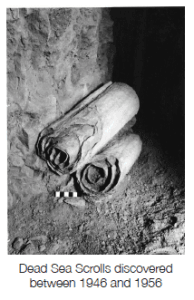 in a cave near the Essene community of Qumran has pushed back the history of the Hebrew text of the Old Testament by a thousand years. Before the discovery of this text, the oldest Hebrew manuscript of any length dated to the ninth century AD. There is a remarkable agreement (approximately 95%) between our extant translations of the Old Testament and these scrolls. Since many of the biblical texts found in the scrolls date back to the middle of the second century BC, they refute modern critical thought of dating Daniel to the late second century and Ecclesiastes to the first century. The finding of Isaiah as one unit conflicts with the higher critical concept of two authors for Isaiah. They also demonstrate that the background of John’s gospel is Hebrew in origin, rather than Hellenistic as claimed by some recent critics. In addition to thus confirming the biblical record as written, greater insights have been gained by the scrolls and the excavations in Qumran on the origin of the concept of baptism and the hostile relationship between the Essene community and those of the Sadducees and Pharisees.
Ebla Tablets: In 1964 two Italian archaeologists, Drs. Paolo Matthiae and Giovanni Petinato of the University of Rome, led an expedition that unearthed the ancient city of Ebla in northern Syria. The 140-acre site proved to contain the ruins of a metropolis of some 260,000 inhabitants during the time of the kings of Akkad. In its primacy, it controlled all of northern Syria and much of Mesopotamia. The dig uncovered the “scribe’s room,” with nearly 15,000 clay tablets. Many of these were trade records, mentioning such biblical cities as Ur, Damascus, Hazor, Lachish, Megiddo, Joppa, and Salim (the earlier name of Jerusalem). Sodom and Gomorrah are mentioned as being part of the “cities of the plain.” As Professor David Freedman points out, “This record precedes the great catastrophe [of the destruction of those cities] which many scholars have regarded as entirely fictional.” The finding of binary word lists only in Eblaite (a Semitic language) and Sumerian suggests that Ebla preceded the time of Moses when 70 languages were found (Genesis 10:5,20,31). Other texts in the library include Canaanite versions of creation and the flood and a Canaanite code of law.
Archives of Mari: Mari, an important city in the middle Euphrates, was excavated in 1933 by a team led by Professor Andre Parrot. In unearthing the king’s palace, the royal archives were discovered. It contained scores of diplomatic letters from all parts of the Middle East. Frequent references were made to cities having such Old Testament names as Harran, Nahor, Serug, Peleg, and the “mound of Terah,” along with the personal names of Reu, Terah, Abraham, Isaac, Jacob, Joseph, Benjamin, and David. (Charran and Surui, or Serug, still exist in Turkey). Dr. William Foxwell Albright remarks, “Abraham, Isaac, and Jacob no longer seem isolated figures, much less reflection of later Israelite history; they now appear as true children of their age, bearing the same names, moving about over the same territory, visiting the same towns (especially Harran and Nahor), practicing the same customs as their contemporaries.”
Lachish Letters: In Sennacherib’s invasion of Israel, he conquered 46 cities before being defeated at Jerusalem. Of all these conquests, he seems to rejoice most in overcoming the city of Lachish, some 30 miles southwest of Jerusalem. In the excavations of 1850 (supplemented by a more thorough dig from 1932-38) a pack of 21 letters written by one of the Assyrian military commanders was unearthed. These were written during the time of Jeremiah the prophet and give deep insight into his prophecies. One example is found in Letter VI where it is written, “And let my lord know that we are watching for the signals of Lachish according to all the indications which my lord hath given, for we cannot see Azekah.” These signals from Lachish explain the “sign of fire” in Jeremiah 6:1 as a call to arms for an approaching army. All in all, the significance of these letters lies largely in their reflection of the tense political and social situation of the later times when Jeremiah prophesied and was imprisoned.
The observations above noted, largely culled from the Archaeological Supplement to Thompson’s Chain Reference Bible by G. Frederick Owen, D.D., Ed.D., and from the International Standard Bible Encyclopedia are only a few of many [references] to show that, while archaeology does not prove the Bible (that remains a matter of faith), it certainly puts the stamp of authenticity on its historical context.
–– The Herald of Christ’s Kingdom 2000/4