
Therefore being justified by faith, we have peace with God through our Lord Jesus Christ by whom also we have access by faith into this grace wherein we stand, and rejoice in hope of the glory of God. –– Romans 5:1, 2
Three conditions in the Christian’s upward call to glory are mentioned here by the Apostle Paul: (1) being justified by faith; (2) the grace wherein we stand; and (3) the glory of God. The first two of these are present attainments of the Christian, while the last is his grand prospect of a resurrection inheritance with his Lord and Master.
All three of these positions are described as being attainable only “through our Lord Jesus Christ.” In addition the first two are attributed by the Apostle as being “by faith.”
Justified By Faith
The relationship between our justification and our faith is spelled out in detail in Galatians 3:24-26:
“Wherefore, the law was our schoolmaster to bring us unto Christ, that we might be justified by faith. But after that faith is come, we are no longer under a schoolmaster. For ye are all the children of God by faith in Christ Jesus.”
To the Jew, then, this faith was an end to the law, for with it they were “no longer under a schoolmaster.” The faith which performs this freeing work is specifically described as “faith in Christ.”
This faith operates gradually in a believer’s life. By it he first comes to the Father in prayer. By it he seeks forgiveness for sin. By it he receives leadership and guidance into ever deeper truths. By it he is looked upon as righteous through the eyes of a loving heavenly Father. No wonder the Apostle John could say, This is the victory that overcometh the world, even your faith (1 John 5:4).
The entire argument in the epistles is that faith makes us acceptable to God. The greater the faith the greater the acceptance –– “according to thy faith be it unto thee” (Matthew 9:29). For the Christian consecration to be “acceptable unto God” (Romans 12:1, 2), it must be accompanied by faith.
Although “justification” is a word that means “to make right,” and that can be done only through the application of Christ’s merit to the believer, the Bible does use the word in an accommodated sense. For instance, in the parable of the Pharisee and the Sinner, in Luke 18:9-14, Jesus said that the sinner, rather than the Pharisee, went to his house “justified.”
It is in this sense that Paul uses the phrase “justified by faith” in Romans 5:1. This relationship produces “peace with God,” a sense of oneness between the believer and his Lord. But more progress is to be made before he attains the “peace of God which passeth all understanding” (Philippians 4:7).
Access To Grace
Paul goes on to assure us that we have more than this faith justification. He adds in Romans 5:2 “by whom also we have access by faith into the grace wherein we now stand.” The little word “also” informs us that this is a further position than the first described –– “being justified by faith.”
The grace here referred to is the “high calling of God in Christ Jesus” (Philippians 3:14). This is called “grace” because it is an unmerited favor; whereas salvation, though undeserved, is obligatory because Christ died for all. The death of the Redeemer, however, does not warrant a spiritual call, only a return to the Edenic condition of perfection in the midst of a perfect earth.
Paul makes this point early in the Epistle to the Romans because the balance of his writings exhort the Roman brethren as to how to maintain that position of favor they obtained through the unmerited grace of God.
To obtain this position of grace, there was a responsibility for the Christian: to offer his life in consecration to God (Romans 12:1,2). This was the next step of the onward journey to which faith propelled him. Now it was not just the faith of the believer, but the faith of the doer: motivational faith.
The resultant peace, “the peace of God,” was another unmerited gift, another grace, from his Lord. Peace I leave with you, my peace I give unto you: not as the world giveth, give I unto you. Let not your heart be troubled, neither let it be afraid (John 14:27).
The Glory Of God
But, praise God, there is more to follow. The Christian not only is “justified by faith,” obtaining a relationship with God, not only “stands” in a unique position of grace, but he can also “rejoice in hope of the glory of God.”
Here hope, not faith, is the activating element, because here we have the future prospect of glorification, the sharing of God’s own nature: unmerited favor, grace beyond degree.
But, notice that we hope for this glory, not merely wish for it. As opposed to a wish, a hope has a solid foundation, a reason for expecting fulfillment. The believer has many such reasons for his hope; they are the “exceeding great and precious promises” (2 Peter 1:4). One will suffice for illustration, but do not settle for one, seek for more, trust in them and make them a part of your faith structure. “Be thou faithful unto death, and I will give thee the crown of life” (Revelation 2:10).
Not merely faith but faithfulness is required. As we read in James 1:22, But be ye doers of the word, and not hearers only, deceiving your own selves.
The Tabernacle
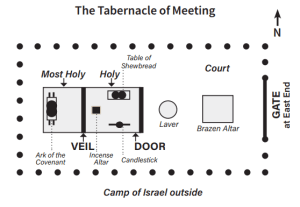
These three conditions are well illustrated by the three compartments in Israel’s Tabernacle in the wilderness. This structure itself had two rooms: the holy and the most holy, set within a fenced enclosure, called the court.
In this court were two articles: a brazen altar for offering animals and a laver for cleansing purposes. In the first room of the tabernacle proper there was a golden candlestick, a golden table with twelve loaves of bread, and a golden altar for offering incense. The innermost room, the most holy, contained only a relatively small box, an ark, in which were stored the two tables of the Law given to Moses, a golden pot of imperishable manna, and Aaron’s rod that budded, to show the supremacy of the tribe of Levi. This box was covered with a golden lid, called the Mercy Seat. This lid was topped by two golden figures of cherubim, between which glowed a mysterious light, the Shekinah, signifying the presence of God himself.
The journey from outside this structure into the most holy can be likened to the Christian’s approach to God. He, too, goes through stages. In the first of these he appreciates and places his faith in the sacrifice of Christ, pictured by the brazen altar. This faith leads him on to a measure of cleansing, as shown in the laver. To the extent this faith builds, to that extent he is more acceptable to his heavenly Father, more justified by his faith in the blood of Christ.
As his Christian course progresses, he yields himself in full, unreserved consecration to do the will of God. God responds by infusing him with the holy Spirit, a begetting to a new, a spiritual, life. The Spirit, opening his mind, enables him to see the light of truth, to eat of the bread of life, and to offer his prayers as sweet incense unto God.
But though his faith has brought him thus far, still more lies beyond –– the holy of holies, the most holy, heaven itself. For this he must hope and increasingly support that hope with faithfulness to his consecration vows. This prospect of being with his beloved Lord urges him on, just as the same joy in prospect proved to be such an incentive for Jesus.
Looking unto Jesus the author and finisher of our faith; who for the joy that was set before him endured the cross, despising the shame, and is set down at the right hand of the throne of God (Hebrews 12:2).
Thus, as Paul says in our text, having access to this grace of spirit begettal, the Christian now may “rejoice in the hope of the glory of God.”
Three Entrances
The three compartments of Israel’s tabernacle were entered through a portal, a drawn curtain. There was a gate to the Court, a door to the holy and a veil leading into the most holy. Each of these, is representative of Jesus Christ.
Jesus saith unto him, I am the way, the truth, and the life: no man cometh unto the Father, but by me (John 14:6).
To receive justification by faith, the believer must accept Jesus as the way to salvation. He must be willing to walk in the same way Jesus walked, to remold his life in the image of his Master.
To progress further in his faith to “the grace wherein we stand,” Jesus must take on a new role for the believer. He becomes the truth, the ultimate verity. As the truth he assumes the sole position of headship for the Christian, determining his every action, guiding his every step.
But the believer hopes for more, even “the glory of God.” This he will attain when Jesus becomes the life, raising him from the sin, sorrow and degradation of the present life to the glories of eternity in association with himself in the heights of heaven.
Then, looking back, the believer will praise the way God has led him day by day. Then he will say of his Lord:
“He is the Way. He is the Truth. He is the Life.”
–– The Herald of Christ’s Kingdom 1994/3