
The vision of Ezekiel’s temple is the most prominent part of his prophecy. It covers the last nine chapters of the book and is the focal point of his entire message. This remarkable book covers a span of 20 years, from the fifth year of Jehoiachin’s captivity (Ezekiel 1:1,2) to the vision of the temple in the fourteenth year after the fall of Jerusalem and the removal of Zedekiah (Ezekiel 40:1).
Appropriately enough, the burden of the book is punishment for sin and redemption. After discussing the punishments for Judah’s captivity (chapters 4-24) and the judgments against surrounding nations (chapters 25-32), the prophet predicts the restoration of sovereignty to the oppressed people (chapters 33-39) before he highlights the return of their worship of Jehovah (chapters 40-48).
Ezekiel sees three visions of God:
Chapter 1 –– He sees the glory of the Almighty.
Chapters 8–11 –– He witnesses God as the stern, yet just, judge.
Chapters 40–48 –– In this closing vision, he sees God as the one who again claims Israel’s worship as his just and righteous due.
The Dating of the Vision
Great care is given by the prophet to state the date of the vision precise to the day, month, and year. This prophecy is still early in the period of servitude, which began when Nebuchadnezzar took Jerusalem in the days of King Jehoiakim (Daniel 1:1). The year may be significant, as it was 33 years (19 plus 14) from the start of the servitude –– the same as the age of Jesus when he was crucified at Calvary.* Both that sacrifice and the temple vision relate to the grand theme of redemption and restoration. The date of the vision is significant. We are uncertain whether the first month of the civil year (Tishri) or the religious year (Nisan) is meant. The tenth day of both months was an important day for the Hebrews. On the tenth of Nisan, each family was to select a lamb for the Passover sacrifice. On the tenth of Tishri, they celebrated the Day of Atonement.
We suggest it was the civil year for the following reasons. Having no temple or altar on which to sacrifice, it is unlikely there was any selection of lambs during the Babylonian captivity. Since religious observances were kept only partially, if at all, there was little need for a religious year while they were in Chaldea. On the other hand, the Day of Atonement, whether observed with sacrifices or not, was the very symbol of redemption and essential for the cleansing of their houses of worship for the functions of the temple or tabernacle.
Thus, by giving the vision on the Day of Atonement, Jehovah is stressing that this new and visionary temple would be clean and acceptable to him for the worship of his people.
The Location of the Vision
Verse two says Ezekiel was transported in spirit to a high mountain in Israel where he could view restored Jerusalem in the south. The usual perspective for one to get an overview of the holy city is on the Mount of Olives to the east. The only mount that fits the description of Ezekiel is Mount Scopus, the site of the Hadassah Hospital today.
Scopus is the Latin name of the mount given by the Roman general Titus when he established his siege and came against Jerusalem in 70 AD. The name literally means “Lookout Mountain” because of its commanding view of the city. This mount is identified by most scholars with the biblical Nob. This mount also served as a lookout for the Assyrians in their unsuccessful assault in the days of Hezekiah (Isaiah 10:32).
Nob is appropriate not only because of its location as a lookout but also because it was a priestly city. It was here that David sought food for his men from the high priest Ahimelech, and here that Saul, in retaliation, slaughtered all the priests that were there.
As distinct from the usual vantage point on the Mount of Olives, the choice of this mount shows the viewpoint to be presented by Ezekiel is different than usual. That it was a priestly city may indicate the panorama can be best appreciated by the antitypical priests. Its use by the forces of Titus and previously by the Assyrians connects it further with a scene of judgment.
The Man in Bronze
We are given little description of the lone actor in the vision other than that “his appearance was as the appearance of brass” (verse 3). The same description is found of “men” three other times in the Bible. In the first chapter of Ezekiel four living creatures are similarly depicted. The angel who communed with Daniel, presumably Gabriel, has arms and feet like polished brass (Daniel 10:6). In the first chapter of Revelation the Lord himself is described as having feet like fine brass (Revelation 1:15). In all these cases the ones bearing this description are heavenly or spirit beings. Evidently, then, the one doing the measuring in the temple vision is also a spirit being, either an angel or, more likely, the Lord himself.
There is an inclination among some Bible Students, in appreciation of his clear expositions of biblical truths, to apply the man in Ezekiel 40 to Charles Taze Russell. The two views are related. The Lord uses human agencies to carry forth his work, and it is often not wrong for them to use the same title of office as the Lord himself. For instance, in Luke 12:37 the Lord himself serves his people meat in due season at his return, whereas in Matthew 24:45 this work is done by the “wise and faithful servant.”
This principle is delineated in Revelation 1:1, “The Revelation of Jesus Christ, which God gave unto him, to shew unto his servants things which must shortly come to pass; and he sent and signified it by his angel unto his servant John.” This revelation, like most truths, originates with God who gives it to his Son to distribute through chosen “angels” or messengers.
In the case of Revelation, these messengers are the angels to the seven churches of the second and third chapters.
The Measuring Reed
The measuring reed in the hand of the man in bronze is cut at six cubits, each being an ordinary (probably Babylonian) cubit plus a hand–breadth. There have been many estimates of the length of these so-called “royal cubits,” from 15 to 25 inches. There is a method of inferring the approximate measure in the last chapter of this prophecy.
Chapter 48 deals with the division of the land among the twelve tribes. Here, as opposed to recognizing natural boundaries, the land is neatly sliced into twelve portions running east to west. 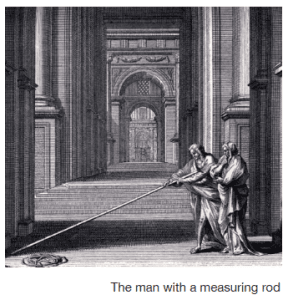 Seven tribes are in the north, five in the south, and between them is a special allotment of land for the priests, Levites, and the city. This allotment measures 25,000 x 25,000, and the unit of measure may be the six-cubit reed mentioned above. Within this allotment, the depth of the portions for the priests and Levites are each 10,000 measures. If we assume the tribal allotments were also 10,000 measures deep, the entire depth of land from north to south would be 145,000 reeds (12 X 10,000 + 25,000 = 145,000). The northern border is given as Hazar-Enan, at the crossroad between the highway from Damascus to Hethlon, and south to Hamath (verse 1). The present city best matching this description is Banias (the Caesarea Phillipi of the New Testament) at the southern base of Mt. Hermon.
On the south, we have Tamar, Kadesh, and the River of Egypt (verse 28, NAS). Tamar is the biblical En-Gedi (2 Chronicles 20:2). These three points delineate a diagonal line from the middle of the Dead Sea to the southern rim of the Mediterranean Sea.
Thus, the distance from the most northern point to the most southern is approximately 250 miles. We can determine the approximate length of the cubit by dividing 250 miles into 145,000 measures, each measure containing six cubits (each cubit extended by a handbreadth, Ezekiel 40:5). This yields a reed length of 9.1 feet, and a cubit length of 18.2 inches. (Another argument against a cubit of 25 inches is that the reed would be over 12 feet long. A man holding a 12-foot rod would be more awkward than if the rod were nine feet.)
Standing in the Gate
Ezekiel 40:3 says the man in bronze “stood in the gate.” We are not told which gate, and the temple had six of them (three to the inner court, three to the outer court). Though it is tempting to think of this as the eastern gate (since that was the gate by which the glory of the Lord entered), probably it was the northern gate, since Ezekiel could see it in vision from his prospect on the northern mount.
The gates here are not ordinary doors, but buildings with multiple rooms for the guards who supervised entrance thereto. The gates were also places of meditation and communion (Ezekiel 44:2,3). Another function of city gates is that they provide a place for the judges of the city to sit and hold court. Each of these functions is appropriate in this vision. The thought of our verse is that the Lord meets with Ezekiel at the place of communication.
Ezekiel’s Commission
“And the man said unto me, Son of man, behold with thine eyes, and hear with thine ears, and set thine heart upon all that I shall shew thee; for to the intent that I might shew them unto thee art thou brought hither: declare all that thou seest to the house of Israel” (Ezekiel 40:4).
Though the vision was for Ezekiel’s eyes alone, it was Ezekiel’s vision of the temple 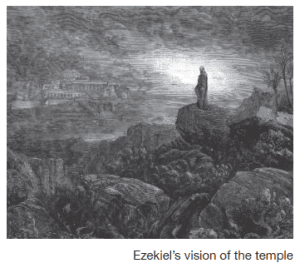 not just for his personal information. He was commissioned to show all he had seen to the House of Israel. And though Ezekiel is writing from Babylon, he does not confine his message to Judea but includes all twelve tribes. This is evident also from the land promises of the final chapter.
However, though he was to communicate all he saw to the entire Hebrew populace, it was not to be done in one message, nor all parts given to all of the exiles. There are further details to this commission in Ezekiel 43:10,11. “Thou son of man, shew the house to the house of Israel, that they may be ashamed of their iniquities: and let them measure the pattern. And if they be ashamed of all that they have done, shew them the form of the house, and the fashion thereof, and the goings out thereof: and the comings in thereof, and all the forms thereof, and all the ordinances thereof, and all the forms thereof, and all the laws thereof. and write it in their sight, that they may keep the whole form thereof, and all the ordinances thereof, and do them.”
The vision was to be shared in two parts. First, he was to give an overall description of the temple for the purpose of producing repentance. Then, and only to those in whom repentance was found, he was to give the further details of the services.
The overall vision can be subdivided into five sections:
1) the structure itself (40:4-43:9),
2) the servants of the temple (44),
3) the services of the temple (44, 45),
4) the river from the temple (47), and
5) the land division of restored Israel (48).
The reiteration of Ezekiel’s commission comes at the transition point between the first two sections. (There is one notable exception: the description of the altar is placed in section two.)
The question might be asked how the description of a physical structure, with precise and intricate measures, could be expected to lead to the emotion of repentance. One merely needs to put himself in the position of a sincere Jewish exile. After the initial shock of deportation, the Israeli community adapted well to life in Babylon. Many became prosperous.
Business enterprises were permitted and encouraged. Some, notably Daniel and his three friends, had risen to high positions in government. In fact, it was so comfortable that when permitted to return by Cyrus, only a small percentage accepted the invitation. Life was not all that bad; it was more comfortable than suffering the rigors of a pioneer and returning.
But one thing was absent. To the sincere Israelite, this one thing meant everything. There was no temple of Jehovah in Babylon. Thus, Daniel prayed three times a day with his face toward Jerusalem. To them, true worship involved regular visits to the place where God had put his name (1 Kings 9:3; 11:36). The vision of Ezekiel, with a restored temple even greater than that of Solomon, was designed to awaken this renewed desire to serve God in his place and in his ways.
Those who were not so moved were not deemed worthy of hearing the details of the temple worship. Those who did show repentance were to be given both the details of temple service and the promises of restoration to their land, and identification with the river of blessing that would reach all the families of the earth.
The same is true today with telling others of God’s plan. We should freely give forth the general outline of that plan with its core message of redemption and restitution for all people. But the deeper truths of personal worship and responsibility, the message of consecration and what it entails, are only for those who show this repentance.
With this background, the further study of the details of Ezekiel’s temple “and all the laws thereof, and all the forms thereof,” will surely bring a blessing to the careful student of God’s word. This message is for the development of the Church of Christ. Speaking of the new Jerusalem, John writes “And I saw no temple therein: for the Lord God Almighty and the Lamb are the temple of it” (Revelation 21:22).
*A close calculation may raise a difficulty here. The fall of Zedekiah was actually 18 years after the first captivity, and thence to the temple vision in the “fourteenth” year after the fall of Zedekiah would be an additional interval of 13 years. The result would be 31 rather than 33 years. — David Rice
–– Beauties of the Truth 1998/1