
The Bible is notable for recording the faults along with the virtues of the characters that cross its pages. Rather than portraits of black and white, people of the Bible are sketched in various shades of gray. Few of its actors are more mottled in gray than Solomon, son of David, king of Israel at the zenith of its power.
He was infamous for his “seven hundred wives and three hundred concubines.” Many of his marriages were to establish political alliances with neighboring countries, thus ensuring the peace that marked his name.
He was infamous for the idolatry which he permitted to please his foreign wives, and even more so for the proximity of this worship to the environs of the magnificent temple of Jehovah in Jerusalem.
Though noted for his ambitious building programs, including his own palatial estate and those of his wives, these came at great cost. The national debt and trade deficits, especially to the Tyrian kingdom of Hiram, nearly placed Israel in bankruptcy. Taxes had been raised to such a level that when his son Rehoboam threatened to raise them again to finance the rising cost of government, it fomented rebellion and the kingdom was split, the larger portion going to his rival Jeroboam.
Defense costs demanded an ever-larger part of the budget, as Solomon built military fortress cities, such as Megiddo, throughout his realm. Horses were imported from Egypt and chariots were introduced into the Hebrew arsenal.
Commercial expansion 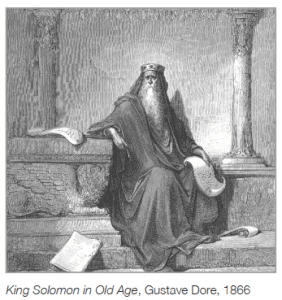 exceeded the power to finance it, with the development of copper mining and smelting industries near Eilat calling for a large fleet of ships to be built and the most modern port of its time established on the nearby island of Ezion Geber. The capital expenditures for these developments provided a further drain on the national treasury. Thus, self-indulgence, idolatry, and profligate spending were the three strikes against this remarkable king.
The Other Side of the Coin
Balanced against this, one must make the following observations on the positive side:
- He humbly asks in prayer for wisdom rather than
- He is the tool for realizing David’s prayer of building a fitting house for
- His prayer at the dedication of the Temple was a model example of repentance and the accompanying petition for forgiveness.
- He was the only king of Israel to expand the borders to those promised by God to Abraham.
- Jesus refers to himself as “the greater than ”
- His kingdom of 40 years, following reigns of the same length by Saul and David, pictures the glorious Millennial age following the Jewish and Gospel ages.
How is such a complex life to be judged? Fortunately, that decision is not ours, safely entrusted to the hands of God. We may make various subjective judgments, but these are based on limited knowledge far removed in time from first-hand witnesses and conflicting circumstantial evidence.
However, there is one source testimony well worth consideration. No one knew Solomon better than Solomon himself. He left behind three autobiographies, none of which appear to be self-serving. These are the books of Song of Solomon, Proverbs, and Ecclesiastes. Though the canonical order is different than this, we suggest that internal evidence supports this order as the chronological order of these writings.
Song of Solomon
Solomon must have inherited the poetic gene from his psalmist father. The phrasing of the Song of Solomon is eloquent in any language, the imagery expressive, and the Hebrew meter precise. While the storyline and its spiritual significance are open to various interpretations, the song. itself is a moving love poem. It is the emotional autobiography of Solomon, enthralled by the deep romantic love of his life.
The first recorded marriage of the king is with the daughter of the pharaoh of Egypt (1 Kings 3:1). Notably, this precedes Solomon’s prayer for wisdom. However, Canticles celebrates his marriage with a Shulamite and not an Egyptian. Although there is no record of it, this wedding with the Shulamite may well have been an even earlier union. Clearly, the events described take place during the lifetime of Bathsheba for he receives his marital diadem from his mother (Canticles 3:11).
Although sensuous, even erotic, in its imagery, the underlying theme is of the deepest love a man can have for a woman. Taken in connection with the description of a hardworking and devoted wife in Proverbs 31:10-31, this book provides a picture of the Old Testament ideal for marriage.
Proverbs
If the Song of Solomon is the emotional biography of Solomon, Proverbs is his mental biography, detailing his lifelong search for wisdom.
It is probable that the book of Proverbs was compiled, and partially written, by Solomon in the earlier part of his reign. The theme may have been suggested by Solomon’s request for wisdom shortly after the onset of his kingship. The book naturally divides into four sections, the first and third being messages to Solomon while the second and last portions were sayings either compiled or penned by the king. After a short introduction, the first section opens with the words “My son, hear the instruction of thy father, and forsake not the law of thy mother” (Proverbs 1:8). Since David died at the beginning of Solomon’s reign it is reasonable to suppose that his mother Bathsheba wrote this first section (and probably the third as well).
This section includes a call to wisdom as the prime attribute of life and defines wisdom as that which is in harmony with the Creator. The section concludes with the longest parable in the Bible, covering chapters 7, 8, and 9 in which the rival claims of wisdom, personified as a woman, and foolishness, represented by a harlot, are presented.
Solomon’s response to this call to wisdom is in a series of short adages in chapters 10 through 22:16. This section was so valued in latter times that Hezekiah had his scribes copy them (Proverbs 25:1). He is then given further instruction (through the 24th chapter) before concluding with his own responses. The last two chapters, though attributed by the Jewish rabbis to Solomon, are a collection from other sources (chapter 30) and a closing admonition from his mother in chapter 31 (note verse 1).
Ecclesiastes
It is in the third autobiography of Solomon, however, where we see the biography of his heart. Ecclesiastes is a deeply introspective book. Written in his old age, when his sight was failing and sleep was difficult (Ecclesiastes 12:2-7), it records the reflections of a chastened and wiser king. The wisdom, for which he had spent his life searching, seems finally within his grasp.
The first six chapters delineate the disappointments of his seemingly fruitless search for meaning in life, while the last six catalog the lessons learned from his search. The word “vanity,” the keyword of the entire book, is well rendered “meaningless” by the New International Version.
In the first portion, he bemoans the transitoriness of all he has tried (Ecclesiastes 1:4-11); how all is spoiled by the existence of evil (Ecclesiastes 1:12-18); and how the rewards of pleasure, work, and riches (Ecclesiastes 2) are all cut short by the certainty of death (Ecclesiastes 3). He recalls the inequities of injustice and how riches are unsatisfying because their enjoyment is limited to the short life span of man (Ecclesiastes 4-6).
In the second section, he concludes that the problem is human sin and selfishness and that the conclusion lies in the inscrutable providence of God, which purposefully uses natural disorders to chastise men. With these observations, Solomon moves on to the conclusions his life has brought.
The light he has discovered through his introspection is indeed “sweet” and not to gather that lesson would be indeed vanity, “meaningless” (Ecclesiastes 11:7,8).
Ruefully he bemoans a fact that was not his lot — “remember thy Creator in the days of thy youth” and thus avoid the darkness that plagued his life.
Now, having gained the wisdom that was his life-long quest, he resolves to continue being a teacher to his people, setting forth even more proverbs for reverential living. Now his instruction will aim toward one single goal — “fear God and keep his commandments” (Ecclesiastes 12:13).
While others may look at Solomon as a man who fell far short of his youthful promise — and such was surely the case — Solomon sees the sum of his life as a repentant penitent who, having gone widely astray, seeks to return to the God of his ancestors, the God of his father and mother, and the God for whom the prophet Nathan, his childhood tutor, taught him to worship and serve.
–– Beauties of the Truth 2003/1