
Overview, Psalm 51
To the chief Musician, A Psalm of David, when Nathan the prophet came unto him, after he had gone in to Bathsheba. –– Psalm 51
David’s prayer for forgiveness after his sin with Bathsheba is rightly considered a model expression of repentance and plea for forgiveness. It is noteworthy that this Psalm is assigned to the chief musician — as a hymn to be repeatedly sung. There is no attempt to hide or downplay his misdeed, his repentance is both public and, by repetition, enduring.
Nor does he wait for his sin to be discovered but makes his public confession “when Nathan the prophet came unto him,” upon the first realization of the enormity of his guilt.
“Have mercy upon me, O God, 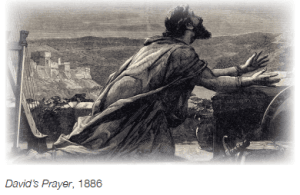 according to thy lovingkindness: according unto the multitude of thy tender mercies blot out my transgressions. Wash me thoroughly from mine iniquity, and cleanse me from my sin. For I acknowledge my transgressions: and my sin is ever before me. Against thee, thee only, have
I sinned, and done this evil in thy sight: that thou mightest be justified when thou speakest, and be clear when thou judgest. Behold, I was shapen in iniquity; and in sin did my mother conceive me. Behold, thou desirest truth in the inward parts: and in the hidden part thou shalt make me to know wisdom. Purge me with hyssop, and I shall be clean: wash me, and I shall be whiter than snow” (Psalms 51:1-7).
Sin and Iniquity
In these few verses David uses three different Hebrew words to describe the error of his ways. These are represented by the English words “iniquity,” “sin,” and “transgression.”
We demonstrate the distinction in these terms in the chart below.
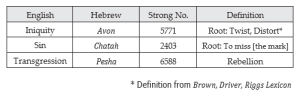
From the above definitions we can infer that to sin, to miss the mark as an archer with good intent does not always hit a bull’s eye, is to err with no intention of doing wrong; while iniquity, a twisting or distortion of right principles, is more reprehensible.
Verse 5 illustrates a further difference between the words for “sin” and “iniquity.” We are “born in sin,” but “shapened in iniquity.” Behavioral scientists have long recognized that the two vital elements that shape a man’s character are heredity and environment. David expresses the same thought.
We are born in sin. Genetically the effects of original sin are passed down from one generation to another. But we are shaped in iniquity. Iniquity is not an inherited trait; it is a result of environmental forces.
Transgressions
The third word the Psalmist uses to describe his wrongdoing is “transgression.” From the table above we see that the Hebrew word used here suggests rebellion. Rebellion is compared to witchcraft in 1 Samuel 15:23, a passage which Adam Clarke translates “As transgression comes from iniquity, divination from teraphim, and rebellion from stubbornness, so because thou hast rejected the word of the LORD, he hath also rejected thee [Saul] from being king.”
If this is correct, then transgression is an outgrowth of iniquity. Partial willfulness leads to greater willfulness, which in turn leads to stubbornness and its successor, rebellion.
This reasoning suggests that David recognized three gradations in sin, pleading guilty to all three — inherited sin (chatah, sin), measurable willfulness (avon, iniquity), and stubborn persistence in a wrong course (pesha, rebelliousness). All three are within the forgiving power of God. “Keeping mercy for thousands, forgiving iniquity and transgression and sin, and that will by no means clear the guilty; visiting the iniquity of the fathers upon the children, and upon the children’s children, unto the third and to the fourth generation” (Exodus 34:7).
Antidotes
The verbs the penitent uses in his prayer as he pleads for remedies for his guilt are also instructive. We will examine ten of these antidotes from Psalm 51.
1 –– “Blot out my transgressions” (verse 1)
2 –– “Wash me thoroughly from my iniquity” (verse 2)
3 –– “Cleanse me from my sin” (verse 2)
4 –– “Purge me with hyssop, and I shall be clean” (verse 7)
5 –– “Wash me, and I shall be whiter than snow” (verse 7)
6 –– “Hide thy face from my sins” (verse 9)
7 –– “Blot out all mine iniquities” (verse 9)
8 –– “Create in me a clean heart” (verse 10)
9 –– “Renew a right spirit within me” (verse 10)
10 –– “Deliver me from blood guiltiness” (verse 14)
1) “Blot Out My Transgressions” — The allusion is to a charge that is written in a book, as in a court record. He would have these charges removed from the record. This he pleads based on God’s mercy and not based on justice. Isaiah 43:25 states, “I, even I, am he that blotteth out thy transgressions for mine own sake, and will not remember thy sins.” It is a plea to God’s magnanimity (“for mine own sake”) that willfulness can be removed from the annals of the divine
2) “Wash Me Thoroughly from My Iniquity” — The Hebrew word for “wash” is kabac (Strong’s 3526) and literally means “to whiten.” On four occasions it is translated as “fuller (dyer).” It would not be inappropriate to render it “bleach.”
The International Standard Bible Encyclopedia has an interesting description of the cleansing process used by the fuller:
“The Syrian indigo dyer still uses a cleaning process closely allied to that pictured on the Egyptian monuments. The unbleached cotton is soaked in water and then sprinkled with the powdered ashes of the ishnan, locally called qali, and then beaten in heaps on a flat stone either with another stone or with a large wooden paddle. The cloth is washed free from the alkali by small boys treading on it in a running stream or in many changes of clean water (compare En-Rogel, literally, “foot fountain,” but translated also “fuller’s fountain” because of the fuller’s method of washing their cloth).”
The earliest soaps were powdered ashes, usually vegetable but sometimes also from burnt animals. These ashes were called qali, from which we derive our English word alkali, a main ingredient in soap today. Probably from this usage the ashes of the red heifer (Numbers 19:17-19) were used as part of a spiritual cleansing in the Tabernacle.
The word ishnan, used above, is of Indian origin and describes the purification process used by the Sikh community. The Imperial College Union of London, commenting on this purification ritual, states: “The Sikhs are told to clean the body and mind from vices and sins. The Sikh must wash up the body, clean the mind in nectarine stream, and bathe the soul in the love of God.”
Thus, David is praying for a thorough (Hebrew, repeated) cleansing by the use of symbolic ashes and repeatedly being trodden underfoot — a recognition of the need for chastising experiences to correct him from the error of his ways.
3) “Cleanse Me from My Sin” — One of Professor Strong’s definitions for the word translated cleanse (taher, Strong’s 2891) implies Sin is an inherent contaminant. Only the blood of Christ can remove the contaminant of sin. David desires cleansing from the effects of Adamic sin and the chastisements necessary to remove his willfulness.
4) “Purge Me with Hyssop” — Though this is possibly a reference to the ritual cleansing of ancient Israel through the sprinkling of the ashes of the red heifer mixed with burnt hyssop (Numbers 19:1-14), it more likely refers to the cleansing of the leper where the hyssop was used for sprinkling blood on the sick man (Leviticus 14:6,7). Alternatively, it might be a reference to the first Passover in Egypt, when hyssop was used to sprinkle the doorposts and lintels as protection from the death angel of the last plague preceding the Exodus.
The word “purge” is the Hebrew chatah, the same word usually translated “sin” or “sin offering.” Adam Clarke translates Psalm 51:7, “Thou shalt make a sin offering for me with hyssop.” It might be worth noting here that the American Standard Version correctly translates Numbers 19:9, speaking of the sacrifice of the red heifer, “it is a sin offering.” 1 Leviticus 14:13 similarly relates the offering in the cleansing of the leper to a sin offering.
The purging which here cleanses evidently refer to the chatah of verse 2, alluding to Adamic sin.
5) “Wash Me, and I Shall Be Whiter Than Snow” — As in verse 2, the word “wash” is used to describe the thorough washing of the fuller, a whitening or bleaching by the application of an alkaline soap and trampling underfoot to allow the ashes to thoroughly penetrate the pores of the cloth before being rinsed away in cold This was not to remove the sin but the concomitant iniquity for which David claimed personal responsibility.
6) “Hide Thy Face from My Sins” — Only the redeeming merit of Christ can cover our Adamic weaknesses from the searching eyes of that divine justice which has “purer eyes than to behold evil” (Habakkuk 1:13).
7) “Blot Out All Mine Iniquities” — Recognizing that his stubborn willfulness had caused him to sin with Bathsheba, he again pleads for God’s mercy in erasing that shortcoming on the commitment that David would pledge not to become a repeat
8) “Create in Me a Clean Heart” — Mending the heart was not enough, there was a need for a clean heart to be created. Such a spiritual heart transplant can come only at the cost of the death of the old heart. Paul states the principle, as applied to another age, thus: “For in Christ Jesus neither circumcision avails any thing, nor uncircumcision, but a new creature” (Galatians 6:15). David knew he could not accomplish this, but that it would need to be created by God alone.
9) “Renew a Right Spirit Within Me” — Here he requests the He once had had a right spirit. He had lost that with his dreadful misdeed. He desired to return to his former spirit and consequent relationship with God. This would require a process in which he would need to cooperate with a determined effort to reform.
10) “Deliver Me from Blood Guiltiness” — Verse 14, in which this expression is found, begins a new section of the The writer turns from the sin against Bathsheba to focus on the sin against Uriah, whom David arranged to have killed in battle, hoping to cover up the sin of adultery.
Recognizing his guilt for that blood, he throws himself on God’s mercy and asks deliverance from that burdening emotion.
Guilt has both a proper and improper place in our lives. This heavy overburdening emotion should, like a weighty load, cause our knees to buckle in prayer. Once it has produced that repentant condition of heart, divine forgiveness must be accepted, and the burden laid aside or else we will not be able to rise again. How true it is that “a just man falleth seven times, and riseth up again; but the wicked [remaining non-repentant] shall fall into mischief” (Proverbs 24:16).
The Result of Restoration
“Restore unto me the joy of thy salvation; and uphold me with thy free spirit. Then will I teach transgressors thy ways; and sinners shall be converted unto thee” (Psalm 51:12,13). Here is the reason why God permits mistakes in our Christian lives. Lessons learned can become lessons taught.
This is the method by which the Church is trained to become teachers with Christ. This is how the Church’s part in the sin offering works.
There is great truth in the tale that is told of the conversation between the disciple and his teacher. Disciple: “Tell me, Master, what is the source of your wisdom.” Master: “Good choices, my son.” Disciple: “And how did you learn to make such good choices.” Master: “By experience.” Disciple: “And how did you receive such experience.” Master: “Bad choices, my son, bad choices.”
Solomon phrased it this way: “And I gave my heart to seek and search out by wisdom concerning all things that are done under heaven: this sore travail hath God given to the sons of man to be exercised therewith” (Ecclesiastes 1:13). To which David agrees, “Before I was afflicted I went astray: but now have I kept thy word. It is good for me that I have been afflicted; that I might learn thy statutes” (Psalm 119:67, 71).
Additional Scriptural Confirmation
Three additional scriptures can be cited which imply the same distinction between sin, iniquities, and transgressions. Isaiah 53:5 — “But he was wounded for our transgressions, he was bruised for our iniquities: the chastisement of our peace was upon him; and with his stripes we are healed.”
It was not Jesus’ death, but his wounding, the daily dealing with man’s condition, which gave him the necessary empathy to help us overcome our rebelliousness. “For in that he himself hath suffered being tempted, he is able to succor them that are tempted” (Hebrews 2:18). Likewise, it was his bruising that was especially for our iniquities.
The Hebrew daka, here translated as “bruised,” literally means to crush underfoot. This is the same process that was used in the ancient cloth washing of the fuller, a term we also noted was for iniquities. Jesus suffered at the hands of iniquitous men to understand iniquity and help men overcome it in his kingdom.
Leviticus 16:21 — “And Aaron shall lay both his hands upon the head of the live goat, and confess over him all the iniquities of the children of Israel, and all their transgressions in all their sins, putting them upon the head of the goat, and shall send him away by the hand of a fit man into the wilderness.”
In the offering of the scapegoat on the Day of Atonement, it was not the sins of Israel that were removed. These had been atoned for by the sin offering of a bullock and a goat. Rather it was the iniquities and the amount of transgression in their sins which were thus taken away. To paraphrase the latter portion of this verse, “confess over him all the partial willful sins and the degree of willfulness in their sinful ways.”
This work is generally, and we believe correctly, applied by Bible students to the work of the Great Company, as is implied in our third text:
Ezekiel 44:10 — “The Levites that are gone away far from me, when Israel went astray, which went astray away from me after their idols; they shall even bear their iniquity.”
This text appears to confirm the identification of the scapegoat with the Great Company, for it is generally agreed that this is the class whom the Levites typify. Here, as with the scapegoat, it is not a sin offering, but to erase iniquity that they are to accomplish. The reason is given as well, “because they went far away from me after their idols” (also note Ezekiel 44:15, 48:11).
How often, in each of our lives, we find ourselves guilty of all three — sin, iniquity, and transgression — Adamic weakness, perverse willfulness, and stubborn rebellion. How grateful we are that God has, in Christ, provided a remedy for all three.
(1) Calling the red heifer “a sin offering” should not be confused with the sin offering of Leviticus 16. The Apostle Paul specifies those sin offerings in which “the blood was brought into the sanctuary for sin” (Hebrews 13:11). Israel had many sin offerings, but the one on the Day of Atonement was special and unique.
–– Beauties of the Truth, 2003/2