
Wisdom Better Than an Army
There was a little city, and few men within it; and there came a great king against it, and besieged it, and built great bulwarks against it: Now there was found in it a poor wise man, and he by his wisdom delivered the city; yet no man remembered that same poor man. –– Ecclesiastes 9:14,15
Chaos reigned supreme in Israel after the forces of David squelched the rebellion of his son Absalom. There was dissension in the military. Joab, the son of David’s sister Zeruiah, had been the commanding general since
David assumed the throne. However, Joab had fallen into David’s disfavor. The king appointed another nephew, Amasa, the son of his sister Abigail, to Joab’s former position (2 Samuel 19:13). The choice of Amasa may also have been partly a diplomatic move to heal the country since Amasa had been commander of the forces of Absalom (2 Samuel 17:25).
Politically, the union of the two-tribe southern kingdom and ten-tribe northern area which David had striven so hard to achieve, was threatening to fall apart. The northerners were upset because the tribe of Judah had not consulted them concerning arrangements for David’s triumphal return to Jerusalem. Judah based their claim to the right to make these arrangements on their kinship to the returning king. Israel argued that they, by the mere fact of numbers, had a ten-fold interest in the king (2 Samuel 19:41-43).
Meanwhile, Sheba of Benjamin, possibly in a desire to restore the throne to the Benjaminite house of Saul, was drumming up support for a coup to oust David from the kingship. Taking advantage of the jealousy between the ten tribes and Judah, he began seeking support in the north.
David moved decisively to put down the secession cause of Sheba. He gave Amasa three days to assemble an army to pursue the Benjaminite. When the newly appointed commander was unable to accomplish this task in the allotted time, David turned the job over to Abishai and Joab. Joab enlisted mercenaries from the Canaanite Cherithites and the Philistine Pelethites and began the pursuit of Sheba.
Along the way he met Amasa who had by now gathered the troops David had requisitioned. Grabbing Amasa’s beard in pretended friendship, Joab killed his cousin and rival (2 Samuel 20:10). Adding those who proclaimed fealty to David to his band, Joab proceeded in his pursuit of Sheba.
Abel-Bethmaacah
The pursuing army caught up with their prey in the far northern city of Abel- Bethmaacah, some 12 miles due north of the Sea of Galilee. Sheba and the “Berites” had come here to enlist recruits for his campaign against David. Since there is no discovered area for these “Berites,” it is probable that the Latin Vulgate correctly translates the word “choice young men”— the recruits Sheba had already chosen for his ragtag army.
Abel-Bethmaacah was no mean town. Originally called Abelmaim [meadow of waters] it was renamed in honor of Maacah, the king of neighboring Geshur who probably controlled the region for a time (2 Samuel 3:3). It was the capital city and a site of large grain storage in the tribe of Naphtali (2 Chronicles 16:4). The town was noted for its learning and wisdom. In the International Standard Bible Encyclopedia, Willis Beecher writes: “The adjacent region is rich agriculturally, and the scenery and the water supply are especially fine. Abel-maim, ‘meadow of water,’ is not an inapt designation for it.”
When the Hebrew army arrived, they began an immediate assault. First, they laid siege by stopping all traffic from coming or going. Then they began preparations to take the city. Today’s English Version perhaps best conveys the methods used: “They built ramps of earth against the outer wall, and also began to dig under the wall to make it fall down” (2 Samuel 20:15).
A Wise Woman
This background brings us to a consideration of a woman who was not remembered. The account is found in 2 Samuel 20:15-22.
“And they came and besieged him in Abel of Bethmaachah, and they cast up a bank against the city, and it stood in the trench: and all the people that were with Joab battered the wall, to throw it down. Then cried a wise woman out of the city, Hear, hear; say, I pray you, unto Joab, Come near hither, that I may speak with thee. And when he was come near unto her, the woman said, Art thou Joab? And he answered, I am he. Then she said unto him, Hear the words of thine handmaid. And he answered, I do hear. Then she spake, saying, They were wont to speak in old time, saying, They shall surely ask counsel at Abel: and so they ended the matter. I am one of them that are peaceable and faithful in Israel: thou seekest to destroy a city and a mother in Israel: why wilt thou swallow up the inheritance of the LORD? And Joab answered and said, Far be it, far be it from me, that I should swallow up or destroy. The matter is not so: but a man of mount Ephraim, Sheba the son of Bichri by name, hath lifted up his hand against the king, even against David: deliver him only, and I will depart from the city. And the woman said unto Joab, Behold, his head shall be thrown to thee over the wall. Then the woman went unto all the people in her wisdom. And they cut off the head of Sheba the son of Bichri, and cast it out to Joab. And he blew a trumpet, and they retired from the city, every man to his tent. And Joab returned to Jerusalem unto the king.”
First, we note the bravery of this woman. Since the city was under siege, 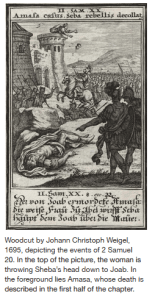 it is impossible to imagine that the gates would be open for her to call out for Joab. Considering the amount of noise that was going on in the construction of the ramparts and the continuous slamming of the battering rams, it is inconceivable that she could make her voice heard from within the city walls. She must have either ascended the walls, putting her in plain view of the attackers, or, like Rahab in Jericho, lived in a place that had a window through the outside walls. Most likely she climbed the walls and called from there.
Joab was sufficiently impressed with her boldness and bravery to give her a private audience and came close enough that they could hold a conference. Her words were well composed. Her voice showed no fear. She systematically outlined her argument against the army’s attack on her city. “The words of wise men are heard in quiet more than the cry of him that ruleth among fools” (Ecclesiastes 9:17). As the prophet wrote, “In quietness and in confidence shall be your strength” (Isaiah 30:15).
She bolstered her plea for the city with four arguments:
1) The counselors and sages in Abel were so well noted that their decisions in a dispute “ended the matter.” It was almost as though the counsel of Abel was considered the supreme court of the region.
2) She and, presumably, the city for which she pleaded, were both peaceable and faithful to Jewish law and The very tone of voice that her words imply was both calm and peaceable, designed more to reason than to support her position. There is an implied rebuke in this argument, for the Jewish law did not permit the attack of even an enemy city without first making an offer of a peaceful settlement. “When thou comest nigh unto a city to fight against it, then proclaim peace unto it. And it shall be, if it make thee answer of peace, and open unto thee, then it shall be, that all the people that is found therein shall be tributaries unto thee, and they shall serve thee. And if it will make no peace with thee, but will make war against thee, then thou shalt besiege it” (Deuteronomy 20:10-12). If this were true of a Canaanite city, how much more would it be true against a city of their nation and religion?
3) The city was “a mother in Israel.” This phrase was a Hebrew idiom indicating a recognized administrative capital (see Keil and Delitzsch, Commentary on the Old Testament).
4) The city was not Joab’s to take but was part of the “inheritance of the Lord.” In other words, the city was not part of Judah’s tribal lot but was given by the Lord to the people of
A term we often hear in military attacks is “collateral damage.” Joab would have been guilty of immense collateral damage if he had attacked Abel-Bethmaacah to bring Sheba and his few followers to justice. This appears to be the main thrust of the woman’s argument.
Impressed with her words, Joab virtually apologized and laid down one pre- condition for lifting the siege — the surrender of Sheba. It is noteworthy that he does not request that Sheba’s followers also be delivered, perhaps feeling that if the leader of the revolt were gone, the rebellion would be successfully quenched.
There is no indication that this woman had any standing amongst the judges of the city. Yet, she persists in her attempt to secure peace, persuading the town fathers to execute Sheba and throw his head over the wall. The city judges are persuaded, and the siege is lifted. So, the woman saved the city of Abel-Bethmaacah with her wisdom.
Solomon’s Comments
Less than a half-century later Solomon wrote Ecclesiastes, the third of his biblical works.
“This wisdom have I seen also under the sun, and it seemed great unto me: There was a little city, and few men within it; and there came a great king against it, and besieged it, and built great bulwarks against it: Now there was found in it a poor wise man, and he by his wisdom delivered the city; yet no man remembered that same poor man. Then said I, Wisdom is better than strength: nevertheless, the poor man’s wisdom is despised, and his words are not heard. The words of wise men are heard in quiet more than the cry of him that ruleth among fools. Wisdom is better than weapons of war: but one sinner destroyeth much good” (Ecclesiastes 9:13-18).
It is debatable whether Solomon had this instance in mind when he wrote these words. He could have been giving a generic parable or referring to another incident in a nearby country. But he could have been referencing the incident at Abel- Bethmaacah, the account being so unremembered that even her gender was forgotten. The tale of the wise woman happened within a generation of the time Solomon wrote these words.
In any case, the story of Abel-Bethmaacah well illustrates the principles Solomon is enunciating. How often words of wisdom, though heeded at the time, go unremembered! How frequently well-known quotes of wisdom are marked “Anonymous.” True wisdom seeks not fame, but for the logic of its reasoning to be noted and appreciated. True men of God often come from the humbler walks of life and the sagacity of their thinking will long outlive the remembrance of their name.
Certainly, in the case under study in this article, the words of the wise woman were better than the strength of Joab’s mighty army. Her wisdom repelled all the siege weapons of war because she did not, by her wisdom, permit one sinner (Sheba) to destroy much good.
A Final Lesson
The nineteenth-century theologian Wangemann suggests a personal application: “The beleaguered city is the life of the individual; the great king who lays siege to it is death and the judgment of the Lord.” In this illustration, the obvious application of the poor wise woman is to the principle of wisdom itself, as it is personalized in Proverbs chapters 7 to 9. It is only through the application of divine wisdom, as found in God’s holy book, that a Christian can find the answer to the condemnation of death and the knowledge of it working in his members.
While we may not be privileged to ever know the name of the “wise woman,” let us each be ever mindful to apply her counsel in our hearts and lives.
–– The Herald of Christ’s Kingdom 1999/5