
He shall cover thee with his feathers, and under his wings shalt thou trust: his truth shall be thy shield and buckler. –– Psalm 91:4
The familiar words of this divine promise present before the mental vision of many of us the mighty wings of a great eagle or the protective fold of the mother hen for her young. Either vision is comforting. Both portray to us the loving care of a concerned heavenly Father. But is this the imagery of this particular psalm?
According to Jewish tradition, this psalm, like the one that precedes it, is a Psalm of Moses. Some translations run the two psalms together as one. The indications are, then, that this psalm is associated with the wilderness wanderings of Israel. In the 90th Psalm, the authorship of Moses gives special weight to such verses as 3, 7, 10, 12, and 15. Similarly, in the 91st Psalm, verses 1, 2, 7, 9, 10, and 13 take on added meaning with this background.
The opening of this psalm suggests that it was written in celebration of the construction of the Tabernacle.
“The secret place of the Most High” appears to be a reference to the Most Holy of the Tabernacle. This interpretation is suggested on page 43 of Volume 4 of Studies in the Scriptures and is supported by a reference on Reprint page 3331, section 5. In other references (Reprints, pp. 4925, 5815, 5989, 1913), Pastor Russell applies this to the Holy. If the Most Holy is the correct interpretation, it is probably in the sense of the hopes of the Christian, as in Hebrews 6:19, “Which hope we have as an anchor of the soul, both sure and steadfast, and which entereth into that within the veil.”
The expression in verse one, “abiding under the shadow of the Almighty;” seems peculiarly appropriate to the Most Holy where Jehovah’s presence was manifest through the Shekinah glory.
The expressions “refuge and fortress” in verse two, though applicable to God’s protection in general, seem particularly apt in reference to the security they felt in the Tabernacle with its assurance that God was with them and had taken up his dwelling in their midst.
With this contextual background, we come to the verse under consideration. The context of the Tabernacle picture is suggestive that the “wings” and “feathers” referenced are not bird wings but angel wings. In the Most Holy of the Tabernacle rested the ark of the covenant. Its Mercy Seat was topped with two carved cherubim or angels. Their faces were cast downward toward the Mercy Seat, their wings in repose, almost touching each other. Many feel that these two wings represent God’s love and power waiting for the sprinkling of the atonement blood on the Mercy Seat.
In the later Temple construction, these angels are overtopped by two large carved cherubim, with outstretched wings as though to fly, looking outward towards the Holy. These apparently indicate that the Temple picture applies after the blood is sprinkled and these angels of love and power are ready to accomplish their redemptive work. The small shadow of the Tabernacle cherubim gives way to the far larger shadow of the Temple picture.
With these thoughts in mind, we read on in Psalm 91:11,12, “For he shall give his angels charge over thee, to keep thee in all thy ways. They shall bear thee up in their hands, lest thou dash thy foot against a stone.”
Once again it is the imagery of angels, not of birds, that is referenced.
Other scriptures attest to this relationship of covering wings and the house of the Lord.
Psalms 61:4 — “I will abide in thy tabernacle for ever: I will trust in the covert of thy wings. Selah.”
Psalms 63:2,7 — “To see thy power and thy glory, so as I have seen thee in the sanctuary. Because thou hast been my help, therefore in the shadow of thy wings will I rejoice.”
Psalms 36:7,8 — “How excellent is thy lovingkindness, O God! therefore the children of men put their trust under the shadow of thy wings They shall be abundantly satisfied with the fatness of thy house; and thou shalt make them drink of the river of thy pleasures.”
2 Chronicles 5:7,8 — “And the priests brought in the ark of the covenant of the LORD unto his place, to the oracle of the house, into the Most Holy place even under the wings of the cherubim: For the cherubim spread forth their wings over the place of the ark, and the cherubim covered the ark and the staves thereof above.”
Hebrews 9:5 — “And over it, the cherubim of glory shadowing the mercy seat; of which we cannot now speak particularly.”
The same forcefulness of “angels’ wings” can be seen to a lesser extent if the term “the secret place of the Most High” refers to the Holy. Here, too, the priest was overshadowed with angels’ wings. Angels formed the main decorative aspect of the Holy. At the very least, they were found on the second veil (Exodus 26:31) and overhead on the linen covering. (Exodus 26:1) It is also possible that they were seen on the door leading into the Holy (though that is not evident in Exodus 26:36). If the suggestion of Anton Frey on page 109 of his Notes on the Tabernacle is correct, these angelic images may have also been evident on the side walls of the Holy. There he suggests that it “is … plausible … that the ‘boards’ were light, strong frames shaped somewhat like the accompanying figure, sufficiently rigid to sustain the weight of the curtains and give the necessary firmness to the walls and yet so open as to allow the rich embroidery of the inner curtains to be visible from the inside, which would be impossible on the ordinary theory that qeresh means a solid ‘board’ or pillar. This imagery was also picked up in both the Temple of Solomon (1 Kings 6:29) and that of the vision of Ezekiel 41:18.”
Another related term is “the wings of the wind:” This is found in 2 Samuel 22:10,11, which is quoted 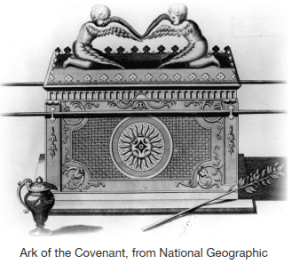 in its entirety in Psalm 18:9,10: “He bowed the heavens also, and came down: and darkness was under his feet. And he rode upon a cherub and did fly: and he was seen upon the wings of the wind.” Pastor Russell treats David in the Samuel context as a picture of the Church and imagery as that of the deliverance of the truth through a time of trouble (Reprints, p.153).
Adam Clarke, in his Commentary, notes the following: “This seems to be the image intended to be conveyed in the place before us. ‘He rode upon a cherub and did fly; he flew on the wings of the wind, i.e., the cherub supported and led on the tempest, in which the Almighty rode as in his chariot. This is agreeable to the office elsewhere ascribed to the cherubim. Thus, they supported the mercy seat, which was peculiarly the throne of God under the Jewish economy:”
A similar expression (referring to the giving of the law at Mt. Sinai) which associates the angels as God’s chariots is found in Psalm 104:3,4: “Who layeth the beams of his chambers in the waters: who maketh the clouds his chariot: who walketh upon the wings of the wind. Who maketh his angels spirits; his ministers a flaming fire.”
In these passages the cherubim form a chariot, as it were, swiftly transporting the Lord to his appointed tasks. It is this image we see examined in considerable detail in Ezekiel 1. We quote selected verses for brevity.
“And I looked, and, behold, a whirlwind came out of the north, a great cloud, and a fire infolding itself, and a brightness was about it, and out of the midst thereof as the color of amber, out of the midst of the fire. Also out of the midst thereof came the likeness of four living creatures. And this was their appearance; they had the likeness of a man … And they had the hands of a man under their wings on their four sides; and they four had their faces and their wings. Their wings were joined one to another; they turned not when they went; they went every one straight forward … Whithersoever the spirit was to go, they went, thither was their spirit to go; and the wheels were lifted up over against them: for the spirit of the living creature was in the wheels … And when they went, I heard the noise of their wings, like the noise of great waters, as the voice of the Almighty, the voice of speech, as the noise of an host: when they stood, they let down their wings. And there was a voice from the firmament that was over their heads, when they stood, and had let down their wings. And above the firmament that was over their heads was the likeness of a throne, as the appearance of a sapphire stone: and upon the likeness of the throne was the likeness as the appearance of a man above upon it” (verses 4, 5, 8, 9, 20, 24-26).
This image of God’s angels as a chariot is also found in Psalm 68:17, “The chariots of God are twenty thousand, even thousands of angels: the Lord is among them, as in Sinai, in the holy place.” This was well illustrated when the Syrian army invaded the ten-tribe city of Dothan in the days of Elisha the prophet. The relevant verse is 2 Kings 6:17, “And Elisha prayed, and said, LORD, I pray thee, open his eyes, that he may see. And the LORD opened the eyes of the young man; and he saw: and, behold, the mountain was full of horses and chariots of fire round about Elisha.”
The wording here perhaps gives a clue to another use of the imagery of chariots in the Bible. When Elijah and Elisha walked together beyond Jordan, they were separated by a chariot of fire. “And it came to pass, as they still went on, and talked, that, behold, there appeared a chariot of fire, and horses of fire, and parted them both asunder; and Elijah went up by a whirlwind into heaven” (2 Kings 2:11). These chariots, we suggest, represent the angelic protection at the time of the final glorification of the church.
In summary, we have seen that though the thought of the wings of birds is often used in the Bible to show divine protection for the Church (as in Exodus 19:4, Psalm 68:13, Matthew 23:37), this does not appear to be the analogy in Psalms 91. There, as in many other places, we have a more specific application of wings to the comfort and assistance of the angelic “Are they not all ministering spirits, sent forth to minister for them who shall be heirs of salvation?” (Hebrews 1:14)
–– Beauties of the Truth 1999/2