
Yea, they that feed of the portion of his meat shall destroy him, and his army shall overflow: and many shall fall down slain. And both these kings’ hearts shall be to do mischief, and they shall speak lies at one table; but it shall not prosper: for yet the end shall be at the time appointed. –– Daniel 11:26, 27
In Volume 3, page 34, of Studies in the Scriptures, verse 26 is applied to the Roman emperor Aurelian, and verse 27 to the rise of clerical, or papal, power. “Verse 27 applies not to Rome and Egypt, but to two kings or powers
in the Roman empire the Imperial power gradually dying, and the Clerical power slowly coming to life and ambition. Each sought to use the other for its selfish ends while denying such designs.”
Since there is no suggestion in verse 27 of a time jump from verse 26, and since there was no clerical temporal power in the days of Aurelian (270-275 AD), the question arises: what basis is there for this interpretation? The purpose of this article is to resolve this question.
Further complicating this issue is the fact that verse 28 refers again to Aurelian, his return from defeating Queen Zenobia at Palmyra in Syria with great spoil, and his subsequent turn to violent opposition and oppression of Christianity.
Historical Background
The period from 235 to 285 AD saw a marked decline in the government of Rome. Twenty-four different emperors reigned during this period. The growing size of the empire and dissensions between the Senate and the Emperor made the task of ruling Rome almost impossible.
After 285, strong empirical powers were given to the Emperor and Rome entered a totalitarian state of government. One of the strongest of these rulers was Diocletian. Realizing the size of his task, Diocletian divided the empire into four administrative districts, called tetrarchs, and shared power with Maximian, Galerius, and Constantius I.
When Diocletian and Maximian retired, Galerius became the chief ruler in the East. Just before his death he issued an edict of toleration granting freedom of worship and paved the way for the legalization of Christianity by Constantine I.
Galerius then named Licinius emperor in the West, which was beset by civil war. Licinius joined ranks with the son of Constantius, Constantine, who defeated Maxentius at the battle of the Milvian Bridge near Rome in 312 and Maximinus Daia in 313.
Constantine’s tilt toward Christianity brought him into conflict with the pagan Licinius. In 324 Constantine defeated Licinius at Adrianople and Chrysopolis, thus becoming the chief ruler in the West.
The death of Galerius and the defeat of his successor Maximinus Daia left Constantine in charge of the entire empire. His conversion to Christianity and the calling of the Council of Nicea in 325 gave rise to the beginnings of a clerical hierarchy with high governmental connections.
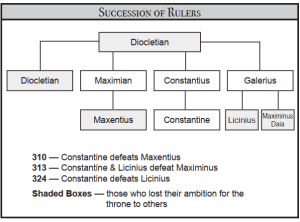
The Two Kings
The above history suggests that there were two literal kings, Galerius and Maximian, who fulfilled the prophecy of Daniel 11:27 in the time shortly following that of the preceding verse, applying to Aurelian in 275. The mischief and lies relate to the power struggle involved in the division between east and west declared by Diocletian, and the continuing civil war in the west.
The result of these disputes, however, was to place Constantine in firm power as the reorganizer of the Roman empire. This, in turn, produced the two lines of powers, kings, which are referenced in Volume 3 — the clerical and the civil.
Note the following from Grolier’s Encyclopedia concerning the relative achievements of Constantine in both the civil and religious spheres:
“More important to the pagan majority in the empire, whose beliefs Constan- tine had rejected but continued to tolerate, were the secular problems that required new and vigorous solutions. Meeting the invasions of the Goths and other tribal groups along the western frontiers; the attempt to secure the provinces by dividing the army, increasingly recruited from the barbarian population of the empire, into stationary frontier units and a more mobile reserve; the reform of the coinage to prevent further inflation; the expansion of the bureaucracy to meet the real or imagined needs of an increasingly centralized government — in his day Constantine’s reputation rested more on his handling of these issues than on his arbitration of Christian disputes. In historical terms, though, these actions were less influential than his unexpected, and largely unexplainable, adoption of Christianity. Even the founding in 324 of Constantinople (modern Istanbul), the “new Rome” that survived the collapse of the Western empire, was a less important innovation. Embellished with monuments pirated from pagan sanctuaries, Constantinople itself was not only the new capital of the empire but also the symbol of Christian triumph.
“The civil war following Constantine’s death on May 22, 337, did not destroy the new order he had created. The victor in the struggle, his son Constantius II, was an Arian, but he was no less committed to the Christianization of the empire than his father. Paganism survived, but only during the short reign (360-63) of Julian the Apostate was it again represented on the imperial throne.”
Recap
In short, then, the period from Aurelian’s conquest of Palmyra, 270 AD (Daniel 11:26) to the establishment of Christianity in power by Constantine, ca. 330 AD (Daniel 11:27), may be looked upon as a continuing process producing one consequence.
Aurelian gave credit for his victory over Queen Zenobia of Palmyra, his reclaiming several western provinces from the Gauls, and rebuilding the walls around Rome to the Syrian sun god, Sol Invictus. This brought him into head-to-head conflict with Christianity, which he violently suppressed.
This oppression saw its heights in the early days of Diocletian, 303-313 (see Revelation 2:10). Diocletian then divided the empire into the tetrarchy from which he maintained maximum power in the east while Maximian (later Constantine) reigned in the west. These two kings (Diocletian and his successors and Maximian and his successors) “sit down at one table” to settle their disputes.
Out of these negotiations and subsequent battles, Constantine gains the upper hand and first legalizes, then exalts, Christianity to a position of power. By the end of the period, we see two new sets of kings, civil and clerical, scheming for control of the empire.
The Telescopic View
Scanning quickly down the years we see Christianity passing three critical milestones to complete temporal power. At the Council of Nicea in 325 AD they became officially recognized in the corridors of power. In 539 AD, after the edict of Justinian and as a result of the victory of Belisarius at Ravenna, they became equal partners in government. In 799 AD, with the crowning of Charlemagne, they assumed full power and the title of “Pontifex Maximus,” supreme ruler.
As an interesting sidelight, the Pope most responsible for the assumption of temporal power was Gregory I, elected Pope in 590 AD. This was exactly 265 years after Constantine called the Council of Nicea. The same number of days, 265, is the approximate time of human gestation.
This provides an interesting parallel with the birth of the man-child in Revelation 12:5.
–– Beauties of the Truth 1998/1