
Joanna
And the women also, which came with him from Galilee, followed after, and beheld the sepulchre, and how his body was laid. And they returned, and prepared spices and ointments; and rested the sabbath day according to the commandment. It was Mary Magdalene, and Joanna, and Mary the mother of James, and other women that were with them, which told these things unto the apostles. –– Luke 23:55,56; 24:10
Festive boughs adorned the walls of the Citadel of David from the majestic tower of Miramne to the tower of Hananel. It was Passover time in Jerusalem and a happy mood pervaded the atmosphere. Jews from every corner of the land came streaming into the holy city in preparation for the holy day ceremonies. Friends renewed associations with acquaintances from far places. It was a good time to be in the City of David.
The Citadel was the home of Herod Antipas when he visited Jerusalem. His father had built the majestic structure as part of his massive building campaign. Although Antipas was not Jewish, his father being Idumean and his mother Samaritan, he found it politically expedient, as tetrarch of Galilee, to observe all the Jewish festivals.
Jerusalem stood in sharp contrast to Machareus, the desert fortress built by Herod the Great some nine miles east of the Dead Sea. There the atmosphere was tense. The fort was on the border with Arabia whose king, Aretas, repeatedly attacked after Herod, who had married his daughter, sent her back in exile so he might marry Herodias, the wife of his brother Phillip. He had seduced Herodias while in Rome and found her a soul mate, whose ambition for power matched his own.
Herod’s retinue in Jerusalem included his chief steward from Machareus,¹ Chuza. Joanna, Chuza’s wife, accompanied him. She was happy to do so, not only to escape Machareus for a time, nor to join with other faithful Jews in the holy holiday season, but to see many of her beloved friends, especially Mary Magdalene. Perhaps she would even get a glimpse of Jesus whom she followed. Little did she realize how that was to come about.
At the Citadel
It was early on that fateful Passover morning when the soldiers from Pilate arrived with their prisoner. There was some surprise in Herod’s courtyard, partly because few criminal cases were heard on Jewish holidays and partly because Pilate and Herod had been at enmity ever since the Roman procurator had killed several Galileans (Luke 13:1). It is unclear whether Pilate sent Jesus to Herod to avoid making judgment or for the very purpose of bringing harmony to their severed relationship.
The Apostle Peter attributes this reconciliation as being the fulfillment of Psalms 2:1,2 when he says in Acts 4:25-28, “Who by the mouth of thy servant David hast said, Why did the heathen rage, and the people imagine vain things? The kings of the earth stood up, and the rulers were gathered together against the Lord, and against his Christ. For of a truth against thy holy child Jesus, whom thou hast anointed, both Herod, and Pontius Pilate, with the Gentiles, and the people of Israel, were gathered together, for to do whatsoever thy hand and thy counsel determined before to be done.”
Joanna was well acquainted with Herod’s mood swings. She was probably at Machareus ² that fateful night when Salome danced, and Herod was forced to keep his rash promise of ordering the beheading of John the Baptist. She was familiar with his superstitious assumptions that Jesus was that same John risen from the dead (Mark 6:16). Therefore, she may not have been surprised at Herod’s reaction to the appearance of Jesus. “And when Herod saw Jesus, he was exceeding glad: for he was desirous to see him of a long season, because he had heard many things of him; and he hoped to have seen some miracle done by him” (Luke 23:8).
No longer fearful that Jesus might be John, resurrected to exact revenge for his unjust beheading, Herod now was anxious for some demonstration of this Galilean’s miracle-working power. He had hoped for some such signs earlier (Luke 9:9). Undoubtedly his questioning of the prisoner was along these lines. When Jesus “answered him nothing,” the king’s mood quickly swung from mere curiosity to anger and contempt.
Three Robes
Jesus was wearing his usual clothing that day, including a robe that was “without seam” (John 19:23). Joanna may have recognized it as a gift she, or one of her friends, had given the Master. ³ Robes of such a seamless nature were a feature of the garments of the priests of Israel.⁴
Now, in mockery, Herod’s men covered that seamless robe with a white garment.5 Thayer defines the Greek lampros as clear or translucent. This stands in marked contrast with the purple robe which Pilate used for much the same purpose. The color difference was apparently due to localized traditions. It was customary for Jewish kings (and it was as a Jewish king that Herod the Edomite ruled) to wear white robes, while their Roman counterparts wore purple ones.
Thus, in mockery, both Herod and Pilate separately acknowledged Jesus as “King of the Jews.” It is perhaps significant that, whereas Pilate had Jesus stripped of his garment before placing the purple robe upon him, Herod placed the white robe over the seamless coat that Jesus wore. Thus, in Herod’s citadel, Jesus combined both the white robe of kingship with the seamless garment of priesthood — proclaiming him as a king and a priest, the office held prophetically for Christ by Melchizedek. It may also go to show that Jesus’ title to kingship is based on his sinless life of purity, illustrated by the seamless robe.
Memories
Joanna’s heart was torn by this turn of events. How well she remembered happier days with her Master. She had been one of his earliest followers, being convinced of Jesus’ teachings by her husband when the Galilean had healed her son of a fever, bringing him back from the brink of death. This was Jesus’ second miracle.6 Her husband, Chuza, had been stationed in Capernaum at that time. It was he who had taken the lead in traveling the 25 miles to Cana to plead with Jesus to heal their son. They had both been amazed that, though Jesus did not personally come to lay his hands on their child, his fever left him, and he began to improve the very hour (the seventh hour) when the Master said that the boy would live. It is little wonder, noticing this coincidence, that John records that Chuza “believed, and all his house” (John 4:53).
Expressing their beliefs had not always been easy while in Herod’s service. She had bitter memories of Herod’s birthday, Salome’s dance, and John’s beheading. The Baptist was, after all, a cousin of her Lord. She saw the injustice. She witnessed the immoralities of court life and the brazen ambitious plays for political power.
Yet there were benefits. She and her husband were not the only believers in Herod’s court. She may have well known Herod’s foster brother Manaen (today, spelled Menachem, meaning consoler) and possibly she or Chuza had given him his first knowledge of the Galilean. Manaen faithfully followed in the footsteps of Jesus and eventually became an elder in Antioch (Acts 13:1, KJV). Tradition has it that this Manaen was a relative, possibly the son, of another Manaen7 mentioned by Josephus 8 who was an Essene and had foretold the greatness of Herod the Great and later became his close friend.
Chuza’s job paid well. Thus, Joanna had sufficient funds, not only for her own living, but enough to make generous financial contributions to Jesus and his cause (Luke 8:3). Her greatest trial in the last few months was the relocation to Machereus. This kept her far removed from being able to follow the ministry of Christ more actively. The greatest compensation was being able to share her faith with her beloved Chuza and accompany him on occasion to the areas where Jesus was actively preaching.
Reality
But the time for reverie soon passed. Joanna now had to face the harsh reality that the Master she adored, supported, and served, was now on trial for blasphemy (the charge under Jewish law) and treason (the accusation under Roman law) and could face the death sentence. Although we are not informed in the Bible, it is probable that she made the journey to the Antonium where Pilate was to pronounce the final sentence.
There she would have heard the raucous cries of the mob: “Crucify him! Crucify him!” There she would have seen him stripped and adorned with mockery in royal robes and a crown of thorns. There she would have seen the whiplash tear into his tender flesh.
She may have followed the crowds watching the prisoners being marched to their deaths along the Via Dolorosa. Her weeping voice may have joined the choir of women who cried loudly, lamenting his death. She may have heard Jesus’ response: “Daughters of Jerusalem, weep not for me, but weep for yourselves, and for your children. For, behold, the days are coming, in the which they shall say, Blessed are the barren, and the wombs that never bare, and the paps which never gave suck. Then shall they begin to say to the mountains, Fall on us; and to the hills, Cover us. For if they do these things in a green tree, what shall be done in the dry?” (Luke 23:28- 31).
She was almost certainly on Golgotha’s hill when Jesus was nailed to the cross, thrown upright, and jolted as the heavy cross fell into its earth-hewn socket. There she would have heard his agonies (“I thirst,” “Eli, Eli lama sabachthani. My God, why hast thou forsaken me”), his tender concern for others (saying “Woman, behold thy son” to his mother, and “Behold thy mother” to his beloved John); and finally his victory cry (“It is finished”).
There they lingered, long after the Savior’s dying breath, perhaps watching as his body was removed from the cross and carried to the tomb of Joseph of Arimathea. The day which had started with such happy promise in her room at the Citadel, ended so tragically on the hill of Calvary.
Spices for Anointing
The Sabbath was fast approaching. With an aching heart, she headed home. There was much to do. Quickly she, with Mary Magdalene and Mary, the mother of James, and Salome, prepared spices so that they might anoint his body when permissible after the Sabbath.
This was to be the saddest Sabbath of her life. For over three years she had followed Jesus, now the last she could do was follow him to the tomb. As soon as morning dawned, she and her companions hurried to the grave to place their spices on his body. She may have heard of how that other Mary, the sister of Martha and Lazarus, had poured her spices on the Master while he was still living. She may have thought of the words of the Lord reported to her on that occasion, “Let her alone: against the day of my burying hath she kept this” (John 12:7). How she may have wished she could have poured her ointments on him while he was yet alive. But that time was over now. Among the last at the cross, she would be among the first at the tomb. 9 There she, who had loyally supported him for the past three years, would do one last service.
He, who at his birth had received gifts of gold, frankincense, and myrrh from royalty from afar, would at his death, receive fragrant spices from the women who had been close to him in his ministry on earth. Their spices were to produce a sweet aroma indeed.
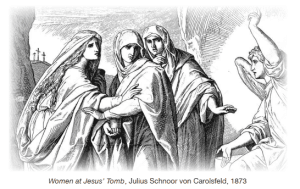
Yet, once more, the mood was changed. They arrived at the tomb only to find the stone rolled away. Gripped at first by the fear that someone had stolen the body, two angels appearing as men garbed in shining robes quickly assured them saying, “Why seek ye the living among the dead? He is not here, but is risen: remember how he spake unto you when he was yet in Galilee, saying, The Son of man must be delivered into the hands of sinful men, and be crucified, and the third day rise again” (Luke 24:5-7).
“And they remembered his words, and returned from the sepulchre, and told all these things unto the eleven, and to all the rest” (Luke 24:8,9). We may never know the degree of joy that filled Joanna’s heart as she and the others ran to bring the exciting news to Peter and the disciples. She was richly rewarded for her unshrinking faith and devotion to the one who had done so much for her.
May we each share both the sorrows of the cross and the joys of the resurrection, showing our appreciation to him who has saved us by yielding the rich perfume of our lives as a small token of gratitude for all he has done for us.
NOTES
1) Godbey, B., Gospel Harmony, Ages Digital Library, p. 197
2) Russell, T., Watch Tower Reprints, May 1, 1906, “Trifling with Conscience,” R3778
3) Russell, T., Watch Tower Reprints, June 1, 1898, “A Look at the Crucified One,” R2316
4) Edersheim, Alfred, The Temple: It’s Ministry and Service, 69. A similar thought is implied by Anton Frey in Tabernacle Notes, p. 275
5) Barnes’ Notes, Biblesoft Electronic Edition, Luke 23:11 — “A white or shining robe, for this, is the meaning of the The Roman princes wore ‘purple’ robes, and Pilate, therefore, put such a robe on Jesus. The Jewish kings wore a ‘white’ robe, which was often rendered very shining or gorgeous by much tinsel or silver interwoven. Josephus says that the robe which Agrippa wore was so bright with silver that when the sun shone on it, it so dazzled the eyes that it was difficult to look on it.”
6) Russell, C. T., Watch Tower Reprints, February 1, 1908, “The Rewards of Faith,” R4132
7) International Standard Bible Encyclopedia, Biblesoft Digital Version, “Manaen”
8) Josephus, Flavius, Antiquities of the Jews, XV, x, 2
9) Russell, T., Watch Tower Reprints, May 15, 1895, “The Resurrection of our Lord,” R1816
–– The Herald of Christ’s Kingdom 2000/2